Showing posts with label quotes. Show all posts

Friday, September 26, 2025

slider way, give it all you got

Here's a crackpot theory for you, and, as all the best theories do, it has to do with Robert Redford, who died last week at the age of 89, and shoes.

The only films in which Redford starred which I could say with complete confidence that I've seen are Butch Cassidy And The Sundance Kid, The StingAll The President's MenThe Great Waldo PepperOut Of Africa and Pete's Dragon. The first three there are obviously classics, the fourth is a bit of fluff with some surprisingly dark moments thrown in (such as Susan Sarandon falling off an aeroplane, or when Redford's character has to cave a fellow aviator's head in with a hunk of timber to prevent him burning to death in his crashed plane), the fifth is a bit turgid for my taste and I can't honestly remember Redford even being in the last one, presumably because I was distracted by a giant furry green CGI dragon.

Anyway, the central point made in a number of the obituaries was that it was easily to be distracted from his acting ability by how absurdly handsome he was, something easy even for a tediously vanilla heterosexual bloke such as myself to appreciate. That is something that Redford himself complained about (but not too much; I mean, come on) in the context of it limiting his range of roles. The quote that was circulating on the internet after his death was this one from director Mike Nichols in relation to Redford being considered for the role that eventually went to Dustin Hoffman in The Graduate:

“I interviewed hundreds, maybe thousands, of men,” Nichols explained. “I said, ‘You can’t play it. You can never play a loser.’ And Redford said, ‘What do you mean? Of course I can play a loser.’ And I said, ‘O.K., have you ever struck out with a girl?’ and he said, ‘What do you mean?’ And he wasn’t joking.” 

What you might be asking at this point is: yes, but what does all this have to do with shoes? Well, I'll tell you. I was at Newport Leisure Centre the other day taking the girls to a swimming lesson, and there were several people there sporting what these days seems to be quite a common footwear combo of shortish white sports socks pulled up quite tight, and sliders. I assume the original idea was to give some sort of post-training-session Premiership footballer vibe, but it seems pretty ubiquitous now. One of the Dads who was supervising the activities of his child in the showers even had socks and sliders on and must have been getting wet socks. 

So, getting to the point, my thesis is this: there are two sorts of people in the world, with two fundamentally different sorts of outlook on it, and life. The first sort either apply absolutely no thought whatsoever to what might happen beyond two minutes from now, or have a sort of blithe assurance that all will be well, nothing can or will go wrong, and they won't ever get into a position where they get stranded (e.g. if the car breaks down) on the way home from the swimming run and have to hike across a field in the dark in sliders, flip-flops, whatever. The other group of people assume that these things may well happen and that some more robust ready-for-anything footwear may be required. I myself for instance do own a pair of flip-flops, but they are strictly for home or holiday use and never worn in any situation where I might be required to do anything involving walking any significant distance or driving a car. I might wear my Converses or Vans if I'm in a cazh mood and the weather is warm and dry, with the caveat that I probably wouldn't wear the Converses for the swimming run as the thin canvas material and those two little instep holes mean they suck up water pretty effectively.

Looking at it another way I think this probably also divides down the nerd/jock boundary, where the nerd contingent might be slightly more inclined to get into the habit of wearing shoes that facilitate a quick getaway in the event of trouble. To put it another way, people who might feel a need to escape from other people (anyone who was ever bullied at school, for instance) might be more inclined to wear escape-facilitating footwear than those who might more generally expect other people to run away from them.

The pursuer/pursuee (yeah, I know, not really a word) model works for linking this back to Robert Redford as well - imagine (if you can) being someone who looked like him. I don't want to use the phrase "beating them off with a shitty stick" but it seems pretty appropriate here; it's hard to imagine him ever having to expend very much effort to be in the company of someone who wanted to get into his pants. The only advantage for the rest of us who might have to work slightly harder is that (this is what I choose to believe, anyway) since we had to work a bit harder at attracting a partner in the first place, and additionally might have more of an incentive to keep them around, we might be more inclined to generosity and attention to detail in the bedroom department, if you know what I mean, ladies. 

Friday, January 28, 2022

back in the (former) USSR

Here's another post inspired by some initial exchanges over on Twitter - it also shares a theme with this earlier post about imaginary straight-line journeys between American states. I follow a few map-related accounts on Twitter and one of them tweeted the map below which I quote-tweeted with a challenge, also related to imaginary straight-line map journeys, as you can see:

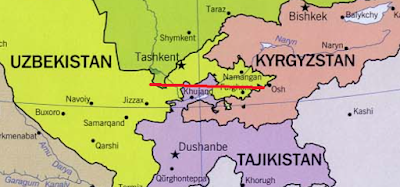
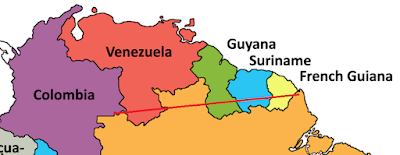
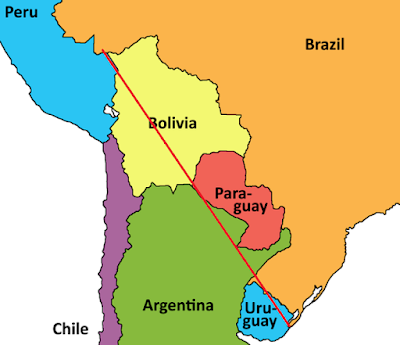
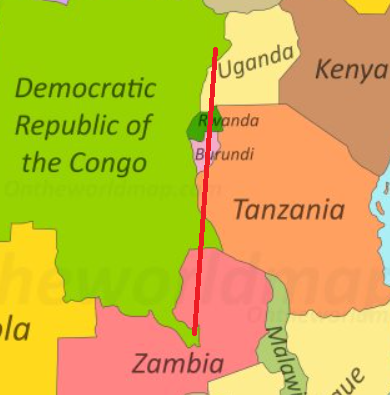
You can see, just at a conceptual level, the sort of thing we'll be looking for here: quite large countries which have fairly irregularly-shaped borders, in particular we're looking for areas of convexity where you can draw a line which joins two points in the country but passes outside of it in doing so. As you'll see from the thread following that initial tweet, I had a go at finding a few - examples are below:

Uzbekistan - Kazakhstan - Tajikistan - Kyrgyzstan - Uzbekistan:


Brazil - Colombia - Venezuela - Guyana - Suriname - French Guiana - Brazil:


Brazil - Peru - Bolivia - Paraguay - Argentina - Uruguay - Brazil:


China - Nepal - India - Bhutan - Myanmar - Laos - Vietnam - China:


Democratic Republic of the Congo - Uganda - Rwanda - Burundi - Tanzania - Zambia - Democratic Republic of the Congo:


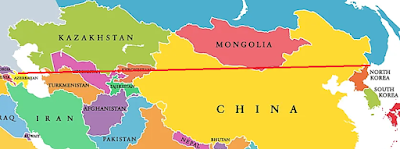
All of those (apart from the first one) traverse five other countries (in some cases more than once, and in some cases re-entering itself - ooer - on the way; I deem this not to matter) before coming back into the starting country. Better ones are available, and it should come as no surprise that the best one I know of (and it wasn't my work, I should add) features the largest country in the world, Russia. This one starts on the western edge of the Caspian Sea and then traverses no fewer than eight other countries before returning to Russia over near Vladivostok. Take a look:

Russia - Azerbaijan - Turkmenistan - Kazakhstan - Uzbekistan - Kyrgyzstan - China - Mongolia - North Korea - Russia:


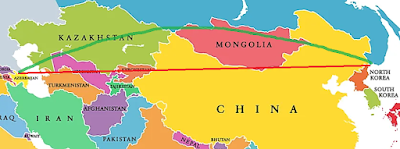
Now I know what you're thinking: a pity we couldn't juuuuust bend the line southwards slightly to snick the top end of Tajikistan as well, as that would clock up an extra country. This is dangerously subversive thinking and opens up questions like: you know, the world is not actually flat, so doesn't this whole straight line thing depend entirely on which map projection you're using? And my answer to that is WELL I'M GLAD YOU ASKED as there is a whole other world of nerdy interest there which there isn't really time and space (if you will) to go into now. Suffice it to say that the only projection-independent way of rendering straight lines is to use great circles, which look a bit weird and somewhat counter-intuitive on 2-dimensional maps given that they actually represent the shortest distance between points on the Earth's surface (assuming you're constrained to travelling over that surface rather than just tunneling directly through the Earth's crust). A great circle route between our Russian end-points actually reduces the country count considerably, as it looks like this:


Represented on the original map 2-D that would look something like this (the green curved line) - note that this way you lose Turkmenistan and Kyrgyzstan from the original list:


The borders between Kyrgyzstan, Tajikistan and Uzbekistan are actually even more complex and wiggly and convoluted than this fairly large-scale map makes it look, as it happens. We might come back to this later. 

Anyway, I leave you with the words of TS Eliot which seem somehow appropriate here:
And the end of all our exploring
Will be to arrive where we started
And know the place for the first time

Wednesday, January 05, 2022

what's another year

Time for the end-of-year book and general blogging stats round-up. If asked to characterise 2021 in general terms I would probably respond by just recycling my valedictory verdict on 2020, as follows:

Well, here we are at the end of another year, one which has, on balance, sucked ass most egregiously

We weren't under quite such stringent pandemic restrictions in 2021 as we were for a good (well, not good exactly) chunk of 2020, but nonetheless slightly decreased scope for just swanning off may have led to increased opportunities for catching up on reading. That might go some way to explaining how 2021 ended up being the second-bookiest year on record, its totals of 30 books and 10359 pages both being second only to 2011 (33 and 10597 respectively), a year in which, let's not forget, I had no kids to wrangle and a three-week honeymoon ripe with opportunities for reading (yes, yes, and other stuff too, OY OY etc.).

Here are the usual charts (plus a new one):


A few highlights to savour: 
  • Longest book of the year was The Pope's Rhinoceros at 753 pages, shortest was Call For The Dead at 157 pages.
  • Average book length was just over 345 pages, second only to 2020's whopping 384. Unlike 2020 which featured six books of over 500 pages, 2021 featured only two, The Pope's Rhinoceros and The Lacuna. There were no fewer than eight of between 400 and 500 pages, though. 
  • While 2021's total of 69 blog posts was one more than 2020, and therefore the most since 2016, the number of non-book-related posts actually went down. The book-posts-as-a-percentage-of-total-posts figure was higher than it's ever been at 43.5%.
  • The new chart at the bottom is to assess the split between male and female authors, something I've been more conscious of following the ten-month gap (May 2019 to March 2020) between books by women that I observed here. 2021 turns out to be not terrible by historical standards in that regard, in that 9 out of the 30 books were by women. That 30% is the highest since 2016 and considerably better than the dark days of 2019 where only 2 out of 17 books were by women - the only year in which more than a third of the books I read were by women was 2013 (7 out of 19).

Monday, April 12, 2021

keir and present danger

I had an interesting exchange on Twitter earlier after I saw this tweet on my timeline, which basically makes the claim that, on the basis of a recent interview, Keir Starmer, if he were to become Prime Minister, would be the first openly atheist Prime Minister of the UK. My first thought was: well, Keir Starmer's leadership of Labour may be distinctly underwhelming on a number of levels, but the statement of non-belief here is commendably clear and non-waffly and pretty unusual for a top-flight politician who might actually harbour some ambition of getting to be Prime Minister one day. 

You'll notice the response from Humanists UK, though, basically saying: yes, this is great, but it's actually not that unusual, as there have been plenty of atheist Prime Ministers, and here are a few examples. My original quote-tweet sounded a note of caution, mainly intended to emphasise how unusually direct I thought Starmer's statement was. I would describe Humanists UK's two subsequent replies as "brusquely dismissive" and "slightly defensive" respectively. I should add that I'm not intending any criticism of them as an organisation or their social media team individually here, but it is a useful exercise in proper critical thinking and scepticism not to take statements at face value, even when they are made by people whose worldview and aims you broadly agree with. It would be ironic, after all, if we were to have what you might call "articles of faith" which are recited by rote but never subjected to any scrutiny.

Taking Clement Attlee as the first example, just about all the Google hits for "Clement Attlee atheist" bring back the exchange referred to here which is his biographer Kenneth Harris' recalling (at an unspecified later date) of a conversation they had on an unspecified date, but almost certainly no earlier than mid-1950s, i.e. well after Attlee's stint as Prime Minister had ended in 1951, and probably after he ceased to be Labour leader in 1955. Attlee died in 1967 and Harris' biography of him, containing this brief exchange, wasn't published until 1982. I have no reason to doubt the basic truth of Harris' depiction of Attlee's beliefs, but I think that a) 15 years after your death and b) while still Leader of the Opposition and prospective Prime Minister are worlds apart when it comes to expressing them.

James Callaghan was a Baptist Sunday school teacher in his early life, and the standard Google result for "James Callaghan atheist" is a reference to a television interview in the 1980s where he supposedly professed his atheism. Again, I have no reason to doubt that that is true (although I haven't seen a transcript of the interview anywhere), but Callaghan's stint as Prime Minister ended in 1979 (when he was already 67) and he stood down as an MP in 1987.

Ramsay MacDonald seems to have roved about through various flavours of religious affiliation throughout his early life but to have arrived at what would these days be called humanism by the start of the twentieth century, well before his multiple stints as Prime Minister (the first of which started in 1924). In fact he served as President of the Union of Ethical Societies a couple of times in the early twentieth century, that organisation being a precursor to the British Humanist Association who have now changed their name to Humanists UK. 

Finally, what of dear old Winnie, the increasingly problematic saviour of Britain during World War II? Well, again, most of the obvious Google search terms yield results which all point back to the same source quote, which is one supposedly from a letter he wrote to his mother in his mid-twenties which includes the line "I do not accept the Christian or any other form of religious belief". On the other hand if you trawl through his most famous quotations looking for invocations of God and Christianity as key pillars of civilisation which need to be defended against, variously, Nazism, Communism, Islam, you name it, you will find many. 

So I think if you were to ask yourself the question: which of these people had made clear, unambiguous and widely-circulated public statements of non-belief prior to their being Prime Minister, I think you could only really come up with Ramsay MacDonald. On the other hand it's almost unimaginable that any of the people mentioned here would have been subjected to, or subjected themselves to, an interview where such intrusive questions would have been asked. Times change, and I, for one, view this as progress.


Monday, February 24, 2020

getting blown off at the weekend

Two motivational celebrity quotes for you today. The first is from the great Bill Hicks, whose views on the desirability of exciting and diverse weather I wholeheartedly share (the bit quoted here was talking about the prevailing weather in Los Angeles):


Secondly, dear, dear Larry Olivier was apparently once quoted as saying something like: if you really want to be an actor, you will; if you end up not being one, you just didn't want it enough. Now this may very possibly be one of those motivational quotes that some Californian loony cooked up in order to sell his latest bullshit "life coaching" course to rich gullible people, and then decided it would acquire some unearned gravitas if he attached some famous person's name to it. Winston Churchill is the name people usually attach to these things, and indeed some people I know have this "quote" prominently displayed in their house despite its being pretty clearly late-20th-century psychobabble and not something Churchill would ever have said. CRITICAL THINKING, people.

I digress. The point of those two quotes, and their relevance to what follows, is to celebrate varied and exciting weather conditions, even those which are intermittently inconvenient, and to venture the theory that when conditions are a bit arduous and some on-the-hoof re-planning and re-prioritising may be required, a bit of mental fortitude may also be required to push through and achieve your objective, whatever it may be.

No doubt this is wisdom applicable to various situations, but here I specifically have in mind the walk I and my friend Alex did on Saturday. I had been granted a childcare-obligation-free day as a sort of birthday present to go and do a walk of my own devising, so I'd devised a new route up Pen y Fan, a mountain I have been up more times than I can remember, but even restricting myself to trips recorded on this blog ascended in 2008, 2009 (a post which includes a couple of summit pics from older, pre-blog, ascents), 2010, 2013 and 2018 plus an abortive attempt in 2007.

Those trips encompassed a variety of different routes in an attempt to keep things fresh and interesting - Saturday's route was meant to involve ascending via the Cefn Cyff ridge to Fan y Big, skirting round the south side of Cribyn to bag Pen y Fan, and then heading back to the summit of Cribyn and down via the Bryn Teg ridge. Both of those ridges were unexplored territory for me.

So we parked up at Cwmgwdi, the main car park for assaults on the eastern Beacons from the northern side, and set off. When we reached the farm at Cwmcynwyn, though, it soon became clear that the innocuous word "Ford" on the OS map hid a world of raging watery terror in the wake of Storm Dennis, and that the Nant Cynwyn brook, which you could probably step over in summer, was not going to be passable without full-body immersion and possibly death. So we devised plan B, which was to head up Bryn Teg instead, do Cribyn and Pen y Fan and head back down the Cefn Cwm Llwch ridge which takes you straight back to the car park.

Once we got onto the ridge, though, another problem presented itself. Not the usual rain or low cloud (visibility was actually pretty good most of the day), but being battered flat by high winds. An inconvenience you can laugh off when on a wide whale-backed ridge, but the last section up to Cribyn is a steep scramble up a narrow ridge with steep drop-offs on either side, and we reluctantly concluded that it probably wasn't a good idea. This presented a problem, though, as Cribyn had to be got over or round if we were going to get to Pen y Fan. So we adopted the time-honoured approach to crisis management and real-time route adjustment: sit down and have a pork pie and devise Plan C.

Having dropped off the eastern side of the ridge to facilitate wind-free pie consumption it became apparent that a bit of pathless but uncomplicated descent would enable us to intersect with the major path which crosses the east-west ridge at Bwlch ar y Fan. From here we skirted round the south side of Cribyn and up onto the Pen y Fan summit plateau, where we were once again exposed to the wind, and (as you can see below) barely able to stand for the summit picture - luckily there were some other nutters up there who were happy to do photo duty, as I wouldn't have fancied trying to wield a selfie stick. From there it was a straightforward but wind-battered descent back to the car park. A very respectable 9 miles in extremely challenging conditions, rather than the 12-13 miles the original walk would have been, but I was delighted just to get something meaningful done in the circumstances. Route map, altitude profile and summit shot are below. You'll note that the red-lined route forms the shape of a boot with Pen y Fan at the heel, appropriately given the amount of ASS that was KICKED by our efforts. A small number of photos can be found here.


Monday, June 25, 2018

good morning and here is the vagina, I mean news

By my reckoning no-one's called Jeremy Hunt (or anyone else) a cunt on live TV or radio for just over a year. Well, that run ended today as Today presenter Justin Webb dropped a big old c-bomb during a news item about social care costs (about 10 seconds into the clip below):
There is some suggestion in this Radio Times article that Webb managed to swerve the gaffe at the last moment; Webb and some ex-colleagues are certainly spinning it that way. But have a listen to the clip: he might have just about managed to chop the last "t" from "Cunt", but that makes no difference whatsoever, it basically sounds the same.

Webb thus joins a long and distinguished list of broadcasters who have suffered such an outburst on live TV or radio, many but by no means all of them relating to an attempt to say Jeremy Hunt's name. Previous inductees include:
That list is by no means exhaustive, even when you add in the extra items linked to from the Bill Turnbull and Norman Smith posts, including Nicky Campbell's thrilling life-or-death struggle with the words "West Kent Hunt". The Niki Cardwell one also includes a bonus penis from football pundit Mark Lawrenson.

Sunday, June 30, 2013

jew cannot be serious

Really tremendous work from Rabbi Jonathan Sacks this week in The Spectator, as befits the de facto spokesman for non-scary secular-ish Judaism in the UK. And by "as befits" I mean: at this stage of human cultural development you're unlikely to be making an awful lot of new recruits, certainly from outside your standard catchment area of people born into the religion anyway, so your focus really ought to be turning to hanging onto as much of your current flock as possible. And the best way to do that is to talk about the alternatives (i.e. atheism, secularism, humanism, rationalism and the like) while waving your arms about in a spooky manner and to throw as many tired old tropes at the wall as possible and hope a few of them stick, at least for long enough for the faithful to be scared into pulling their yarmulkes on a bit tighter and lighting a few more sacrificial candles or whatever the fuck it is that they do.

The whole thing is basically a checklist of all the laziest, most facile anti-atheism jibes you can imagine; the only originality points I can award are for the last-minute swerve Sacks makes away from Godwinning himself, contenting himself with banging on about how Nietzsche had some ideas that weren't very nice: well, no shit, Sherlock.

The one section I'd pick out demonstrates how religion, instead of granting its adherents some sort of special magical Spidey-sense regarding moral and ethical matters, in fact rots the ethical faculties in certain unique ways that those who don't adhere to religion just aren't subject to (thought that's not of course to say that they aren't capable of their very own moral turpitude and depravity; I know I am). The rabbi is an intelligent and widely-read man, so I can absolutely guarantee that he knows pretty much every word of this paragraph is a lie:
But if asked where we get our morality from, if not from science or religion, the new atheists start to stammer. They tend to argue that ethics is obvious, which it isn’t, or natural, which it manifestly isn’t either, and end up vaguely hinting that this isn’t their problem. Let someone else worry about it.
Most rationalists who've given the issue any thought will tell you pretty much the same thing: no, there is no such thing as an "objective" morality - how could there be? That said, most successful societies have operated around some broadly similar rules ever since we stopped being nomadic hunter-gatherers and started being social creatures, cultivating crops and the like; the development of these rules is explained in large part by fascinating things like game theory. There really is very little mystery around all this.

I don't know about the Torah specifically, but there is definitely something in the Bible about not bearing false witness. The following seems to be a sentiment that various people have expressed in various ways through the years, but the current definitive version is attributed to Nobel laureate Steven Weinberg:
Religion is an insult to human dignity. With or without it you would have good people doing good things and evil people doing evil things. But for good people to do evil things, that takes religion.

headline of the day

Here's one in the Daily Mail today:


Well. We've all been there, haven't we? I myself had a lamb and mung bean curry last night that prompted very similar thoughts. I was put in mind of the words of J. Robert Oppenheimer (borrowed from the Bhagavad Gita) on the successful development of the atomic bomb:
Now I am become death, the destroyer of worlds.
- and also of the words from the early pages of Susan Cooper's classic children's fantasy novel The Dark Is Rising:
...this night will be bad, and tomorrow will be beyond imagining.
It turns out it's not a reference to curry-induced sulphurous flatulence after all, though, but to honky rap superstar Eminem's prescription drug problems. Here's the full headline:


The concept of hitting "bottom" before being prepared to surrender yourself to a recovery programme is central to most variants of the 12-step programme pioneered by Alcoholics Anonymous. All of which are no doubt terrific, if that's what you need, but come liberally soaked in the sort of unreflective goddiness that brings me out in hives with their talk of surrendering to a higher power and all that bullshit. But, hey, if it got Eminem off the happy pills and onto the alfalfa sprouts and mineral water, then good for him.

Tuesday, March 12, 2013

don't panic

I'm a day late, as his birthday was yesterday (he would have been 61) but I think it would be appropriate at this point to offer you a couple of quotes from Douglas Adams, who died back in 2001. The anthropic-principle-torpedoing puddle analogy is one of the more famous ones, but I've referenced that at least once here before, so we'll go with a couple of different ones:
Anything that is in the world when you're born is normal and ordinary and is just a natural part of the way the world works. Anything that's invented between when you're fifteen and thirty-five is new and exciting and revolutionary and you can probably get a career in it. Anything invented after you're thirty-five is against the natural order of things.
If you describe yourself as 'Atheist', some people will say, "Don’t you mean 'Agnostic'?" I have to reply that I really do mean Atheist. I really do not believe that there is a god—in fact I am convinced that there is not a god (a subtle difference). I see not a shred of evidence to suggest that there is one. It’s easier to say that I am a radical Atheist, just to signal that I really mean it, have thought about it a great deal, and that it’s an opinion I hold seriously. It’s funny how many people are genuinely surprised to hear a view expressed so strongly. In England we seem to have drifted from vague wishy-washy Anglicanism to vague wishy-washy Agnosticism—both of which I think betoken a desire not to have to think about things too much.
Needless to say you should read everything Adams wrote, not that there is actually that much of it. Some people are put off reading the fiction, which basically comprises the five-part Hitch-Hikers Guide To The Galaxy series and the two Dirk Gently novels, by the perceived nerdiness of the sci-fi associations and the books' extreme cultiness, but the trick is to realise that Adams was first and foremost a great British comic novelist in the same vein as PG Wodehouse or Kingsley Amis, and the stuff about spaceships was just the genre that he happened to choose to express himself in. If you're too lazy to bother with all of it, I'd suggest just reading the first two Hitch-Hiker books (The Hitch-Hiker's Guide To The Galaxy and The Restaurant At The End Of The Universe) and the first Dirk Gently one (Dirk Gently's Holistic Detective Agency). Oh, and you should also read the spoof dictionary The Meaning Of Liff, co-written with John Lloyd, an entire online transcript of which, with occasional typos, appears to be here.

Lots more great stuff here; this is where the first quote came from. The second one was from Jerry Coyne's website here; a truncated version also appears on this excellent list. The full text of the interview from which it's taken appears to be here, which is a bit bizarre since the interview was with American Atheists and the website appears to be a Buddhist one.

Wednesday, January 30, 2013

a foaming tankard of meades

As usually happens when I tune in to BBC Four, I happened upon something interesting while cooking dinner last night: Jonathan Meades' new series The Joy Of Essex. Meades (or rather the character "Jonathan Meades" with the black clothes and the shades and the slightly arch deadpan delivery that he adopts for these programmes; I don't suppose he's like that in real life) is always good value, and interesting on the stuff he really cares about, mainly architecture, while being wrong (though always interestingly wrong) pretty much constantly about the stuff that doesn't really interest him, like sport, the natural world, all that stuff.

Pleasingly, Meades is also an enthusiastic supporter of both secularism and humanism - here are a couple of Meades quotes lifted from those links:
If you believe in fairies at the bottom of the garden you are deemed fit for the bin. If you believe in transubstantiation, parthenogenesis and the rest of it, you're deemed fit to run the country.
The secularisation of society is vital. That means: quashing faith schools; instituting a uniform and predominantly Anglophone educational system; administering civil laws which do not acknowledge religions’ peculiarities; insisting on the primacy of free expression over the rights of institutionalised superstitions.
Following the BBC Four/atheism theme for a minute, something you may also find interesting is Jonathan Miller's Atheism: A Rough History Of Disbelief. I've mentioned this before, but the whole series is now available on YouTube (in three parts: here, here and here) and is well worth a watch, though one might say the whole thing is a bit wordy and earnest - there is a lengthy discussion in the first programme about what "belief" really means, for instance, which you might want to skip, although it's always good to be clear about these things. One might also argue that Miller is a little bit in love with his own stooping donnish glasses-round-neck polymathic silver fox persona, perhaps to a very slightly grating degree - if so here's an antidote courtesy of Spitting Image.

Sunday, June 17, 2012

look at that man commentary his words

Latest missive from the strange planet on which Tiger Woods' ex-coach and current Sky Sports summariser Butch Harmon lives - a planet where they speak a language almost, but not quite, entirely unlike English. This is his reaction to an excellent recovery from sand by young amateur prodigy Beau Hossler during the early stages of round 3 of the US Open yesterday:
LOOK AT THAT! LOOK AT THAT YOUNG MAN GOLF HIS BALLS! GO AHEAD ON YOUNG MAN! HAVE A GOOD TIME!
Nurse! Time for Mr. Harmon's medication.

Monday, May 03, 2010

the last book I read

Invisible Cities by Italo Calvino.

There's a Gore Vidal quote on the back of my Vintage edition of this book which says:
Of all tasks, describing the contents of a book is the most difficult and in the case of a marvelous invention like Invisible Cities, perfectly irrelevant.
Well that's this book review fucked. I'll plough on anyway, though. As always Gore is being a bit hyperbolic for effect but, as always, he's got a point. You're not about to get, for instance, anything much in the way of a description of plot, because there barely is one. Basically Marco Polo and Kublai Khan are sitting in a palace garden, shooting the shit as Mongol emperors and Venetian merchants do, and Polo tells Kublai Khan a series of brief stories, each one a brief description (a page or two at most) of a city, supposedly one that Polo has visited on his travels, but all clearly imaginary; cities slung on ropes across chasms, cities of ghosts, watery cities, cities periodically torn up and rebuilt elsewhere, cities overrun by their own garbage.

And the point of all this? Well, to divert, provoke and entertain, of course, but also to illustrate aspects common to every city like, mundanely, what do you do with all the dead people and rubbish? Polo is also describing aspects of one particular city - his distant home, Venice. It's like a novel-length version of the TS Eliot quotation:
We must never cease from exploration. And the end of all our exploring will be to arrive where we began and to know the place for the first time.
This being Calvino there are also some post-modern structural games being played here - just as with Georges Perec's Life A User's Manual (a much longer book similarly constructed from short loosely-related episodes with a framing device holding it all together) you can ignore all this if you want to without losing anything much. The authorial dicking about is certainly less intrusive than it is in the other Calvino I've read, If On A Winter's Night A Traveler, though I recommend both books highly. At 148 pages (with a lot of white space for all the chapter breaks) it's very short, and it's not like there's any plot to remember, just a series of little tasty delights to dip into to freshen the palate after the great big beefy main course that preceded it.

Thursday, April 01, 2010

quote of the day

I've seen this attributed to Democratic senator Tom Harkin, but it seems that it's probably older than that. You can understand the temptation to keep recycling it though, as it's nice and pithy:
Politics is like driving. To go backward put it in R. To go forward put it in D.
Obviously the party references place this firmly in the USA, but so does the unthinking assumption that everyone will be familiar with the layout of an automatic gearbox. I don't have any figures for the ratio (if you'll pardon the pun) of automatic to manual transmission cars sold in the USA, but the general references in US book and film to a "stick shift" being something weird and exotic suggests it's quite high. This article from September 2006 suggests that the ratio (pardon the pun, again) is about 4:1 in favour of manual transmission in Europe; I wouldn't be surprised if the situation were reversed in the USA. I suppose the sheer size of the place means the ratio (pardon, etc.) of driving along in a straight line in the same gear to stopping and starting and going round corners and shit is relatively high compared to little old Europe.

If anyone has a definitive set of figures I'd be interested to see them. Well, I say interested, I'd tolerate them. Well, I say tolerate......[etc.]

[Footnote: this article suggests that less than 10% of cars sold in the USA now have manual transmission. Lazy bastards.]

Thursday, October 22, 2009

warsi versus nazi

In the light of the decision to allow fat odious racist buffoon Nick Griffin to appear on BBC Question Time tonight and the storm of media commentary surrounding it, let me offer you another quote, this one from the late Linda Smith:
I don't want to give them the oxygen of publicity. I don't even want to give them the oxygen of oxygen.
I believe that was originally offered in relation to Neil and Christine Hamilton, but it works equally well here. I should qualify all this by saying I think it was probably the right decision to allow Griffin to appear, but regrettable that his loathsome party have acquired enough of a platform to make it necessary to consider the question at all. A cogently-argued alternative view can be found here.

As always the Daily Mash captures the mood of the nation - the huge TV audience the show will no doubt attract won't be people keen to see democracy in action or people taking a genuine interest in the BNP's policies, it'll be people hoping Griffin comes on in full Nazi regalia and starts denying the Holocaust or calling Baroness Warsi a Paki on live TV.

quotes of the day

In the first place divest yourself of all bias in favour of novelty & singularity of opinion. Indulge them in any other subject rather than that of religion. It is too important, & the consequences of error may be too serious. On the other hand shake off all the fears & servile prejudices under which weak minds are servilely crouched. Fix reason firmly in her seat, and call to her tribunal every fact, every opinion. Question with boldness even the existence of a god; because, if there be one, he must more approve the homage of reason, than that of blindfolded fear.
Thomas Jefferson
There is something feeble and a little contemptible about a man who cannot face the perils of life without the help of comfortable myths. Almost inevitably some part of him is aware that they are myths and that he believes them only because they are comforting. But he dares not face this thought! Moreover, since he is aware, however dimly, that his opinions are not rational, he becomes furious when they are disputed.
Bertrand Russell (found here). Incidentally Russell was born in Trellech in Monmouthshire, which makes him eligible for nomination as today's Welshman Of The Day.

Friday, October 31, 2008

his eyes slid down the front of her dress

The unfortunate journalistic turn of phrase of the week award goes to the Independent's article about the Quantum Of Solace premiere in Leicester Square on Wednesday:

New Bond girl Olga Kurylenko arrived on the red carpet wearing a dramatic red dress which plunged to the floor. The Ukrainian born 28-year-old turned and waved coquettishly to the cameras.
Pretty cool just to turn and wave coquettishly when your dress has just plunged to the floor. Must have been a bit chilly too. I'm starting to wish I'd been there now.

Tuesday, July 01, 2008

warning: this blog post failed to pbutt the profanity filter and has been rebreastled

Here's an amusing article highlighting the difficulties of automated text-editing, in this case to change every instance of the nice cuddly term "gay" to the more judgmental "homosexual" to better reflect your loony religious right-wing agenda. Trouble is that when the article in question refers to American sprinter Tyson Gay things start to get a bit tricky. Although Tyson Homosexual is quite a cool name, in a weird sort of way. What next? References to Enola Homosexual dropping the first atomic bomb? A nice tot of Mount Homosexual Rum?

This, of course, is a specific example of a problem well-known to those in the computing industry, which is how to get computers to perform operations on text without making what seem to the human eye to be obvious mistakes, computers being, contrary to their usual portrayal in films, phenomenally stupid. This makes writing reliable obscenity filters (see the Scunthorpe Problem) and spell-checkers (see the Cupertino Effect) very difficult. Further amusing examples can be found in this Daily WTF article and the comments following it. You can have fun imagining news headlines after being passed through these sort of filters: JFK buttbuttinated in Dallas: Johnson buttumes Presidency to avoid Consbreastutional crisis.

The other classic example of search & replace ham-fistedness is the immortal phrase "cdesign proponentsists" which exposed the religious fundamentalists' hilariously half-arsed attempt to rebadge creationism as "intelligent design" and thereby shoehorn it into school science lessons. Following on from the epic pwnage described here it's worth reflecting on the full-scale, trousers-down arse-spanking the loons got in court when they tried this on before. Which is no guarantee they won't chug down a few chalices of communion wine and march forth to do it again some time in the future. "The price of liberty is constant vigilance", as Eleanor Roosevelt (supposedly) said. Then again she also said: "A woman is like a teabag. You never know how strong she is until she gets into hot water", so make your own mind up.

Friday, May 30, 2008

follow me to the slagroom, where we will toss hoengkwee into a cockring

You'll have already seen the collection of photos we took on our weekend in Amsterdam. Here's a few randomly assembled thoughts about the weekend.

Dutch is a language that seems to lend itself well to the generation of words and phrases that have unfortunate connotations in English. A small montage of some of the best ones we found and photographed is displayed below.


Just a quick run-through:
  • U kunt means "you can"; the full sentence read U kunt ook met muntgeld betalen, which means "you can also pay with coins".
  • hoengkwee appeared on the menu in the Indonesian restaurant we went to (see below); it was translated as "hoengkwee" which left us none the wiser. We didn't order the item in question (some sort of sweet coconut drink) so I can't speculate on what it might be; probably just as well.
  • slagroom is Dutch for "whipped cream"
  • SISSY-BOY HOMELAND appeared to be some sort of clothes shop
  • AANSLAG appears to mean "onslaught"
  • TOSS is some sort of game - not entirely clear about the rules but I suspect the naked ladies on the box may provide a hint
  • and finally COCKRING did genuinely appear to be some sort of sex club
Playing Scrabble with a set designed for words in another language (as we did in the La Tertulia coffeeshop we went to on Saturday afternoon) is slightly odd; not only does Triple Word Score become 3X Woord Warde, but the letters aren't worth what you're used to them being worth. A Dutch set, for instance, has more Js and Zs than an English one, and they're only worth 4 points each as a result. So my JIZZ, for instance, is worth considerably less under Dutch rules, which is a shame. Tile distribution for each country is as below.


We ate at the excellent Indonesian restaurant Kantjil & de Tijger on Sunday night; a bit of a nostalgia trip for me as we lived in Indonesia for a couple of years when I was a child (8-10 years old, roughly). So the nasi goreng and the rendang brought back some memories, as did the Bintang beer which I recall my Dad & others tucking into at various expatriate gatherings.

The Rijksmuseum is currently undergoing some extensive renovations, so various wings are being closed off at different times. They keep the major attractions on view at all times though, which I guess for most people will be the Rembrandts, the Vermeers and the odd Frans Hals (though not the Laughing Cavalier as this is in the Wallace Collection in London). I like Vermeer a lot; the rest I can take or leave.

Possibly more interesting is the Van Gogh Museum, depending of course on whether you like Van Gogh's work or not. Personally I do, so that's good.

And you probably have a moral duty to go to the Anne Frank House as well, though if you are going to go I seriously recommend getting there before the 9am opening time, otherwise the queues will be round the block. Doesn't take long to get round the place, maybe an hour or so at most, because it is, after all, quite small. All very sobering; funny the things that strike you at these times though - "Anne" was short for "Annelies", and with the German/Dutch pronunciation would have been rendered as "Anna", or near as dammit anyway, so we've been saying it wrong all these years. There are various quotations written on the walls in the museum; the one that brings a lump to the throat is Primo Levi's:
One single Anne Frank moves us more than the countless others who suffered just as she did, but whose faces have remained in the shadows. Perhaps it is better that way: if we were capable of taking in the suffering of all those people, we would not be able to live.
I must confess I've never read the diary; it's a cliché but I think its main appeal is to girls of a similar age. If you want a holocaust memoir then Levi's If This Is A Man and its follow-up The Truce (generally available as a single volume) are pretty much indispensable, I would say.

The history of the Netherlands is very interesting, particularly the massive civil engineering effort required just to stop the entire country slurping inexorably out into the North Sea, being as it is largely just a collection of low-lying silty deposits and sandbars. None of which is going to save them from being first against the wall come the revolution; well, them and Bangladesh. And Norfolk.

Wednesday, March 19, 2008

Arthur C cark

Legendary science fiction author Arthur C. Clarke died in Sri Lanka yesterday, aged 90.

As a writer I would say Clarke was more of a source of ideas than a great writer in the literary sense - the most obvious and famous example of this being the (loose) adaptation of his short story The Sentinel into Stanley Kubrick's seminal film 2001: A Space Odyssey. That said I can't say I've read a huge amount of his stuff - I think the only book of his I actually own is the short early novel Earthlight.

But he was very influential, and a man of clear-thinking good sense and scepticism:

I would like to assure my many Buddhist, Christian, Hindu, Jewish, and Muslim friends that I am sincerely happy that the religion which Chance has given you has contributed to your peace of mind (and often, as Western medical science now reluctantly admits, to your physical well-being). Perhaps it is better to be un-sane and happy, than sane and un-happy. But it is the best of all to be sane and happy. Whether our descendants can achieve that goal will be the greatest challenge of the future. Indeed, it may well decide whether we have any future.
This is further demonstrated by his firm instructions for his funeral arrangements. I am reminded of Woody Allen's quote about death at this point as well:

I don't want to achieve immortality through my work; I want to achieve immortality through not dying. I don't want to live on in the hearts of my countrymen; I want to live on in my apartment.
My instructions for my own funeral arrangements can be found in this earlier post.

Sunday, December 09, 2007

let's kill God!

A few pithy, or possibly pissy, quotes to liven up your lives and stimulate the cerebral muscles. Health warning attached: these are shots in the ongoing science v religion war, so if that's not your cup of tea, or you're sick of me going on about it, read no further. And bugger off.

Let's start with the aforementioned Jim Crace, from an introductory piece written about Quarantine for amazon.com:
I do not like to give offence to Christians. I say, if asked, that I’m agnostic. But the truth is I'm an atheist, impatient with the simple-mindedness of orthodox religion, its lack of imagination, its bafflegab. I never go to church. I’ve never prayed. I’ve not been Christened, yet. So, when I began my novel Quarantine (which retells the story of Christ's forty days of temptation in the wilderness) I expected – indeed, intended – to inflict some bruises on religious dogma. An easy target, I thought. Christendom has never been in such an undernourished and diminished state. Every week the godless mechanics of the universe, from Big Bang to the tiny chemical percussions of the brain, are revealed in finer detail. Meanwhile, with two thousand years in which to collect its evidence, the church – no longer able to claim that Earth and all its creatures have come ready-made from God’s Creation Workshop, or that thunder is really the Almighty stamping with displeasure at our sins – has been reduced to ritual and display. Plenty of incense smoke, but no divine cigar.
Now here's quantum physicist and bongo-player Richard Feynman highlighting the fundamental difference between the two disciplines:
One of the ways of stopping science would be only to do experiments in the region where you know the law. But experimenters search most diligently, and with the greatest effort, in exactly those places where it seems most likely that we can prove our theories wrong. In other words we are trying to prove ourselves wrong as quickly as possible, because only in that way can we find progress.
More Feynman here.

Finally, I've seen this attributed to Penn Jillette in various blogs, though I can't find any independent citation for it. Doesn't really matter, though it's certainly consistent with his views:
There is no god, and that's the simple truth. If every trace of any single religion were wiped out and nothing was passed on, it would never be created exactly that way again. There might be some other nonsense in its place, but not that exact nonsense. If all of science were wiped out, it would still be true and someone would find a way to figure it out again....Evolution is the truth. And with truth comes a lack of panic....The bad guys always have to fight for their ideas to be taught. They must cheat. Government force, propaganda, and hype are the tools you desperately need when you're wrong. Truth abides.
Here's some amusing ranting on the subject of Biblical self-inconsistency from Penn & Teller's Bullshit!. And finally here's a page of links to further amusing video resources in similar vein.