Showing posts with label rants. Show all posts

Sunday, November 11, 2018

the spouse that roared

Ronald Reagan once said that the most terrifying words in the English language are: "I'm from the government, and I'm here to help". And as previously observed here Gore Vidal is reputed to have once claimed that the three most depressing words in the English language are "Joyce Carol Oates".

I'm going to go out on a limb here and claim that the three most terrifying and/or depressing words in the English language are: Military Wives Choir. Whoooaaah, there, you'll be saying, you've gone too far this time with your robustly controversial yet thought-provoking opinions. Have a pop at The Big Guy all you like, he can take it, but Our Brave Girls? You disgust me.


Let me see if I can walk you through it a bit:
  • Firstly, and most obviously, patriarchy. There's a sort of misty-eyed fantasy at work here which envisages these women sitting looking wistfully out of a window waiting for their husbands' return, clad in some demure and respectful clothing - nothing too overtly sexy but clearly not a manky old pair of pyjamas or a crusty comedy onesie either. In this scenario where the women are defined solely by being married to some guy in the forces, and possibly by the requirement to bring up his children during his periods of absence, maybe there is an expectation that they'll have lots of free time, not all of which can be spent wistfully gazing through windows, and therefore the little ladies, bless 'em, need something to occupy them. I mean, it's not as if any of them have jobs, right? No-one's going to be a lawyer, or a fitness instructor, or a financial advisor, or a thrusting senior executive at some major corporation, so why not get together for a bit of an old sing-song in your spare time, in between making jam and that.
  • Similarly, it's not as if anyone in the armed forces is a woman, right? Granted, they could still have wives, but that's not the wholesome corn-fed vanilla family scenario that we're thinking of here, is it?
  • This is a particularly pernicious example of what you might call the Nick Knowles effect, that is to say the inexplicable (to me, anyway) tendency of the record-buying public to purchase stuff based on whether they know of the people involved, and indeed imagine (clearly mistakenly) that they know them personally in some way, rather than on the basis of whether, you know, it's any good.
  • In this case that's reinforced by the weird and, I would contend, generally unhealthy reverence that the British public have for the armed forces. This goes double at this time of year when everyone loses their freakin' MINDS over appropriate poppy-wearing protocol. Combine that with the Nick Knowles effect above and you have a toxic situation where any criticism (such as: Christ, this is all a bit shit, isn't it?) basically prompts the response WHY DO YOU HATE OUR TROOPS and WHY DO YOU HATE BRITAIN and WELL WE'LL JUST GET INVADED AND RAPED AND MURDERED BY ISLAMOFASCIST COMMUNISTS THEN SHALL WE AS THAT'S CLEARLY JUST FINE WITH YOU. It's a short hop from here to showering people with abuse when they make a considered decision not to wear a poppy, or mindlessly recycling a load of Britain First propaganda.
  • Further to the Nick Knowles effect is the Gareth Fucking Malone effect whereby this supremely irritating nerdy bloke tries to get the country singing (endearingly amateurishly, naturally), to lots of furtive OH YOUNG MAN from the late-middle-aged TV-watching public. Malone was heavily implicated in the formation of some of the early versions of the Military Wives choirs, and is, as I think I may have mentioned above, really fucking annoying. I think it's another aspect of communal joinery-innery with the associated curled lip towards anyone who'd rather not, thanks very much.
It was on Chris Evans' breakfast show on Radio 2 that I heard the reference which prompted this post - shortly afterwards I switched over to Radio 4 to catch Melvyn Bragg's In Our Time about Marie Antoinette. About 27 minutes in there's a bit about how the French revolution and its instigators viewed the rights of women, and the verdict (230 years ago, let's not forget) was, and I quote: "women belong in the private sphere; man belongs in the public sphere". Plus ça change, and all that.

Tuesday, June 28, 2016

it's all good fun until someone loses an EU

So, Brexit, then. And while it's awfully tempting to dismiss the 52% of the UK population who voted to leave the European Union as just a rabble of dimwitted racists, and I'm not saying there isn't a good deal of truth in that, it might just be more productive to try to work out what the hell went wrong.

A few things are obvious: no-one really thought there was an economic case to be made for leaving, so no-one really seriously bothered trying to make one. So basically there was just a lot of dog-whistling around the subject of immigration, which has turned into an elephant in the room totally out of proportion with its actual importance (since the British public are as utterly wrong about the immigration figures and impact as they are about just about any other subject you could care to mention). So when people urge political parties to really tackle immigration, what they really mean is address people's largely imaginary concerns about it and their mistaken perception of its impact. This is actually quite hard to do without just pointing out to people that they are massive racists, which as a vote-winning strategy is not great.

Equally obvious is that, of the major Leave campaign figureheads, Boris Johnson is a brazen and ruthless political opportunist who was campaigning for a Remain vote as recently as February 2016, and moreover as a European correspondent in the 1990s was personally responsible for a whole stream of the sort of barmy Eurocrat banana-straightening stories that fuelled UK Euroscepticism in the first place. Nigel Farage, by contrast, is a proper old-school fascist of the type that always seem hilarious and buffoonish right up until the point where they acquire power and it becomes clear they weren't joking after all. Like that comical Charlie Chaplin lookalike guy in Germany in the 1930s. I mean, who remembers him now?

A gazillion words have already been written bemoaning the barking irrationality of the Leave vote, and in particular how places like Ebbw Vale were persuaded to cast a vote profoundly in opposition to their own best interests, so it might be more profitable to explore a couple of wider (but still related) issues, like, for instance: who can we blame? I have a couple of suggestions.

Firstly, and most obviously, David Cameron. I'm inclined to blame Cameron for a lot of things, as you know, but this referendum really is his fault, since he promised it back in 2013 as a sop to the truculent faction of borderline Nazis in his own party who he feared would otherwise defect to UKIP in large numbers.

But, you might say, what's wrong with having a referendum? This is democracy in its purest form! Anyone arguing against having a referendum must basically HATE DEMOCRACY. This is quite difficult to argue against, since the counter-argument basically boils down to: people are idiots. It's quite salutary to remember why parliamentary democracy exists: because it's absurdly impractical to canvass everyone's opinion on any particular subject (modern technology means it's easier than it's ever been, but it's still absurdly slow and difficult) and it's desirable to bundle up that decision-making capacity - region by region, say - into a single elected representative whose job it quite literally is to be engaged and informed on the topics that decisions might need to be made about, while the people who elected him or her get on with their day jobs amid their usual fug of ignorance.

I'll tell you who else is to blame, though: the media. The BBC, for one, has come in for some criticism in the past for, as this Huffington Post article puts it, "sacrificing objectivity for impartiality", or, in other words, promoting some bullshit idea of "balance" in a debate by presenting both sides and being reluctant to take a position on how those sides align with reality. Both of those linked articles were about climate change, but the same charge can be levelled at the BBC's (and other broadcasters') coverage of the referendum. If there are two sides, and one side is peddling easily-debunked lies and nonsense, it might actually do the viewing public a service if the liars were held to account. To put it another way, the current model only really works when politicians occupy a position somewhere within the bounds of what you might call "reasonableness" or at least can be trusted (most of the time) to be arguing in good faith - once you get a statistical outlier like Farage or Johnson (or Donald Trump, to pick an example from elsewhere) who will just brazenly lie, and, if challenged, shift their position and lie again, the system can't really cope. And treating people like Farage like any other politician legitimises and normalises his political views - look at how often he gets invited onto Question Time, say. I haven't seen Nick Griffin get invited back, and pretty much the only difference between them is that Farage looks less like a thug and has a posh voice.

On that subject, it's interesting to reflect how much we as a nation are still unconsciously in thrall to archaic notions of class, and more specifically notions of what a member of the ruling class looks and sounds like. Take the currently-beleaguered Labour leader Jeremy Corbyn, for instance. Now I'm certainly not going to claim him as the potential saviour of humanity, but my experience is that most people, even those not inclined to vote Labour, think that he is clearly a man of principle, honesty and decency who talks a lot of good and compassionate sense on issues regarding social justice. However, ask those people whether they can see him as Prime Minister and they'll probably laugh and say: well, no, of course not. But why not? Because, I put it to you, that's not what members of the ruling class look like. Rather than looking like a scruffy and slightly humourless geography teacher, the ruling classes wear sharp suits, have braying penetrating posh voices and have arrived at the top of the political ladder without acquiring any messy baggage along the way by ever having expressed any sort of principled view or taken a stance that might now be inconvenient.

Furthermore the ruling classes have their debating skills honed at debating societies at Oxford and Cambridge where they become well-practised not only in arguing for causes they have no belief in (equally handy for a career in the legal profession if the political thing doesn't work out), but also in the art of the meaningless sound-bite, the swift and pithy put-down, and the sort of wordless braying and hooting that will stand them in good stead in the House of Commons. So, for instance, despite being a monumental failure as a Chancellor even by his own self-imposed measures, George Osborne still gets a free pass as a "serious" politician because he's a toff who can afford some nice suits, as well as, as some may have alleged, a boatload of cocaine. Similarly, Tony Blair, despite not being a Tory, looked the part, while Ed Miliband, while he had the suits, talked a bit funny and once made a bit of a hash of eating a sandwich, so clearly he wasn't quite the thing.

Now it's certainly true that, as well as not having much support among the Parliamentary Labour Party, Corbyn's approval figures with the general public aren't great either. But one thing we know after the referendum is that Joe and Josephine Public are easily swayed by bullshit tabloid stories, and if there's one person the tabloids love writing bullshit stories about, it's Jeremy Corbyn.

I think, as it happens, that it's likely he'll have to go, but I'm troubled by the whole business as a natural Labour voter for several reasons. Firstly I don't see an obvious successor, secondly I wonder how the Labour party membership have got so out of step with the PLP and the public (or vice versa, depending how you look at it), and thirdly the tabloid venom, which is just an aspect of the wider problem I've described above, can't be a healthy thing in the 21st century. But then again neither can a vote to leave the EU. So, in summary, fuck you, Britain.

Actually, hang on, lots of Brexit- and Corbexit-bemoaning there without any proposals for solutions. So, briefly, here's a couple of ideas:
  • Stop legitimising racism by saying either that a large tranche of the Leave vote wasn't motivated by it or that lots of people have "legitimate concerns" over immigration. No they don't, they just hate brown people. Tiptoe round the issue and you are part of the problem.
  • Electoral reform. If, as looks possible, the Labour party splits into left and centre-right factions and the LibDems experience an uptick in popularity as a result of their commendably bold anti-Brexit stance, then we're going to be in the sort of multi-party environment we haven't been in since forever. Which is all great, but for the first-past-the-post system which will ensure massive Conservative majorities forever under those circumstances, particularly if the Scots take themselves out of the picture by leaving the Union after a second referendum. Some sort of proportional representation system whereby every vote counts might go some way towards hauling general election voter turnout upwards towards the 70-odd percent that the referendum got. 
  • Stop having referendums, as they're clearly a terrible idea, particularly if most voting happens under the first-past-the-post system, and therefore encourages the view that people can register a "protest" vote (perhaps as part of a general unfocused desire to register dissatisfaction with the political process) without it having any consequences, as some people seem to have done here.
  • Have a look at the House of Commons. Yes, tradition, heritage, all that bullshit, but it's toe-curlingly embarrassing to watch the general school-playground quality of the exchanges in there. If some of the I-refer-the-right-honourable-gentleman-to-the-answer-I-gave-some-moments-ago bullshit has to be swept away in order for Joe Public to feel involved in the policy-making process, then so be it. Alternatively, require ministers to regularly appear before some sort of select committee for some much more forensic questioning, get some non-political subject matter experts in to grill the hell out of them, and make sure it's televised.

Tuesday, May 03, 2016

and on the third day he blogged again

A couple of religion-related stories in the news around Easter (so a few weeks ago now, but y'know, sue me, I've been busy), occupying spots somewhere near the tragic and comic ends of the spectrum, respectively.

Firstly, David Cameron's at it again with his Easter message: farting all sorts of meaningless soundbites out of his potato-ey face-hole. The co-opting of things that are clearly universal human things, or at least things that most societies that have progressed beyond making crudely-fashioned drinking vessels out of each other's skulls and crudely-fashioned flutes out of each other's femurs have adopted as the best ways to behave, as somehow quintessentially Christian values, is a pretty common one, even while being a) patently ridiculous and b) implicitly making the claim that any other religions that claim them as foundational values are WRONG and have STOLEN THEM from Christianity.

Some of the things that Cameron is claiming LITERALLY DID NOT EXIST until some bunch of ill-educated goat-herds threw the Bible together some time during the first couple of centuries AD are such hilariously anodyne concepts as:
Values of responsibility, hard work, charity, compassion and pride in working for the common good and honouring the social obligations we have to one another, to our families and our communities.
Needless to say things like "hard work" are things that pre-Christian societies like the ancient Egyptians and Greeks knew nothing of, while they were building the pyramids and the Parthenon and that. Interestingly the paragraph above appears to be an almost word-for-word retread of part of a speech he gave in Oxford back in late 2011. I guess once you've got your shtick down there's no point trying to re-work it. Zoe Williams in the Guardian picks all the bullshit apart far better than I've done here.

The other obvious riposte, made more pithily by Stephen Fry here, is that what Christianity considers its foundational values have changed over time - not much "compassion" on show during the crusades, for instance. If you want a modern example, look at attitudes to things like women's rights and homosexuality - things the various churches would have been implacably opposed to back in the day, and would have found wider society broadly in agreement, but since societal attitudes have moved on and become generally more groovy and inclusive those same churches are increasingly desperately hanging onto its coat-tails to try to retain some relevance.

Cameron knows what he's doing, of course: no public statement of this sort will be issued without there being some point to it in terms of keeping the core Conservative voting bloc onside. Cameron's Machiavellian strategist Lynton Crosby will no doubt have run the figures and calculated that there's more value in issuing some vaguely comforting platitudes to the ageing spinsters and apoplectic retired colonels who vote Tory habitually than in saying anything vaguely meaningful to people who care about statements actually making sense, since the stuff-making-sense demographic won't be voting Tory in large numbers anyway.

Secondly, there's this rather bizarre story about the Archbishop of Canterbury Justin Welby wanting to standardise the date of Easter. Now I actually quite like the rather haphazard appearance of Easter in the calendar, for a number of reasons, one of which is: since I'm exceptionally averse to advance planning I rarely know when Easter is more than a couple of weeks in advance, so the four-day weekend is always a pleasant surprise. But, says the Archbish, people find it confusing, so we should try and have it on the same date every year. As always it's interesting to try and put yourself in the head of someone who, while seemingly able to do normal things like drive a car, operate a bank account and make it to the toilet in time, also believes some hair-raisingly irrational shit, and try to work out what makes them tick.

The obvious criticism of Easter as it stands is: look, this is meant to be the most significant thing in the Christian calendar, and the whole significance of it rests on its being the commemoration of some actual events that actually happened, as ridiculous as they might sound. So surely that would necessitate the festival being on the same day every year? Christmas is on the same day every year, after all. And the current arrangement with the whole business of it being linked to the cycle of the moon is a bit of a DEAD GIVEAWAY of its pagan beginning-of-spring nature-worshipping origins (although it should be said that the whole thing about the conveniently-named pagan goddess Ēostre is fairly thinly-evidenced).

Amusingly, though, the Telegraph article demonstrates that either the Telegraph's reporter or the church authorities themselves haven't grasped the actual nature of the problem, since there's talk of keeping Easter to a Sunday:


Now you can see the point of this, since there's a well-established tradition of having the Good Friday and Easter Monday bank holidays bookending the Easter weekend, and if Easter suddenly starts happening on a Wednesday then there's the whole question of what happens to them. As much as I don't care about imaginary Jewish zombies, I don't want to lose my four-day weekend. And those Lindt bunnies are pretty awesome as well.

The trouble is, of course, if you keep it to a Sunday you aren't fixing the date of Easter at all, you're just introducing a slightly simplified arbitrary rule for calculating the Sunday on which it occurs: the first Sunday in April, say, rather than the first Sunday after the first full moon after the vernal equinox as it currently is. To which the obvious riposte is: why would you bother? And I suppose the obvious answer is: because it keeps the church in the news, and provides at least the illusion of the people in charge being open to change, responding to criticism, moving with the times and all that horseshit.

My advice to the Christian churches is this: either leave things as they are, thereby implicitly acknowledging that your absurd Bronze Age voodoo belief system survives mainly by virtue of how deeply culturally embedded it is, and that actually the last thing you want to do is to make people think too much about what any of it means, or fold up your tents, sneak away into the night, and stop bothering everyone. Or, I suppose, thirdly, produce some proper evidence for the resurrection (and, moreover, that the guy who was resurrected was the Son of God, and, even moreover, that there's this guy called God who totally exists) that ties it to some specific date which we can all then agree hereafter to call Easter. Job done.

Friday, June 12, 2015

what are you waffling on about

I'll tell you what really grinds my gears: yeah, that's right, potato waffles. I know they may be waffly versatile and all, and moreover capable of being cooked in a toaster if you can't be arsed to use the oven, but there's still a problem.


Look (on the left) at how the individual waffles are arranged in the box - 3 stacks of 4 waffles each, arranged so that the long edges are facing you as you open the end of the box. That's only really a rational arrangement if everyone in the world eats waffles in groups of four, and no-one ever eats one, two or three waffles at a time. Since my elder daughter is the prime waffle consumer in the household - I never eat them, though I suspect my wife of being an occasional clandestine wafflist - and is a girl of fairly modest eating habits, one at a time tends to be how they get consumed. So you're left with one, two or three waffles flapping about loosely in the end of the box, threatening to fall out at any moment and restricting your ability to secure them by folding the end of the box over.

Aha, you're saying, but while all that's true, any revision to the stacking protocol would mean redesigning the box. Well, not so, as it happens. Observe (above right) how each waffle's width is exactly (or near enough, anyway) four times its thickness. So you could just as easily stack the waffles one by one in the box with their faces touching each other, like the slices in a sliced loaf. Then you could take as many as you liked out and immediately be able to fold the end of the box over to the required point to keep the rest from falling out. I am genuinely curious as to why they don't do it this way. And it's not just the cheapo unbranded ones we get from Aldi that do this; the posh Bird's Eye ones are the same, or at least they were back in the heady days when I had the disposable income to be able to buy them.


I was going to preface this brief rant with some sort of humorous crack about OCD, but I'm wary of doing that as it's become a bit of a humorous short-cut, and of course actual OCD (which 99.9% of people who refer unironically to "my OCD" don't have) is a very real and debilitating thing. So instead I'll just say that people who have a liking for things fitting perfectly into other things - and who doesn't? - (no, stop it, it's not what you're thinking), will find this collection particularly pleasing. No waffles, though.

Friday, May 29, 2015

in excelsis mondeo

Following on from my election manifesto What I'd Do If I Were In Charge as summarised here (alternative title: Things Are Going To Be Pretty Ruddy Different Round Here From Now On Let Me Tell You) here's a couple of extra items.

You'll recall there was some stuff in the original list about changes to house-building regulations, well, this is a perfect opportunity to crack down on some of the ridiculousness inherent in modern car design as well. I know that the majority of cars driven in the UK are probably manufactured outside it, but let's ignore that for the moment; I'm in no danger of being asked to actually implement any of this shit anyway, so it doesn't really matter how ill-thought-out it is.

We already know what item one is going to be: more human-readable diagnostic information in the event of a fault being logged by the engine management system. In other words, cars must carry an on-board version of the little diagnostic gizmo I was obliged to buy off Amazon. Since most cars now have a display screen and menu options built in anyway, the engine diagnostic menu could just be added to this.

Item two is as follows: for fuck's sake make changing the headlamp bulbs a bit easier. It can't be beyond modern vehicle science to come up with a way of, for instance, changing the main beam bulb on a 2008 Ford Mondeo that doesn't involve undoing two Torx screws and one cross-head screw, wiggling the entire (quite large) headlamp housing free from its position and removing it, unclipping the protective cover from the back, pulling out the bulb holder, removing the bulb, replacing it with a new one, and then putting the whole lot back together again, having, if you're sensible, tested the whole set-up first to make sure it's working. Not only that, but since I didn't have any Torx bits of the relevant size I had to buy some, although that did afford me the opportunity to buy this rather neat little ratchet screwdriver kit off Amazon for the absurdly reasonable price of £3.49.


As I've said before, I'm not especially expert with car maintenance, but I'm perfectly capable of following instructions. So I'm extremely thankful for the existence of YouTube and its excellent selection of car maintenance videos, including this one which describes and demonstrates the elaborate procedure I described above - in particular the advice regarding replacing the bulbs between 3:40 and 4:00 is invaluable and I urge you to take heed of it if you're attempting the same job. If I'd been trying to do it from a series of grainy still photos in the Haynes manual, or, worse still, having to work it out for myself, I probably wouldn't have dared even trying to start. And that's the problem: you don't really want to be going straight to a garage to get a bulb replaced, but equally you definitely don't want to be going to a garage with a headlamp housing with various vital bits sheared off or shattered because you've had a go at fixing things yourself and made a colossal bish of it.

As with the diagnostic thing, I realise there's no commercial incentive for car manufacturers to comply, but equally there was no commercial incentive for them to fit seat belts either, which was why legislation was required. So let's legislate the shit out of this, and look forward to a world of simple screw- or snap-in bulbs that you can do one-handed while sipping a nice G&T.

Monday, May 11, 2015

never ending tory, ah-ah-ah ah-ah-ah ah-ah-ah

So, as we all settle down to watch the government snooping on our private communications, gleefully gutting and privatising the NHS, ruthlessly squeezing the poor, disabled, unemployed and the suspiciously foreign, and just generally doing the usual bog-standard cartoonish supervillainy, what should we do?

Well, if "we" in this context means progressive left-leaning liberal types concerned with things like equality, fairness and social justice rather than things like tax breaks for the ultra-rich, screwing the underprivileged and sucking people's brains out through a straw, then your primary concern is going to be with the state of the Labour party, what went wrong this time, and what needs to happen between now and the next general election in 2019/2020.

1) Grow a pair, stand up for your record and stop trying to be the Tories. The biggest thing that prevented a Labour victory this time, aside from Ed Miliband's personal approval ratings, some ill-defined fears about the SNP, voters' understandable but misguided desire to give the Liberal Democrats a kicking, or, almost too horrifically to even contemplate, the notion that voting UKIP might be a good idea, was the success of the Conservative narrative regarding the economy, the deficit, and borrowing under the previous Labour administration.

That narrative goes something like this: Labour spent wildly, profligately, when they were in power, buying Bentleys for Polish plumbers and financing Bangladeshi lesbian dance collectives in Birmingham until the public coffers were empty and the whole country was in hock up the wazoo. Then, when the deficit was out of control and we, the people of the UK, were literally on the brink of all having to sell our children for medical experiments, the Conservatives stepped in, did what had to be done, including making tough decisions where necessary, and brought things under control.

It should hardly need saying that this is bullshit, but apparently it does, as that narrative seems to have been not only swallowed whole by the electorate, but also by the 2015 Labour party. Or, more likely, they decided that it simply wasn't possible to refute given the soundbite-y environment which they're obliged to inhabit during the campaign. That's the trouble: folksy narratives comparing national economies to households and talking of "tightening our belts" and "tough choices" play well with the public because they sound superficially plausible; unfortunately the idea that economies are just large-scale households is nonsense, and they behave differently in all sorts of counter-intuitive ways.

These paragraphs by 1996 Nobel economics laureate William Vickrey (from a longer essay here) are well worth reading:
Deficits are considered to represent sinful profligate spending at the expense of future generations who will be left with a smaller endowment of invested capital. This fallacy seems to stem from a false analogy to borrowing by individuals. 

Current reality is almost the exact opposite. Deficits add to the net disposable income of individuals, to the extent that government disbursements that constitute income to recipients exceed that abstracted from disposable income in taxes, fees, and other charges. This added purchasing power, when spent, provides markets for private production, inducing producers to invest in additional plant capacity, which will form part of the real heritage left to the future. This is in addition to whatever public investment takes place in infrastructure, education, research, and the like. Larger deficits, sufficient to recycle savings out of a growing gross domestic product (GDP) in excess of what can be recycled by profit-seeking private investment, are not an economic sin but an economic necessity. Deficits in excess of a gap growing as a result of the maximum feasible growth in real output might indeed cause problems, but we are nowhere near that level. 

Even the analogy itself is faulty. If General Motors, AT&T, and individual households had been required to balance their budgets in the manner being applied to the Federal government, there would be no corporate bonds, no mortgages, no bank loans, and many fewer automobiles, telephones, and houses.
Just to throw another Nobel laureate at you, here's a longish (but fascinating) piece by Paul Krugman on financial crises and government austerity drives (here's a slightly shorter piece by the same author). Also, here's a graph of the UK budget deficit from 1979 to 2012: as you can see running a deficit is entirely normal (the only times the budget has been in surplus during that period are 1988-1989 under the Conservatives and 1998-2001 under Labour). Note also that the deficit run by the last Labour administration was well within perfectly normal historical bounds until after 2008 (up to which point the Conservatives had pledged to match Labour spending pound for pound anyway), only increasing sharply in the wake of the global financial crisis in 2009. Note also that since the deficit has come down a bit (but not that much) since 2012 the coalition has now borrowed considerably more in 5 years than the previous Labour administration did in its 13 years in power.

It's worth noting also that the economy was recovering in early 2010 during the last days of the Labour administration, and then went back into recession during the early days of the coalition as George Osborne's austerity policies started to bite. Now one can argue about the causes of the recession, but the point is that the central charge of the coalition picking up a Labour economic shambles is, once again, bullshit.

Basically the problem with refuting the simplistic folksy narrative here is the same as the problem evolutionary scientists have when a creationist whips out the old "why are there still monkeys?" gambit. There's an obvious right answer, but it takes a couple of minutes to outline, and people will have stopped listening well before the end.

Another example of a fatal lack of self-confidence: Liam Byrne's infamous note left for his successor at the Treasury. Clearly just a silly (and highly ill-advised) joke, but, scarcely believably, allowed to be brandished by various Conservatives (including David Cameron himself in one of the BBC debates) as some sort of evidence of Labour's economic failure. It must surely have been possible to challenge this sort of nonsense directly and robustly - seriously? it was a joke; get a grip, man - but no-one seemed to have the will to do it, and so it became A Thing, just like the economic argument.

2) Elect a halfway-sensible new leader. There's not exactly a wealth of candidates, but I quite like both ex-Health Secretary Andy Burnham (who seems to be the current favourite) and Yvette Cooper, who will at least have a ready-made campaign manager now her husband Ed Balls is looking for a job. I can't see David Miliband being a realistic candidate, not least because he isn't an MP currently, but also because he's very closely associated with the Blair/Brown administration and he's got a bit of a toxic surname at the moment.

3) Come up with some arresting policies. Here's a couple for you - this is pretty much my manifesto should I ever run for government:
  • A combined affordable housing/green housing scheme. Provide some incentives for building affordable housing, but introduce legislation that says: any new house built in the UK must have one or more of the following built in: a rainwater/greywater collection and re-use system, solar panels, a rooftop wind turbine, a composting toilet. Hell, make it all of them.
  • Electoral reform. There's been a lot of retweeting of this chart about how the 2015 election results would have looked under a pure proportional representation system. That's slightly misleading for a couple of reasons: firstly, there are many variants between the current first-past-the-post system and "pure" PR like the alternative vote or single transferable vote systems, either of which are probably a more likely option than pure PR as they retain some connection with the old constituency system, secondly if people know in advance that every vote counts in a way that it currently doesn't they'd probably vote differently. So to anyone worried about the prospect of UKIP getting 82 seats I say: firstly, that's democracy, like it or lump it, secondly, I strongly suspect that wouldn't happen under a different system. Of course there's a bit of a catch-22 situation here, in that any government elected under the first-past-the-post system is going to have a vested interest in keeping the system that got it elected in place, so they're going to be disinclined to change it. This goes double for the Conservatives, the party for whom the phrase "vested interest in the status quo" was invented.
  • Compulsory voting. This is a bit of a sharp-intake-of-breath one for people: compulsory voting? As in: you can be prosecuted for not doing it? Well, think of it as being like jury service. It's only once every few years, so I think you can reasonably be expected to get off your fat arse and drag yourself to a polling station. Other countries have it and democracy has not collapsed.
  • Legalise drugs. Personally I favour across-the-board legalisation, since I see no rational reason for them to be illegal, but I accept that it might be better to have a phased approach which plucks some low-hanging fruit first. So let's start with cannabis. They tried it in Colorado, and, a year or so later, everything's still pretty mellow.
  • Abolish faith schools. Well, you couldn't expect me to get through a whole, fairly lengthy post without having a pop at religion, could you? Michael Gove, who is now, laughably, justice secretary, is a reliable source of horrible right-wing wrongness about just about everything, and this is one of those things. You can get rid of academies, too, while you're at it. The notion that education should be a) administered by the state and b) secular seems to me pretty uncontroversial, but maybe I'm just a crazy old dreamer.
4) the tl;dr version. Be a proper, left-leaning if not overtly left-wing, alternative to the Tories, and you will find that there is a public appetite for it. Aping their policies won't work, because the public will always be drawn to the self-abasing thrill of voting for something truly, chillingly evil rather than something just a bit evil. Also, if you don't get it together before the next election, and David Cameron is serious about standing down, there's the very real prospect of Boris Johnson being Prime Minister. So think on, and shape up.

Thursday, January 08, 2015

fuck you and the winged horse you rode in on

Just a quick ugly ill-thought-out splurge to express my revulsion and outrage at the Charlie Hebdo massacre earlier today. I really just have two thoughts:

Firstly: humour is the key marker of a properly civilised society. If your culture is relaxed and self-confident enough to tolerate people taking the piss relentlessly then you're probably on the right track. Conversely, any regime which is hyper-sensitive to criticism, and mockery in particular, just betrays its own lack of confidence in its own rightness. Islam is the canonical example of this: look at the grinding humourless, sexless, life-denying, ritualised childishness of it all. That's my first reaction on hearing of an atrocity like this: oh, you fucking BABIES. You stupid, brainwashed, pathetic, petulant, humourless BABIES.

Secondly: this is what you get when you are too lily-livered to publicly criticise religious lunacy, Islamic or otherwise. You cannot simultaneously hold up freedom of expression as an absolute and then dance around the subject of "blasphemy", as the current UK government has repeatedly done, by saying, yeah, freedom of expression and all, but we should respect others' beliefs and just generally avoid saying anything that might offend. No, fuck that: you either have freedom of expression or you don't, and that includes the right to say things like: fuck the fictional prophet Mohammed, fuck his flying horse and fuck all his followers.


Saturday, December 13, 2014

poke her with the SOFT CUSHIONS

The recent publication of the CIA torture report and the accompanying media brouhaha is extremely interesting in itself; almost more interesting is what people's reactions to it, and the question of the use of torture in general, reveal about people's unexamined assumptions, and their willingness to examine those assumptions when invited to do so.

First a confession, freely offered, so there's no need to pull any of my toenails out (though, as we'll see, that probably wouldn't do any good anyway): I was prompted to write this by a good friend of mine retweeting something which on the face of it appeared to be pooh-poohing the findings of the report and offering a big American FUCK YEAH to torturing people.
Now I'm not judging anyone: other opinions than mine are available and maybe this was offered in a mocking, satirical sort of way, or just retweeted without due care and attention. Just in case it wasn't, it's worth noting that Eric Bolling, rather than being some sort of military intelligence expert, is in fact a Fox News Channel presenter and the man who achieved the fairly remarkable feat of making the United Arab Emirates seem less sexist than the USA. The original tweeter also appears to be a boneheaded racist, so it's all good.

The trouble is that if, like most people of a conservative persuasion, you're not really inclined to think too much about stuff, then there is a sort of appealing superficial logic to the use of torture: these are people who HATE OUR FREEDOM and will stop at nothing to destroy it, and so, sometimes, regrettably, it becomes necessary to get answers quickly and sometimes, regrettably, that means tearing up the so-called "rulebook", manning the hell up and doing what needs to be done.

The main problem with that is that every single bit of it is bullshit on even a moment's reflection (so obviously the key is to avoid even a moment's reflection). Most of the arguments for the use of torture involve the wheeling out of some bullshit hypothetical "ticking time bomb" scenario that dissolves at the slightest scrutiny: how do you know you've got the right man? how do you know he'll give you accurate information? what motivation does he have to give you accurate information, rather than a) something he thinks you want to hear or b) literally anything that'll make you stop?

In any case, if you're into thought experiments, try this: let's assume that in the ticking time bomb scenario above, you've also got Mohammed J. Terrorist's wife and two-year-old daughter in the next room. Now Mo might be a tough guy, and able to resist things like having his fingernails pulled out with a pair of rusty pliers, but how would he stand up to seeing his two-year-old daughter raped in front of him? Not so tough now, eh? So we should probably do that, right? I mean, in this bullshit hypothetical situation literally thousands of lives are at stake, right? Or, heck, millions, if you like. And when billions of lives are in the balance, our effete western distaste for the brutal raping of young children will have to be put to one side. So we should swallow our pansy liberal pride, saddle up and get raping. The future of the civilised world depends on it.

Now you might say: well, yes, a moment's thought will reveal that the ticking timebomb scenario is bullshit, and indeed most of the well-established torture techniques are almost guaranteed to produce a mental state where you'll get nothing coherent or useful back, BUT maybe that isn't the point; maybe the point is to strike fear into our enemies. Couple of problems with that, firstly that that is almost the dictionary definition of terrorism, so we might need to reflect on who the bad guys are:


- secondly, one of the things that the limp-wristed girly surrender monkeys who drafted the Geneva Convention achieved was to save countless lives by providing a point to surrendering during a conflict: there's no value in surrendering if you believe that you, as a captive, are likely to be either summarily executed or slowly and lingeringly tortured to death; you might as well go out on the battlefield and try and take as many of the enemy as possible with you. If there is some structure that ensures your safety and survival once the combat situation becomes hopeless, well then that gives you a get-out that saves further pointless bloodshed.

So, to recap, torture is a bad idea because:
  • it surrenders any moral high ground we might seek to occupy
  • it is more than likely counter-productive just on a purely utilitarian lives saved vs. lives lost basis
  • it does not work in terms of getting any useful information
Nonetheless some people have an almost visceral attachment to it as an idea. As always, examining your own motivations is the key here, and it would probably be better to admit that rather than some fictitious idea of obtaining information your key motivation here, in the aftermath of some atrocity that the person in front of you (probably foreign, most likely brown) may or may not have been involved with is a more primal desire for revenge. And if the pansy-ass liberals have ensured that you can't just arbitrarily kill people without incurring a substantial amount of paperwork then the least you can do to avenge your fallen comrades is POUND SOME FUCKING HUMMUS UP HIS ASS, GODDAMMIT.

Wednesday, October 15, 2014

pale, male and stale

It was, of course, inevitable that in the wake of the mainstream media interest in the atheist community's sexism problems there would be a backlash from that most oppressed and put-upon group, Angry Blokes.

Basically this gist of this bone-headed article is: hey, dude, look up "atheist" in a dictionary! It just says "lack of belief in gods", right? Nothing about racism or feminism or any of that shit, right? CHECKMATE, etc., etc. Or, to rephrase the complaint a bit: "nobody told me that when I started being an atheist I had to stop being an arsehole".

Well, firstly, nobody is telling you that you have to stop being an arsehole, just that it would be nice if you did, and, furthermore, that we reserve the right to tell you when you are being one.

The depressing thing is, this is actually quite simple. Putting the dictionary aside, anyone who bothers to be an "out" atheist and tell people about it, as opposed to an "out" a-unicornist, say, is effectively already making a political statement, one which says: I'm bothering to mention this because (by contrast to the unicorn stuff) there are real-world consequences of people believing this stuff, most generally hostility to reasoned enquiry and dissent, the tendency to kill each other for believing in slightly differing flavours of nonsense, and the brutal oppression of women. Furthermore, you're making the (hopefully fairly obvious) statement: I think these things are bad, and that the world would be a better place if they stopped, as far as is possible.

To come at it from another directiom, I maintain that atheism does imply and entail a concern for feminist issues, because in large part the social structures which maintain patriarchy have been established and enforced by religions. So if you hold to the idea that, say, brutal Islamic oppression of women is bad (which it undoubtedly is) then you can't really go on to say that you're fine with, say, Sam Harris' lazy trotting out of sexist tropes. Or, at least, not unless you're a) engaging in some extreme denial about the existence of institutionalised sexism in western societies or b) pulling a Dear Muslima and suggesting that because one is "worse" than the other (by some imaginary metric) that we can safely not care about the one involving the rich white dudes whose books we like.

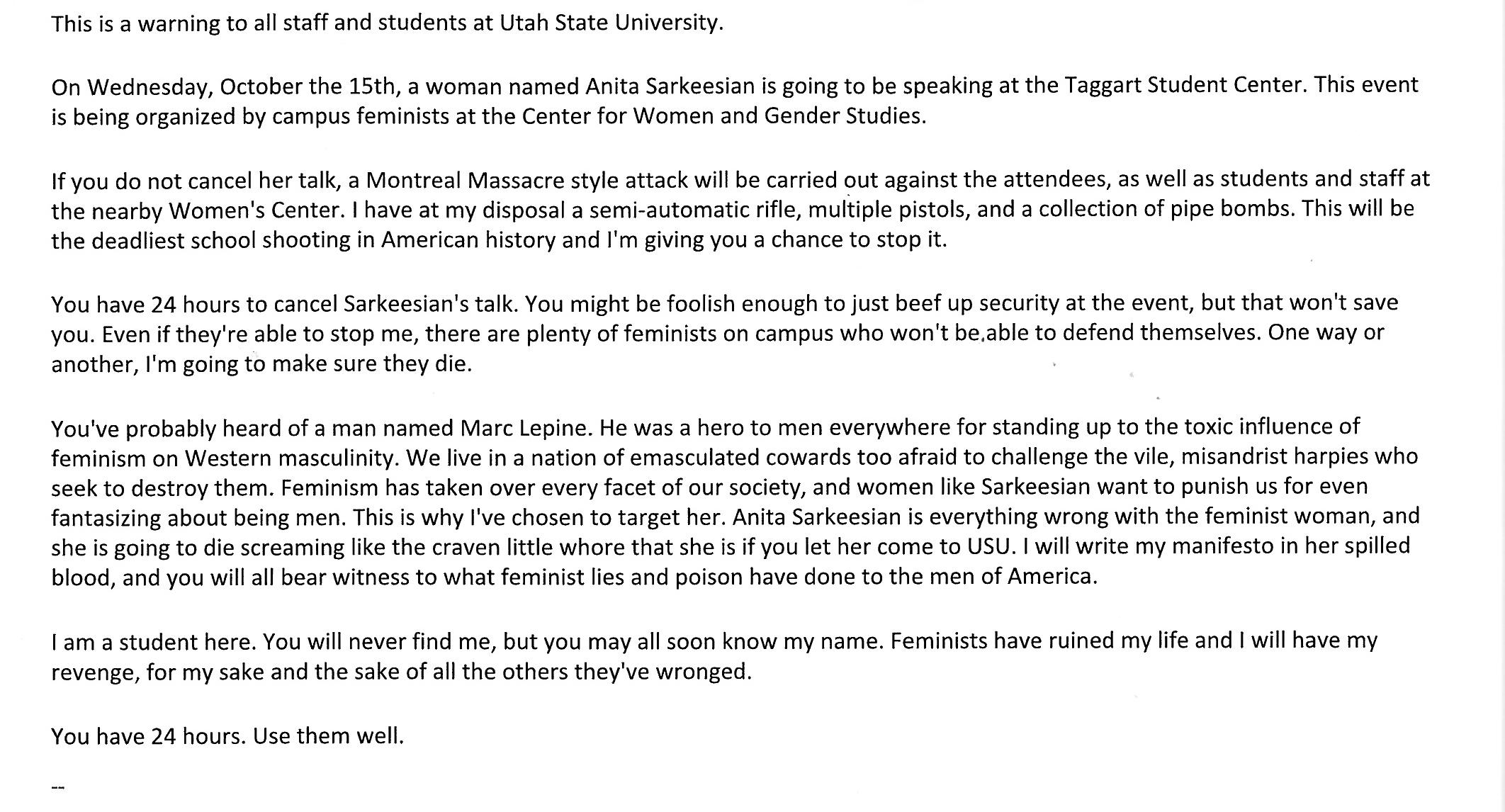
Among the things that involves ignoring, though, are things like the terrorist threat made against Utah State University TODAY for having the temerity to invite computer games writer and activist Anita Sarkeesian to speak. This isn't the first death threat that's been made against Sarkeesian, and the authorities are taking it extremely seriously, not least because the guy mentioned admiringly in the e-mail, Marc Lépine, was very real and killed 14 people (injuring 14 more) at the École Polytechnique in Montreal in 1989, supposedly because of a similarly virulent anti-feminist agenda. And let's not forget that this is all happening because Sarkeesian dared to put out some videos making the (fairly self-evident and uncontroversial, you'd think) case that the video game industry has a problem with how its products portray women.

The barely believable follow-up to that is that the talk has been cancelled, not by USU but by Sarkeesian herself, over concerns for her own safety once it became apparent that Utah's barking gun laws would permit attendees to carry concealed weapons into the venue even after a threat such as this one had been issued.

Back to the original article - one of the more chucklesome elements is the juxtaposition of the pooh-poohing of "liberal issues" and "social justice" and the photo-montage the author (or an editor) saw fit to illustrate the piece with. Take a look:


It may be instructive to list the people illustrated here:
  • Penn Jillette, 59, white, magician, comedian, tedious hectoring loudmouth, likes calling women cunts;
  • Neil DeGrasse Tyson, 56, person of colour, astrophysicist, occasional inaccurate quote-rememberer, generally pretty good on recognising social justice issues, BUT a man who, crucially, does not self-identify as an atheist, for what I think are weaselly bullshit reasons, but nonetheless that's not a label that he accepts;
  • Bill Maher, 58, white, comedian, talk show host, pseudoscience advocate, likes calling women cunts;
  • Lawrence Krauss, 60, white, physicist, unfortunate choice of friends, rumours of inappropriate conference behaviour;
  • Christopher Hitchens, 62, deceased, white, journalist, casual dismisser of women;
  • Sam Harris, 47, white, writer, neuroscientist, careless perpetuator of sexist tropes and taker of great umbrage when called out on it;
  • Daniel Dennett, 72, white, philosopher, cognitive scientist, no known form on the subject that I know of;
  • Richard Dawkins, 73, white, evolutionary biologist, tweeter without due care and attention;
  • Ricky Gervais, 53, comedian, purveyor of thoughtless ableism, likes calling people cunts;
  • Ayaan Hirsi Ali, 44, person of colour, writer, activist, regrettable neo-conservative wingnut.
Just to summarise, of these ten people, only 9 of whom actually self-identify as atheists in the first place, eight are white, nine are male, and all but two (of the nine who are still alive) are over 50, with the youngest being 44. If the list had been specifically chosen to satirise and undermine the article it was attached to, and perfectly illustrate the point being made by the people it was dismissing, then I'd say they'd done a pretty good job.

Thursday, September 18, 2014

carry on with your knitting, ladies, nothing to see here

Here's the opening part of a conversation (well, a small section of a longer conversation) that happened in the atheist blogosphere and Twittersphere this week:
Big Name Atheist Guy: I see more guys at atheist conferences because, well, I assume guys are just more into, like, critical thinking and the like because of some GENDER ESSENTIALIST SHIT I just pulled out of my ass or something. 
Other atheists, some of them women: you're not wrong about the gender imbalance, but whoah, that GENDER ESSENTIALIST SHIT you're pushing there is perpetuating some lazy sexist tropes and you probably need to think a bit harder about what you're saying.
So far, so innocuous. The whole Men Are From Mars, Women Are From Venus, pink for girls, blue for boys gender essentialism bullshit is very irritating (and, just to be clear, generally unsupported by the science), but it's an easy trap to fall into, and, hey, sometimes we say things without thinking about them enough and fall foul of some cognitive shortcut caused by the culture we've all been swimming in since we were born. It's really no biggie, and certainly doesn't tar the speaker as an irredeemable bigot, just someone who once didn't think before he spoke (or, to use an Americanism, "misspoke"). We all do that; I know I do.

So at this point the conversation can go one of two ways, as follows:

option A:
BNAG: hmmm, yes, you're right, there are clearly a whole host of cultural issues that I'm ignoring here. see how easy it is for even a rationalist to slip into lazy modes of thinking? thanks for the heads-up.
OASOTW: no probs. we all do it from time to time. patriarchy, eh? tchoh. anyone fancy a pint?
option B:
BNAG: OMG you just called me a filthy sexist pig you shrill bullying harpy. HELP HELP POLITICAL CORRECTNESS THOUGHT POLICE WITCH HUNT FEMINAZIS
OASOTW: *sigh*
BNAG: also, some of my best friends are women.
OASOTW: *facepalm*
It won't surprise anyone to discover that option B represents how the subsequent conversation actually went. What might surprise some people is that the big name atheist losing their shit in such a major way was not (as you'd probably assumed) Richard Dawkins, but Sam Harris, author of such seminal New Atheist books as Letter To A Christian Nation and The End Of Faith and, with Dawkins, one of the original Four Horsemen (Daniel Dennett and the late Christopher Hitchens being the other two). In fairness to Harris I should link here to the original article containing the quote, and reproduce the relevant section:
I think it may have to do with my person slant as an author, being very critical of bad ideas. This can sound very angry to people. People just don’t like to have their ideas criticized. There’s something about that critical posture that is to some degree instrinsically male and more attractive to guys than to women. The atheist variable just has this – it doesn’t obviously have this nurturing, coherence-building extra estrogen vibe that you would want by default if you wanted to attract as many women as men.
I hope you'll agree that my humorous paraphrasing above retains most of the original gist. Dawkins isn't in the clear here, though, as he predictably weighed in to accuse Harris' critics of being some sort of Orwellian Thought Police and then went Full Mental Jacket by accusing anyone expressing critical opinions of only doing it to attract traffic to their own websites. Coming from the man whose books, admirable as they mostly are, sell in large numbers at least partly because of his own ability to foment controversy and outrage this sent most people's irony meters off the scale.

Harris has some previous form in the area of blithely assuming his own infallibility, most obviously the lengthy conversation he had with security guru Bruce Schneier in the wake of Harris' suggestion that we should single out Muslims for special treatment at airports. A conversation that can be read in full here and here (and I recommend you do, because it's quite interesting) but can basically be summarised as follows:
Harris: Let's profile for Muslims. Because 9/11. And when I say Muslims, I mean anyone who looks Muslim. And by that I mean brown and possibly a bit beardy, or wearing those funny clothes that they wear; you know the sort of thing. 
Schneier: Even if the sort of profiling you're proposing were ethical or even possible, it would be pointless and self-defeating. Security engineering is complex and often counter-intuitive and you clearly don't understand the first thing about it.
Harris: But Muslims! 9/11!
Schneier: *facepalm*
The lesson here is that being right about one thing doesn't guarantee being right about any given other thing, and that even as a high-profile "public intellectual" you shouldn't assume that you can never be wrong about anything, and that particularly in the age of Twitter you, big atheist celebrity, might actually end up getting taken to task by someone who knows more than you who's just some Joe Public type. The shame of it! The airport security discussion in particular reinforces the point that "common sense" and "intuition" are generally utterly hopeless guides to anything, least of all life-and-death decision-making, and that a prominent public intellectual ought to know this. The other lesson is that if you ever get so self-regarding that you lose the ability to apply your awesome critical thinking skills to yourself or gracefully acknowledge when you've got something wrong then you've clearly jumped the shark in a big way.

Harris, clearly following the Dawkins playbook, later issued a huffy (and lengthy) "clarification" blog post, which basically amounts to saying: some of my best friends are women; heck, I'm even married to one of them. Interestingly he made pretty much the same defence against a charge of using sexist language after writing an opinion piece about Sarah Palin in 2008. Here are the exact words:

2008:
For what it’s worth, the article was vetted by the two women closest to me (wife and mother) and by two female editors at the LA Times.
2014:
Listen, I was raised by a single mother. I have two daughters. Most of my editors have been women, and my first, last, and best editor is always my wife.
Well that's OK then. Of course the irony here is that Harris' careless trotting out of the old "women don't like hard sums and thinking because they're all nurturing and shit" trope was instantly self-refuting as he was confronted with a wall of criticism, most of it far from "nurturing" and a good proportion of it from women.

Friday, August 22, 2014

dawkogeddon

There have been a couple of moments of late where I considered adding a footnote so one of the many Richard Dawkins/Twitter/foot/mouth incidents, and then never quite got round to it. The only time I did get round to it what pushed me over the edge was only partly imagining I had something interesting to say, and partly the fact that I'd just knocked up an amateurish image mashup of Professor Yaffle in a Gestapo hat, so I wanted an excuse to use it.

In addition to the usual immediate hoopla in the wake of the last couple of incidents, there has also been a bit of more general discussion about whether Dawkins is an asset or a liability to the atheism "movement" (inasmuch as there is one) in general.

Just in case you missed them, the last couple of major twittersplosions have related to:
  • Dawkins' attempt to explain the fairly basic point that saying "X is worse than Y" doesn't imply approval for Y. Unfortunately (after warming up with a few innocuous ones) he chose the horribly inappropriate examples of being raped by an acquaintance or a stranger as X and Y, and then when people went: whoah, that's not cool, he threw his virtual hands up in faux-innocence and said, look, you can swap the order if you like, that's not my point. 
  • Then, this week, Dawkins got involved in a conversation about the horribly oppressive Irish laws regarding abortion, in the wake of some minor tinkering to make them slightly less horrible. It all started well, with Dawkins upholding the primacy of the woman's right to choose whether to continue the pregnancy or not, but then (possibly after some well-placed provocation) went spectacularly off the rails with Dawkins saying that the only moral choice in the event of discovering your foetus had Down Syndrome would be to abort. 
The tragedy here is that in both cases he had a semblance of a point. You visit any internet discussion of, say, female "circumcision", and there will be some clot on there complaining that no-one's mentioned male circumcision yet and that therefore WELL I GUESS YOU FEMINAZIS MUST THINK THAT'S JUST DANDY. The trouble is that quite apart from the foolish (or possibly deliberately provocative, depending on your viewpoint) choice of example, Dawkins himself was guilty of exactly the behaviour he was seeking to criticise with his behaviour at the time of Elevatorgate back in 2011. Possibly prompted by, ooh, about a million people pointing this out, he later issued a sort of mumbly half-apology to Rebecca Watson (though without mentioning her by name), which I guess we should take as progress of a sort, Dawkins not generally being big on admitting being wrong about anything.

Equally clearly there's nothing whatsoever wrong about defending reproductive choice; the whole point, though, is the word "choice". You can't on the one hand say yes, of course a woman should have full autonomy in matters relating to her own body, including terminating a pregnancy on demand if that's what she wants, without having to satisfy anyone that her reasons are acceptable, or, worse, undergo some unnecessary and humiliating invasive procedure beforehand, and then say, but, actually, this particular choice would be immoral and I disapprove.

Just to be absolutely clear, my position on this is that if a woman is pregnant with a foetus that she discovers, after the relevant tests, has Down Syndrome, and she wants to abort it, that's what she should do. Conversely, if a woman is pregnant with a foetus that she discovers, after the relevant tests, has Down Syndrome, and she wants to continue the pregnancy, that's what she should do. That's what "choice" means, no moral judgment implied or necessary.

One interesting corollary of that (moving away from the Dawkins discussion for a moment) is that I don't therefore see a rational argument for legislating against sex-specific abortion. That's not to say that I don't find the whole religious and cultural framework that dictates a lot of these decisions distasteful (although there is some evidence that its prevalence is overstated anyway), but the solution to that is to change the culture, not restrict reproductive freedom.

To answer the question posed in the second paragraph, which probably seems like months ago, there's no doubt that Dawkins has, in the past, been an exceptionally powerful advocate for atheism, mainly through The God Delusion - which, regardless of your opinion of its literary merits, has been the catalyst for large numbers of people to "come out" as atheist - but also through his just being a high-profile person, who was already independently famous for other things, who was also an atheist and not afraid to say so.

I suppose there's an argument that he has, in a way, been the victim of his own success - because the godless community is now so large and so vocal (though still a tiny minority compared to the religious one), particularly online, it's become more inclusive as well, and the previous stereotype of an atheist as an oldish, academic straight white guy no longer applies as much as it did. Add to that the widening of the "atheism" movement to incorporate a whole bunch of other social justice issues like feminism, gay rights, etc., all of which fit nicely under the banner of more general "rationalism", and Dawkins seems more and more like a representative of the past. A bit like that beloved old grandparent who you love having round for Sunday lunch, but you've got to watch him because he will eventually come out with something phenomenally racist.

The problem, though, is that out in the wider world Dawkins is still the public face of atheism for a lot of people, and because a lot of these people are knee-jerk authoritarians there will be an assumption that his pronouncements reflect the opinions of atheists generally. And those who have an interest in maintaining the religious status quo will say: see, told you all that God Delusion stuff was rubbish, now let us all bow our heads in prayer. To ease the frustration of all this, here's a handy infographic (from here) to allow you to navigate these incidents more easily:


Thursday, June 12, 2014

first they came for the gruffaloes

I suppose there's an argument that Richard Dawkins provides a vital service for the rationalist community by acting as a sort of lightning-conductor for abuse and hatred, owing to his being atheism's most publicly-visible spokesperson. And it is true that a lot of the vitriol directed at him is entirely undeserved, and motivated either by a visceral reaction to the perceived threat to the cosy religious status quo, or by some hopelessly ill-thought-through notion of "balance" that shies away from his public statements as being too "strident".

That said, it is also true that some of his public pronouncements are ill-thought-out and badly-presented, and just confirm the view a lot of people already have of sceptics as joyless, humourless hyper-pedants, and of Dawkins himself as some sort of representative of the rationalist thought police, like a sort of cross between Professor Yaffle and Hitler. This is especially true of his Twitter feed, constrained as it is to 140 characters, which is a pretty hilarious record of ill-thought-out statements, general piling on by the rest of the Twitterverse, and then some huffy clarifications, grumpy retractions and complaints about people not understanding nuance or sarcasm or whatever.

The latest spat actually didn't originate on Twitter, but as a result of a speech Dawkins gave at the Cheltenham Science Festival, where, despite later claims that various media outlets had taken his words out of context, he pretty clearly did suggest that fairy tales are at least potentially harmful to children:
I think it's rather pernicious to inculcate into a child a view of the world which includes supernaturalism – we get enough of that anyway. Even fairy tales, the ones we all love, with wizards or princesses turning into frogs or whatever it was. There’s a very interesting reason why a prince could not turn into a frog – it's statistically too improbable.
Needless to say this generated something of a Twitter storm and required him to clarify his thoughts via various media outlets, though he still didn't seem entirely clear, simultaneously claiming that he'd never claimed fairy tales were harmful:
I did not, and will not, condemn fairy tales. My whole life has been given over to stimulating the imagination, and in childhood years, fairy stories can do that.
and that, well, maybe he had, but now he'd changed his mind:
If you did inculcate into a child's mind supernaturalism ... that would be pernicious. The question is whether fairy stories actually do that and I'm now thinking they probably don't. It could even be the reverse.
Of course part of Dawkins' intention here would have been to draw a parallel with religion and its assorted implausible tales, it being a fairly common atheist trope to refer to them scoffingly as "fairy tales" - I've done it myself often enough. I think he's probably taking aim at the wrong target, here, though, unless there are parents who, in addition to reading these stories to their children, insist that they are LITERALLY true and that if you keep sucking your thumbs some crazy person really will come along and cut them off. It's not the implausible content of the stories that's the issue, but rather the fact that there is a subset of implausible stories that some people would have you believe are the literal truth, and furthermore get all punchy and bomb-y if you try to point out that they're not.

There is another problem, of course, which is: what's a fairy story? I mean, I grant you that the whole pumpkins turning into gold carriages, frogs turning into princes thing from what you might consider "classic" fairy stories is obviously not real, but then what of talking pigs? Dragons? And let's not forget there really is no such thing as a gruffalo. Strip away anything not corresponding to the real world and you discard something like 99% of children's literature (and indeed adult literature); you're really just left with the Encyclopaedia Britannica and the Haynes manual.

I was prompted to go off at a mental tangent by all this and think about how much I do, or should seek to, police my daughter's reading material. I don't so much mean the religious stuff, since we don't exactly get a lot of that pushed on us, although I did come across an old hardback Children's Bible Stories book in a pile of stuff the other day which I think must once have been Hazel's (I've hidden it again now). I think I'm more inclined to be all censor-y about the stuff that's pushing the gender essentialism, pink for girls, blue for boys, Disney princess tropes, since all that stuff gives me the heebie-jeebies. We have acquired (by what means I'm not sure) a couple of books that I deem to be over the line in this regard, and I've made sure that they've been shoved down the back of the book rack where they're unlikely ever to be pulled out and read. I answer my own questions about whether I'm being too sensitive about all this by telling myself I can afford to be, given the blizzard of cultural influences in the opposite direction she'll be subjected to once she gets out into the world.

Of course this is fairly easy when you've got a large degree of control over what cultural influences your child is exposed to, but what about when they go to school? This is where you have to make some tricky judgments about what to let slide and what to dig in your heels about - just as I wasn't prepared to bow to prevailing cultural orthodoxy and have Nia christened, I certainly wasn't prepared to have her go to an overtly religious school, not least because there is usually some sort of entry test involving gauging the devoutness of the parents, and that would not have gone well.

But there will still probably be some absurd uniform rules, and inevitably there will be some sort of exposure to religion in one form or another. What about nativity plays, for instance? Do schools in general still do those, or is it just the fundamentalist Christian ones? Would I feel obliged to veto Nia's participation, or would that be heavy-handed? And what if the school organised an outing to Noah's Ark Zoo Farm? I think that might be the thing that tipped me over the edge into torching the place.