Showing posts with label photolinks. Show all posts

Sunday, October 26, 2025

the path of least resistance

Following on from the Blorenge and Scottish walks described in earlier posts, a few more maps I spotted in my collection from recent outings and which I thought might warrant a mention here. Firstly, Pen y Fan. Now you'll probably be aware that I've featured ascents of this particular mountain a few times before on this blog; I won't attempt to collate all of them but you might start herehere, here and here. But it is, let's not forget, the highest mountain in Southern Britain, a slightly woolly claim but one which essentially means that if you draw a horizontal line on a map of Britain a few feet south of the summit of Cadair Idris, as I've done below, the highest point in the region south of that line is indeed the summit of Pen y Fan. Yes, granted, you've defined your terms in such a way as to get the answer you want, but it's not an insignificant thing. 

Anyway, sometimes you want to find new and interesting ways to get up and down (and you almost always can), but sometimes you just want to smash up, bag it, smash down again, bish bosh, sorted. Other considerations are who else is coming along on the walk and how much gratuitous extra distance and effort they'll be prepared to tolerate without getting all whiny and annoying, and indeed who is in charge of route planning. I get a bit twitchy if this isn't me, but sometimes it isn't and you have to take an attitude of Zen-like acceptance in the face of whatever ill-thought-out bullshit other people come up with.

Examples, you say? Gladly. Here is the walk we did for my birthday back in February, a time of year when I get a free one-off opportunity to annoy everybody by making them do an activity of my choosing, which of course is going to be some tedious outdoorsy shit. So I'd proposed a trip up Pen Y Fan, which Nia had done a couple of times before but neither Alys nor Huwie had. I can't remember whether we'd done any advance planning for the Scotland trip at this stage but I might have had the thought of using it as a warm-up for the more strenuous mountain walking that would be involved there. My sister-in-law and brother-in-law and their two boys wanted to come as well, so I thought I'd better play it safe and just do one of the quick routes. So we parked up in the recently-expanded Pont ar Daf car park and did a circular route up via the path from Storey Arms and back down the main path which terminates at the car park, a round trip of a little over eight kilometres, or five miles if you prefer, in a clockwise direction on the map below.


What's very obviously apparent both from looking at the contours and the altitude chart a couple of kilometres in, and indeed from listening to the chorus of complaining from my fellow walkers, is that the forced loss and regain of around sixty metres in height in order to traverse the mini-valley containing the Blaen Taf-fawr stream is a bit of a motivation-killer early doors, just as it's a bit of an unwelcome sting in the tail at the end of a fifteen-mile bi-directional traverse of the main Beacons ridge.

Simple, you'll be saying, just use that prominently-marked green path that swings up to the north and, at the cost of maybe an extra half a kilometre across the ground, stays on the contours the whole way. And my answer to that is I'd love to, but it's not really discernible, still less signposted, any more. If you look at Google Maps' satellite view, really zoom in, and squint a bit you can just about convince yourself that there might be a scratch in the ground resembling a path, and if you drop the StreetView man right at the start of the path up from Storey Arms you might just about make out a grassy track ascending through a break in the heather on the left, but I have walked past here a few times, and past where the path supposedly rejoins the main path at the Tommy Jones obelisk, without noticing anything obvious. Next time I'm up there in reasonable weather with no pressing need to keep anyone else fed or entertained I'm going to have a look for it though.


Similarly, while the OS map shows a few alternative paths either side of the main route up from Pont ar Daf, none of those are discernible any longer at ground level. This will be largely because of the considerable path maintenance and landscaping effort that's gone on alongside the car park improvements to reduce the amount of erosion along these heavily-used routes. That does create a feedback loop, though, in that people will then be constrained, or at least heavily encouraged, to only using those routes for ascent rather than fanning out over a number of different routes to the same end-point, and perhaps reducing wear on any individual one. 

A couple of schools of thought on this one; Cameron McNeish, author of a couple of excellent books on Scottish mountain walking that I own, is a fervent advocate of people being, as he puts it, goats rather than sheep and making their own ways up, on the grounds that this reduces wear and tear and prevents a single furrow being worn into the ground that then needs repair and reinforcement. I'm quite sympathetic to this viewpoint, though the counter-example I would offer is Waun Fach in the Black Mountains, recent-ish recipient of exactly the sort of hard landscaping and path constraining that McNeish decries, but which I don't think anyone could rationally say is a worse place to be on top of now than before

My second ascent of Pen y Fan this year was as part of the I Am Pen y Fan charity challenge organised by SightLife, the charity my wife works for, and at the start of which we were seen off by charity patron Ceri Dupree, who didn't join us for the walk as the fabulous sequined Welsh flag dress he was wearing would have been rather constricting, not to mention a bit chilly on a wet and windy day. You will see from the summit photo that Huwie resolutely rocked a green sequined tailcoat the whole way to the top as a tribute, though. 


Route-wise this was as vanilla as it gets, just straight up and back from the car park, with a small loop on the way up for those who deemed it desirable and/or necessary (i.e. pretty much just me and the kids) to bag Corn Du. The summit photo I've reproduced above also features in this ongoing Twitter thread and in the recently-updated mega-gallery of trig points and mountain summits. 

Tuesday, September 20, 2022

going postal

Another series of tenuously-linked thoughts, if you'll permit me. Firstly, someone retweeted this tweet into my timeline the other day:

Now I'm all about the making unduly harsh snap judgments without giving people an opportunity to defend themselves, as you know, but still, this seems a bit over-the-top to me. Apart from anything else, who even uses snail mail these days? Certainly not The Kids, bless 'em, who are too busy doing things The Kids do these days like making TikTok videos and eating ass, so the opportunity to gaze upon a postbox frontage while posting multiple items and ruminate upon what all the various letterings stand for is a fairly niche thing in 2022.

I mean, I'm pretty sure if someone put the picture attached to the tweet in front of me I could have worked out what it must mean, but the only reason I know what the letters on the front of a postbox mean in relation to the royal cypher in particular is because we used to have a VR postbox in the village we lived in (specifically, this house) on the outskirts of Nottingham for a couple of years around 1981/1982, and I recall one or other of my parents explaining its significance to me. I'm obscurely chuffed with myself that I was able to drop the StreetView man right on the postbox's location first time 40-odd years later. Frustratingly, the lane was evidently too narrow at this point to squeeze the Googlemobile down so you can't actually see the lettering on the box, but fortunately someone's captured it here

Anyway, you'll be saying the name of the village (Normanton-on-the-Wolds) by emphasising the first syllable of NORmanton, right? I mean, like any normal person would. And, just to be clear, you would in this case be right to do so. But not in all cases, goodness me no. I have only a few memories of visiting nearby sites of outdoor interest during our briefish time living in Normanton - the watersports centre at Holme Pierrepont, the vast grassy expanses of Clumber Park - but I do have a clear memory of going for a walk on the banks of a large area of water and snooping round a church which was half-submerged in the water. This hazy memory only shimmered into sharp focus a couple of months ago when we went for a brief camping trip in Rutland, at a site a couple of miles south of Rutland Water. Among the other fascinating information available about Rutland Water (notably that it's the largest reservoir in England by surface area) is the semi-submerged church on its banks at Normanton, prominently featured in much of the tourist literature. We didn't actually have time to visit as part of this trip but I did have a chat with a knowledgeable bloke while scoping out some watersport activity and he talked briefly about the church, and I did do enough Googling to confirm that it is indeed the same church we visited 40-odd years ago, when the reservoir had only been in fully-filled existence for a year or two. Interestingly, though, he clearly and specifically pronounced it NorMANton with the emphasis on the middle syllable. A quick look at a map of the area reveals that there is a place called Manton a few miles to the west, so it's not utterly ridiculous to conclude that Normanton may be a contraction of "North Manton" and the contracted name has retained the accenting from the original name. Note that I'm leaving aside the obvious observation that it should really be called East Manton given its geographical position. 

There are quite a few other places called Normanton in England, notably Normanton le Heath in Leicestershire which featured in the lists here.

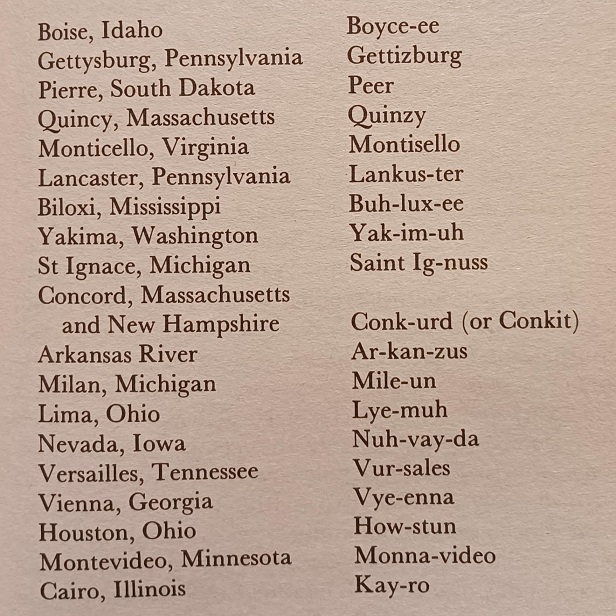
Anyway, a small selection of Rutland photos can be found here. It's not just British place-names - here's a list from Bill Bryson's excellent Mother Tongue featuring US place-names with counter-intuitive pronunciations:

Monday, November 01, 2021

to pen y fan, and dam the consequences

As previously advertised here, I had plans to do a walk up Pen y Fan with Nia on Friday. There were only two things which could have stood in our way: firstly disastrous ankle consequences from my walk on Monday, and secondly some sort of disastrous weather forecast which suggested that we would be imperilling our lives by even stepping outside the front door. Well, while the ankle was more painful than I'd hoped it would be, that certainly wasn't going to be allowed to stand in the way, and while the weather forecast wasn't great - persistent rain, intermittent low cloud and brisk winds - I'd describe it as fairly typical October Beacons weather, so off we went. 

It was immediately apparent that whatever the weather on the day, there had been a lot of rain recently, as there were a couple of spots where the minor road that leads up the side of Pontsticill Reservoir was completely covered in water. It looked (and mercifully was) pretty shallow in both spots, but the prospect of stranding myself and Nia in the middle of nowhere with pretty patchy mobile phone coverage and a broken-down car like, say, one of these idiots was not an appealing one. Anyway, we got through to the car park we were aiming for, just down the road from the Neuadd reservoirs. 

My plan was to go across the lower reservoir dam and straight up the steep ascent onto the Graig Fan Ddu ridge, thus getting the difficult bit of the day knocked off early doors, and then walk along to Corn Du and Pen y Fan and come back down the major path that runs from Bwlch ar y Fan back down to the dam. While we were getting booted and coated a man in a high-vis jacket with a National Park logo came up and engaged us in some chat about what our plans were for the day. He was evidently doing commendable humanitarian work ensuring that people weren't just about to swan off to the top in flip-flops and vests with carrier bags full of Stella, but I confess I bristled slightly at his gentle questioning and had to suppress an urge to say I KNOW WHAT I'M DOING THANK YOU VERY MUCH GOOD DAY TO YOU SIR. He did, to be fair, make the suggestion that given the weather forecast it might be more prudent to do the walk in reverse and take the more gradual route on the way up, thereby making it easier to abandon and come back down if the weather proved too horrible. I stubbornly declined to commit myself to any particular route during our conversation but privately conceded shortly afterwards that he was probably right.

So the upshot of all that was that the route we ended up taking was almost the same one as I'd done with Hazel and Robin way back in early 2009 (photos here) - the differences being that on the earlier walk we parked in the lower car park about half a mile back down the road at Pont Cwmyfedwen and also took in the extra peak of Cribyn on the way round. Route map and summit shot from Friday's walk are below.


Anyway, the main two things to say about the walk are firstly that in complete defiance of the weather forecast it was almost completely dry throughout (aside from some brief light drizzle on the way up and a brief but intense and stinging sleet/hail shower during the final descent) and for our lunch stop on the lower slopes of Cribyn and the ascent and summit of Pen y Fan itself it was positively sunny. Secondly, despite it being a fairly robust 8.7 mile round trip Nia gave every indication of thoroughly enjoying herself and certainly didn't seem to be nearing the limits of her physical capabilities. As for the limits of my physical capabilities the pain from my ankle was noticeable but not disabling, though there is as always a price to pay for the next 48 hours or so. 

One interesting thing that you can see from the small set of photos I took is the current state of the two Neuadd reservoirs. The pair of images below are from 2008 and 2021 and show that both upper and lower reservoirs are currently empty. In the case of the upper one that's because it's been drained because of concerns about the integrity of the dam. As I understand it the intention is that the reservoir be refilled once some sort of remedial action has been taken, but that there isn't currently a timescale for that. 


The situation with the lower reservoir is somewhat different, in that it's been conclusively decommissioned - the way they've done this is to take a big shallow V-shaped wedge out of the dam (unlike the rather ornate stone dam on the upper reservoir the lower one is/was just a big earth bank) to lower the water level and create a new spillway. To retain public access across the dam (which you used to be able to just walk across the top of) they've also built a footbridge across the new spillway. It's all been very nicely landscaped, as you can see from the pictures below - the older picture showing the intact dam is from that 2009 walk.


A final note while we're talking about reservoirs - the larger Pontsticill reservoir has a glory hole spillway which featured in the opening scenes of the BBC drama The Pact, which I cannot offer an opinion on one way or the other except to commend the splendid drone shot of the spillway featured about two minutes into the first episode and captured below.


Tuesday, October 26, 2021

bog standard

So obviously with ankle rehabilitation progressing well and new boots ready to be tested it only remained to find an opportunity to go and test ankle and boots out by going for a long walk. It's currently school half-term and Nia and I have been trying to tee up a crack at Pen y Fan, which she's very keen to do. That's pencilled in for the end of this week but I managed to wangle a free day yesterday as well so I took myself off for a walk after dropping the kids off at their grandparents' in Abergavenny. Now I've done a lot of walking in the vicinity of Abergavenny over the years: there's the Sugar Loaf, the Blorenge, the Black Mountain, Table Mountain above Crickhowell, Coity Mountain near Blaenavon and various Skirrids. So a lot of the obvious boxes have been ticked, and I fancied doing something new rather than re-doing something I'd already done.

The obvious area in the vicinity that I'd never set foot on was the big plateau to the south-west of Crickhowell, cut roughly in half by the B4560 running north-south across it, with the eastern half being Mynydd Llangatwg and the western half being Mynydd Llangynidr. So I planned a circular route, found a car park and set off. 

The first thing to say here is that this isn't a mountain walk in the classical sense: firstly because the car park is at about 440 metres and the high-altitude point of the day is at 541 metres, so there isn't a lot of ascent involved. Furthermore while the two areas either side of the road are each called "mountain" (that being what the Welsh word "mynydd" means) they are actually just one vast plateau with no obvious summits. The focal points of the day are the two trig points, the first one barely a mile and a half into the walk at 541 metres and the second at 529 metres atop a slightly more impressive pile of bits of shattered limestone about four miles to the east. The important thing to say about the first one is that this isn't even technically the summit of Mynydd Llangynidr - that is at 557 metres about a mile and a half to the west, but I couldn't see a way of including it in the walk without increasing the amount of exhausting slogging across trackless wastes to beyond the limits of even my sanity.

Getting from the first trig point to the second is the main challenge of the day - as you can probably imagine a vast flat area of mountain upland in South Wales is going to attract and retain quite a bit of water. The section from the first trig point to the road is basically OK, as is the section from the road to the intermediate high point here. Looking east from there across the slightly lower-lying area between you and the higher ground of Mynydd Llangatwg (the knobbly bit in the centre of the picture) is, I imagine, an experience not unlike gazing across the blasted trackless wastes of Mordor towards Mount Doom.

It's important to take an attitude of Zen-like calm and fatalism here: there's really no way of knowing in advance which is the best (which basically means driest) route, and so the thing to do is pick out a rough route by eye and then just go for it. In hindsight, though, it might have been better to go to the south (right in the photo above) of the two ponds rather than trying to pick a route between them. Around halfway through trying to do that I encountered a very wet section and no amount of hasty high-stepping over tussocks could prevent a certain amount of water from entering over the tops of my boots, instantly invalidating my intended testing of their waterproofing. The advantage of being in such an unfrequented spot is that you can bellow CUUUUNNNT as loud as you like and no-one will mind. 

Once you've gained the high ground of Mynydd Llangatwg, bagged its trig point and dropped off to the north to get out of the wind and eat a pork pie and a Granny Smith, you can quickly drop off the northern edge of the escarpment and down onto a path which hugs the contours along the bottom of the cliffs back towards the car park. I had expected this to be a longish and slightly tedious tail to the walk, but it's actually not quite as simple as that: the first section takes you through some interesting old limestone quarry workings and into the Craig-y-cilau nature reserve, part of the path through which follows the route of an old quarry tramway along a terrace halfway up the cliff. This is an absolute delight to walk after the tedious squelching that's gone before, and once that ends you drop down into some wooded valleys that are equally delightful, if a bit muddy and slippery in the wet. The path then leads past the raised bog at Waun Ddu - apparently very unusual and ecologically significant, though to be honest not much to look at. 

That's your lot for excitement, though, the tedious tail to the walk then materialises, just slightly later than expected, and you have to slog the last two slightly uphill miles along a road.

I can't honestly say I'd recommend this route to anyone but tedious hill-bagging completists and those of an obsessively misanthropic nature - after leaving the car park where there were a couple of guys in an army Land Rover doing mysterious army shit involving shouting into a radio a lot the next time I saw a human being was at around six miles in when I caught a glimpse of the top half of a farmer from about fifty yards away. I then passed within hello-ing distance of a young couple and an elderly lady and her dog while walking through the woods, but that was about it. I enjoyed myself, but I am aware that I find enjoyment in a whole variety of perverse activities that many would find unpalatable.

As an exercise in assessing boot comfort and ankle recovery it was pretty effective, though: marshy tussocky terrain like this is murder on the ankles even when they aren't injured. Twenty-four hours later I would describe my ankle as a bit sore, but not cripplingly so. We'll see what a shorter but steeper (and hopefully drier) walk on Friday does to it.

Route map (start at the green flag thingy in the top left corner and proceed anticlockwise) and altitude profile are below: the altitude profile illustrates how this is very much a walk of two contrasting halves. Note that the starting altitude (calculated by my phone's GPS) and, as a consequence, all the other altitudes, are about fifty metres too high.


I also took a few photos, which can be found here

Tuesday, June 29, 2021

walking back to happiness WOOPBAH et cetera

It was our tenth wedding anniversary at the weekend so Hazel and I managed to wangle a quick break away (specifically, away from the kids, bless 'em) in Pembrokeshire. We borrowed (again) our friend Clare's chalet at the Pleasant Valley Heritage Park (now seemingly just branded as Heritage Park, which seems pointlessly bland and non-specific, but then I am not a marketing guru). Obviously among other things this location, and its proximity to Tenby in particular, allows me to recycle a lame joke I made here and speculate that we'll be going to Elevenby next year, Twelveby the year after that, et hilariously cetera.

Along with general relaxation, getting some reading done, and quaffing lots of prosecco we decided that we wanted to go for a walk on the Saturday (our only full day there). What I came up with was a walk along what used to be known as the Pembrokeshire Coast Path but seems now to have been absorbed into the larger Wales Coast Path for branding purposes (most of the signage says Wales Coast Path now, for instance). You'll recall that the main problem with coast paths is the difficulty of organising a satisfactory circular walk, unless you happen to be in the vicinity of a narrow-necked peninsula of suitable size or are prepared to sign up for a walk that takes a fortnight to complete. As with my trip to Devon a couple of years ago the best solution turned out to be to make use of public transport to get a suitable distance away from the start point, and then walk back. In this particular case there was a convenient railway line with stations at Kilgetty (a mile or so from where we were staying) and Penally (the perfect start point for our walk), so we made use of that. 

A quick note about pronunciation: I was pronouncing Penally's last syllable to match that of Llanelli, i.e. with the proper Welsh voiceless alveolar lateral fricative ll sound. It turns out this marks me out as some sort of hopelessly gauche amateur who may as well have the word TOURIST tattooed on his forehead, as actually Penally is the already-pre-Anglicised version of the name of the village, which in the original Welsh is either Penalun or Penalum, depending where you look. Either way it should just rhyme with Sally; imagine if you will a little alleyway populated entirely by stationery and writing implement shops - that's right, Pen Alley. I recall encountering a similar problem with the village of Llanfoist, near Abergavenny, which we went through on our Blorenge walk - this looks like it ought to be pronounced Llanvoist as a single f in Welsh is rendered as a v sound, but actually the Welsh name is Llanffoist and the single-f version is the supposedly tourist-friendly one. A little learning is a dangerous thing, as Alexander Pope once said, thus conveniently proving my theory from here

One final digression: since there are no ticketing facilities at either Kilgetty or Penally and no-one came round during the twenty-minute train journey to collect monies and issue tickets we got the trip for free, which was nice for us but does raise the question of how much fare money these little regional railways with unmanned stations lose in uncollected fares from people who would have been quite happy to pay given the opportunity (it would have cost us about four quid each). I guess there is a calculation of fare loss versus the infrastructure cost of installing ticket machines and/or barriers at stations, and additionally, during the current pandemic, of the risk to on-train staff of coming through and conversing with the great unwashed. It seems like a problem there ought to be a solution to, though.

Anyhoo, the walk. Starting from the station you walk across the dunes, including crossing the south-western end of Tenby golf links, and emerge on Tenby's South Beach. The tide was out when we were there so we walked along the beach; if it's in then ploughing along the soft bit of the beach for a mile or so would probably be a bit of a slog and you might be better advised to take the path through the dunes or the one that hugs the course of the railway.

One way or the other you eventually arrive in Tenby; we'd had a leisurely lie-in before getting the train so we were there just in time for lunch which we did in two stages: first a refreshing pint outside the Harbwr Brewery - I had a pint of the Tamar's Tusk Pale Ale which was very nice. Duly rehydrated, we moved on to the Pembrokeshire Pasty & Pie Co for one of their stupendous lamb pasties which we ate on a bench overlooking the North Beach being balefully stared at by some large seagulls. Technically I'm not sure if birds salivate but these guys looked like they were giving it a go. 

The best section of the walk is the section of "proper" clifftop coast path between Tenby and Saundersfoot; once you get round the headstone at Monkstone Point it's a steady downhill walk into Saundersfoot where we had a pint in the Boat House (I had the Sharp's Atlantic Pale Ale). Then it was on through the old railway tunnels to Wiseman's Bridge for another pint (the Atlantic again) and a very tasty burger and chips in the Wiseman's Bridge Inn, and from there a short walk back to the chalet.

Route map is below (as always, right click and open it in a new tab to enlarge); this is off my phone app and phone signal is somewhat patchy in this part of Wales so the distance and altitude information was worthless. A separate calculation suggests that it was approximately nine miles (ten if you factor in the walk to the railway station right at the start). The highest point was probably somewhere just after leaving Tenby at no more than eighty metres or so above sea level. A few photos can be found here.


Thursday, June 03, 2021

putting down some routes

As well as traumatising and maiming small children by throwing balls at them and menacing them with bits of wood, the easing of lockdown rules provides some opportunities to get out and do some walking. My capacity to go up proper mountains or walk phenomenal distances is a bit limited at the moment as I've injured my ankle (almost certainly while out running with Nia, though I don't remember any specific incident) but I have nonetheless gone out and done a few things recently which I thought I might share with you here. 

Blorenge

We did this a week or so after my birthday in February, and therefore may have stretched somewhat the terms of the "daily exercise" clause in the lockdown regulations that were in force at the time. Let's just say I wanted to test my recently-injured ankle and a walk up a hill seemed like the best way to do it, just like driving to Barnard Castle is the best way to test out your eyesight.

Anyway, I'd been up the Blorenge once before, back in late 2009. That time we'd parked in the car park on the old railway line at Llanfoist Crossing; this time we walked from my parents' house in Abergavenny. Other than that it was a pretty similar route, we also had pretty similar weather in that it was OK at the lower levels coming across the canal and up the steep hill to the Devil's Punchbowl, but then foggy and drizzly on the higher bits, including the summit. Route map and altitude profile are below - we did the loop clockwise, i.e. the gradual ascent via the Devil's Punchbowl first and the descent by the more direct route. Total walk length is a little under nine miles.


The Blorenge is one of those mountains which is only really a proper mountain from one side (the Langdale Pikes would be another example), as it's really just the abrupt end of an extensive plateau that extends all the way over to Blaenavon. You could very easily cheat, park at the Foxhunter or Keeper's Pond car park and bag the summit at the cost of only a couple of hundred feet of ascent and probably no more than three-quarters of an hour for the round trip, something you couldn't do at, say, the Sugar Loaf

It's a perfectly nice walk; to be honest my recollections of it are negatively coloured by a couple of foot-related issues: firstly it became squelchily apparent that my Salomon walking boots weren't very waterproof any more (something I'd discovered about their predecessors in similar circumstances on Dartmoor in 2007), and secondly it became painfully apparent that my ankle injury wasn't the sort that could just be walked off and/or ignored.

Bath Skyline Walk

To celebrate outdoor meeting up being legal again, some friends and I decided to go for a walk, and since most of this particular group live around Bristol and Bath we decided to do a walk in that area. Excitingly, this meant my first trip to England for about six months. It was a new one on me, but apparently the Bath Skyline walk is a pretty well-known thing, sufficiently so to have its own National Trust webpage. It's so called because it's basically a circuit of the high plateau immediately to the east of the city, much of which is occupied by bits of the university campus.


We did the main loop clockwise, which is how the National Trust walk guide would have you do it, but if you want to do it the other way, go nuts. As the name suggests there are some good views of the city, as well as other local landmarks like Prior Park. The basic circuit is about six miles, but I got the train from Newport so the extra faffing about through Bath to get to the start point and back extended the total distance to about eight and a half miles.

The views are nice, it was a lovely day and the company was excellent, and I did have my first actual pint in an actual pub for over a year (a very nice pint of London Pride in the Boater). For all that, I wouldn't say its the most thrilling walk in the world, but it's clearly not really intended to be, just a nice half-day out in the fresh air.

Tidenham Tunnel

It was Hazel's birthday at the end of May, and as the weather forecast was pretty good we decided we'd offload the kids, pack a picnic and go for a walk. As you know I keep my ear to the ground on Rail Infrastructure Twitter and recalled having recently read something about the opening of the Wye Valley Greenway, a walking and cycling route up a section of old railway line just north of Chepstow. Most excitingly of all this incorporated the kilometre-long Tidenham Tunnel, closed since the late 1950s. So I decided to devise a walk incorporating the tunnel, and came up with the one below, starting at the car park at Tidenham Chase and then proceeding clockwiselywise down to the southern portal of the tunnel, back up through it, along the bank of the Wye for a bit (including a stop for lunch) and then back to the car park - just over six and a half miles in total. 


The altitude profile looks a bit unusual as it's inverted compared to the usual mountain profile with the high point in the middle; here the car park is the high point and the first two-thirds or so of the walk is a gradual descent down to the banks of the Wye at about 30 metres above sea level. You can see that the tunnel (the straight line where my phone app lost the GPS signal for a while) has a slight uphill gradient from south to north.

Anyway, the tunnel is interesting: lit only by some downward-pointing lights at about knee level, which illuminate the ground so you can see where you're going but don't provide much light above knee level. This is by design as there is apparently a resident bat population who they don't want to disturb by lighting the whole thing up like a Christmas tree. The newly-opened path is great, but there's still a bit of work to do integrating it with existing paths like the Gloucestershire Way; we spent a while trying to find an access point from one to the other and eventually resorted to climbing over a fence. 

[EDIT: photo links - Blorenge here, Bath Skyline here, Tidenham here.]

Tuesday, March 09, 2021

cheesy walkers

Here's another lockdown jaunt in the Newport area: having pretty much exhausted the supply of green spaces accessible on foot from the house we got in the car to make the short jaunt over towards junction 27 of the M4 and the Allt-yr-yn nature reserve (note for non-Welsh people re. pronunciation: something like "all-tureen" will probably do). I'd been here a couple of times before for solo walks and you can also end up in pretty much the same place if you follow the canal south and under the M4 from the Fourteen Locks visitor centre. The canal in question is the old Monmouthshire and Brecon canal, the main arm of which ran up from central Newport to Brecon, and which is still navigable in places, though not, as it happens, the section here which runs along the north side of the nature reserve and separates it from the M4. 


Anyway, between the road where we parked and the canal there are some interesting woodland areas to be explored, including a couple of clearly man-made ponds. Just like with Woodland Park there is a back-story here involving a big house that no longer exists, in this case called, unsurprisingly, Allt-yr-yn House. Old maps (the one below is from 1937) show it but the main building seems to have gone now. There was also a lido which seems to have sat above the couple of ponds we explored; it's unclear exactly how much of that remains but I don't recall seeing anything, and we would have walked around pretty much the exact area where it would have been. I expect it was probably landscaped into a natural-looking pond when the area was made into a nature reserve. 


That was very nice and I recommend it highly; a few photos from our walk can be found here. We also did a walk up around Usk which, while much less interesting as a walk, did yield another entry for my occasional Mystery Object contest. Here is a pile of them in a field (the complete pile was considerably bigger and must have comprised a couple of hundred):


And here are a couple of closer views of the one I picked up and brought home with me:


As always someone on Twitter either had the knowledge or was prepared to put in the legwork to find out what it was, and it turns out these are "biomarbles" which are typically used as a hi-tech filtration device for various kinds of noxious industrial and farming effluent. The web page here is a bit vague about what their actual real-world application is, as it's obviously for industry insiders who know what things like "a perfect solution when surface area is more important than voidage" mean. There is an explanatory (well, sort of) video, though. Obviously the implications of finding a large number of them just dumped in a field is that they've probably already been used for their primary purpose, that is to say filtering noxious solids out of noxious liquids, and so a thorough wash of the hands is very much in order.

Saturday, January 16, 2021

soon may the bloggerman come

This seems at first glance like it fits into the lookeylikey category, but strictly it doesn't as I'm very confident these are literally the same people in two different (but thematically linked) contexts, and indeed locations.

Anyone who hangs out on Twitter for any length of time will be aware that trends come and go, things happen, literally everyone is talking about them, they mutate into memes that people copy, retweet, etc., then five minutes later they've been forgotten. Already in 2021 we've had Bean Dad Twitter, Tasing Himself In The Balls To Death While Doing A Terrorism Guy Twitter and now Sea Shanty Twitter

Those of us with a cultural connection to Wales will of course puff ruminatively on our pipe-stems (made out of a hollowed-out daffodil in the traditional manner) at this point and chuckle indulgently at the kids suddenly discovering the joys of close-harmony male voice singing, as this is something of a cultural fixture over here. And there is something rather magnificent about a group of Welshmen of a certain age, probably with a couple of fortifying pints of Mr. Brain's finest ale inside them, belting out Men of Harlech or something similar.

Anyway, while perusing one of the latest of the mashed-up multi-layered versions of Wellerman, the current undisputed number one Twitter sea shanty, I noticed that someone had tweeted a link to this rather splendid rendition of Bully In The Alley, a song in a very similar style ("bully" in this context is apparently one of the seemingly limitless collection of words that just means "drunk"). The thing that immediately grabbed my attention, apart from the barrel-chested magnificence of the guy leading the singing, was the white-bearded guy on the left of the line-up. I felt sure I'd seen him before. Here he is:


Fortunately I am blessed, or perhaps cursed, with a prodigious memory and I recalled almost immediately where it was. When it was was slightly more hazy, but a bit of searching through some old photos yielded this, taken in a shop doorway (presumably chosen for its pleasing acoustics) in Swanage in 2009. 


While the bearded guy on the right with the distinctive shorts and thumbs-in-pockets stance is clearly the guy on the left in the video, notice also how the guy next to him with the distinctive hairline and left-hand-on-ear pose is almost certainly the guy leading the song in the YouTube video. Just a minute there, Sherlock Columbo, you'll be saying, this is all a bit speculative; white-bearded guys in shorts and sandals and rotund types with their fingers in their ears must be ten a penny in folky circles. And I hear what you're saying, but a bit of research (including reading the text below the YouTube video) reveals that these guys are members of a folk troupe called Kimber's Men. If you look carefully at the contents of the open case at the bottom of the Swanage photo you'll see that these guys are offering CDs for sale, and, although the resolution is a bit sketchy, I think you will agree that the upright one is the one pictured here.


Further evidence is provided by the alternative rendition of Bully In The Alley delivered here - the bearded guy in the middle is pretty clearly the guy on the left in the Swanage photo. Just to be clear, this smaller group is Kimber's Men, the large group in the first YouTube video presumably being swelled by the presence of a load of other singers - it was apparently captured at the Deal Maritime Festival in September 2013. 

If you follow the link to the Kimber's Men website above you will note that the white-bearded guy is absent - this is apparently because he died in 2017. His name was Joe Stead and he was evidently something of a legend in folky circles. 

Traditional British folk music carries an unpalatable whiff of real ale and Morris dancing to most people (not that I am averse to the whiff of real ale, as you know) but it's something I like a lot, in carefully calibrated doses. To be honest the fact that it's a thing best enjoyed live in a slightly cramped and sweaty pub just adds to the attraction for me. The reason that Kimber's Men were hanging out in Swanage in the first place was because our visit in 2009 happened to coincide with the Swanage Folk Festival, and I cannot deny that among the many musical acts on display there was quite a bit of Morris dancing, most of it thankfully centred on the wide open areas on the seafront (the esplanade, if you will) rather than in the pubs. Pictures from that trip can be found here.

Friday, December 18, 2020

you must lower me into the steall

A couple of further notes on that Scottish trip, as my memory has now been jogged by looking at the photo gallery, and as I don't seem to have blogged about it at the time: we stayed in one of the cottages here between Glencoe village and Ballachulish; perfectly nice as I recall and well-situated for Glencoe and Fort William. Just to prove that point we'd stayed in the same cottage the previous year and knocked off a pair of Munros in each of those locations. The plan was to do something broadly similar this time. That's not quite how it went, though, and the reasons why not may have some general applicability for those planning and doing mountain walks. 

First attempted expedition was to do the Ring of Steall, one of the great Scottish horseshoe ridge walks, which incorporates four Munros with the option of a couple more if you start super-early and don't mind doing a couple of out-and-back detours from the ridge. Most people will find that four does them quite nicely. The standard route here is to park in one of the car parks up Glen Nevis directly south of Ben Nevis itself and then do the route in a clockwise direction, the start and finish point being at about twelve o'clock. One of the first things you have to do if you take this route is cross the Water of Nevis via the bridge in Steall Meadows. Meh, no biggie, you'll be saying. Weeeell, yeah, but this bridge is a little out of the ordinary. Here are pictures of me, and subsequently Jenny, crossing it.


It is a bit intimidating, and the consequences of falling off are unpalatable (I mean, you wouldn't die, but you'd get extremely wet), but it's not utterly terrifying once you're on. The wires are as taut as they reasonably can be, while still conforming to the laws of physics, so it's not like slacklining, but you do need to keep your mind on the job. Different people have different triggers for going a big rubbery one, though, and this guy (who ended up doing broadly the walk we were planning to do) seems to have bailed out and preferred to ford the river on foot. To be fair, the river was probably a bit shallower when he did it. Hazel was also, it's fair to say, not especially enthused about the prospect, but, in her defence, we'd just discovered she was pregnant with what turned out to be Nia, so a slightly raised level of caution was probably understandable. I have no pictures of Hazel crossing the bridge, probably because the inebriated-docker-strength swearing directed at me throughout fogged the images. At least, I laughingly said when she arrived safely on the other side, we don't have to come back this way. I should really learn to keep my mouth shut.

Anyway, to cut a long story short, the next thing you have to do is ford another, smaller river just below a waterfall. Since it had been raining for the previous fortnight the waterfall was in spectacularly torrential spate - quite a sight, but it meant that a high proportion of the rocks that would normally present themselves as stepping stones were submerged, and after much searching around we concluded that there wasn't a way across that didn't carry a risk of getting either drenched or killed. So we turned back, somewhat reluctantly as it meant that we had to go back the way we'd come, including the bridge. It's actually not so bad on the way back as it's slightly downhill, although that does make getting on in the first place slightly more hair-raising as the drop is a lot longer.

Lessons here are: don't assume little blue lines on the map are insignificant streams which you can just step across, and remember river volumes are highly variable (we found the same thing here and on our ascent of Ben Lui in 2009 but managed to get round it with some radical route re-planning both times). Also, don't assume everyone in the group has the same triggers for going NOPE NOPE NOPITY NOPE, and be understanding when it happens at an obstacle that seems relatively trivial to you.

Anyway, we ended up driving back and going to Kinlochleven for the afternoon, firstly for a mooch around the ice climbing centre (and a visit to the bar, obviously), and thereafter for a session in the Tailrace Inn. We didn't go to the visitor centre, which houses The Aluminium Story, a guide to Kinlochleven's quite interesting industrial history - I forget whether we found it was closed or were just distracted by the prospect of a pint. The other pub that were are in right at the end of the photo gallery, incidentally, is the splendid Clachaig Inn in Glencoe, which I previously mentioned here.

Our next attempted mountain walk was to conquer the two Munros conveniently placed round the back of the cottage where we were staying - well, not exactly, but close by to the south of the A82 between Ballachulish and South Ballachulish (which, confusingly, is due west of Ballachulish, although it is south of North Ballachulish). These two (Sgorr Dhonuill and Sgorr Dhearg) form part of an overall group of peaks known as Beinn a'Bheithir, and are relatively benign in terms of height and difficulty. I have a feeling we didn't set out until relatively late in the day (after lunch, perhaps) as we were waiting for a break in the unrelenting downpour; I think we eventually decided to just go anyway as otherwise we would run out of daylight. We had intended to do this route, only anti-clockwise, to get the boring low-level bit on the road out of the way first. 

That should have been easy, and the entrance off the A82 onto the complex of forestry tracks that leads up into the valley from where you can scramble up onto the summit ridge is completely obvious (it's here). We nonetheless managed to waste a phenomenal amount of time scrambling about in a pathless wood failing to locate the path, probably owing to either mistaking a war memorial for a church or vice versa and leaving the road too early. Whatever the reason, we eventually emerged, wet and frustrated, onto the correct path and followed it for a bit, but before we could start gaining any serious height the heavens opened again and we soon decided that it was a bit too late in the day and we were already a bit too wet for an expedition of this magnitude and we should probably knock it on the head, particularly since the clouds which were dumping gallons of water on us were starting to shroud the summits a bit. You can get an idea of the conditions from the two photos below, which show Jenny and Hazel just about to set off from the cottage, and Jim showing his contempt for the whole situation by having a piss on some logs. 


The lesson here, apart from the obvious one of learn to read a map, you cretin, is that often the most difficult and frustrating bit of a walk, navigationally speaking, is right at the start while you try and find a way onto the hill you're aiming for while respecting the boundaries of other people's property and picking your way around all the other stuff (buildings, fences, walls, lakes, trees, branches of Screwfix) that you don't get so much of once you've gained a bit of altitude. Once you've done that it's also much easier to see where you're going and where you've been, and the contour information from the map and the terrain also helps. 

Just writing this blog post down has rekindled feelings of annoyance and frustration at being thwarted twice within the space of a few days (not to mention marooned on Mull in between), and a determination to one day get back and conquer the six Munros we missed out on, plus a few of the remaining 260 or so I haven't done yet. Obviously having been locked in the house for most of the last ten months hasn't helped either. Realistically this might have to wait ten years or so until the kids are old enough to come with us. Will I still be up for twanging precariously across a wire bridge at the age of 60? Of course I will.

Monday, February 24, 2020

getting blown off at the weekend

Two motivational celebrity quotes for you today. The first is from the great Bill Hicks, whose views on the desirability of exciting and diverse weather I wholeheartedly share (the bit quoted here was talking about the prevailing weather in Los Angeles):


Secondly, dear, dear Larry Olivier was apparently once quoted as saying something like: if you really want to be an actor, you will; if you end up not being one, you just didn't want it enough. Now this may very possibly be one of those motivational quotes that some Californian loony cooked up in order to sell his latest bullshit "life coaching" course to rich gullible people, and then decided it would acquire some unearned gravitas if he attached some famous person's name to it. Winston Churchill is the name people usually attach to these things, and indeed some people I know have this "quote" prominently displayed in their house despite its being pretty clearly late-20th-century psychobabble and not something Churchill would ever have said. CRITICAL THINKING, people.

I digress. The point of those two quotes, and their relevance to what follows, is to celebrate varied and exciting weather conditions, even those which are intermittently inconvenient, and to venture the theory that when conditions are a bit arduous and some on-the-hoof re-planning and re-prioritising may be required, a bit of mental fortitude may also be required to push through and achieve your objective, whatever it may be.

No doubt this is wisdom applicable to various situations, but here I specifically have in mind the walk I and my friend Alex did on Saturday. I had been granted a childcare-obligation-free day as a sort of birthday present to go and do a walk of my own devising, so I'd devised a new route up Pen y Fan, a mountain I have been up more times than I can remember, but even restricting myself to trips recorded on this blog ascended in 2008, 2009 (a post which includes a couple of summit pics from older, pre-blog, ascents), 2010, 2013 and 2018 plus an abortive attempt in 2007.

Those trips encompassed a variety of different routes in an attempt to keep things fresh and interesting - Saturday's route was meant to involve ascending via the Cefn Cyff ridge to Fan y Big, skirting round the south side of Cribyn to bag Pen y Fan, and then heading back to the summit of Cribyn and down via the Bryn Teg ridge. Both of those ridges were unexplored territory for me.

So we parked up at Cwmgwdi, the main car park for assaults on the eastern Beacons from the northern side, and set off. When we reached the farm at Cwmcynwyn, though, it soon became clear that the innocuous word "Ford" on the OS map hid a world of raging watery terror in the wake of Storm Dennis, and that the Nant Cynwyn brook, which you could probably step over in summer, was not going to be passable without full-body immersion and possibly death. So we devised plan B, which was to head up Bryn Teg instead, do Cribyn and Pen y Fan and head back down the Cefn Cwm Llwch ridge which takes you straight back to the car park.

Once we got onto the ridge, though, another problem presented itself. Not the usual rain or low cloud (visibility was actually pretty good most of the day), but being battered flat by high winds. An inconvenience you can laugh off when on a wide whale-backed ridge, but the last section up to Cribyn is a steep scramble up a narrow ridge with steep drop-offs on either side, and we reluctantly concluded that it probably wasn't a good idea. This presented a problem, though, as Cribyn had to be got over or round if we were going to get to Pen y Fan. So we adopted the time-honoured approach to crisis management and real-time route adjustment: sit down and have a pork pie and devise Plan C.

Having dropped off the eastern side of the ridge to facilitate wind-free pie consumption it became apparent that a bit of pathless but uncomplicated descent would enable us to intersect with the major path which crosses the east-west ridge at Bwlch ar y Fan. From here we skirted round the south side of Cribyn and up onto the Pen y Fan summit plateau, where we were once again exposed to the wind, and (as you can see below) barely able to stand for the summit picture - luckily there were some other nutters up there who were happy to do photo duty, as I wouldn't have fancied trying to wield a selfie stick. From there it was a straightforward but wind-battered descent back to the car park. A very respectable 9 miles in extremely challenging conditions, rather than the 12-13 miles the original walk would have been, but I was delighted just to get something meaningful done in the circumstances. Route map, altitude profile and summit shot are below. You'll note that the red-lined route forms the shape of a boot with Pen y Fan at the heel, appropriately given the amount of ASS that was KICKED by our efforts. A small number of photos can be found here.