Showing posts with label bridges. Show all posts

Wednesday, June 03, 2026

loitering within tent

A few notes from our brief trip to Dorset over the Bank Holiday weekend: -

  • We stayed in a campsite called The Dorset Hideaway, which does what it says on the tin by being tucked away in a secluded rural spot. "The middle of nowhere" is a relative term, especially in southern England, but it is a mile or two from the nearest villages. Those villages are Shave Cross, which is really just a few houses and a pub which appears to be currently closed, and Whitchurch Canonicorum, which is very slightly larger and has a pub which does appear to be a going concern, though we didn't get a chance to call in. Anyway, the campsite is perfectly nice, though it pushes the "glamping" angle quite heavily (as you'll see from the website) and, possibly as a consequence, doesn't really have enough toilet facilities for us plebs in the tent field, especially on the hottest weekend of the year when it's busy. 
  • It's a pretty handy location for the various beaches in the area, though, which is an important consideration when it's scorchingly hot. As it happens the Jurassic Coast isn't the best place for traditional sandy beaches; most of them are either various grades of shingle or, at best, a mixture of sand and shingle. Great for fossil hunting, less good for sandcastle building. The best beach for traditional stuff like that is probably Charmouth, which just happens to be the one we were closest to; other more shingly experiences can be had at Bridport, Lyme Regis, Sidmouth and Exmouth. We did also go to Weymouth, which has a reasonably sandy beach, although as it was Bank Holiday Monday when we went you'd have struggled to see any of the sand through the expanse of shoulder-to-shoulder flesh that was occupying it. 
  • We didn't go to the beach in Bridport, but we did go to a couple of food and drink establishments that I deem worthy of mention: firstly Mercato Italiano, somewhat bizarrely situated in a warehouse on an industrial estate but serving excellent pizzas, and secondly Soulshine, a cafe in the centre of town which supposedly does nice food but which we only had time to pop into quickly for a refreshing glass of fizzy rhubarbade
  • We briefly met up with some friends for a lunchtime picnic after packing up at the campsite on the Wednesday - they live in Bournemouth so we went for something in between there and the campsite. I selected this location, fairly unscientifically, by looking at an Ordnance Survey map and finding a big green area that also had the big blue and white P that denotes a car park. That turned out to be Powerstock Common Nature Reserve, a funny little place tucked away under a disused railway bridge (more on this in a minute) and featuring all manner of delightful species of butterfly, newt, and, thrillingly, a population of rare mud snails who I would hope have the good sense not to slurp out onto the paths to be crunchily trodden on by unsuspecting walkers.
  • But enough of that heartwarming gastropod-centric nature crap, you'll be saying, what about this disused railway you so mouth-wateringly dangled in front of us just a bullet point or so back? Well. This is the remnants of the old Bridport branch line which connected with the still-operational main line between Bristol and Weymouth, was earmarked for closure in the Beeching report of the early 1960s but limped on until 1975 before eventually closing. All the track has been lifted and part of the trackbed incorporated into a circular walk round the nature reserve of probably no more than 4 kilometres or so, but which we didn't have the time, inclination or, in some cases, shoes to attempt.


  • The bridge itself incorporates a height/clearance warning sign and you just know I checked that shit against the database from the earlier post. This is in a much more commonly-encountered height range than the weirdly low bridge at Bishton so it's already been bagged; the example given is from Bromsgrove. All I would say to whoever daubed the accompanying graffiti, which says, if you're struggling, "STOP DEMOLITION OF THIS BRIDGE" is: well, so far so good, lads.
  • Lastly, it was Hazel's birthday on the Tuesday - all I would say here is: if you have chocolate-based presents to hand over on an occasion such as this, then a tent on the hottest few days of the year isn't the best place to store them, at least if you want to ensure they're in tip-top store-fresh condition when they eventually get opened. 

Tuesday, May 19, 2026

under the bridge downtown, is where I drew some blood

This is some tremendously nerdy fun - you know those signs you get on low bridges to tell you that you, a lorry driver, are about to unzip the top of your vehicle like an old-fashioned can of sardines? Different countries have different signage to warn unsuspecting drivers of what's ahead - the yellow diamond in the photo on the right is from the USA, in particular the low railway bridge in Durham, North Carolina which is notorious enough to have its own website.

In Britain we operate a system of red signs, sometimes circles and sometimes triangles depending on some rather opaque rules, with clearance heights listed in both metric and imperial measurements. If you thought the rules governing sign shape were arcane, though, wait till you hear the rules governing the derivation of the clearance height figures. I mean, I won't go into it here but the end result is that - somewhat counter-intuitively - a single metric height can be associated with several different imperial heights, and vice versa. 


This opens up the possibility of a sort of sign-spotting subculture emerging, and, as you might imagine, this being the internet, it has. This page lists all the combinations of signs that eagle-eyed people (let's call them people, for the sake of argument) have spotted around the country.

Lest I get too snooty about others' intense weirdness and nerdery, though, I should disclose that the first thing I did, about half-way through watching Matt Parker's video, was think to myself: ooh, I bet I know where a good one is that might not be on the list. And it is in this interesting location near Bishton, just a few miles east of Newport, where a minor road crosses the South Wales Main Line via an interesting take-your-pick over/under arrangement. Head for the level crossing and you might have to wait for a train to pass; head under and you won't have to do that but beware if you've forgotten that you've got the bikes on the roof rack. I have been through the tunnel, a few years back; I can't remember which car it was in but I do remember stopping just in front of the entrance and getting out to visually inspect the clearance, just in case. I assume it can't have been the current family enormo-vehicle, a Seat Alhambra, because there's a good chance that might not have fitted under at all. Don't imagine that going over the top means you can take a fully-extended cherry-picker that way, by the way, as there is also a maximum height restriction of 5 metres to avoid getting entangled with some power lines. 


Anyway, it turns out this is already on the database as the type specimen for the 1.7m/5'6" height combination. Interestingly the type specimen for the 1.7m/5'9" height combination is only a handful of miles away in Caldicot, part of a similar choose-your-fighter under/over tunnel/level-crossing set-up. The lowest signed clearance on the list is, thankfully, not on a road but on the Bude Canal and would presumably require you to own a very low-profile boat (a punt, say) and lie down in it if you wanted to pass underneath. 

Monday, January 08, 2024

cache for questions

Here's a map of a short walk we did with some friends when we went up to Leicestershire to visit them for New Year. We had, collectively, five kids with us, so a twenty-mile route march was out and in any case would have cut unacceptably into drinking time. We ended up performing a slightly complex set of manouevres involving a car in order to ensure that smaller people who didn't want to do the whole walk and might potentially get a bit whingy and risk PISSING ME OFF had an opt-out and in the end it was only three of us (me, Jim and Nia) who did the whole route (around five miles) on foot. 

No claim will be made by me here that this was the most exciting or challenging walk ever, therefore, but I offer it up nonetheless to illustrate that if you're interested in what goes on around you you can find quite a bit to interest and intrigue even on a short, low-level walk such as this.

Start and end point was at our friends' house in Stathern, which I have obfuscated the exact location of just in case anyone decides to go and burgle it. We then walked along the road towards the neighbouring village of Harby before heading north just after the old railway bridge and linking up with the towpath of a disused canal before making our way into Harby, where we had a couple of pints in the pub and then headed back via the more direct on-road route.

Some points of interest along the way: firstly the old railway bridge and the railway it used to carry. This was the slightly cumbersomely-named Great Northern and London and North Western Joint Railway which meandered its way around Leicestershire in a mainly north-south direction. Its main business was goods but there were passenger services (ending pre-Beeching in 1953), and there was a station serving both villages called, imaginatively, Harby and Stathern, whose approximate location is marked by the purple star on the map. As with any station designed to serve two communities, it was roughly equidistant from each and conveniently accessible from neither. 

As if that were not interesting enough, Nia reminded me to have a look at my geocaching app and see if there was anything in the vicinity. I discovered not only that there was, but that there was one right under the railway bridge - cue a lot of scrambling around until we eventually found it under a log by the side of the northern bridge abutment.

I see I've mentioned geocaching a few times on Twitter before but the only mention on this blog seems to be in this post from 2008 wherein I was a bit sniffy about it. Well, all I can say is that was pre-kids and it's a lot of fun hunting them out with the kids and gives them a little bit of extra impetus to agree to outdoor activities. The link earlier in this paragraph includes details of the app, of which there is a free version more than good enough to facilitate some entertaining hunting; give it a go. Top tip: take a pen with you as quite a lot of them have log books and only the really lavishly-appointed ones have an accompanying pen, still less one that works.

So then there's the canal - this is the old Grantham Canal which ran from, you've guessed it, Grantham, to West Bridgford on the southern outskirts of Nottingham (and where I went to school for a couple of years in the early 1980s - I mean, not in the canal specifically) where it joined the River Trent. It's pretty reedy and silty and overgrown these days though still just about recognisable as a waterway. 


Finally, once we'd squelched along the muddy towpath to Harby we called into the Nag's Head for a couple of reviving pints. They'd evidently done their research and knew we were coming, as they'd facilitated a nice home-from-home vibe by having Brains SA on tap, and very nice too. Needless to say we lingered a while longer then we'd originally planned, so when everyone else piled into the car to head home the remaining three of us had to stumble back along the road in the dark. Luckily the roadside verges were fairly wide and my phone flashlight was just about up to the job of helping us see where we were going and avoid getting killed by occasional speeding cars. While we're on the subject of pubs we also called into the Montero Lounge in Melton Mowbray on New Year's Day for lunch. 

Finally, my mention of Melton Mowbray there reminds me to remind you that if you're visiting the area you will be in the middle of both Melton Mowbray pork pie country and Stilton cheese country, so make sure you eat some. I'm not big on blue cheese but I did ensure I ate a pie while I was there. 

Thursday, January 26, 2023

dum dum de dum dum de dum dum de PARK STRIFE

More non-book-related posts, for the love of God, you say? Electric Halibut hears your anguished cries and rides to the rescue on his wingèd steed, entirely naked except for a pair of rather splendid patent-leather riding boots and a dab of Blue Stratos behind the ears.

So, as I mentioned a while back, we moved house during 2022, and of course one of the things that does (unless you've literally moved to the house next door, anyway, which sounds literally insane but which some of our friends literally did a few years back) is put you in the vicinity of some different parts of the city, in particular interesting green areas which might be worthy of exploration.


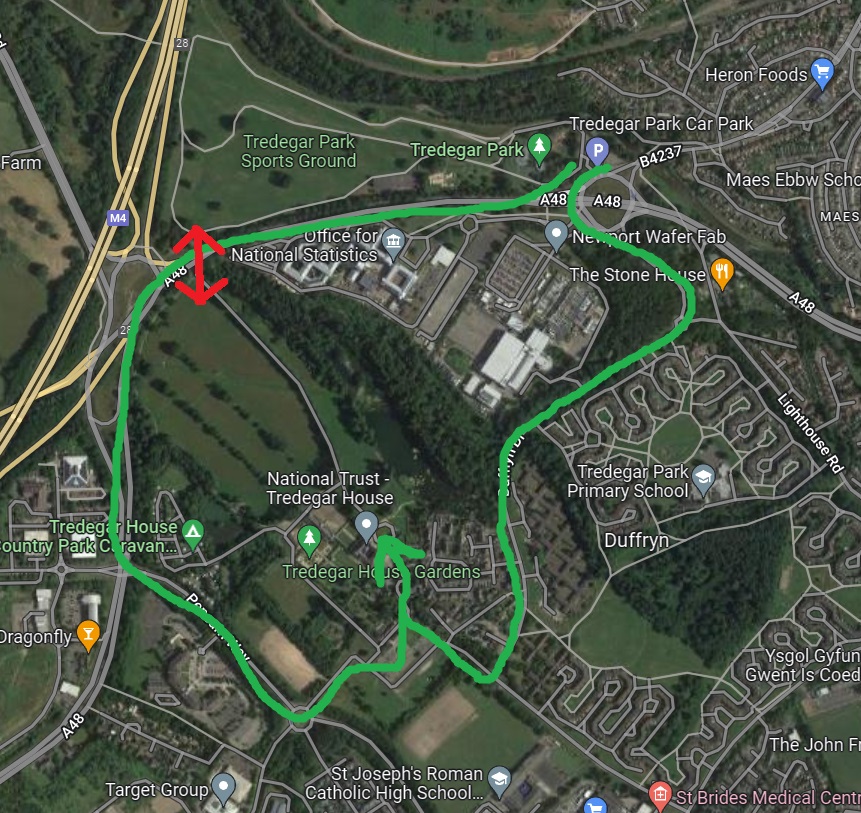
So what the aerial photograph and map above show is some near-contiguous areas of green parkland in the general west Newport area, Newport being essentially divided into western and eastern halves by the River Usk as it makes its meandery way north-south through it. Those areas are, broadly speaking:

  • The little wooded area and park adjoining the northern edge of the mahoosive St Woolos Cemetery and accessible at its northern end from the roundabout on Risca Road; it is allegedly called Coed Melyn Park, which my rudimentary Welsh skills tell me just means "Yellow Tree Park". I can confirm that outside of certain times in autumn the trees are, in fact, predominantly green;
  • the parkland area containing the Gaer hillfort;
  • Tredegar Park (not to be confused with Tredegar House, below);
  • Tredegar House and its surrounding park (not to be confused with Tredegar Park, above).

I have marked those four areas on both images above as yellow, red, blue and a sort of pale mauve, respectively (going from north to south). As you can see they are all very much adjacent to each other, but the connections between them aren't as simple as you might expect. This, in a nutshell, is the point of this post. Let's have a look at them in turn, starting from the top. 


The first one is the connection between the bottom of Coed Melyn Park and the top of the Gaer hillfort; nothing fancy here but you can take a short walk from where the footpath emerges onto Western Avenue, cross Bassaleg Road via the traffic island and enter the park via its main entrance (there are several others along the park's eastern edge). So far, so good.

Take a walk in a broadly southerly direction through the park, maybe via a detour to the top of the hillfort (lots of trees so the location of the actual top is not particularly clear) along the recently-upgraded path and you will find yourself quite near, as the crow flies anyway, to Tredegar Park. So you'll be wanting, I would imagine, to continue your pleasant walk in that direction. Well, I've got some bad news for you, bucko, because there are some insurmountable obstacles in your way, specifically the River Ebbw and a railway line. If you want to continue to Tredegar Park then you'll have to follow the path round to where it ends at the gate at the end of Wells Close, find your way to the footbridge over the railway and then follow the roads round through the main car park and into the park. That's the green line on the map; the two red lines show imaginary crossings which would obviously be much better but would require some quite substantial engineering to bridge both railway and river. The only saving grace with the railway is that it isn't the South Wales main line (that takes a more southerly route to get to Cardiff and points west) but the more minor branch line to Ebbw Vale, calling at (among other places) Pye Corner as mentioned here


Let's assume you've now made the long trek round and have enjoyed all the various delights Tredegar Park has to offer - some outdoor gym equipment, football pitches, a playground, some pleasant riverbank areas - and fancy completing your journey by visiting Tredegar House and its pleasant grounds. Well, strap yourself in for a connecting journey of even more unimaginable complexity and inconvenience, as you'll need to exit via the car park and take one of two possible on-road routes to get round to the only available access points on the south side of the house. How much more convenient it would be, you might think, if one could simply traverse the busy lower reaches of the A48 as it approaches junction 28, where the two parks are probably a hundred yards apart, at most. I mean, you would need a footbridge to avoid being messily dispatched by an HGV, or possibly an underpass to avoid having to thread a footbridge around the ornate (and now unused) pair of gates that face the road at this point.


How utterly marvellous to be able to get on your bike up around Risca Road (in the vicinity of our new house, for instance) and cycle in traffic-free bliss all the way down to Tredegar House; yes, maybe a couple of points where you might have to dismount to traverse a bridge but, really, tish and pshaw to that, certainly in comparison with the current situation. So come on, Newport City Council, how about a bit of joined-up thinking?

Friday, April 16, 2021

a bridge too far

Sticking with the subject matter of the previous post for a minute: let's assume that the current rather tenuous claim of the Basseleg Viaduct to the title of "oldest still in use" lapses, by virtue of it being no longer economically sensible to keep the track and infrastructure maintained for the very occasional trains that run up to the quarry. Questions arise at this point: firstly, which viaduct takes over the title? And the answer to that is: I don't know. A very quick scan of the Wikipedia page linked in the last post suggests it might possibly be the Sankey Viaduct between Liverpool and Manchester, which already makes the vague but grandiose claim of being "the earliest major railway viaduct in the world".

The second question is: what happens to the structure then? And the answer is: it depends. If it's lucky it might get repurposed to carry a cycleway following the course of the old line, like the one at Garndiffaith I rode across many years ago. If it's unlucky enough to be in the way of the relentless march of progress then it may get blown up, like the Thirteen Arches Viaduct in central Bristol (which had to make way for the M32) or the much earlier demolition of the Pwll-y-Pant viaduct near Llanbradach, immortalised on film with some splendid Mr. Cholmondley-Warner commentary here and here

That's all well and good for the spectacular big-ticket items that span vast distances, but what of all the little over- and under-bridges that crop up along a stretch of disused railway? Well, the bridges that carried the railway itself over obstructions like roads can just be demolished, if that's what you want to do and the old line hasn't been repurposed in a way that means a through route needs to be kept. Over-bridges are more of a problem, since they tend to carry something you want to keep (again, most likely a road) over the course of the old railway. 

There has been a certain amount of hoo-hah on Rail Infrastructure Enthusiast Twitter in recent weeks at the announcement by The Man of an intention to divest himself of responsibility for the continuing upkeep of these structures by burying a good many of them under many tons of earth. The Man in this case is the body responsible for the monitoring and upkeep of all the remaining bits of old line, former trackway, bridges, tunnels etc. This is now known as the Historical Railways Estate, but formerly rejoiced in the rather more Eeyore-ish name of the Burdensome Estate. And you can see why, to be fair, as the job basically involves keeping an eye on some crumbly old stuff while someone figures out what to do with it, while also ensuring it doesn't get so crumbly that bits of it fall off and injure people.

It is certainly true that infilling structures like this precludes the possibility of the old trackbed being used for other things, like cycle routes, or even revived rail routes, and moreover that some of them have historical and/or aesthetic and/or architectural value in themselves, and moreover that it's not deranged to be suspicious of government's stated motives for doing stuff, nor to question their cost/benefit calculations. I suppose you do have to ask of the advocacy groups, though, as persuasive as the case they make seems: is there in fact any bridge or part of old pre-Beeching railway infrastructure that they would be prepared to let go? Is this (points at randomly-selected structure) particular farm track overbridge so valuable that it must be preserved in perpetuity? 


Is a compromise solution sometimes acceptable if it keeps the route open? And are the ambitious future plans of wild-eyed oil-bespattered train nerds to run their heritage railway route along an old trackbed really a good enough reason to commit government funds to infrastructure upkeep? 

I leave those questions with you. As blunt and aesthetically-unpleasing as burying stuff under kilotons of sand and rubble is, though, it has been applied as a solution to structural concerns with some much larger structures, including some that you would assume were far too large to bury, or at least not without the resulting pile of stuff having an impractically wide footprint (but where just blowing the whole thing up wasn't an option because of a desire to keep trains running across the top of the structure). But that didn't stop engineers in the early 20th century burying the impressive Kilton Viaduct in North Yorkshire under what was calculated to be 720,000 tons of mining spoil.

A couple of what appear to be even larger ones are available in Connecticut, USA: the Lyman Viaduct towered 137 feet above the valley it traversed before it was entombed inside a giant embankment (oddly, in the same year - 1913 - as the Kilton Viaduct), as was the nearby Rapallo Viaduct. Obviously before you dump all the dirt you have to provide a means for the waterway(s) to continue flowing, unless you want to create a reservoir as well; generally this was done with some massive concrete culverts. The ones under the Lyman Viaduct are big enough to walk through

Thursday, April 15, 2021

well, I just can't get over it

I was surfing Twitter the other day when I came across this tweet:

I thought to myself, hang on, that looks vaguely familiar, and not only that but Bassaleg (pronounced, slightly unexpectedly, Baze-leg) is in Newport, or rather on the western outskirts of it over by junction 28 of the M4. I had a quick look on Google Maps and it turns out to be here, spanning the sensibly-named Viaduct Way as well as the River Ebbw on its way into central Newport. The reason it looked familiar is that I'd driven under it a few months earlier on my way to pick up something Hazel had bought online from someone who lived in the newish housing estate north of the viaduct in the little triangle enclosed by the railway and the river. I can't remember whether it was Viaduct Close or Viaduct View, but what I will say is: good luck getting a view of the viaduct from Viaduct View, because it ain't happening.

Anyway, you can see from the original tweet that a bold claim is being made here, specifically that the Bassaleg Viaduct is, and I quote: "the world's oldest railway viaduct still in use". Claims of this sort are a bit like claims made by distilleries to be the oldest, biggest, highest, northernmost, etc. etc., in that you have to dive down into the small print of the claim that's actually being made to discover the weaselly qualifications it's hedged about with to make it applicable to the specific thing you want to big up.

In this case "viaduct" and "in use" are the two bits that hide a bit of weasellery. One of the things it becomes necessary to consider here (if, of course, you're in the tiny proportion of people who actually give a shit) is: what's the difference between a bridge and a viaduct? Also: what does "in use" mean? Still connected to the rail network and carrying usable track? Actually traversed by trains on some measurable schedule? Carrying regular passenger traffic?

The stock answer to the bridge vs. viaduct question is: a viaduct is a bridge with multiple spans. The reason that this matters in this particular case is that Skerne Bridge in Darlington, opened in 1825 (a year before Bassaleg Viaduct), is also still in use, but is definitely a traditional old-school bridge, with a single span over the River Skerne. Skerne Bridge, as it happens, also fulfils the most exacting version of the "still in use" condition, as it carries passenger trains on the Tees Valley Line to Bishop Auckland and points north. Bassaleg Viaduct, on the other hand, last carried regular passenger traffic in 1962 and since then (occasional enthusiasts' specials aside) has only been in use by goods trains to and from Machen Quarry, and those seem to be very infrequent these days.

Have a look at this Wikipedia page and search for "oldest" and you'll see why these distinctions matter: Causey Arch in County Durham is the oldest surviving railway bridge in the world, built exactly 100 years before Bassaleg Viaduct, but these days only carries pedestrians, as does Laigh Milton Viaduct in Scotland, built in 1812 and also, confusingly, making the claim to being the oldest surviving railway bridge in the world. Adjust that claim to "viaduct" and they might get away with it. 

Another little Newport oddity can be seen if you look at the area surrounding Bassaleg Viaduct (it's circled in red on the map below):


You can see that the viaduct is on a spur off the main line (it's the passenger line up to Ebbw Vale) and that there is a station on that line called Pye Corner. What's odd about this is that, despite that being an unusual name, there are two places called Pye Corner in Newport, one (this one) to the west of the city, and one to the east, a little over four miles away as the crow flies, shown below.


I've no idea what "Pye" in this context is meant to convey or how it derives etymologically. What I can tell you is that there is a location of the same name in London which claims to be the point where the Great Fire ended in 1666, and which is marked by a monument comprising a plaque and a little fella known as The Golden Boy of Pye Corner. 

Friday, December 18, 2020

you must lower me into the steall

A couple of further notes on that Scottish trip, as my memory has now been jogged by looking at the photo gallery, and as I don't seem to have blogged about it at the time: we stayed in one of the cottages here between Glencoe village and Ballachulish; perfectly nice as I recall and well-situated for Glencoe and Fort William. Just to prove that point we'd stayed in the same cottage the previous year and knocked off a pair of Munros in each of those locations. The plan was to do something broadly similar this time. That's not quite how it went, though, and the reasons why not may have some general applicability for those planning and doing mountain walks. 

First attempted expedition was to do the Ring of Steall, one of the great Scottish horseshoe ridge walks, which incorporates four Munros with the option of a couple more if you start super-early and don't mind doing a couple of out-and-back detours from the ridge. Most people will find that four does them quite nicely. The standard route here is to park in one of the car parks up Glen Nevis directly south of Ben Nevis itself and then do the route in a clockwise direction, the start and finish point being at about twelve o'clock. One of the first things you have to do if you take this route is cross the Water of Nevis via the bridge in Steall Meadows. Meh, no biggie, you'll be saying. Weeeell, yeah, but this bridge is a little out of the ordinary. Here are pictures of me, and subsequently Jenny, crossing it.


It is a bit intimidating, and the consequences of falling off are unpalatable (I mean, you wouldn't die, but you'd get extremely wet), but it's not utterly terrifying once you're on. The wires are as taut as they reasonably can be, while still conforming to the laws of physics, so it's not like slacklining, but you do need to keep your mind on the job. Different people have different triggers for going a big rubbery one, though, and this guy (who ended up doing broadly the walk we were planning to do) seems to have bailed out and preferred to ford the river on foot. To be fair, the river was probably a bit shallower when he did it. Hazel was also, it's fair to say, not especially enthused about the prospect, but, in her defence, we'd just discovered she was pregnant with what turned out to be Nia, so a slightly raised level of caution was probably understandable. I have no pictures of Hazel crossing the bridge, probably because the inebriated-docker-strength swearing directed at me throughout fogged the images. At least, I laughingly said when she arrived safely on the other side, we don't have to come back this way. I should really learn to keep my mouth shut.

Anyway, to cut a long story short, the next thing you have to do is ford another, smaller river just below a waterfall. Since it had been raining for the previous fortnight the waterfall was in spectacularly torrential spate - quite a sight, but it meant that a high proportion of the rocks that would normally present themselves as stepping stones were submerged, and after much searching around we concluded that there wasn't a way across that didn't carry a risk of getting either drenched or killed. So we turned back, somewhat reluctantly as it meant that we had to go back the way we'd come, including the bridge. It's actually not so bad on the way back as it's slightly downhill, although that does make getting on in the first place slightly more hair-raising as the drop is a lot longer.

Lessons here are: don't assume little blue lines on the map are insignificant streams which you can just step across, and remember river volumes are highly variable (we found the same thing here and on our ascent of Ben Lui in 2009 but managed to get round it with some radical route re-planning both times). Also, don't assume everyone in the group has the same triggers for going NOPE NOPE NOPITY NOPE, and be understanding when it happens at an obstacle that seems relatively trivial to you.

Anyway, we ended up driving back and going to Kinlochleven for the afternoon, firstly for a mooch around the ice climbing centre (and a visit to the bar, obviously), and thereafter for a session in the Tailrace Inn. We didn't go to the visitor centre, which houses The Aluminium Story, a guide to Kinlochleven's quite interesting industrial history - I forget whether we found it was closed or were just distracted by the prospect of a pint. The other pub that were are in right at the end of the photo gallery, incidentally, is the splendid Clachaig Inn in Glencoe, which I previously mentioned here.

Our next attempted mountain walk was to conquer the two Munros conveniently placed round the back of the cottage where we were staying - well, not exactly, but close by to the south of the A82 between Ballachulish and South Ballachulish (which, confusingly, is due west of Ballachulish, although it is south of North Ballachulish). These two (Sgorr Dhonuill and Sgorr Dhearg) form part of an overall group of peaks known as Beinn a'Bheithir, and are relatively benign in terms of height and difficulty. I have a feeling we didn't set out until relatively late in the day (after lunch, perhaps) as we were waiting for a break in the unrelenting downpour; I think we eventually decided to just go anyway as otherwise we would run out of daylight. We had intended to do this route, only anti-clockwise, to get the boring low-level bit on the road out of the way first. 

That should have been easy, and the entrance off the A82 onto the complex of forestry tracks that leads up into the valley from where you can scramble up onto the summit ridge is completely obvious (it's here). We nonetheless managed to waste a phenomenal amount of time scrambling about in a pathless wood failing to locate the path, probably owing to either mistaking a war memorial for a church or vice versa and leaving the road too early. Whatever the reason, we eventually emerged, wet and frustrated, onto the correct path and followed it for a bit, but before we could start gaining any serious height the heavens opened again and we soon decided that it was a bit too late in the day and we were already a bit too wet for an expedition of this magnitude and we should probably knock it on the head, particularly since the clouds which were dumping gallons of water on us were starting to shroud the summits a bit. You can get an idea of the conditions from the two photos below, which show Jenny and Hazel just about to set off from the cottage, and Jim showing his contempt for the whole situation by having a piss on some logs. 


The lesson here, apart from the obvious one of learn to read a map, you cretin, is that often the most difficult and frustrating bit of a walk, navigationally speaking, is right at the start while you try and find a way onto the hill you're aiming for while respecting the boundaries of other people's property and picking your way around all the other stuff (buildings, fences, walls, lakes, trees, branches of Screwfix) that you don't get so much of once you've gained a bit of altitude. Once you've done that it's also much easier to see where you're going and where you've been, and the contour information from the map and the terrain also helps. 

Just writing this blog post down has rekindled feelings of annoyance and frustration at being thwarted twice within the space of a few days (not to mention marooned on Mull in between), and a determination to one day get back and conquer the six Munros we missed out on, plus a few of the remaining 260 or so I haven't done yet. Obviously having been locked in the house for most of the last ten months hasn't helped either. Realistically this might have to wait ten years or so until the kids are old enough to come with us. Will I still be up for twanging precariously across a wire bridge at the age of 60? Of course I will.

Tuesday, December 01, 2020

light at the end of the tunnel

I will confess (and have done a couple of times before on this very blog) to a bit of a thing for disused railway lines, industrial archaeology and urban exploration. The way I rationalise the railway aspect of this to myself is that I have no interest in trains themselves and all the associated (as I sniffily deem it) geekery, but being impressed by the magnificence of a viaduct is no different from being awestruck by the magnificence of, say, St. Peter's Basilica, it's just a different sort of architecture. The further beauty of old railway architecture is that it can be combined with a rugged and windswept walk in the countryside (or, in certain circumstances, a nice bike ride), another thing that I am very keen on.

This extends to following a few enthusiasts on Twitter, which is how I caught sight of this tweet earlier today. 

This is the railway path between Keswick and Threlkeld in the Lake District which you might recall we walked along in 2008 but were then thwarted from walking along in a similar manner in 2018 by the damage inflicted by Storm Desmond in 2015, which had swept away a couple of old bridges. The picture below is from 2018; the one below it of me on one of the now collapsed bridges, probably irreparably weakening its superstructure with my colossal weight, is from 2008. 


I must say I expected that the rebuilding work would be massively protracted and would possibly never be completed, especially given the lack of progress that seemed to have been made in the couple of years between the damage occurring and our visit. However, things were evidently happening behind the scenes, and two completely new bridges have since been installed (and a third original bridge strengthened and repaired). Some details about the rebuilding project and some videos can be found here. More impressive in some ways than the bridge work was the re-opening of the buried tunnel under the A66 viaduct, whose bypassing by the old path necessitated a section of boardwalk which was a bit hilly and narrow, and therefore a bit awkward if you were either running or on a bike. 

[EDIT] Here's a photo I found from the 2008 collection which shows the eastern portal of the tunnel as it appeared at the time. You can just about see the curved brickwork of the very top of the tunnel opening above what was then ground level.


This video from the excellent people at Forgotten Relics gives a pretty good summary of the work that's been carried out. I'm looking forward to checking it all out on a future visit once, you know, all this (waves hands around vaguely) is out of the way. 

Friday, September 25, 2020

transports of delight

Nia and I fulfilled a long-held ambition last weekend when we went down to the Transporter Bridge and did the high-level traverse of the bridge via the walkway at the top, rather than via the gondola at the bottom. Obviously this is only an option for foot passengers, as you'd struggle to get a motor vehicle up the steps, and you will have to pay a couple of quid extra for the privilege of climbing the 200-odd steps to the top and walking across.


Anyone thinking of doing it should be armed with the knowledge that it's pretty airy and exposed up there and the walkway is not some solid structure made out of stout timber planks (although old photos show it used to have some) or sheet steel but instead some flimsy looking mesh that you can see straight through down to the river below, and which flexes slightly worryingly under your feet as you walk on it. The top of the gondola mechanism which basically just clanks back and forth on rails passes disconcertingly close below your feet as well. I would say if you're in any doubt whether you'll like it or not, chances are you probably won't. Nia was fine, and I'm pretty much OK with heights (though the significant traces of rust and corrosion around some of the bolts in the superstructure gave me pause for thought); my main worry was that while I wanted to get some photographs I was acutely aware of the catastrophic consequences of dropping my mobile phone.

Blog readers with long memories may recall that I'd been across the bridge before back in late 2010 with Hazel, Doug and Anna as part of a general mooch around Newport involving several pubs, back in the pre-kids, pre-pandemic days when you could just do that sort of thing. Photos from last weekend's walk can be found here

Like I say, we'd been planning to do it for a while, as Nia shares my predilection for climbing on top of stuff - what finally prompted us to do it was the news that the bridge is due (as of this coming weekend, in fact) to shut down for a 2-year programme of repairs and maintenance, and that this would therefore be our last chance to do the walk before early 2023. I was half-expecting that we'd be thwarted at the eleventh hour by some draconian pandemic lockdown measures being imposed, but luckily we managed to dodge those by a few days. 

Blog readers who follow me on Twitter may be aware that the bridge has its own Twitter profile; one of the great joys of this is seeing the exchange of tweets between it and various other historic bridges, including the nearby Clifton Suspension Bridge but also an entertainingly banterous rivalry with the only other working transporter bridge in the UK (and one of only six worldwide), the Tees Transporter Bridge in Middlesbrough. It sounds terribly disloyal to say it, but I think the Middlesbrough bridge (also currently closed for maintenance, as it happens) is prettier, as it's slightly chunkier owing to its self-supported construction (the Newport one is cable-supported, a bit like a suspension bridge, complete with chunky cable anchorages on either side) and moreover is currently painted a rather fetching shade of blue. There is, as it happens, a bridge just upriver of the transporter bridge called the Tees-Newport Bridge, and much of the steel for the construction of the Newport transporter bridge (it opened in 1906, five years before the Middlesbrough bridge) came from the Dorman Long steelworks in, you've guessed it, Middlesbrough. Coincidence? or IS IT??!!!? As always, yes: yes it is.

There is a third, smaller, non-operational transporter bridge in Warrington which a band of stalwart enthusiasts are conducting a surely doomed attempt to secure some funding to renovate, and, as you'll recall from this earlier post from our trip to Liverpool for the Open Championship in 2014, there used to be another one, larger than either of the two surviving ones, crossing the Mersey and the Manchester Ship Canal between Widnes and Runcorn. There is actually some footage of this on YouTube - this longer clip from the 1930s and this one dating from just before the completion of the replacement fixed bridge in 1961, which was quickly followed by the old bridge's demolition. Newer transporter bridges, and there aren't many, are generally somewhat smaller, including this rather charming miniature hand-operated one in Germany


Thursday, July 23, 2015

hayling frequencies open, captain

A couple of photo galleries to catch up on from various recent travels:

Firstly, we went to an owl sanctuary for my Dad's birthday. Now I'm aware that there is an element of the Alan Partridge about this, but it was actually quite interesting. Dad is a bit of an amateur ornithologist, Nia likes owls, and we didn't bother to solicit Alys' opinion on the matter, so it was all good. And as it happened it was a nice day and they had various other non-owl wildlife on display as well.

The sanctuary in question is here, just up near Kington, an hour or so's drive from my parents' place in Abergavenny. And it pretty much does what it says on the tin in that they have a lot of owls, of a bewildering variety of species. They also have sheep, goats, alpacas, various rodents, tortoises, ducks, geese, the whole nine yards, as well as a picnic area and the inevitable gift shop where we bought Nia a little cuddly snowy owl, which she promptly christened Snowy, in common with probably 99% of snowy owl toys purchased there.

Last weekend we took ourselves off for a bit of a tour of the south coast, starting off by staying a couple of nights in a little cottage in Emsworth which Hazel had found on Airbnb. Emsworth is a town between Portsmouth and Chichester which has several pubs - including the Bluebell where we had a nice fish & chip lunch and a pint of Doom Bar - and a pleasant little harbour area from which you can walk along the edge of Chichester Harbour, the big tidal area between the mainland and Hayling Island. Better still, the cottage we were in, just north of the main town area, was right next to a charming little miniature nature reserve, and, more prosaically but very usefully, a branch of Tesco.

We'd chosen the location as it was handy for the second half of our trip, but also because it was in close proximity to Paulton's Park, home of lots of exciting rollercoaster-y delights à la Alton Towers (only without the crashing and the limb-severing, hopefully) for older children, but also home of Peppa Pig World, where we'd promised we'd take Nia. Luckily it was a weekday outside of the school holidays so the queues were reasonably short. At busy times it must be absolutely hellish. Anyway, Nia had an absolutely brilliant time, which was the main thing, and it was generally very good and very well-run. Needless to say visitors are obliged to exit through the gift shop, but we got away fairly lightly by purchasing a small cuddly George and a story book at a total cost of about twelve quid. Our triumph at this was short-lived, as we promptly lost George during a trip across the nature reserve and had to buy another one off the internet to replace him.

We happened to catch Chichester Harbour at low tide when we went for our walk, so we were able to wander some distance out onto the mudflats and gaze across to Hayling Island. This is the only one of the three islands (Portsea Island, Hayling Island, Thorney Island) in the extended tidal harbour area (technically it's a ria) that's still a "proper" island, the other two being, via various sea-wall construction and land reclamation, pretty much joined to the mainland these days apart from the odd tidal creek.

Interestingly, a feature of all Ordnance Survey maps of the area is the appearance of a footpath taking a curved route across the channel between Hayling Island and the mainland - it's marked on my brand-new Explorer map, for instance. This is the route of an ancient path called the "wadeway", which was once the only foot route onto the island. It's unclear whether the name derives from the same origin as Wade Court Park just to the north, or just from the fact that you'd have to do a certain amount of wading, even at low tide. These days you'd have to do a bit more than that, as it happens, as the navigation channel of the old Portsmouth and Arundel canal cuts across the route (it's the bit marked as "New Cut" on the map picture, and clearly visible here). Even with a bit of silting up you'd probably find yourself needing a snorkel at some point; I assume the Ordnance Survey retain the route as a historical curiosity and in the hope that no-one would be foolish enough to actually attempt to use it. The stumps on the other side of the modern road bridge are the remains of the old railway bridge that carried the Hayling Island Branch Line.

We went on over to Bournemouth to visit some friends on the Friday, via Staunton Country Park just north of Havant. No owls, but some fairly bog-standard petting zoo/wildlife-feeding stuff, plus an interesting hedge maze which Nia did her best to get lost in. As if that wasn't exciting enough we also got to go to the beach at Southbourne (in glorious sunshine, thankfully) and have a thrillingly late night (by Nia's standards) over at Trafalgar School in Downton while watching our friend Mark play the French horn for the Hyde band. Their finale was an impressive rendition of the 1812 Overture accompanied by a firework display.

So: owl pictures can be found here, south coast tour pictures are here.

Tuesday, March 24, 2015

far canal

Funny what you notice when you're only half paying attention. I put the old Ford Focus in for an MOT today, and much to my forehead-slapping chagrin forgot to take my current book with me (no, it's a secret, you'll have to wait and see). So, faced with a half-hour wait, I was reduced to scouring the little table in the reception area at the MOT centre for reading material. Pretty slim pickings if you're not a fan of motoring magazines, but there was one item of interest: a slightly foxed hardback copy of Wales From The Air, with a foreword by Jan Morris.

Well, that'll do, I thought. Let's start at the beginning. Hmmm, that's odd....


You may be having difficulty reading the text on the left as it'll be a bit small. You may also be having difficulty reading the text on the right, but that'll be because it's in Welsh. Here's a larger version of the English text:


This is all very interesting, but the trouble is that the picture above isn't of the Pontcysyllte aqueduct. The Pontcysyllte aqueduct looks like this, and, as you can see, spans the Dee valley in glorious isolation without a railway viaduct next to it. I know this because I have been across it, in both directions, in a canal boat. This was on our canal boating holiday in April 2000 - here's a couple of pictures:


Both of these pictures show us travelling northwards across the aqueduct; neither of them features me, sadly, since I took them, but as a bonus you do get my mate Martyn doing the hilarious "falling off an aqueduct" pose.


The aqueduct pictured in the book is the Chirk aqueduct, a few miles further south. We went over this one a couple of times on the same trip, as previously mentioned here - note the (slightly higher) railway viaduct also featuring in the picture. The Chirk aqueduct crosses the River Ceiriog, a tributary of the Dee, which this page boldly claims to be the fastest-flowing river in Wales. 

As proof-reading howlers and basic failures of research go this seems like a pretty major one to me. I don't know if the pilots who took the pictures were given specific instructions as to what to photograph, or whether they just flew around and snapped anything that looked interesting and relied on the book people to label it accurately. Someone dropped the ball here in a big way, anyway. 

Sunday, July 27, 2014

scouse of the driving fun

Since my lovely wife managed to snag some tickets for the final day of the Open Championship as an unexpected but very welcome birthday present earlier this year, we found ourselves off to Liverpool last weekend, which as it happens is a city I'd never been to before. That being the case we decided to make a weekend of it and spend Saturday doing some touristy stuff before heading off to Royal Liverpool on the Sunday morning.

So, as you can imagine, this involved stuff like having a look at the Cavern Club, the Liver Building, taking a ferry 'cross the Mersey and all that sort of stuff. That will no doubt be tediously familiar to you, so here's a couple of slightly more tangential facts about the local area:
  • While the Mersey between Liverpool and Birkenhead is criss-crossed with a couple of road tunnels and a railway tunnel, you have to go a surprising distance inland before you encounter a bridge, or more accurately a pair of bridges, spanning the narrow bit of river between Runcorn and Widnes, as well as the Manchester Ship Canal which runs alongside the river at this point. So far so meh, you might say, but until 1961 there was another bridge on this site, known as the Widnes-Runcorn Transporter Bridge. Now you'll be aware that in Newport we have one of only two working transporter bridges in the UK, and the one that makes a claim to be the largest operational one in the world, although the one in Middlesbrough makes similar claims - it all depends which measurements you're talking about. Anyway, the Widnes-Runcorn one was older and bigger than either of the remaining ones, but was crushed by the ruthless utilitarian jackboot of progress, mostly because as fascinating as transporter bridges are, it is an extraordinarily slow and inefficient way of getting traffic across a river, which would be why they never really caught on. The stubs of the approach roads and some of the buildings remain, everything else has gone.
  • Needless to say there are a gazillion establishments named after Beatles songs or other Beatles-related stuff. On just the walk through central Liverpool on Saturday I spotted establishments called Imagine, Rubber Soul, Glass Onion and Eleanor Rigby. No doubt the whole city is riddled with them.
  • We did a quick on-foot tour of the city's two cathedrals - as striking as Paddy's Wigwam is it's Giles Gilbert Scott's monumental Anglican cathedral that really catches the eye. As with the bridges it really depends which measurement(s) you choose to use, but by some measurements this is the largest Anglican church in Europe. It's certainly pretty impressive (and huge) close up, anyway.
  • The stripy knitted tree-warmers we found on Park Lane on our way to the Anglican cathedral were apparently put there as part of the Liverpool International Street Art Festival. This activity is known as "yarn bombing". As things with the word "bombing" in them go, this is one of the nicer ones.
  • While walking from one cathedral to the other we came over all thirsty so we stopped for a pint in the amusingly-named Ye Cracke on Rice Street, which didn't look like much from the outside but turned out to be a little murky spit-and-sawdust gem complete with the inevitable "John Lennon once drank here" claims but also (more importantly) a very delicious and refreshing pint of Hopsack from the Phoenix Brewery in nearby Manchester. 
On to the golf. Luckily we had a beautiful sunny day to walk the course, so we made the most of it by arriving fairly early (about 9am) via the excellent Wirral Line rail link which deposits you at Hoylake station no more than 10 minutes walk from the course entrance. Having availed ourselves of a coffee and bacon bap combo from the tented village we set out onto the course. Fortified by that, as well as the lunch we'd taken with us and a couple of pints of Stella from the on-course bars we managed to get round a good number of the holes and park ourselves in a couple of good spots where we could a) get a good view and b) try to get on television. Our best chance of that was probably on the fourth green, where members of the last two groups (Dustin Johnson and Rickie Fowler) chipped back onto the green from right under our noses, on the ninth where we found a good spot to recline with a pint and a sandwich and on the twelfth where none other than Tiger Woods hoicked his second shot wildly into the crowd only about ten yards from where we were standing. I keep meaning to watch back some of the coverage on the BBC iPlayer and see if I can spot us, but I haven't yet and I suspect I never will.

Unlike at the PGA Championship at Wentworth there isn't really any standing room around the 18th green, so you have to make a decision early on whether you're going to try and see as much golf as possible out on the course and then take your chances later, or try and bag a seat in the stands 3 or 4 hours before the leading groups come through and just stay there for the rest of the day. We didn't fancy this second option very much, so we watched the last couple of holes from the bar area in the tented village, on our way there nearly getting run over by a golf cart carrying none other than Samuel L Monkeyfighting Jackson to some VIP viewing area or other.

Speaking of the PGA Championship, I believe I'm right in saying that, slightly surprisingly, Rory McIlroy is the first man to win it and the Open in the same year, just as Martin Kaymer was the first to win the Players Championship and the US Open in the same year a month or so ago.

Anyway, photos (the golf ones being mostly grainy mobile phone camera shots as technically photography is prohibited on championship days) can be found here.