Showing posts with label Newport. Show all posts

Thursday, May 28, 2026

celoubrity junkeylikey of the day

Cast your mind back, if you will, to (roughly) this time three years ago, when we'd just moved house and were sifting through the mountain of junk that the previous occupant had left behind. We never actually got to meet him - the closest we got was talking to him through a closed front door when we came to do a second viewing of the house with the estate agent and found him unexpectedly at home, self-isolating after contracting COVID. Perhaps, and I'm being as charitable as I possibly can here, this disrupted his plans to do some clearing out of assorted junk in the lead-up to handing the house over and eventually led to him just saying fuck it, I'm off, and bailing out.

The aforementioned junk was all over the house, in the loft and also in the rickety metal shed occupying a corner of the back garden. The stuff in the shed probably contained the most interesting material, including a pair of handcuffs and a diary which I think belonged to the previous owner's ex-wife and seemed to have been started in the wake of her having been dumped by some subsequent boyfriend.

On a similar theme to the handcuffs, the junk in the loft contained a browned old paper CD/DVD envelope bearing the legend "ORGY" but sadly with nothing inside. Maybe this was the one item the previous owner deemed worthy of packing up and taking with him. 


Also in the loft was an intriguing sepia photo - from quite a few years back, judging by the size of the collars - which could be the previous owner, but could also, judging by the heavy-lidded eyes that have clearly Seen Too Much, be a young Lou Reed


Anyway, the rickety metal shed pictured above (the green structure just visible on the right of the first photo) is no more and has been replaced by something unimaginably more fabulous, which I might devote a whole future post to, if I can be arsed. 

Tuesday, May 19, 2026

under the bridge downtown, is where I drew some blood

This is some tremendously nerdy fun - you know those signs you get on low bridges to tell you that you, a lorry driver, are about to unzip the top of your vehicle like an old-fashioned can of sardines? Different countries have different signage to warn unsuspecting drivers of what's ahead - the yellow diamond in the photo on the right is from the USA, in particular the low railway bridge in Durham, North Carolina which is notorious enough to have its own website.

In Britain we operate a system of red signs, sometimes circles and sometimes triangles depending on some rather opaque rules, with clearance heights listed in both metric and imperial measurements. If you thought the rules governing sign shape were arcane, though, wait till you hear the rules governing the derivation of the clearance height figures. I mean, I won't go into it here but the end result is that - somewhat counter-intuitively - a single metric height can be associated with several different imperial heights, and vice versa. 


This opens up the possibility of a sort of sign-spotting subculture emerging, and, as you might imagine, this being the internet, it has. This page lists all the combinations of signs that eagle-eyed people (let's call them people, for the sake of argument) have spotted around the country.

Lest I get too snooty about others' intense weirdness and nerdery, though, I should disclose that the first thing I did, about half-way through watching Matt Parker's video, was think to myself: ooh, I bet I know where a good one is that might not be on the list. And it is in this interesting location near Bishton, just a few miles east of Newport, where a minor road crosses the South Wales Main Line via an interesting take-your-pick over/under arrangement. Head for the level crossing and you might have to wait for a train to pass; head under and you won't have to do that but beware if you've forgotten that you've got the bikes on the roof rack. I have been through the tunnel, a few years back; I can't remember which car it was in but I do remember stopping just in front of the entrance and getting out to visually inspect the clearance, just in case. I assume it can't have been the current family enormo-vehicle, a Seat Alhambra, because there's a good chance that might not have fitted under at all. Don't imagine that going over the top means you can take a fully-extended cherry-picker that way, by the way, as there is also a maximum height restriction of 5 metres to avoid getting entangled with some power lines. 


Anyway, it turns out this is already on the database as the type specimen for the 1.7m/5'6" height combination. Interestingly the type specimen for the 1.7m/5'9" height combination is only a handful of miles away in Caldicot, part of a similar choose-your-fighter under/over tunnel/level-crossing set-up. The lowest signed clearance on the list is, thankfully, not on a road but on the Bude Canal and would presumably require you to own a very low-profile boat (a punt, say) and lie down in it if you wanted to pass underneath. 

Wednesday, March 04, 2026

me my shelf and I

I tweeted a photo of my bookshelves the other day, after doing the painstaking up-shuffling of everything to incorporate the various books I'd got for Christmas and my birthday. It occurred to me afterwards that I'd put a similar picture into a blog post a while back (that turned out to be here) and that maybe I should do another one. Part of the motivation for this is just to illustrate the slightly expanded shelfage area following our house move in mid-2022, but also for me to do an updated heat map of where the currently unread books are, as always just for my own amusement.

It is genuinely true, despite sounding slightly mental, that one of the big selling points (to me, anyway) of the house we now live in was the front reception room featuring a long straight side wall uninterrupted by windows or doors or fireplaces or other inconveniences. There was a radiator, but one of the first things we did after moving in was have that moved to a different wall. The motive here, of course, was to accommodate the long IKEA shelving unit holding all the books; I was very excited at having done some measurements and thereby determined that this wall was longer than the one in the old house by a sufficient amount to accommodate a whole extra horizontal span of shelving, with the giddying prospect of extra book-storage space. The other main advantage of this new library area was that it wasn't in our bedroom; not the best place for an area that you might want to make accessible to others. 

So anyway, compare the new shelving arrangement with the old one by looking at the pictures below (old one first). One probably obvious point to make is that while the extra fifth shelf span in each horizontal row moves the numbers around a bit, those numbers will also refer to an intersecting but non-identical set of books, since I've read quite a large number in the four years since the old photo was constructed and also acquired quite a lot of new books.


Things to note:
  • one of the things the new layout has done is bring the Stephen King section occupying D3-E3 directly under the Dick Francis section in D2-E2; this accounts for the very low numbers in that section.
  • two 6s and a 7 in the old picture, nothing higher than a 5 in the new one. We've flattened the curve!
  • to generate even more extra room I reduced the vertical spacing of the shelves slightly when reconstructing them; as a result while the shelves still accommodate the old A- and B-format paperbacks they no longer accommodate the occasional "trade-format" outliers like House Of Leaves and The Road Home. Books of this size (and you can see there's only a handful of them) occupy the far-right end of the very top shelf above E1. It's a bit unsatisfactory but I decided it was worth it for the extra space it made available. 
  • having constructed this new image I'm now loath to ever read anything from column A given the pleasing ascending sequence occupying it; in fact I might buy a couple of new books in the T-Z range just to bump up the counts by one in the two lowest sections.
  • if I were to ignore that and just try and whittle the numbers down by attacking the highest-numbered sections first I would be spending a lot of time in the bottom-left corner, as that seems to be a heavy area for unread books; maybe because it's furthest from the door?

Tuesday, December 30, 2025

running joke

I'm not big on New Year's resolutions, but one that I did make at the start of 2024 (pretty much the only serious one I've ever made, actually, thinking about it) was to get out to the parkrun a bit more often, and since "a bit more often" is unacceptably woolly and just invites weaselling out or retrospective redefinition of the challenge to accommodate laziness, I made it a bit more specific: at least one parkrun every calendar month during 2024. So that means every month of the year has to include a parkrun, no skipping March and doing two in April, for instance; that doesn't count. 

I am a tedious evangelist for parkrun as a thing - all you have to do is register, save your membership barcode in some form (this used to mean some physical format but as of recently includes just having it saved on your phone), turn up, and run five kilometres (a smidge over three miles). That's it; all the timing and collating of results is done for you, including collection and analysis of your own personal stats. It's great, and for the reluctant runner (something I would definitely class myself as) provides just enough structure and accountability to encourage participation while not making the bar to entry too high. Running with a large group of other people of extremely mixed abilities has advantages as well; some find the whole community spirit and post-run chat and coffee thing delightful, while some (like me) don't really go for that but find it helpful and motivating to run in a group including lots of other people who are not conspicuously thinner and fitter than them but who are nonetheless not succumbing to the temptation to walk for a bit or just jack the whole thing in and slope off for a pint and a fag.

My brief parkrun history is as follows: I became aware of it back in the early noughties when some friends from Newbury started going regularly to the Greenham Common one and (as people tend to do) evangelising their ass off about it to all and sundry. No disrespect intended to those people, but I looked at them and thought, well, I could probably do that. This was around the time that parkrun (which started in late 2004 in Bushy Park in west London but only added a handful of events in its early years) really started to take off, and my first one was at Tredegar House (which bagged the Newport parkrun name as it was the first in the area in 2011) in March 2013, at which I ran a perfectly respectable 28:58 (that's me approaching the finish line on the right). I did another in May of that year and then took a brief sabbatical for around five and a half years before doing my next one at Riverfront in central Newport (which had started up in 2017) in September 2018. 

That pattern of occasional dabblings continued until early 2020 when Nia, who'd been a reasonably regular participant at the junior parkrun (two kilometres) decided that she'd like to upgrade to the adult version. We did a couple, the second of which in March 2020 turned out to be the last one before the COVID lockdown regulations prevented large groups of people getting together to breathe heavily and sweat over each other for around eighteen months. We participated in the first one back at Riverfront in August 2021 (and got our picture in the paper!) by which time it was clearly evident to me that I was on borrowed time in terms of finishing in front of Nia, or even keeping up with her for any length of time. 

Even after that participation was a bit patchy, though - having done three in the remainder of 2021 and an excellent nine in the first seven months of 2022 I then did none in the rest of 2022 and not a single one in 2023, for reasons I have no recollection of and therefore must just have been apathy. And so by the end of that year I obviously felt that some structure needed to be imposed.

Anyway, long story short, having done a total of eighteen parkruns up to the start of 2024 I fulfilled the terms of the challenge by doing fourteen in 2024 - double-up months were the nice friendly summer months of June and August, the second one in August being my first proper bit of parkrun tourism as we went to Wycombe Rye and had a minor celebrity encounter as described here. In renewing the challenge for 2025 I added a couple of optional stretch objectives: do more parkruns in total than in 2024, and have a crack at getting to fifty in total by the end of the year. That second one would entail doing eighteen during the year, something I'm here to tell you I achieved by running the new Llanfoist Crossing parkrun in early December. I'm slightly reluctant to make a big thing of it, although it's significant to me, as I personally know people whose tally stands at well over a hundred and the guy I spent most of the December parkrun behind (though I'd like it noted that I had him in the sprint finish) was wearing a 250 T-shirt, and I have seen a few 500s at other parkruns. 

I fully intend to renew the basic one-per-month resolution for 2026, though I'm not sure exceeding eighteen for the year is realistic. 

A few random observations to finish:

  • My personal best progression is a bit of an odd one: while some people spend years nibbling off a few seconds here and there I set a target of 26:11 at my first ever Riverfront parkrun in 2018 and didn't improve on it until May 2025 when I ran 25:44. Not wanting to have that stand for another seven years I subsequently lowered it again to its current mark of 25:29 (at Riverfront again) in August.
  • The watershed of Nia's PB being faster than mine was crossed in September 2024 when she ran 26:05 at Riverfront and she has remained ahead since (and I'm sure will permanently). Her current PB stands at just over a minute faster than mine at 24:36.
  • You'll notice that Riverfront seems to be a PB-friendly course, and so it is. This is highly dependent on gradient and terrain, and Riverfront is pretty flat and on tarmac all the way. The one at Tredegar House, by contrast, is mostly flat but there are roots and rocks and mud to cope with so it's never as fast. The hilliest one I have done is at Belvoir Castle up in Leicestershire. 

Friday, January 27, 2023

the path of righteousness

A quick follow-up to the previous post which also serves as an opportunity to plug the fantastic map-related service provided by the National Library of Scotland. My particular favourite thing is the facility they provide to view old and new maps side-by-side on the screen. Here's the Gaer hillfort area in a contemporary aerial photo and (on the left) a map which purports to be from around 1900. I've reproduced the map bit below:


What you will notice (in the red circle) is that there used to be a tunnel under the railway, carrying some sort of path. If you zoom in on the contemporary map you will see that there are still some markings on the ground that suggest it might be still there, and sure enough if you drop the little yellow StreetView man at the end of Golden Mile View you can see it. The footbridge just south of the tunnel that goes over the river is still there, as it happens, and having been closed for a number of years was recently re-opened to provide access between the park and the new housing developments north of the river. 


Well, hurrah, you might say, problem solved. Yes, the inter-park access would be better situated at the bottom end of the park, but at least it exists. Trouble is it doesn't, for two reasons: firstly it looks from the StreetView picture as if the tunnel may be fenced off (though it's hard to see), secondly even if you could get there from Golden Mile View the M4 is now in the way of getting there from the Gaer hillfort area. 

Golden Mile View, by the way, is so named because of the section of railway which ran through Tredegar Park and was subject to tolls payable to Lord Tredegar, whose land it was, the name being an allusion to the substantial sums his lordship was trousering each time a train ran over the route. 

Thursday, January 26, 2023

dum dum de dum dum de dum dum de PARK STRIFE

More non-book-related posts, for the love of God, you say? Electric Halibut hears your anguished cries and rides to the rescue on his wingèd steed, entirely naked except for a pair of rather splendid patent-leather riding boots and a dab of Blue Stratos behind the ears.

So, as I mentioned a while back, we moved house during 2022, and of course one of the things that does (unless you've literally moved to the house next door, anyway, which sounds literally insane but which some of our friends literally did a few years back) is put you in the vicinity of some different parts of the city, in particular interesting green areas which might be worthy of exploration.


So what the aerial photograph and map above show is some near-contiguous areas of green parkland in the general west Newport area, Newport being essentially divided into western and eastern halves by the River Usk as it makes its meandery way north-south through it. Those areas are, broadly speaking:

  • The little wooded area and park adjoining the northern edge of the mahoosive St Woolos Cemetery and accessible at its northern end from the roundabout on Risca Road; it is allegedly called Coed Melyn Park, which my rudimentary Welsh skills tell me just means "Yellow Tree Park". I can confirm that outside of certain times in autumn the trees are, in fact, predominantly green;
  • the parkland area containing the Gaer hillfort;
  • Tredegar Park (not to be confused with Tredegar House, below);
  • Tredegar House and its surrounding park (not to be confused with Tredegar Park, above).

I have marked those four areas on both images above as yellow, red, blue and a sort of pale mauve, respectively (going from north to south). As you can see they are all very much adjacent to each other, but the connections between them aren't as simple as you might expect. This, in a nutshell, is the point of this post. Let's have a look at them in turn, starting from the top. 


The first one is the connection between the bottom of Coed Melyn Park and the top of the Gaer hillfort; nothing fancy here but you can take a short walk from where the footpath emerges onto Western Avenue, cross Bassaleg Road via the traffic island and enter the park via its main entrance (there are several others along the park's eastern edge). So far, so good.

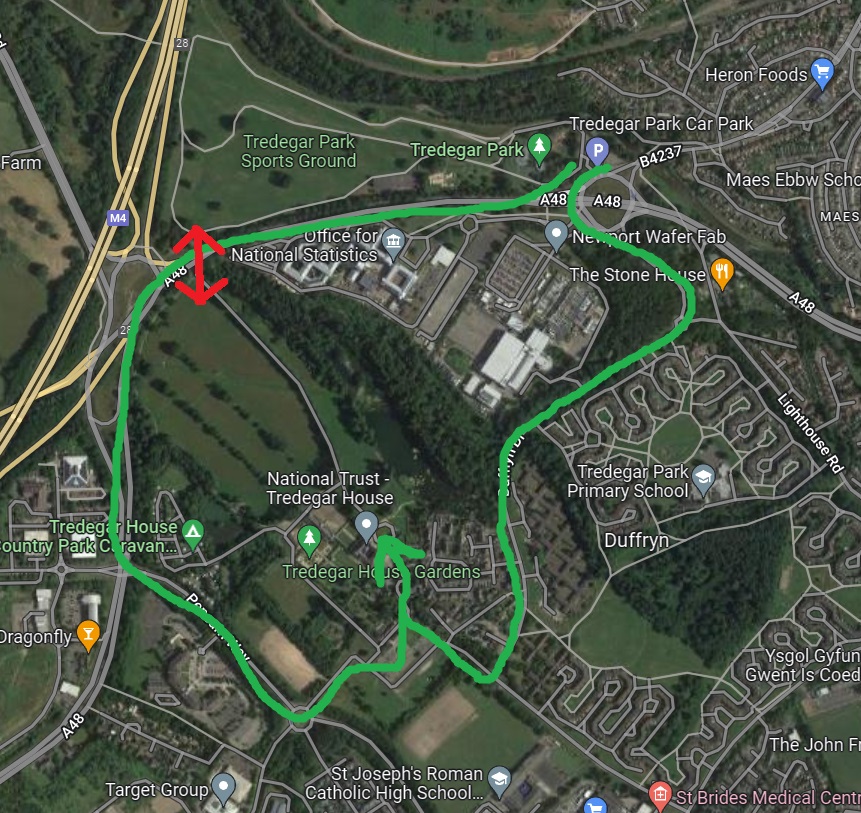
Take a walk in a broadly southerly direction through the park, maybe via a detour to the top of the hillfort (lots of trees so the location of the actual top is not particularly clear) along the recently-upgraded path and you will find yourself quite near, as the crow flies anyway, to Tredegar Park. So you'll be wanting, I would imagine, to continue your pleasant walk in that direction. Well, I've got some bad news for you, bucko, because there are some insurmountable obstacles in your way, specifically the River Ebbw and a railway line. If you want to continue to Tredegar Park then you'll have to follow the path round to where it ends at the gate at the end of Wells Close, find your way to the footbridge over the railway and then follow the roads round through the main car park and into the park. That's the green line on the map; the two red lines show imaginary crossings which would obviously be much better but would require some quite substantial engineering to bridge both railway and river. The only saving grace with the railway is that it isn't the South Wales main line (that takes a more southerly route to get to Cardiff and points west) but the more minor branch line to Ebbw Vale, calling at (among other places) Pye Corner as mentioned here


Let's assume you've now made the long trek round and have enjoyed all the various delights Tredegar Park has to offer - some outdoor gym equipment, football pitches, a playground, some pleasant riverbank areas - and fancy completing your journey by visiting Tredegar House and its pleasant grounds. Well, strap yourself in for a connecting journey of even more unimaginable complexity and inconvenience, as you'll need to exit via the car park and take one of two possible on-road routes to get round to the only available access points on the south side of the house. How much more convenient it would be, you might think, if one could simply traverse the busy lower reaches of the A48 as it approaches junction 28, where the two parks are probably a hundred yards apart, at most. I mean, you would need a footbridge to avoid being messily dispatched by an HGV, or possibly an underpass to avoid having to thread a footbridge around the ornate (and now unused) pair of gates that face the road at this point.


How utterly marvellous to be able to get on your bike up around Risca Road (in the vicinity of our new house, for instance) and cycle in traffic-free bliss all the way down to Tredegar House; yes, maybe a couple of points where you might have to dismount to traverse a bridge but, really, tish and pshaw to that, certainly in comparison with the current situation. So come on, Newport City Council, how about a bit of joined-up thinking?

Tuesday, September 20, 2022

I hate you, Butler

A couple of related things following the sudden death of rugby pundit and journalist (and former Wales rugby captain) Eddie Butler. Firstly that while I do retain some vague memory of seeing the Grand Slam game in 1978 and probably a handful of other less individually memorable games from the same era my formative rugby-watching years were in the early 1980s when pickings were a good deal slimmer in terms of Welsh wins, let alone titles and trophies. The statistics are stark: 1969-1979 brought eight championships (two shared), three Grand Slams and six Triple Crowns, while the period from 1980-2004 brought two championships (one shared), no Grand Slams and one Triple Crown (in 1988). Obviously I've chosen the dates carefully there for maximum impact, and things have picked up quite a bit since 2005, but it's quite a contrast. Butler came into the team and served a stint as captain during the early part of that era (his debut was in 1980).

I recall that during Butler's time in the Welsh team and particularly on his being named as captain in 1983 there was a bit of suspicion of him in some quarters owing to his public school and Cambridge University background (and not, presumably, something more appropriate like coal-mining). Similarly during his career as writer and broadcaster his penchant for slightly flowery poetic flights of fancy was a bit Marmite-y, and occasionally prompted the thought that he was enjoying the sound of his own voice more than the audience was. But his occasional commentary sparring with Brian Moore was always entertaining and clearly derived from mutual affection, like for instance this entertaining exchange about Gavin Henson's leg-shaving habits before he kicked the monster penalty that defeated England and started Wales' 2005 Grand Slam campaign.

He also did some interesting stuff outside of the narrow subject of rugby union, including this half-hour documentary about his birthplace and my place of residence, the city of Newport. Among the many interesting historical snippets included are a bit about the city's key role in the Chartist movement, the Newport Rising in particular, and the role of John Frost in all of it. Frost managed to avoid being massacred and lived to the ripe old age of 93, long enough to be pardoned for his role in the uprising, but not long enough to see various Newport landmarks being named in his honour including John Frost Square in the city centre and John Frost School.

We'll come back to the square in a minute, but the school illustrates the city's rather incoherent approach to commemorating its Chartist history: it was renamed (it was formerly plain old Duffryn High School) in 2015, but only two years earlier the city had approved the demolishing of the Chartist mosaic/mural in the city centre, albeit in a rather unprepossessing location on an underpass wall. 

Anyway, back to John Frost Square, in a roundabout sort of way (that's a hilarious pun, for reasons that you'll see in a minute) - I was delivering Nia to her best friend's house at the weekend for a sleepover and pointed out the big clock sitting on top of a pair of steel columns that occupies the roundabout at the entrance to the new(ish) Glan Llyn estate, which in turn occupies part of the western end of the vast Llanwern steelworks site. Anyway, I told Nia that I was vaguely aware that the clock used to be in the city centre somewhere and moreover had some sort of mechanism that opened up the top and did something dramatic on the hour.

Further investigation reveals that it is a mechanical sculpture designed by a guy called Andy Plant , was formerly situated in John Frost Square (between about 1994 and 2008, as far as I can gather - there is some info on that Wikipedia page) and did some fairly bonkers stuff as part of its on-the-hour routine. It does seem a pity that the mechanism isn't operational any more - I've no idea whether it's still in there but needs a squirt of WD-40 or if it's been removed, but if it's the former (as seems more likely, on balance) it seems a shame not to spend a bit of money repairing it. That said, it doing its thing in the middle of a roundabout might be deemed a bit of a distraction hazard for motorists and there might not be the appetite for another relocation (nor indeed anywhere for it to go).

Just to clear up another couple of Newport claims-to-fame in the Butler documentary: it is certainly true that Joe Strummer lived in Newport in the 1970s (when he went by the name Woody Mellor), but it seems to have only been for about a year between 1973 and 1974, so any formative influence on his later work with the Clash seems a bit dubious. Even more dubious is the claim that Newport was the place where the mole grip was invented, as there seems to be a general consensus that it was invented (admittedly under a different name) in Nebraska in the 1920s. Newport was certainly the centre for UK manufacture from the 1950s onwards, but anyone claiming that means they were invented here needs to, so to speak, get a grip. 

Wednesday, May 25, 2022

goodbye, cubey tuesday

Halibut Towers has always been a location of the mind, not tied to anything as mundane as actual physical bricks and mortar, concrete and steel, wattle and daub, cowshit and bits of twig and what have you. And just as well, as our recent house move means that I'm currently sitting in the fourth physical manifestation of Halibut Towers since the birth of this blog back in late 2006 (one in Bristol, three in Newport). More on the move and the new house later (well, maybe) but here's a specific thing that caught my eye when we moved in.

Our predecessor left quite a considerable quantity of what you might call "bonus house contents" - or less charitably "random stuff", or less charitably still "shit" - in the house when he vacated it. Overall that's been a pain in the arse, though there have been a few things that we decided we might keep. Anyway, this item is really neither of these things but as it's just sitting quietly on a mantelpiece minding its own business and staying out of the way I'm fairly neutral about it.

So, it's a calendar. Big fucking deal, you might say, and you'd be mostly right, but the detail of its construction caught my eye. As you can see it's basically two cubes which you have to juggle around to make the correct number for the day of the month. Again, big fat hairy deal, you might say, but I was prompted to wonder about the distribution of the numbers across the two cubes, as you can't just randomly distribute the digits across the twelve available spaces and assume it'll work, as there may be numbers you need that you won't be able to make. Before we get into any theorising, here are the numbers on the first cube (0, 1, 2, 6, 7, 8):

And here are the numbers on the second (0, 1, 2, 3, 4, 5):

The secret with these things is not to try and bite off more than you can chew and come up with some all-encompassing Theory of Everything right off the bat, but instead make some obvious statements and see where they lead you. Here's a couple:

  • You need a 1 and a 2 on both cubes, for two reasons: firstly that they need to pair with every other number to make 10-19 and 20-29 and there isn't enough space to store all the second digits on a single cube, and more obviously that you'll need to be able to make 11 and 22.
  • You need a 0 on both cubes, for the first reason above (but not the second, as the zeroth of May is not a thing).

So each cube has three faces already spoken for by the digits 0, 1, 2. That leaves us with six faces as yet unoccupied, and the digits 3-9 to accommodate. Well, that's us fucked, then, you may be saying, because that's seven digits to fit in six spaces. And indeed we would be EXCEPT for the saving grace that you don't need two separate digits for 6 and 9 because you can just turn one upside-down to get the other (and the additional saving grace that you don't need a 69th of May, still less a 96th of May).

It is my assertion that it doesn't particularly matter how you distribute the remaining digits and the arrangement we have here of 3, 4, 5 on one cube and 6, 7, 8 (and by rotation 9) on the other is purely arbitrary. I guess the way to convince yourself of this is that none of the digits 3-9 ever have to be paired with another from the same range and there'll always be a 0, 1 or 2 on the "other" cube to pair with regardless of where they end up.

As always, needless to say I'm not the first person to ponder this problem: others including the great Martin Gardner have kicked it around as well.

Friday, April 16, 2021

a bridge too far

Sticking with the subject matter of the previous post for a minute: let's assume that the current rather tenuous claim of the Basseleg Viaduct to the title of "oldest still in use" lapses, by virtue of it being no longer economically sensible to keep the track and infrastructure maintained for the very occasional trains that run up to the quarry. Questions arise at this point: firstly, which viaduct takes over the title? And the answer to that is: I don't know. A very quick scan of the Wikipedia page linked in the last post suggests it might possibly be the Sankey Viaduct between Liverpool and Manchester, which already makes the vague but grandiose claim of being "the earliest major railway viaduct in the world".

The second question is: what happens to the structure then? And the answer is: it depends. If it's lucky it might get repurposed to carry a cycleway following the course of the old line, like the one at Garndiffaith I rode across many years ago. If it's unlucky enough to be in the way of the relentless march of progress then it may get blown up, like the Thirteen Arches Viaduct in central Bristol (which had to make way for the M32) or the much earlier demolition of the Pwll-y-Pant viaduct near Llanbradach, immortalised on film with some splendid Mr. Cholmondley-Warner commentary here and here

That's all well and good for the spectacular big-ticket items that span vast distances, but what of all the little over- and under-bridges that crop up along a stretch of disused railway? Well, the bridges that carried the railway itself over obstructions like roads can just be demolished, if that's what you want to do and the old line hasn't been repurposed in a way that means a through route needs to be kept. Over-bridges are more of a problem, since they tend to carry something you want to keep (again, most likely a road) over the course of the old railway. 

There has been a certain amount of hoo-hah on Rail Infrastructure Enthusiast Twitter in recent weeks at the announcement by The Man of an intention to divest himself of responsibility for the continuing upkeep of these structures by burying a good many of them under many tons of earth. The Man in this case is the body responsible for the monitoring and upkeep of all the remaining bits of old line, former trackway, bridges, tunnels etc. This is now known as the Historical Railways Estate, but formerly rejoiced in the rather more Eeyore-ish name of the Burdensome Estate. And you can see why, to be fair, as the job basically involves keeping an eye on some crumbly old stuff while someone figures out what to do with it, while also ensuring it doesn't get so crumbly that bits of it fall off and injure people.

It is certainly true that infilling structures like this precludes the possibility of the old trackbed being used for other things, like cycle routes, or even revived rail routes, and moreover that some of them have historical and/or aesthetic and/or architectural value in themselves, and moreover that it's not deranged to be suspicious of government's stated motives for doing stuff, nor to question their cost/benefit calculations. I suppose you do have to ask of the advocacy groups, though, as persuasive as the case they make seems: is there in fact any bridge or part of old pre-Beeching railway infrastructure that they would be prepared to let go? Is this (points at randomly-selected structure) particular farm track overbridge so valuable that it must be preserved in perpetuity? 


Is a compromise solution sometimes acceptable if it keeps the route open? And are the ambitious future plans of wild-eyed oil-bespattered train nerds to run their heritage railway route along an old trackbed really a good enough reason to commit government funds to infrastructure upkeep? 

I leave those questions with you. As blunt and aesthetically-unpleasing as burying stuff under kilotons of sand and rubble is, though, it has been applied as a solution to structural concerns with some much larger structures, including some that you would assume were far too large to bury, or at least not without the resulting pile of stuff having an impractically wide footprint (but where just blowing the whole thing up wasn't an option because of a desire to keep trains running across the top of the structure). But that didn't stop engineers in the early 20th century burying the impressive Kilton Viaduct in North Yorkshire under what was calculated to be 720,000 tons of mining spoil.

A couple of what appear to be even larger ones are available in Connecticut, USA: the Lyman Viaduct towered 137 feet above the valley it traversed before it was entombed inside a giant embankment (oddly, in the same year - 1913 - as the Kilton Viaduct), as was the nearby Rapallo Viaduct. Obviously before you dump all the dirt you have to provide a means for the waterway(s) to continue flowing, unless you want to create a reservoir as well; generally this was done with some massive concrete culverts. The ones under the Lyman Viaduct are big enough to walk through

Thursday, April 15, 2021

well, I just can't get over it

I was surfing Twitter the other day when I came across this tweet:

I thought to myself, hang on, that looks vaguely familiar, and not only that but Bassaleg (pronounced, slightly unexpectedly, Baze-leg) is in Newport, or rather on the western outskirts of it over by junction 28 of the M4. I had a quick look on Google Maps and it turns out to be here, spanning the sensibly-named Viaduct Way as well as the River Ebbw on its way into central Newport. The reason it looked familiar is that I'd driven under it a few months earlier on my way to pick up something Hazel had bought online from someone who lived in the newish housing estate north of the viaduct in the little triangle enclosed by the railway and the river. I can't remember whether it was Viaduct Close or Viaduct View, but what I will say is: good luck getting a view of the viaduct from Viaduct View, because it ain't happening.

Anyway, you can see from the original tweet that a bold claim is being made here, specifically that the Bassaleg Viaduct is, and I quote: "the world's oldest railway viaduct still in use". Claims of this sort are a bit like claims made by distilleries to be the oldest, biggest, highest, northernmost, etc. etc., in that you have to dive down into the small print of the claim that's actually being made to discover the weaselly qualifications it's hedged about with to make it applicable to the specific thing you want to big up.

In this case "viaduct" and "in use" are the two bits that hide a bit of weasellery. One of the things it becomes necessary to consider here (if, of course, you're in the tiny proportion of people who actually give a shit) is: what's the difference between a bridge and a viaduct? Also: what does "in use" mean? Still connected to the rail network and carrying usable track? Actually traversed by trains on some measurable schedule? Carrying regular passenger traffic?

The stock answer to the bridge vs. viaduct question is: a viaduct is a bridge with multiple spans. The reason that this matters in this particular case is that Skerne Bridge in Darlington, opened in 1825 (a year before Bassaleg Viaduct), is also still in use, but is definitely a traditional old-school bridge, with a single span over the River Skerne. Skerne Bridge, as it happens, also fulfils the most exacting version of the "still in use" condition, as it carries passenger trains on the Tees Valley Line to Bishop Auckland and points north. Bassaleg Viaduct, on the other hand, last carried regular passenger traffic in 1962 and since then (occasional enthusiasts' specials aside) has only been in use by goods trains to and from Machen Quarry, and those seem to be very infrequent these days.

Have a look at this Wikipedia page and search for "oldest" and you'll see why these distinctions matter: Causey Arch in County Durham is the oldest surviving railway bridge in the world, built exactly 100 years before Bassaleg Viaduct, but these days only carries pedestrians, as does Laigh Milton Viaduct in Scotland, built in 1812 and also, confusingly, making the claim to being the oldest surviving railway bridge in the world. Adjust that claim to "viaduct" and they might get away with it. 

Another little Newport oddity can be seen if you look at the area surrounding Bassaleg Viaduct (it's circled in red on the map below):


You can see that the viaduct is on a spur off the main line (it's the passenger line up to Ebbw Vale) and that there is a station on that line called Pye Corner. What's odd about this is that, despite that being an unusual name, there are two places called Pye Corner in Newport, one (this one) to the west of the city, and one to the east, a little over four miles away as the crow flies, shown below.


I've no idea what "Pye" in this context is meant to convey or how it derives etymologically. What I can tell you is that there is a location of the same name in London which claims to be the point where the Great Fire ended in 1666, and which is marked by a monument comprising a plaque and a little fella known as The Golden Boy of Pye Corner. 

Tuesday, March 30, 2021

that's dentertainment

One of the things that will have been a major factor in determining the specific flavour of your COVID-19 lockdown experience, it seems to me anyway, is whether you have kids or not. Many people have (as part of a generally commendable look-on-the-bright-side attitude) written about how, hey, lockdown is tough and the general loneliness and sense of social dislocation is a mental challenge, but at least it's given them a chance to really get to grips with learning to knit, whittling that scale model of the Taj Mahal, playing the euphonium, and of course baking a bewildering variety of bread products, assuming that they'd panic-bought enough flour and yeast

As entertaining as those anecdotes are, my first thought is always: aha, there's someone who doesn't have kids. I mean I'll grant you we did have a half-hearted crack at making bread, but any serious hobbying designed to eat up several consecutive hours is a non-starter. I should add I'm not about to attempt to reach a verdict about whether a child-free or child-rich environment is better/worse/harder/easier in terms of surviving lockdown with sanity mostly intact, I'm just making the point that it would have been two very different experiences. As brilliant and generally delightful as our three kids are I will confess to finding the need to keep them constantly entertained a bit relentless at times, especially when combined with needing to keep up with schoolwork as well.

One of the things I expect a lot of people with kids have done during the period of enforced being-in-the-house is make dens, this being a thing that all kids love doing. I myself recall my parents having a set of rather bizarre brown foam-rubber furniture (probably an absolutely appalling fire hazard by modern standards) when we were kids, whose corner units, when flipped on their side, were perfect building blocks for dens. We don't have any of those, but as you'll see below the kids did manage to come up with some alternatives. Nia, as befits the oldest of the group, was generally chief engineer, with Alys providing labouring muscle and Huwie fulfilling a key quality assurance role by running into things and attempting to break them. 

So here is a pictorial summary of the 2020/2021 den-building season:

Number one is a solo effort from Nia. The legend on the front reads "Nia's umbrella den. Must have permishion." She insisted that she was going to spend the night in it, and subsequently did, commendably bloody-mindedly as it can't have been that comfortable. 


Use of umbrellas as a key element of den construction is going to become a bit of a theme, as you'll see. Luckily we have quite a few of them as Hazel has a stash of white parasol-style ones from her wedding photography supplies. 

The next one is an extension of the original concept to include a couple of extra umbrellas, some towels, a large number of clothes pegs and our pop-up Peppa Pig tent. An increase in the amount of interior room, but as you can imagine it's a bit of a complex labyrinth of umbrella-stalks once you're inside. 


The next one harks back to the original, but increases the headroom somewhat by introducing a couple of kitchen chairs into the mix. This one has a slightly yurt-y look to it, though we were unable to grout it with yak butter in the traditional manner as Asda were out of that as well.


Number four is similar to number two, but the addition of the two upright white parasols in the centre of the structure gives it a vaguely Middle-Eastern feel, or possibly just evokes thoughts of the Mound Stand at Lord's. 


Structural details of this next one are unclear except that it evidently encompassed one of the sofas. Huwie is revelling in the illicit thrill of being somewhere his sisters have probably forbidden him to be. 


A sudden shift of both location and design ethos for the next one as we relocate to the bunks in the girls' bedroom and a stark and simple design in white. There was a version of this which enclosed the top bunk (Nia's) as well via the addition of a couple of my old golf clubs and another couple of sheets, but I don't have a photo of it. I'm not sure whether Huwie is just messing about on the floor or has just been violently ejected from the enclosed lower bunk by the girls.


The next one is more of a pre-fabricated den, in that it's one of my old tents, which the kids insisted on sleeping in out in the garden. The original idea was that we'd put our family enormo-tent up and all sleep in it - what larks! - but tragically there wasn't room so Hazel and I had to take one for the team and sleep in our own bed. 


Those were all from the first half of 2020; what I like to call "denthusiasm" wore off a bit after that, or perhaps it was just my inclination to bother taking photos of them. Anyway, the next couple are from this year after we rediscovered our mojo. Here's one from February which all three of them insisted on spending the night in. You can see that it's basically three adjoining interconnected slumbering podules: Alys on the sofa, Nia in the middle on the floor and Huwie in the Peppa Pig tent. 


Finally, this one from a couple of weeks ago: no thought to sleeping comfort this time, just maximum unsupported internal span thanks to a light bedsheet-based design and use of four kitchen chairs. Once again the boy is taking his quality assurance role very seriously by seeing how many of the clothes pegs he can remove before the whole structure collapses on his head. 


So there you have it. I just get the feeling that we're starting to exhaust the possibilities now, so either we need to start getting back to normal life again or I'll need to start sawing up some furniture. 

Wednesday, March 10, 2021

just say N2O to drugs

Here's a supplementary item to add to yesterday's Mystery Object round, and it's another one you might want to wash your hands after handling, although to be fair that applies to pretty much everything at the moment. I was loading small children into the car to deliver them to school/childcare when I spotted the item below nestling on the edge of our driveway, next to the wall.


Now I'm not as up with current drug fashions as I used to be but I reckoned there was a pretty good chance that this was an item of drug paraphernalia. It's a similar shape to something like an amyl nitrite capsule, but those are usually glass as they're designed to be crushed. A moment of reverse Google image searching revealed that this is a nitrous oxide canister, huffing laughing gas being apparently all the rage at the moment. Not much else to laugh about, to be fair.

The Sun is of course the best place to go for some cold hard facts on this subject, but even viewed through the lens of some right-wing moral panic nitrous oxide seems to be relatively benign, with the obvious caveats which apply to pretty much anything, i.e. don't attempt to operate heavy machinery while under the influence, inserting pressurised gas canisters directly into bodily orifices is probably a bad idea, and there is an upper limit to the amount it's safe to take and going beyond that may have unpleasant and permanent consequences. All of which advice (apart from the sticking gas canisters in your arsehole bit) applies equally well to more socially acceptable stuff like, say, gin.

There is also an amusing typo in the first Sun article which, if it were true, would make the drug considerably less appealing to its users:


Tuesday, March 09, 2021

cheesy walkers

Here's another lockdown jaunt in the Newport area: having pretty much exhausted the supply of green spaces accessible on foot from the house we got in the car to make the short jaunt over towards junction 27 of the M4 and the Allt-yr-yn nature reserve (note for non-Welsh people re. pronunciation: something like "all-tureen" will probably do). I'd been here a couple of times before for solo walks and you can also end up in pretty much the same place if you follow the canal south and under the M4 from the Fourteen Locks visitor centre. The canal in question is the old Monmouthshire and Brecon canal, the main arm of which ran up from central Newport to Brecon, and which is still navigable in places, though not, as it happens, the section here which runs along the north side of the nature reserve and separates it from the M4. 


Anyway, between the road where we parked and the canal there are some interesting woodland areas to be explored, including a couple of clearly man-made ponds. Just like with Woodland Park there is a back-story here involving a big house that no longer exists, in this case called, unsurprisingly, Allt-yr-yn House. Old maps (the one below is from 1937) show it but the main building seems to have gone now. There was also a lido which seems to have sat above the couple of ponds we explored; it's unclear exactly how much of that remains but I don't recall seeing anything, and we would have walked around pretty much the exact area where it would have been. I expect it was probably landscaped into a natural-looking pond when the area was made into a nature reserve. 


That was very nice and I recommend it highly; a few photos from our walk can be found here. We also did a walk up around Usk which, while much less interesting as a walk, did yield another entry for my occasional Mystery Object contest. Here is a pile of them in a field (the complete pile was considerably bigger and must have comprised a couple of hundred):


And here are a couple of closer views of the one I picked up and brought home with me:


As always someone on Twitter either had the knowledge or was prepared to put in the legwork to find out what it was, and it turns out these are "biomarbles" which are typically used as a hi-tech filtration device for various kinds of noxious industrial and farming effluent. The web page here is a bit vague about what their actual real-world application is, as it's obviously for industry insiders who know what things like "a perfect solution when surface area is more important than voidage" mean. There is an explanatory (well, sort of) video, though. Obviously the implications of finding a large number of them just dumped in a field is that they've probably already been used for their primary purpose, that is to say filtering noxious solids out of noxious liquids, and so a thorough wash of the hands is very much in order.

Sunday, January 17, 2021

parklife!

Another weekend, another walking trip to explore some green areas within a 20-minute walk of our house, another Newport park to add to the list of lockdown discoveries.

Beechwood Park, just round the corner, is our go-to park of choice for quick and easy running about, going down slides and climbing on stuff entertainment, and it's big enough that you can usually find a new and unusual way of making your way through it. I did notice, though, that there was another, smaller park area over just a few streets to the west, labelled as Woodland Park on the map. 

As always, although it didn't look like much on the map, there was plenty of interest to keep the kids happy once we'd got there, including the orthodox grassy park areas but also a couple of interesting wilder wooded areas, some of which contained some low walls whose purpose wasn't obvious but which seemed to indicate that buildings had once occupied part of the site. As always with a green area smack dab in the middle of a city there was a regrettable amount of random rubbish and occasional dogshit strewn about, but generally it was fine and the kids had a lot of fun exploring and climbing on the large number of felled trees around the place (precautionary fellings due to ash dieback, as far as I could gather).


We'll come back to the mysterious building remnants in a minute: one thing that struck me as I was walking round the wooded area was the number of low tree stumps which seemed to have little plastic plugs embedded in them, like the ones pictured below. No sooner had I stooped down to take a picture of one than Nia shouted at me from a few yards away to come and look at these weird bits of plastic she'd found in a tree stump. Nia is a terrifyingly bright and inquisitive girl still not completely cured of the opinion that I know lots of stuff about everything, so I was disappointed to have to add another data point in support of the obvious truth, which is that I am just busking being an adult and in fact know almost nothing about anything. 


Anyway, if you Google something like "plastic inserts in tree stumps" you can find the answer very easily, and it turns out that these are little plugs containing noxious stump-killing compounds to prevent regrowth. To be fair, that is broadly what we'd guessed they were at the time. You can get them in bulk here, if you have a ruthless campaign of tree-slaughtering in mind. 

Back to the mysterious apparent ex-buildings: further internet research reveals that Woodland Park as a publicly-accessible entity didn't exist until after World War II (unlike Beechwood Park which was opened in 1900), and before that date was largely occupied by a house called Gaerwood House and its grounds. After this and its unfortunate occupants were bombed into oblivion during World War II, the area was turned into a public park and a memorial (which we failed to spot) was placed in a prominent spot. Whether the walls we saw in the woods were part of the house, or were the remains of some other more proletarian housing bombed flat in the same raid I couldn't say.

As always, historical map sites are a source of almost endless interest, if you happen, like me, to have an almost endless interest in old maps. The excellent SABRE maps site yields this map (supposedly from the 1950s) which still shows a prominent house in the middle of what is now the park. I've marked the park boundary (roughly) in green and the house (if it was Gaerwood House, presumably just a flattened ruin at this point) in red. Some further info on the park's history, plus some photos, can be found here

Another excellent old map site yields this map from 1937 which has Gaerwood House specifically labelled and reveals that it is indeed the red one on the other map.