Showing posts with label hard sums. Show all posts

Tuesday, May 19, 2026

under the bridge downtown, is where I drew some blood

This is some tremendously nerdy fun - you know those signs you get on low bridges to tell you that you, a lorry driver, are about to unzip the top of your vehicle like an old-fashioned can of sardines? Different countries have different signage to warn unsuspecting drivers of what's ahead - the yellow diamond in the photo on the right is from the USA, in particular the low railway bridge in Durham, North Carolina which is notorious enough to have its own website.

In Britain we operate a system of red signs, sometimes circles and sometimes triangles depending on some rather opaque rules, with clearance heights listed in both metric and imperial measurements. If you thought the rules governing sign shape were arcane, though, wait till you hear the rules governing the derivation of the clearance height figures. I mean, I won't go into it here but the end result is that - somewhat counter-intuitively - a single metric height can be associated with several different imperial heights, and vice versa. 


This opens up the possibility of a sort of sign-spotting subculture emerging, and, as you might imagine, this being the internet, it has. This page lists all the combinations of signs that eagle-eyed people (let's call them people, for the sake of argument) have spotted around the country.

Lest I get too snooty about others' intense weirdness and nerdery, though, I should disclose that the first thing I did, about half-way through watching Matt Parker's video, was think to myself: ooh, I bet I know where a good one is that might not be on the list. And it is in this interesting location near Bishton, just a few miles east of Newport, where a minor road crosses the South Wales Main Line via an interesting take-your-pick over/under arrangement. Head for the level crossing and you might have to wait for a train to pass; head under and you won't have to do that but beware if you've forgotten that you've got the bikes on the roof rack. I have been through the tunnel, a few years back; I can't remember which car it was in but I do remember stopping just in front of the entrance and getting out to visually inspect the clearance, just in case. I assume it can't have been the current family enormo-vehicle, a Seat Alhambra, because there's a good chance that might not have fitted under at all. Don't imagine that going over the top means you can take a fully-extended cherry-picker that way, by the way, as there is also a maximum height restriction of 5 metres to avoid getting entangled with some power lines. 


Anyway, it turns out this is already on the database as the type specimen for the 1.7m/5'6" height combination. Interestingly the type specimen for the 1.7m/5'9" height combination is only a handful of miles away in Caldicot, part of a similar choose-your-fighter under/over tunnel/level-crossing set-up. The lowest signed clearance on the list is, thankfully, not on a road but on the Bude Canal and would presumably require you to own a very low-profile boat (a punt, say) and lie down in it if you wanted to pass underneath. 

Monday, April 20, 2026

miami twice

A couple of follow-ups (follows-up, if you must) to the Lost Man's River review: firstly I alluded to it having taken quite a long time to read - just to apply some exactitude there I have that number as 63 days. The last book to take longer than that was Auto Da Fe back in 2022; looking back further there was....oh, heck, let's do a table:

Book Pages Completion date Days Pg/Day
Lost Man's River 539 19th April 2026 63 8.56
Auto Da Fe 428 13th June 2022 66 6.48
The Pope's Rhinoceros 753 6th September 2021 61 12.34
A Man In Full 742 2nd August 2018 56 13.25
The Human Stain 361 23rd December 2017 60 6.02
The Conservationist 323 22nd July 2017 67 4.82
Zeno's Conscience 437 4th December 2016 78 5.60
Midnight's Children 463 16th September 2014 91 5.09
Infinite Jest 1079 10th February 2013 96 11.24
The Name Of The Rose 502 28th June 2012 53 9.47
Sunset Song 258 12th August 2008 66 3.91


That's applying 50 days as an arbitrary cut-off threshold. Infinite Jest remains the leader here, though to be fair it is also the longest book on this entire list. Sunset Song is the shortest book to clock up over 50 days to read and as a result nabs the award for slowest read at a glacial 3.91 pages per day. I can't remember what I would have been doing to distract me from reading in summer 2008 but it was pre-kids so it was probably some carefree frolicking and spending of ample disposable income or some nonsense of that sort.

Secondly, you'll recall that Killing Mister Watson included a couple of maps at various scales showing the area where the action takes place; Lost Man's River contains what at first glance appears to be the same set of maps, but closer examination reveals some differences, reflecting the decades-later setting of the second book (later map on the right below).


Obvious differences include the Tamiami Trail linking Tampa and Miami (you see what they did there) and indeed the inclusion of Miami itself, which is labelled Lemon City on the earlier map. As far as I can gather the settlement of Miami did exist pre-1910 (the date of the Watson killing); the settlement of Lemon City is now a neighbourhood of Miami known as Little Haiti. The settlements of Homestead and Naples are also on the later map only. You might also notice that the settlement of Punta Rassa at the mouth of the Caloosahatchee River has acquired a second "s" between books; I'm unclear whether this was just a mistake on the earlier map or whether it reflects some real shift in spelling over the decades.

Wednesday, March 04, 2026

me my shelf and I

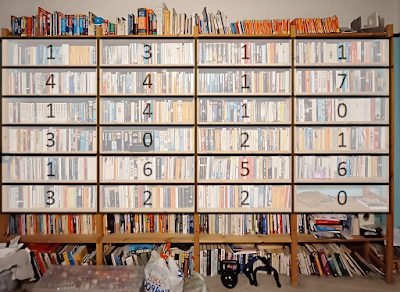
I tweeted a photo of my bookshelves the other day, after doing the painstaking up-shuffling of everything to incorporate the various books I'd got for Christmas and my birthday. It occurred to me afterwards that I'd put a similar picture into a blog post a while back (that turned out to be here) and that maybe I should do another one. Part of the motivation for this is just to illustrate the slightly expanded shelfage area following our house move in mid-2022, but also for me to do an updated heat map of where the currently unread books are, as always just for my own amusement.

It is genuinely true, despite sounding slightly mental, that one of the big selling points (to me, anyway) of the house we now live in was the front reception room featuring a long straight side wall uninterrupted by windows or doors or fireplaces or other inconveniences. There was a radiator, but one of the first things we did after moving in was have that moved to a different wall. The motive here, of course, was to accommodate the long IKEA shelving unit holding all the books; I was very excited at having done some measurements and thereby determined that this wall was longer than the one in the old house by a sufficient amount to accommodate a whole extra horizontal span of shelving, with the giddying prospect of extra book-storage space. The other main advantage of this new library area was that it wasn't in our bedroom; not the best place for an area that you might want to make accessible to others. 

So anyway, compare the new shelving arrangement with the old one by looking at the pictures below (old one first). One probably obvious point to make is that while the extra fifth shelf span in each horizontal row moves the numbers around a bit, those numbers will also refer to an intersecting but non-identical set of books, since I've read quite a large number in the four years since the old photo was constructed and also acquired quite a lot of new books.


Things to note:
  • one of the things the new layout has done is bring the Stephen King section occupying D3-E3 directly under the Dick Francis section in D2-E2; this accounts for the very low numbers in that section.
  • two 6s and a 7 in the old picture, nothing higher than a 5 in the new one. We've flattened the curve!
  • to generate even more extra room I reduced the vertical spacing of the shelves slightly when reconstructing them; as a result while the shelves still accommodate the old A- and B-format paperbacks they no longer accommodate the occasional "trade-format" outliers like House Of Leaves and The Road Home. Books of this size (and you can see there's only a handful of them) occupy the far-right end of the very top shelf above E1. It's a bit unsatisfactory but I decided it was worth it for the extra space it made available. 
  • having constructed this new image I'm now loath to ever read anything from column A given the pleasing ascending sequence occupying it; in fact I might buy a couple of new books in the T-Z range just to bump up the counts by one in the two lowest sections.
  • if I were to ignore that and just try and whittle the numbers down by attacking the highest-numbered sections first I would be spending a lot of time in the bottom-left corner, as that seems to be a heavy area for unread books; maybe because it's furthest from the door?

Tuesday, January 07, 2025

stats entertainment

Here's the obligatory end-of-year/beginning-of-following-year roundup of blogging activities and the like. Anyone who'd just like the management summary can take away the headline fact that 2024 was pretty similar to 2023 in most respects, remarkably similar in fact. 

Just to illustrate that point: 2023 had 59 posts overall and 23 book reviews, while 2024 had 58 posts overall of which 22 were book reviews. There is a little bit of a subtlety here, though, in that I actually read (or, more accurately, finished) 23 books in 2024 but the last one was so near to the end of the year that I didn't get round to writing the review until 2025. The overall page count and therefore average book length were very slightly up on 2023; the outliers here remain 2011 and 2021 (overall page count) and 2020 (average book length). The sex split (no, stop it) was exactly the same as 2023: 17 male authors, 6 female. Anyway, here are the graphs you ordered:


A quick note on the most recent review, still very much in the realm of stats nerdery: if we insist on actual words in the title (and therefore treat G. as a special case) then Ice jointly holds the record for shortest title in this list, along with Pig and Utz. It also joins the list of one-word titles referred to here

Tuesday, October 03, 2023

spaghetti alla carbonfibre

I see I didn't do a stats update in the wake of Europe's demoralising defeat in the 2021 Ryder Cup, so I guess a catch-up is in order in the wake of Europe's glorious victory in the 2023 edition.

Year Foursomes Fourballs Doubles Days Singles Overall
Eur USA Eur USA Eur USA Fri Sat Eur USA Eur USA
1979 3 5 2½-5½ 5-3 11 17
1981 2 6 10½ 4½-3½ 1-7 4 8 18½
1983 4 4 4 4 8 8 4½-3½ 3½-4½ 13½ 14½
1985 4 4 5 3 9 7 3½-4½ 5½-2½ 16½ 11½
1987 6 2 10½ 6-2 4½-3½ 15 13
1989 3 5 6 2 9 7 5-3 4-4 5 7 14 14
1991 2 6 6 2 8 8 3½-4½ 4½-3½ 13½ 14½
1993 5 3 4½-3½ 4-4 13 15
1995 5 3 2 6 7 9 5-3 4-4 14½ 13½
1997 5 3 10½ 4½-3½ 6-2 4 8 14½ 13½
1999 10 6 6-2 4-4 13½ 14½
2002 8 8 4½-3½ 3½-4½ 15½ 12½
2004 6 2 5 3 11 5 6½-1½ 4½-3½ 18½
2006 5 3 5 3 10 6 5-3 5-3 18½
2008 7 9 2½-5½ 4½-3½ 11½ 16½
2010 5 3 n/a n/a 5 7 14½ 13½
2012 3 5 3 5 6 10 3-5 3-5 14½ 13½
2014 7 1 3 5 10 6 5-3 5-3 16½ 11½
2016 4 4 3-5 3½-4½ 11 17
2018 6 2 4 4 10 6 5-3 5-3 17½ 10½
2021 2 6 3 5 5 11 2-6 3-5 4 8 9 19
2023 7 1 10½ 6½-1½ 4-4 6 6 16½ 11½
Totals 93½ 82½ 93½ 82½ 187 165 92½-75½ 87-81 125 139 312 304

So one thumping win for the USA and one slightly less thumping win for Europe leaves the overall balance of the stats relatively unaffected. A couple of statistical nuggets to tease out of this year's:

  • the 7-1 result in Europe's favour in the foursomes mirrors the record margin (also in Europe's favour) from 2014;
  • slightly surprisingly, the 6-6 tie in the singles is the first one in the history of the event in its current form;
  • Europe continue to be slightly better than the USA in both the doubles formats, interestingly the extra columns I've added show they also do best on day one, Friday, with the margin narrowing significantly on the Saturday. The missing year, 2010, was the occasion of some catastrophic weather which necessitated a Monday finish and rendered all that by-day analysis meaningless;
  • winning both days of the doubles is quite unusual, even in matches that were relatively one-sided overall: Europe in 1987, 1997, 2004, 2006, 2014 and 2018; USA in 2012, 2016 and 2021. Of those years, only Europe in 2004, 2006, 2014 and 2018 and USA in 2016 and 2021 went on to also win Sunday's singles. 2012 at Medinah is unique in that a team won both days of the doubles competition and still lost overall.

Of course the key question here is: after all the doom and gloom at Whistling Straits, how did Europe turn it around to win? There are a few competing theories: some mystery illness affecting the USA team, rumblings over money, questionable USA preparation. There is also the question of the impact of the absent LIV golfers - USA had two LIV players absent who'd been in the 2021 team (Johnson and DeChambeau) whereas Europe had five (Garcia, Casey, Wiesberger, Poulter, Westwood) so in theory it ought to have had more of an impact on Europe. On the other hand at least four of those Europeans were coming to the end of long careers, and maybe an enforced end to their Ryder Cup participation actually had a beneficial effect?

All of this probably ignores the elephant in the room, which is that home advantage has become disproportionate. It has always been significant, with only six of the twenty-two modern tournaments resulting in away wins, but it's getting more so with only one of the last nine (Medinah again). As I sort-of predicted last time, five of the 2023 USA team (Scheffler, Clark, Schauffele, Morikawa, Burns) weren't born the last time they won a Ryder Cup on European soil. I agree with the sentiments expressed here: a few really tight finishes and the occasional away win would benefit the tournament as a whole.

Wednesday, July 12, 2023

the unbreathable lightness of not being

Hot on the heels of Cormac McCarthy's demise comes the death of Czech novelist Milan Kundera. Long-standing consumers of my ghoulish authorial-death-related output may remember that, while I feel it's slightly beyond the pale to keep some sort of official Dead Pool list of who I think might be next, I have nevertheless speculated on the subject in the past to the extent of offering up a list of authors whose books have featured on the list, are alive, and are quite old, in a not wishing ill on anyone but Just Saying sort of way, and that Kundera's name has featured, and no wonder as I think he is (or was) the oldest living author on the list.

Kundera featured here twice, in 2008 and 2016 with The Unbearable Lightness Of Being and The Book Of Laughter And Forgetting respectively. Those are probably his two best-known books, the first being made into a film in the 1980s. The Unbearable Lightness Of Being is probably the one to go for, but he had a substantial body of other work that I haven't read.

Anyway, here's the updated list. You might remember that when Alison Lurie died a couple of years back I confidently announced that she was the oldest curse victim at the age of 95. I'm not sure why I did this, because the obituary I linked to specifically says she was 94, and so she was. I'll leave the original post as-is as a monument to my carelessness, but I've corrected her age in the table here. The reason this is relevant (other than a general desire for accuracy) is that Kundera was also 94, as was Doris Lessing when she died back in 2013. So who was oldest? Well, I can reveal that I've done the maths, or, rather, got Excel to do the maths for me, and the result is that Kundera was older than Lurie by a mere 9 days, with Lessing a comparative spring chicken at 74 days younger. 


Kundera also smashes the record for longest curse length at over fifteen years, ending Cormac McCarthy's brief posthumous ownership of the title.

Author Date of first book Date of death Age Curse length
Michael Dibdin 31st January 2007 30th March 2007 60 0y 59d
José Saramago 9th May 2009 18th June 2010 87 1y 40d
Beryl Bainbridge 14th May 2008 2nd July 2010 77 2y 50d
Russell Hoban 23rd August 2010 13th December 2011 86 1y 113d
Richard Matheson 7th September 2011 23rd June 2013 87 1y 291d
Iain Banks 6th November 2006 9th June 2013 59 6y 218d
Elmore Leonard April 16th 2009 20th August 2013 87 4y 128d
Doris Lessing 8th May 2007 17th November 2013 94 6y 196d
Gabriel García Márquez 10th July 2007 17th April 2014 87 6y 284d
Ruth Rendell 23rd December 2009 2nd May 2015 85 5y 132d
James Salter 4th February 2014 19th June 2015 90 1y 136d
David Cook 24th February 2009 16th September 2015 74 6y 205d
Henning Mankell 6th May 2013 5th October 2015 67 2y 152d
William McIlvanney 7th September 2010 5th December 2015 79 5y 90d
Umberto Eco 30th June 2012 19th February 2016 84 3y 234d
Anita Brookner 15th July 2011 10th March 2016 87 4y 240d
William Trevor 29th May 2010 20th November 2016 88 6y 177d
John Berger 10th November 2009 2nd January 2017 90 7y 55d
Nicholas Mosley 24th September 2011 28th February 2017 93 5y 159d
Helen Dunmore 10th March 2008 5th June 2017 64 9y 89d
JP Donleavy 21st May 2015 11th September 2017 91 2y 114d
Ursula Le Guin 6th December 2015 22nd January 2018 88 2y 49d
Anita Shreve 2nd September 2006 29th March 2018 71 11y 211d
Philip Roth 23rd December 2017 22nd May 2018 85 0y 150d
Justin Cartwright 7th September 2008 3rd December 2018 75 10y 89d
Toni Morrison 18th July 2010 5th August 2019 88 9y 20d
Charles Portis 3rd April 2018 17th February 2020 86 1y 320d
Alison Lurie 24th March 2007 3rd December 2020 94 13y 254d
John le Carré 21st February 2008 12th December 2020 89 12y 295d
Joan Didion 14th December 2010 23rd December 2021 87 11y 12d
Hilary Mantel 22nd October 2010 22nd September 2022 70 11y 338d
Greg Bear 4th October 2021 19th November 2022 71 1y 48d
Russell Banks 4th December 2018 7th January 2023 82 4y 35d
Cormac McCarthy 22nd September 2009 13th June 2023 89 13y 265d
Milan Kundera 27th March 2008 11th July 2023 94 15y 105d

Wednesday, May 25, 2022

goodbye, cubey tuesday

Halibut Towers has always been a location of the mind, not tied to anything as mundane as actual physical bricks and mortar, concrete and steel, wattle and daub, cowshit and bits of twig and what have you. And just as well, as our recent house move means that I'm currently sitting in the fourth physical manifestation of Halibut Towers since the birth of this blog back in late 2006 (one in Bristol, three in Newport). More on the move and the new house later (well, maybe) but here's a specific thing that caught my eye when we moved in.

Our predecessor left quite a considerable quantity of what you might call "bonus house contents" - or less charitably "random stuff", or less charitably still "shit" - in the house when he vacated it. Overall that's been a pain in the arse, though there have been a few things that we decided we might keep. Anyway, this item is really neither of these things but as it's just sitting quietly on a mantelpiece minding its own business and staying out of the way I'm fairly neutral about it.

So, it's a calendar. Big fucking deal, you might say, and you'd be mostly right, but the detail of its construction caught my eye. As you can see it's basically two cubes which you have to juggle around to make the correct number for the day of the month. Again, big fat hairy deal, you might say, but I was prompted to wonder about the distribution of the numbers across the two cubes, as you can't just randomly distribute the digits across the twelve available spaces and assume it'll work, as there may be numbers you need that you won't be able to make. Before we get into any theorising, here are the numbers on the first cube (0, 1, 2, 6, 7, 8):

And here are the numbers on the second (0, 1, 2, 3, 4, 5):

The secret with these things is not to try and bite off more than you can chew and come up with some all-encompassing Theory of Everything right off the bat, but instead make some obvious statements and see where they lead you. Here's a couple:

  • You need a 1 and a 2 on both cubes, for two reasons: firstly that they need to pair with every other number to make 10-19 and 20-29 and there isn't enough space to store all the second digits on a single cube, and more obviously that you'll need to be able to make 11 and 22.
  • You need a 0 on both cubes, for the first reason above (but not the second, as the zeroth of May is not a thing).

So each cube has three faces already spoken for by the digits 0, 1, 2. That leaves us with six faces as yet unoccupied, and the digits 3-9 to accommodate. Well, that's us fucked, then, you may be saying, because that's seven digits to fit in six spaces. And indeed we would be EXCEPT for the saving grace that you don't need two separate digits for 6 and 9 because you can just turn one upside-down to get the other (and the additional saving grace that you don't need a 69th of May, still less a 96th of May).

It is my assertion that it doesn't particularly matter how you distribute the remaining digits and the arrangement we have here of 3, 4, 5 on one cube and 6, 7, 8 (and by rotation 9) on the other is purely arbitrary. I guess the way to convince yourself of this is that none of the digits 3-9 ever have to be paired with another from the same range and there'll always be a 0, 1 or 2 on the "other" cube to pair with regardless of where they end up.

As always, needless to say I'm not the first person to ponder this problem: others including the great Martin Gardner have kicked it around as well.

Monday, December 20, 2021

fiction section selection direction

A couple of observations following the last book review: firstly that this post that you're reading now breaks a sequence of five consecutive book review posts (Family Album, Outline, Thud!, Call For The Dead, The Shipping News), which I'm pretty sure equals a record set between November 2018 and January 2019 and observed here. [EDIT: anyone equipped with the ability to a) look at stuff and b) count will spot that it's actually a record-busting sequence of six, The Day Of The Jackal being the missing one right at the start]. Also observed there is that this isn't necessarily a cause for celebration, as it just reveals the dwindling of posts on matters other than what I've been reading lately. There are a number of reasons for this: parenting duties for multiple children, limited opportunities in a pandemic to go out and do blog-worthy stuff and probably most importantly since mid-2016 (when the blog atrophy really set in in earnest) a general feeling of futility about expressing any sort of opinion about anything in the wake of Brexit and Trump (and subsequently Johnson) happening. As many people whose day-to-day business it is much more directly than mine have said, this stuff is the death of satire - nothing you could ever make up could be as simultaneously frightening and absurd.

Anyway, let's snap out of that sort of attitude and return to more important topics, like: all this book review stuff is great, but how do you choose which book you're going to read next? Well, there are a few criteria, although in general I like not to second-guess myself too much and steer clear of giving it too much thought until the moment of needing to make a decision arrives (like, for instance, I've just finished a book and I really need a poo). There are obvious ones like probably not doing two Projects back to back ...

... keeping an eye on not getting too male-author-centric, usually following a longish book with a shortish one and vice versa, and likewise a "light" book with a more serious one. None of these rules is actually so much of a rule that it can't be broken if I feel like it, though. 

Another way of looking at it is illustrated by the image below: my fiction bookshelves are arranged alphabetically by author as the basic minimum level of non-insane good sense dictates. So are the unread titles evenly distributed? Recall that there is some distortion in terms of alphabetic distribution, partly (but not entirely) brought about by my having several large blocks of books by the same authors (Iain Banks, Dick Francis, Stephen King to name but the most obvious suspects). 


The numbers here denote how many unread novels there are in each section - I can't remember whether I included The Shipping News in the numbers or not, but it doesn't really matter. For the purposes of the analysis that follows you'll need to imagine that the columns are lettered A-D and the rows numbered 1-6 as if the whole thing were an Excel spreadsheet.

So it's easy to see that the distribution isn't particularly even - the zeroes at D3 and B4 are largely due to a block of John Irvings and a block of Stephen Kings respectively (the one at D6 is due to that section being empty), and Iain Banks and Dick Francis largely account for the two ones at A3 and C1. The highest count in a single section is seven at D2, mostly among the Es and Fs, and there is a run of three adjacent sections at B5, C5 and D5 that includes seventeen incorporating the end of the Ms through to nearly the end of the Ss. So I could impose some sort of rule obliging me to do some sort of affirmative action shit and choose my next book from one of the most deprived areas on the shelves. I'm not going to, but I could. 

Thursday, February 04, 2021

cricizen kane

I was prompted by the recent resumption of near-normal Test cricket in New Zealand, and in particular by the record-breaking feats of Kane Williamson, to revisit a couple of previous posts featuring deep cricket stat-nerdery and do my best to out-nerd them in some way.

Williamson's innings of 238 against Pakistan in Christchurch was of particular interest to me as it was the first innings of 238 in the 145-year history of Test cricket. You may recall my post from a few years back (January 2013 to be precise) about the esoteric study of yet-to-be-made individual innings scores in Test cricket, and the subsequent flurry of pant-moistening excitement in late 2015 when several entries on that list were knocked off in quick succession. 

Since the compilation of my original list by painstaking manual methods in 2013 I have developed some fiendishly clever automated methods for extracting statistics related to this subject, and I am both proud and, yes, all right, slightly aroused to present some of the results here.

The first thing to say is that there was an error in my original list: the inclusion of 114 as a score which was once the lowest un-made score in a Test match was an error, and the first occurrence of that score was not by Herbert Sutcliffe in 1929 but by Jack Hearne in 1912 (Sutcliffe's innings was actually the fourth 114 in Test history). So the revised progression looks like this:

ScorePlayerDateMatchSpan (time)Span (Tests)
100JT Tyldesley3rd July 1905ENG v AUS28y 110d84
110WH Ponsford19th December 1924AUS v ENG19y 169d73
125PGV van der Bijl3rd March 1939RSA v ENG9y 261d90
139ED Weekes11th April 1955WI v AUS16y 39d133
171IR Redpath11th December 1970AUS v ENG15y 244d271
186Zaheer Abbas23rd December 1982PAK v IND12y 12d267
199Mudassar Nazar24th October 1984PAK v IND1y 306d54
218SV Manjrekar1st December 1989IND v PAK5y 38d134
224VG Kambli19th February 1993IND v ENG2y 80d84
228HH Gibbs2nd January 2003RSA v PAK9y 318d423


The five lowest "missing" scores in Tests are now 229, 252, 265, 272 and 273. The last ten innings which plugged a gap on the list were as follows:

ScorePlayerTeamOppositionDateVenue
238KS WilliamsonNew ZealandPakistan03/01/2021Christchurch
335*DA WarnerAustraliaPakistan29/11/2019Adelaide
264*TWM LathamNew ZealandSri Lanka15/12/2018Wellington
303*KK NairIndiaEngland16/12/2016Chennai
269*AC VogesAustraliaWest Indies10/12/2015Hobart
290LRPL TaylorNew ZealandAustralia13/11/2015Perth
245Shoaib MalikPakistanEngland13/10/2015Abu Dhabi
263AN CookEnglandPakistan13/10/2015Abu Dhabi
294AN CookEnglandIndia10/08/2011Birmingham
293V SehwagIndiaSri Lanka02/12/2009Mumbai (BS)

At the other end of the scale, multiple occurrences of the same score for the same batsman: the highest individual score to be made more than once by the same batsman is 203, by Shoaib Mohammad and Shivnarine Chanderpaul (twice each), the highest individual score to be made three times by the same player is 158 by Kevin Pietersen, the highest individual score to be made four times by the same player is 105 by Alastair Cook and the only batsman to make the same individual score on five separate occasions is Virat Kohli with 103.

The only two instances in Test history of a batsman making two identical scores in excess of 100 in the same Test match were a pair of 105s by Sri Lanka's Duleep Mendis in 1982 and a pair of 101s by Pakistan's Misbah-ul-Haq in 2014, the second of those 101s being at the time the joint-fastest century in Test history in just 56 balls (New Zealand's Brendon McCullum has since taken sole possession of the record).

Wednesday, December 30, 2020

the year of not living dangerously

Well, here we are at the end of another year, one which has, on balance, sucked ass most egregiously for an exceptionally large number of people. I would include myself and my immediate family among that number while at the same time acknowledging that by most objective criteria we've been exceptionally lucky: my job enables me to work from home very easily (I'd already been doing it a couple of days a week since Huw's arrival in late 2016), we've all been healthy and virus-free (apart from the inevitable round of coughs and sniffles every time the kids went back to school) and we've managed to retain whatever meagre wisps of sanity we were in possession of at the start of the year. 

During the heady days of summer between the first and second waves of the coronavirus pandemic we managed to get away for a couple of camping trips, one in Devon and one in Yorkshire, but apart from that we were largely confined to barracks. One of the side-effects of being away less often is that I got a lot more reading done - at least, I assume that's the cause of the numbers you'll see below, but as I have precious little explanation for some of the peaks and troughs in previous years it could just be random variation. 

Anyway, here are some graphs (as always, click to enlarge) which chart some blog and book statistics for this year and also 2019, since I don't seem to have blogged about it at the time. Similar posts can be found from early in 2019, 2018, 2016 (twice), 2013 and 2012. Since I'm not going to finish my current book before the end of tomorrow, and nor am I intending any further blog posts this year after posting this one, I can now declare the blog activity closed for 2020. Statistical nuggets here include:

  • 2019 was a poor year for reading activity with 17 books and an aggregate total of 5147 pages, better than 2016 and 2017 where my time would have been partly taken up with wrangling a premature baby, but ahead of only 2014 in "normal" years. 
  • 2020, by contrast, was a bumper year with 24 books read (more than any year since the all-time high of 2011) and a mammoth total of 9223 pages, exceeded only by 2011, the year of my honeymoon and also the last child-free year of my life. The only other years in which I've read 24 or more books were 2007, 2009 and 2010, but none of them could match 2020's page count.
  • As a consequence, 2020's average book length smashed all previous records at just over 384 pages (2015 with 333 was the previous record-holder). Six of 2020's 24 books were over 500 pages; even 2011 only included four, 2007 one and 2009 none. Longest book of the year was House Of Leaves at 709 pages (some of, them, admittedly, only containing a single word); shortest was Behind The Waterfall at 199. 
  • Overall blogging frequency remains low by historical standards, but 2020's total of 68 posts (this one being the 68th) is the highest since 2016's 77. The book-reviews-as-a-percentage-of-total-blog-posts number just avoids being the highest ever at 35.29% (2018's was very slightly higher).


Monday, November 02, 2020

sudoku? yunohu tugotu

Nia has been getting into some more adult puzzle-wrangling lately, including sudoku, which reminded me of a couple of things that intrigued me about it back when it was suddenly A Thing a few years ago (mid-2000s seems to have been the start of sudoku-mania in the Western world). Firstly, I'm still slightly vexed at how many people mispronounce it, but I have come to accept that some people just seem to have a general sort of word-blindness and once they've fucked something up once will never be able to (or, more judgmentally, care enough or be capable of exercising enough intellectual curiosity to) avoid continuing to fuck it up in perpetuity. I also experience slight annoyance every time someone describes them as "mathematical puzzles", generally as an excuse to avoid engaging with them, since they are clearly nothing of the sort. The usual set of nine things arranged in the grid is a set of numbers, admittedly, but it could just as easily be any other set of nine distinct things; there's no mathematics involved.

I dabbled with quite a bit of sudoku back in the day, and I might still have a go if I happen across one in a magazine during an idle moment, but the thing that always intrigued me about them, more than the actual solving of them, was how the partly empty grids were constructed. Clearly the starting point is a fully-filled in 9x9 grid containing the "solved" puzzle, and the challenge (essentially the reverse of the "actual" puzzle) is to remove a number of the values from the grid until you arrive at a grid (the starting grid for the solver) which is acceptably "hard" depending on what sort of a challenge you're aiming to provide, retains enough information for the solver to be able to reconstruct the grid you started with, and, moreover, for that grid to be the only valid one reconstructible from the set of starting values. 

This Wikipedia page has what appears to be a good and comprehensive summary of most of the relevant mathematics (unlike the puzzle-solving itself this undoubtedly is a mathematical puzzle); on the other hand it might be utter horseshit, I'm not really qualified to judge. The bit that is of interest to the layperson, though, is this section wherein it is revealed that the minimum number of clues you need to provide for a uniquely-solvable puzzle is 17, and that this number varies depending on the specific characteristics of the grid layout you've chosen.

Similar thoughts occurred to me during a game of The Genius Square, a game I was given for Christmas last year and which Nia has taken to with frightening speed, with Alys not far behind, as the picture below shows. 


Basically this is a sort of horizontal Tetris where you have to fit a set of 2-D pieces into a grid, the twist being that the grid is a slightly different shape every time owing to the presence of seven "blockers", whose placement is dictated by a set of dice.

The parallel to what you might call the sudoku meta-problem here is: given the set of pieces you're provided with, you can clearly construct a theoretical blocker placement which would make filling in the grid impossible (see below). 


So there must be some constraint which ensures that this can never happen, and the clue is in the claim made on the box that there are 62,208 distinct puzzle layouts. Now there are seven blockers and therefore seven dice and therefore in theory 67=279,936 possible permutations; a moment's thought should reveal that this is impossible, though, as there are 42 dice faces and only 36 squares, so some square addresses must appear in more than one place. And sure enough while 5 of the 7 dice have six distinct square addresses on them, the sixth has four (two appearing twice) and the seventh has just two (appearing three times each). Sure enough if you do the maths 6x6x6x6x6x4x2 turns out to be 62,208.


So what the three diagrams above show is as follows: the first one just shows what values appear on each face of the seven dice. The second shows, for each square in the grid, how many distinct dice faces it appears on (and therefore indicates how likely it is to come up during a random throw of all seven dice). The third, which is probably the most interesting (though clearly this is all relative), divides the grid up into seven "zones", each corresponding to the set of values contained on a single die. The important point here is that for each of the seven coloured zones, you will only ever have a single blocker in that zone during a game. Note also the rotational symmetry between, in particular, zones 2 and 5, and 3 and 6. You can see how the corners are the "awkward" spots and how it'd be desirable to increase the likelihood of having a blocker in a corner (and that the dice configuration ensures that you'll always have at least one corner blocked), but how you get from there to a mathematical demonstration that the dice layout provided guarantees a solution in every case I have no idea. 

Friday, September 18, 2020

end of a century, oh, it's nothing special

Well, I promised you stats, and stats you shall have, specifically some comparisons of the components of my book-reading triple-century. The brief analysis of the first hundred books appears at the end of the review for the hundredth, Light On Snow, and the analysis of the second hundred has its own post here. I'll rehash some of the numbers from those here for comparison purposes so you don't feel obliged to flick back and forth comparing.

  • The third hundred took 2053 days to complete, compared to 1474 for the first and 1601 for the second - note that these are slightly different numbers from the original posts; I'm not sure what formula I was using there to do the calculations but I suspect it was wrong, albeit only slightly. In real money that's 5.6 years, compared with 4 and 4.4 for the first two.
  • On the other hand, the third hundred books were, on aggregate, the longest at 31,782 pages, compared with 28,361 and 30,761 for the first two. That still means the pages-per-day numbers were lower than for the first two at 15.5 - numbers for the first two were almost identical at 19.2 for both. That's largely a legacy of 2016 and 2017 both being very light in terms of book consumption, compared with other years anyway. For 2017 that can be partly explained by having a tiny baby who was either in hospital or at home being extremely difficult and time-consuming to feed, which certainly would have curtailed some of my reading opportunities. Since Huw only turned up at the tail-end of 2016 I'm not sure I can plausibly account for the figures for that year being so low, though.
  • Longest book for each hundred in chronological order: The Corrections at 653 pages, Infinite Jest at 1079 pages, A Man In Full at 742 pages.
  • Number of distinct authors for each hundred in chronological order: 93, 88, 92.
  • Number of authors who were new to me (generally, not just among books reviewed here) for each hundred in chronological order: 40, 36, 42.
  • Male/female split for each hundred in chronological order: 75:25, 72:28, 80:20. None of the selection is consciously by sex but it's interesting nonetheless that this is the most male hundred of the three (I noted a ten-month gap in this tweet - note that the book I was reading at the time was Imaginary Friends). Within the bounds of plausible random variation, though, I suppose, and it partly reflects my book-buying habits (from, in most cases, a few years back) as well as my current selecting-the-next-book-to-read habits, since I can only select from what's on the shelves.

Finally, an update to the multiple-blog-featurees table last displayed here. Note that the late Iain Banks (in his two incarnations) has now taken the lead on his own, with a few new authors slipping into the 3-book category.

Number of books Author(s)
8 Iain (M) Banks
6 Ian McEwan
Russell Hoban
5 TC Boyle
William Boyd
4 Lawrence Durrell
3 Cormac McCarthy
Stieg Larsson
Patricia Highsmith
William Gibson
Beryl Bainbridge
Jim Crace
Robertson Davies
Alison Lurie
Anita Shreve
Paul Theroux
Anne Tyler

Wednesday, August 19, 2020

on ilkley moor sans chapeau

One thing that has always intrigued me, and almost certainly no-one else in recorded history, and which I was reminded of while we were up in Yorkshire a couple of weeks ago: the prevalence in the north of England of place names which have a French bit in them, usually the word "le" embedded between two English words, sometimes spliced together with hyphens, but equally sometimes not.

I was actually reminded of this not so much by our activities during the week - we stayed at the Crow's Nest campsite up on the clifftops between Filey and Scarborough - but by reminiscing about our trip to the nearby North York Moors between attending two weddings (in Hull and Middlesbrough respectively) waaaay back in the glory glory days of 2007, before my spirit was crushed by a mortgage, three kids and male pattern baldness. While map-reading during a walk from the Spiers House campsite where we stayed during that trip I recall sniggering at there being a nearby village called Hutton-le-Hole - there is also one a couple of miles away called Appleton-le-Moors. 

In this as in all things it's worth validating your own assumptions, so in addition to the obvious question - what's this English/French mashup naming convention all about, then - I asked myself another one: is it actually the case that this type of place-name is more prevalent in the north of England?

All you need to come up with an answer to that question is a bit of persistence and a list of place-names, ideally segregated by what county they're in. Wikipedia has one of these, and there is also the Gazetteer of British Place Names which seems to have a few smaller settlements listed that Wikipedia omits. Search for any place name with "le" or "la" embedded in it, whether hyphen-spliced or not, and here's what you end up with:

County

Occurrences

Settlement(s)

Bedfordshire

1

Barton-le-Clay

Cheshire

1

Thornton-le-Moors

Derbyshire

2

Alsop en le Dale
Chapel-en-le-Frith

Durham

8

Chester-le-Street
Dalton-le-Dale
Haughton-le-Skerne
Houghton-le-Side
Howden-le-Wear
Preston-le-Skerne
White-le-Head
Witton-le-Wear

East Riding of Yorkshire

1

Thorpe le Street

Essex

4

Kirby-le-Soken
Layer de la Haye
Stanford-le-Hope
Thorpe-le-Soken

Greater London

1

St Mary-le-Bow

Hampshire

1

Hamble-le-Rice

Kent

1

Capel-le-Ferne

Lancashire

7

Bolton-le-Sands
Clayton-le-Dale
Clayton-le-Moors
Clayton-le-Woods
Poulton-le-Fylde
Walton-le-Dale
Whittle-le-Woods

Leicestershire

5

Ashby-de-la-Zouch
Barkestone-le-Vale
Donington le Heath
Normanton le Heath
Stretton en le Field

Lincolnshire

23

Ashby de la Launde
Barnoldby le Beck
Barnetby le Wold
Burgh le Marsh
Burton-le-Coggles
Carlton-le-Moorland
Gayton le Marsh
Gayton le Wold
Holton le Clay
Holton le Moor
Kirkby la Thorpe
Kirmond le Mire
Maltby le Marsh
Mareham le Fen
Normanby le Wold
Stainton le Vale
Sutton le Marsh
Thornton le Fen
Thornton le Moor
Thorpe le Fallows
Thorpe le Vale
Welton le Marsh
Welton le Wold

Merseyside

2

Brighton le Sands
Newton-le-Willows

North Yorkshire

15

Appleton-le-Moors
Appleton-le-Street
Barton-le-Street
Barton-le-Willows
Chapel-le-Dale
Hutton-le-Hole
Laughton-en-le-Morthen
Marton-le-Moor
Newton-le-Willows
Norton-le-Clay
Thornton-le-Beans
Thornton-le-Clay
Thornton-le-Moor
Thornton-le-Street
Wharram le Street

Northamptonshire

1

Aston le Walls

Nottinghamshire

1

Sturton le Steeple

South Yorkshire

2

Adwick le Street
Brampton en le Morthen

Suffolk

1

Walsham le Willows

Tyne and Wear

2

Hetton-le-Hole
Houghton-le-Spring

Wiltshire

1

Fisherton de la Mere


Counties with zero occurrences (omitted from the table to save space) are Berkshire, Bristol, Buckinghamshire, Cambridgeshire, Cornwall, Cumbria, Devon, Dorset, Gloucestershire, Greater Manchester, Herefordshire, Hertfordshire, Isle of Wight, Norfolk, Northumberland, Oxfordshire, Rutland, Shropshire, Somerset, Staffordshire, Surrey, both Sussexes, Warwickshire, West Midlands, West Yorkshire and Worcestershire.

So, as you can see, Lincolnshire is the clear winner here with 23, followed by North Yorkshire, Durham, Lancashire, Leicestershire, Essex (the major statistical outlier here), Derbyshire, Merseyside, South Yorkshire and Tyne and Wear, of those that have more than one occurrence. Essex is the only one of those that could unequivocally be said to be in the South. Looking at the data on a map will probably make it clearer.


So, as you can see, if we draw an arbitrary but not unreasonable north-south dividing line from the vicinity of King's Lynn across to mid-Wales, respecting county boundaries all the way across, what we find is that the numbers above the line total 70, whereas the numbers below total just 11. Not only that, but the five counties running consecutively from Lincolnshire up to Tyne and Wear up the east coast total 50, a whopping 62% of the total.

A closer look at the results also reveals that, of the 81 items, 5 have an "en" in front of the "le", while three of the four that have "la" instead of "le" have a "de" in front of the "la". Those with "en le" can reasonably be taken to convey "in the", and most of the "de la" items correspond to an old ruling family who had that as part of their name.

It's surprisingly difficult to find any non-crackpot theories as to what the rest (i.e. the ones with the single "le") are about. The most persuasive theory I've seen (which I'm pretty convinced is correct) is that this is a variant on the archaic French word lès (or occasionally lez), often used as a conjunction in place names and just meaning "near".

That's all terrific, but one obvious question remains - why, if this is a legacy of (presumably Norman) French influence, is the concentration skewed towards the north of England, since, all other things being equal, you'd expect there to be a sort of gradient from high to low depending how far from France you were, i.e. with the highest numbers on or near the south coast.

Note also that there are other French-flavoured place names which don't conform to the le/la structure, like Buckland-Tout-Saints and Stoke Mandeville - those two just acquired the names of the powerful Norman families who owned most of the land, but other etymological routes are probably available. There's also Hartlepool, which started out as "Hart-le-Pool" but then got squashed into its current form. That would be one more for Durham, but rules are rules.