Saturday, May 14, 2011

more bristalgia

Here's a couple more things in similar vein to the last post:
  • firstly here's another demolition film, this one showing the dismantling of the old Severn railway bridge in 1967, seven years after it had been partially demolished by having two barges driven into it - just in case that wasn't destructive enough they were both laden with various highly flammable and/or explosive materials, so you can imagine what happened next. Ironically the bit that wasn't instantly destroyed in the accident seems to have been pretty tenacious as it took until 1970 to finish the dismantling job. All that's left these days is a few stumps visible at low tide and the stone base of the swing bridge section that used to span the Gloucester and Sharpness Canal.
  • a more recent bit of disappeared Bristol is the old flyover that you used to have to go under on the bus to get to Temple Meads railway station. Built in the late 1960s as a temporary relief measure it was only demolished in 1998 when the grandly-named Temple Circus Gyratory was built, so I remember it well. The idea was to provide a one-way-only short-cut from Temple Way to Redcliffe Way (which ploughed through the middle of Queen Square at the time). I only went over it in a car a couple of times, but it was very narrow and bumpy and frankly rather alarming. Anyway, some nostalgic photos can be found here, here and here. If you can't get your bearings I've helpfully drawn in virtual green crayon on a map, below.

viaduct? vy not

Talk amongst yourselves for a bit while I indulge my odd obsession with maps, industrial architecture in general and old railway remnants in particular. I was trying to remember, in the aftermath of going out cycling for the first time since last year, where it was that I'd been cycling in the Newport area a while back and gone over the top of a quite impressive viaduct. Eventually I remembered that it was on the cyclepath between Pontypool and Blaenavon - my recollection is that I came here for a quick bit of bike-checking and training in advance of the Forest of Dean trip back in May 2008. That seems about right as I remember it was one of the first excursions I did after getting the car in April.

Anyway, the viaduct in question is properly known as the Garndiffaith viaduct, apparently, and does indeed carry a cyclepath over the top, although it's my recollection that it's heavily fenced on either side of the track which spoils the view a bit - presumably this is not so much to prevent suicidal cyclists from cycling the four miles or so up from Pontypool just to hurl themselves off the parapet as to prevent local ne'er-do-wells from lobbing chunks of masonry onto passing cars down on Viaduct Road. Like the nearby viaducts at Hengoed and Cefn Coed it's built on a gentle curve; whether this is something enforced by Welsh geography or just Welsh architectural whim I have no idea. Anyway, the Cefn Coed link is from the fascinating Forgotten Relics website, something of a guilty geeky pleasure for those fascinated by abandoned bridges, hidden tunnels and the like. So much so I've added it to the sidebar.


While much remains to be sought out and casually trespassed on, much stuff has inevitably been obliterated by the ruthless utilitarian jackboot of progress. Here's a good example from my long-time place of residence, Bristol: the bit of the Frome valley now occupied by Eastville Tesco, Ikea and junction 2 of the M32 was previously spanned by the impressive Clay Bottom viaduct (colloquially known as Thirteen Arches viaduct to locals), which ran east-west across the river valley (while the M32 now goes north-south along it). The only evidence nowadays that it was ever there is the continued presence of its smaller sibling a few hundred yards further along at Royate Hill. Ignore the Google aerial view which suggests that some horrific tectonic incident has befallen it, it's still intact and in fact these days houses a miniature nature reserve.

How did they get rid of the bigger one? Well, they blew it up. If you don't believe me, have a gander at this fairly remarkable bit of old footage from 1968 which shows them doing exactly that (the picture above is a still from the same film). The excellent SABRE maps website provides before and after maps for comparison.

Tuesday, May 10, 2011

the last book I read

Mountolive by Lawrence Durrell.

This is volume three of the Alexandria Quartet, following on from Justine and Balthazar as previously featured here. As I mentioned there, the first three novels cover essentially the same period of time and describe broadly the same series of events, but from different perspectives: Justine is schoolteacher Darley's naïve first-person recollection of his affair with the mysterious Jewish temptress of the title, while Balthazar is his subsequent reflections on the same events in the light of a series of letters sent to him by the eponymous doctor.

Mountolive gives yet another view of the same events, but this time it's a rather more orthodox third-person narrative. I suppose it's a bit like those extreme close-up shots they used to ask people to identify on Ask The Family (with the highly-mimicworthy Robert Robinson), which as the camera pulled out would usually be revealed to be a toilet brush or a potato masher or some such household implement - the progression through the three books representing, in a very real sense, the gradual pulling back to reveal a wider and deeper view of the toilet brush, I mean events.

Anyway, the eponymous David Mountolive is a career diplomat who has just landed a prestigious posting as British ambassador to Egypt. The novel starts with a flashback to his earlier time in Egypt as a young man, when he was engaged in a torrid older woman/younger man relationship with Leila Hosnani, whose son Nessim is now married to none other than Justine. Ah, what a tangled web, etc. etc.

While Justine's dalliances with Darley and Pursewarden were portrayed in the first two books as just the typical casual infidelities of your average bored Alexandrian nympho housewife, it transpires here that they are part of a fiendish plan hatched by Nessim and his Coptic Christian brethren to resist the encroachment of Arabs (and, more generally, Islam) into Egypt and the marginalisation of the Copts from political life and power. One of the ways in which they choose to do this is by supporting the Jews in Palestine by supplying them with arms (the novels are set in the years preceding the Second World War, i.e. prior to the formation of the modern state of Israel). Mountolive has got Pursewarden to secretly gather information for him about what Nessim is up to, and it's the knowledge of Nessim and Justine's betrayal that induces Pursewarden to top himself. As the net closes in Nessim is obliged to "take care of" his loose cannon of a brother, Narouz, in a lake-based execution scene very reminiscent of Michael and Fredo in The Godfather Part II.

The change of viewpoint makes this quite a different book from the previous two - Durrell's prose is still pretty thick and chewy, but the third-person perspective provides less scope for florid internal agonising and more space for a bit of narrative drive, not that that much actually happens even then. The general critical consensus seems to be that this is the weakest of the quartet, but actually I enjoyed it at least as much as the other two, perhaps more.

Now that we've examined events from every possible angle, the fourth book in the series, Clea, promises to move things along time-wise and provide some plot resolution. All we know at this stage about the title character is that she is a painter, much mentioned in the first three books but seldom featured directly, and that pretty much everyone seems to either have been or still be in love with her. Since I read Justine in January 2007 and Balthazar in November 2008 that means respectively 22 and 30 months between books in the series; if that pattern continues I should get round to reading Clea in 38 months' time in July 2014.

Incidentally a film based on the Alexandria Quartet, Justine, was released in 1969. Anouk Aimée stars in the tile role (here's a trailer); although she's plausibly exotic-looking I'd always pictured Justine looking more like Isabelle Adjani. It's not generally regarded as being much good, and shouldn't be confused with this rather more racy film of the same name which came out in the same year.

Sunday, May 01, 2011

guillotine some sense into 'em, is what I say

Yeah, all right, last word on this for the moment - here's the Independent's Johann Hari with a cogent summary of the viewpoint of those of us subject to a hot flush of cringing embarrassment every time the royal wedding gets a mention. If you prefer a spoken-word version of the same article, try this.

Just to nip another inane response in the bud, and to re-use a phrase from the last (unrelated) post, I have, in general, no personal animosity towards the individuals who collectively comprise the British royal family, with a couple of exceptions which I'll come to in a minute. In particular, while I suspect that on a personal level they are achingly dull people you wouldn't want to be trapped in a room with, William and Kate seem like a personable enough couple, and from William's past pronouncements it's very possible that they would have preferred a low-key ceremony of their own devising like everyone else gets, rather than the ludicrous Disneyland spectacle they were required to participate in. The point is that they got no choice - heaven forbid they should have decided they didn't want a church wedding at all, or to marry but not have any kids, or not marry but have kids anyway, or rope Kate's sister Pippa into a ménage à trois (come on, you would, wouldn't you?), or any of the other choices they'll never get to even consider. This sort of talk is usually the lead-in to the next monarchist canard, which goes something like: see, they do a difficult and demanding job; you wouldn't want to do it, would you? To which the answer is no, I most certainly would not, so let's abolish the job altogether; that way no-one has to do it. Problem solved.

Some useful resources for those confronted with the usual pro-monarchy nonsense can be found here.

Scrolling back through some of Johann Hari's old Independent articles provides this useful hook from which to hang a paragraph or so about the less benign side of the royals. Even if we leave aside the flirtation with Nazism (whitewashed nicely in The King's Speech) there's still Charles' hare-brained obsession with quackery, religion and some other bullshit too vague to be worthy of a name. Since we're unlikely to see any change to the current system under the current monarch, I think perhaps the best-case scenario is for Charles to succeed to the throne and be unable to resist the temptation to hold forth on various topics in stereotypically blithering and ill-informed fashion and to interfere with government policy-making in exactly the way the current Queen has been scrupulously careful not to do. I think if we suddenly acquire a politically-engaged King, and a massive idiot to boot, public patience could wear thin quite quickly.

More importantly, what the heck was Princess Beatrice wearing on her head (see picture above) for the wedding? Theories I've seen so far include:
  • antlers
  • an octopus
  • a stylised representation of the female reproductive system
I would love it if it were the last one, but it seems unlikely. A strong contender for Scariest Eye Make-Up of the day, as well.

Saturday, April 30, 2011

look at this: I think it's gone sceptic

You'll recall I provided a few links to Robert Llewellyn's Carpool a while back - I've caught a few of the shows following its transition to full-blown TV series on Dave as well, and the respective guest lists provide a poignant illustration of what can be achieved when just doing what seems interesting on the web, and what happens when the suits get involved and you have to consider what is going to appeal to your "core target demographic" and loathsome phrases like that.

Basically the web series had a few of Llewellyn's comedy buddies but also lots of interesting sceptical and scientific types as well, plus a few random other people. The TV series, on the other hand, seems to be exclusively assorted comedy hacks, none of whom I have any personal animosity towards, but there is a limited amount of interest in hearing a load of comedy showbiz anecdotes again and again.

As an antidote to that deplorable dumbing-down here's the totally awesome Rebecca Watson, head honcho of the equally awesome Skepchick, in passenger-seat-based conversation from back in 2009.

panem et circenses

I'm not going to tackle the subject of the Royal Wedding face-on as it would be a) the longest blog post ever and b) a torrential outpouring of bile punctuated by occasional incoherent guttural barking and salivating, and, well, really, no-one wants that.

So I'll sneak up on the subject tangentially by observing the close parallels between uncritical royalism and adherence to religion. One of the most obvious parallels is the co-opting of an unrelated concept (patriotism and morality, respectively) and dishonestly shackling it to your chosen brand of voodoo nonsense, and then suggesting that if you want to throw away the voodoo nonsense then the other thing has to go too.

Here's how it goes for religion: "You're an atheist? Well then you have no moral code you AMORAL HEARTLESS SOULLESS DEAD-EYED BABY-EATING KILLING MACHINE!!!"

The equivalent for royalism is: "You want to get rid of the Royal family? WHY DO YOU HATE BRITAIN???"

Express the mildest reservations about God or the Queen and you tend to find yourself shackled to a giant straw man, making further rational discussion difficult.

Of course the two things come together anyway on the occasion of a royal wedding, because there's the lengthy voodoo ritual itself, involving the cuddly beardy old Archbishop of Canterbury, head of the Church of England, who embodies his church's tweedy woolly vacuous vagueness perfectly in this video, where he drops the word "God" in a couple of times, but, really, you come away not really knowing what he really believes about anything. As I've said before, the cowardly refusal to set out what you really believe (so that it can get a deserved kicking) disguised as "thoughtfulness" and "inclusiveness" or some such bullshit is probably more annoying than the table-thumping biblical fundamentalism of the more out-there American preachers. At least you know what they think.

Still, it kept the proles happy, and that's the main thing. You know where else they had uncritical flag-waving crowds all vying to outdo each other in the patriotic chanting stakes? That's right, Nuremberg.

Oops.

Friday, April 29, 2011

the revolution will not be televised

Not being subject to the mass outbreak of flag-waving Stockholm Syndrome that seems to have gripped the rest of the nation in the run-up to the Royal Wedding, I decided the day would be better spent burning off some calories (not to mention a bit of republican frustration and revolutionary rage) up a hill somewhere.

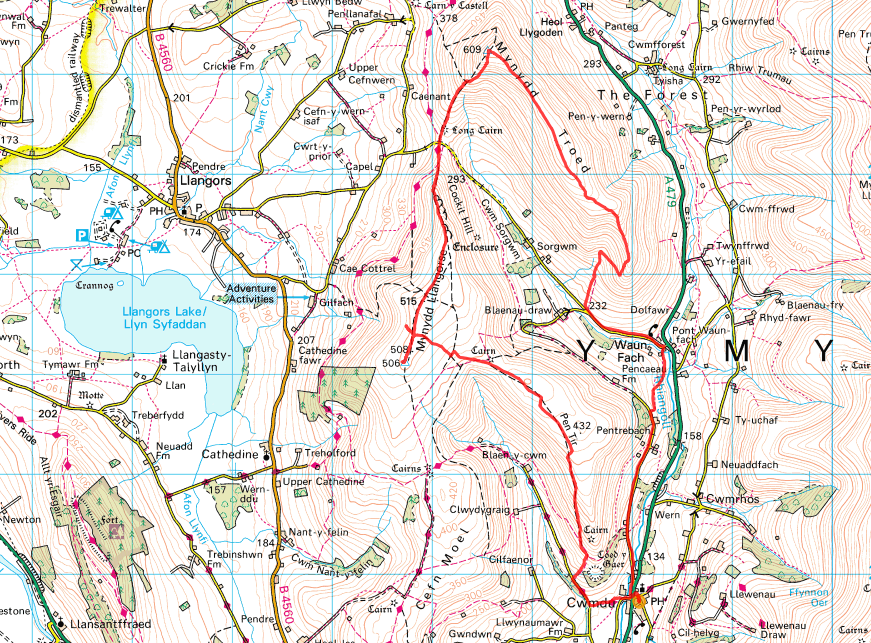
The "somewhere" in question turned out to be some hills over between Crickhowell and Llangorse Lake. These are overlooked by the higher hills that I went up on my epic Black Mountains horseshoe walk a year or so ago, but they were new to me, so I thought I'd check them out. I parked up in Cwmdu and headed up Mynydd Llangorse, and then across to Mynydd Troed and back into Cwmdu. A round trip of, according to my GPS data, exactly ten miles (and around four hours) - route map is here, altitude profile is below (just to be clear, measurements are in metres, so the high point is a whisker under 2000 feet).


Llangorse Lake supposedly has an afanc or lake monster known locally as "Gorsey". No sign of it today, though. Indoors watching the wedding, I expect. Apparently William kissed Kate "on the upper balcony"; if I'd known that was going to happen I might have watched. Oh and apparently her ring was very tight. Now then, stop it.

As always I took some photographs (of the walk, not of Kate's ring), including the ritual OCD-esque bagging of the two available trig points; photos can be found here.

Tuesday, April 26, 2011

technical hitch

Reading Martin Amis's piece on Christopher Hitchens in the Guardian prompted a few thoughts, the first being: Christ, get a room, boys - Amis's puppyish big-brother adoration of Hitchens' every utterance (though in fact Hitchens is only about four months older) is slightly comical, and in any case literary types reminiscing about their younger days of hanging about drinking in various fashionable salons while being effortlessly and raffishly witty and beating off the ladies with a shitty stick always loses a bit in the telling, unless you were actually there at the time.

My second thought was to (slightly more charitably) cut Amis a bit of slack, as this really has the feel of a eulogy about it, and the general news about Hitchens' current state of health following his cancer diagnosis back in mid-2010 is not good. Let's hope Amis doesn't know something we don't.

Then, just when I was getting a warm feeling about Amis's reminiscences about his old friend, he goes off the rails in the last four paragraphs, starting thus:
My dear Hitch: there has been much wild talk, among the believers, about your impending embrace of the sacred and the supernatural. This is of course insane. But I still hope to convert you, by sheer force of zealotry, to my own persuasion: agnosticism. In your seminal book, God Is Not Great, you put very little distance between the agnostic and the atheist; and what divides you and me (to quote Nabokov yet again) is a rut that any frog could straddle. "The measure of an education," you write elsewhere, "is that you acquire some idea of the extent of your ignorance." And that's all that "agnosticism" really means: it is an acknowledgment of ignorance.
This notion that a sort of "aaah, but we can't actually know" agnosticism is somehow a more nuanced and sophisticated and grown-up position to take than plain unvarnished atheism is pretty high on the list of things that make my blood boil, particularly as it's usually (as here) uttered by people who really should know better. Russell's teapot and the Flying Spaghetti Monster are funny constructs, but they exist to make a very simple philosophical point about where the burden of proof for extraordinary claims lies. To ignore this is either craven intellectual surrender to the status quo or just plain dishonesty.

To wash away the bad taste left by all that, here's Hitch on his favourite whisky, which turns out to be Johnnie Walker Black Label. I wouldn't say it's my favourite, although it is excellent, but then I think it's fair to say that even after he's had to cut down a bit recently Hitch puts away a fair bit more of it than I do, so I defer to his judgment. He does also make a case against fixating on some esoteric malt as your tipple of choice here:
Be careful about up-grading too far to single malt Scotch: when you are voyaging in rough countries it won't be easily available.
Fair point. Note however that he appears to be slumming it with a bottle of Red Label in the photo above (which is from here).

Finally, just to bring the blood back to the boil for a moment longer, here's a Daily Mail article about Hitchens' cancer treatment. Note how there's a sneaky implication that Hitchens is having some sort of deathbed conversion here, atheists-in-foxholes stylee - that would be true if he were getting the eminent Francis Collins to pray for him, but in fact Collins is doing some pioneering experimental genetic treatment and Hitchens has volunteered to be a guinea pig, having, it would appear, very little to lose by doing so.

Monday, April 25, 2011

the last book I read

The Light Of Day by Graham Swift.

George Webb is an ex-cop, thrown off the force after being caught coercing a witness to try to secure a confession; drawing on his police experience he now makes a living as a private detective, specialising in, hem hem, "matrimonial" work, i.e. snooping on errant husbands on behalf of their suspicious wives.

George isn't above occasionally providing, hem hem, "comfort" of a physical nature to his lady clients, despite the obvious moral dubiousness involved in doing so - indeed his receptionist and general Girl Friday, Rita, reached that position via the preliminary ones of client and lover.

Sarah Nash is a bit different, though - not in terms of her requirements, which are pretty similar to everyone else's, but in terms of George's reaction to her. By the time the preliminaries have been addressed and the terms of George's engagement agreed - follow Sarah's husband Bob and their Croatian lodger (and Bob's lover) Kristina to Heathrow and make sure he puts her on a plane and then returns home - George has fallen in love with Sarah. Which makes for some complications when, everything having panned out as required at the airport, Bob returns home to Sarah and she stabs him to death with a carving knife while a pot of coq au vin simmers away in the background.

So, like A Dark-Adapted Eye, it's not really a whodunit, as we know who and, broadly, why within the first few chapters. Some back-story is provided for George: his father's affair with the mother of one of George's schoolfriends, and George's silent collusion in keeping it a secret from his mother, the break-up of George's marriage to his wife Rachel in the wake of his disgraced exit from the police force and the subsequent tentative re-establishing of contact with his daughter Helen.

After the court case and Sarah's subsequent imprisonment for Bob's murder George establishes a routine of regular prison visits, and it's the occasion of one of these on the second anniversary of the murder that provides the "now" (i.e. by the book's own internal timeline) that the story hangs off, and provides the trigger for the increasingly minute and obsessional re-working of the events of the fateful day in George's head. Ironically, of course, however forensically George picks over the known sequence of events, certain key elements remain out of reach: what did Bob and Kristina say to each other at the airport? what did Bob say or do when he got home to turn a tense reconciliation over a plate of coq au vin and a glass of wine into a crime scene? what could George have done to prevent things from turning out as they did?

That's the whole point, of course: regret, remorse, the impossibility of really getting inside someone's head and finding out what they're thinking (even someone you're married to), the arbitrary and senseless nature of human love and passion. George's literary voice is deadpan and un-frilly; this is one of those novels where you feel the author spent as much time taking stuff out as in putting it in.

Structurally it's all very clever, and Swift makes you work a bit by introducing characters and events without much explanation, so you have to pay attention to work out the context. George's instant infatuation with Sarah and subsequent dedication to a lifetime of prison visits to see her seems a bit implausible, but I suppose it's axiomatic that love at first sight isn't really based on a sober and rational underpinning.

Good though this is I don't think it's quite up to the standard of the other Swifts I've read - Last Orders, Ever After and Waterland - but that's more a reflection of how good they are rather than there being anything much wrong with The Light Of Day. I know I've said it before, but Waterland remains one of my favourite novels: if you haven't read it, go and do it now.

Sunday, April 24, 2011

christ on a bike

As it was such a nice day on Friday I thought I'd take the mountain bike out for its first spin of the year. Plus, what better way to commemorate the suffering and naily death agony of our Lord Jesus Christ than through the medium of cycling? I suppose someone truly committed would have embedded some upturned nails in the saddle.

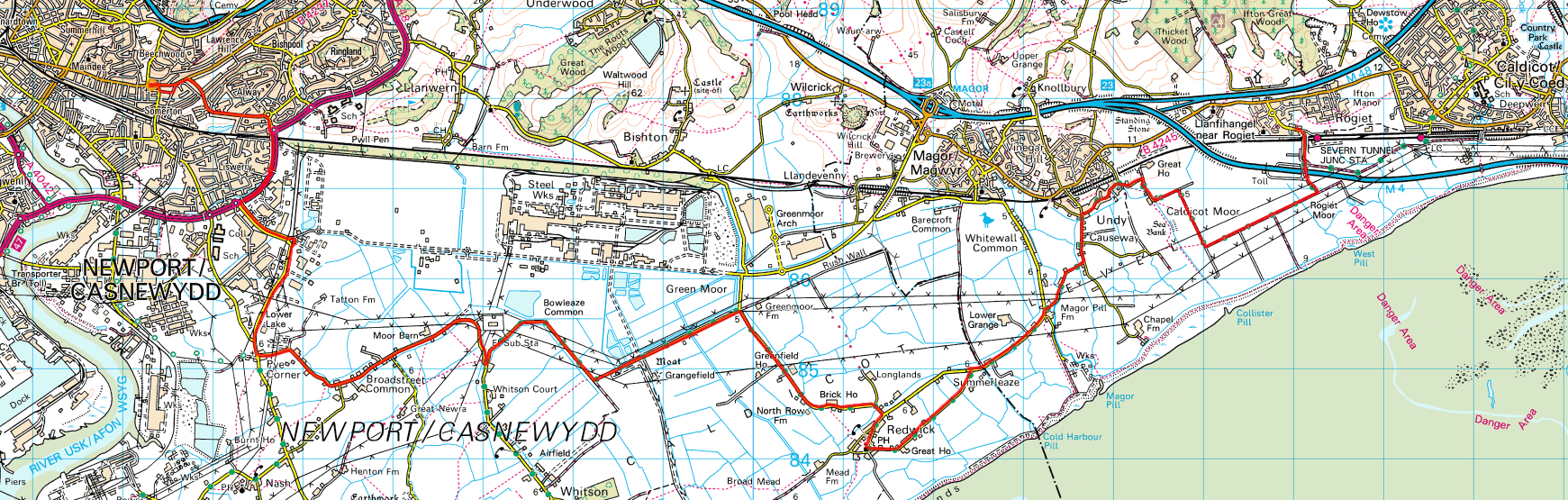
As I mentioned here, living at the narrow end of Newport means that you can be out of town fairly quickly, in this case by hopping over to the ring road and down past Newport Retail Park. If you then head down towards Nash and turn left at Pye Corner you're out onto the Caldicot and Wentloog Levels, a strange man-made reclaimed landscape of drainage reens, sea walls and long straight roads. It's a bit featureless in terms of topographical variation, but excellent if all you want to do is get some miles in the legs and check the bike isn't completely rusted to buggery. The sort of completely straight road pictured on the right is what my grandfather apparently used to call a "dead horse mile", the point of the idiom being that a (presumably already tired) horse would look at the prospect ahead of it and just keel over there and then rather than slog all the way along it. A sentiment I had a certain amount of sympathy with, particularly on the way back.

I cycled out to Redwick (where I resisted the temptation to pop into The Rose for a pint) and then on over the M4 to Severn Tunnel Junction railway station, for no particular reason except that it provided a convenient point to turn round and come back. I came back the same way I went, which is why the route map only appears to have a single line on it, and the altitude chart (see below) looks so symmetrical. Note, however, the vertical scale - apart from getting out of Newport (and back in later) it's under 10 metres all the way, which is about as close to perfectly flat as you can manage. That'll be why I was able to do a round trip of a little over 29 miles in a fraction over three hours.


Anyway, I took a handful of photos en route, which can be found here.

Thursday, April 21, 2011

i don't beliiieeeeeve it!

There was an interesting article in the New Statesman this week, which basically asked the question of various prominent people who profess a belief in God: for fuck's sake, why? The answers are simultaneously interesting and disappointing. A few common patterns emerge, as they always do:
  • There's a few variations on the "I choose to believe because it's too scary not to" theme, notably Peter Hitchens and Stephen Clark.
  • Paul Davies doesn't really seem to believe in anything.
  • There are a few others who seem to believe only in the most basic "first cause" sort of a god, i.e. a sort of vague Deism - but then, through some magical sleight of hand, transform it into the very specific God of the Bible. Praise Jesus!
  • Then there's Stephen Green of Christian Voice - who apparently "came to faith in God through seeing the ducks on a pond in People's Park, Grimsby". What I thought he was going to say was: "I came to faith in God through beating the crap out of my ex-wife". My mistake.
  • Peter Bussey offers a particularly absurd argument involving St. Paul's Cathedral and Christopher Wren, to try and deflect the perfectly good infinite regress arguments against God as first cause of anything. The trouble is, it is perfectly legitimate to ask "how did St. Paul's Cathedral come to be?" and then go on to ask "how did Christopher Wren come to be?", and an answer is available, involving Mr. and Mrs. Wren loving each other very much, and Mr. Wren putting his winky in Mrs. Wren's foo-foo, and, well, you get the idea, no supernatural stuff required. Shoehorning "design" into the question is just begging the question, and is intellectually dishonest, assuming one cares about such things.
In the end you are left with the feeling: is this really the best you guys have got? Because this is fucking pitiful. Not quite as pitiful as this article, though, wherein the New Statesman commission a thoughtful article on faith (and lack thereof) from none other than intellectual heavyweight, erm, Russell Brand.

Tuesday, April 19, 2011

the only way is ethics

My getting to work timing was pretty much spot on yesterday morning: late enough to catch the start of Start The Week after the 9 o'clock news, and to hear the opening exchange between Andrew Marr and the always interesting Sam Harris, but early enough that I was pulling into the car park and switching the radio off by the time Marr got round to asking the Reverend Lucy Winkett for a response, so all I heard was something along the lines of "well, I totally agree with Sam about bad religions, but....". To be honest I think I can fill in how the rest of that sentence went myself, near enough.

Harris was there to plug his new book, The Moral Landscape, which attempts (as I understand it anyway) to apply scientific methods to notions of "good" and "evil" and how those terms might be applied to certain patterns of behaviour; in other words, to remove any vestige of the notion that we need religion to enable us to make these judgments.

To be honest (and no doubt the Reverend Lucy Winkett would disagree) this all seems a bit superfluous to me, as people as far back as Plato and Epicurus had pointed out some obvious problems with the religious approach several hundred years before the bible was even written. There's some fascinating stuff to be written about how human morality and ethics evolved: the constraints of living in close-knit societies, game theory, shared ritual as a means of identifying who's "one of us" and who isn't when societal groups are big enough that you don't just know everyone by sight, that sort of thing - I'm not so sure, from the brief synopses I've heard so far, that this is it. But, as with the Grayling book, no doubt it's a bit more nuanced than the soundbites being thrown around so far suggest.

One of the more gnarly problems associated with all this is that as fascinating as the story of how ethics and morality have evolved is, it really tells us nothing, on the face of it at least, about how we ought to behave. Add to that that our instinctive icky feelings towards certain things really have no basis in rationality and you have some interesting hurdles to overcome; note again that I'm not saying Harris doesn't address all this, indeed I'm sure he probably does. An excellent illustration of the problem is this example which is attibuted to psychologist Jonathan Haidt:
Julie and Mark are brother and sister. They are traveling together in France on summer vacation from college. One night they are staying alone in a cabin near the beach. They decide that it would be interesting and fun if they tried making love. At the very least, it would be a new experience for each of them. Julie was already taking birth control pills, but Mark uses a condom too, just to be safe. They both enjoy making love, but they decide never to do it again. They keep that night as a special secret, which makes them feel even closer to each other. What do you think about that? Was it OK for them to make love?
Now clearly on a simple balancing-out of what Harris calls "well-being", it's all good here; no-one gets hurt, no-one else finds out. And yet most people would have an instinctive reaction in the opposite direction, despite all the obvious arguments (genetic defects of offspring, etc.) having been pre-empted. Your willingness to examine and analyse your own reactions to questions like this marks out, among other things, where you lie on the liberal/conservative spectrum - here's Haidt on that very subject.

If you can bear watching professional religious apologist, liar and charlatan William Lane Craig for a bit then there is a long series of YouTube clips of a recent debate between Harris and Craig touching on this very subject, starting here - alternatively the whole thing can be seen here. Just to give you an idea of what to expect, this (i.e. Craig) is a man who thinks the Kalam cosmological argument is a slam-dunk winner, philosophy-wise. No, really.

the last book I read

Snow Crash by Neal Stephenson.

It's some time in the 21st century in what used to be Los Angeles, and Hiro Protagonist is delivering a pizza for the Mafia. Just another ordinary night, then, really, except that owing to a series of cock-ups Hiro is left with an impossible delivery schedule to fulfil and, failure to deliver a Mafia pizza on time being unthinkable, takes a reckless shortcut through a residential area and plants his car into a swimming pool.

Meanwhile skateboard courier Y.T. (aka Yours Truly) has harpooned the back of a fast-moving vehicle as a means of hitching a high-speed ride to her next destination, only for it to take an unscheduled detour through someone's garden and pancake into a swimming pool. She delivers the stricken driver's pizza for him, and in the nick of time, too, earning Mafia boss Uncle Enzo's eternal gratitude.

Despite this good fortune Hiro gets the sack and has to fall back on his other area of expertise: computer hacking. Any hacker worthy of the name spends a lot of time hanging out in the virtual reality cyber-world of the Metaverse, and it's here that Hiro encounters the Snow Crash virus. Now obviously computer viruses aren't new, but this one is unusual - it seems to infect people's avatars by firing a stream of binary data into their eyes, and it also has some unpleasant real-life effects as well, like turning your brain to mush. When Hiro's hacker chum Da5id is reduced to a vegetable by the virus Hiro takes it upon himself to investigate, assisted by Y.T., with whom he's gone into partnership as data gatherers for the Central Intelligence Corporation, the corporatised commercial version of the former CIA.

So where did Snow Crash come from? And what's it for? Well, strap yourselves in, as this is where it gets a bit complicated. Hiro's ex-girlfriend (and Da5id's ex-wife) Juanita is a language scholar and reckons it's something to do with ancient Sumerian mythology and the Tower of Babel. Sure enough groups of people start turning up who seem to be able to speak in tongues, including a group who live on the lawless surroundings of The Raft, a giant floating city made out of the remains of various sea-going craft and assorted debris that is slowly orbiting the Pacific gyre and currently nearing the western coast of the former USA. It seems to be partially under the control of computer communications mogul L. Bob Rife, who may or may not also be in possession of the nam-shub that is the antidote to the virus - the suggestion seems to be that the original virus was transmitted via the Sumerian language, and that the Tower of Babel incident was an attempt to avoid infection by ensuring no-one could understand each other.

Anyhoo, Hiro and Y.T. make their separate ways to the Raft, along with various other parties who seem to have an interest - one of whom is a scary Aleut kayaker and harpoonist called Raven, who is in the slightly disturbing habit of carrying a nuclear bomb around with him, programmed to go off if he should be killed. After some exciting real-life boat chases and swordplay around the Raft (Hiro, as befits his Japanese ancestry, is an expert and deadly swordsman) it becomes clear that Rife has employed Raven to be the bearer of the Snow Crash virus, which he is going to release into an assembled crowd of hackers inside the Metaverse in a sort of cybergeddon. There then follows a Tron-style motorcycle chase through the Metaverse in which Hiro attempts to thwart Raven, while back in the real world Y.T. struggles to escape from Rife's thugs with a bit of help from kindly old Uncle Enzo, who's taken a bit of a shine to her after the pizza incident.

If you're going to call your principal characters Hiro Protagonist and Yours Truly then you've already put yourself in the red a bit in terms of your readership's goodwill and suspension of disbelief, so it's to Stephenson's credit that this doesn't really count against him too much. Furthermore any novel as cyberpunk-y as this is going to have to withstand comparisons to William Gibson's seminal Neuromancer, especially when it echoes some of the tropes so closely - battered but capable male character, spunky, attractive but slightly wild and dangerous female character (Case and Molly in Neuromancer, Hiro and Y.T. here, Rydell and Chevette in Virtual Light as well), rampant commercialisation and commodification of just about everything with the associated shrivelling of anything resembling countries or governments in the sense that we know them, strong Oriental influence (mainly Hong Kong and Japanese here), and of course lots of virtual reality/matrix/Metaverse cyber-shenanigans as well. Again, this really doesn't come out too badly - it's not as good as Neuromancer, but it's pretty good. The back cover blurb says "Neuromancer crossed with Vineland" and that's probably quite apt - Gibson's grimy techno-futurism with the nasty dark cut-throat bits taken out and replaced with some Pynchonian silliness. I mean, plenty of people still die, but it all seems fairly cartoonish and inconsequential, and it's no-one we really care about; there's also the suspicion that this is a knowing satire of cyberpunk rather than being played entirely straight - Y.T.'s semi-sentient skateboard and Mr. Lee's cyborg security system consisting of super-fast nuclear-powered armadillos are pretty silly when you stop to think about them.

The story really only drags during the lengthy bouts of exposition wherein Stephenson reveals that he really has done lots of research about Sumerian mythology, and by jiminy he's going to make sure you know it. Things run into a bit of a brick wall at these points, which is doubly irritating because, interesting though some of it is, it's largely an irrelevant plot MacGuffin anyway.

Despite all that, Snow Crash was rated as one of Time magazine's 100 best 20th-century novels, as was Neuromancer and a couple of others in this series. Incidentally while Neuromancer (published in 1984) is generally accepted as being the source of the words "matrix" and "cyberspace", or at least their adoption into popular culture in the context they're now generally used, Snow Crash (published in 1992) is supposedly the source of the word "avatar" in its modern meaning, i.e. a digital representation of one's physical self.

As an aside, I was able to nod sagely to myself a few times during the Sumerian exposition sections, particularly the bits referencing El and Asherah, because I'd caught an episode of the BBC's Bible's Buried Secrets a few weeks back wherein the rather foxy Dr. Francesca Stavrakopoulou talked us through where the committee of myrrh-crazed goatherds who wrote the Bible got their ideas from. That the Judeo-Christian myths contained in the Old Testament are a syncretic mish-mash of a selection of much older (and in many cases polytheistic) myths is pretty uncontroversial stuff, but that didn't stop the red-faced retired colonels at the Daily Mail getting all aerated about it (not to mention a few other loons). I suspect that their main objection was not so much the content, but that it was delivered by someone with the bloody cheek to be a) young b) a woman and c) possibly slightly foreign.

Tuesday, April 12, 2011

dead good

One thing I do remember observing in the ill-fated phantom book review of the other day was that the thing of someone dying and leaving some sort of artefact or artefacts for those left behind to sift through for meaning, and probably find out some unexpected and perhaps unpalatable truths that they weren't aware of while the dead person was alive, is quite a common fictional trope - books that spring to mind that use a similar plot device include:
I also remember theorising that the general downer-ness of the book pointed to the author just having generally been in a bad mood when he wrote it: the canonical example of this is Douglas Adams' shift in mood between writing the fabulously cheery and optimistic So Long And Thanks For All The Fish and the corrosively sour and gloomy Mostly Harmless. I seem to remember an interview in which he bemoaned this, blaming it on some parallel grimness in his personal life, and expressed a wish to go back and redress the balance - presumably by some time-travel or parallel-universe trickery, since everyone dies at the end of Mostly Harmless - unfortunately he carelessly keeled over and died before he could do so, which I don't suppose improved his mood any.

Monday, April 11, 2011

no whey

You'll recall that back in the halcyon days of cheese racing, when we were featured in Kerrang! and harboured crazy dreams of one day becoming a proper viral internet sport thing like extreme ironing, Andy and I did a couple of radio interviews on a couple of regional radio stations to promote the sport. Well, things have gone a bit quieter of late, but there seems to have been a recent resurgence of interest in the noble sport. Maybe people can't afford to swan off to Magaluf any more and are having to staycation in Bognor or Rhyl instead, and need to liven up the long wet summer evenings with some outdoor activity, and keep warm at the same time.


Anyway, whatever the reason, Andy appeared on Gold Radio this very morning to big up cheese racing, just in time for the start of the summer season. If you click on this link to Paul Coyte's breakfast show and navigate to about 1:41 or so you'll hear a brief interview spreading the good news to a whole new generation of cheese racers. The powers that be decided to exclude Andy's normal radio sidekick from the airwaves; I can only assume I was deemed too radical, too subversive, too downright dangerous for public consumption first thing in the morning. You don't want to be having a nice bowl of Sugar Puffs and a cup of tea and have some maniac bellowing PISS out of the radio at you, I suppose.

Textbook YouTube cheeseracing action can be seen here, here, here (in a toaster oven!) and here.

Sunday, April 10, 2011

dogs must be carried on escalator

Spotted while driving from Usk to Pontypool yesterday - a new entry in the series Amusing Road Sign Noun/Verb Confusion.

This one said "Badgers for 2 miles". Unfortunately the Google Streetviewmobile was between photos when it passed it, so this slightly blurry image is the best I can do; you can just about make it out though. The one pictured on the left is apparently near Nantwich in Cheshire.

Other honourable mentions in this series include the more widespread "Humps for 200 yards", venerable comedy classic "HEAVY PLANT CROSSING", and one (pictured on the right) that will only make sense if, as Doug and I did, you shared a flat for a year with a bloke whose surname was Rumble, and who you would on no account have wanted to see naked.

Saturday, April 09, 2011

a little whine

Just heard this on the Masters golf coverage - one of the American commentators alluding to Miguel Ángel Jiménez and his legendary fondness for a glass of red wine after a round - apparently this makes him an "affectionado" of red wine. You can sort of see what he meant, as MAJ does have an "affection" for it, but of course aficionado is the word he was looking for. He did also refer to said post-round tipple as being "a glass of Cabernet", whereas I'm pretty confident it would actually be Rioja.

mull this over

On the way back from Usk I popped over to Morrison's in Rogerstone to do a bit of shopping, and being in an expansive sunny Saturday sort of mood I snapped up a whisky bargain while I was there: a bottle of Ledaig for a measly £17.99.

Ledaig is the peated whisky produced at the distillery in Tobermory on the Isle of Mull (the unpeated one being just called Tobermory) - they've recently revamped their whisky range and packaging (here's the old and new Tobermory, for instance - an improvement I think) to include a 10-year-old Ledaig, but this one has no age statement. As you may recall we were planning a distillery visit on our last trip to Scotland in June 2010, but didn't go in the end. We're off up there again in September so we may have another crack at it.

It's pronounced "Led-chig", incidentally. Those crazy Scots.

Anyway, this looks young as it's very light and straw-coloured, but if you're expecting something thin and uninspiring you're in for a pleasant surprise. It's got the same slight rubbery smell that the Oban had, but with something intriguingly salty and umami-y as well - Marmite? Kippers? Tiger piss? It's one of those where the smell is more interesting than the taste, which is mainly some gentle peat and a bit of sweetness, but all very pleasant. Anyway, in terms of quality:price ratio I reckon this is pretty much unbeatable, especially as I don't think the Morrison's price is a special offer or anything, it's just the regular price.

Fascinatingly (or not, please yourselves), the word "Usk" derives from an old Celtic word for "water", same root as the first half of the old Scots Gaelic phrase uisge beatha, "water of life", which is the root of the word "whisky". So I pretty much had to buy it.

usk not what your country can do for you

Well, it's a bit late now, but if I'd known about it at the time this tip might have helped me recover yesterday's lost book review post before it vanished down the memory hole never to be seen again. Worth remembering for future reference anyway.

But one shouldn't dwell on these things, teeth-grindingly irritating as they may be. As I was at a loose end today and it was nice and sunny I decided to go out for a walk; now normally my inclination (geddit?) would be to go and climb a hill somewhere, but I'm currently nursing a slightly busted ankle courtesy of a game of squash a couple of weeks ago, so I plumped for something slightly more sedate instead and drove up to Usk.

Usk is only 15 minutes or so from Newport, straight up the A449, so it's easily accessible, and is quite a nice little place with plenty of pubs, as well as a few other things of interest: these include the river Wye with an old arched stone bridge over it, some bits of old railway line, and a castle.

The railway line is a segment of the old Coleford, Monmouth, Usk and Pontypool Railway, which, as you might imagine, ran from Coleford to Pontypool via Monmouth and Usk. Most of the trackbed between Monmouth and Usk is now occupied by the A449, but between Usk and Pontypool it's mostly still there, though overgrown; note that most of this is not legally accessible to the general public, so if you get nicked for trespassing, we never had this conversation. That SABRE maps link is really good, by the way, so I've added it to the sidebar.


Anyway, a short section of the track around Usk is still accessible and forms a sort of miniature nature reserve; this comprises the old railway bridge over the Wye and the old Usk tunnel, just outside which is the site of the old Usk railway station, though you'd be hard-pressed to know it was there these days. Walk over the bridge and through the tunnel and you eventually come out on the main road on the east side of town.


Head back into town and you pass the driveway which leads up to Usk Castle; this is a funny little place which is basically part of someone's back garden, but is open to the public for a couple of quid dropped in the honesty box at the gate. Because it's not under the management of the usual heritage organisations like the National Trust the signage isn't quite as good as you might expect, I walked past it a couple of times before I found it. It's worth a look, though; not many castles have rope swings and gazebos attached to them and geese and chickens running around inside.

I took a few photos on the way round: these can be found here.

Friday, April 08, 2011

headline of the day

I think this one has been doing the rounds since earlier in the week, but it bears repeating: as you can see if you look at the URL for this article in the Irish Sunday Business Post, it originally carried a slightly different headline, as captured in this snap of the sadly unamendable dead tree edition:


Language Log has before and after images of the online version, just to prove the point. That's where I nicked the image above from, as well.

the last book I read

The Rain Before It Falls by Jonathan Coe.

Well, fuckety fuckety fuckety bollocky fuck. I wrote a comprehensive and perceptive review of this fucking book, in my usual inimitable idiom, being careful to hit the "Save Now" button at regular intervals along the way, and now Blogger has fucked itself up the arse, crashed, and eaten the fucker. Fuck. First time for everything, I suppose.

I may, at some point in the future, feel inclined to return and retype some of my thoughts, but my feeling at the moment is: fuck it, I'm not doing the whole fucking thing again. Here's the Independent and Guardian reviews instead.

Here's the one-paragraph version, which some of you may even prefer anyway: Gill's aunt Rosamond dies, by her own hand it turns out, but not before whe's recorded a load of tapes for her long-lost relative Imogen. Imogen can't be found, so Gill ends up listening to the tapes, which chronicle Rosamond's friendship with Imogen's grandmother Beatrix, and the story of Beatrix's daughter Thea (Imogen's mother). It's short (though this is sneakily concealed by some comically large print, like here and here) and pretty grim and depressing. If you wanted an even shorter version you could just try Philip Larkin's poem This Be The Verse, as read by the author here. If you want a Coe (and why wouldn't you, as he's generally very good) I would start with The House Of Sleep.

Monday, April 04, 2011

grayling failing

I bow to no man in my admiration for AC Grayling, who I reckon is the most intelligent and articulate of the celebrity atheists, and is certainly a far more formidable thinker and debater than Richard Dawkins, the media's usual go-to guy on the subject. I mean no disrespect to Dawkins by that, it's just that he is primarily a biologist and not a professional philosopher in the same way that Grayling and Daniel Dennett are. And Grayling does have the most phenomenal hair, which adds a bit of slightly rakish scholarly gravitas as well. I think there's just a faint possibility that he could be Robert Plant's dad (image is from Crispian Jago's Skeptic Trumps).

Having said all that I was therefore surprised to find myself cringing on his behalf a bit when he popped up on the Today programme this morning to plug his new book, called - wait for it - The Good Book: A Secular Bible. Nothing wrong with the contents, indeed I'm sure it's largely excellent, but the title seems like a bit of an own goal to me. I mean, I can see what he was trying to do, but, well.....the very easy criticism for theists (and Christians in particular, of course) to make now is: see, we told you atheism was just another religion, and now you've proved it by having to have your own holy book, because for all your criticism you obviously think the Bible is a pretty admirable model, don't you, eh? Giles Fraser, who they'd wheeled in to provide an opposing view, could barely conceal his glee at being on the not obviously completely silly side of an argument for once, although he did manage to slot in a bit of Eagletonesque scoffing at any hopelessly unsophisticated literalists who might imagine that the Bible might set itself up as a source of moral guidance (or, to put it another way, about 99% of all the Christians in the world).

Needless to say given a bit more space and time to make a case, like for instance this Guardian article, Grayling does so in a typically persuasive and erudite way. I still think not aping the title of a religious work would have been best, though, although I'm not ruling out some pressure from his publishers to cook up a bit of controversy and hence sales.

I should point out also that I recall a book called Bible Two being published back in the early 1980s - its fate and that of its author are a salutory lesson. Take ye not the Lord's name in vain, lest he visit his vengeance upon you.

A quick footnote: the link I provided above for Giles Fraser is to the splendid Platitude Of The Day site, which simultaneously summarises and satirises the daily Thought For The Day slot on Radio 4. I've added it to the blog sidebar as well.

Saturday, April 02, 2011

the last book I read

Cloudstreet by Tim Winton.

Strewth, what a a bunch of larrikins and galahs.

Here's the Pickles family, in dire financial straits after patriarch Sam carelessly gets all the fingers on one hand mashed off in some machinery on a fishing boat and then pisses away most of the rest of their money with some ill-advised "investments" on the horses. Luckily the landlord of the pub in Geraldton Sam and wife Dolly have been looking after conveniently dies and leaves them a big ramshackle house in suburban Perth, to which the whole family relocates.

Here's the Lamb family, Lester and Oriel and their kids, relocating to Perth after their son Fish nearly drowns in a fishing accident and survives only at the cost of fairly severe mental retardation. Arriving in town with nowhere to stay they discover that there are rooms available in a big suburban house on Cloud Street.

So that's the set-up out of the way and the Pickles and Lambs safely installed; all this preamble happens during the Second World War, and the remainder of the book tracks the course of the respective families' combined adventures over the following 20-odd years. The Lambs open a general store at the front of their half of the house and start to make a comfortable living, Sam continues to enjoy mixed fortunes down at the track and on the card table (on one occasion having to be bailed out by Lester Lamb after a beating from some creditors), Dolly hits the bottle in a big way and Oriel Lamb moves out to a tent in the back garden for ill-defined reasons.

Meanwhile the kids grow up and have their own adventures. Mainly the book focuses on Rose Pickles and Quick Lamb - Rose gets a job in the telephone exchange of a Perth department store, has a brief but doomed affair with journalist Toby Raven and battles with occasional eating disorders; Quick leaves home, spends some time living rough in the bush and hunting kangaroos, has a brief but doomed affair with ranch-owner's daughter Lucy Wentworth, and eventually returns to Cloudstreet. There are other kids in both families but they feature less prominently, with the exception of Fish Lamb who is a constant presence despite not really doing much beyond hanging round the house, talking to the Lambs' pet pig out in the back yard and going on occasional fishing trips with Quick.

Eventually Quick and Rose decide that they are in love, and promptly get married. Quick joins the police force, just in time to get involved in the hunt for the "Nedlands Monster" (aka real-life serial killer Eric Edgar Cooke). Quick and Rose have a baby, and eventually we end up with all the members of both families gathering for a celebratory picnic down by the river; hold up, you think: this is where we came in in that little prologue. You also think: aha, now I see what all those occasional little ghostly magical interludes were about - the whole story is told as a flashback through the mind of Fish Lamb as he plunges off a jetty and drowns, finally allowing himself to be claimed by the water that took part of him when he was a child.

Cloudstreet won the Miles Franklin Award for Australian fiction in 1992 - Winton has won this award four times, for Shallows in 1984 and Dirt Music in 2002 (both of which I have read) and Breath in 2009 (which I haven't) - overall my list for this one goes 1984, 1989, 1992, 1999, 2002. You get the impression Winton set out with the intention of writing a deliberately big, sprawling, sentimental family saga complete with much roistering and raging and rollicking, not to mention rucking and rogering, and that's what he's done. It's very entertaining, but to my mind other Wintons like The Riders and Dirt Music are subtler and more satisfying, as well as featuring more likeable characters, pretty much the entire cast of Cloudstreet being entertainingly useless to a greater or lesser degree.