Tuesday, March 28, 2023

you don't know dick

So you might have seen news of the death of Dick Fosbury a week or so ago, and you'll have been hanging out in the pub with your mates going oh, yeah, Dick Fosbury, the Fosbury flop, you know, revolutionised the high jump - *slurps pint* - revolutionised it. You know, before Fosbury - Mexico, 1968 it was - people could jump about, oh, I dunno, this high *gestures at about knee height*, and then along comes this lanky Fosbury bloke and only goes and leaps clean out of the stadium! Backwards! Revolutionary. Course *colossal belch*, everyone does it now, innit. 

Well, I'm here to be the annoying guy at the next table who acts as a sort of human QI klaxon and goes WELL ACTUALLY it's not quite as simple as that. Thinking about it, this is a bit like the post I did after the demise of Arnold Palmer, with a similar disclaimer that it's not in any way having a pop at Fosbury, just making a couple of observations about how actual events get massaged into a sort of glorious mythic version which irons out some of the inconvenient messy complexities of actual reality.

A brief tangent: it was actually this tweet which prompted me to actually do a bit of research here:

There are some interesting responses in the comments, including the only other example which occurred to me - the switch in ski-jumping from an in-flight posture with the skis extended in parallel to one where they're in a sort of V-shape, which turns out to be considerably more aerodynamic for reasons I can't begin to fathom. I recall seeing (probably on Ski Sunday) a Finnish jumper called Matti Nykänen doing it in the 1980s and it eventually became the standard, just as the Fosbury flop did (with some caveats, see below). 

Anyway, Ian Leslie's tweet was evidently a bit of research in advance of this interesting article about Fosbury. I mean there is a bit of life-coach bollocks in there as well - "seize the adjacent possible", if you please - but even in that exact section there is an interesting point: Fosbury's innovation was only feasible, or safely feasible anyway, because of advances in landing mat technology.

The physics of the Fosbury flop are fascinating and stem from a realisation (Fosbury had a background in engineering) that it wasn't necessary for the whole body to be above the level of the bar at the same time (as, broadly, it was for the variety of previous techniques); indeed in a perfectly executed flop the centre of mass of the athlete passes under the bar. Think of it as exchanging the energy required to lift an entire bucket of water over the bar for the much lower energy required to use a hose to siphon the water over bit by bit. This video shows the progression through the years from the basic scissors (essentially just hurdling the bar; I'm sure you can make up your own jokes about furious scissoring in the women's event) of the early years to some variation of the Western roll in the 1920s and a gradual transition to the full straddle by the 1950s, and then Fosbury and his successors. Note also the equivalent video showing the progression of the ski-jumping world record with the switch to the modest V-shape in the early 1990s and the gradual exaggeration of the posture to the full spatchcock of modern jumpers. 

Here's the mildly contrarian HOT TAKE bit: you would think, from watching that video, which shows only floppers post-1968, that Fosbury's innovation prompted an immediate switch, by everyone, to the new technique, with a bit of embarrassed coughing all round at not having thought of it themselves. Not so, actually, as there was quite a lengthy transitional period where straddlers persisted and in fact claimed the men's high jump gold at the very next Olympics, in Munich in 1972 (for which Fosbury failed to qualify) and the women's high jump gold at the one after that, in Montreal in 1976. The men's world record was only claimed by a flopper in 1973 - Fosbury's Olympic-winning (and, to be fair, Olympic record-setting) height of 2.24 metres in 1968 was four centimetres short of the world record at the time. Moreover, the world record was reclaimed by a straddler, Vladimir Yashchenko, in 1977 and only relinquished finally to a flopper in 1980. As I see I said here, the world records for the two styles are still only ten centimetres apart, despite no-one having seriously competed with the straddle since about 1980. It's interesting to speculate how things might have panned out if Yashchenko's career hadn't been ended by a knee injury when he was only 20, and if his illustrious predecessor Valeriy Brumel, who raised the world record six times in about two years in the early 1960s, and was still the world record holder at the time of Fosbury's Olympic triumph, hadn't had his career ended by a motorcycle accident when he was only 25.

Furthermore, it's interesting to note that Fosbury may well not even have been the pioneer of this style; Canadian jumper Debbie Brill was also doing it in the mid-1960s and it's not clear who thought of it first or to what extent the two pioneers knew about each other. This article is the only one I can find which quotes Fosbury referring to Brill, but it's a bit vague. 

Lastly, it's also interesting to note the progression of the world records for the main jumping events (high jump, long jump and triple jump) and theorise that human progress in this area has stagnated. These are some of the longest-standing records in athletics:

  • Men's high jump: Javier Sotomayor, 1993 (30 years)
  • Women's high jump: Stefka Kostadinova, 1987 (36 years)
  • Men's long jump: Mike Powell, 1991 (32 years)
  • Women's long jump: Galina Chistyakova, 1988 (35 years)
  • Men's triple jump: Jonathan Edwards, 1995 (28 years)
  • Women's triple jump: there was a 26-year gap between 1995 and 2021 but subsequently the record has been raised twice by Yulimar Rojas. Still, you know, exceptions, rules, etc.

Maybe another similar technical revolution is needed. Or maybe we've just cracked jumping, as a species, and that's it, barring evolving some extra limbs or something.

Thursday, March 23, 2023

four shalt thou not count, neither count thou two, excepting that thou then proceed to three

Inspired by this tweet a month or two back to give the subject a bit of thought, I present to you now my collected Books Of The Year list wherein I nominate three from each of the years of this blog's existence (well, I only did one from 2006 as there were only a handful). Three seemed the right number to make the decision-making tricky from an average yearly sample of twenty or so. No particular rules except I tried to avoid picking two by the same author (not generally a problem) and tried not to agonise about it too much or spend too much time on it. 

The table below presents the list; I've spiced it up a little by including a piece of text (strictly unedited) from the original review which will hopefully either give a flavour of the book, ruin a key aspect of the plot, or just amuse. I may make this A Thing in future as part of the annual book round-up I try to do in January.

Year Author Title Comment
2006 Anita Shreve The Weight Of Water two parallel intertwined stories kind of story
2007 William Boyd Restless inevitable betrayals and double-crossings
TC Boyle Riven Rock traumatic formative sexual experiences
Joyce Carol Oates The Falls small fly in the ointment of her marital bliss
2008 Robertson Davies The Cunning Man all manner of throwaway literary and cultural anecdotes
F Scott Fitzgerald The Great Gatsby driving off gaily in your Hispano-Suiza, getting your scarf caught in the wire wheels and strangling yourself
Anne Tyler A Patchwork Planet all you've got left to hold the reader's attention is your actual skill at writing believable characters
2009 Iain M Banks Inversions knife missile which she uses to escape, with impressively bloody results
Cormac McCarthy The Road what will you do when you meet people who will do those things, and more
Isabel Colegate The Shooting Party ruthlessly enforced social structures and strictures preventing you from ever saying what you really think
2010 Peter Ackroyd Chatterton only employed as a model because he was working up to running off with his wife
Joyce Carol Oates We Were The Mulvaneys periodically fleeing to the next one when anyone starts to rely on her too much or show her any personal affection
Stieg Larsson The Girl With The Dragon Tattoo the obligatory secret subterranean porn dungeon for the hero to be rescued from in the nick of time as he is about to be buggered to death
2011 Kazuo Ishiguro Never Let Me Go hopefully we might carry on a bit longer, and avoid the organ-harvesting death squads
Tim Winton Cloudstreet much roistering and raging and rollicking, not to mention rucking and rogering
Patricia Highsmith The Talented Mr Ripley various psychological issues, like, you know, murdering people
2012 Iain M Banks Look To Windward but in fact on a deadly mission so secret EVEN HE DOESN'T KNOW WHAT IT IS!!!
William Boyd Ordinary Thunderstorms a man hiding in a hedge isn't really going to drive the narrative along, so we need more plot
Arkady & Boris Strugatsky Roadside Picnic the constant danger of getting arrested or shot or stumbling into a gravitational anomaly and getting turned inside-out
2013 TC Boyle Drop City a guy who can render his own bear-fat, make moose sausages and knock together a dog-sled with just a few bits of discarded porcupine guts and some whittling
Alison Lurie Foreign Affairs what sympathetic people might call "flighty", "free-spirited", "eccentric", etc., but the rest of us would just call "mental"
Ian McEwan The Innocent Progress down the tunnel towards the Russian sector continues, as does Leonard's progress down Maria's "tunnel", hem hem
2014 GB Edwards The Book Of Ebenezer Le Page all of whom disappoint him in some way with their laziness, stupidity, and embrace of modern ideas like the motor car, feminism or the television set
Russell Hoban Riddley Walker any notion of standard rules for spelling and grammar have gone out of the window, not that anyone has windows any more
Walter Tevis The Queen's Gambit eating properly, heading down the gym and, most importantly, cutting out the pints of white wine for breakfast
2015 Sebastian Faulks Birdsong getting better acquainted with Mrs. Azaire by going down on her comme une tonne de briques while René is out of the house
Richard Yates Revolutionary Road otherwise intelligent young people waking up one morning in their sterile little suburban box and realising that they don't know each other at all
Christopher Priest Inverted World necessitate a rethink of the policy of keeping the plebs ignorant of the outside world
2016 Marilynne Robinson Home before either his father dies or Jack's desire to disappear and be away from responsibility and scrutiny gets the better of him
Daniel Woodrell Winter's Bone everyone has too many guns, drinks too much hooch and is cooking up crank
EL Doctorow Ragtime falls out of a wardrobe while having a furtive wank
2017 Robertson Davies The Rebel Angels the circumstances in which he subsequently murdered McVarish during the course of an elaborate sex game
Yann Queffelec The Savage Wedding the persuasive suggestion that with Ludo gone things might get a bit spicier in the boudoir department
Kurt Vonnegut Cat's Cradle causes the sea, as well as all rivers, streams and groundwater on the planet, to solidify into ice-nine, instantly ending almost all life
2018 Russell Banks The Sweet Hereafter attach an actual face to the child in the back of the bus disappearing off a ravine into the cold murky water
LP Hartley The Go-Between they interrupt Ted giving Marian a practical farming tutorial, in particular a demonstration of some vigorous ploughing
Tom Wolfe A Man In Full a bit of a problematic Mary Sue in an otherwise unmitigated sea of arseholes
2019 Kazuo Ishiguro The Remains Of The Day Miss Kenton is wearing a sign that says AVAILABLE, or possibly RIDE ME LIKE ONE OF LORD DARLINGTON'S PRIZE MARES
Marilynne Robinson Gilead what's a respectable Reverend doing having a son in his late sixties, the randy old goat?
Iain Banks Transition one person's disastrous turn of events about which Something Must Be Done is someone else's wholly necessary and exciting developments
2020 Jim Crace Harvest ill-equipped to adapt to quickly-changing circumstances, and WAIT A MINUTE here are some circumstances quickly changing
Mark Z Danielewski House Of Leaves the fact that a corridor has just poofed into appearance out of freakin' nowhere
Alasdair Gray Lanark only if you're some sort of hopelessly gauche naïve ingénue who expects fictional narratives to follow a linear pattern, hahahaha
2021 John Christopher The Death Of Grass so a few people's lawns die, you might say, no biggie
Hilary Mantel Bring Up The Bodies actual public bloody dismemberment rather than discreet shuffling off to a nunnery
Arturo Perez-Reverte The Flanders Panel the pristine "original" work? What does that even mean? What do words, in general, even mean?
2022 China Miéville The City & The City a city (takes drag on cigarette) .... OF THE MIND. Though, erm, also totally real (coughs)
Jim Harrison The Road Home a fierce and independent girl not prepared to take any shit from anybody, including her grandfather
Tim Winton Breath all good things must come to an end, even bracingly transgressive and dangerous under-age sex

Monday, March 20, 2023

the last book I read

The Underground Railroad by Colson Whitehead.

Cora's life seems pretty sweet, on the face of it*, if by sweet you mean relentlessly shitty and brutal. Born into slavery on the Randall plantation in Georgia, as was her mother Mabel before her, after her grandmother Ajarry was kidnapped and transported from Africa to America, Cora lives with a group of other slaves and works in the cotton fields. The slaves are kept fed and sheltered, after a fashion, but woe betide you if you fail to harvest your allotted amount of cotton, talk back to the white masters or try to escape.

Escape certainly seems like a pretty appealing option given the unrelenting hardship of day-to-day life, but the risks are appalling - a crack team of slave-catchers is just waiting to be unleashed and if you are caught you will be brought back to the plantation and executed in an appallingly protracted and public fashion pour encourager les autres

As it happens Cora's mother, Mabel, escaped from the plantation ten years or so previously and, despite the best efforts of elite slave-catcher Ridgeway and his men, was never caught. When her fellow slave Caesar comes to her and suggests an escape bid she is initially resistant but eventually agrees, and they set out across the swamps in the dead of night.

Caesar has been in touch with agents of the Underground Railroad, in real 19th-century America a network of safe routes for escaping slaves, but as depicted here an actual physical railroad with trains and tunnels and people maintaining secret stations in slave states. Cora and Caesar hook up with a sympathetic farmer who has access to an underground station and ride the rails up to South Carolina. 

Meanwhile, back at the plantation, Cora and Caesar's absence is swiftly noted and the slave-catchers sent after them, a team led by Ridgeway who is taking a personal interest in retrieving Cora after a rare failure in the pursuit of her mother. Cora and Caesar have found refuge in South Carolina, though, which operates a much more liberal regime, former slaves being provided with housing and gainful employment while, yes, technically still being owned by the state, but, hey, who's counting? And it's better than being back in Georgia swinging from a rope, right? Pay no attention to the medical staff taking blood samples for no apparent reason and the strong encouragement for black women to consent to being sterilised. I mean, it's for your own convenience - the state doing you a favour, when you think about it. 

Cora is starting to smell a rat when the decision to move on is taken for her - she gets wind of slave-catchers making enquiries and flees to the house of the local station agent for the Underground Railroad. And not before time as they are hot on her tail and burn the house down, leaving her to board the next available train and get off at the next available stop, which happens to be a partly-abandoned station in North Carolina. Well, North Carolina will be pretty much like South Carolina, right? Only, you know, further north and all. Well, not a bit of it as they have decided the whole slavery thing is just too much trouble and decided on a policy of just exterminating black people wholesale and instead shipping in Irish and Italians to do the menial jobs the slaves formerly did. Having been rescued by the station agent, Martin, a rather unlikely and reluctant hero, having inherited the job from his father, Cora is obliged to endure a miserable few months hiding in the attic of his house while awaiting an opportunity to escape. Eventually the inevitable happens and one of the neighbours denounces Martin and his wife Ethel to the authorities, Ridgeway and his henchmen turn up at the house, throw Cora in the back of the cart to be returned to Georgia and cart Martin and Ethel off to be summarily hanged. 

In some ways the fact that it was Ridgeway who was on hand to make the arrest is a good thing for Cora, as if it had been one of the local goons she would probably have been strung up and set on fire there and then. On the other hand now she has to endure a long and uncomfortable cross-country slog back to her old plantation with the likelihood of a more protracted and public death at the end of it. Fate intervenes, though, when, after they have crossed into Tennessee, the cart is held up by a group of black men who rescue Cora and leave Ridgeway and his men tethered with their own chains.

Cora, the group leader, Royal, and the others make their way (via the Underground Railroad) to Indiana, another (ostensibly at least) more liberal state, and take refuge at the farm of John Valentine, along with a host of other waifs and strays and runaways. Useful work is provided, there is an extensive library, Cora and Royal begin a tentative romance, all seems calm. But even here there is discontent, not so much internally to the farm but among their predominantly white neighbours. This big black community is all very well, you know, but all that fancy book-learnin' might give them ideas. And the next thing you know they'll be round here cutting our throats and defiling our daughters. Maybe it'd be better on the whole to have a bit of regrettable but necessary unpleasantness and rid ourselves of them. 

And so a mob descends on the Valentine farm, bent on general mayhem and destruction, except for the persistent Mr. Ridgeway who only has eyes for Cora, and, once he has captured her, the location of the Underground Railroad. Cora takes him to the nearest station she knows, under a remote barn rumoured to be the terminus of a long-abandoned branch line to who knows where. With the last of her strength she grapples Ridgeway off the rickety stairway down to the platform and, as he lies wounded on the ground, limps off down the tunnel. After an unknowable amount of time in the darkness she emerges near a road and hitches a ride on a wagon headed for Missouri and then west to California.

The history of slavery in the United States has, unsurprisingly, been a rich subject for various forms of art. Notable similarities with The Underground Railroad can be found in parts of Beloved, for instance, and some of it will seem familiar to anyone who's seen 12 Years A Slave. The principal difference is the conceit of having the railroad be an actual physical thing, rather than a metaphor. This provides an odd juxtaposition with the gritty realism of what's going on generally, since a) it's not an actual thing that ever existed and b) a moment's thought will make the whole thing fall apart. Leave aside that it's inconceivable that the stations would not have been found and the rails made impassable, where did all the metal come from? Didn't someone notice entire locomotives going missing? How did they stop the tunnels from falling in? What about ventilation? Wouldn't it be literally impossible to cope with the changes in elevation for an underground railway on a bigger scale than, say, a single city? Clearly all of these things are trivially true, but the idea presumably is that you hold one part of the book (the gritty realist bits) in one part of your mind and the other (the bits featuring the railroad) in another, and apply slightly different rules to each. Whether you can do that or find that the two parts rub together in an uncomfortable way is probably just a matter of taste, and of how much of a tedious literalist you are. It should be noted that quite a few of Colson Whitehead's earlier works have a fantastical and/or speculative element to them as well. My personal feeling is that while I did find the friction between the two elements occasionally troublesome, it didn't detract from the overall effect, which, I should make clear, was tremendously impressive. 

Other people who were tremendously impressed included the Pulitzer Prize committee for 2017, which makes The Underground Railroad the second novel I've read in 2023 to have received it, the other being The Overstory. Perhaps it's time for a recap of my Pulitzer list, which goes as follows: 1928, 1940, 1953, 1961, 1981, 1985, 1988, 1989, 1992, 1994, 1996, 2003, 2005, 2007, 2017, 2019. It also won the National Book Award the previous year; my updated list here goes: 1958, 1962, 1965, 1980 (paperback), 1988, 1993, 2001, 2016.

* I promise this is the last time I will do this

Wednesday, March 08, 2023

the last book I read

Tomorrow by Graham Swift.

Paula Hook's life seems pretty sweet, on the face of it: beloved husband Mike, nice dual income (she is an art dealer, he is the editor of a successful science magazine), nice house, two lovely kids (twins, Kate and Nick). And yet here she is, in the early hours of the morning, her husband snoring post-coitally beside her, fretting over the impending revelation of a family secret to the children, something she fears will change their lives irrevocably. It's a fully planned-for revelation. Paula and Mike having agreed long ago to do it shortly after the twins' sixteenth birthday, but it's still a daunting prospect.

So what is it? Come on, you know how this works: that would make for a very short novel, for one thing. No, we need to circle our way round to the central subject by adding in some explanatory context first, specifically a potted history of how Paula and Mike met (at Sussex University in the mid-1960s) and fell in love, awkward early meetings with in-laws (especially Paula's father Dougie who is, rather intimidatingly, a High Court judge), early married life, money worries (it is Paula who is the main breadwinner in their early years), and, as the years roll on, just a hint of a suspicion of a raised eyebrow from the in-laws about the lack of any kids being produced.

In fact Paula and Mike have done some reflecting on this situation already and have had some tests done which revealed that Mike has a very low sperm count. No worries, they conclude, we'll just tip the odds in our favour by throwing lots of sex at the problem. Some more years go by and it's clear this isn't working, though. It's only the slightly random acquisition of a cat, Otis, that prompts some reflection on this situation, as when Paula takes Otis to the vet he nods, sagely and says: ah, a child substitute. Do Mike and Paula want to just be cat people, or do they want to do something about it?

It's about here that the reader starts to get a glimpse of roughly where this is heading: something about Kate and Nick's parentage, or the circumstances of their early lives. A whole host of options here, from the sort of baby-abduction described in Swift's earlier novel Waterland to the more lurid stuff featured in The Midwich Cuckoos or The Boys From Brazil. The trouble with the (seemingly) endless deferral of the revelation, as demanded by the novel's own architecture, is that anything short of alien zombie Hitler is going to seem like a bit of an anti-climax. That said, the actual revelation here [PLOT SPOILER ALERT], which is that Paula and Mike were some of the earliest recipients of IVF (in 1978, the same year Louise Brown was born), probably would have seemed like a bit of a let-down on page one of a one-page novel. There is a little bit of extra spice, to be fair, in that Mike's rancid old jism being utterly useless for conception purposes even in a lab-assisted environment meant that donor sperm had to be used, and that therefore Mike is not the biological father of his own children. Even then, though, it's fairly thin gruel after 150-odd pages of Paula's tortured build-up.

Even though Tomorrow is fairly short at about 250 pages, there do seem to be a few episodes whose narrative purpose isn't particularly clear, unless it's just to bump up the page count. The whole business with Otis the cat is clearly meant to foreshadow the challenges and anxieties of having kids in some way, but really mainly serves to contrive a series of meetings between Paula and vet Alan Fraser, meetings which culminate in a stolen weekend together in a hotel when she's meant to be in Paris on an art-acquisition trip. The excuse Paula presents for this - she's preparing herself in some way for carrying another man's child - doesn't really make any sense. Similarly the episode shoehorned in near the end where Paula recounts Mike's rescuing both of the twins from drowning in the sea when they were younger doesn't seem to have any point other than to illustrate that Mike is a good swimmer and really loves his kids. 

There's plenty of good stuff here about how love and marriage evolves from the early carefree days of spending all day naked in bed together drinking champagne to the constraints imposed by having kids and how these radical transformations aren't better or worse, necessarily, just different. It's just that all that good stuff is hitched to a structure and a central revelation that seems to invite a shrug and an "is that it?". 

Quite a few of the reviews of Tomorrow made similar criticisms; I particularly enjoyed this Irish Times article which recounts an especially grumpy interview with Swift in the aftermath of a lukewarm review of Tomorrow. One thing that none of the ones I've read mention, as far as I can see anyway, is the structural similarity between Tomorrow and Hanif Kureishi's Intimacy. Unless I'm remembering it completely wrongly, that novel also features one half of a couple, up late while their family sleeps,  contemplating a life-changing announcement that they're going to make the following morning, though the nature of the announcement is quite different. The long-deferred revelation of something from a family's past is a common feature of Barbara Vine's novels as well, though generally the central revelation is of something a bit more juicy. 

Anyway, Swift is a fine writer but this is probably the weakest of the half-dozen or so of his novels that I've read; both of its predecessors here - The Light Of Day and Shuttlecock - are more satisfying. John Crace nails some of its flaws in this Digested Reads column. Waterland remains the one to read, anyway. 

Tuesday, February 28, 2023

the last book I read

The Last Life by Claire Messud.

Sagesse LaBasse's life seems pretty sweet, on the face of it: her parents and grandparents own and run a hotel on the Mediterranean coast of France and she spends a lot of time just hanging out by the pool with her friends. But she's a teenager (about fifteen when the book starts) so a certain amount of surly teenage dissatisfaction is pretty much de rigueur, n'est-ce pas

To be fair, Sagesse does have some actual stuff to worry about as well: her younger brother Etienne suffered some severe brain injuries after being deprived of oxygen at birth and survives at home only with the provision of round-the-clock care from family and a series of nurses. Sagesse is also something of an outlier among her peers in terms of her background: her mother Carol is American and her father's family were pied-noirs (or possibly pieds-noir or maybe even pieds-noirs), French people of European descent who lived in Algeria when it was a French colony and who almost all relocated to mainland France after Algeria's independence in 1962. In late-1980s/early-1990s liberal France reminders of France's colonial past are a bit unwelcome, and people who were involved tend to get the side-eye as potential closet racists. 

Things start to deteriorate when Sagesse's grandfather, finally exasperated beyond reason by Sagesse's friends' noisy late-night cavorting in the hotel pool, fires a gun from the upstairs balcony and injures (fortunately not seriously) a couple of them. Sagesse herself, as it happens, isn't among them as she is down on the beach a short distance away being inexpertly fingered by her teenage boyfriend Thibaud. The parents aren't prepared to take "not severely injured" for an answer, though, and proceed with the enthusiastic pressing of charges against Sagesse's grandfather. This causes some tension with Sagesse's best mate Marie-Jo, one of the key witnesses, and they drift apart.

At her mother's suggestion, Sagesse visits her American cousins in New England as an escape from all the awkward legal business, and again finds herself an outsider, this time for her half-Frenchness rather than her half-Americanness. Some things are common to the teenage experience the world over, though, and after falling out with her cousin Becky over a boy, and drinking too much at a beach party and being fountainously sick, Sagesse makes her way back to France.

Grandfather ends up getting a seven-month prison sentence, during the course of which Sagesse's father takes a more active role in running the hotel's affairs. It also becomes clear to Sagesse that Dad is running certain, hem hem, "affairs" of his own a little closer to home after she and some school friends arrive home unexpectedly. Grandfather's release, on the face of it cause for family celebration, has the opposite effect on her father as he is gradually ground down by Grandfather's insistence on being involved in the day-to-day running of the hotel. While it's almost certainly not the only factor - he appears to have what would today be described as some sort of bipolar disorder - this may have contributed to father's eventual decision to drive out along the coast to a favourite beauty spot, sit in the car overlooking the ocean and shoot himself in the head.

The disintegration of her family almost complete, Sagesse heads off to boarding school in America. On her return at the end of the year she finds her mother shacked up with a new man and contemplating shuffling Etienne off to some permanent care facility so that she can enjoy a bit of middle-aged freedom before it's too late. Grandfather, perhaps fuelled by outrage at this development, has a massive stroke and requires a permanent care facility of his own. Sagesse is a bit outraged on Etienne's behalf as well, though needless to say not enough to volunteer to jack in her studies and come home to look after him herself.

And so we end, via a quick framing device featuring Sagesse, a few years later, pursuing graduate studies at Columbia University and seemingly content with a fairly solitary existence, the odd fleeting lover aside.

Well, so far so standard coming-of-age novel, you might say: teenage protagonist, parents and grandparents of various degrees of eccentric grotesqueness and shouty oppressiveness, funny feelings and furtive sticky fumblings, you know, down there, occasional envious encounters with contemporaries of impossible beauty, fabulous riches or devil-may-care freedom, contemplation of all of the above from the remove of a few years hence, full adult sophistication having been gained in the intervening time. There's something in that, but at the same time there's plenty here to lift The Last Life above the formulaic, in particular the complications of the family's Algerian background, and some kicking around of ideas about how we perpetually re-invent ourselves, even to the extent of re-inventing our own pasts to better fit the stories we want to tell in the present.

The Last Life was Claire Messud's second novel, published in 1999; it was her third novel The Emperor's Children in 2006 that gave her her big breakthrough sales- and awards-wise. There's a touch of the "write about what you know" here, as Messud's own father was a pied-noir - these days Messud is half of a major literary power couple with her husband, critic James Wood. 

Anyway, The Last Life is very well-written and enjoyable without doing anything especially startling. The previous book in this series to feature Algerian independence as a major plot point was the rather faster-moving The Day Of The Jackal

Thursday, February 23, 2023

pando moany mum

Here's one for the COINCIDENCE? OR IS IT?* files:  It can now be revealed that the book I was reading at the time was The Overstory - there is in fact further reference to these aspens later in the book that makes it clear that it is specifically the massive Pando colony that's being referred to. 

The quaking aspen colony is named because "pando" is Latin for "I spread"; it turns out it's also quite a widely-used brand name for a variety of companies doing a variety of things. Once again, though, my instinctive reaction is coloured by my recent experience as a father of three young-ish children and my immediate thought was of Bing's panda friend and his disinclination to wear the yellow shorts he always starts off an episode wearing. 


Huwie was quite into Bing a couple of years ago and I see I tweeted about it an embarrassingly large number of times. It does seem to be a thing that generates strong feelings among parents, as this Mumsnet thread demonstrates.


* as always: yes; yes it is.


Thursday, February 16, 2023

there we are then

Well.


approach with caution

This summary is not available. Please click here to view the post.

Tuesday, February 14, 2023

unn believable

A couple of footnotes to the last post - I have no idea how likely Siss and Unn are as names for young girls in 1960s Norway (The Ice Palace was published in 1963) but as a father of still fairly young children I can still vividly recall our nightly appointments with In The Night Garden and its cast of weird squishy nonsense-spouting primary-coloured characters, including the Tombliboos. Those are the three stripy mofos with the spotty trousers (source of much oh-no-we've-all-got-each-other's-trousers-on confusion and hilarity) who live in, and I quote, "an extraordinary bush". Stop sniggering at the back there. Anyway, their names are Unn, Ooo and Eee, for reasons which I assume are obvious. It wouldn't really have been in keeping with The Ice Palace's rather sombre tone for Unn's two sisters to have suddenly shown up and started playing the drums and having comical trouser mishaps, but the thought did briefly cross my mind.

Another example of inappropriate hilarity at serious moments was provided last weekend when the girls decided that we should watch The Railway Children for our Saturday night movie. Anyone who's seen this will know that the last scene (it's actually not quite the last scene, but you know what I mean) is a legendary not-a-dry-eye-in-the-house moment (unlike some other Jenny Agutter movies which demand a ready supply of tissues for different reasons). To guard against succumbing to this I was idly imagining whose appearance out of the smoke (i.e. in place of Iain Cuthbertson) would be most amusing, and I came up with Mr. Blobby; cue me ruining the scene for everyone with some most inappropriate guffawing. Here is roughly how I imagined the scene; you'll have to supply the sound effects yourself.


the last book I read

The Ice Palace by Tarjei Vesaas.

Siss is just a regular girl (not sure if her age is ever stated explicitly, but I think we are to assume around eleven or twelve) in the frozen Arctic wastes of rural Norway, just trying to get through the day without falling into a fjord and freezing to death, getting trampled to death by a moose or dying after eating some tainted rakfisk.

Siss is a popular and influential girl at school and so when a new girl, Unn, arrives, the class look to her for a definitive thumbs up or down. Siss is intrigued by Unn - quiet, reserved, very happy to be in her own company at break-times and not mingle much with her contemporaries - and arranges a visit to her house after school to get better acquainted.

The visit offers further intrigue - Unn has come to live with her aunt after her mother's death, her father being absent long since and known to Unn only through a couple of old photographs. Unn also alludes vaguely to some dark secret, the details of which she keeps to herself but which she imagines may be visible to Siss in some way after they undress in front of each other (what, you mean you don't do this on a first visit to someone's house). Siss is made a little uncomfortable by all this but the two make a promise to be BFFs before Siss heads home.

Unn herself is a bit spooked by the intensity of this first meeting and decides to bunk off school the next day to avoid the awkwardness of having to meet Siss in front of everyone else. Luckily it's midwinter and there are lots of icy delights to explore, notably a frozen lake and, near its outflow, a spectacular frozen waterfall that the locals call the Ice Palace. Unn ventures into the ice palace, mesmerised by its weird beauty and the unearthly creaking and cracking noises that it makes. But the constant thawing, cracking, dripping and re-freezing mean that the ice palace is constantly re-shaping itself, and where there is beauty there is also danger.

Siss is surprised by Unn's absence from school, and heads for her aunt's house to check on her, only to find that Auntie hasn't seen her either. The alarm is raised and a search commences, including the lake and the ice palace, but no trace of Unn can be found. 

Obviously life goes on, for everyone else anyway, and Siss' schoolfriends want to welcome her back into their group, But Siss is mindful of her promise to Unn and keeps to herself, fiercely guarding Unn's empty desk against anyone wanting to re-use it. But where does it end? It's increasingly obvious to everyone, even as they diligently continue searching, that Unn isn't coming back.

Springtime arrives and things start to warm up - relatively speaking anyway, it's still Norway - and the lake ice starts to thaw. Unn's aunt decides to sell up and move away, and encourages Siss to move on with her life and set aside her promise to Unn. And so Siss and her schoolfriends make a final trip to see the ice palace before its eventual inevitable collapse.

The Ice Palace tells a pretty simple story in a stark, understated way. The central metaphor is pretty straightforward - the chilly hardness and subsequent thawing of the waterfall being echoed by Siss' coldness towards her friends in the aftermath of Unn's disappearance and her eventual re-acceptance into the group. There is some deeper, darker stuff going on as well, though - Unn's dark secret is never revealed, and there are some hints of burgeoning pre-teenage sexuality both in Siss and Unn's charged first encounter at Auntie's house and in Siss' tentative friendship with the boy who seems to have become a leader of the group of schoolfriends in Siss' absence. And it's never completely clear what's happened to Unn - we assume she's frozen to death and been entombed within the shifting walls of the ice palace, but if that's true then at some point during the spring thaw her semi-frozen corpse should slurp out of the ice and spoil someone's picnic. Maybe she will just be washed away with the collapsed remnants of the ice palace and never be found.

There's always an interesting contrast involved in following a pretty long book with a very short one - The Overstory had lots of characters, lots of digressions into arcane bits of tree-related lore, peaks and troughs in terms of the relevance of what's currently going on to the perceived main thread of the narrative, and no desire to coyly allude to things where devoting a whole chapter to them will do instead; The Ice Palace has none of that, being all told from Siss' point of view except for the chapter where Unn ventures into the ice palace, and with pretty much nothing in terms of fat on the bones and certainly no desire to explain itself beyond the ruthlessly-imposed bounds of the story it sets out to tell. None of that is a value judgment, it's just interesting. I enjoyed The Ice Palace very much, and it certainly passes the "lingers oddly in the mind" test that I mentioned here and here, and the "interesting short novel that's probably ideal film material" test that I mentioned here, here and here. And sure enough it was filmed in 1987 - what appears to be the complete movie is available on YouTube here.

Tuesday, February 07, 2023

this story works on many levels

One thing I could have added to the review of The Overstory is that the endpoint of Patricia's logical train of thought about how to save the planet, i.e. as many of us as possible need to die, is strongly reminiscent of the stated aims of the Voluntary Human Extinction Movement, which you may remember from this post from way back in 2007 - they appear still to be going, those of them who haven't gone voluntarily extinct, anyway. More generally I'd agree with this Guardian review's comment that there's just a suspicion that "something slightly antihuman has crept into the philosophy" - don't forget that what most people mean when they voice the vague concept of "saving the planet" is "saving humanity in something like its present form"; the planet, after all, will be fine, for the next few billion years until it gets engulfed by the sun anyway. Knowing that after our demise our shattered cities will be repopulated by glorious verdant ranks of trees is nice and all but small comfort to most people, as we won't be there to see it, and in any case would only complain about access to Sainsbury's being partly blocked by a massive baobab full of hooting gibbons.

A bit of detail on the novel's slightly clunkily punny title, as well: the overstory is the topmost layer of plant life in a forest with the understory being, as you might expect, under it. That's "story" as in level or layer; in UK English it's more usually rendered "storey" but US English often omits the "e".

Monday, February 06, 2023

the last book I read

The Overstory by Richard Powers.

Hate trees? You'll hate this. Then again, what kind of idiot hates trees? Those great big lovable wooden bastards are everyone's friends: you can climb in them, shelter under them, eat the fruit and nuts they produce (even when the fruit is actually a berry, the nut is actually a seed or a legume et tediously cetera), and then cut them down, chop them up and use the wood to build boats, houses, aeroplanes and what have you. Trouble is, once you cut a tree down, it's dead, and it takes bleedin' centuries to grow a new one. So you have what you might call a sustainability problem and a requirement for humanity, as the de facto custodians of the planet, to manage the available resources in a responsible way. So are we doing that? Are we fuck. Now read on...

Enough of this Meetings With Remarkable Trees stuff, though - let's meet some actual people. Each of the principal protagonists gets an introductory chapter, each chapter recounting some childhood background loosely associated with a particular species of tree. So Nick Hoel gets an American chestnut on the family farm, valiantly holding out against the merciless sweep of chestnut blight across North America in the early 20th century; Chinese immigrant's daughter Mimi Ma gets a mulberry in the garden of their family home; Adam Appich gets a maple; Ray Brinkman and Dorothy Cazaly get an oak and a lime respectively; Douglas Pavlicek gets a Douglas fir (though the tree that rescues him when he parachutes out of a burning plane in Vietnam is some exotic species of fig); wheelchair-bound software genius Neelay Mehta gets a fig; Patricia Westerford gets a beech; Olivia Vandergriff gets a ginkgo.

Having introduced our characters (generally as children) we now zoom ahead and gradually meet them all again as adults. Olivia Vandergriff's life is transformed when she is shocked - literally - out of her slightly aimless student existence by a badly-wired bedside lamp and, convinced that some higher power is using her as a conduit, heads off on a cross-country trip in her car with some fuzzy-edged ideas about saving trees. On the way she meets up with Nick Hoel, tending to a dying chestnut and an empty house at the family farm in Iowa, and he agrees to join her.

Eventually Olivia, Nick, Adam Appich (now a psychologist), Mimi Ma (an engineer) and Douglas Pavlicek (a drifter and occasional forestry worker) form a loose collective campaigning for environmental reform. This starts as the usual non-violent chaining themselves to bulldozers and occupying trees (Olivia and Nick spend most of a year up a giant redwood) but eventually the group as a whole decide that the only way to shock humanity out of its gradual and inexorable slide towards irreversible eco-disaster is direct action, and moreover direct action of the destructive and explodey variety.

Meanwhile Patricia Westerford, a botanist specialising in trees, writes a paper detailing some of her theories about how trees communicate with each other and is roundly mocked by her colleagues for such crazy hippy-dippy nonsense.


Chastened by this experience, Patricia retreats to a hermit-like existence as a forest ranger for the next couple of decades until scientific orthodoxy catches up with her and she belatedly becomes a celebrity, helped by a book contract and subsequent popular-science bestseller.

It soon becomes clear that humanity isn't going to suddenly have a big collective moment of clarity, shrug off its slash-and-burn ways and embrace a more sustainable but less comfortable way of life, and things start to fall apart. The whole eco-terrorism gig, always a bit perilous, goes spectacularly tits-up as the group botch the bombing of a development project which is about to dispatch an area of forest and Olivia dies. After ceremonially lobbing her corpse on the resulting inferno, the group disperses and all take up separate lives, but with the nagging knowledge that The Man may one day come for them.

Ray and Dorothy have led a more conventional life, his income as a prominent lawyer keeping them comfortably off. Tensions arise when they are unable to have children, and ramp up when Dorothy has an affair. Ray's reaction to this is to have a spectacular brain aneurysm and require round-the-clock care for the rest of his life, something Dorothy commendably abandons her carefree boning to do. Pretty clearly Ray isn't going to be up for any tree-related activism but he and Dorothy fill their later years conducting a quiet suburban rebellion and letting their garden re-wild itself, much to the chagrin of the neighbours.

Patricia, meanwhile, a couple of bestsellers notwithstanding, has decided that the best thing humanity can do for the good of the planet is hasten its own demise, and that only a spectacular gesture in this direction can engage people's attention. So she agrees to be a guest speaker at an eco-convention and plans to commit suicide as a spectacular climax to a lecture. Will this shocking gesture do any good?

Adam, meanwhile, is giving a lecture of his own, having resumed his career as a psychologist. One day the inevitable happens and a team of armed FBI agents shows up in the back row; Adam immediately knows what has happened. But maybe he can use his subsequent high-profile domestic terrorism trial as a means of publicising the cause?

Neelay, meanwhile, has become one of the richest individuals in the USA by designing a series of computer games. Inspired by Patricia's actions he turns his attention to designing some sort of bot army that can use Big Data to co-ordinate a response to the climate crisis. Can AI succeed where humanity has failed?

So I'm pretty sure all but the most bone-headed denialists acknowledge that climate change is a thing, and that one of the primary causes is galloping deforestation, sustained by humanity's uncontrollable breeding habits and voracious appetite for wood for all manner of uses. What, The Overstory asks, are we going to do about it?

Well, the short answer is: no easy answers are offered here, and probably rightly so given that this is at least ostensibly a novel set in the real world where people are reluctant to give up their colour TVs and digital watches and suddenly start living on acorn paste and ferns. While there are some encouraging signs of a spread of eco-activism following some of the high-profile events (Adam's trial, for instance) it's still all very slow and there seems to be a suggestion that technology (most likely Neelay's bot army) will be the thing most likely to save us. Personally I'm not persuaded that this is true and am highly suspicious that those who are haven't seen The Matrix

Structurally the book is a bit odd - the character introductions in the first section ("Roots") are compelling little short stories and probably the most focused and enjoyable bits of the book. The remaining sections ("Trunk", "Crown" and "Seeds") seem a bit unfocused in comparison (the book as a whole is a beefy 625 pages) and feel like they could have used a trim - it's not very clear to me, for instance, what purpose Ray and Dorothy's story serves here and what would have been lost by leaving it out. You might also reflect on the momentous and life-changing (life-ending, in Olivia's case) activities of the eco-terrorism group and ask: what did that actually achieve, in the end? You'd probably, if you were honest, have to answer: well it isn't very clear at the end, but possibly not much. 

That said the depth of research here and evident love of the subject is impressive and the story being told is never less than compelling, and anything that prompts us puny humans to think on a timescale not directly tailored to our own brief lifespans is probably valuable. So it's highly readable and thought-provoking without my being completely knocked sideways by it in the same way as the judging panel for the 2019 Pulitzer Prize evidently were. Previous Pulitzer winners here include Breathing Lessons, Foreign Affairs, The Bridge Of San Luis Rey, Gilead, Beloved, The Grapes Of Wrath, The Road, Independence Day, A Thousand Acres and The Shipping News.

Friday, January 27, 2023

the path of righteousness

A quick follow-up to the previous post which also serves as an opportunity to plug the fantastic map-related service provided by the National Library of Scotland. My particular favourite thing is the facility they provide to view old and new maps side-by-side on the screen. Here's the Gaer hillfort area in a contemporary aerial photo and (on the left) a map which purports to be from around 1900. I've reproduced the map bit below:


What you will notice (in the red circle) is that there used to be a tunnel under the railway, carrying some sort of path. If you zoom in on the contemporary map you will see that there are still some markings on the ground that suggest it might be still there, and sure enough if you drop the little yellow StreetView man at the end of Golden Mile View you can see it. The footbridge just south of the tunnel that goes over the river is still there, as it happens, and having been closed for a number of years was recently re-opened to provide access between the park and the new housing developments north of the river. 


Well, hurrah, you might say, problem solved. Yes, the inter-park access would be better situated at the bottom end of the park, but at least it exists. Trouble is it doesn't, for two reasons: firstly it looks from the StreetView picture as if the tunnel may be fenced off (though it's hard to see), secondly even if you could get there from Golden Mile View the M4 is now in the way of getting there from the Gaer hillfort area. 

Golden Mile View, by the way, is so named because of the section of railway which ran through Tredegar Park and was subject to tolls payable to Lord Tredegar, whose land it was, the name being an allusion to the substantial sums his lordship was trousering each time a train ran over the route. 

Thursday, January 26, 2023

dum dum de dum dum de dum dum de PARK STRIFE

More non-book-related posts, for the love of God, you say? Electric Halibut hears your anguished cries and rides to the rescue on his wingèd steed, entirely naked except for a pair of rather splendid patent-leather riding boots and a dab of Blue Stratos behind the ears.

So, as I mentioned a while back, we moved house during 2022, and of course one of the things that does (unless you've literally moved to the house next door, anyway, which sounds literally insane but which some of our friends literally did a few years back) is put you in the vicinity of some different parts of the city, in particular interesting green areas which might be worthy of exploration.


So what the aerial photograph and map above show is some near-contiguous areas of green parkland in the general west Newport area, Newport being essentially divided into western and eastern halves by the River Usk as it makes its meandery way north-south through it. Those areas are, broadly speaking:

  • The little wooded area and park adjoining the northern edge of the mahoosive St Woolos Cemetery and accessible at its northern end from the roundabout on Risca Road; it is allegedly called Coed Melyn Park, which my rudimentary Welsh skills tell me just means "Yellow Tree Park". I can confirm that outside of certain times in autumn the trees are, in fact, predominantly green;
  • the parkland area containing the Gaer hillfort;
  • Tredegar Park (not to be confused with Tredegar House, below);
  • Tredegar House and its surrounding park (not to be confused with Tredegar Park, above).

I have marked those four areas on both images above as yellow, red, blue and a sort of pale mauve, respectively (going from north to south). As you can see they are all very much adjacent to each other, but the connections between them aren't as simple as you might expect. This, in a nutshell, is the point of this post. Let's have a look at them in turn, starting from the top. 


The first one is the connection between the bottom of Coed Melyn Park and the top of the Gaer hillfort; nothing fancy here but you can take a short walk from where the footpath emerges onto Western Avenue, cross Bassaleg Road via the traffic island and enter the park via its main entrance (there are several others along the park's eastern edge). So far, so good.

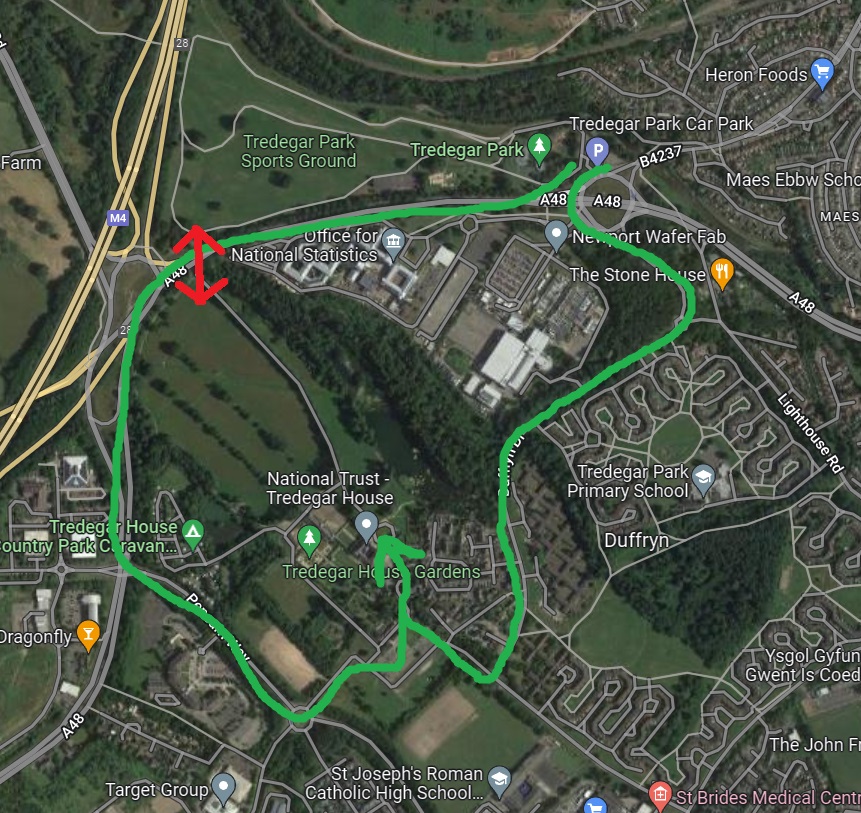
Take a walk in a broadly southerly direction through the park, maybe via a detour to the top of the hillfort (lots of trees so the location of the actual top is not particularly clear) along the recently-upgraded path and you will find yourself quite near, as the crow flies anyway, to Tredegar Park. So you'll be wanting, I would imagine, to continue your pleasant walk in that direction. Well, I've got some bad news for you, bucko, because there are some insurmountable obstacles in your way, specifically the River Ebbw and a railway line. If you want to continue to Tredegar Park then you'll have to follow the path round to where it ends at the gate at the end of Wells Close, find your way to the footbridge over the railway and then follow the roads round through the main car park and into the park. That's the green line on the map; the two red lines show imaginary crossings which would obviously be much better but would require some quite substantial engineering to bridge both railway and river. The only saving grace with the railway is that it isn't the South Wales main line (that takes a more southerly route to get to Cardiff and points west) but the more minor branch line to Ebbw Vale, calling at (among other places) Pye Corner as mentioned here


Let's assume you've now made the long trek round and have enjoyed all the various delights Tredegar Park has to offer - some outdoor gym equipment, football pitches, a playground, some pleasant riverbank areas - and fancy completing your journey by visiting Tredegar House and its pleasant grounds. Well, strap yourself in for a connecting journey of even more unimaginable complexity and inconvenience, as you'll need to exit via the car park and take one of two possible on-road routes to get round to the only available access points on the south side of the house. How much more convenient it would be, you might think, if one could simply traverse the busy lower reaches of the A48 as it approaches junction 28, where the two parks are probably a hundred yards apart, at most. I mean, you would need a footbridge to avoid being messily dispatched by an HGV, or possibly an underpass to avoid having to thread a footbridge around the ornate (and now unused) pair of gates that face the road at this point.


How utterly marvellous to be able to get on your bike up around Risca Road (in the vicinity of our new house, for instance) and cycle in traffic-free bliss all the way down to Tredegar House; yes, maybe a couple of points where you might have to dismount to traverse a bridge but, really, tish and pshaw to that, certainly in comparison with the current situation. So come on, Newport City Council, how about a bit of joined-up thinking?