Tuesday, March 29, 2022

a short interval where I interpret the internet

Same as last time, just a few follow-up thoughts after the last book review

Firstly, I follow Flags Mashup Bot on Twitter because I have a nerdy fascination with flags (I follow a few map-related accounts for a similar reason). Basically that account produces flags of imaginary countries by combining the colours and names of two existing countries and their flags. Here's a thing they came up with a couple of days ago:

One for the coincidence OR IS IT files (the answer as always being: yes; yes it is). It turns out the Ul Qoma flag is a fairly regular featuree as an ingredient; presumably there's just a database of flags that the bot randomly chooses from. But (and I'm sure you're ahead of me here) in what sense is there actually a flag of Ul Qoma? 

Fortunately for the purposes of this post, and also for the theory that 90% of Twitter interaction is just bots interacting with and retweeting each other, there is a counterpart bot called Original Flags Bot which replies to each of the mashup tweets with images of the original flags. The Ul Qoma one is the one on the left. 
A bit of Google image searching turns up this page which seems to suggest that the flags (there is a Besźel one as well, though it doesn't seem to be in the mashup database) were cooked up for the 2018 TV adaptation, which is the explanation that makes the most sense, on reflection.

Another thing I noticed from reading The City & The City was the regular use of the word "interstices"; it's a good word and describes the notion of unseen things lurking in unsuspected spaces pretty well, this being one of the novel's major themes. I think most people know how to pronounce "interstices"; emphasis on the second syllable, in-TERSE-tiss-eeze. What was less familiar to me was the use of the singular form of the noun. Challenge number one here is: what even is the singular form of "interstices"? I think if you'd asked me a couple of weeks ago I would have said: actually I dunno, is it one of those words ending in "x" that gets an "ices" in the plural form? Like, say, "matrix", or "index"? So maybe the singular form is "interstix" or "interstex" or something like that? Not a completely ridiculous thing to imagine, but, as it happens, wrong: the singular form is "interstice". But how are we saying that? Surely not in-TERSE-tiss-ee? But, equally, surely not IN-terst-ICE either?

Well, it turns out it's in-TERSE-tiss. I think this is counter-intuitive for a couple of reasons; firstly that I still have the residual sense of saying something like "matrice" or "indice" which would be obviously wrong, and secondly that most three-syllable words that start "inter-" have the emphasis on the first syllable rather than the second, like "interview", "internet", "interval", "intercom", and so on. "Interpret" is the only other obvious example I can think of of such a word where the emphasis falls on the second syllable.

Monday, March 28, 2022

the last book I read

The City & The City by China Miéville.

Evenin' all. The name's Borlú: Inspector Tyador Borlú of the Extreme Crime Squad. Yeah, I guess I'd call myself a maverick cop: don't always play by the book, but - dammit - I get results. Where? Well, I'm in Besźel, but there's another city as well - a city (takes drag on cigarette) .... OF THE MIND. Though, erm, also totally real (coughs). Anyway, I'm going to hand you back to your blogger now. No further questions; mind how you go.

Um, thanks. So we're in Besźel, a rather run-down city-state on the far Eastern edges of Europe, probably somewhere in the area occupied by Romania and Bulgaria, and Inspector Tyador Borlú of the Extreme Crime Squad has been called out because, well, there's been an extreme crime. Murder, in fact: a young woman found dumped naked under an old mattress on a piece of waste ground next to a newish housing development. But who is she? And why was she killed? 

Borlú finds it frustratingly difficult getting his investigation off the ground, even the basic stuff like finding out the young woman's name. He soon realises that this is because he's starting his investigation in the wrong place. We need to do a wibbly-wobbly dissolve here for a bit of exposition. The city-state of Besźel, it turns out, occupies only a portion of the larger physical city where it is located. The other half(ish) of the physical city is occupied by the neighbouring (and rather more affluent) city-state of Ul Qoma, with a complex and circuitous border dividing the two, including areas of "cross-hatch" which are in both cities at once. But you can't just walk from one to the other, my goodness no; well, in fact you can in that it is physically possible, but it is forbidden in the strictest terms and if you do you will attract the attention of the shadowy organisation called Breach who police these things in a very robust way. 

For that reason Besźel and Ul Qoma natives are conditioned from birth not only to avoid the possibility of physical breach but even to "unsee" things right in front of them which are in the "other" city. Even waving at someone across the city boundary, or reading a street-sign, admiring a building - these are all acts of mental breaching which run the terrible risk of bringing Breach down upon you, something you emphatically do not want.

Anyway, it turns out that the murdered woman is Mahalia Geary, an American student based in Ul Qoma and heavily involved in various archaeological digs there. But why would someone kill her? Well, it turns out that she was involved with various shady unificationist groups in both cities - people who, as the name suggests, want an end to the segregation of the city. In order to continue his investigation Borlú finds himself having to cross into Ul Qoma by the only legally permitted method, crossing at the single border point under Copula Hall, a building existing simultaneously in both cities. It's not quite as simple as that, though, as after a lifetime of studiously unseeing everything in Ul Qoma he now has to undergo a rigorous and intensive acclimatisation programme to teach him to flip all that on its head and instead unsee everything in Besźel. 

On hooking up with some of Mahalia's associates - both the respectable kind at her place of study and the sketchier kind who shared her subversive views - Borlú becomes convinced that she was murdered because she knew something, something about the city, something that she was not meant to have known. But what? Could it be connected to her work on the fringe theory that there is actually a third city, Orciny, invisible to both Besźel and Ul Qoma and secretly controlling both? 

Eventually things kick off when Borlú tries to smuggle Mahalia's friend Yolanda over the border back into Besźel and a sniper picks her off with a head-shot at the checkpoint. But she was in Ul Qoma and the shooter was in Besźel, so whose jurisdiction does it fall under? And since the murder occurred across the legal border boundary, no breach has technically occurred, so there's nothing for Breach to be interested in. Borlú soon solves that problem by chasing the sniper and shooting him. Trouble is the shooter is in Besźel and Borlú is in Ul Qoma, so this is an act of breach, and sure enough almost immediately various shadowy figures appear as if from thin air, seize Borlú, tranquilise his ass and spirit him off to a mysterious location for interrogation. 

Once in the clutches of Breach Borlú soon realises that they are just a bunch of guys, albeit deadly combat ninja stylee ones, and moreover guys who are quite interested in what Mahalia knew, and Borlú now knows, which is why he hasn't just been summarily rubbed out and dumped in a canal like some of the more commonplace breachers. Some further detective work (facilitated by Breach's near-limitless powers within the city boundaries) reveals that the whole Orciny thing is a fairy-tale (if there is a shadowy third city it is Breach itself) designed to cover up a much more mundane scheme of corrupt selling-off of archaeological artefacts to large corporations, a scheme involving various high-ranking Besźel government officials who will stop at nothing to avoid capture, even arranging large-scale breachings and plunging the whole city/cities into anarchy. 

As with many mystery thrillers the pay-off here (i.e. wherein the solution to the mystery is revealed) doesn't really match up to the build-up (it's some fairly vanilla cheesy corporate evil), but by the time we get to it (and all the various climactic explosions and shootings) that doesn't really matter as that's not what the book is about. What it is about is the perfection of the central conceit of the two cities, their geographical intertwining and the conditioned behaviour of their respective inhabitants. This is the sort of idea that constantly teeters on the edge of absurdity - the reader, in a way, is having to do their own "unseeing" to avoid the whole fragile construction shattering under the strain of its own implausibility. There are a few jarring moments when foreigners visit the cities and start galumphing about breaching left right and centre like a herd of bleedin' elephants where there is a danger of the reader taking a step back and saying: yes, actually this is a bit silly, but generally the reader is kept securely tethered to the central premise, something that takes considerable authorial skill and discipline.

No doubt there are a few metaphors being played out here: the fundamental absurdity of arbitrary lines on a map as dividing lines between groups of closely-related people on the ground, totalitarianism and the desire to control even the near-unconscious thought processes of your citizens (so echoes of Nineteen Eighty-Four, of course), but also the "unseeing" that most of us do every day (or at least every day during non-pandemic conditions when we're free to roam the streets) of litter, dogshit, homeless people, conflict, harassment, etc. 

The most important thing to take away here, though, is that this is an absolutely terrific read for anyone even slightly interested in boundary-pushing fiction, mystery thrillers, or really just fiction in general, and I recommend it highly. Here's a brief interview with the author wherein he gives a potted summary of the plot.

The City & The City was adapted into a four-part TV series in 2018 starring David Morrissey (a former featuree here) as Borlú; obviously the key question you'll be asking is: how do they render the "unseeing"? And the answer is: with some blurring, like this. That works OK as far as I can see, though as it happens the mental picture I had was of the "other" city sort of receding to a lower-contrast, lower-brightness washed-out near-monochrome. Potayto potahto though, innit.

The City & The City also won a host of science fiction and fantasy awards - even though, unlike Miéville's earlier work, it arguably contains almost no elements of either genre - including the venerable Hugo Award, the other recipient of which to feature on this blog was The Dispossessed

Tuesday, March 22, 2022

shocking news

A couple of quick follow-ups (follows-up?) to the My Abandonment post:

You'll recall my slight bafflement at the odd but pivotal episode in the book where Caroline and her Dad stumble upon an odd little makeshift building where they meet another odd couple (a woman and a boy), get agreement that they can stay the night, and then find the following day that the woman has killed Dad while Caroline and the boy were out sledging (no, not like that). Well, it turns out that Peter Rock's earlier novel The Bewildered featured a group of people who steal copper wire from power lines and have some sort of odd addiction to being in close proximity to high-voltage lines and even getting electric shocks. So I think those in the know (i.e. who've read the earlier book) are meant to draw the inference that the couple here (and their odd dwelling place - the Shock Shack, the Yurt of Hurt, the Shed of Dead, if you will) are perhaps characters from the earlier book and that their odd behaviour and baldness is a side-effect of extended proximity and occasional zappings. This newspaper article reproduced on Rock's website alludes to links between the two novels as well. 

I should add that while I try not to be a language prescriptivist the repeated use of the word "electrocution" to describe the receipt of non-fatal electric shocks made my teeth itch a bit, as the word as originally coined in the late 19th century was a portmanteau of "electricity" and "execution" and specifically referred to an electric shock resulting in death. Buuuuut language evolves and all that stuff and I note through gritted teeth that some (though not all) dictionaries now allow "death or severe injury" as a possible outcome. 

Lastly, I note from the Kirkus review I've already linked to that one of the main protagonists of The Bewildered uses Yukio Mishima's The Sailor Who Fell From Grace With The Sea as a sort of life guide, which seems like a generally bad idea.

Monday, March 21, 2022

the last book I read

My Abandonment by Peter Rock.

Caroline's Mum has died, so now she lives with her father. Not that unusual, of course. And where do they live? Weeeeell slightly unusually they live in a series of makeshift shacks built from tarpaulins, branches and bits of moss in the vast area of Forest Park on the edge of Portland, Oregon. A thrilling environment for a thirteen-year-old, though, right? Well, yes, in some ways, although there are the mundane day-to-day concerns of keeping dry and warm, not getting assaulted and/or murdered, finding somewhere dry and secure to keep your stuff (or enduring having to carry it around with you) and not being discovered by the authorities, who take a dim view of this sort of thing.

Discovery is also a risk when Caroline and her father have to make their regular trips into the city (which is fortunately only a short walk away over the St. Johns Bridge) to buy food and supplies and also to collect and deposit Dad's monthly veteran's pension cheques, their only regular source of income. But you've got to eat, and while Caroline maintains a little vegetable patch in the forest that doesn't feed them both, and similarly while she and Dad are pretty crafty with the old Swiss army knife it's pretty difficult to whittle yourself a new pair of shoes out of tree bark when the old ones wear out. 

Nonetheless Caroline and Dad have managed to exist like this for about four years, since they were reunited in initially rather vague circumstances following Caroline's stint with some foster parents. But all good things come to an end, and, following a chance encounter where Caroline is spotted in the vicinity of their current lodgings by a jogger, The Man turns up, tooled up and in intimidating numbers and Caroline and Dad find themselves carted off to a place of confinement and questioning where they are kept separated from each other.

Caroline is placed in the care of some people who seem nice but are very curious about the exact details of her life in the forest with Dad and keen to determine how she's managed without formal education (answer: pretty well, as she's acquired a set of encyclopedias, so she's pretty much on top of any subject starting A to L). As apparently sympathetic as they are to their situation they aren't about to allow them to continue living in the forest; instead they arrange for Dad's practical outdoor skills to be put to use by finding him a job on a horse ranch, a job that comes with living quarters provided and the prospect of Caroline attending school like "normal" people. 

It is here that some cracks start to appear, in particular in Dad's psychological state - we already know he is a veteran and seems to be suffering from some form of PTSD, and he has constant dreams about helicopters from which he awakens in an agitated state. Nonetheless he is diligent about his work and Caroline is happy exploring the ranch and making plans for going to school. Then one night Dad decides that it's time for them to pack their bags, slip away and jump on a bus to who knows where. An escape from the gilded cage and the prying eye of The Man? Or a spectacular pissing on one's newly-acquired chips? You decide.

Things get more chaotic from here on - Dad and Caroline spend a period squatting in a condemned hotel block for a while and Dad accepts some shady and mysterious work from some shady characters to beef up their savings. Eventually it is decided that it's time to get out of the city and forage for nuts and berries in the countryside. It turns out that it may not have been the best time of year to make this decision, though, as once they've taken a bus journey into central Oregon Caroline and Dad soon find themselves trudging through snow and having to spend a series of fairly miserable nights either in the open or breaking into uninhabited buildings for shelter. This culminates in the bizarre episode where Caroline and Dad break into some sort of remote hut, powered by some sort of Heath Robinson series of wires spliced off a nearby power-line, only to find it already occupied by a woman and a boy, both A Bit Strange in some indefinable way - after it is agreed that they can stay the night Dad suggests that Caroline take the boy out to play in the snow in the morning so he and the woman can have "a chat". It's unclear whether Dad was expecting any jiggy-jiggy but that's not what ensues, or maybe it is and then an argument breaks out - either way when Caroline returns to the hut (meeting a hastily-departing woman on the way) she finds Dad entangled in the wires and clearly dead from a massive electric shock. 

After dragging his body to a more appropriate final resting place (a nearby cave), Caroline sets off on her own. She still has some of Dad's money (and access to future cheques until such time as the authorities learn of his death), but will she be able to manage without him? Or will she be better off without his increasingly erratic guidance?

I mean, PLOT SPOILERS and all, but the ending is more upbeat than you might expect from what's gone before: Caroline treks all the way to Boise, Idaho to revisit her childhood foster home and ponder on some of the questions raised (or, rather, implicitly invite the reader to ponder on them), like: why was Caroline put into foster care in the first place? Is the sister she grew up with, who she knew as Della, actually her real-life sister, as Dad had suggested? And given that he'd basically just turned up out of the blue one night and spirited her off, can we be sure he was actually her father after all? And what of her mother? None of these questions is answered in any definitive way but Caroline departs satisfied, returns to rural Oregon and finds herself an outdoorsy job that enables her to live as she wants.

My Abandonment is based on a curious real-life case from 2004 where a fiftysomething man and his daughter were discovered living in Forest Park in circumstances very similar to those described in the book. According to the news articles collected on the author's own website, the real-life story ends at the point the pair did a runner from their post-forest accommodation. Who knows what happened to the real-life pair after that, but this is the point in the fictional version where things really start to unravel, mainly through Dad's increasingly suspect decision-making and Caroline's growing awareness that he is not the rock-solid infallible life guide she'd always thought he was when she was younger. What was wrong, she thinks, with the nice little life we were starting to settle into at the ranch? I could have made some friends at the school. Would that really have been worse than dodging drug dealers in a derelict hotel, or shivering in a snowy field? Is this "freedom"? Is being warm and comfortable really so bad?

The circumstances of Dad's eventual demise are a bit odd, to say the least. I'm not sure what we are to make of the pair they meet in the little yurt with the power hook-up, who they assume are mother and son but turn out not to be. Why do they talk so strangely? Why are they both bald? What happened inside the yurt while Caroline was outside in the snow? How come the woman is so casual about having just committed a murder? The whole episode just seemed to have a slightly incongruous tone in comparison to the rest of the book. I suppose I should add that the ending seems slightly implausible as well, Caroline managing to re-integrate herself into society somewhat is a nice satisfying conclusion to her character arc but you can't help feeling there'd have been more difficulty involved in doing something as basic as applying for a library card if you'd basically disappeared from society for several years, and if you provided your real name or some real documents that would surely invite the possibility of setting some alarms off at whatever government agency prised her and Dad out of the forest camp in the first place.

You're inclined to let Caroline off, though, because she is a very appealing central character and you are rooting for things to work out for her. She's somewhat reminiscent of Ree in Winter's Bone: undemonstrative and a bit quiet to start with but developing a steely self-reliance as she gets older. The father/child relationship with the father's death at the end is also reminiscent of The Road, although the father here is a much more ambiguous character. The doomed desperation to stay away from any reliance on "society" with its money and television and cheeseburgers and squalid moral compromises is also slightly reminiscent of The Mosquito Coast (whose father figure also dies at the end).

The key with a novel written from the viewpoint of a thirteen-year-old girl (she's about seventeen by the epilogue at the end) who's obviously very bright but has had a rather unconventional upbringing is to make her voice convincing, something that will go unnoticed if you do it right, but will be jarring if you get it wrong. I think it's pretty well done here, Caroline being fairly naïve about many things and (at least at first) unquestioning about some of the odder aspects of her situation, and occasionally reeling off factoids and definitions that she's obviously memorised out of one of her encyclopedias. 

Some reservations about unanswered questions aside (mainly relating to Caroline's earlier childhood and the fatal interlude at the House Of Electric Death) this is powerful and engaging stuff, grappling with tricky questions about parenthood, trust, freedom and acceptable levels of state intrusion into people's lives, or, to look at it the other way round, the state's duty of care to prevent people fucking up their lives and the lives of their children. 

My Abandonment was adapted into a film called Leave No Trace in 2018, which appears to take some considerable liberties with the later stages of the plot, including leaving out the father's death. 

Monday, March 14, 2022

the last book I read

When She Woke by Hillary Jordan.

Hannah Payne is red. It's not a metaphor, still less a touch of sunburn, but instead evidence that she has been melachromed, a punishment meted out to criminals to ensure their instant recognisability by other, law-abiding members of society. Presumably in this vaguely dystopian future world, which appears to be both post-apocalyptic (Los Angeles has been taken out by some sort of nuclear device) and post-pandemic (a now-concluded virus outbreak that left a large percentage of the population sterile) prisons are a bit of an administrative headache and well, if members of the public decide to CLEANSE THE STREETS by knocking off a few melachromed individuals, no-one's going to judge them too harshly.

Especially the reds, red being the colour reserved for those convicted of killing - more minor crimes get yellow, the weird sex stuff gets blue, maybe purple for minor insurance fraud, teal for parking offences, I dunno. Anyway, Hannah's conviction wasn't for just your commonplace killing, but for having an abortion - an emotive and reviled crime in this society for a number of reasons; firstly there's been an uptick in religiosity as is standard in the wake of apocalyptic events, secondly the pandemic and the uncertainty over whether the human race would even survive has made voluntarily terminating a pregnancy a taboo act. Hannah's situation was somewhat complicated by her lover and the father of her child being one Aidan Dale, family friend, famous television evangelist and general pillar of American society, Hannah's sentence (i.e. the amount of time she has to walk around glowing like a just-cooked lobster) being increased by her refusal to name him during her trial. 

So here she is, released after a period of solitary confinement after the melachroming process and back out on the streets. Her father (unlike her mother, who has disowned her) is still looking out for her and books her into a sort of halfway house for melachromed women. Dad seems to genuinely have Hannah's best interests at heart but this turns out to be a terrifyingly fundamentalist (with the emphasis on the "mentalist") religious sect with a ruthlessly cruel and repressive regime just crying out for a climactic scene where Hannah throws off its shackles, throws a washstand through a window and flees, and sure enough that's what happens, more or less. 

While in the clutches of the sect Hannah has at least made a connection with someone she trusts, fellow red Kayla, and she tracks her down just in time to find her being dumped by her boyfriend and ripe for joining forces and facing an uncertain future together. A future that looks even more uncertain when Hannah and Kayla are abducted from a parking lot by some mysterious masked kidnappers. However it turns out that these may be the good guys after all, and were a few minutes ahead of some properly nasty vigilantes intent on either summarily rubbing them out or selling them into slavery.

Hannah and Kayla's abductors turn out to be the Novembrists, a radical group defending women's reproductive rights and therefore with a particular interest in Hannah's case. They provide escape routes to Canada (where more relaxed laws apply) for women in Hannah's situation but are ruthless of disposing of anyone they deem not to be of interest, i.e. Kayla. Hannah, however, finding some untapped reserves of assertiveness after a life of meek compliance, insists on Kayla coming along too.

The escape route to Canada from Texas involves various handovers between sympathetic groups administering various safe houses on the route north. Hannah and Kayla come a cropper at the first hurdle, though, as the charming Stanton who operates a safe house in Mississippi turns out to have a sideline in occasionally turning over the more attractive female escapees who pass through his hands to the highest bidder for a bit of the old sex slavery. Fortunately, just as Hannah and Kayla are being drugged and spirited away onto a boat to who knows where the Novembrists screech up and effect another nick-of-time rescue, though this time only of Hannah. In the aftermath of this Hannah is having none of this safe house nonsense, being handed around like a sack of spuds, and demands to be provided with the means of effecting her own escape. Reluctantly Simone, the head of the Novembrist operation, agrees to provide a vehicle and some supplies. 

Hannah has promised to adhere to the route they'd planned, but deviates in the vicinity of Washington DC for a brief and bittersweet reunion with Aidan - bittersweet because she realises he can't come with her and she has outgrown her need for him anyway. She then proceeds to a remote border location, abandons the vehicle and sets off through the snowy forest in the hope of linking up with the Novembrists' Canadian counterparts. 

This is first and foremost a book that invites comparison with a host of other books - most obviously for sophisticated literary types in smoking jackets who are not ignoramuses like me who think erudite is a kind of glue, it's a futuristic re-working of Nathaniel Hawthorne's The Scarlet Letter, with lots of echoes from the main protagonist's name (Hannah Payne/Hester Prynne) onwards. It's also reminiscent of several seminal works of dystopian fiction, most obviously The Handmaid's Tale for the whole post-apocalyptic sterility thing and the intense focus on women's sexuality and fertility, The Chrysalids for the knowledge-denying religous sect and the long dangerous flight into exile under the guidance of a mysterious resistance group and perhaps Never Let Me Go for the slightly hand-wavey approach to describing any of the science underlying the central plot points. In particular the whole business about the implants which enable Chromes to be tracked and the corresponding jamming devices that the rebels have, and the need to get your melachroming topped up occasionally to prevent a descent into mental fragmentation and unrecoverable madness, seem to be occasionally forgotten and then remembered again according to the demands of the plot. It's unclear, for instance, how the topping-up is going to work once Hannah gets across the border into Canada and goes to ground there.

My main criticism here is that, oddly for a post-apocalyptic dystopian novel, it's all a bit nice. What I mean by that is that despite the threat of a whole host of nasty types (including The Fist, a Chrome-hunting squad of which Hannah's brother-in-law seems to be a member) Hannah seems to drift along being conveniently rescued in the nick of time from various situations: the parking-lot abduction, the sex-slavery abduction in Mississippi. It was the Novembrists coming to her rescue on both those occasions, but there is also the kindly female priest who offers shelter and a nice glass of single malt as Hannah is trudging through the ice and snow for her final meeting with Aidan, and, most absurdly of all, the message from her Canadian rescuers right at the end that says yes, you're safe and oh, by the way, we've had word that your mate Kayla, last seen on a speedboat with her rapey kidnappers while in the early stages of Chrome-withdrawal mental fragmentation, is Absolutely Fine and safe and will be joining you shortly. It is also almost beyond the stretchiest bounds of plausibility that she could have arranged her last night of bittersweet valedictory boning with Aidan via electronic messaging without it being snooped by the authorities, who are ALL ABOUT the intrusive monitoring outside, apparently, of this one narratively-necessary circumstance.

It's bold, especially for an American, to write a novel whose plot revolves around abortion and to basically take the position that, well, it's not without some moral considerations but the overriding point is that it's a woman's choice and should remain one she can freely make. Indeed it's sometimes a bit bluntly polemical and heavy-handed in pursuit of this point, although I think this Washington Post review is a bit harsh:

primarily agitprop: ham-handed, disrespectful and quite dumb in places where it should be smart

I should say, as a counterpoint to all this, that it's very thrilling, Hannah is an appealing protagonist and it's an ideal quick read for someone who's just spent a month or so digesting Nostromo. I can't see an overriding reason to read this in preference to any of the other dystopian novels listed above, though, assuming you haven't already.

Tuesday, March 08, 2022

the last book I read

Nostromo by Joseph Conrad.

Welcome to the Republic of Costaguana, in some fictional South American location but most likely somewhere on the Pacific coast occupied by real-life Colombia. If you don't like the weather, well, there'll be some different weather sweeping down from the coastal mountains in a few minutes; if you don't like the government, well, pretty much the same rules apply. We are in the coastal town of Sulaco, largely cut off from the rest of Costaguana by a high mountain range, and mainly accessible by sea. 

People in Sulaco are generally just regular people trying to get through the day and make a living; those that aspire to greater things have a problem to deal with: you probably need help from the government, or at least some sort of understanding that they'll leave you alone and let you get on with your business. The trouble is, if you yoke yourself too explicitly to one particular governing regime, you'll be in a slightly awkward position when a different governing regime comes along, with the usual ruthless purges of those felt to be too inflexibly loyal to its predecessor.

Case in point: Charles Gould, English by blood but born and raised in Costaguana, owner of the San Tomé silver mine and very keen to see it productive and turning a profit. Trouble is, you can't run some massive industrial operation involving excavating most of the inside of a mountain without it attracting attention. Nice silver mine you've got here, shame if it was to CATCH FIRE, and so on. Gould has come to an arrangement with the current regime, but then the inevitable glorious revolution happens and all bets are off. In a panic Gould decides to take all the stash of silver ingots that he's been keeping in a Sulaco dockyard warehouse and get some trusted men to take them off in a ship and hide them somewhere more discreet. These trusted men turn out to be Giovanni Battista Fidanza, expatriate Italian, Capataz de Cargadores (i.e. head longshoreman), local legend, widely known to most as Nostromo, and, less obviously, Martin Decoud, Frenchman and editor of the local newspaper. 

Nostromo and Decoud take a shitload, sorry, shipload of silver ingots away from Sulaco but on their way out towards the open sea have a close encounter with an incoming ship carrying some advance troops from the new regime and have to make an emergency landing on one of the Isabels, the island group that guards the entrance to Sulaco harbour. Nostromo swims all the way back to Sulaco, leaving Decoud to guard the silver and generally contemplate the futility of existence in solitude. 

The new regime's reign of terror is mercifully brief and is brought to an end by another glorious revolution sweeping over the mountains and liberating Sulaco, just as certain high-profile residents (Charles Gould, for one) were about to be strung up for being insufficiently deferential and (in Gould's case) not handing over the deeds to the mine. The story has got about that the boat carrying the silver sank after the collision, which means no-one's expending much energy looking for it. Now obviously Nostromo could tell the authorities where it is, but he's a bit put out at the lack of recognition for his heroics and decides not to. You can't just wander into town with a coat full of silver ingots with Property of San Tomé stamped on them and expect to be able to exchange them for various consumer goods without arousing suspicion, though, so Nostromo hatches a plan of gradually spiriting them away by sea to distant ports and exchanging them there. 

This all works OK for a while, but it's slow. So you can imagine Nostromo's dismay when plans are hatched to built a ruddy great lighthouse on top of the Great Isabel where most of the silver still resides. Nostromo is nothing if not resourceful, though, and contrives to have his old friend Giorgio Viola installed as lighthouse-keeper, which gives him a pretext to sail over and visit, especially as it's always been assumed that Nostromo will marry Viola's elder daughter, Linda. 

So, everything's fine, then? Well, no, as having hung out with the Viola family a bit Nostromo decides that actually Linda is a bit feisty for his liking and that actually he'd prefer her younger sister Giselle, more delicate and pale-skinned and apparently timid and demure, though with just a suspicion of ABSOLUTE FILTH on the quiet. An unfortunate incident ensues where Nostromo sneaks along the beach to Giselle's window for a night-time assignation and is shot by her father, lingering long enough to be transported back to Sulaco for some mournful farewells before expiring.

This is the first Joseph Conrad book I've ever read (although he did get a brief tangential mention here), and I picked up my Penguin Twentieth-Century Classics edition for a couple of quid in a charity shop for £2 several years ago. If I'd read Giles Foden's lengthy Guardian Conrad profile wherein he describes the forbiddingness of Conrad's prose and of Nostromo in particular ("probably the most difficult to read of all Conrad's novels") I might have had second thoughts about the whole affair, and overall I'd say that would have been a shame, for all that I do see what he means. There are sections describing the political backdrop to the events in Sulaco that are pretty daunting walls of text; equally, though, some of the sections describing Nostromo and Decoud's seafaring adventures are genuinely thrilling. You'd have to say the overall tone is generally fairly pessimistic, though, all the characters being eventually corrupted either by political ambition or simple greed, even, eventually, Nostromo himself. The few characters who are sympathetically portrayed get a pretty raw deal as well, most obviously the fragrant and lovely Emily Gould, wife of Charles, of generally saintly disposition and well-disposed towards the poor and underprivileged. It's made clear, though, or as clear as it can be in a novel published in 1904, that she is keen to have children and keen for A Portion in a more general sense but is Not Getting Any because old Charles is off tending to his mine workings instead of, as it were, detonating something in, if you will, her tunnel.

You will recall a couple of lists of reading Projects that I shared on Twitter over the course of the last couple of years, and that Nostromo appeared on both lists, along with a few others. 

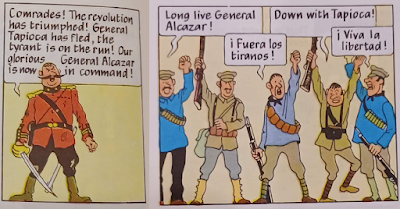
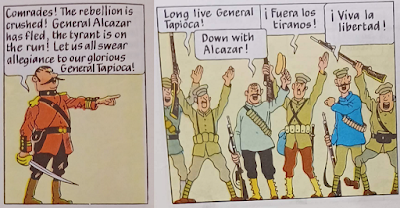
The other thing I was put in mind of on reading this, with reference to the regular changes of governing regime in particular, was the Tintin book The Broken Ear, which features a running joke about the regular changes of regime in the republic of San Theodoros:


The other bit of cultural overlap here is with the Alien movies, the first of which features a ship called the Nostromo, and the second of which features a ship called the Sulaco

Thursday, March 03, 2022

vloody near volodymyr

Never let it be said that Electric Halibut doesn't surf the bleeding edge of the Zeitgeist; as if to prove that point today's post is so topical it hurts, and it makes the following highly relevant geopolitical slash sporting point: former actor - whose previous roles included the voice of Paddington Bear and, erm, the President of Ukraine - and current President of Ukraine Volodymyr Zelenskyy looks a bit like England scrum-half and (as of last weekend) caps record-holder Ben Youngs.


Sunday, February 27, 2022

tha must be caracas

So, do you want to know my Wordle score? I absolutely know that you don't, and as it happens that's just as well, as I've never played it, though if you hang out on Twitter as much as I do it sometimes seems as if that puts me in a pretty small minority. I do have a couple of related anecdotes to share, though.

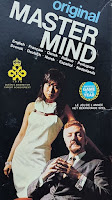
Firstly, while I've never played Wordle - and note that I have no particular animus towards it, it just doesn't spark my interest - I have played Master Mind, the game of which it is a sort of lexical variant, many times, including quite a lot recently as we bought Nia quite a nice Jaques wooden edition of it a year or two ago (around the same time as we acquired the Genius Square). Materials-wise that is a significant upgrade to the cheap-looking grey plastic of the old edition we had when we were kids; what that edition did have in its favour, though, was the classic exterior box design featuring the supercilious-looking Bond villain guy and his exotic younger lady friend. Do what you will behind your flimsy plastic screen, puny adversary, the picture seemed to say - four different colours, some tricksy red-blue-blue-red shit or just something literally mental like four greens - this guy will have anticipated it already, and when it's his go, despite you clearly seeing him putting two reds and two yellows in, when you have exhausted your hilariously gauche guesses his combination will be revealed to be something like a lotus flower atop a koi carp, a snail crawling along the edge of a straight razor or the faint odour of kumquats. And, moreover, having intellectually humiliated you, he will then leave you to contemplate your disgrace while he heads off to the boudoir for some eye-wateringly athletic tantric sex with his lady friend. 

What I had not realised until one of my Facebook friends casually mentioned it in passing a few weeks ago was that there was a deluxe version of the game with eight colours and five peg-holes (the standard edition has six and four respectively), whose box design featured a similar set-up but with a different, slightly older-looking, seated beardy guy and a similarly exotic lady who appeared to be Indian. You can make up your own "different lady"/"extra hole" jokes if you must; I want no part of it. Anyway, this edition came out in 1975 (the original dates back to 1971) so it's not new, but I was blissfully unaware of it (and, by implication, that I was playing an easier version of the game like some sort of dim-witted child) for over forty-five years. Oh well, never mind.

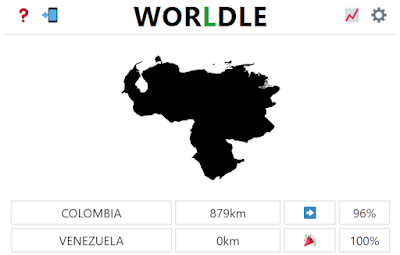
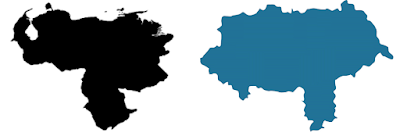
The other Wordle variant - a successor openly based on it this time, or at least aping its name and scoring graphics - is the amusing Worldle, based around silhouette maps of countries that you have to guess, with escalating scores based on your guess's physical proximity to the correct answer, rather than something more nebulous and coding-intensive like size or shape resemblance. There's a hard-to-hit sweet spot here between too easy (New Zealand came up the other day and I reckon over 99% of people would have got it in one) and too hard (tiny archipelagic nations are inherently very difficult and I failed to get anywhere near the Cape Verde Islands a couple of weeks ago), but occasionally you get one that sparks genuine interest - I spent six guesses fruitlessly circling the Balkans a week or so ago without landing on Serbia. When you do recognise one it's interesting to try to pinpoint what makes it distinctive - in the case of the one below it's the little teardrop-shaped inlet at the top left. If you spend as long looking at maps for fun as I do you'll recognise Lake Maracaibo (technically a narrow-necked brackish tidal bay rather than a lake); all you have to do then is remember which country it's in. As you can see below, I had a choice of two and guessed wrong the first time. Annoyingly, if I'd looked back at this recent-ish post I would have got it, as Venezuela features there as part of an imaginary straight-line journey from and to Brazil.


One other distinctive thing about Venezuela is the south-pointing protrusion in the middle at the bottom. I'm sure you don't need me to, but let me point you to the map here, and the prominent inclusion of North Yorkshire in particular. Now I'll grant you it doesn't have a ruddy great big lake on the north-west corner, but apart from that it's the spitting image, right down to the pendulous dangly bit in the middle. 


Just as with the Sakhalin/Eday thing there is a bit of a difference in scale - notwithstanding North Yorkshire being the largest county in England, Venezuela (the 32nd largest country in the world) is just under 114 times larger by area. While North Yorkshire's southern panhandle contains the city of York and the amusingly-named Sherburn-in-Elmet (previously featured in the amusing placenames list here), Venezuela's is occupied by the the state of Amazonas, lots of wilderness and very few people. 

Wednesday, February 09, 2022

we blog again

It's been a scarcely-believable fourteen years since this post about odd sporting clichés, so it's probably about time we set our stall out early doors, gave it 110% and left everything out on the pitch to try and come away with a result at the end of the day by doing another one.

In fact you might say: we go again. Right? I mean, you might say that, if it were not an extremely weird way of saying anything. But nonetheless this is the current phrase of choice in the sporting world, on Twitter in particular. The usual usage is in the wake of a sporting setback, to denote perseverance, undauntedness and a determination to redouble efforts, learn from adversity, come back stronger, once more unto the breach, this is SPARTA, all that sort of horseshit. Here's England prop Ellis Genge in the wake of their Calcutta Cup defeat last weekend:

Note that Genge cashes in "not to be" as well, another standard lament in the event of getting your arse handed to you in a sporting context. Here's Liverpool and England footballer Jordan Henderson in similar defiant post-ignominious-defeat mood:

In fact the phrase seems to be deeply embedded in the culture at Liverpool FC as they make liberal use of it at all levels of the club. It's not just Liverpool, to be fair, and it's not just football either - here are some from rugby, cricket and motor racing.

The interesting question here is: when did this start happening? My impression is that it's relatively recently, but it's hard to tell by just Googling stuff, not least because you have to sift out all the stuff that features the string "here we go again", which is also very common and conveys a completely different meaning. 

Sunday, February 06, 2022

the last book I read

Master Georgie by Beryl Bainbridge.

That's Mr., or perhaps even Dr., George Hardy to you - man of many talents, principally photographer and surgeon, occasionally even combining those two talents for experimental purposes. Obviously you can't wield a scalpel expertly with one hand and do some sort of selfie with the other hand, particularly not with one of those early cameras with the massive concertina lens and the hood and the explosive magnesium flash powder. So George has a photographic assistant, Pompey Jones, that he makes use of on certain occasions; Pompey being indebted to George for patching him up after a fire-eating accident.

We may as well meet the rest of the supporting cast of characters while we're here - there's Dr. Potter, husband of George's sister Beatrice, and then there's George's adoptive sister Myrtle, taken in by the Hardy family in Liverpool slightly accidentally at the age of three and intended to be shipped on to an orphanage, something that never quite happened. Myrtle has always looked up to George with a sort of puppyish devotion and has made herself useful to him in many ways, most notably at the age of twelve helping him to deal discreetly with the death of George's father - old Mr. Hardy having expired in rather inopportune circumstances during the physical act of coitus with a tuppeny-ha'penny prostitute in her foetid lodgings. Clearly this will not do, not least in terms of breaking the news to Mrs. Hardy, so some discreet shuffling around of remains is in order.

There are some odd episodes while the cast of characters remains in and around Liverpool - a bizarre episode where Pompey Jones is dragged along to a secret location to photograph George performing a cataract operation on an ancient ape, and further oddness where Pompey habitually sneaks into the Hardy residence in the early hours and moves various items of furniture around to see if anyone will notice. Eventually someone does notice, and unfortunately it's George's young wife Annie, who is spooked by an unexpected encounter with a tiger-skin rug and has a miscarriage.

We then jump forward four years and George, Myrtle, Pompey and Dr. Potter are on their way from Liverpool to Constantinople with the intention of bringing George's combined surgery and photography skills to bear in the bloody ghastly theatre of the Crimean War. Beatrice and Annie come along initially but it soon becomes apparent that this is no place for ladies and they return home; Myrtle is made of sterner stuff (and in any case would never abandon George) and stays. 

George makes himself useful assisting with the steady stream of casualties, and since some of them have been hit by cannonballs you can imagine there's a bit of stitching up and making good to be done. Pompey is working as a war photographer and Dr. Potter and Myrtle are making themselves useful where they can. War is not a tidy process with clear boundaries between participants and observers, though, and the party find themselves drawn into the conflict more and more directly, until eventually they are right in the middle being shot at and having severed limbs flying past their ears. 

This is the third novel from what one might think of as the second half of Bainbridge's career where her novels had a real-world historical setting; both its predecessors in that genre (The Birthday Boys and Every Man For Himself) having featured on this blog. Master Georgie is probably a slightly more oblique treatment of actual historical events than either of those two (I suppose in the case of The Birthday Boys that's partly because the characters are actual people who actually lived - and, shortly afterwards, died) and some aspects are slightly frustratingly oblique and allusive. The obvious example of this is that while it's obvious that George has occasionally struggled with repressed homosexuality, and that furthermore something slightly untoward has been going on between George and Myrtle (i.e. they've been fucking), most of the reviews take it as a given that Myrtle is actually the mother of George's children, something that I'm not convinced you could be sure of from reading the actual text. 

It's tremendously sly and clever, of course, and as the previous paragraph suggests makes some demands of the reader. It's perhaps a book that you admire for its craft and cleverness rather than engaging with the characters at a visceral level or being genuinely invested in the matter of whether they live or die among the flying cannonballs and gobbets of pulverised limb-flesh. Nevertheless Master Georgie was nominated for the Booker Prize in 1998 (the winner that year was Ian McEwan's Amsterdam, generally accepted as being his worst novel). Bainbridge was famously nominated for the Booker five times (in 1973, 1974, 1990, 1996 and 1998) but never won. 

Monday, January 31, 2022

the last book I read

The Hydrogen Sonata by Iain M Banks.

There comes a time in every major civilisation's life when you sit back and think: hey, we've done it all. Evolved some form of opposable limb appendages to facilitate tool use, used those tools to construct machines to escape our home planet's gravity well and traverse the galaxy, come into contact with other civilisations, some very different from our own, and managed to find a way to co-exist without annihilating each other, made some thought-provoking art about all of the above, stood around and appreciated it for a while; I mean, what else is left to do? Basically it's either the long slow process of decline and decay, or you go out in a blaze of glory and Sublime.

Now this is not like the chemical process of sublimation where something solid vanishes in a poof of smoke and is no more - wait, no, actually it's pretty much exactly like that. Once a civilisation has democratically decided it wants to Sublime - and the bar is set pretty high for an acceptable majority, none of your 52-48 business here - and a date is agreed upon, that's basically it. Assistance is mysteriously forthcoming from the Sublimed realm and on the appointed date everyone who's decided to go (and individual opt-outs are available for anyone who really wants to eke out their existence on a ghost planet, or, more sensibly, hop on a passing spaceship and start a new life somewhere else) just mumbles some mystical incantations and poof, job done. 

Tradition dictates that other civilisations who have links to the Subliming-adjacent one send tokens of their esteem and attempt to make good any unfinished disputes in a mutually respectful way. And so it is that a ship representing the reality-bound remnants of the already-Sublimed Zihdren civilisation makes its way to Gzilt space with a message. Once it has been intercepted by a Gzilt ship, though, the whole mutual respect thing goes out of the window and it is forced to reveal the contents of the message it is carrying earlier than planned, and, upon the contents being revealed, is promptly blasted into its component molecules for its trouble. I mean, don't shoot the messenger, right?

Vyr Cossont is just minding her own business trying to master a fiendishly difficult composition (the Hydrogen Sonata of the title) for a fiendishly complex eleven-stringed instrument that she's had a couple of extra arms grafted onto her torso especially to help with. That's Lieutenant Commander Vyr Cossont to you, actually, although everyone on Gzilt acquires a military rank by default and she has no military experience whatsoever. This doesn't stop her being conscripted for a top-secret mission, though; apparently something of crucial importance that could have a major bearing on the whole Subliming thing. But why her, and not, say, someone who knows what they're doing? Well, it turns out that while doing some interplanetary travelling a few years earlier (a sort of space-based gap year) she happened to spend some time with one Ngaroe QiRia, a Culture citizen who may be the oldest human alive, and by virtue of that may have access to some secrets which may explain the Zihdren-Remnanter "incident" and shed some light on the contents of the message being (unsuccessfully) delivered.

Meanwhile representatives of some Scavenger species are circling the various Gzilt home-worlds; these guys move into planets recently vacated by the Sublimed, hoover up all the loot (you really can't take it with you, you know) and sometimes move in, if the atmosphere and solid/liquid ratios suit their crazy alien physiology. Usually the outgoing civilisation confers a sort of Preferred Looter status on one set of ships, so the stakes and emotions are high. In this case the front-runners are the Ronte, sort of big insect-y dudes, and the Liseiden, who are big sentient eels slurping around in giant fishtanks. A delegation of Culture ships is also in attendance, either to provide a calming influence and a neutral party for conflict resolution, or to be interfering holier-than-thou do-gooders and spoil everyone's fun, depending on your point of view, and whether or not you are a giant sentient eel.

Cossont leaves her Gzilt home-world in search of QiRia but is promptly nearly rubbed out on the orders of some high-ranking Gzilt politicians who would rather things just be allowed to take their course without anyone rocking the boat, thanks very much. Rescued by a Culture ship, she enlists its help finding QiRia. Things are more complex than they appear, though, as while the physical QiRia is located, it turns out he's had lots of his memories removed and stored on various mind-state backups in various locations. The relevant memories, it turns out, hilariously, are actually back on Gzilt, in an old pair of QiRia's eyes. So, all back to my place, collect the eyes, see what's on them, have a pint and wait for all this reality to blow over, right?

Obviously it's not quite that simple: for one thing there are hordes of Gzilt and Culture ships having a Mexican stand-off in orbit around the planet, and secondly the eyes turn out to be in the possession of a guy/creature called Ximenyr who is the sort of master of ceremonies for a marathon end-of the-real-world party on an endlessly circling airship. So getting in won't be easy, and getting out next to impossible. Fortunately Cossont has the Culture on her side and those guys do six next-to-impossible things before breakfast. The memories are retrieved, decisions are made about the value of sharing the data more widely at this late stage (literally hours before the Subliming), full-scale spaceship wars are avoided, honour is seen to be satisfied all round and everyone poofs off into an orthogonal dimension for ever as planned. Well, except for Cossont who decides that actually she'd prefer to stick around, practise her sonata a bit more, hitch a lift on a Culture ship, go and visit QiRia again and have some more adventures.

Sadly there won't be any future Culture novels describing those adventures, as this was the last science fiction novel of Banks' life, published in October 2012 about eight months before his death (The Quarry was his last non-genre novel, published posthumously). 

It's tremendously entertaining, as these books always are, and there are a couple of tremendously exciting action set-pieces, but to be honest it's not up there with the best of the Culture series, in my view anyway. There are a couple of reasons for this: firstly that there's too much plot involving the Culture ships with their tiresomely hilarious names and inter-ship messaging and not enough recognisably human-scale interaction. The ratio is far better than, say, Excession, which as I recall involved pretty much no organic life at all, but still. The other problem is the whole notion of Subliming - mentioned in a very hand-wavey way in several of the earlier books, it's always teetered on the edge of magic and/or religion (and aren't they, after all, pretty much the same thing) and the attempt to rationalise it here as being a sort of re-calibration of matter into a higher dimension (seventh? eighth? eh, you know, one of the spare ones) undetectable to the "real" universe feels like a bit of a cheat.

Vyr Cossont is an engaging protagonist but she doesn't really have enough to do, and, a bit like Lededje Y'breq, the nominal main character of Surface Detail, spends a lot of time being ferried around and saved from peril by a Culture ship and its AI Mind. And the endless airship party reminded me of the endless flying cocktail party in Life, The Universe and Everything - the one Arthur Dent gets hit in the small of the back by while flying - although with lots of extra body modification and freaky sex. Lastly, the central plot MacGuffin is entirely inconsequential - the big secret the Zihdren wanted to impart was that the Gzilt holy book, The Book of Truth, was, rather than being handed down from some mystical realm, a Zihdren plant as part of a sort of sociological experiment. I mean, I'm not the best person to adjudicate here, but since one of the unusual features of the Gzilt Book of Truth was that substantial portions of it did, indeed, turn out to be true, or at least consistent with how the universe behaves, it's not very clear why anyone should care. In any case the Culture Minds choose not to disseminate the information widely anyway, so no-one ever finds out.

So, obviously, completing the last Culture novel is the obvious time to construct that Culture novel top ten you've been waiting for, except that I can't, because there are only nine of them. I should preface this by saying that they are all good and contain more wit and imagination than most books of any genre, and within the sci-fi genre in particular stand out for containing humour, sex and strong female characters, none of those being things sci-fi has traditionally been very good at. So, here we go: 

  1. Consider Phlebas
  2. Inversions
  3. Look To Windward
  4. Surface Detail
  5. Matter
  6. The Player Of Games
  7. The Hydrogen Sonata
  8. Use Of Weapons
  9. Excession

Obviously the order you read them in has a bearing; I made a point of reading them in the order they were written, so Consider Phlebas was the first one I read, and also objectively contains the most rootin'-tootin' space adventure action of all of them. That's not the sole criterion, as Inversions is pretty cerebral, although stuff does happen. Anyway, I reserve the right to change my mind about the exact order on a near-daily basis. 

Friday, January 28, 2022

bordering on the ridiculous

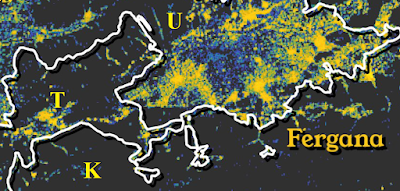
Further to the international border talk in the previous post, go back to the start and zoom in on the map in the original tweet and you'll see some oddities. Here (see below), for example. What are those little bits that seem to have dropped off Tajikistan (T) and Uzbekistan (U) and landed in Kyrgyzstan (K)? And indeed the little splinter a bit further north that seems to have peeled off Tajikistan and ended up in Uzbekistan?


Well, once again, I'm glad you asked. See, we all remember those wall maps of the world with the coloured blobs representing the countries and the nice neat black lines representing the borders between them. I mean, yes, some of the borders were a bit wibbly-wobbly where they followed some sort of natural feature, maybe a mountain range or more usually a river (though this can itself lead to problems, since rivers change course occasionally), but fundamentally one side of the border was Country A and one side was Country B and if you zoomed in enough or went and stood in the relevant spot you could step over the line from one country to the other.

Moreover there's a sort of unspoken assumption - unspoken because it's almost too obvious to need stating explicitly - that countries are internally "connected" in some way, i.e. that if you pick any two random points in a country there'd be a route between them, however circuitous, which didn't require you to cross a border and enter another country. It turns out that this is not true, though, and that if you zoom in on some areas of the map the picture isn't just the same, only bigger, but far more complex than you could have imagined. Take the examples above: the blobs on the map are various exclaves of Tajikistan and Uzbekistan including Sokh and Vorukh.

Weeeeell, you'll be saying, those crazy vodka-fuelled, horse-rectum-crazed ex-Soviets had all sorts of weird habits; we urbane western Europeans would never get involved with that sort of nonsense. Well THINK AGAIN suckers, because let me introduce you to a little place called SPAIN that you might have heard of. Hold on there, bucko, you'll be saying, I know where Spain is: big squarish country occupying most of the Iberian Peninsula. Well let me BLOW YOUR MIND by revealing that some of Spain is wholly in France, and even more bizarrely some of it is on the north coast of Africa. It's not just the Spanish who are at it, though: there are bits of Germany in Belgium and Switzerland, bits of Italy in Switzerland, and most bizarrely of all the absolute insanity of the situation in Baarle-Hertog and Baarle-Nassau and their division between the Netherlands and Belgium. The only thing that might have out-bonkersed it would have been the scattered confetti of a couple of hundred exclaves on the India-Bangladesh border, but sanity prevailed and they were all (well, all but one) swapped back to being in their surrounding country in 2015. Which is a shame, in a way, because they included the only third-order enclave in the world (a piece of India within Bangladesh within India within Bangladesh). You'll have to content yourself with third-order lake islands instead. 

All of this largely comes about because while drawing borders on a map is pretty easy, things get a lot more complicated on the ground at 1:1 scale when you involve real people and real immovable bits of landscape. Even the really simple stuff that's probably cropped up in one of your lockdown Zoom quizzes like Colorado and Wyoming being the only two perfectly rectangular US states turns out not to be true - it turns out that thanks to various surveying cock-ups and some inconvenient mountain terrain Colorado is actually a hexahectaenneacontakaiheptagon. Put that in your next Zoom quiz.

back in the (former) USSR

Here's another post inspired by some initial exchanges over on Twitter - it also shares a theme with this earlier post about imaginary straight-line journeys between American states. I follow a few map-related accounts on Twitter and one of them tweeted the map below which I quote-tweeted with a challenge, also related to imaginary straight-line map journeys, as you can see:

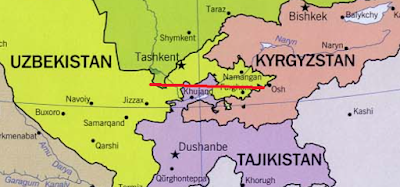
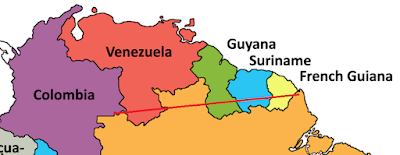
You can see, just at a conceptual level, the sort of thing we'll be looking for here: quite large countries which have fairly irregularly-shaped borders, in particular we're looking for areas of convexity where you can draw a line which joins two points in the country but passes outside of it in doing so. As you'll see from the thread following that initial tweet, I had a go at finding a few - examples are below:

Uzbekistan - Kazakhstan - Tajikistan - Kyrgyzstan - Uzbekistan:


Brazil - Colombia - Venezuela - Guyana - Suriname - French Guiana - Brazil:


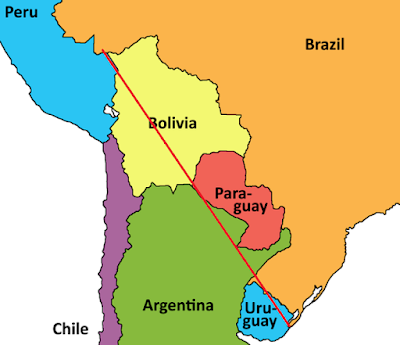
Brazil - Peru - Bolivia - Paraguay - Argentina - Uruguay - Brazil:


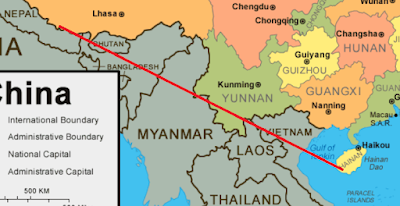
China - Nepal - India - Bhutan - Myanmar - Laos - Vietnam - China:


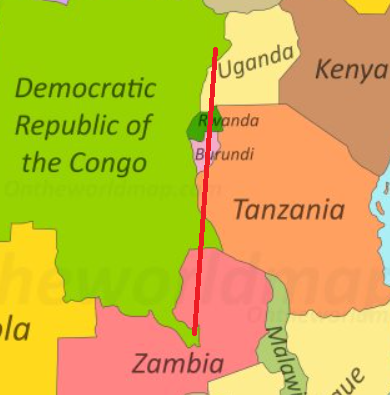
Democratic Republic of the Congo - Uganda - Rwanda - Burundi - Tanzania - Zambia - Democratic Republic of the Congo:


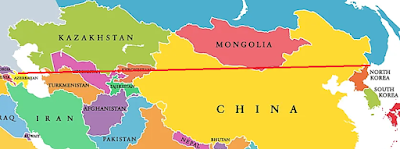
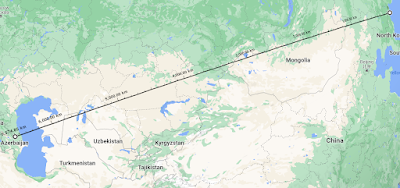
All of those (apart from the first one) traverse five other countries (in some cases more than once, and in some cases re-entering itself - ooer - on the way; I deem this not to matter) before coming back into the starting country. Better ones are available, and it should come as no surprise that the best one I know of (and it wasn't my work, I should add) features the largest country in the world, Russia. This one starts on the western edge of the Caspian Sea and then traverses no fewer than eight other countries before returning to Russia over near Vladivostok. Take a look:

Russia - Azerbaijan - Turkmenistan - Kazakhstan - Uzbekistan - Kyrgyzstan - China - Mongolia - North Korea - Russia:


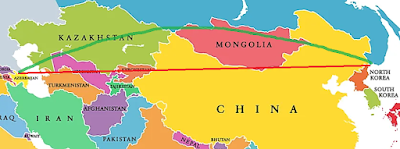
Now I know what you're thinking: a pity we couldn't juuuuust bend the line southwards slightly to snick the top end of Tajikistan as well, as that would clock up an extra country. This is dangerously subversive thinking and opens up questions like: you know, the world is not actually flat, so doesn't this whole straight line thing depend entirely on which map projection you're using? And my answer to that is WELL I'M GLAD YOU ASKED as there is a whole other world of nerdy interest there which there isn't really time and space (if you will) to go into now. Suffice it to say that the only projection-independent way of rendering straight lines is to use great circles, which look a bit weird and somewhat counter-intuitive on 2-dimensional maps given that they actually represent the shortest distance between points on the Earth's surface (assuming you're constrained to travelling over that surface rather than just tunneling directly through the Earth's crust). A great circle route between our Russian end-points actually reduces the country count considerably, as it looks like this:


Represented on the original map 2-D that would look something like this (the green curved line) - note that this way you lose Turkmenistan and Kyrgyzstan from the original list:


The borders between Kyrgyzstan, Tajikistan and Uzbekistan are actually even more complex and wiggly and convoluted than this fairly large-scale map makes it look, as it happens. We might come back to this later. 

Anyway, I leave you with the words of TS Eliot which seem somehow appropriate here:
And the end of all our exploring
Will be to arrive where we started
And know the place for the first time