Wednesday, November 30, 2011

abyssinia later: I'm off to hang with dahomeys

My brief dalliance with mid-20th century African history and politics in the last book post, as well as the interesting old bits of paper post a few days ago, remind me that I have been sitting (not literally) on some more interesting stuff for a while. As so often the more fascinated by maps you are the more interesting it'll be.

My sister Hannah gave us a book of photographs from the Magnum photographic co-operative last Christmas - fascinating in its own right, but almost more fascinating (to me, anyway) was the paper she'd wrapped it in, an old wall map of some sort. Clearly fairly old, judging by the names of some of the countries. But how old?

We all know the method for dating a dictionary: masturbation. I don't mean doing it, I mean looking the word up. Maps require a different approach, though, and the obvious one would seem to be: construct a table of date ranges from the names shown on the map, and the date of the map will be in the (hopefully narrow) band of dates that they all have in common. Let's check it out.

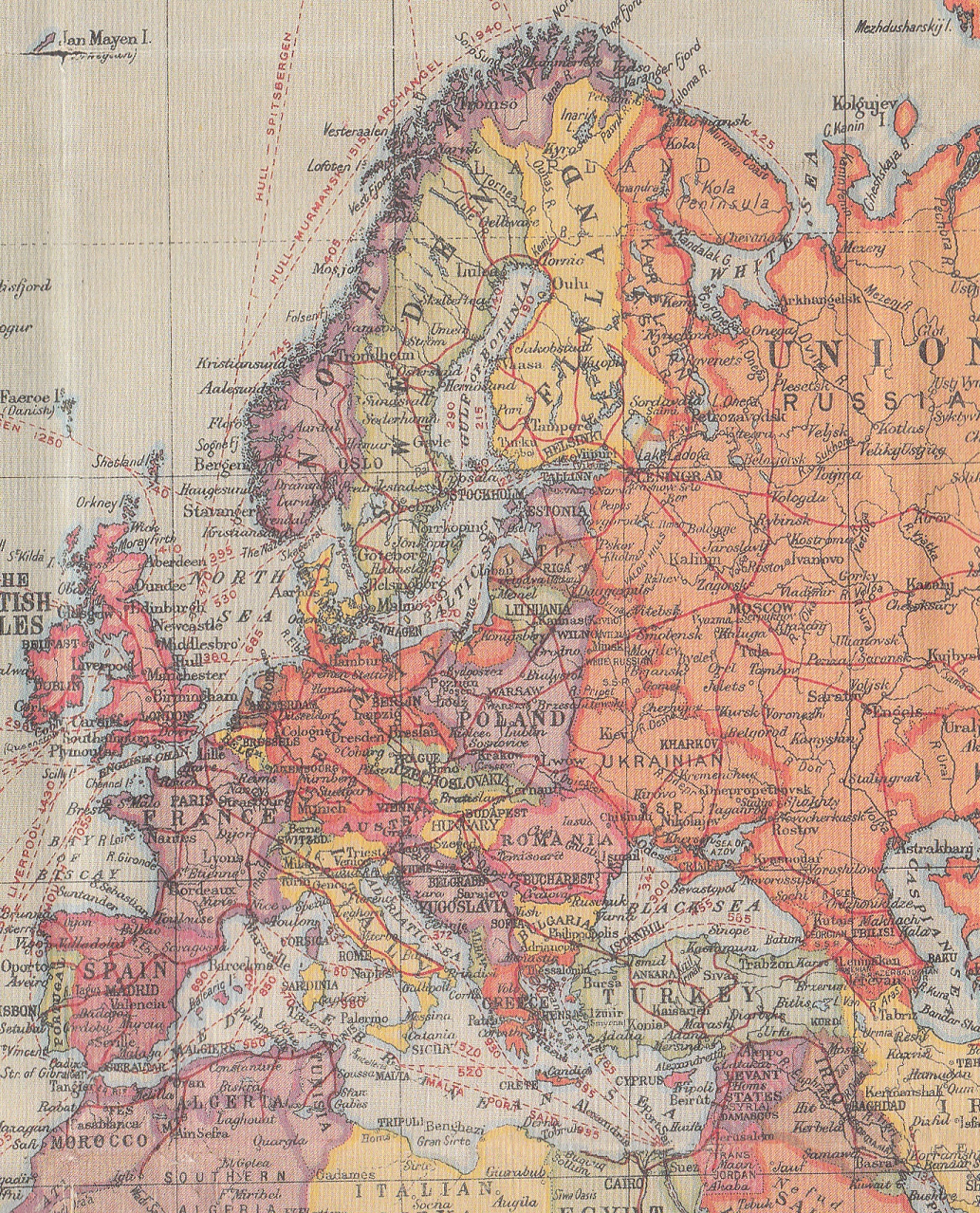
Europe and the Middle East first - a larger map can be viewed here.

  • Most obviously there is a united Germany, which means it must be before 1949 (or after 1990, but I'm ruling out that possibility). The presence of the Polish Corridor and the Free City of Danzig suggests it's the post-Treaty of Versailles borders, i.e. after 1919.
  • Yugoslavia's borders suggest it's before 1941, it must also be after 1918 as Yugoslavia didn't exist before then.
  • Similarly Czechoslovakia didn't exist before 1918.
  • There's no Israel, so it must be before 1948.
  • The "Levant States" generally referred to the French Mandates of Syria and Lebanon between 1920 and 1946; similarly Transjordan existed between 1921 and 1946 (at which point it became Jordan).
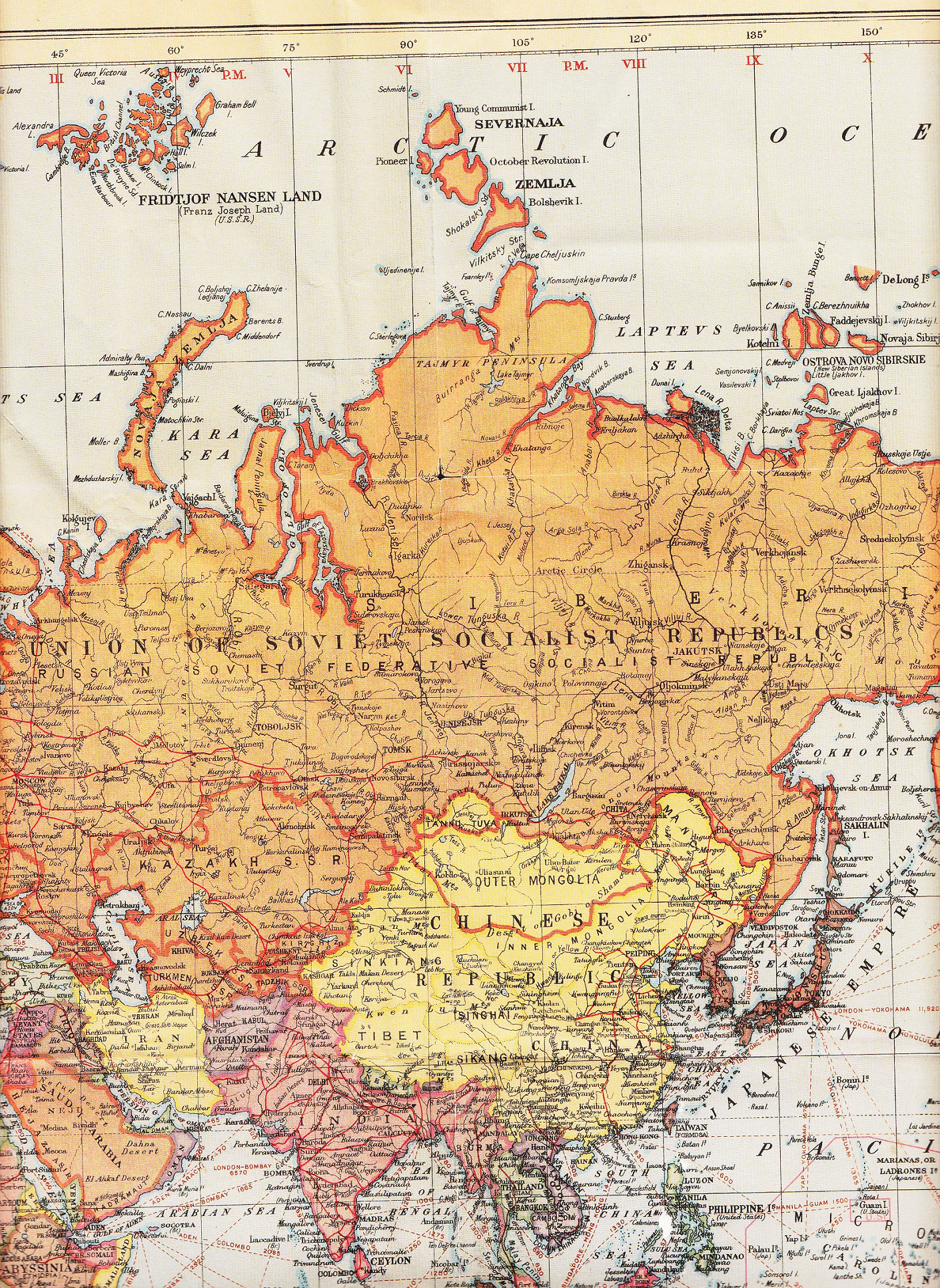
Let's take a look at Asia (bigger map here):

  • French Indochina existed officially between 1887 and 1954, after which it became North and South Vietnam and Cambodia.
  • India is still occupying all the territory now occupied by Pakistan and Bangladesh, which puts it before 1947.
  • Sri Lanka is still called Ceylon; the change happened in 1972.
  • Sakhalin is still in two bits, the lower bit being the northernmost prefecture of Japan - this situation lasted from 1905 to 1945 when the whole island reverted to belonging to the Soviet Union.
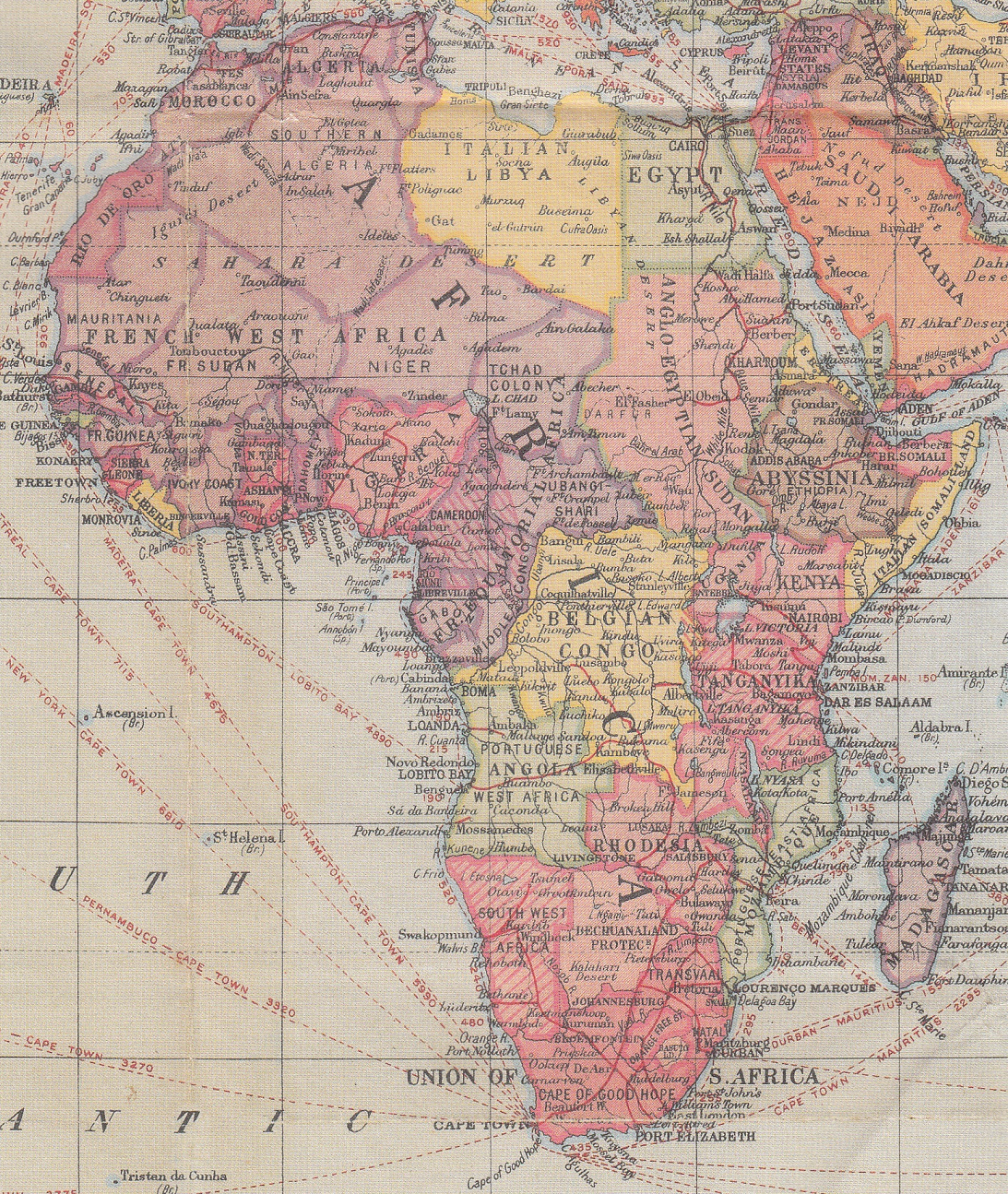
This is all very interesting, but we know where the real interest is going to be: Africa. Countries change their names there as almost often as I change my underpants - i.e. once every two or three years. So we should be able to narrow it down still further. Let's have a look (bigger map here):

So, if my identification of all those dates is correct, it would seem that we can conclude that this is a map of the world that dates from the mid-1930s, specifically between 1932 and 1936.

Thursday, November 24, 2011

read all about it

Much upheaval at Halibut Towers over the last few weeks, some planned, some not. More of that at tedious and unnecessary length later, but for the moment here's some by-products of a few trips up to our loft to lift up some boards and have a general root about and tidy up in advance of getting some electricians in to sort out the parlous and potentially fatal state of our wiring.

Among all the knackered old loft insulation, bits of polystyrene and wood and other assorted junk I found some bits of old newspaper that had evidently been used as makeshift packing and/or insulation back in the day. And when I say back in the day, I mean way back in the day, as upon closer inspection the bits I retrieved reasonably intact turned out to be from a copy of the South Wales Argus from Friday, January 20th, 1956. Here's a few scanned pages:


A few things to note:
  • There's a report on the first day's play in this unofficial Test match between England and Pakistan in Lahore.
  • Leslie Davey from Blaenavon was convicted of beating to death William Roberts, the man whom his wife had been "associating" with. Just to be clear for a 21st century audience, that means "fucking".
  • You could pick up a nice house in the Beechwood Park area (i.e. pretty much the exact location of Halibut Towers) for around £3,000.
  • Just to put that into perspective, a top salesman could expect to earn in excess of £1,000 per year.
There is (on the penultimate page) a list of the pubs in the Newport area where you could obtain a delicious pint of creamy Guinness (and these were the days when it was still OK to claim that it was "good for you"). Of the ones in Newport proper here's the current state of play:

  • The Cambrian Inn on Commercial Road appears to have met its demise fairly recently, as the building is still there, and still recognisably a pub, at least until recently.
  • J. Dobell and Bartholomew Ltd. on the High Street is long gone as far as I know.
  • The Griffin on Griffin Street is still there.
  • The Murenger House on the High Street is still there and remains probably the best of the city centre pubs; that said it's the only one on this short list that I've ever been in.
  • The Potter's Arms on Dock Street is now just Potters, a bit more trendy wine bar-y these days.
  • The Old Rising Sun on Shaftesbury Street is still there but is long since empty; it's on a bit of an awkward spot these days right on a roundabout under the giant Heidenheim Drive flyover.

Wednesday, November 23, 2011

duvalwatch continues

There was an interesting article on the BBC website the other day about David Duval, one of my favourite golfers and a man whose recent trials and tribulations would have crushed the life out of a lesser man. Duval seems to have a Zen-like calm about him these days despite seemingly uncontrollably erratic form; the article describes his bid to qualify for his PGA Tour card for the 2012 season (and so far so good as he finished tied 2nd in the preliminary event).

The last time Duval got a mention here he had just finished tied 2nd in the 2009 US Open - after that he started off the 2010 season with a bang by finishing tied 2nd at the AT&T tournament at Pebble Beach. Results after that were a bit erratic, but included another top 10 at the Frys.com Open late in the season, and a few other decent results meant that he kept his tour card by finishing 106th on the money list, his best result since 2002. 2011 was less good - after a couple of tidy results in the early tournaments including a tie for 9th at the Northern Trust Open the rest of the season was pretty dreadful and he ended up down at 152nd on the money list, outside the top 125 that retain their card by right.

Duval's struggles resonate with me in particular, as he's not just grindingly mediocre in an easily understandable way - he makes a lot of birdies, but just throws in the occasional disastrous quadruple bogey at inopportune moments, something I can relate to very closely. But there are plenty of fairly recent examples of players emerging from decade-long slumps to enjoy a string of late-career victories, Hal Sutton and current world number 5 Steve Stricker to name but two.

Saturday, November 19, 2011

the last book I read

The Poisonwood Bible by Barbara Kingsolver.

I've seen this little quote in various places, mostly unattributed - this link attributes it to Annie Dillard's book Pilgrim At Tinker Creek, though she is only quoting a story she heard somewhere else. Anyway, here it is:
I read about an Eskimo hunter who asked the local missionary priest, 'If I did not know about God and sin, would I go to hell?' 'No,' said the priest, 'not if you did not know.' 'Then why,' asked the Eskimo earnestly, 'did you tell me?'
There are a few schools of thought regarding what you have to do to get to the Christian heaven (the particular branch of vacuous hand-waving nonsense concerned with this is called soteriology). Some say just being generally nice is enough, while others say no, you pretty much have to buy into the whole God/Jesus/crucufixion/rich man/eye of camel thing, otherwise you're fucked. Which, as this blog post observes, means that either all missionaries are arseholes, or God is.

Nathan Price clearly is of the get yourself in there and convert those heathen savages school of thought, and wouldn't have much truck with the Eskimo anecdote, judging by his decision to uproot his family from rural Georgia to the deepest darkest depths of the Congo in 1959. His wife Orleanna and his four daughters Rachel, Leah, Adah and Ruth May clearly don't get much of a say in the matter.

Needless to say when they get installed it's not quite the parade of grateful pickaninnies queuing up to be delivered from their primitive unsaved state that they might have expected - the locals have their own gods, thanks, and they seem to be about as effective as any others, generally not wiping out the harvest and killing everyone with flood and pestilence unless they really feel like it. Plus the village chief derives part of his authority from supposedly having the ear of certain key guys in the existing hierarchy. So this new guy Jesus is going to have to display some pretty impressive chops if he's going to displace the incumbents, and Reverend Price is labouring under a few disadvantages, not least the language barrier, but also a general lack of aptitude for dealing with conflict. It's probably at least partly a lack of practice, there being not much in the way of rival snake-worshipping voodoo religions in 1950s Georgia, and not much sassy back-chat at home either, the Rev being an iron-fist patriarchal type.

The daughters, whose alternating voices most of the novel is written in (with occasional interjections from Orleanna) are a bit more receptive to their new surroundings and do their best to integrate with the new community, in their differing ways. Rachel, the eldest, affects a lofty disdain for all the undignified messiness of it all, a stance somewhat undermined by her gift for unfortunate malapropism. Meanwhile feisty Leah helps her father dig the vegetable garden and picks off targets with her home-made bow and arrow, all watched by her mute and crippled twin sister Adah and younger sister Ruth May.

The family survives various scrapes - Adah is briefly believed to have been eaten by a lion, Ruth May breaks her arm, the village is briefly overrun by army ants, and Rachel has to negotiate a series of misunderstandings which nearly result in her being betrothed to the village chief Tata Ndu. Eventually their luck runs out, though; Ruth May is bitten by a green mamba and dies. This is the last straw for Orleanna, and, having presided over the burial, she leads the rest of her daughters out of the village, on foot and in the clothes they stand up in, leaving Nathan to continue his ministry alone.

Having gone their separate ways, the family re-establish themselves in various far-flung locations. Orleanna and Adah return to America, where Adah is eventually cured of her disabilities and becomes a doctor. Leah stays in the Congo with her husband Anatole and witnesses the country's troubled metamorphosis into Zaire. Meanwhile Rachel is working her way through a succession of husbands and ends up running a hotel somewhere north of Brazzaville. The fate of Nathan is never conclusively established, but it is rumoured that he chose the wrong group of people to preach to somewhere deep in the jungle and got himself killed. The novel ends with mother and daughters, reunited, returning to a newly-renamed Congo to try to locate Ruth May's grave.

The troubled history of this particular bit of central Africa, and the Congo Crisis of the early 1960s in particular, is tightly interwoven with the story of the Price family; it turns out, for instance, that Ruth May dies on the same day as Patrice Lumumba is killed and much hope for a brave post-colonial world dies with him. Instead Joseph Mobutu siezes power, with American connivance, and ushers in 30 years of violence and corruption.

The historical stuff is all very fascinating, in fact in a way it's more fascinating than the Price family's African antics - the first two-thirds of the book, covering the family's time living in the village, is interesting in its own way, but not much of any real consequence happens until Ruth May's death, at which point the chronological pace speeds up and the last third of the book covers 35 years or so. You can bet that if this had been by Joyce Carol Oates, an author whose work it superficially resembles, that a great deal more misery and indignity would have been heaped on the family's heads. The all-female voice means that Nathan is a strangely remote figure, too - the inner thoughts and motivations of an evangelical Baptist missionary prepared to come halfway across the world to preach are potentially a good deal more interesting than those of his sixteen-year-old daughter, with the best will in the world.

On the basis of the two Barbara Kingsolver novels I've read, I'd say Prodigal Summer is probably the one to go for, which is not to say that there's anything terribly wrong with The Poisonwood Bible, just that I wasn't totally bowled over by it. I'd also suggest that if you want a novel about a charismatic and slightly deranged father-figure leading his young family into the wilderness with predictably tragic results, the novel you want is Paul Theroux's The Mosquito Coast.

Wednesday, November 16, 2011

you ain't seen me, right

A couple of brief supplementary bits after the last post:
  • We went to a few pubs in Edinburgh, most notably the excellent Abbotsford on Rose Street, which we went to while we were on our way to Calton Hill to watch the fireworks. The firework display was actually happening at Meadowbank Stadium a mile or so up the road, but we (and a lot of other people) decided we were too lazy and/or tight to get tickets so we hung around on top of the hill and watched from there. Anyway, the Abbotsford has many interesting local (or at least Scottish) ales, most notably Avalanche from the Fyne Ales brewery which I had a couple of and was very good.
  • If you followed the link to the Silent UK raid on the Forth Bridge you may have seen some of the other fascinating stuff on the site, most notably the infiltration of the now-defunct Mail Rail lines under London. The whole urban exploration thing is fascinating, I think - if you think so too then you will find much to enjoy at places like Forlorn Britain, Derelicte, Forbidden Places and PlaceHacking. If you're tempted to try and emulate any of their activities, just remember it's trespassing, almost certainly illegal and we never had this conversation.

you (now) know what I did last summer

Here's a few links to some recent batches of photos that may or may not be of interest:
  • Firstly, and rather belatedly, some photos from my wedding to the lovely Hazel back in June at the delightful Steppes Farm, which is in Rockfield just a few miles from Monmouth. The licensed venue for weddings at Steppes Farm is their restaurant, The Stonemill, which is also well worth a visit just for the food, which is excellent. They also serve excellent beer from the Kingstone Brewery, which is just a few miles away in Tintern - the Kingstone Gold is particularly quaffable, and I should know, as I quaffed quite a quantity of it on the day.
  • Secondly, the annual Swanage trip in September. You'll pretty much know the drill by now, and I've eased off on the obsessive documentation of the pub crawl(s), so there are fewer photos than in previous years. We did, however, branch out on the Sunday and go to Wareham, where, after a pitifully short token stroll up the river and back we did a tour of some pubs, most of which were quite good, the pick probably being The Old Granary, which in addition to having a scenic riverside location and some of the best Badger beer I've ever had, appears to have a strictly all-supermodel bar staff hiring policy in place, which is nice.
  • Finally, a brief jaunt to Edinburgh a couple of weeks ago to do a recce for a wedding Hazel is shooting in December, as well as some standard touristy activities we didn't do last time we were there in February 2009. One of the things we did do last time was visit the Scotch Whisky Experience up by the castle, but as it was being refurbished at the time we got a somewhat cut-down version of the full experience - basically a room, a video, a PowerPoint presentation and a glass of whisky. This time, however, we got the full multimedia package complete with a trip on a little ghost-train style ride with carriages shaped like whisky barrels. And, equally importantly, more whisky (Old Pulteney, as it happens, on this occasion). Served, interestingly, in a room dedicated to displaying the world's largest single collection of Scotch whisky, collected by some guy from Chile and then donated. A fascinating historical document (of, in a lot of cases, distilleries that no longer exist and whiskies that can no longer be obtained, anywhere) but I really think buying this stuff and then not consuming it is missing the point a bit. We also rectified an omission from an earlier trip and climbed the 287 steps to the top of the Scott Monument. I should warn anyone aspiring to do this that the last section is very cramped and narrow; I am not especially fat (well, not massively fat, anyway) but I did struggle to cram my broad manly shoulders through the top section of the spiral staircase and emerge onto the top platform. Good views, though. And you get a certificate (see right). While Hazel was off doing wedding-related activity on the Saturday morning I took myself off on the train from Haymarket to North Queensferry (about a fiver for a return, and a trip of about 15-20 minutes) to have a look at the Forth Bridge. And very impressive too, although it was still somewhat shrouded in mist. So I went back to the station, got on a train going the other way, got off at Dalmeny on the other side of the bridge and wandered about the slightly larger and more interesting South Queensferry for a bit. By that time the mist had cleared and I got some quite good pictures, aided by the bridge being largely free of unsightly scaffolding for once. Those even more fascinated by bridges than me might want to get even more up close and personal, in which case try either this video of someone taking a lift to the top, or this account of some somewhat hair-raising ninja-stylee urban exploration.
Tuesday, November 01, 2011

good heavens

Any form of social change which proceeds by little baby steps (as most of them do) will tend to be largely invisible to those participating in it unless they make a point of stepping back and reflecting on it. Hell, that applies to any form of incremental change; I still see the same face looking back out of the bathroom mirror as I did when I was 20, but I'm self-aware enough to know that that's an illusion.

It's instructive, then, to watch this clip from the BBC programme The Big Questions and reflect that it wouldn't have been so long ago that it would have been unthinkable for the intervention about 25 seconds in to have been made, and for the subsequent exchange to have happened. If for some reason you can't see the clip, here's a (slightly paraphrased) summary:
God-botherer: All aborted foetuses go to heaven. Totes. For real.
Sensible woman: By that rationale, doesn't that mean we've done them a favour by aborting them before they can get all soiled and sinful?
God-botherer: No. Also....look over there! [runs away]
Sensible woman: This whole "heaven" idea is patently ridiculous, isn't it? I mean, look at yourselves.
Some idiot: Aha, but you "believe" in money, and that doesn't exist, does it? HA! CHECKMATE!
Sensible woman: WTF?
Some idiot: Money. Doesn't exist. Ergo, a) there is a God, and b) I win.
Sensible woman: WTF?
The woman courageous enough to tell a room full of swivel-eyed goddists that they are idiots is Kate Smurthwaite, who is a stand-up comic, vice-chair of Abortion Rights UK, blogger and tweeter.

Now you might usefully choose to argue with the value of calling those who believe in heaven "idiots" (clearly by any objective measure they are idiots, but you might question the political effectiveness of telling them so). It's interesting, though, to compare that pretty mild rebuke with the reactions in the comments threads at the various sites where the video clip has been posted, a few of which are reproduced here, and a disturbing number of which take the form "how dare she - a woman - diss God? Someone should RAPE SOME SENSE INTO HER". Now it's not necessarily easy to tell which of these are genuine insane religious outrage, and which are just 14-year-olds trolling, and, in both cases, how much these sentiments are amplified as a result of the Greater Internet Fuckwad Theory, but it puts "idiot" in perspective, anyway.

Of course the increasing social acceptability of vocal dissent from the status quo of religious nonsense being given uncritical approval is great - on the other hand the fact that there still exists a religious TV programme on a main terrestrial channel called The Big Questions is a bit depressing. As this tweet says, as far as God and religion go there really is only one "big question", and the answer is "no".

Sunday, October 30, 2011

mmmmm......fattening

We went to the Cowbridge Food Festival today, always a reliable source of tempting yet expensive gourmet items. Today's haul (pictured below) included:

We also popped into the Vale Of Glamorgan Inn as they were running a real ale festival. I had a couple of quite decent pints, which is always nice at a real ale festival where you're generally required to choose from a list of a dozen or so you've never heard of, but more importantly in order to get to the bar for the second of them I had to step around none other than legendary Wales and British Lions full-back JPR Williams. Given that the 17-month driving ban he picked up for a drink-driving incident in March 2010 will have expired only a couple of months ago I trust he had made alternative arrangements for getting home, seeing as how he was tucking into a pint with some gusto.

Thursday, October 27, 2011

the last book I read

The Very Model Of A Man by Howard Jacobson.

A good story has a beginning, a middle and an end, they say. And this one has a beginning, all right: the Beginning Of All Things, which, according to some people anyway, was exactly 6014 years ago last Sunday.

Actually we don't quite start from the very beginning, as this isn't principally God's story, any more than it is Adam and Eve's, though they all feature at various points. This is the story of Cain, a more significant figure in human history (or at least this mythical version of it) than most people realise. Think about it: the first human to be born, rather than just poofed into existence out of some dust or a rib-bone, and therefore the first baby, the first child, the first teenager, all that stuff, as well as possibly the first person with a belly-button. And, of course, as you'll know if you were paying attention in bible study class, the first murderer.

It's not quite a straight rehash of the Book of Genesis, though - Adam and Eve aren't the innocent fig-leaf-clad nymphs of popular legend, but instead a pair of cantankerous middle-aged types, while God is barely competent to take charge of the planet without accidentally magicking stuff into existence left and right. Meanwhile Cain amuses himself thinking up names for stuff - parsley! gazelle! molybdenum! - and growing various amusing mutant plants. All is well until Eve bears another son - Abel, the apple of his parents' eyes, and the source of much inevitable fraternal (and, ultimately, fratricidal) tension and resentment.

These post-Edenic reminiscences are revealed to be a series of public performance-art-esque readings given by Cain in his new dwelling place, Babel. Yeah, that Babel. What he's been up to since fleeing the familial home isn't clear, but he's now set up in Babel and seems to be something of a local celebrity, as well as a focus for fear and superstition among the local seers and sages and entrail-readers.

Anyway, Cain's rambling recollections eventually build up to the climax we and his audience have been waiting for, the story of how he killed his brother. Having delivered himself of this, he feels it necessary to escape from other people, and from the ground which cried out and betrayed him after he killed his brother. So, what better way to do this than to build a ruddy great big tower? That can only go well.

The Very Model Of A Man could be said to mark a key mid-point in Howard Jacobson's literary career - following the rollicking comic novels Coming From Behind, Peeping Tom and Redback (the last of these published in 1986, six years before The Very Model Of A Man in 1992), and preceding a six-year gap in his output (prompted, some say, by the lukewarm critical reception it got). It's certainly the least obviously comic of the novels of his that I've read, though it does still contain some cherishable turns of phrase, and is (as all Jacobson's books are) liberally marinated in concentrated Jewishness, with the obligatory kvetching and pessimism.

Beyond the surface cleverness and the bold choice of subject matter it's hard to see the point of it, though: it's not as if there's any particular surprise in the climactic revelation about Abel's death; we all knew that was going to happen, and there isn't even the consolation of any spectacular chainsaw dismemberment or anything like that; Cain just punches him in the head a few times and he carks it. In Cain's defence, though, bear in mind that Abel is the first person in human history to die - had God made it clear that this was even possible? This is all pre-Ten Commandments, don't forget, with the "thou shalt not kill" and all that stuff. Are we sure that Cain knew the possible consequences of his actions? What the point of all the surrounding scenes set in Babel is isn't clear either, beyond establishing, given Cain's treatment of his native girlfriend Zilpah, that a few years contemplating the error of his ways hasn't made him a nicer person.

A geographical footnote, while I remember: the half-built ziggurat at Etemenanki that Cain is offered as the starting point for his tower is a real place, a few miles south of Baghdad, and is even marked as "Tower of Babel" on Google Maps. Nothing but a few lumps of rubble left now, though.

No doubt Woody Allen is heartily sick of people hankering after "the early, funny ones", but my favourite Jacobson books are the first three. The later ones like No More Mr. Nice Guy and The Mighty Walzer are fine, but don't have the manic comic energy of the earlier ones. And The Very Model Of A Man is probably best described as an interesting experiment with some good moments, but overall it feels like an overwrought attempt to write something "serious" and "significant". Peeping Tom is probably still the one I would recommend, overall, though I should point out that I haven't read the more recent ones like the 2010 Booker winner The Finkler Question.

Saturday, October 22, 2011

you really CAN'T get better than a Kwik-Fit fitter

I went to Kwik-Fit the other day. Nothing so very out of the ordinary in that, you might say, and of course you would be right. It was just a fairly bog-standard trip to get the front two tyres on my car replaced, expedited by the provision of the facility to pre-order your chosen tyres via the Kwik-Fit website.

It's all done while-u-wait stylee, so my only complaint would be regarding my own failure to take a book with me, so I was left reading an out-of-date Sunday newspaper colour supplement for the 45 minutes or so I was sitting around waiting for the horny-handed oily proletarian type they'd assigned to my car to finish the job.

No, the only reason I mention any of this is that on examination of the invoice they presented me once they'd done the job I discovered something rather interesting. Take a look:


No? Look a little closer; here, I'll do it for you:


I swear to you there's no fakery involved here; my car was genuinely manhandled by that bloke off Civilisation (here's episode 1 in full; check out the sidebar for the others) in the early 1970s (and Conservative MP and serial sex pest Alan Clark's dad), with subsequent quality control procedures being carried out by Frank Sinatra's mate and Jerry Lewis' comedy sidekick. You can just imagine what would have happened if something had proved to be seriously wrong with the car:
When some swarf hits your eye
Like a big pizza pie
That's your head gasket gone, guv, that'll cost you
- not to be confused, of course, with the marine biologist eel-spotting song That's A Moray; one of a whole sub-genre of songs including Come On And Do The Conger and Are Eels Electric? And of course this one.

Friday, October 21, 2011

that's quite a feet

It's tabloid innumeracy time again. Have a look at this Daily Mail story about some canoe-footed freak who sent off for a pair of slippers off the internet, one a size 13 and the other a size 14½. He got the size 13 one back all right, or so the story goes, but there was a decimal point mix-up with the other one and he ended up with a size 1450 slipper! Which is seven feet long! Those crazy inscrutable Chinese.

Now I know what you're thinking, because it's what I was thinking - why would a decimal point mix-up result in a size 1450 slipper? A size 145 one, sure, but how and why would they have slipped the extra zero in? And while there isn't a strict linear relationship between shoe sizes, surely common sense dictates that a ratio of 100 between the shoe sizes would have resulted in a ratio of more than seven (if we assume, and let's do that for the moment, that the proper size one would have been about a foot long) between the slippers?

Time to pop over to Wikipedia for the lowdown on how UK shoe sizes are calculated. It turns out that the length difference between successive shoe sizes is a barleycorn, or a third of an inch, and that an adult size 1 shoe will fit a foot 8⅔ inches long. The upshot of which is that given either the shoe size S or the foot length L (in inches) you can calculate the other by plugging it into one of the following formulae:
  • S = 3L - 25
  • L = (S + 25)/3
So if you had a foot that was exactly a foot long, you would take a size 11 shoe. Similarly, a size 14.5 shoe would fit a foot (14.5 + 25)/3 = 13.2 inches long.

So what of the claim in the original story? Well, let's plug some numbers into the formulae and see what falls out. A seven-foot slipper is 84 inches long, which means it corresponds to shoe size 227. On the other hand, a size 145 slipper is 56.7 inches long, or about 4 feet 9 inches. Stick an extra factor of ten into the mix, though, and you find that a size 1450 slipper is 491.7 inches long, or a fraction under 41 feet. Considerably bigger than the one in the picture, clearly.

So pretty much none of the numbers in the Mail's story bear any resemblance to reality. It seems most likely that what they've got hold of here is a publicity stunt for a shoe-related website, combined that with a failure to do even the most basic checking of either the facts or the sanity of the numbers being thrown around, and vomited up this pointless abomination onto the page.

Thursday, October 20, 2011

howls of derisive laughter, bruce

More interesting and revealing word choices from the Daily Mail today as they attempt to wind their readership up to a frothing climax of right-wing outrage. Here's Australian Prime Minister Julia Gillard, the brazen hussy, not only failing to wear a hat in the presence of the Queen, but also failing to display the correct degree of servile forelock-tugging deference to unearned privilege by curtsying in the designated manner. I don't know, you hand the bally country over to the bally convicts and this is the sort of thanks you get. As always the comment thread provides some amusingly frothing lunacy:
She has no breeding whatsoever, that is why she didn't curtsey. Awful excuse for a woman, and an even worse example for a leader of a government.
Explanation for this weird and seditious behaviour is provided just beneath the main banner headline: apparently Ms. Gillard is a "self-confessed republican". Not only that, but she is - you might want to sit down at this point - an atheist; self-confessed, I shouldn't wonder. And not married. And, most troublingly for the Mail's readership, it is strongly rumoured that she is a woman. The horror!

Fortunately the Queen is a good Sheila, and not at all stuck-up.

[Following a brief exchange in the comments wherein it was pointed out that Gillard was born in Barry, I hereby nominate her Welshman of the Day as well; for a gender-based disclaimer regarding this title see this post.]

Sunday, October 16, 2011

celebrity lookeylikey of the day

Here's a couple selected from the team I confidently expect, after today's awesome performance against Australia in the semi-final, to be lifting the World Cup next weekend. France may have something to say about that, but they'll have to improve by several hundred percent on anything we've seen so far. Anyway, here's splendidly-named All Black full-back Israel Dagg and American actor (and ex-husband of Greta Scacchi, the jammy git) Vincent D'Onofrio, pictured here in Full Metal Jacket. Thanks to Dagg's efforts it was the Australians who were in a world of shit, however.


Next, and I'm aware that I'm not the first to notice this, here's All Black centre (and sole try-scorer today) Ma'a Nonu, and the Predator, Arnie's main antagonist in the 1987 film, erm, Predator.

Saturday, October 15, 2011

i've got some dice; fancy a game of c***s?

Just as the producers of the Ed Sullivan Show discovered in the mid-1960s when they took exception to the line "trying to make some girl" in the Rolling Stones' song (I Can't Get No) Satisfaction and demanded that it be bleeped, getting all pearl-clutchy and censoring something entirely innocuous usually just leads to people filling in the blanks in their own minds with something far more filthy. Here's a good example:


My first thought (WARNING: swearing approaching) was: what the hell is a "cuntping machine"? Is that even a word?

For full comedy effect note also that the shooter was called Mr. Deadman, and that he claimed to be acting on orders from the golf club's manager, one Mr. Badger. You couldn't make it up. Unless someone did, which, on reflection, this being the Daily Mail, is quite possible.

Tuesday, October 11, 2011

stand up and be counted

Hearken ye back, my friends, if you will, to the brief bit I did some time back about the Bill Bailey gig we'd been to in Bristol. Now Bill was pretty good, but I don't want to claim that he was the catalyst for the sharp uptick in the frequency of our attendance at various comedy gigs in the Bristol and Cardiff area over the last 18 months or so. Nonetheless, deny it as I may, that uptick has provably and demonstrably happened, and so it demands an explanation. And yet I don't have one. Deal with it.

Anyway, we're perhaps in danger of straying from the point, which is, or was, a brief summary of some recent comedy gigs I've been to, possibly with a view to influencing, however slightly, your future comedy-gig-attendance behaviour patterns. I will say, in advance, that there seems to have been a bit of an Irish theme - I don't know why, that's just how it panned out.
  • Dara O'Briain, also in Bristol, in, if this review is of the same gig, which I suspect it is, March 2010. He's stopped doing the excellent homeopathy routine, but it was still very good.
  • Russell Howard at the Cardiff International Arena, which since we went there has mutated, Fiery Phoenix stylee, into the Motorpoint Arena. He was fine, though he's a bit matey and genial and bouncy for me, and the CIA (as it was) is a great huge echoey impersonal enormodome of a place, which isn't ideal for a comedy gig.
  • Dylan Moran at the St. David's Hall in Cardiff. I had high expectations of this as I love Black Books and I've seen some gig footage on TV which was hilarious. However, I don't know whether he was just having an off night (and with someone whose act is as apparently randomly rambling and discursive as Moran's - though of course it could be incredibly tightly scripted for all I know - there's probably some natural variation) or had imbibed too heartily of the backstage hospitality, but he seemed to be phoning it in somewhat. I was reassured that I hadn't just imagined this when he apologised when signing off before the interval for having been a bit rubbish and promised to be better afterwards. Which he was, to be fair, but the damage had been done.
  • Ed Byrne, also at the St. David's Hall, just a couple of weeks ago. Now I'd seen Ed Byrne on various comedy panel shows - Mock The Week, for instance - and he was, you know, OK. So my expectations were sort of middling - maybe that's the key, as in fact it was excellent.
Fondly remembered comedy gigs from my past include before-they-were-famous encounters with Harry Hill and Al Murray in the comedy/cabaret tent at Glastonbury back in the 1990s, punctuated by foul-mouthed and increasingly surreal (and increasingly naked as the evening wore on) compering from the late Malcolm Hardee, including some memorable banter with a bloke in the audience who kept bellowing "tell us a joke" at him. Hardee's reply was "OK, I'll tell you a joke - there was an Englishman, an Irishman and a Scotsman.....and they all thought you were a cunt".

Now that Bill Hicks is dead the living comic I'd most like to get to see is probably Stewart Lee, though I accept that he is a bit Marmite-y - you either think the Beckettian deconstruction of all the scaffolding under the jokes is the funniest thing ever or you hate every minute of it. I find it difficult to believe that people would not find the somewhat controversial Top Gear routine to be a work of genius though. Also, showbiz anecdote time: I once saw Stewart Lee walking past the Queen's Head and Artichoke pub near Great Portland Street tube station in London while I was sitting around outside with my friends Mark & Lorna eating tapas. Slightly redder in the face and fatter in real life, as all showbiz types are when not caked in slap and wearing a corset.

saturday, 6am and I've got a semi

I reckon this has been one of the more interesting Rugby World Cups, and of course it's not over yet. My overall opinion may yet be coloured by what happens on Saturday morning, but for the moment it's all very exciting. As always Welsh expectation has gone through the roof, largely off the back of one very impressive performance against an Irish team who probably started the game as marginal favourites.

We were a bit up and down during the group stages, starting with a narrow loss to South Africa that really should have been a win, following up with a nervous win over our old nemeses Samoa, and then two easy wins over Namibia and Fiji that included lots of confidence-building tries but didn't really tell anyone anything useful. So we'll see. My only worry is that we may just go into the semi-final as slight favourites, which is an unaccustomed position for us, but if we play like we did against Ireland there's absolutely no reason why we can't win.

Inevitably there's been lots of harking back to the inaugural World Cup in 1987, which was the only previous occasion Wales got to this stage of the tournament, eventually finishing third after a last-gasp 22-21 win over Australia in the play-off match, thanks to this Adrian Hadley try and Paul Thorburn's touchline conversion. It's also been noted that the four semi-finalists here (Wales, France, New Zealand and Australia) are the same as at the 1987 tournament.

Here's another little statistical oddity that makes this current World Cup unique, though: three of the four semi-finalists have lost at least one pool match on the way.
France's qualification for the semi-final stage after losing two pool matches is unique in World Cup history. The only previous World Cup semi-finalists to arrive at that stage without a 100% record in the pool matches were:
  • France in 1987 who drew 20-20 with Scotland in the pool stages
  • England in 1991 who lost 18-12 to New Zealand in the pool stages
  • England in 2007 who lost 36-0 to South Africa in the pool stages
  • France in 2007 who lost 17-12 to Argentina in the pool stages
The first three of those went on to reach the final, but all lost. Unless the All Blacks win the tournament as expected (and given their history, plus a couple of key injuries, most notably to Dan Carter, you never know) then this will be the first World Cup won by a team who lost a match on the way. Exciting times.

Saturday, October 08, 2011

the rear of the hair in the easiest and best way

We're all accustomed to clearing a bit of spam out of our webmail accounts - you know, that phishing, advance fee fraud and herbal Viagra stuff that clutters up your inbox and your junk mail folder and obscures that vital and long-awaited mail from the cantilevered genital truss suppliers.

I've never had spam in Arabic before, though, so I was slightly taken aback to get a few in the last couple of days.


Now normally you can just scan down the list and go: yup, herbal Viagra, 419, 419, fake Facebook message, phishing, herbal Viagra, etc. and then just click "empty". But how to know what the Arabic messages are telling you, or indeed selling you? It could be something really important, like directions to the Ark of the Covenant or something like that. Luckily Google Translate has an Arabic capability these days, so let's do a bit of cut & pasting and see what we get:


Well I don't remember that from Koran school. Let's try another one:


Well I don't know if doing it "Basahel ways" makes any difference, but that appears to be essentially the same thing. How about the next one?


Those crazy Sri Lankans. Here's the last one:


That doesn't make a lot of sense, but that's just the subject line; the body of the e-mail goes on at some length in similarly incoherent vein. Whether this incoherence is a property of the original e-mail or of Google's translation I'm not remotely qualified to tell you, but this one seems to be a bit more in the standard vein of trying to get you to buy something rather than obsessing about clitoral hygiene or male breast-feeding, which to be honest is something of a relief.

Saturday, October 01, 2011

the last book I read

Havoc, In Its Third Year by Ronan Bennett.

It's some time shortly after 1630 - no, not half past four, you idiot, the year 1630. Which means that we're in the reign of Charles I, who of course eventually met a head-choppy demise at the hands of Oliver Cromwell's Roundheads. We haven't got to that stage yet, but there is an increasingly militant upswell of Puritan feeling afoot.

It's in this climate of suspicion that John Brigge comes to an unnamed town somewhere in the north of England to discharge his duties as coroner, specifically in regard to a seemingly clear-cut case of infanticide - Irishwoman Katherine Shay has been arrested after a dead newborn infant is found in her room at a lodging-house. An open-and-shut case, on the face of it, but one of the primary witnesses, a young woman, has disappeared. Brigge orders her found and brought before him before a verdict can be reached.

Brigge himself is somewhat preoccupied with matters relating to childbirth - his wife Elizabeth is expecting their first child, and he must regularly ride the distance between his country farm and the town in order to keep tabs on Elizabeth's condition while still fulfilling his duties as coroner. These duties are made more difficult by the increasingly hysterical political atmosphere - Brigge's former friend Nathaniel Challoner has been swept to power in the town on a promise to crack down on matters of law and order, dispense swift justice for wrongdoers, cleanse the streets of vagrants and petty criminals, that sort of thing. The Puritan underpinnings of all this cause Brigge further problems - he is secretly a Catholic, something that could already get you into trouble, but which under the brutal new regime would probably cost you your head.

Brigge's child (a son) eventually arrives, but not without a few dicey moments for both mother and child. When Brigge returns to his duties after this drama he finds things have deteriorated further - various former town dignitaries have been arrested and imprisoned on trumped-up charges, and he himself is viewed with increasing suspicion. He discovers that the young witness in the Katherine Shay case has still not been found and resolves to find her, concluding that the town's governing regime's reluctance to pursue her must mean they have something to hide. having finally caught up with her he finds that this is true - it was her child that died, and the child's father who smothered it in a bid not to be revealed as the father. But who was he? Brigge suspects Richard Doliffe, a local constable who has risen rapidly under Challoner's regime, but before he can act he discovers that his wife has died (of some sort of post-childbirth blood infection, by the sound of it). After burying her and returning to town he finds that things have reached a new pitch of hysteria and paranoia, and shortly after witnessing the hanging of a Catholic priest he is arrested and imprisoned.

Awaiting his inevitable public execution, Brigge awakens to find smoke pouring in through the window; the town is under attack and on fire. Released from his cell by a former employee of his who is now working for Challoner, Brigge escapes, then returns to the prison, frees as many prisoners as he can and flees the town with a motley assortment of followers, including Katherine Shay, various members of his household staff and his infant son.

Inspired by Katherine Shay's constant addressing of Brigge as "Germanus" a loose cult grows up around Brigge, who had after all delivered most of them from probable death. Not really the time or the place to be deviating from Protestant orthodoxy, though, and the people the group meet react badly to the pilgrims, eventually resulting in a violent encounter as a result of which Brigge is reunited, in a way, with Elizabeth.

Bennett is an interesting character, by the sound of his Wikipedia page; Northern Irish, imprisoned a couple of times for his political activities in the 1970s, he's written a couple of novels set in exotic locales which seem to be allegories for stuff closer to home (The Catastrophist for one), and Havoc, In Its Third Year is similar, though time is the distancing factor here. The past is a foreign country, after all. The modern themes being satirised are clear though, fundamentalism, intolerance, anti-intellectualism, that sado-masochistic yearning conservatively-inclined people have for a Strong And Decisive Leader who will Crack Down on stuff and Get Things Sorted Out. And once things are sorted out, you can have your basic rights back, OK? It's just that at the moment, in the current climate, they're inconveniencing the swift discharge of justice.

You could ignore the allegorical stuff and just read it as a rollicking story of intrigue and suspense if you wanted though, and it would still work. The language in particular is nicely pitched - you want people speaking in plausibly archaic-sounding English instead of saying "yeah, that is well bad, innit", but you don't want impenetrable archaisms sending you to the dictionary every five minutes and getting in the way of the story. My only criticism would be that the ending is a bit weird - the mini-pilgrimage after the escape from the burning town only occupies the last ten pages or so, but it adds a weirdly quasi-religious coda that doesn't really sit comfortably with what's preceded it. And Brigge's demise with the visions of Elizabeth beckoning him across a field of corn is a bit, well, corny, evoking as it does the final scene of Gladiator.

That aside this is excellent, though, and the judges who gave out the Irish Novel Of The Year award in 2005 agreed with me, which is nice, even if they did give the equivalent 2007 award to Winterwood, which I was less keen on.

Wednesday, September 28, 2011

headlines of the day

It appears, tragically, that the story of Percy Foster, dwarf, porn star and Gordon Ramsay lookeylikey, and his tragic death in a badger sett in mid-Wales was made up. Which is a terrible shame, as it generated some cracking headlines, of varying degrees of hysteria - the first is from Sky Australia and the second from the inimitable Sunday Sport (where the story seems to have originated).


Apparently real, though, however much it might sound like something out the Final Destination movies, is this story of a bloke who managed to fall into a clothes horse - and not in an understandably fatal manner like out of an aeroplane or anything, it was from ground level.

there's nothing like a tight end in frilly pants

Following on from my pointless bitching at the tail-end of the last post, here's another thing that always strikes me as odd - more in amusement than anger this time.

Have you noticed how people mangle the fairly simple French word lingerie? You know, bras and pants and stuff. I don't know (just as an aside) if there's some sort of ISO standard for the threshold of skimpiness and frilliness which marks the boundary between bog-standard "underwear" and Sunday-best "lingerie", but clearly some sort of dividing line exists, however arbitrary. Anyway, while standard French pronunciation would require the word to be rendered "lan-jer-ee", with the middle syllable all but swallowed if you're doing a proper French accent, more often than not people render it "lon-jer-ay" for reasons I can't begin to imagine. The Wikipedia article linked above reckons this a specifically US pronunciation, but I've heard it in the UK as well, probably more often that the proper one in fact (though I should point out that I don't hang out in social circles where the word lingerie crops up all that much in day-to-day conversation).

More importantly the picture on the right isn't posed, or at least not in quite the way you might think; no, there really is a Lingerie Football League (in America, naturally) where young ladies play American football while wearing their underwear (and a token amount of protective clothing). I think I'm right in saying that this is the most awesome sport ever invented anywhere, ever.