Sunday, February 27, 2022
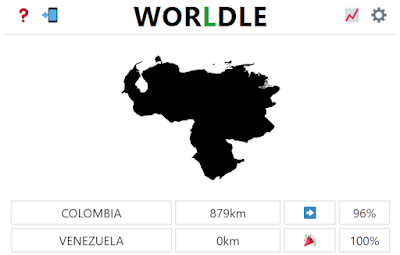
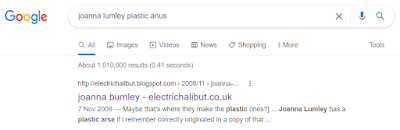
tha must be caracas
Wednesday, February 09, 2022
we blog again
It's been a scarcely-believable fourteen years since this post about odd sporting clichรฉs, so it's probably about time we set our stall out early doors, gave it 110% and left everything out on the pitch to try and come away with a result at the end of the day by doing another one.
In fact you might say: we go again. Right? I mean, you might say that, if it were not an extremely weird way of saying anything. But nonetheless this is the current phrase of choice in the sporting world, on Twitter in particular. The usual usage is in the wake of a sporting setback, to denote perseverance, undauntedness and a determination to redouble efforts, learn from adversity, come back stronger, once more unto the breach, this is SPARTA, all that sort of horseshit. Here's England prop Ellis Genge in the wake of their Calcutta Cup defeat last weekend:
Thanks for all the travelling support today, not easy in the current climate - literaly. Not to be today but we learn and we go again.
— Gengey (@EllisGenge) February 5, 2022
Note that Genge cashes in "not to be" as well, another standard lament in the event of getting your arse handed to you in a sporting context. Here's Liverpool and England footballer Jordan Henderson in similar defiant post-ignominious-defeat mood:
Disappointing result but we go again Wednesday. pic.twitter.com/xCRcR7ELcV
— Jordan Henderson (@JHenderson) December 27, 2020
In fact the phrase seems to be deeply embedded in the culture at Liverpool FC as they make liberal use of it at all levels of the club. It's not just Liverpool, to be fair, and it's not just football either - here are some from rugby, cricket and motor racing.
๐๐ถ๐ป๐ฒ ๐บ๐ฎ๐ฟ๐ด๐ถ๐ป๐ ๐ฌ
— Saracens Rugby Club (@Saracens) December 11, 2021
We go again next week ๐#StrongerTogether ⚫️๐ด pic.twitter.com/MYhiyBt65q
The interesting question here is: when did this start happening? My impression is that it's relatively recently, but it's hard to tell by just Googling stuff, not least because you have to sift out all the stuff that features the string "here we go again", which is also very common and conveys a completely different meaning.
Sunday, February 06, 2022
the last book I read
Master Georgie by Beryl Bainbridge.
That's Mr., or perhaps even Dr., George Hardy to you - man of many talents, principally photographer and surgeon, occasionally even combining those two talents for experimental purposes. Obviously you can't wield a scalpel expertly with one hand and do some sort of selfie with the other hand, particularly not with one of those early cameras with the massive concertina lens and the hood and the explosive magnesium flash powder. So George has a photographic assistant, Pompey Jones, that he makes use of on certain occasions; Pompey being indebted to George for patching him up after a fire-eating accident.
We may as well meet the rest of the supporting cast of characters while we're here - there's Dr. Potter, husband of George's sister Beatrice, and then there's George's adoptive sister Myrtle, taken in by the Hardy family in Liverpool slightly accidentally at the age of three and intended to be shipped on to an orphanage, something that never quite happened. Myrtle has always looked up to George with a sort of puppyish devotion and has made herself useful to him in many ways, most notably at the age of twelve helping him to deal discreetly with the death of George's father - old Mr. Hardy having expired in rather inopportune circumstances during the physical act of coitus with a tuppeny-ha'penny prostitute in her foetid lodgings. Clearly this will not do, not least in terms of breaking the news to Mrs. Hardy, so some discreet shuffling around of remains is in order.
There are some odd episodes while the cast of characters remains in and around Liverpool - a bizarre episode where Pompey Jones is dragged along to a secret location to photograph George performing a cataract operation on an ancient ape, and further oddness where Pompey habitually sneaks into the Hardy residence in the early hours and moves various items of furniture around to see if anyone will notice. Eventually someone does notice, and unfortunately it's George's young wife Annie, who is spooked by an unexpected encounter with a tiger-skin rug and has a miscarriage.
We then jump forward four years and George, Myrtle, Pompey and Dr. Potter are on their way from Liverpool to Constantinople with the intention of bringing George's combined surgery and photography skills to bear in the bloody ghastly theatre of the Crimean War. Beatrice and Annie come along initially but it soon becomes apparent that this is no place for ladies and they return home; Myrtle is made of sterner stuff (and in any case would never abandon George) and stays.
George makes himself useful assisting with the steady stream of casualties, and since some of them have been hit by cannonballs you can imagine there's a bit of stitching up and making good to be done. Pompey is working as a war photographer and Dr. Potter and Myrtle are making themselves useful where they can. War is not a tidy process with clear boundaries between participants and observers, though, and the party find themselves drawn into the conflict more and more directly, until eventually they are right in the middle being shot at and having severed limbs flying past their ears.
This is the third novel from what one might think of as the second half of Bainbridge's career where her novels had a real-world historical setting; both its predecessors in that genre (The Birthday Boys and Every Man For Himself) having featured on this blog. Master Georgie is probably a slightly more oblique treatment of actual historical events than either of those two (I suppose in the case of The Birthday Boys that's partly because the characters are actual people who actually lived - and, shortly afterwards, died) and some aspects are slightly frustratingly oblique and allusive. The obvious example of this is that while it's obvious that George has occasionally struggled with repressed homosexuality, and that furthermore something slightly untoward has been going on between George and Myrtle (i.e. they've been fucking), most of the reviews take it as a given that Myrtle is actually the mother of George's children, something that I'm not convinced you could be sure of from reading the actual text.
It's tremendously sly and clever, of course, and as the previous paragraph suggests makes some demands of the reader. It's perhaps a book that you admire for its craft and cleverness rather than engaging with the characters at a visceral level or being genuinely invested in the matter of whether they live or die among the flying cannonballs and gobbets of pulverised limb-flesh. Nevertheless Master Georgie was nominated for the Booker Prize in 1998 (the winner that year was Ian McEwan's Amsterdam, generally accepted as being his worst novel). Bainbridge was famously nominated for the Booker five times (in 1973, 1974, 1990, 1996 and 1998) but never won.
Monday, January 31, 2022
the last book I read
The Hydrogen Sonata by Iain M Banks.
There comes a time in every major civilisation's life when you sit back and think: hey, we've done it all. Evolved some form of opposable limb appendages to facilitate tool use, used those tools to construct machines to escape our home planet's gravity well and traverse the galaxy, come into contact with other civilisations, some very different from our own, and managed to find a way to co-exist without annihilating each other, made some thought-provoking art about all of the above, stood around and appreciated it for a while; I mean, what else is left to do? Basically it's either the long slow process of decline and decay, or you go out in a blaze of glory and Sublime.
Now this is not like the chemical process of sublimation where something solid vanishes in a poof of smoke and is no more - wait, no, actually it's pretty much exactly like that. Once a civilisation has democratically decided it wants to Sublime - and the bar is set pretty high for an acceptable majority, none of your 52-48 business here - and a date is agreed upon, that's basically it. Assistance is mysteriously forthcoming from the Sublimed realm and on the appointed date everyone who's decided to go (and individual opt-outs are available for anyone who really wants to eke out their existence on a ghost planet, or, more sensibly, hop on a passing spaceship and start a new life somewhere else) just mumbles some mystical incantations and poof, job done.
Tradition dictates that other civilisations who have links to the Subliming-adjacent one send tokens of their esteem and attempt to make good any unfinished disputes in a mutually respectful way. And so it is that a ship representing the reality-bound remnants of the already-Sublimed Zihdren civilisation makes its way to Gzilt space with a message. Once it has been intercepted by a Gzilt ship, though, the whole mutual respect thing goes out of the window and it is forced to reveal the contents of the message it is carrying earlier than planned, and, upon the contents being revealed, is promptly blasted into its component molecules for its trouble. I mean, don't shoot the messenger, right?
Vyr Cossont is just minding her own business trying to master a fiendishly difficult composition (the Hydrogen Sonata of the title) for a fiendishly complex eleven-stringed instrument that she's had a couple of extra arms grafted onto her torso especially to help with. That's Lieutenant Commander Vyr Cossont to you, actually, although everyone on Gzilt acquires a military rank by default and she has no military experience whatsoever. This doesn't stop her being conscripted for a top-secret mission, though; apparently something of crucial importance that could have a major bearing on the whole Subliming thing. But why her, and not, say, someone who knows what they're doing? Well, it turns out that while doing some interplanetary travelling a few years earlier (a sort of space-based gap year) she happened to spend some time with one Ngaroe QiRia, a Culture citizen who may be the oldest human alive, and by virtue of that may have access to some secrets which may explain the Zihdren-Remnanter "incident" and shed some light on the contents of the message being (unsuccessfully) delivered.
Meanwhile representatives of some Scavenger species are circling the various Gzilt home-worlds; these guys move into planets recently vacated by the Sublimed, hoover up all the loot (you really can't take it with you, you know) and sometimes move in, if the atmosphere and solid/liquid ratios suit their crazy alien physiology. Usually the outgoing civilisation confers a sort of Preferred Looter status on one set of ships, so the stakes and emotions are high. In this case the front-runners are the Ronte, sort of big insect-y dudes, and the Liseiden, who are big sentient eels slurping around in giant fishtanks. A delegation of Culture ships is also in attendance, either to provide a calming influence and a neutral party for conflict resolution, or to be interfering holier-than-thou do-gooders and spoil everyone's fun, depending on your point of view, and whether or not you are a giant sentient eel.
Cossont leaves her Gzilt home-world in search of QiRia but is promptly nearly rubbed out on the orders of some high-ranking Gzilt politicians who would rather things just be allowed to take their course without anyone rocking the boat, thanks very much. Rescued by a Culture ship, she enlists its help finding QiRia. Things are more complex than they appear, though, as while the physical QiRia is located, it turns out he's had lots of his memories removed and stored on various mind-state backups in various locations. The relevant memories, it turns out, hilariously, are actually back on Gzilt, in an old pair of QiRia's eyes. So, all back to my place, collect the eyes, see what's on them, have a pint and wait for all this reality to blow over, right?
Obviously it's not quite that simple: for one thing there are hordes of Gzilt and Culture ships having a Mexican stand-off in orbit around the planet, and secondly the eyes turn out to be in the possession of a guy/creature called Ximenyr who is the sort of master of ceremonies for a marathon end-of the-real-world party on an endlessly circling airship. So getting in won't be easy, and getting out next to impossible. Fortunately Cossont has the Culture on her side and those guys do six next-to-impossible things before breakfast. The memories are retrieved, decisions are made about the value of sharing the data more widely at this late stage (literally hours before the Subliming), full-scale spaceship wars are avoided, honour is seen to be satisfied all round and everyone poofs off into an orthogonal dimension for ever as planned. Well, except for Cossont who decides that actually she'd prefer to stick around, practise her sonata a bit more, hitch a lift on a Culture ship, go and visit QiRia again and have some more adventures.
Sadly there won't be any future Culture novels describing those adventures, as this was the last science fiction novel of Banks' life, published in October 2012 about eight months before his death (The Quarry was his last non-genre novel, published posthumously).
It's tremendously entertaining, as these books always are, and there are a couple of tremendously exciting action set-pieces, but to be honest it's not up there with the best of the Culture series, in my view anyway. There are a couple of reasons for this: firstly that there's too much plot involving the Culture ships with their tiresomely hilarious names and inter-ship messaging and not enough recognisably human-scale interaction. The ratio is far better than, say, Excession, which as I recall involved pretty much no organic life at all, but still. The other problem is the whole notion of Subliming - mentioned in a very hand-wavey way in several of the earlier books, it's always teetered on the edge of magic and/or religion (and aren't they, after all, pretty much the same thing) and the attempt to rationalise it here as being a sort of re-calibration of matter into a higher dimension (seventh? eighth? eh, you know, one of the spare ones) undetectable to the "real" universe feels like a bit of a cheat.
Vyr Cossont is an engaging protagonist but she doesn't really have enough to do, and, a bit like Lededje Y'breq, the nominal main character of Surface Detail, spends a lot of time being ferried around and saved from peril by a Culture ship and its AI Mind. And the endless airship party reminded me of the endless flying cocktail party in Life, The Universe and Everything - the one Arthur Dent gets hit in the small of the back by while flying - although with lots of extra body modification and freaky sex. Lastly, the central plot MacGuffin is entirely inconsequential - the big secret the Zihdren wanted to impart was that the Gzilt holy book, The Book of Truth, was, rather than being handed down from some mystical realm, a Zihdren plant as part of a sort of sociological experiment. I mean, I'm not the best person to adjudicate here, but since one of the unusual features of the Gzilt Book of Truth was that substantial portions of it did, indeed, turn out to be true, or at least consistent with how the universe behaves, it's not very clear why anyone should care. In any case the Culture Minds choose not to disseminate the information widely anyway, so no-one ever finds out.
So, obviously, completing the last Culture novel is the obvious time to construct that Culture novel top ten you've been waiting for, except that I can't, because there are only nine of them. I should preface this by saying that they are all good and contain more wit and imagination than most books of any genre, and within the sci-fi genre in particular stand out for containing humour, sex and strong female characters, none of those being things sci-fi has traditionally been very good at. So, here we go:
- Consider Phlebas
- Inversions
- Look To Windward
- Surface Detail
- Matter
- The Player Of Games
- The Hydrogen Sonata
- Use Of Weapons
- Excession
Obviously the order you read them in has a bearing; I made a point of reading them in the order they were written, so Consider Phlebas was the first one I read, and also objectively contains the most rootin'-tootin' space adventure action of all of them. That's not the sole criterion, as Inversions is pretty cerebral, although stuff does happen. Anyway, I reserve the right to change my mind about the exact order on a near-daily basis.
Friday, January 28, 2022
bordering on the ridiculous
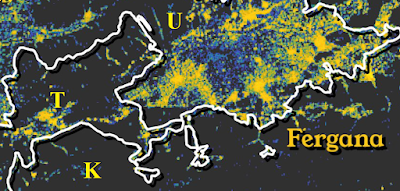
Further to the international border talk in the previous post, go back to the start and zoom in on the map in the original tweet and you'll see some oddities. Here (see below), for example. What are those little bits that seem to have dropped off Tajikistan (T) and Uzbekistan (U) and landed in Kyrgyzstan (K)? And indeed the little splinter a bit further north that seems to have peeled off Tajikistan and ended up in Uzbekistan?
back in the (former) USSR
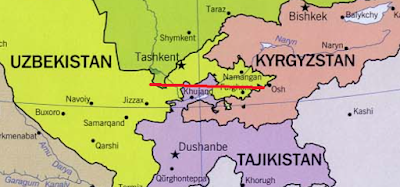
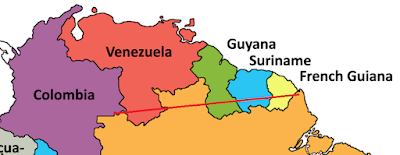
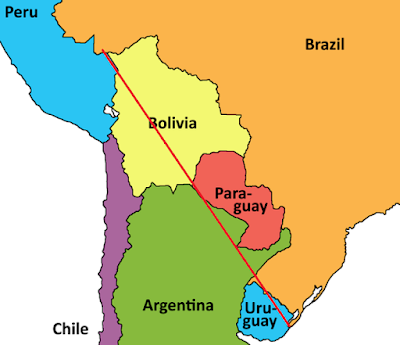
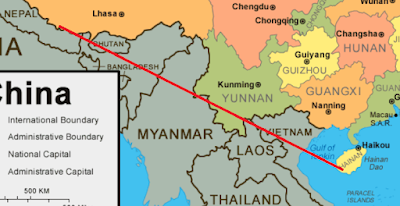
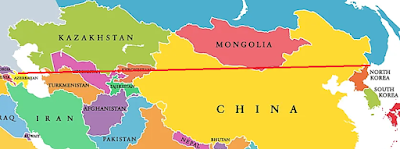
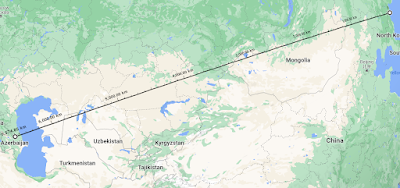
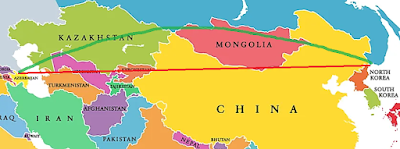
Here's another post inspired by some initial exchanges over on Twitter - it also shares a theme with this earlier post about imaginary straight-line journeys between American states. I follow a few map-related accounts on Twitter and one of them tweeted the map below which I quote-tweeted with a challenge, also related to imaginary straight-line map journeys, as you can see:
Interesting academic challenge: given a free hand to select any two distinct points in a country, can you select two so that a straight line between them passes through the maximum number of other countries? And, given the whole world to play with, what is that maximum number? https://t.co/BFYDthfqYk
— Dave Thomas (@electrichalibut) November 23, 2021
And the end of all our exploringWill be to arrive where we startedAnd know the place for the first time
Tuesday, January 25, 2022
making a spectacle of myself
— Memorial Device (@memorialdevice) January 23, 2022Just to make it clear, that is a photograph of me, aged probably about 2, and therefore from around 1972. After a brief period of reeling in surprise and spluttering WHAT WITCHCRAFT IS THIS it occurred to me that I had published that very same photo on the public internet back in 2013 as part of this blog post. That made it available to Google image crawlers, and hey presto, a search for "NHS glasses" or similar now leads you to this page featuring a different photograph of me as the header image (commendably my original post is properly credited at the bottom of the page), and also (if you scroll a bit further down the image results) the absolutely legendary primitive-1970s-lazy-eye-remediation photo above.
Monday, January 17, 2022
the last book I read
Shuttlecock by Graham Swift.
Prentis (we never find out his first name) has a slightly mysterious job as a senior clerk in a murky government department, a sort of deep archive of cold case material which needs to be kept safe and indexed and occasionally retrieved for use in new cases or when fresh evidence comes to light in old ones. His immediate superior, Quinn, is a slightly odd, mercurial sort of bloke, the sort of boss who keeps his staff in a constant state of mild unease with his unpredictable moods. Nonetheless Prentis has been led to understand that despite being relatively young (early thirties) he is being groomed for Quinn's job once Quinn retires in a few years.
Prentis has a fresh set of challenges once he arrives home from work: his wife and two sons, approaching puberty and teenagerdom and all that tricky stuff (the sons, not the wife), don't seem to like him very much, partly because of his occasional penchant for administering a swift backhander to any and all of them. While he and his wife still have a fairly active sex life - partly because she's nervous of saying no to him - of late this has involved a set of increasingly eye-watering positions and utensils just to keep the interest going. Some further tension is provided by Prentis' twice-weekly visits to his father in a nursing home - not only does this mean him monopolising the car so the wife and sons can't go anywhere, but he usually arrives home in a state of frustration brought on by the strange speechless near-catatonic state his father has been in for the last twenty years. As a substitute for actual conversation with his father Prentis has been re-reading Shuttlecock, his father's memoir of his heroic exploits as a spy (and subsequently as a prisoner of war) in occupied France during World War II.
A few odd things have been happening at work: Prentis, always entrusted with the trickiest assignments by Quinn, finds himself tasked with finding connections between cases and files that seem to have no relation to each other. Moreover, certain key files seem to be missing altogether, something that ought to be anathema to Quinn, but something that he seems oddly reluctant to pursue when Prentis broaches the subject.
On further examination, and after conducting some not-strictly-permitted external enquiries of his own, Prentis discovers that at least one of the subjects of his latest set of seemingly unconnected dossiers knew his father, and that the details that would explain the connection are more than likely in the missing files. Having finally persuaded himself to confront Quinn about it, Prentis finds Quinn only too willing to tell all over a post-work gin-and-tonic. Quinn has been selectively removing files which he deems to contain information which would be needlessly hurtful to people should it ever emerge. In this particular case the missing file contains some letters which were sent to Prentis' father twenty years ago in an attempt to blackmail him, and which allege that not only did he have an affair with the wife of one of his wartime comrades, he wasn't actually a war hero at all, the account in Shuttlecock of his heroic escape from being tortured in a Nazi prison being wholly fictitious. Instead it was alleged that he cracked under torture and betrayed several other spies who were then captured and shot.
But what to do with this information? It's very tempting, given the dates, to imagine that these letters may have been the catalyst for Prentis' father's breakdown; but if they were, does that necessarily mean that all the allegations they contained were true? And even if they were, is it so terrible to have failed to withstand torture? Being intolerable is, after all, its purpose. And what of Quinn's efforts to spare people from revelations such as these? Will Prentis continue this (as Quinn pretty clearly wants him to) once he takes over the top job?
While Prentis ponders these questions, and some more practical ones, like what he's going to say to his Dad the next time he sees him, he finds himself oddly liberated, both by Quinn's departure and by the removal of the weight of the intimidating comparison between his life's achievements and those of his father. While his sons still pity and despise him (they are, after all, soon to be teenagers) there has been some thawing of relations, and he and Marian have settled back into a more relaxed relationship - fewer ever-more-complex joyless rubbery couplings, more furtive quickies in the dunes at Camber Sands while the boys are in the sea.
This was Graham Swift's second novel, published in 1981; it's also the second Swift to appear on this blog, the other being the much later novel The Light Of Day back in 2011. It's a little slow to get going, but the atmosphere built up by Prentis' slightly Brazil-esque pointless shuffling of files and dealing with weirdly arbitrary requests for information is very effective. Things only really take off when big chunks of Shuttlecock, the book-within-a-book, start to appear, the breathless excitement of Dad's wartime exploits providing a slightly odd contrast with the suburban sterility of his son's day-to-day life. The idea of a wholly involving and thrilling World-War-II-based adventure, presented as true (within the novel's own reality anyway), which subsequently turns out to be fictitious may also be familiar to anyone who's read Ian McEwan's Atonement (or seen its film adaptation). Shuttlecock was itself adapted into a film in 1993, universally agreed to have been something of a shambles (although it does feature Wiping Your Arse With Silk Guy from the second and third Matrix movies) and which appears to have taken some liberties with the plot, in particular making Quinn the director of the mental institution rather than Prentis' boss. Oddly that wasn't the end of the story, the original film's director updating it 25 years later and re-releasing it as Sins Of A Father, sadly to a similarly lukewarm response.
Anyway, it's very good, slightly darker and odder than it at first appears, like most of Swift's novels. They are all good, but if you only want one I would unreservedly recommend Waterland, a book I tediously extol the virtues of at every opportunity (and have done at least a couple of times previously on this very blog).
Thursday, January 13, 2022
the last book I read
Breath by Tim Winton.
Bruce Pike and his best mate Ivan Loon (Pikelet and Loonie to their friends, who basically comprise each other) are a pair of young larrikins in their early teens living in a smallish community on the west coast of Australia. Not much to do, and the only obvious source of fun and adventure is the huge waves that break just off the coast, so the boys take up surfing, and soon discover a taste for it and its attendant thrills and danger.
The boys aren't out in the waves on their own, though; there's a group of adult surfers from the nearby larger town of Angelus who warily allow the boys to share their patch. More intriguingly there's also a lone surfer known as Sando, clearly head and shoulders above anyone else in terms of ability, who doesn't associate with the group much but takes a shine to Pikelet and Loonie's youthful enthusiasm and becomes a sort of mentor, allowing them to store their boards under his house and offering some surf tuition and hippy-ish surf-related life philosophy. Think of Patrick Swayze in Point Break, but without the robbing banks while dressed as Ronald Reagan, and indeed without the shooting your gun in the air and going AAAAAAARRRGGHH.
Pikelet and Loonie tag along with Sando on a series of expeditions to ever gnarlier waves, some in secret locations that only Sando seems to know about. A bit of a rivalry develops, for bragging rights over who has surfed the biggest waves but also for Sando's approval. The boys spend a lot of time hanging out at Sando's place and meeting his American wife Eva, who isn't wholly impressed with her husband taking on a couple of teenage disciples and is intermittently grumpy and sedated from painkillers for a gammy knee.
Pikelet comes up against the limits of his courage when Sando takes the boys to surf an astonishingly dangerous wave just about covering some spiky rocks a few miles offshore, and after Loonie steps up and surfs it he and Sando go off on an expedition to Indonesia for several weeks without telling either Pikelet or Eva much about it. Pikelet does some surfing on his own and mooches around the house in Eva's slightly reluctant company before the two of them decide to move the plot along by getting down to some serious fucking. This is obviously tremendously exciting for Pikelet, not to mention wholly inappropriate and rapey on Eva's part as he is barely fifteen.
We learn a little more about Eva's background here: she was a highly-rated freestyle skier before landing awkwardly off a jump and crocking her knee, something several bouts of surgery and painful rehabilitation have subsequently failed to correct. So her and Sando moved away from snowy ski country to avoid her being reminded of what she was missing every day - on the other hand, hey, here they are near the beach and she has to watch Sando and the boys head off to get their daily dose of adrenaline and peril every day. No wonder she's a bit grumpy. Moreover, she has to find danger in other ways, as Pikelet discovers when she produces a plastic bag and a rope from a cupboard and asks him to throttle her during sex.
But all good things must come to an end, even bracingly transgressive and dangerous under-age sex: Sando is due to return and Eva turns out to be pregnant. She assures Pikelet that he isn't the father, though the timelines are left too vague for the reader to be able to work out whether she's lying or not. When Sando eventually does return (seemingly without cottoning on to what's been happening in his absence) it is without Loonie who seemingly did a runner mid-trip to who knows what murky corner of south-east Asia.
Sando and Eva pack up and relocate back to America to await the arrival of the baby and we zoom back to the framing device featuring a middle-aged Pikelet, now a paramedic, a divorcee and father to two grown-up girls. Sando has become a millionaire surf merchandise magnate and lifestyle guru, while Eva and Loonie are both dead, Loonie in some drug-related shooting in Mexico, and Eva in a somewhat undignified Hutchence/Carradine-style naked hanging mishap in a hotel in Oregon. Pikelet himself alludes darkly to some addictive risk-taking behaviour of his own in the past, though it's not clear whether this is the reason for his divorce. Anyway, as we leave him he seems to have come to terms with his life by helping others continue theirs, occasionally by having him rescue them from some of the same risky behaviour that got him and his friends into trouble in the first place.
The first thing to say here is that Tim Winton is one of my favourite authors and I enjoyed this very much, just as I enjoyed all the other books of his that I've read (Shallows, Cloudstreet, The Riders and Dirt Music). Like many coming-of-age stories it occupies a territory I described here as "That Last Golden Summer At The End Of Which That Thing Happened Where My Whole Life Went To Shit". Much is implied rather than explicitly stated: clearly Eva's relationship with Pikelet is abusive, however much he might have been going WAHEY and climbing on enthusiastically at the time, but Sando's relationship with the boys is more subtly suspect as well, his desire to be a guru with adoring disciples blinding him to the physical danger he is putting the boys in. And the significance of the paramedic call-out and the apparent teenage suicide by hanging which provides the book's opening scene before the wibbly-wobbly dissolve into flashback only becomes clear once you get to the end. As with some other books which use a similar narrative device, the winding-up of the various loose ends of plot once we snap back into the "present" seems a bit rushed, but the descriptions of the surfing action are tremendous, and I speak as someone who doesn't really like the water and finds all the mystical horseshit associated with surfing generally irritating. I suppose if you want a single Winton recommendation it would probably be The Riders, but I would strongly recommend all of them. Breath was filmed in 2017, to generally positive reviews; interestingly Winton himself provides the voice of the adult Pikelet who serves as a narrator for parts of the film.
Monday, January 10, 2022
the last book I read
The Thirty-Nine Steps by John Buchan.
Richard Hannay is the right sort of chap; our sort of chap. Resourceful, tough, cool head in a crisis, owns a compass and a penknife, master of disguise, can handle himself when it all gets a bit tasty. A bit like that Jackal chap, although the whole assassination thing is a bit unsporting and he'd have no truck with getting distracted by huge-titted Euro-countesses. That sort of beastliness distracts and weakens a man and probably leads to communism and the like. No, a cold bath and a brisk walk with a stout stick soon takes care of those sort of urges, and a good thing too.
Hannay was born in Scotland but has spent most of his life in southern Africa where he has built a respectable fortune in the mining business. Back in the UK for the first time since he was a child, he is knocking around London feeling a bit stifled and starved of excitement when some lands conveniently on his doorstep: a man named Scudder approaches him in the corridor of the building where he has rented an apartment and tells him a remarkable story of international espionage and conspiracy and moreover how he, Scudder, is the only person who knows about it and needs somewhere to lay low now that he has faked his own death.
Intrigued, Hannay invites him in, and hears the rest of the details of the plot, which are sketchy but involve the imminent UK visit of the Greek premier, Karolides, and an attempt to be made on his life, with the wider objective of destabilising European relations in some way and accelerating the already imminent approach of war. Hannay has some errands to run but allows Scudder to lie low in his apartment - when he gets back he finds Scudder lying rather lower than he expected, having been skewered to the floor through the heart with a large knife.
Needless to say this is rather awkward for Hannay and, having been through Scudder's pockets and retrieved an interesting-looking notebook with some coded messages in it, he slips out of the apartment and hops on a train to Scotland, hoping to go to ground in the hills of Galloway. But his pursuers are on the trail - those pursuers comprising the usual police but also a small group of dastardly types who may or may not be German, but give every appearance of being British. Since this second group were responsible for the murder of Scudder and plan to be responsible for the assassination of Karolides those are the guys that Hannay is principally concerned about, although of course being collared by the rozzers would be an inconvenience in terms of foiling the plot.
There follows a rollicking chase through the Scottish lowlands and a series of frankly absurd coincidences, most prominently Hannay running into someone he knows on a road on a wild and remote area of moorland, and later on Hannay blundering into a country house that just happens to be occupied by the principal set of villains, who instead of just shooting him in the face and lobbing him in a loch decide to lock him in a barn which just happens to contain a substantial quantity of explosives. Hannay's mining experience then enables him to blow up a wall and escape. One of the other people Hannay runs into (literally in this case as they are involved in a car crash) also just happens to be related to some high-ranking Foreign Office johnny and promises to write a letter introducing Hannay and describing the plot.
Hannay eventually makes his way back to southern England and seeks out his Foreign Office contact in his lavishly-appointed country house. Naturally, rather than dismissing Hannay as some kind of frothing loony he instantly recognises the kind of upstanding chap he is and they hot-foot it off to London. Hannay has been working on decrypting Scudder's notebook and has extracted the phrase "the thirty-nine steps" and some stuff indicating tide times. But where? Luckily the assembled company includes someone who knows about these things and they narrow the search down to a handful of beaches in Kent. The one they eventually identify does indeed have a staircase running down to the beach (with thirty-nine steps), a boat waiting mysteriously offshore and a handy cottage at the top of the cliffs where Hannay confronts the three occupants. But are they the villains in convincing disguise as holidaying English gents, or actual holidaying English gents? Have they got the right men? Have they got the right beach? As time ticks down a tense stand-off ensues until eventually one of the villains Gives Himself Away, Hannay raises the alarm and the rozzers steam in and arrest everyone.
I mentioned The Thirty-Nine Steps as a likely precursor to Rogue Male almost exactly a year ago, with the caveat that I hadn't at that point read it. Now that I have read it I'm still pretty comfortable with the comparison, although I think Rogue Male is a better book. You can see the debt subsequent spy/espionage/escape thrillers owe to this one, though, and their central characters, James Bond being an obvious example. In fact The Thirty-Nine Steps reads in parts like a sketched-out template for writing a spy thriller rather than a spy thriller itself, absurdly exciting in many places but lacking in any sort of clear indication of what the central plot actually involves (and as a consequence a lack of clarity around what benefit foiling it brings, since Karolides gets offed and World War I breaks out shortly afterwards anyway), and turning on a number of utterly implausible coincidences that kill some of the built-up tension. It's also extremely short at only 119 pages - that's not necessarily a criticism, just a reflection that there's not much room for detail or nuance among all the hooning about on the moors. It's interesting that all of the major film adaptations introduced some contrivance to provide a pretext for Hannay to wander into the villains' lair halfway through, rather than just have it happen by accident, and changed the ending from the rather downbeat one of four blokes playing a game of bridge in a clifftop cottage to something rather more kinetic.
It almost goes without saying that there are a swathe of warnings to be issued here around the inevitable racism, anti-Semitism, general Baden-Powell-esque disdain for squishy city types who don't know how to gut a squirrel - there isn't much sexism but only because there are barely any female characters in the whole book. How much of an outlier Buchan was in that respect in the heady days of 1915 it's hard to say. But anyway, it's a rollicking good read and won't occupy you for more than a couple of days, so why not.
Friday, January 07, 2022
the last book I read
The Black Dahlia by James Ellroy.
Dwight Bleichert, known to everyone as Bucky because of the size of his, erm, dental appendages, is one of a large number of American men who emerged from the armed forces after World War II looking for something useful to do, ideally providing a similar level of excitement to being constantly shot at by Nazis. Bucky decides that joining the LAPD is the thing to do, and soon encounters and partners up with Lee Blanchard, who he vaguely knows from his army days as they were both successful amateur boxers.
Bleichert and Blanchard become mildly legendary in police circles for staging a fund-raising boxing match against each other, and also for their exploits in gunning down four perps on the streets of Los Angeles. So when the gruesome discovery of a young woman's mutilated nude body is made on an empty building plot in the city, Bleichert and Blanchard are quickly assigned to the case.
This isn't just any old clumsy shooting or stabbing in the heat of passion though; someone has taken some trouble over this. The body has been bisected, most of the organs removed, drained of blood, various ritual wounds inflicted on it after death and then brought from wherever the preliminary torturing and murdering was done to the drop-off location and arranged in a stylised sexual pose to be found. Definitely not your run-of-the-mill murder.
Obviously the first thing to do is to identify the victim, and she turns out to be Elizabeth Short, a young woman in her early twenties and an aspiring film starlet who didn't seem to have been getting much legitimate movie work but may have been earning a living in, hem hem, other ways.
Bleichert and Blanchard have an odd sort of partnership outside of the job as well, with an odd three-way relationship with Kay Lake, a woman Blanchard became involved with after he put her abusive mob boyfriend away for a bank robbery. This is strictly frowned upon by LAPD policy, as is the relationship Bucky enters into with Madeleine Sprague, a woman who may or may not have hooked up with Elizabeth Short at one of LA's lesbian bars before her death, and who closely resembles Elizabeth, now nicknamed the "Black Dahlia" by LAPD and the local press.
It turns out Elizabeth appeared in a couple of lesbian-themed, hem hem, "stag movies", and after the acquisition and private screening of one of these by LAPD Lee has an odd turn and flees. It turns out he is haunted by memories of his younger sister, who disappeared in mysterious circumstances and whose body was never found. Lee ends up all the way over the Mexican border in Tijuana, and when Bucky follows him there it transpires that Lee has been killed and buried on a beach.
Meanwhile the Black Dahlia plot thickens: it turns out that an LAPD officer had hired her for sex only a couple of days before her gruesome demise. Could the killing be an inside job? Well, long story short, the answer is no: by chance one of Bucky's colleagues finds an abandoned shack up near the Hollywood sign with a crusty old blood-stained mattress inside, and this leads Bucky back, via Madeleine, to the Sprague family and in particular their former employee George Tilden, who Bucky traces to another abandoned property in the area and has a climactic showdown with among a gruesome collection of body parts in jars.
But wait a minute, what's this? Holy last-minute plot twist (and, needless to say, PLOT SPOILER ALERT), it turns out that, while George was certainly involved, the prime instigator of the killing was none other than Ramona Sprague, Madeleine's mother. Bucky has to decide whether to shop the now cancer-riddled Ramona for the murder, thereby torpedoing his own future career (since he suppressed the original evidence relating to Madeleine) or keep schtum and wait for nature to take its inevitable course.
James Ellroy write quite a few books before The Black Dahlia in 1987, but it is generally regarded as the first of the novels on which his reputation rests. Most people will be familiar with his work from the classic 1997 adaptation of his later novel LA Confidential. It's interesting to see some echoes of that in this earlier work, in particular the Bleichert/Blanchard partnership as a precursor to the Exley/White one, and Lee Blanchard and Bud White both having an odd mix of brutality and protectiveness towards women as a result of being unable to protect a family member earlier in life (Blanchard's sister and White's mother). I haven't read LA Confidential; the only other Ellroy I've read is American Tabloid, set in the early 1960s and culminating in the assassination of John Kennedy. That one is if anything even terser, denser and more complex than The Black Dahlia, and similarly marinated in booze, cigarettes, amphetamines and a kind of corrosive misanthropy which I would guess might become exhausting if you read too many of these in quick succession. The mid-20th-century LA setting and queasy incest subplot (here involving Madeleine and her father) are strongly reminiscent of Chinatown as well. The Black Dahlia was itself filmed, somewhat less successfully, in 2006.
The Black Dahlia is based on real-life events: there really was a woman called Elizabeth Short, she really was an aspiring starlet, she really was murdered in gruesome circumstances in 1947 and she really was given that nickname afterwards. Outside that real-life framework most of the other details and characters in the book are fictional; in particular the killer was never found, although even now someone occasionally pops up to say MY DAD DID IT and get a lucrative TV interview and book deal out of it. The other relevant real-life event is the (also unsolved) murder of Ellroy's mother in 1958, something he credits in interviews with getting him interested in crime as a general topic in the first place. Ellroy revels in the nickname "the demon dog of American crime fiction", a moniker that, rather like Paul Ince's "the guv'nor", would carry more weight if it were not for the suspicion of being self-applied.
One of the things that you'll see if you watch any of the gazillion true-crime video clips associated with the case is that Americans say the word "dahlia" differently from people in the UK. I had a brief moment where I thought whoa, maybe it's just me, but no, British people do tend to say day-lia, while Americans say dah-lia, or maybe dal-lia. This is another of those cases where you laugh indulgently to yourself and say: haha, stupid Americans, but of course if you think about it that is actually a much more sensible way of pronouncing it, since the flowers were named for Anders Dahl, an 18th-century Swedish botanist (rather than, say, Jim Dale).
Anyway, enough horticulture, back to the book: I enjoyed it very much and recommend you read at least one Ellroy novel, though they are dense and dark and rich and you might need to freshen the palate afterwards with something a bit more well-disposed towards humanity in general. As it happens both the Ellroys I've read (The Black Dahlia and American Tabloid) are the first book in a series (a quartet and a trilogy respectively) so they might be good ones to start with.
Wednesday, January 05, 2022
what's another year
Time for the end-of-year book and general blogging stats round-up. If asked to characterise 2021 in general terms I would probably respond by just recycling my valedictory verdict on 2020, as follows:
Well, here we are at the end of another year, one which has, on balance, sucked ass most egregiously
We weren't under quite such stringent pandemic restrictions in 2021 as we were for a good (well, not good exactly) chunk of 2020, but nonetheless slightly decreased scope for just swanning off may have led to increased opportunities for catching up on reading. That might go some way to explaining how 2021 ended up being the second-bookiest year on record, its totals of 30 books and 10359 pages both being second only to 2011 (33 and 10597 respectively), a year in which, let's not forget, I had no kids to wrangle and a three-week honeymoon ripe with opportunities for reading (yes, yes, and other stuff too, OY OY etc.).
Here are the usual charts (plus a new one):
- Longest book of the year was The Pope's Rhinoceros at 753 pages, shortest was Call For The Dead at 157 pages.
- Average book length was just over 345 pages, second only to 2020's whopping 384. Unlike 2020 which featured six books of over 500 pages, 2021 featured only two, The Pope's Rhinoceros and The Lacuna. There were no fewer than eight of between 400 and 500 pages, though.
- While 2021's total of 69 blog posts was one more than 2020, and therefore the most since 2016, the number of non-book-related posts actually went down. The book-posts-as-a-percentage-of-total-posts figure was higher than it's ever been at 43.5%.
- The new chart at the bottom is to assess the split between male and female authors, something I've been more conscious of following the ten-month gap (May 2019 to March 2020) between books by women that I observed here. 2021 turns out to be not terrible by historical standards in that regard, in that 9 out of the 30 books were by women. That 30% is the highest since 2016 and considerably better than the dark days of 2019 where only 2 out of 17 books were by women - the only year in which more than a third of the books I read were by women was 2013 (7 out of 19).
Monday, December 27, 2021
didion, didioff
Even in the festive season the roving and merciless eye of The Curse Of Electric Halibut is seeking out fresh victims, and its latest victim is Joan Didion, essayist and novelist whose novel The Last Thing He Wanted appeared here in late 2010. Didion was probably better known as an essayist and non-fiction writer - she wrote five novels over 33 years and none after The Last Thing He Wanted in 1996.
Didion was 87, which puts her right in the median range for authorial death ages. More interestingly as you can see from the table she is the first person to appear since John le Carrรฉ almost exactly a year ago. I have done a quick sweep of the end-of-2021 literary reviews and round-ups and I can't find any reference to anyone else who's ever featured here, which does not definitively mean there wasn't anyone.
The Curse Of Electric Halibut likes to bide its time and play the long game and what the table shows is a whole barn of chickens coming home to roost - five of the last eight victims have featured a curse gestation period of more than ten years. As older long-ago featurees feel the icy hand of death upon them new featurees step in to fill the breach, some of them (e.g. Terry Pratchett) already dead, some of them (e.g. Rachel Cusk) pretty youthful, and some of them right in prime scythe-sharpening range. E. Annie Proulx (86) and Frederick Forsyth (83) are the most obvious recent examples.