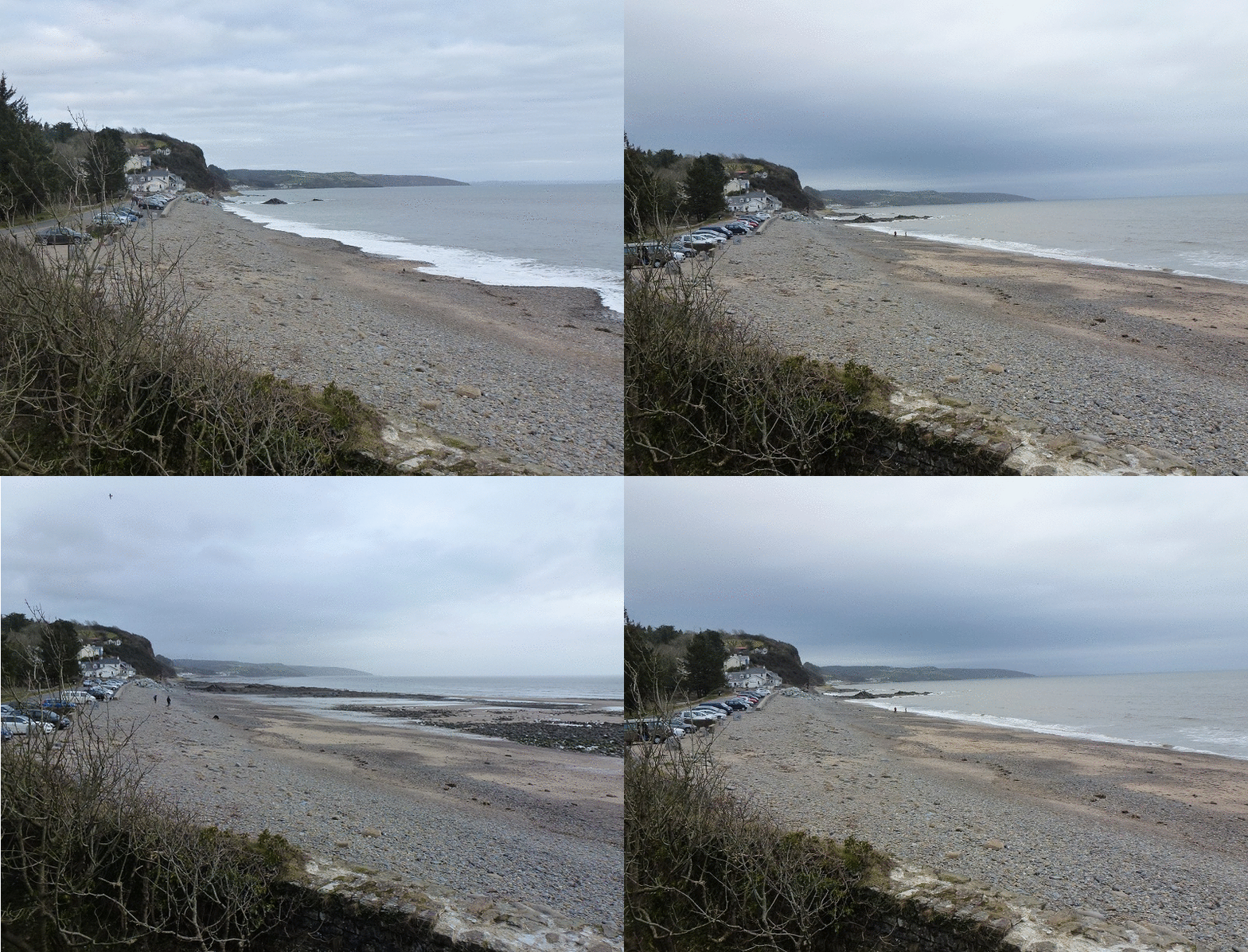
Thursday, April 30, 2015

throwing in the sponge

As I think I've said before, I'm not big on baking, since it requires a degree of discipline and adherence to exactitude and recipe-following that I find constricting. However, I'm always open to trying new things, especially if those things involve minimal effort for maximum results. One of the reasons I like the various versions of the clafoutis recipe so much is that it basically involves just chucking everything in a blender.

As it happens, the situation I found myself in yesterday was similar to the one that prompted my first stab at clafoutis-making, i.e. a desire to do something with the remnants of a batch of fruity alcoholic liquor. In this case it was some hooch that I'd put together just after Christmas to use up a large pack of fresh cranberries that we didn't use over the festive period, and various dregs of various clear spirits (principally vodka and rum) that we had lying around in the drinks cupboard.


As always the method with making this sort of stuff is: be fairly conscientious about regular shaking of the jar for the first few weeks, and then put it in a cupboard and forget about it for three or four months. So having done that and ended up with some pleasingly ruby-red liquid as a result, I was left with some alcohol-infused cranberries to use up.

What I did first is stew them up with a good splash of orange juice and a dollop of raspberry jam, until they'd softened up a bit and it didn't smell like you could strike a match over them and take your eyebrows off. So the question then was: what to do with them? A crumble? Another clafoutis?


It was then that this recipe caught my eye in what I think is a sort of "simple grub for kids" book Hazel occasionally uses. Sounds good, and seems pretty simple, but there is still a bit of multi-stage creaming, sieving and folding-in action going on. To that I say: fuck that shit, I'm just going to stick everything in a food processor and let it take its chances.

In case you can't see that image properly, here's the ingredients list:
  • 75g butter
  • 75g sugar
  • 100g self-raising flour
  • 1 egg
  • 2 tablespoons milk
That will give you a fairly thick batter the consistency of, say, floor tile adhesive (though, hopefully, tastier). What you do then is put the fruit mixture in an oven-proof dish, spread the sponge batter over the top and put it in the oven for 30-40 minutes. These quantities will yield a thick-ish sponge topping for 2 (so you might need a bit of extra cooking time) or a slightly thinner one for 3-4, assuming you're using a wider dish to accommodate more fruity stuff.


The point here, just in case you weren't keeping up, is that this is a good general-purpose thing you can do with any fruity gubbins you've got lying around, and it's a nice alternative to crumble and clafoutis.

Dish up, bit of ice cream (or accompaniment of your choice), bish bosh, couldn't be simpler. While you're cooking you'll be needing a drink, so what I recommend is a combination of recently-decanted cranberry vodrum and some Asda Bitter Cranberry drink. Cheers!


Monday, April 20, 2015

the last book I read

All Tomorrow's Parties by William Gibson.

You remember Berry Rydell, right? Ex-cop, now security operative for hire, last seen in Virtual Light heading off into the sunset with sexy ass-kicking bike messenger Chevette Washington, having foiled some slightly incomprehensible plot involving using nanotechnology to regenerate areas of earthquake-devastated San Francisco.

You remember Colin Laney, right? Gifted with the ability to "see" patterns in the flow of online data, last seen in Idoru helping to facilitate some slightly incomprehensible business involving the titular idoru, a female AI construct called Rei Toei.

Some unspecified amount of time has passed. Chevette Washington and Berry Rydell have had a bust-up and gone their separate ways, Chevette to live with a rich and punchily abusive new boyfriend and Rydell back to his old job as door security. Meanwhile Colin Laney is spending almost all his time immersed in the virtual world, living in a cardboard box at a Tokyo railway station, looking for patterns and connections in the data as his physical body atrophies rankly around him.

Laney has become obsessed with a shadowy PR guru called Cody Harwood, who he is convinced is shortly to have some key involvement in what Laney calls a "nodal point", a key moment in history, recognisable as such to most mere mortals only in hindsight. For reasons that no doubt seem completely obvious to Laney (but not so much to everyone else, the reader included) he decides that what needs to happen is for Berry Rydell (who Laney met, briefly, in the early stages of Idoru) to go to The Bridge (you'll recall from Virtual Light that this is the remains of the San Francisco-Oakland Bay Bridge rendered impassable to vehicles by the last earthquake) and act in such a way as to come to the attention of a certain individual. It turns out the "coming to the attention of" bit is fairly simple, it's the staying alive afterwards bit that might be difficult, since the individual in question turns out to be some sort of Taoist assassin, a bit like Yoda but taller and less green (and without the verbal tics) and wielding a Japanese tantō instead of a light sabre.

Meanwhile Chevette has escaped from her abusive boyfriend, and with the help of her Australian friend Tessa has temporarily holed up at Chevette's former place of residence, The Bridge. Inevitably she hooks up with Rydell again, but there's no time for any gooey romantic stuff, as it appears there are a large number of people out to kill him, and who if they can't take him out individually are quite prepared to torch the entire bridge and everyone on it. Fortunately the dagger-wielding assassin is on Rydell and Chevette's side, and turns out to be pretty useful with assorted other weaponry as well. Rydell has another ally in Rei Toei, who makes a crucial intervention during the climactic showdown to foil whatever it was Cody Harwood was trying to bring about.

What exactly Cody Harwood was trying to achieve is never very clear, beyond that it was something to do with nanotechnology, but, just as with the magic sunglasses in Virtual Light, that's largely irrelevant anyway. All Tomorrow's Parties is nominally the third book in the Bridge trilogy, Virtual Light and Idoru being the other two, but actually since those two were barely related to each other it reads better as simultaneously a sequel to each of them, the whole trilogy then forming a sort of two-pronged fork, a Y-shape if you will, rather than a straight line. 

That said it's much more similar to Virtual Light than Idoru, and you could criticise it (as this New York Times review does) for being basically a bit of a rehash of the earlier book with a few elements out of Idoru thrown in. The plot doesn't really make sense, and it doesn't really give Chevette in particular enough to do other than be rescued from peril a few times. The ineffably cool knife-wielding assassin (who it turns out is called Konrad) is really the star of the show here, along with the brilliance of the basic concept of the Bridge as high-rise semi-anarchic shanty town. 

As always Gibson throws in some prescient stuff involving technology - Tessa's relentless filming and documenting of her own life and adventures using a miniature camera attached to a remote-controlled airborne drone seems bang up-to-date, even though the book was published in 1999. 

So, as always, if you must have one and only one Gibson it still has to be Neuromancer. If you want one other it'd have to be Virtual Light, but I'd recommend you read all of them.

Friday, April 17, 2015

only a masters of evil, darth

I am, as I think I've said before, not a betting man. I'm too mean, for one thing, and secondly I'm just too damn lazy to put in the legwork and do the amount of research necessary for my selections to be anything more than hopelessly blind stabs in the dark.

So even if you'd asked me for Masters tips when it would have been useful, I doubt whether I could have given you many useful ones. I mean, I think if you'd said - I'm thinking of having a punt on Jordan Spieth, what do you think? - I'd have probably nodded and said, yes, that's a pretty good pick. And so it proved - it also proved, as it happens, that my pre-tournament idea of just going straight to the PGA Tour money list and picking someone from the top five there wasn't such a crazy idea after all.
I mean, it's not exactly a ringing endorsement of either the idea generally or Spieth specifically, but you can't deny I did mention his name. Twice. Anyway, that set me to thinking - how much would just following the form book help you decide who to bet on at the Masters? The answer is: quite a bit actually.

The PGA tour has recently re-jigged its season to do away with the Fall Series and have the season start as soon as the previous season ends, i.e. after the FedEx Cup play-offs. For the purposes of this analysis I'm going to ignore this and deem each "season" to start on January 1st. A typical PGA tour season from 1970 (my arbitrary starting point) features 40-50 events (it varies slightly from year to year) of which typically 12-14 happen before the Masters, which is generally scheduled to finish on the second Sunday in April.

So my childishly simple theory says: look at the dozen or so PGA Tour tournament winners so far this year (fewer if anyone's won multiple tournaments), by all means apply a bit of further selection if you want, and then pick one of them. In the 46 Masters tournaments since 1970, the winner was someone who'd already won on tour that year on no fewer than 18 occasions (or 39.13% of the time), as follows:
  • Jordan Spieth in 2015
  • Bubba Watson in 2014
  • Phil Mickelson in 2006
  • Tiger Woods in 2005
  • Phil Mickelson in 2004
  • Mike Weir in 2003
  • Tiger Woods in 2002
  • Tiger Woods in 2001
  • Tiger Woods in 1997
  • Fred Couples in 1992
  • Ian Woosnam in 1991
  • Sandy Lyle in 1988
  • Craig Stadler in 1982
  • Fuzzy Zoeller in 1979
  • Tom Watson in 1977
  • Jack Nicklaus in 1975
  • Jack Nicklaus in 1972
  • Billy Casper in 1970
Now of course you might say, well, OK then, let's flip that around and say you'd actually be better served by a strategy of ruling out anyone who'd already won, since 28 of the 46 winners were people who hadn't yet won on tour that year. To which I'd say, yeah, well, good luck with that, losers.

Note that my two picks, Jimmy Walker and Henrik Stenson, finished tied for 19th and tied for 38th respectively.
Stenson's sore knee would have been caused by this irate club-snapping incident at the 13th during Friday's second round. I'm a big fan of Stenson, partly because he seems to be a wryly humorous interviewee when he's in a good mood, but also for the occasional flashes of equipment-abusing temper on course, something all too painfully familiar to me. Here's a couple more Stenson moments, one from the US Open in 2011 where he eventually finished in a tie for 23rd, and one from the BMW Championship in 2013, the third tournament of the four-tournament FedEx Cup series which Stenson went on to win and be showered with unimaginable riches for. Imagine how annoyed he'd get if he was playing badly! Stenson also features (twice!) in this compilation of the top 5 club-throwing incidents. I think the one at number 4 is my favourite - the casual toss of the club over the shoulder into the lake, not even looking where it's gone - textbook stuff.

Wednesday, April 15, 2015

shoot that poison arrow to my she-e-e-ed

Let's do another mystery object, as we haven't done one of those, for, erm, about three and a half years. So, uncle and youngest goldfish, what's this?


This one is actually more in keeping with the original spirit of the Ask The Family mystery object round than the mannequin leg spike thingy, in that generally once you weren't viewing the object from a crazy angle it was plainly obvious what it was. And so it proves here:


Zoom in a bit for something Googleable and you find this:


This in turn yields some links which reveal that this is some proper serious hunting kit, not a child's toy or anything. All of which raises the question: how the hell did one of these 85cm death-dealing devices end up in my garden? Because that's where I found it, up on the decking near the shed. I have no idea, but common sense dictates that it must have come by an aerial route. We do get a demoralising amount of rubbish just blowing in off the street and under the gate, but this is too heavy to have been wind-borne, and it would have taken some serious twister action to launch it up onto the decking. Which raises the further question: so is someone in the neighbourhood just launching these into the air to fall to earth they know not where? If so, is that technically legal in a built-up area?
I should add that the arrow didn't, as far as I can tell, have a deadly pointy tip attached to it; small mercies and all that. Nonetheless if you collected an untipped arrow in the side of the head at launched-from-a-bow speeds I expect it might smart a bit. Those tips are called "points" among the hunting cognoscenti, people who will no doubt be nodding sagely over the product descriptions here, while the rest of us are sniggering childishly over each occurrence of the words "penetration" and "shaft".

Saturday, April 11, 2015

the last book I read

Dead Air by Iain Banks.

Ken Nott - né Ken McNutt before he de-Scottished himself a bit - is a radio DJ on a popular London station, a station owned by an aging rock star entrepreneur type who also owns an airline, if you're following me. He's styled as a "shock jock", but of a slightly more cerebral and less lurid kind than people like Howard Stern; Nott's thing is more about unfettered political discussion, sticking it to The Man, telling it like it is and to hell with that political correctness nonsense, that sort of thing.

Ken's ranty shtick has gained him a wide audience and made him into something of a minor celebrity, something he has gleefully exploited to get into the pants of a whole series of women, including his current girlfriend Jo, a punky type who works for a record company, but also including a few ill-advised bunk-ups with wives of close friends, and a series of liaisons in posh hotel rooms with the exotic and enigmatic Celia, who turns out to be married to a guy called John Merrial, a notorious London gangster and the sort of man you really don't want to get on the wrong side of, particularly by repeatedly fucking his wife.

So when a bit of promising-looking flirting with a mysterious female admirer in a late-night bar results in Ken getting his drink spiked and being whisked away to some unspecified East London location, he has some cause to wonder which of the many people he's pissed off is responsible. For what exact purpose the whisking was done we never discover, since Ken manages to rouse himself enough to punch his erstwhile lady friend in the kisser and escape out of the cab window.

It turns out, some time later, that this incident was nothing to do with the shadowy Mr. Merrial at all; instead it was cooked up by some other shady character who was keen to have some traffic charges (for an incident where Ken was a witness) dropped. So that's a relief. But, never a man to sit back and savour his chips when he could be pissing on them instead, Ken makes an unwise phone call after a night out getting spectacularly drunk, and ends up leaving an incriminating message on Celia's landline answering machine at the London house she shares with John Merrial.

When Ken phones Celia's mobile in panic he discovers that both she and John are (separately) out of town for the day and there's just a slim chance that he can avert disaster by breaking into the house, erasing the contents of the tape, and then getting the hell out again. Yes, there are alarms and locked doors and all that stuff, but Celia can talk him through that. As if it weren't already complicated enough, though, Ken's phone battery is low, and he's got the mother of all hangovers.

As remarkably successfully as the break-in goes, considering, Merrial inevitably finds out about it (who'd have thought a major gangster might be paranoid enough to have CCTV?) and so the scene is set for the climactic scenes whereby Ken is whisked away again, this time by professionals who aren't going to let him escape, for a nice little chat with Mr. Merrial. Can Ken's quick wit and silver-tongued talky skills get him out of this one?

Dead Air was published in 2002, in the wake of the 9/11 attacks, which feature tangentially in the plot and are clearly the inspiration for a couple of Ken's rants (either on-air or in the pub, since he's one of those guys who doesn't seem to have an "off" switch), not to mention being the inspiration for the cover image on my paperback copy. Other than that they're not really central to the plot; one of the reasons for this is that there is almost no plot to speak of. Apart from the attempted kidnap incident (for wholly contrived and implausible reasons) about halfway through, the only real action that occurs is the break-in to the Merrial house, which commences around page 360 of a 430-page novel. The panicked attempt to get to an answerphone to erase a message before it's heard has a strong 1980s sitcom feel about it, to the extent that you can almost imagine it happening in speeded-up motion with the Benny Hill theme playing in the background. It's a trope that featured in Douglas Adams' Dirk Gently's Holistic Detective Agency as well, and no doubt countless other places.

Ken Nott is clearly an authorial alter ego, and a pretty transparent one at that, his job providing Banks with a convenient mouthpiece for some fairly facile anti-Bush and anti-religion diatribes. It's a bit of authorial wish-fulfilment having Ken's ranty articulacy make him strangely irresistible to women, too. Ken is also, with his penchant for drink and drugs, something of a retread of the Cameron Colley character from Complicity.

The basic problem with Dead Air, a bit like its immediate (among the non-"M" mainstream fiction, anyway) predecessor The Business, is that despite being written in Banks' engaging style, and therefore being very readable, nothing of any great significance actually happens, and it's therefore difficult to see what the point of it was. This Guardian review suggests that maybe he gradually came to find the separation between the wildly imaginative science fiction strand (as "Iain M Banks") and the mainstream fiction stifling to the latter. It's certainly true that while The Business (1999) and Dead Air (2002) are not especially great, the M-branded book between them, Look To Windward (2000), is one of the best things he ever wrote.

Dead Air is the second book in this series to feature the events of 9/11 as a plot device, the other being Falling Man.

Tuesday, April 07, 2015

out of focus

Indulge me briefly, if you will, and permit me a misty-eyed eulogy to my trusty old Ford Focus, which I sold earlier this week after owning it for about a week short of seven years.

Actually it's not a particularly misty-eyed tribute, as I am not especially interested in, still less sentimental about, cars. Anyone wanting a genuinely heartfelt farewell to a car is urged to read Doug's tribute to his old Skoda Fabia here. My attitude to cars is more or less the same as my attitude to televisions and computers: I want them to work, I want them to facilitate me doing stuff I would otherwise be unable to do, or at least would find a great deal more difficult and time-consuming, but I'm not really that interested in them per se, certainly not in their internal workings, certainly not to the extent of feeling that I personally need to get involved. As far as cars specifically are concerned, that means I can change a wheel, a headlamp bulb, and a fuse, and I can top up tyre air, coolant, washer fluid and oil as and when required, but that's about it. Anything else warrants getting a man in.

The Focus did have a lot of good points, not least a decent-sized boot which you could get a surprising amount of stuff in, especially with the rear seats down. Here's a Facebook picture of an almost certainly unsafe quantity of smashed-up decking about to be taken down to the municipal tip in July 2012.


The only petrol-headed comment I'll make, beyond that it was perfectly pleasant to drive, is: I liked the gearbox. Nice and notchy and definite, even compared with our newer Mondeo which is a bit vague and rubbery in comparison, and even with the Mini, which has reverse gear in a position where it's just (if you're not really paying attention) possible to get into reverse when aiming for first, which is never good.

For all that, the Focus earned my affection mainly by being low-maintenance and trouble-free. You might not have got that impression from this post back in November 2013, written in the wake of a concentrated burst of trouble and expense, but there was little to report between then and last week apart from a lower-cost reprise of the suspension issues at the 2014 MOT (basically replacing all the bits that hadn't been replaced the previous year), and an alarming-sounding but actually trivial incident a few months back where the car overheated because I'd forgotten to put any coolant in it for, ooh, about a decade. Even the 2015 MOT which I'd been anticipating with a certain amount of trepidation (partly because the car had been sitting on the drive unused for the best part of two months following our acquisition of the UW Mini) resulted in the first clean pass since (I think) 2011.


So anyway, I posted an ad on Gumtree with the expectation of having to wade through some unrewarding interaction with semi-literate trolls. And so it proved - and, just as with the stuff I'd previously sold, the first person who enquired and appeared to be a reasonably close approximation to a normal human being bought the car. The image above is a farewell picture of it being driven away. Notice how I've forgotten to reclaim the Halfords child-protecting sunshade thingy from the rear window - the only other things I know I left in the car were the Haynes manual (though this was intentional) and the Land Rover-branded tax disc holder Andy bought me when I passed my driving test back in March 2008. That would have been kept for sentimental value at best, though, since you don't need a tax disc any more.

Perhaps the text of the Gumtree ad can serve as an epitaph:
Ford Focus 5-door hatchback, pepper red (i.e. sort of burgundy). This is my beloved and trusty old Focus that I've had since April 2008; the previous owner had it since it was new in September 2001. Great car, very reliable, used for daily commutes to Bristol & back every day up until about a month ago. Wife's shiny new company car forces sale. Brand new MOT from THIS WEEK, good until April 2016. 158,000 miles on the clock, 97,000 or so of them put on by me.

All the usual kit: alloy wheels, heated windscreen, electric front windows, Sendai CD/radio with aux input for iPods. I'll even throw in the Haynes manual in the passenger seat pouch. Bodywork generally very good, bit of minor rust on a couple of door edges. Did I mention that it's got a BRAND NEW MOT? And there's half a tank of petrol in it as well. My Newport-Bristol commute generally yields around 35mpg.

Maintenance since I bought it: various tyres, new ignition coil, various suspension parts replaced after an MOT failure two years ago, apart from that it's been very low-maintenance. Only times it's broken down have been when the ignition coil packed up and when a coolant hose split and it overheated. 

Bargain price reflects age, mileage and my desire for a quick sale to free up some drive space. 
I can also tell you that over the period I owned the car I clocked up an average of just over 38 miles per day, which is just under 13900 miles per year, and around 97000 in total. In reality it was somewhere between 15000 and 18000 for the first few years, when it was our main vehicle for long-distance trips away as well as being my day-to-day commuting vehicle, less after we acquired the giant Ford Mondeo estate in late 2012 in the wake of having Nia, and only about 9000 miles in the last year thanks to a couple of months of idleness in February and March. Comparing what I paid for it with what I sold it for reveals that it depreciated at an average of just under £1.30 per day over the period I owned it.

Monday, March 30, 2015

incidental music spot of the day

The Dress Looks Nice On You by Sufjan Stevens in episode 7 of series 4 of Stella on Sky the other day. I'm a big fan of Stella, just as I was of Gavin & Stacey, though in both cases the whole comedy/drama/tears/laughter not-quite-one-thing-or-the-other thing won't be for everyone. The same could probably be said of Sufjan Stevens - I love it, but: whispery folky gorgeousness? or insufferably fey twee whimsy? It's a fine line. However, his songs certainly seem to be rich pickings for incidental music compilers; previous spottings can be found here, here and here.

Stevens' Fifty States project (of which 2005's Come On Feel The Illinoise! was the second instalment) now seems to be permanently parked. If this 2009 interview is to be believed he was never that serious about it anyway.
His Fifty States Project, which he announced in 2003 as an epic song cycle about every American state, hasn't quite got off the ground. It began with an album about Michigan, then came Illinois, but there it stopped. "I have no qualms about admitting it was a promotional gimmick," he laughs.
There is a non-state-related new album, Carrie & Lowell, out now. Generally well received but I haven't got round to sampling it yet.

Back to the original song: The Dress Looks Nice On You features on Stevens' 2004 album Seven Swans, an album awash with religious and indeed explicitly Christian themes. That it's still so great despite all that is a testament (YSWIDT) to the quality of the songs. Here's The Dress Looks Nice On You in concert - the clip doesn't specifically identify when & where it's from, but similar clips are supposedly from Austin City Limits in 2006, which sounds plausible.

Tuesday, March 24, 2015

far canal

Funny what you notice when you're only half paying attention. I put the old Ford Focus in for an MOT today, and much to my forehead-slapping chagrin forgot to take my current book with me (no, it's a secret, you'll have to wait and see). So, faced with a half-hour wait, I was reduced to scouring the little table in the reception area at the MOT centre for reading material. Pretty slim pickings if you're not a fan of motoring magazines, but there was one item of interest: a slightly foxed hardback copy of Wales From The Air, with a foreword by Jan Morris.

Well, that'll do, I thought. Let's start at the beginning. Hmmm, that's odd....


You may be having difficulty reading the text on the left as it'll be a bit small. You may also be having difficulty reading the text on the right, but that'll be because it's in Welsh. Here's a larger version of the English text:


This is all very interesting, but the trouble is that the picture above isn't of the Pontcysyllte aqueduct. The Pontcysyllte aqueduct looks like this, and, as you can see, spans the Dee valley in glorious isolation without a railway viaduct next to it. I know this because I have been across it, in both directions, in a canal boat. This was on our canal boating holiday in April 2000 - here's a couple of pictures:


Both of these pictures show us travelling northwards across the aqueduct; neither of them features me, sadly, since I took them, but as a bonus you do get my mate Martyn doing the hilarious "falling off an aqueduct" pose.


The aqueduct pictured in the book is the Chirk aqueduct, a few miles further south. We went over this one a couple of times on the same trip, as previously mentioned here - note the (slightly higher) railway viaduct also featuring in the picture. The Chirk aqueduct crosses the River Ceiriog, a tributary of the Dee, which this page boldly claims to be the fastest-flowing river in Wales. 

As proof-reading howlers and basic failures of research go this seems like a pretty major one to me. I don't know if the pilots who took the pictures were given specific instructions as to what to photograph, or whether they just flew around and snapped anything that looked interesting and relied on the book people to label it accurately. Someone dropped the ball here in a big way, anyway. 

Thursday, March 19, 2015

up a gumtree

We've recently been having a bit of a rethink of the upstairs room arrangements in the light the impending arrival of our second child. What this basically means is that we have to provide some living space for this small person, ready for when he or she turns up, and consequently all the other stuff that formerly occupied the upstairs space has to be crammed into a slightly smaller amount of space. As it happens this provides an opportunity to consider whether some of the stuff we've got lying around is really necessary, or whether we're likely to ever make use of it.

Having concluded that there's some stuff that can go, we decided that we might as well try and get some money for it, so I created a Gumtree account and posted a few items up there. So far we've managed to get rid of, for modest amounts of money, but with the convenience of not having to dispose of them:
  • a double bed including mattress
  • a 5-way metal ceiling spotlight
  • an office chair
  • a filing cabinet
Just in case anyone's interested there's a very nice pair of Wharfedale S500 hi-fi speakers still available for a very reasonable price, though that may well be an attempt on my part to sell a product that no-one uses any more, since everyone's got their entire house networked into iTunes via their media server now. Well, I haven't, as it happens, but I expect all the kids have.

I was slightly apprehensive about engaging with Gumtree simply because it implied also engaging with, you know, people. And, sure enough, although the people who have actually bought stuff managed to get their act together enough to communicate clearly, find our house, and remember to bring the agreed amount of money and some suitable transport, I did get involved in a couple of clabby text conversations that I eventually abandoned as they clearly weren't going to lead anywhere useful. The only useful thing they did was provide a bit of baffled amusement, and it's in that spirit that I reproduce them here.

This one was about the speakers - the only sniff of interest they've generated so far, but not in a form resembling human communication closely enough for me to be able to close the sale:


This guy wanted the bed. He also really wanted me to deliver it, even after I'd told him I wasn't going to, though clearly not explicitly enough:


Once I've got it through an MOT, hopefully not at sphincter-tightening cost, I'm going to put the Ford Focus up there, so we'll see what utterly mental responses that generates.

the last book I read

Ravelstein by Saul Bellow.

Abe Ravelstein is an old-ish Jewish professor of philosophy, with a formidable academic reputation, and, late in life, a public and commercial profile as well after publishing a book of his potted philosophical insights to great acclaim and unexpected sales success - a sort of Brief History Of Time, but with fewer black holes and more philosophy.

Ravelstein isn't actually the narrator of this book, though; that job falls to his old friend and colleague Chick (we infer that this is either his surname or some sort of affectionate nickname). As the novel opens Chick and Ravelstein are in Paris discussing the possibility of Chick writing Ravelstein's biography, a job Ravelstein wants Chick to take on partly because he wants his old friend to cash in on the money-making opportunity created by Ravelstein's own unexpected fame and fortune.

We learn a bit (though not much) about the two protagonists' back-story - not much about how they met or became friends, but some detail about their personal lives. Ravelstein is gay and lives with his much younger lover Nikki, while Chick seems to be a serial marrier of younger women, dwelling a bit on his former wife Vela, an exotic physicist, and his current wife Rosamund, one of Ravelstein's former pupils.

Among all the kvetching some serious events happen: Ravelstein contracts AIDS (whether from Nikki or someone else is never really explained) and succumbs to a whole host of secondary ailments including Guillain–Barré syndrome, which result in his eventual death. Chick has a bit of a wrestle with his conscience about writing the biography, but then has events taken out of his hands somewhat when during a supposedly therapeutic Caribbean holiday with Rosamund he contracts ciguatoxin poisoning from a dodgy tropical fish platter, is taken ill, whisked back to the USA and comes perilously close to dying himself.

That's about it for narrative, as it happens. To be fair, narrative isn't really the point, the point being more the musings of two old Jewish-American codgers on the subject of death, human relationships, philosophy, and, well, just being Jewish-American. It's a fairly short book (230 pages, large-ish print), so we never get to know either of the protagonists especially well, so when the book ends with Chick, now just about recovered from his brush with death, basically saying: "What about that Ravelstein, eh? Crazy guy. But what a mensch." - we have to reply: well, I'll have to take your word for it.

Like Frankie & Stankie this is a book that makes more sense, in terms of understanding the author's motivation for writing it in the first place, once you know the closeness with which it parallels real-life events in the author's life. So clearly the Chick character is a thinly-disguised Saul Bellow, while Ravelstein is his friend Allan Bloom, whose book The Closing Of The American Mind is the model for Ravelstein's own bestseller. Chick's penchant for serial marriage to younger women mirrors Bellow's own (he was married five times) and Chick's most recent ex-wife Vela is presumably based on Bellow's fourth wife Alexandra, a mathematician.

This was Bellow's last novel, published in 2000 when he was 85 (he died in 2005), so it's not surprising that ageing, frailty and death play major roles. But while it's easy, given the real-life parallels, to see why Bellow cares about the characters, it's not that easy to see why the reader should. There's no faulting the quality of the writing, but if you want a Bellow from the three I've read I'd say Herzog is deeper and more satisfying, while Henderson The Rain King is more fun.

men with funny-shaped balls

Great excitement at Halibut Towers last weekend as Wales managed to hold off Ireland to win a thrilling encounter 23-16 and keep alive their slim hopes of winning the Six Nations Championship going into the last round of matches this weekend. Basically it boils down to either having to rely on a couple of unlikely results in the other two matches (specifically, France beating England and Scotland beating Ireland) or, more likely, having to beat Italy by a hatful of points (probably 40 or so) and then hoping Ireland and England win by relatively narrow margins.

Much hoopla in the aftermath of a heroic defensive effort from Wales, and rightly so, in particular much bandying around of the stat regarding their tackle count, which was quoted as being 289 after the game (37 of them by lanky long-necked lock Luke Charteris), but now seems to have been downgraded to 250 (31 of them by Charteris). Both of those are still apparently records (the previous team record being 208 by Italy against Ireland last year), but it set me wondering: who decides this stuff? Presumably there's someone who sits around watching the game and, in real time, or very nearly, logging when each tackle is made and by whom. Not only that, someone (presumably not the same person) is meticulously calculating how much distance each player has travelled with the ball, and there's also some more general logging of possession and territory stats. We have to also conclude that there's some scope for these things being revised after the game, presumably as a result of a post-match review deciding that some things that were logged as tackles weren't really tackles, and so on.

Anyway, as memorable a game as that was it perhaps doesn't qualify for the list I've just thought of, entitled something like: top ten Five/Six Nations matches I specifically remember watching at a specific venue, usually (but not always) somewhere other than my house.

Wales v France 1978

As I've said elsewhere, this was the first rugby game I can specifically remember watching, though it's almost certain that I'd watched several others before. We would almost certainly have watched it in our house in Three Acre Road, Newbury, here. It was evident even at the time (well, perhaps not to me, as I was only eight) that this was the end of an era for the golden Welsh generation of the 1970s: the last Five Nations match for Gareth Edwards and Phil Bennett, and what would have been the last one for Gerald Davies as well had he not been ruled out at the last minute by injury. Quite how much of an end wasn't immediately apparent as Wales won another Triple Crown (their fourth in succession) in 1979, and only missed out on a Grand Slam as the result of a one-point loss to France in Paris. Thereafter they won one further Triple Crown (in 1988) in the next 26 years until the Grand Slam year of 2005 (more on that later). A couple of other statistical nuggets: firstly this match was 37 years ago TODAY, and secondly, and perhaps surprisingly, it was the first occasion where two teams both with three wins out of three played each other in the final round of matches with the Grand Slam at stake. This situation was repeated in 1984, 1990, 1991 and 1995 in the old Five Nations and in 2003 after it expanded to the Six Nations.

Wales v England 1989

This was about the single high point of Five Nations watching during my university days, since the three seasons between 1989 and 1991 saw Wales lose ten games, draw one and win one (this one). This game (it finished 12-9 to Wales) was the last in a glorious sequence where Wales hadn't lost to England in Cardiff since 1963, a sequence that was firmly ended in 1991 when England won 25-6 thanks largely to Simon Hodgkinson's boot. I watched this on the frankly inadequate television in the TV room at Badock Hall, and my recollection is that Mike Hall's match-winning try was a bit of a chip and chase job with a somewhat dubious slap of the ball into the turf at the end which would probably have been disallowed in the modern era of TV replays.

Wales v England 1993

Another Wales-England match in Cardiff, another against-the-odds win for Wales, another chip-and-chase try, this time featuring Ieuan Evans outsprinting a snoozing Rory Underwood. 10-9 to Wales at half-time, and my main recollection of the second half is England camped in Wales' 22 trying to batter a way through and being repeatedly repulsed, the match eventually finishing 10-9 with no scoring at all in the second half. It does seem inconceivable in hindsight that all the pressure couldn't at least have manufactured a chance for Rob Andrew to have a pop at a drop-goal - maybe it did and he kept missing. Anyway, I watched it at my then-girlfriend Posy's flat in Shrewsbury (somewhere near here) - apparently she was rather concerned that I was having either some sort of seizure or a heart attack after the final whistle went. Actually it turns out that YouTube have the whole thing, so you can check my memory for yourself.

Wales v England 1999

Another Wales-England match, but despite being nominally a "home" game for Wales it was actually played at their temporary home of Wembley while the Millennium Stadium was being built (it opened later the same year). Glorious sunny day at Wembley, Wales hanging on by the skin of their teeth thanks to Neil Jenkins' boot, and then the glorious climax of Scott Gibbs thundering through for the decisive try, at which point the small Wales contingent among the horde of baying English supporters in O'Neill's Irish bar in Bath (it's called Molloy's now) erupted in jubilation. All except me, as I was unwilling to assume the conversion was a formality, even though it was Jenkins taking it. Fortunately it went over, and I was free to go a big rubbery one for a couple of minutes. Strangely, once I'd composed myself a bit the white-shirted brigade had drifted away rather than stick around and witness my protracted glee; can't say I blame them. The icing on the cake was that this marked the first of three successive occasions where the Celtic nations took turns to deny England a Grand Slam in the final game - Scotland did it in 2000 and Ireland in 2001.

Wales v England 2005

Well, you see the theme developing by now re. the usual opposition: no great expectations coming into this match after a championship whitewash in 2003 and two wins in 2004, but Wales dominated for long stretches and should have been well ahead. However, Charlie Hodgson's penalty in the 75th minute put England 9-8 up and it looked like another defeat was on the cards. But we'd reckoned without Gavin Henson and his golden thighs silver boots. I watched this in the Old Fish Market in Bristol with Robin and John and Hayley and various others, to whom I retrospectively apologise for shouting so much.

Wales v Ireland 2005

Last game of the tournament and one where I really should have been getting drunk in a pub somewhere. However a terrible failure of planning meant that I was running in the Bath half-marathon on the following day, and, not trusting myself to stay off the sauce if I'd been to the pub, I instead barricaded myself in my Bristol flat with some orange squash and an inflatable daffodil. The match was only intermittently tense as Wales were at one point 29-6 up, but frankly for a first Grand Slam in 27 years I was prepared to forgo a bit of nail-biting.

Wales v England 2008

We'd moved to Newport in January 2008, and we thought we'd celebrate by going to a pub to see the first game of the Six Nations. Not really knowing the area we ended up in the quaint and pokey surroundings of Langton's cafe/bar in the centre of town, watching a game where Wales got taken to the cleaners in the first half, and were at one point 19-6 down before two late tries gave them a cheeky 26-19 win, one that set them on the way to another Grand Slam. Judging by Google Street Maps' time-travel facility Langton's stopped being Langton's not long after we were there and turned into Johnnie Rocco's American Diner, and appears now to have been empty for a couple of years.

Wales v England 2012

Another pub, this time the Hanbury Arms in Caerleon, another desperately tense encounter with the deadlock finally broken with 5 minutes left when Scott Williams dispossessed Courtney Lawes on halfway and gathered his own kick to score. Extra spice was provided by the group I was with mainly comprising English supporters, and Hazel being no more than three or four weeks short of her due date with Nia. We had to promise the landlord that we wouldn't get too excited and induce any childbirth shenanigans - well, we failed on the first count but as it happened Nia stayed put for another six weeks or so, so that was OK.

Wales v England 2013

Another slight failure of planning, combined with the constraints of Ray's availability with his van, meant that we had to set aside the day of the game to build a garden fence, in what ended up being torrential rain. Having received occasional shouted score updates from indoors, when we eventually finished the job and came in it was still 12-3 to Wales with about 25 minutes to go. However pretty much as soon as we'd popped a tinnie and sat down the floodgates opened, Alex Cuthbert ran in two tries and wild celebrations ensued.

Honourable mention, though they're ineligible under my own self-imposed rules, should go to the first and second Lions tests in South Africa in 1997, both of which I watched in the Byron (also not there any more) on the Triangle in the centre of Bristol, where (for the first one anyway) I just wandered in after seeing the rugby on the TV through the window and realising it'd just kicked off. As with the 1995 Ryder Cup, part of the pleasure is the unplanned nature of the whole thing.

Saturday, March 14, 2015

there's a feeling I get when I look to the west

A couple of photo galleries for you, one associated with the couple of trips we took to London in late January as described here.

The other documents our short break in Pembrokeshire a few weeks ago (for, among other things, my birthday). We stayed in a little chalet at the Pembrokeshire Heritage Park, which is here just near Stepaside, or, as the blurb on the website says, "set in the idylic Pleasant Valley". Pity about the spelling, but you get the general idea. While you can in theory hire chalets in the park, they're mainly geared to selling them to people - we got the use of ours because it's owned by our showbiz chum Clare and she kindly let us borrow it for a few days.

We've done quite a bit of holidaying in Pembrokeshire in recent years:
In a shocking failure of internet maintenance, I seem to have neglected to blog any details about the log cabin/Pendine trip - all I can really recall about it is that we took a trip to the impressively huge Pendine Sands and the Museum Of Speed that's situated just behind it. Disappointingly, on the day we went JG Parry-Thomas' car Babs wasn't on display for some reason - this being the car that Parry-Thomas broke the land speed record in at Pendine in 1926 and was then killed in the following year. Equally disappointingly, the lurid and widely-circulated story about Parry-Thomas' death - that he was decapitated by a snapped external drive chain - seems to be now generally held to be untrue. What certainly is true is that Babs was buried in the dunes at Pendine after being wrecked and was then dug up in 1969 and restored. I also have a dim recollection of a slightly foetid pint of Bass in the Springwell Inn in Pendine village.

Anyway, back to the present day: things to see within easy reach (walking range with a 3rd-trimester pregnant person and a pretty energetic nearly-3-year-old, say) include:
  • the remains of Stepaside Ironworks (also known as Kilgetty Ironworks) right on the doorstep in the Heritage Park car park;
  • a walk down the path of an old railway to the beach at Wiseman's Bridge where there is also a pub, which we visited for a cheeky pint of Doom Bar;
  • a walk further along the same old railway route, including passing through three exciting echoey tunnels of varying length, to Saundersfoot. Saundersfoot is basically a smaller and quieter version of Tenby, with a nice beach and a couple of pubs, including the Royal Oak where we went and had some fish and chips and another pint of Doom Bar. The food was perfectly nice, though it appears they have been up before the beak for some hygiene infringements in the past. We suffered no ill-effects, anyway. 
  • Tenby Dinosaur Park! Like all nearly-3-year-olds Nia is nutty about dinosaurs, so we took her to see some a couple of miles west of Tenby, here. Not only are there a whole host of life-size plaster dinosaurs in their little woodland area (including Nia's favourite, the triceratops) there's an outdoor playground (bit wet the day we were there) and a big indoor "Dino Den" with lots of soft-play stuff and ballpits and the like. 
Photos can be found here. Meanwhile here's a soothing animated GIF of the tide coming in and going out again at Wiseman's Bridge.

Thursday, March 12, 2015

terry's all cold

This is by way of a brief RIP tribute to Terry Pratchett, who died today aged 66. I had a bit of a splurge of reading Pratchett's books 25 or so years ago which basically took in the first seven Discworld novels, which still occupy a small area of shelf space in my bookshelves, as you can see below.


Like Douglas Adams, Pratchett was first and foremost a comic writer, the weird fantasy universe he chose to set the books in merely being the one which most readily allowed him to explore whatever real-world topic he felt like satirising without having to laboriously conjure a different world into being for each book. I have to say that in my view the books weren't as funny or as interesting as Adams' books, but that's probably partly because Adams didn't write very many and Pratchett was ridiculously prolific, so there's the (probably irrational) sense of the ideas being spread more thinly.

Anyway, my recollection, which may be wrong, was that I bought the last two or three of my Pratchetts roughly as they were published in paperback (Pyramids was published in 1989), and, having read the last one, decided that that was all great, thanks very much, and they'd all been very enjoyable, but that I'd got the idea and didn't really have the urge to read any more.

As it happens my withdrawal from Pratchett-reading was well-timed, as having (up to that point) produced seven books in about the same number of years, Pratchett ratcheted up his productivity to the extent of cranking out another 26 Discworld books in the next 15 years, and eventually 41 overall, so that's an awful lot of reading I'd have been signing up for.

Pratchett is also famous for his advocacy for Alzheimer's sufferers, having been diagnosed with a rare form of the disease at an unusually young age, and also for the right to die (assisted dying, assisted suicide, call it what you will). He was also a vocal atheist and had links to both the British Humanist Association (their excellent tribute is here) and the National Secular Society. All of which makes him a good bloke in my book.

Tuesday, March 10, 2015

power steering, central locking, cunted windows

Good to see John Inverdale keeping the BBC's end up in terms of regular inadvertent broadcasting of the c-word to the nation, continuing the rich tradition previously upheld by such national treasures as Nicky CampbellJim Naughtie, Andrew Marr and Jeremy Paxman. Inverdale (no stranger to the occasional on-air faux pas) blotted his copybook during BBC Radio 5 Live's coverage of the Cheltenham Festival.

It's interesting to compare how these on-air slips arise: the Campbell one was caused by the unfortunate proximity of the words "Kent" and "Hunt", the Naughtie and Marr ones by the unfortunate proximity of the words "Hunt" and "culture", and the Paxman one by a mispronunciation of the word "cuts". Inverdale, on the other hand, seems to have been a victim of indecision - having started to say "rose-coloured glasses", he evidently realised halfway through that "rose-tinted glasses" would be the more usual form of the phrase, with disastrous results.

Here's the YouTube audio clip - a slightly longer one is available on the Daily Telegraph website here, but be warned you have to sit through some advertising and, unforgivably, they blank out the key word, presumably to avoid giving the eightysomething retired colonels who comprise their readership a collective coronary.


Thursday, February 26, 2015

the last book I read

A Thousand Acres by Jane Smiley.

Larry Cook is an Iowa farmer, who's built up and expanded the farm he inherited from his father and grandfather by some shrewd acquisitions of neighbouring farmland from those who didn't share his work ethic or his nose for business.

Needless to say keeping on top of this sort of operation requires day-to-day dedication, and moreover a supporting team who will take care of the administrative duties like washing clothes, keeping the house clean, cooking dinner, looking after the kids, helping out with the harvest when necessary. This duty falls first on the wife and thereafter on the children and their spouses, those who choose to stay in the vicinity anyway.

In Larry's case his wife died 20-odd years ago, nominally of cancer but presumably at least partly of exhaustion. Since then the burden of domestic tasks has fallen mostly to Larry's two oldest daughters Ginny and Rose, and the burden of helping out with farm activities to their respective spouses Ty and Pete, the youngest daughter, Caroline, having escaped to a career as a lawyer in nearby Des Moines.

At a party thrown by a neighbouring farmer, Larry springs a bit of a surprise - he's effectively retiring, and has had legal documents drawn up to transfer ownership of the farm and all its assets jointly to the three sisters. Ginny and Rose, after a bit of thought, accept, while Caroline, possibly suspicious of her father's motives, possibly just reluctant to be drawn back into day-to-day farm business, is a bit more hesitant. At this point Larry impulsively cuts her out of the deal and splits the assets equally between Ginny and Rose instead.

From this point things start to unravel fairly quickly. Larry finds himself a bit aimless without the day-to-day concerns of keeping the farm afloat and quickly enters a spiral of increasingly drunken and eccentric behaviour. Meanwhile Jess Clark, the son of Harold Clark, the farmer next door, returns from a long exile which began when he was drafted into the Vietnam War, and soon embarks on a brief affair with Ginny. Ty, who has shouldered most of the responsibility for the running of the farm, takes out a large and risky loan to finance setting up a pig-breeding operation and doing all the necessary construction.

Things get worse. Larry has a change of mind about the handover, and, with some help from Caroline (with whom he has quickly effected a reconciliation) brings a legal action to try and have the handover annulled. Rose has a heart-to-heart with Ginny wherein she reveals that Larry abused her sexually when she was younger, and she strongly suspects that he abused Ginny as well, though Ginny claims to have no recollection of it. Ginny's involvement with Jess having petered out, Rose starts sleeping with Jess, and Pete, having been clued in by Rose both to the childhood abuse and the present-day affair, drunkenly drives his truck into a lake and drowns. Larry, increasingly mentally unstable, has a very public meltdown at another community gathering, and eventually moves out to go and stay with the Clarks up the road. On returning to her childhood bedroom to do some tidying up after his departure, Ginny experiences a rush of repressed memories and realises that Rose was right and Larry had been abusing her, too.

Ginny finds living with Ty's constant absences on the farm and Rose's relationship with Jess increasingly intolerable, and eventually tensions rise to a point where Ginny decides that she has to get away. She takes a job as a waitress in a nearby town and lives in happy ignorance of events at the farm for a couple of years, until eventually both Ty and Rose call on her, Ty to tell her he's selling up and moving to Texas to start a new life and wants a divorce, and Rose to tell her that her breast cancer has returned and that she's in hospital. By this point Larry has also died of a heart attack.

So Ginny returns to the farm to look after Rose's two daughters while Rose is in hospital, where she eventually dies. The farm and all the buildings and their contents are to be sold to pay off debts, so Caroline and Ginny meet at the farmhouse to attempt to divvy up some family possessions, immediately have an argument and go their separate ways, Caroline back to Des Moines and Ginny back to her waitressing job, this time with Rose's two daughters in tow.

And that's it. Reading that back it all sounds like it's set in Grimsville, Iowa, and I suppose it is in that a whole relentless load of trouble is shovelled onto the central characters, and everyone is left in a state of either death, divorce or exile at the end. That it doesn't feel as depressing as it ought to is a testament to Smiley's skill as a writer - the details of the vastness of the Iowan landscape, the intricate details of family relationships and the interaction with the tight-knit local community where everyone knows everyone else's business are so fascinating that the fact that everyone's lives are going to shit around their ears is almost incidental.

The other thing about A Thousand Acres is that it's clearly based on the King Lear story (as in, you know, Shakespeare and that). As this New York Times review says, that poses a difficulty in that you want to acknowledge it, while at the same time not getting into some trainspottery listing of similarities and differences at the expense of just enjoying the novel. As it happens I was in the fairly happy position of not being especially familiar with the play (I don't think I've ever seen it on either stage or screen), so beyond the obvious parallels of the principal characters' names (Larry, Ginny, Rose, Caroline versus Lear, Goneril, Regan, Cordelia) and the knowledge that it's a tragedy (and so things were unlikely to end well for all concerned) I didn't have the background knowledge to do the comparisons and was able to just immerse myself in the story.

A Thousand Acres won two of the heavyweight American fiction awards when it was published in 1991, the Pulitzer Prize for Fiction and the National Book Critics Circle Award. My brief lists for these go: 1953, 1961, 1981, 1985, 1992, 1996, 2003, 2007 and 1991, 2000, 2002 respectively. For what it's worth I thought it was exceptionally good and - just a thought - if you're looking for your Great American Novel you could do worse than start here.

Wednesday, February 25, 2015

incidental music spot of the day

More Sigur Rós, this time during the opening moments of The Living Mountain: A Cairngorms Journey on BBC Four earlier this evening. Remarkably I was able to pinpoint this one rather more exactly than here, as it's one of their most memorable tunes. I still can't tell you what it's called, as it doesn't officially have a title (unofficially it's called Njósnavélin), but it's the fourth track on their 2002 "brackets" album.

The program itself was an interesting celebration (by travel writer Robert Macfarlane) of the little-known book The Living Mountain by Nan Shepherd, written in the 1940s but not published until 1977. Not a book I was previously familiar with, but it sounds fascinating from the snippets available to read at the Amazon link. That's not to say I agree unreservedly with all the sentiments expressed in the programme - as much as I advocate and encourage a bit of wandering about, smelling the flowers and looking at the scenery I can't really get behind an approach that "abandons the summit as the organising principle of a mountain". If I'm going up a mountain then the focal point of the day is standing on top of it, whatever other delights might be experienced on the way up and down. No doubt this is reflective of some patriarchal notions of conquest in my irredeemable male psyche, and makes me some sort of nature rapist. Oh well.

So on the one hand some of it sounds a bit hello clouds hello sky for my taste; on the other hand nobody who loves mountains would deny that there's a sort of transcendent thing going on when you're standing on a lofty peak on a clear day with no-one else for miles around. This in turn is probably reflective of some profound misanthropy on my part, something I'll cop to without any protest at all.

headline of the day

Not much to add to this, really:


- except to commend the nice deadpan tone of the article in Wigan Today describing the original incident, especially this bit:
He then began performing a sex act and walked over to the postbox and “started to make sexual advances towards it.”
See, you can't just leap onto a postbox and start humping it, you've got to start by making some "sexual advances" - you know, looking away all bashfully before casting coquettish glances back over your shoulder, that sort of thing. Not an easy thing to do with the required dignity and panache while sitting on a bench with your trousers around your ankles.
A statement read by the prosecution described the defendant as drunk.
Since the police are treating the death as "non-suspicious" I assume that Mr. Bennett failed to be sufficiently chastened by his experiences (or possibly just didn't remember them) to make the lifestyle changes that he needed to make. Or maybe he spoke out of turn in the Chinese restaurant and someone slipped him a tainted spring roll. I do have a recollection of sitting in Mr. Kong's Chinese restaurant off Leicester Square with my friend Tony and some others back in the late 1990s having a competition to see who could say TRIADS the loudest before someone emerged from the kitchen and attacked us with a meat cleaver. Luckily the staff failed to conform to racist stereotype and just ignored us.

Bennett was also obliged to sign the Sex Offenders register as a result of the postbox incident, which seems fair enough for an incident in a public place bookended by a lot of other trousers-down public exposing behaviour. The 2007 case of the Scottish man who attempted to have sex with a bicycle seems a bit less clear-cut to me, since he was in the relative privacy of his room at the time. This follow-up article mentions another man who was nicked for two separate incidents involving a shoe and a traffic cone. There's really no accounting for taste.