Thanks to Google StreetView's splendid time-travel facility, I can now demonstrate what I was talking about here by showing you the view across the scrubby wasteland to the old railway embankment (featured in the image attached to the original post) from July 2008, and the view of the roundabout at the bottom of the new approach road to Crindau Sainsbury's from August 2012. Feel free to convince yourself that they are from the same viewpoint (or as near as possible given the reorganisation of the road layout) by orienting yourself using the distinctive white house in the middle right of the two pictures.
Here's another pair of views (2008 and 2012) of the same thing from a different angle, and here's the view from up on the former railway embankment, now Heidenheim Drive, in 2009 and 2012. Note that the aerial view has been updated too.
Contrast this glorious march of progress with the same process happening in reverse for the former city centre Sainsbury's branch on Wyndham Street just a mile or so down the road - bustling in 2009, derelict in 2012.
Monday, July 28, 2014
Sunday, July 27, 2014
welcome to the piggledome
If you clicked on the photo gallery link in the last post, you might have noticed that once you get to the end of the golf-related stuff there are some other pictures not obviously related to what's gone before. These are some pictures of the In The Night Garden Live show that we took Nia (and some of her cousins) to see last week.
To be honest Nia's interest in watching the TV show has waned slightly of late, although we still generally have it on in the 6:20-6:50 slot just to provide a marker for the segue into story time and bedtime, so I was a bit concerned that she wouldn't be all that keen on the stage version. My fears were unfounded, however, as once she'd got over a bit of initial nervousness about the pre-show darkness and noise she was absolutely beside herself with excitement, and has been telling everyone she meets all about it at high volume ever since.
The show we went to was in Cannon Hill Park in Birmingham - basically it's presented in a sort of mobile inflatable big top which they just pack up and move on to the next venue. It was all quite well done, to be fair, though I was ready for some human conversation and an ice-cream by the end.
To be honest Nia's interest in watching the TV show has waned slightly of late, although we still generally have it on in the 6:20-6:50 slot just to provide a marker for the segue into story time and bedtime, so I was a bit concerned that she wouldn't be all that keen on the stage version. My fears were unfounded, however, as once she'd got over a bit of initial nervousness about the pre-show darkness and noise she was absolutely beside herself with excitement, and has been telling everyone she meets all about it at high volume ever since.
The show we went to was in Cannon Hill Park in Birmingham - basically it's presented in a sort of mobile inflatable big top which they just pack up and move on to the next venue. It was all quite well done, to be fair, though I was ready for some human conversation and an ice-cream by the end.
Labels:
photolinks,
the bairn,
TV
scouse of the driving fun
Since my lovely wife managed to snag some tickets for the final day of the Open Championship as an unexpected but very welcome birthday present earlier this year, we found ourselves off to Liverpool last weekend, which as it happens is a city I'd never been to before. That being the case we decided to make a weekend of it and spend Saturday doing some touristy stuff before heading off to Royal Liverpool on the Sunday morning.
So, as you can imagine, this involved stuff like having a look at the Cavern Club, the Liver Building, taking a ferry 'cross the Mersey and all that sort of stuff. That will no doubt be tediously familiar to you, so here's a couple of slightly more tangential facts about the local area:
Unlike at the PGA Championship at Wentworth there isn't really any standing room around the 18th green, so you have to make a decision early on whether you're going to try and see as much golf as possible out on the course and then take your chances later, or try and bag a seat in the stands 3 or 4 hours before the leading groups come through and just stay there for the rest of the day. We didn't fancy this second option very much, so we watched the last couple of holes from the bar area in the tented village, on our way there nearly getting run over by a golf cart carrying none other than Samuel L Monkeyfighting Jackson to some VIP viewing area or other.
Speaking of the PGA Championship, I believe I'm right in saying that, slightly surprisingly, Rory McIlroy is the first man to win it and the Open in the same year, just as Martin Kaymer was the first to win the Players Championship and the US Open in the same year a month or so ago.
Anyway, photos (the golf ones being mostly grainy mobile phone camera shots as technically photography is prohibited on championship days) can be found here.
So, as you can imagine, this involved stuff like having a look at the Cavern Club, the Liver Building, taking a ferry 'cross the Mersey and all that sort of stuff. That will no doubt be tediously familiar to you, so here's a couple of slightly more tangential facts about the local area:
- While the Mersey between Liverpool and Birkenhead is criss-crossed with a couple of road tunnels and a railway tunnel, you have to go a surprising distance inland before you encounter a bridge, or more accurately a pair of bridges, spanning the narrow bit of river between Runcorn and Widnes, as well as the Manchester Ship Canal which runs alongside the river at this point. So far so meh, you might say, but until 1961 there was another bridge on this site, known as the Widnes-Runcorn Transporter Bridge. Now you'll be aware that in Newport we have one of only two working transporter bridges in the UK, and the one that makes a claim to be the largest operational one in the world, although the one in Middlesbrough makes similar claims - it all depends which measurements you're talking about. Anyway, the Widnes-Runcorn one was older and bigger than either of the remaining ones, but was crushed by the ruthless utilitarian jackboot of progress, mostly because as fascinating as transporter bridges are, it is an extraordinarily slow and inefficient way of getting traffic across a river, which would be why they never really caught on. The stubs of the approach roads and some of the buildings remain, everything else has gone.
- Needless to say there are a gazillion establishments named after Beatles songs or other Beatles-related stuff. On just the walk through central Liverpool on Saturday I spotted establishments called Imagine, Rubber Soul, Glass Onion and Eleanor Rigby. No doubt the whole city is riddled with them.
- We did a quick on-foot tour of the city's two cathedrals - as striking as Paddy's Wigwam is it's Giles Gilbert Scott's monumental Anglican cathedral that really catches the eye. As with the bridges it really depends which measurement(s) you choose to use, but by some measurements this is the largest Anglican church in Europe. It's certainly pretty impressive (and huge) close up, anyway.
- The stripy knitted tree-warmers we found on Park Lane on our way to the Anglican cathedral were apparently put there as part of the Liverpool International Street Art Festival. This activity is known as "yarn bombing". As things with the word "bombing" in them go, this is one of the nicer ones.
- While walking from one cathedral to the other we came over all thirsty so we stopped for a pint in the amusingly-named Ye Cracke on Rice Street, which didn't look like much from the outside but turned out to be a little murky spit-and-sawdust gem complete with the inevitable "John Lennon once drank here" claims but also (more importantly) a very delicious and refreshing pint of Hopsack from the Phoenix Brewery in nearby Manchester.
Unlike at the PGA Championship at Wentworth there isn't really any standing room around the 18th green, so you have to make a decision early on whether you're going to try and see as much golf as possible out on the course and then take your chances later, or try and bag a seat in the stands 3 or 4 hours before the leading groups come through and just stay there for the rest of the day. We didn't fancy this second option very much, so we watched the last couple of holes from the bar area in the tented village, on our way there nearly getting run over by a golf cart carrying none other than Samuel L Monkeyfighting Jackson to some VIP viewing area or other.
Speaking of the PGA Championship, I believe I'm right in saying that, slightly surprisingly, Rory McIlroy is the first man to win it and the Open in the same year, just as Martin Kaymer was the first to win the Players Championship and the US Open in the same year a month or so ago.
Anyway, photos (the golf ones being mostly grainy mobile phone camera shots as technically photography is prohibited on championship days) can be found here.
Thursday, July 17, 2014
gene therapy
I note that it's something like eight years, back in the very earliest days of this blog in fact, since I last enthused about Gene Clark's 1974 album No Other. And I need very little encouragement to enthuse about it, since it is one of the most remarkable albums of the 1970s or any other decade for that matter.
The specific catalyst for this post, however, is my discovery of this video of a concert at the Music Hall Of Williamsburg in New York in January of this year, wherein an assortment of members of various hipster-ish bands re-enacted the entire album in its original running order. A recipe for some sort of horrific car-crash, you might think, but actually it genuinely seems to have been done with a good deal of care and love, and the results are for the most part pretty splendid, especially given that the album's sound wouldn't have been the easiest to reproduce in a live setting (Clark himself never attempted to tour in support of the album on its original release).
My personal highlights are the two songs featuring Fleet Foxes' front-man Robin Pecknold, Life's Greatest Fool and Strength Of Strings, partly because they showcase the stupendous female backing vocal ensemble. I must also mention From A Silver Phial, not so much because Hamilton Leithauser makes an especially memorable job of the vocal but because it remains one of my favourite songs. It's a pity that the high-definition video doesn't include the encores, as then I could have linked to a better-quality version of Victoria Legrand's spooky version of Clark's Hear The Wind, but it's still worth a listen.
The specific catalyst for this post, however, is my discovery of this video of a concert at the Music Hall Of Williamsburg in New York in January of this year, wherein an assortment of members of various hipster-ish bands re-enacted the entire album in its original running order. A recipe for some sort of horrific car-crash, you might think, but actually it genuinely seems to have been done with a good deal of care and love, and the results are for the most part pretty splendid, especially given that the album's sound wouldn't have been the easiest to reproduce in a live setting (Clark himself never attempted to tour in support of the album on its original release).
My personal highlights are the two songs featuring Fleet Foxes' front-man Robin Pecknold, Life's Greatest Fool and Strength Of Strings, partly because they showcase the stupendous female backing vocal ensemble. I must also mention From A Silver Phial, not so much because Hamilton Leithauser makes an especially memorable job of the vocal but because it remains one of my favourite songs. It's a pity that the high-definition video doesn't include the encores, as then I could have linked to a better-quality version of Victoria Legrand's spooky version of Clark's Hear The Wind, but it's still worth a listen.
Wednesday, July 16, 2014
house of the tiling fun
When we moved into our current house in June 2010, it was with the knowledge that there would be a few things we'd want to change around the place. I think unless you're moving into some sort of pristine showhome or you're a gazillionaire and you've designed the place down to the last detail, from the cocktail bar and recreational ball pit in the conservatory to the cocktail bar and recreational studded sex harness in the bedroom, then it's likely that you'll at least want to apply a lick of paint here and there to freshen things up, even if you're not knocking walls down.
Our predecessors (the male half of whom - the previous occupant of my shed - is now sadly deceased) had been in the house for 30-odd years, and some of the decor was obviously of similar vintage. That weird shiny vinyl wallpaper with the swirly patters or the bumpy embossed stuff is all a bit 1970s - indeed so, I would argue, is the whole concept of wallpaper. So that had to go from a couple of places, as did the strange chain attachment hanging from the ceiling in the spare bedroom. Aha, you'll be saying, the recreational sex harness. Well, maybe, but the story we were told is that my male predecessor was a former amateur boxer and that it had at one time been the attachment for a punch bag. You may choose to believe that story or not as you wish.
Anyway, not to get ahead of myself, here's the order in which we tackled the various decoration & renovation tasks. Where there is a link on the room name/description this will take you to a photo gallery.
1) second downstairs reception room - this was the first priority as it was intended to be Hazel's client reception & album viewing area and would enable her to relinquish the separate office space she was renting for this purpose at vast expense. Bit of wallpaper stripping, a lick of paint and some new light fittings, nothing too major.
2) the master bedroom - second priority as my wife refused to allow me to erect my IKEA bookshelves until we'd painted the wall they were going to sit in front of. Wallpaper stripping and painting mainly - sounds simple but it's an absolutely gargantuan room with lots of fitted cupboards, so it was all a bit fiddly in places.
3) the spare bedroom - this room featured possibly the most bizarre decor in the whole house, as most of one wall had been given over to wall-to-ceiling cork tiles for who knows what purpose - thankfully my fears of finding my predecessor's mother-in-law walled up behind it proved groundless. Less thankfully they were an absolute bastard to remove and necessitated getting the wall where they'd been replastered afterwards. There was also some furniture which had been fitted flush with the wall and floor by removing the relevant sections of skirting board and carpet, thus also necessitating complete replacement of both. And then there was the recreational sex harness as mentioned above.
4) what is officially one of the two small bedrooms towards the back of the house, and had been my "office", but was then designated as Nia's room (or "the baby" as she was then, as she hadn't been born when we started) and so needed to be converted. The usual de-wallpapering (some particularly horrible grey swirly vinyl stuff) and painting, plus converting the cupboard containing the boiler and water tank into a storage cupboard for baby clothes via an ingenious removable shelving system of my own design.
5) The garden. The first of the really big tasks, and the one I'm retrospectively most proud of. The garden was in a bit of a state as my predecessor had planned to build a one-storey extension at the back of the house, and had done various ground clearance activities in preparation for this as well as building a low breeze-block wall with various wire wall ties protruding from it. The bits that weren't a horrible sharp concrete and wire-based death trap were a jungle of buddleja and various other invasive plants. The impetus for this was - again - having Nia and being aware that once she was properly mobile she'd need access to a garden that wasn't going to rip her face off as soon as she set foot in it. So what we did was:
6) the downstairs bathroom. This is located in a little brick lean-to structure at the back of the house, the best theory for the original purpose of which that I've heard is that it was probably the coalshed. That would explain the obvious bricked-up door on the outside wall, and the fact that the current entrance door from the utility room appears to have been knocked through at a later date. Anyway, it's handy to have a downstairs bathroom, but this one was a bit delapidated and contained a rather manky shower cubicle as well as a ragged hole where our old boiler used to be (it's now been replaced by a much smaller one in a cupboard in the kitchen). I hadn't planned to segue straight from finishing the garden into starting the bathroom, but then the shower packed up necessitating a bit of emergency plumbing (basically cutting off and capping some pipes) and that seemed like a good moment to start a bit of general demolishment.
So what I did was:
So, in my mind at least, that concludes major DIY operations in and around the house for the foreseeable future. That doesn't mean that I can put my feet up completely, as there are numerous other bits of more mundane maintenance that need taking care of: some broken guttering needs replacing (which I'm going to get a man in for), the roof on the porch by the back door is somewhat leaky and rotten, I need to put some more shelves up in the shed, and the side wall could do with repointing. No rest for the wicked....
Our predecessors (the male half of whom - the previous occupant of my shed - is now sadly deceased) had been in the house for 30-odd years, and some of the decor was obviously of similar vintage. That weird shiny vinyl wallpaper with the swirly patters or the bumpy embossed stuff is all a bit 1970s - indeed so, I would argue, is the whole concept of wallpaper. So that had to go from a couple of places, as did the strange chain attachment hanging from the ceiling in the spare bedroom. Aha, you'll be saying, the recreational sex harness. Well, maybe, but the story we were told is that my male predecessor was a former amateur boxer and that it had at one time been the attachment for a punch bag. You may choose to believe that story or not as you wish.Anyway, not to get ahead of myself, here's the order in which we tackled the various decoration & renovation tasks. Where there is a link on the room name/description this will take you to a photo gallery.
1) second downstairs reception room - this was the first priority as it was intended to be Hazel's client reception & album viewing area and would enable her to relinquish the separate office space she was renting for this purpose at vast expense. Bit of wallpaper stripping, a lick of paint and some new light fittings, nothing too major.
2) the master bedroom - second priority as my wife refused to allow me to erect my IKEA bookshelves until we'd painted the wall they were going to sit in front of. Wallpaper stripping and painting mainly - sounds simple but it's an absolutely gargantuan room with lots of fitted cupboards, so it was all a bit fiddly in places.
3) the spare bedroom - this room featured possibly the most bizarre decor in the whole house, as most of one wall had been given over to wall-to-ceiling cork tiles for who knows what purpose - thankfully my fears of finding my predecessor's mother-in-law walled up behind it proved groundless. Less thankfully they were an absolute bastard to remove and necessitated getting the wall where they'd been replastered afterwards. There was also some furniture which had been fitted flush with the wall and floor by removing the relevant sections of skirting board and carpet, thus also necessitating complete replacement of both. And then there was the recreational sex harness as mentioned above.
4) what is officially one of the two small bedrooms towards the back of the house, and had been my "office", but was then designated as Nia's room (or "the baby" as she was then, as she hadn't been born when we started) and so needed to be converted. The usual de-wallpapering (some particularly horrible grey swirly vinyl stuff) and painting, plus converting the cupboard containing the boiler and water tank into a storage cupboard for baby clothes via an ingenious removable shelving system of my own design.
5) The garden. The first of the really big tasks, and the one I'm retrospectively most proud of. The garden was in a bit of a state as my predecessor had planned to build a one-storey extension at the back of the house, and had done various ground clearance activities in preparation for this as well as building a low breeze-block wall with various wire wall ties protruding from it. The bits that weren't a horrible sharp concrete and wire-based death trap were a jungle of buddleja and various other invasive plants. The impetus for this was - again - having Nia and being aware that once she was properly mobile she'd need access to a garden that wasn't going to rip her face off as soon as she set foot in it. So what we did was:
- tidy up the smashed concrete driveway by extending it to the back door and putting some nice neat brick edging on it
- remove about a quarter of the decking area to increase the area available for putting a lawn on - on removing the decking boards it turned out that a lot of the superstructure was rotten anyway, so it would have had to go one way or the other. Under the decking was a 4-inch thick layer of concrete that I had to hire a breaker from the good people at HSS (which happened to be about 50 yards down the road) to smash up, and under that was a foot-high layer of loamy soil that probably hadn't seen air or daylight for about 30 years.
- cover up the ugly breeze-block wall by facing it with some nice big railway sleepers that we got from the timber yard in Crumlin. We decided to extend the sleepers down the side wall to make a sort of long low bench when we discovered that the lawn level was in danger of being below the bottom of the wall, and that the wall didn't seem to be sitting on any meaningful foundations.
- fill up the areas enclosed behind the railway sleepers to make some raised beds for planting vegetables in.
- use the earth from under the decking to level the rest of the garden up in preparation for making a lawn.
- dump 6 tons of topsoil onto this area and then lay some turf on top of that (in what turned out to be freezing temperatures and torrential rain)
- put a child-proof fence around the edge of the decking area to avoid any plummeting incidents
- extend the side wall upwards by about 3 feet by putting a fence on top of it
6) the downstairs bathroom. This is located in a little brick lean-to structure at the back of the house, the best theory for the original purpose of which that I've heard is that it was probably the coalshed. That would explain the obvious bricked-up door on the outside wall, and the fact that the current entrance door from the utility room appears to have been knocked through at a later date. Anyway, it's handy to have a downstairs bathroom, but this one was a bit delapidated and contained a rather manky shower cubicle as well as a ragged hole where our old boiler used to be (it's now been replaced by a much smaller one in a cupboard in the kitchen). I hadn't planned to segue straight from finishing the garden into starting the bathroom, but then the shower packed up necessitating a bit of emergency plumbing (basically cutting off and capping some pipes) and that seemed like a good moment to start a bit of general demolishment.
So what I did was:
- rip out the shower cubicle and its floor tray
- smash all the tiles off the wall and floor
- brick up the hole in the wall where the outlet flue from the old boiler had been
- get a man in to relocate some of the pipework, specifically the inlet pipes for the wash-basin and the shower, replace and skim the ceiling and install a new window to replace the old rotten one
- attach battens to the external-facing walls and then plasterboard them (among other things allowing concealment of the inlet pipes)
- do the same for the internal walls but by sticking the plasterboard directly to the walls
- concrete in the shower waster pipe so as to allow a "wet-room"-style floor tiling arrangement (i.e. by building a slight slope into it)
- build a brick plinth for the wash-basin to stand on
- build a stud wall to enclose the future location of the "back-to-wall" toilet cistern
- seal and waterproof plasterboard and floor in preparation for tiling
- tile the floor (preserving the slope towards the shower drain but also ensuring that the door could still be closed and that there wasn't a step between utility room and bathroom for people to trip over)
- install the toilet and cistern
- tile the walls
- build a cupboard where the old boiler used to be
- install the washbasin
- tidy up, make good, etc.
- christen the toilet by having a big shit in it
So, in my mind at least, that concludes major DIY operations in and around the house for the foreseeable future. That doesn't mean that I can put my feet up completely, as there are numerous other bits of more mundane maintenance that need taking care of: some broken guttering needs replacing (which I'm going to get a man in for), the roof on the porch by the back door is somewhat leaky and rotten, I need to put some more shelves up in the shed, and the side wall could do with repointing. No rest for the wicked....
Labels:
Newport,
photolinks
Sunday, June 22, 2014
incidental music spot of the day
The opening bars of White Room by Cream over the opening moments of the Radio 4 adaptation of Philip K Dick's Do Androids Dream Of Electric Sheep? at 9pm yesterday evening. I caught the first 20 minutes or so of it at the end of a long drive back from Derby, long enough to also catch a snippet of Jimi Hendrix's Voodoo Chile (Slight Return) later on as well.Two filmic links, firstly that Do Androids Dream Of Electric Sheep? was the basis (with the usual liberties taken with the plot) for Ridley Scott's classic 1982 film Blade Runner, and secondly that the canonical use of Voodoo Chile (Slight Return) in film is towards the end of Withnail And I as the two protagonists return to London. Get in the back of the van!
Wednesday, June 18, 2014
the last book I read
Metroland by Julian Barnes.
Chris and Toni are a couple of 16-year-old schoolboys in suburban early-1960s London. In addition to the usual teenage pursuits of malodorous spottiness and relentless wanking they also cultivate some slightly more cerebral ones, mainly scoffing at the stupidity of their school contemporaries, despising the bourgeois sterility of their parents' lives and fantasising about heading off to France and being bohemian poetic types, France being the centre of all that is arty and revolutionary as well as containing lots of knowing Gauloise-toting French girls who are gagging for it.
We then jump forward to 1968, and Chris has realised at least part of his fantasy by being in Paris, on the flimsy pretext of writing a thesis about French theatre. He's soon enthusiastically pursuing the other half of the Paris fantasy as well, by meeting sultry French girl Annick and persuading her to relieve him of his virginity. So bound up is he with cashing in on the sex thing at every possible opportunity that the seminal events of May 1968 rather pass him by, something he's slightly embarrassed about in hindsight, particularly since Toni reminds him about it constantly.
The last part of the novel happens in 1977 - Chris has settled into his own version of suburban sterility and tedium, or so Toni would have him believe anyway. Married to Marion, the clever, down-to-earth English girl he met towards the end of his time in Paris, father to a young daughter and occupant of a steady job and a nice house, Chris certainly seems to have embraced the whole bourgeois middle-class thing with a vengeance. So why is he so happy? And is Toni really as scornful of Chris' lifestyle as he purports to be, or is he just jealous?
This was Julian Barnes' first novel, published in 1980, and follows many of the standard rules for first novels: most importantly, write about what you know. The bits describing Chris' childhood are supposedly reasonably close to being autobiographical - Barnes certainly did grow up in suburban north-west London, and the close ties with France are real, Barnes being if anything more celebrated as a novelist in France than he is in Britain.
It's pretty short (176 pages in my Picador edition) and less experimental than some of Barnes' later stuff, Flaubert's Parrot and A History of the World in 10½ Chapters in particular. It's very good on the business of how bright, slightly smug teenage boys act (and I know, because I used to be one), and raises some interesting questions about how youthful idealism mutates into a strong desire to do nothing more than just hang out with your wife and kids. It's fairly slight, though, and as with the rest of Barnes' books one ends up perhaps admiring the cleverness of it rather than really engaging with the characters. I would recommend the pair of love triangle books Talking It Over and Love, Etc. and the darker, slightly Ian McEwan-esque Before She Met Me. Barnes won the Booker Prize in 2011 for The Sense Of An Ending, having been nominated three times before - I think there may be just a hint of a lifetime achievement award being handed out there, just as for some other past recipients.
Metroland won the Somerset Maugham Award in 1981, as did A Good Man In Africa. The usual list can be found there. It was also made into a film - starring Christian Bale and Emily Watson among others - in 1997.
Chris and Toni are a couple of 16-year-old schoolboys in suburban early-1960s London. In addition to the usual teenage pursuits of malodorous spottiness and relentless wanking they also cultivate some slightly more cerebral ones, mainly scoffing at the stupidity of their school contemporaries, despising the bourgeois sterility of their parents' lives and fantasising about heading off to France and being bohemian poetic types, France being the centre of all that is arty and revolutionary as well as containing lots of knowing Gauloise-toting French girls who are gagging for it.
We then jump forward to 1968, and Chris has realised at least part of his fantasy by being in Paris, on the flimsy pretext of writing a thesis about French theatre. He's soon enthusiastically pursuing the other half of the Paris fantasy as well, by meeting sultry French girl Annick and persuading her to relieve him of his virginity. So bound up is he with cashing in on the sex thing at every possible opportunity that the seminal events of May 1968 rather pass him by, something he's slightly embarrassed about in hindsight, particularly since Toni reminds him about it constantly.
The last part of the novel happens in 1977 - Chris has settled into his own version of suburban sterility and tedium, or so Toni would have him believe anyway. Married to Marion, the clever, down-to-earth English girl he met towards the end of his time in Paris, father to a young daughter and occupant of a steady job and a nice house, Chris certainly seems to have embraced the whole bourgeois middle-class thing with a vengeance. So why is he so happy? And is Toni really as scornful of Chris' lifestyle as he purports to be, or is he just jealous?
This was Julian Barnes' first novel, published in 1980, and follows many of the standard rules for first novels: most importantly, write about what you know. The bits describing Chris' childhood are supposedly reasonably close to being autobiographical - Barnes certainly did grow up in suburban north-west London, and the close ties with France are real, Barnes being if anything more celebrated as a novelist in France than he is in Britain.
It's pretty short (176 pages in my Picador edition) and less experimental than some of Barnes' later stuff, Flaubert's Parrot and A History of the World in 10½ Chapters in particular. It's very good on the business of how bright, slightly smug teenage boys act (and I know, because I used to be one), and raises some interesting questions about how youthful idealism mutates into a strong desire to do nothing more than just hang out with your wife and kids. It's fairly slight, though, and as with the rest of Barnes' books one ends up perhaps admiring the cleverness of it rather than really engaging with the characters. I would recommend the pair of love triangle books Talking It Over and Love, Etc. and the darker, slightly Ian McEwan-esque Before She Met Me. Barnes won the Booker Prize in 2011 for The Sense Of An Ending, having been nominated three times before - I think there may be just a hint of a lifetime achievement award being handed out there, just as for some other past recipients.
Metroland won the Somerset Maugham Award in 1981, as did A Good Man In Africa. The usual list can be found there. It was also made into a film - starring Christian Bale and Emily Watson among others - in 1997.
Labels:
books,
the last book I read
Monday, June 16, 2014
mapsolutely fabulous
Inspired by this quiz in the Guardian last week - which you should go and do first; I got a distinctly average 7/10, and that was aided by a couple of lucky guesses - I've harvested a few pictures of maps from some (fiction) books on my bookshelves. These are in no particular order, and I'm not promising that I've captured every book I own that contains a map, but as it happens this quick skim yielded a nice round ten pictures, so here they are. Have a look (click for embiggenment) and see if you recognise any. If it helps at all, four of these are from books which have featured in this blog - I have omitted the obvious one, Riddley Walker, since I've reproduced the map here before, and that would be too easy. Answers in comment #1, unless someone beats me to it.
1
2
3
4
5
6
7
8
9
10
Labels:
books,
maps,
pointless ridiculosity
Friday, June 13, 2014
bulbous developments #4
Right, you know the drill by now, so no frills, here's the low-down: latest bulb to expire was bulb number 11, which went a week ago on June 6th. This was another of the surviving 40W incandescent jobs, so no money/days calculation here. I just thought you might like to know.
Labels:
light entertainment,
Newport
Thursday, June 12, 2014
mine eyes have seen the gory of the nailing of the Lord
Just a follow-up to the last post, with reference to the 1970s Bible-stories book in particular - you might say, well, as long as you set up the context correctly, i.e. it's just some old stories and not actually true, where's the harm?
As it happens the book I've got - which a quick look at the front page reveals was given to Hazel for her christening in April 1978 - has some illustrations which reveal the child-friendliness of these charming old stories.
Here's the Great Flood - Noah and his family are all fine (animal poo build-up problems aside), sailing off over the horizon in their great big ark, but everyone else is completely fucked:
Here's old Moses reading out the ten commandments - just to make the point that this is NOT A JOKE and God is REALLY SERIOUS about this shit, he's doing it in front of a blood-smeared altar upon which there are some pots with all manner of unspeakable animal remains in them:
Here's where this shit really gets real: Salome carting around the head of John the Baptist (looking a bit surprised, as I imagine you would be) on a plate:
And finally, from the otherwise more mellow and cuddly New Testament, here's that nice Jesus chap being nailed to a tree:
The point is that far from being a collection of cosy harmless morality tales, this is an unmitigated series of Bronze Age horrors with no redeeming moral message whatsoever, unless of course you actually believe your kids need to be traumatised into obedience lest they meet a fate far worse than any of those illustrated in unnecessarily lavish detail above, i.e. burning in hell for all eternity. Since that's all utter nonsense the best thing is probably to keep this well out of the reach of children.
By contrast, let me once again commend to you the work of Julia Donaldson and Axel Scheffler, partly because they're just terrific stories, but also for the subtle messages of equality and tolerance that get unobtrusively slipped into the books. Here's Tabby McTat's new owners, Prunella and Pat - it's never deemed worthy of special mention that they are a pair of middle-aged lesbians - why would it be, after all?
And the knights-rescuing-princesses thing is nicely subverted in Zog when Princess Pearl announces that Zog and the knight can just ruddy well cut out all that nonsense about fighting for her honour, as she doesn't need saving, thank you very much, and she's going to go off and be a doctor.
Try any of that stuff in the Bible, and they'll probably stone you to death. It's even worse than saying Jehovah.
As it happens the book I've got - which a quick look at the front page reveals was given to Hazel for her christening in April 1978 - has some illustrations which reveal the child-friendliness of these charming old stories.
Here's the Great Flood - Noah and his family are all fine (animal poo build-up problems aside), sailing off over the horizon in their great big ark, but everyone else is completely fucked:
And then there's the first Passover - those who were foolish enough not to smear their front door with a sufficient amount of goat guts having their first-born arbitrarily killed:
Here's old Moses reading out the ten commandments - just to make the point that this is NOT A JOKE and God is REALLY SERIOUS about this shit, he's doing it in front of a blood-smeared altar upon which there are some pots with all manner of unspeakable animal remains in them:
Here's where this shit really gets real: Salome carting around the head of John the Baptist (looking a bit surprised, as I imagine you would be) on a plate:
And finally, from the otherwise more mellow and cuddly New Testament, here's that nice Jesus chap being nailed to a tree:
The point is that far from being a collection of cosy harmless morality tales, this is an unmitigated series of Bronze Age horrors with no redeeming moral message whatsoever, unless of course you actually believe your kids need to be traumatised into obedience lest they meet a fate far worse than any of those illustrated in unnecessarily lavish detail above, i.e. burning in hell for all eternity. Since that's all utter nonsense the best thing is probably to keep this well out of the reach of children.
By contrast, let me once again commend to you the work of Julia Donaldson and Axel Scheffler, partly because they're just terrific stories, but also for the subtle messages of equality and tolerance that get unobtrusively slipped into the books. Here's Tabby McTat's new owners, Prunella and Pat - it's never deemed worthy of special mention that they are a pair of middle-aged lesbians - why would it be, after all?
And the knights-rescuing-princesses thing is nicely subverted in Zog when Princess Pearl announces that Zog and the knight can just ruddy well cut out all that nonsense about fighting for her honour, as she doesn't need saving, thank you very much, and she's going to go off and be a doctor.
Try any of that stuff in the Bible, and they'll probably stone you to death. It's even worse than saying Jehovah.
Labels:
books,
Jesus H Christ,
the bairn
first they came for the gruffaloes
I suppose there's an argument that Richard Dawkins provides a vital service for the rationalist community by acting as a sort of lightning-conductor for abuse and hatred, owing to his being atheism's most publicly-visible spokesperson. And it is true that a lot of the vitriol directed at him is entirely undeserved, and motivated either by a visceral reaction to the perceived threat to the cosy religious status quo, or by some hopelessly ill-thought-through notion of "balance" that shies away from his public statements as being too "strident".
That said, it is also true that some of his public pronouncements are ill-thought-out and badly-presented, and just confirm the view a lot of people already have of sceptics as joyless, humourless hyper-pedants, and of Dawkins himself as some sort of representative of the rationalist thought police, like a sort of cross between Professor Yaffle and Hitler. This is especially true of his Twitter feed, constrained as it is to 140 characters, which is a pretty hilarious record of ill-thought-out statements, general piling on by the rest of the Twitterverse, and then some huffy clarifications, grumpy retractions and complaints about people not understanding nuance or sarcasm or whatever.
The latest spat actually didn't originate on Twitter, but as a result of a speech Dawkins gave at the Cheltenham Science Festival, where, despite later claims that various media outlets had taken his words out of context, he pretty clearly did suggest that fairy tales are at least potentially harmful to children:
There is another problem, of course, which is: what's a fairy story? I mean, I grant you that the whole pumpkins turning into gold carriages, frogs turning into princes thing from what you might consider "classic" fairy stories is obviously not real, but then what of talking pigs? Dragons? And let's not forget there really is no such thing as a gruffalo. Strip away anything not corresponding to the real world and you discard something like 99% of children's literature (and indeed adult literature); you're really just left with the Encyclopaedia Britannica and the Haynes manual.
I was prompted to go off at a mental tangent by all this and think about how much I do, or should seek to, police my daughter's reading material. I don't so much mean the religious stuff, since we don't exactly get a lot of that pushed on us, although I did come across an old hardback Children's Bible Stories book in a pile of stuff the other day which I think must once have been Hazel's (I've hidden it again now). I think I'm more inclined to be all censor-y about the stuff that's pushing the gender essentialism, pink for girls, blue for boys, Disney princess tropes, since all that stuff gives me the heebie-jeebies. We have acquired (by what means I'm not sure) a couple of books that I deem to be over the line in this regard, and I've made sure that they've been shoved down the back of the book rack where they're unlikely ever to be pulled out and read. I answer my own questions about whether I'm being too sensitive about all this by telling myself I can afford to be, given the blizzard of cultural influences in the opposite direction she'll be subjected to once she gets out into the world.
Of course this is fairly easy when you've got a large degree of control over what cultural influences your child is exposed to, but what about when they go to school? This is where you have to make some tricky judgments about what to let slide and what to dig in your heels about - just as I wasn't prepared to bow to prevailing cultural orthodoxy and have Nia christened, I certainly wasn't prepared to have her go to an overtly religious school, not least because there is usually some sort of entry test involving gauging the devoutness of the parents, and that would not have gone well.
But there will still probably be some absurd uniform rules, and inevitably there will be some sort of exposure to religion in one form or another. What about nativity plays, for instance? Do schools in general still do those, or is it just the fundamentalist Christian ones? Would I feel obliged to veto Nia's participation, or would that be heavy-handed? And what if the school organised an outing to Noah's Ark Zoo Farm? I think that might be the thing that tipped me over the edge into torching the place.
That said, it is also true that some of his public pronouncements are ill-thought-out and badly-presented, and just confirm the view a lot of people already have of sceptics as joyless, humourless hyper-pedants, and of Dawkins himself as some sort of representative of the rationalist thought police, like a sort of cross between Professor Yaffle and Hitler. This is especially true of his Twitter feed, constrained as it is to 140 characters, which is a pretty hilarious record of ill-thought-out statements, general piling on by the rest of the Twitterverse, and then some huffy clarifications, grumpy retractions and complaints about people not understanding nuance or sarcasm or whatever.
The latest spat actually didn't originate on Twitter, but as a result of a speech Dawkins gave at the Cheltenham Science Festival, where, despite later claims that various media outlets had taken his words out of context, he pretty clearly did suggest that fairy tales are at least potentially harmful to children:
I think it's rather pernicious to inculcate into a child a view of the world which includes supernaturalism – we get enough of that anyway. Even fairy tales, the ones we all love, with wizards or princesses turning into frogs or whatever it was. There’s a very interesting reason why a prince could not turn into a frog – it's statistically too improbable.Needless to say this generated something of a Twitter storm and required him to clarify his thoughts via various media outlets, though he still didn't seem entirely clear, simultaneously claiming that he'd never claimed fairy tales were harmful:
I did not, and will not, condemn fairy tales. My whole life has been given over to stimulating the imagination, and in childhood years, fairy stories can do that.and that, well, maybe he had, but now he'd changed his mind:
If you did inculcate into a child's mind supernaturalism ... that would be pernicious. The question is whether fairy stories actually do that and I'm now thinking they probably don't. It could even be the reverse.Of course part of Dawkins' intention here would have been to draw a parallel with religion and its assorted implausible tales, it being a fairly common atheist trope to refer to them scoffingly as "fairy tales" - I've done it myself often enough. I think he's probably taking aim at the wrong target, here, though, unless there are parents who, in addition to reading these stories to their children, insist that they are LITERALLY true and that if you keep sucking your thumbs some crazy person really will come along and cut them off. It's not the implausible content of the stories that's the issue, but rather the fact that there is a subset of implausible stories that some people would have you believe are the literal truth, and furthermore get all punchy and bomb-y if you try to point out that they're not.
There is another problem, of course, which is: what's a fairy story? I mean, I grant you that the whole pumpkins turning into gold carriages, frogs turning into princes thing from what you might consider "classic" fairy stories is obviously not real, but then what of talking pigs? Dragons? And let's not forget there really is no such thing as a gruffalo. Strip away anything not corresponding to the real world and you discard something like 99% of children's literature (and indeed adult literature); you're really just left with the Encyclopaedia Britannica and the Haynes manual.
I was prompted to go off at a mental tangent by all this and think about how much I do, or should seek to, police my daughter's reading material. I don't so much mean the religious stuff, since we don't exactly get a lot of that pushed on us, although I did come across an old hardback Children's Bible Stories book in a pile of stuff the other day which I think must once have been Hazel's (I've hidden it again now). I think I'm more inclined to be all censor-y about the stuff that's pushing the gender essentialism, pink for girls, blue for boys, Disney princess tropes, since all that stuff gives me the heebie-jeebies. We have acquired (by what means I'm not sure) a couple of books that I deem to be over the line in this regard, and I've made sure that they've been shoved down the back of the book rack where they're unlikely ever to be pulled out and read. I answer my own questions about whether I'm being too sensitive about all this by telling myself I can afford to be, given the blizzard of cultural influences in the opposite direction she'll be subjected to once she gets out into the world.Of course this is fairly easy when you've got a large degree of control over what cultural influences your child is exposed to, but what about when they go to school? This is where you have to make some tricky judgments about what to let slide and what to dig in your heels about - just as I wasn't prepared to bow to prevailing cultural orthodoxy and have Nia christened, I certainly wasn't prepared to have her go to an overtly religious school, not least because there is usually some sort of entry test involving gauging the devoutness of the parents, and that would not have gone well.
But there will still probably be some absurd uniform rules, and inevitably there will be some sort of exposure to religion in one form or another. What about nativity plays, for instance? Do schools in general still do those, or is it just the fundamentalist Christian ones? Would I feel obliged to veto Nia's participation, or would that be heavy-handed? And what if the school organised an outing to Noah's Ark Zoo Farm? I think that might be the thing that tipped me over the edge into torching the place.
Labels:
books,
Jesus H Christ,
rants,
science bits,
the bairn
Monday, June 09, 2014
water way to plan a walk
Anyone reading the extraordinary weather predictions being made by the Daily Express late last week could have been forgiven for thinking that going out for a walk on Saturday would have been literally madness. I mean, who would willingly subject themselves to "hailstones the size of cricket balls", "DEADLY lightning strikes" and "extreme tornado activity", except someone in the grip of severe mental derangement?
Other weather forecasting methods are available, though, and the BBC Weather website actually reckoned that the place we were heading for would be relatively rain-free on Saturday. Additionally there is Dave's Rule Of Weather Forecasting, which has two parts, as follows:
Anyway, I can ruin the suspense for you now by revealing that, a bit of initial drizzle and a couple of brief squally showers aside it was shorts and T-shirts weather most of the day. Not a hailstone in sight, not even a little one.
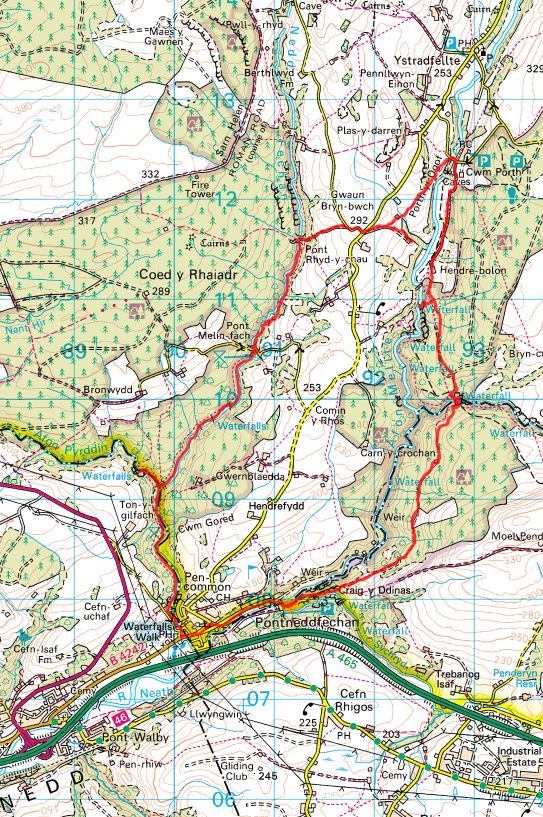
This is the latest in a series of walks that has previously taken in a number of routes in the Gloucestershire area, as well as a couple in Wales. We decided for this one that we'd head over towards the western Brecon Beacons and have a tour of the Ystradfellte waterfalls. Basically these are sandwiched between the main peaks of Pen y Fan and its neighbours and the more remote Black Mountain (venue for my stag weekend in May 2011), about an hour's drive from Newport.
No great elevation involved - highest point is a smidgen under 300 metres - but a bit of up and down and some scrambling, particularly in the vicinity of the waterfalls, of which there are many: Sgwd Gwladus, Sgwd Clun-gwyn and Sgwd yr Eira being the most impressive of the ones we saw. Sgwd yr Eira is particularly noteworthy for having a path running across the rock face behind the waterfall which the intrepid walker can take if he or she doesn't mind getting a bit wet.
There's a fair amount of variation in the amount of water coming over the various waterfalls, depending on how much rain has fallen on the hills above the falls in the past few weeks. I'd say they were reasonably full but not exceptional yesterday, somewhere between the bare trickle they get reduced to in the summer and the raging torrents they become after persistent heavy rain. Compare for instance the picture of Sgwd Gwladus (the first picture) here, and the one here, and note the before and after pictures of Sgwd yr Eira here.
Here's the route map - if you can't get it to display big enough, try this one. We parked in the Dinas Rock car park in Pontneddfechan and did a clockwise circuit from there.
The GPS tracking info (from which that map is drawn) reckons the round trip was 10.8 miles, more than enough distance to justify stopping off for a cheeky pint of Rhymney Bitter in the Angel in Pontneddfechan before heading home. As always there are some photos, here. To augment the photos, Robin captured a couple of brief snippets of video footage in the vicinity of Sgwd Gwladus and behind Sgwd yr Eira.
Other weather forecasting methods are available, though, and the BBC Weather website actually reckoned that the place we were heading for would be relatively rain-free on Saturday. Additionally there is Dave's Rule Of Weather Forecasting, which has two parts, as follows:
- Chances are tomorrow's weather will be very much like today's;
- If you want to know what the weather will be like the day after tomorrow, wait until tomorrow and then apply rule 1.
Anyway, I can ruin the suspense for you now by revealing that, a bit of initial drizzle and a couple of brief squally showers aside it was shorts and T-shirts weather most of the day. Not a hailstone in sight, not even a little one.
This is the latest in a series of walks that has previously taken in a number of routes in the Gloucestershire area, as well as a couple in Wales. We decided for this one that we'd head over towards the western Brecon Beacons and have a tour of the Ystradfellte waterfalls. Basically these are sandwiched between the main peaks of Pen y Fan and its neighbours and the more remote Black Mountain (venue for my stag weekend in May 2011), about an hour's drive from Newport.
No great elevation involved - highest point is a smidgen under 300 metres - but a bit of up and down and some scrambling, particularly in the vicinity of the waterfalls, of which there are many: Sgwd Gwladus, Sgwd Clun-gwyn and Sgwd yr Eira being the most impressive of the ones we saw. Sgwd yr Eira is particularly noteworthy for having a path running across the rock face behind the waterfall which the intrepid walker can take if he or she doesn't mind getting a bit wet.
There's a fair amount of variation in the amount of water coming over the various waterfalls, depending on how much rain has fallen on the hills above the falls in the past few weeks. I'd say they were reasonably full but not exceptional yesterday, somewhere between the bare trickle they get reduced to in the summer and the raging torrents they become after persistent heavy rain. Compare for instance the picture of Sgwd Gwladus (the first picture) here, and the one here, and note the before and after pictures of Sgwd yr Eira here.
Here's the route map - if you can't get it to display big enough, try this one. We parked in the Dinas Rock car park in Pontneddfechan and did a clockwise circuit from there.
The GPS tracking info (from which that map is drawn) reckons the round trip was 10.8 miles, more than enough distance to justify stopping off for a cheeky pint of Rhymney Bitter in the Angel in Pontneddfechan before heading home. As always there are some photos, here. To augment the photos, Robin captured a couple of brief snippets of video footage in the vicinity of Sgwd Gwladus and behind Sgwd yr Eira.
Labels:
crackpot theories,
friends,
maps,
photolinks,
the great outdoors
Monday, June 02, 2014
the last book I read
Fanny Hill or Memoirs Of A Woman Of Pleasure by John Cleland.
What is a bright, ambitious and, as it happens, comely and buxom young girl of fifteen to do when both her parents are carried off in quick succession by the pox and she is left without any means of supporting herself? You'll recall young Kate aka Bob being left in a similar situation in the first episode of Blackadder II and failing to heed her father's advice:
Just as Fanny's future seems to be mapped out, though, she meets a young man called Charles, sleeping off an excess of drink in Mrs. Brown's kitchen, and after a courtship lasting all of a couple of minutes the pair decide that they are in love and that Charles will take her away from all this and set her up as his mistress. So they slip away and spend the next few weeks living together, during which time Charles relieves Fanny of the tiresome burden of her virginity.
Disaster strikes when Charles is sent overseas at short notice by his father, and Fanny is once again left on her own. But she is a shrewd and resilient girl and soon gets herself set up as the live-in mistress of the wealthy Mr. H, whom she doesn't love but who treats her well enough. All goes well until one day she comes home early and sees Mr. H giving the chamber maid a good seeing-to, whereupon Fanny is roused to take revenge by seducing the delivery boy and is caught in the act by Mr. H.
So Fanny is out on the street again. But her adventures have given her a clear instinct for self-preservation, a head for money-making, and a pretty good idea of where her, hem, hem, talents lie. So it doesn't take long for her to get set up in the house of Mrs. Cole, another smart old madam, and really get to grips with the prostitutional life. And what a life! If she's not participating in eight-way orgies, there's riverside skinny-dipping action, some spicy flagellation and even a bit of through-the-keyhole spying on some hot forbidden penetrative man-on-man action.
But all good things must come to an end, and eventually Mrs. Cole decides she's getting too old for the old whoring game and retires to her little cottage (Dunwhorin, presumably) in the country. Landing on her feet once again, Fanny takes up with a kindly sixtysomething gentleman who just happens to possess a considerable fortune (which he soon makes Fanny the sole beneficiary of) and a dicky heart, leaving Fanny, still barely nineteen, a woman of considerable independent means. So when she meets Charles again, returned from his overseas trip but fallen upon hard times, she's in a position to make him an offer to their mutual benefit. And so to bed.
Fanny Hill is such a cultural and comedy staple that it's hard to know what to expect when reading it. You'll need to know that it was first published in 1749, and allegedly written piecemeal over the preceding 20 years, so there'll be some archaic language to get through. But, as with some other books, the unfamiliarity of the language really isn't much of a burden once you get used to it, and the flowery prose in which the central scenes are rendered can't conceal the utter filth they contain:
There have been many under-the-counter-in-a-brown-paper-bag film adaptations of Fanny Hill over the years; the BBC did a rather more respectable one back in 2007, which necessarily took a bit more of a soft-focus approach to the sex (thereby, arguably, defeating the object) but which may be of interest to anyone wondering where they'd seen the female flatmate from those BT Infinity adverts before.
One last thing: it's unclear from the various online dictionaries whether Fanny Hill is the inspiration for the use of the word "fanny" to describe (US readers should probably stop reading now to avoid confusion) the female genitalia. It's listed as a possible derivation here; most other dictionaries don't offer any clues. My giant Chambers dictionary is similarly tight-lipped (ooer) on the subject.
What is a bright, ambitious and, as it happens, comely and buxom young girl of fifteen to do when both her parents are carried off in quick succession by the pox and she is left without any means of supporting herself? You'll recall young Kate aka Bob being left in a similar situation in the first episode of Blackadder II and failing to heed her father's advice:
Father: I'm sad because, my darling, our poverty has now reached such extremes that I can no longer afford to keep us. I must look to my own dear tiny darling to sustain me in my frail dotage.Well, it turns out Kate's old Dad knew what he was talking about after all. After heading up to London to seek her fortune under the supervision of an older friend, who promptly abandons her, Fanny is taken under the wing of kindly old Mrs. Brown, who it turns out is a serial "rescuer" of young girls, and who provides them with bed and board and expects very little in return except a bit of the old whoring. Fanny is a bit taken aback by this, at least at first, being an innocent country girl, but soon gets the idea after a bit of gentle girl-on-girl action from roommate Phoebe, and a bit of hiding-in-the-cupboard voyeurism.
Kate: But father, surely...
Father: Yes Kate, I want you to become a prostitute.
Just as Fanny's future seems to be mapped out, though, she meets a young man called Charles, sleeping off an excess of drink in Mrs. Brown's kitchen, and after a courtship lasting all of a couple of minutes the pair decide that they are in love and that Charles will take her away from all this and set her up as his mistress. So they slip away and spend the next few weeks living together, during which time Charles relieves Fanny of the tiresome burden of her virginity.
Disaster strikes when Charles is sent overseas at short notice by his father, and Fanny is once again left on her own. But she is a shrewd and resilient girl and soon gets herself set up as the live-in mistress of the wealthy Mr. H, whom she doesn't love but who treats her well enough. All goes well until one day she comes home early and sees Mr. H giving the chamber maid a good seeing-to, whereupon Fanny is roused to take revenge by seducing the delivery boy and is caught in the act by Mr. H.
So Fanny is out on the street again. But her adventures have given her a clear instinct for self-preservation, a head for money-making, and a pretty good idea of where her, hem, hem, talents lie. So it doesn't take long for her to get set up in the house of Mrs. Cole, another smart old madam, and really get to grips with the prostitutional life. And what a life! If she's not participating in eight-way orgies, there's riverside skinny-dipping action, some spicy flagellation and even a bit of through-the-keyhole spying on some hot forbidden penetrative man-on-man action.
But all good things must come to an end, and eventually Mrs. Cole decides she's getting too old for the old whoring game and retires to her little cottage (Dunwhorin, presumably) in the country. Landing on her feet once again, Fanny takes up with a kindly sixtysomething gentleman who just happens to possess a considerable fortune (which he soon makes Fanny the sole beneficiary of) and a dicky heart, leaving Fanny, still barely nineteen, a woman of considerable independent means. So when she meets Charles again, returned from his overseas trip but fallen upon hard times, she's in a position to make him an offer to their mutual benefit. And so to bed.
Fanny Hill is such a cultural and comedy staple that it's hard to know what to expect when reading it. You'll need to know that it was first published in 1749, and allegedly written piecemeal over the preceding 20 years, so there'll be some archaic language to get through. But, as with some other books, the unfamiliarity of the language really isn't much of a burden once you get used to it, and the flowery prose in which the central scenes are rendered can't conceal the utter filth they contain:
Standing then between Harriet's legs, which were supported by her two companions at their widest extension, with one hand he gently disclosed the lips of that luscious mouth of nature, whilst with the other, he stooped his mighty machine to its lure, from the height of his stiff stand-up towards his belly; the lips, kept open by his fingers, received its broad shelving head of coral hue: and when he had nestled it in, he hovered there a little, and the girls then delivered over to his hips the agreeable office of supporting her thighs; and now, as if he meant to spin out his pleasure, and give it the more play for its life, he passed up his instrument so slow that we lost sight of it inch by inch, till at length it was wholly taken into the soft laboratory of love, and the mossy mounts of each fairly met together.Basically the flimsy plot devices, such as they are, just serve as the scaffolding to hold the sex scenes together. It hardly needs saying that this is as rose-tinted a view of the business of prostitution as Pretty Woman or Belle de Jour, probably more so given that the action takes place in the mid-18th century, not exactly prime female-empowerment territory. Apart from anything else the vexed issue of contraception never really arises, except in that it's pretty clear that no barrier methods are being used. Fanny does get pregnant during her brief sojourn of living with Charles (and subsequently miscarries) but how all the rest of the uninhibited unprotected fucking isn't resulting in sprogs popping out everywhere isn't clear. On the plus side the whole notion of unabashed female hunger for, and enjoyment of, sex was a good deal more subversive then than it is now, and Fanny is a very engaging central character who clearly enjoys her job greatly, and not just for its money-making aspects. A bit like The Fermata, analysis beyond just revelling in the joyous filthiness of it all is probably missing the point.
There have been many under-the-counter-in-a-brown-paper-bag film adaptations of Fanny Hill over the years; the BBC did a rather more respectable one back in 2007, which necessarily took a bit more of a soft-focus approach to the sex (thereby, arguably, defeating the object) but which may be of interest to anyone wondering where they'd seen the female flatmate from those BT Infinity adverts before.
One last thing: it's unclear from the various online dictionaries whether Fanny Hill is the inspiration for the use of the word "fanny" to describe (US readers should probably stop reading now to avoid confusion) the female genitalia. It's listed as a possible derivation here; most other dictionaries don't offer any clues. My giant Chambers dictionary is similarly tight-lipped (ooer) on the subject.
Labels:
books,
the last book I read
Friday, May 30, 2014
paris in the the spring
We've been on a couple of trips lately that have generated some photos, so this is mainly just somewhere to hang the links from. A few explanatory notes, though:
- Hazel and I went to Paris on the Eurostar at the beginning of May, a quick 48-hour jaunt organised (and, more importantly, paid for) by Utility Warehouse, who Hazel does some work as a distributor for in addition to her photography activities. I can't give you the promotional spiel for UW, but if you want to have a look at what they have to offer, start here. Anyway, the point is we got a free trip to Paris out of it, staying at the very nice Hyatt Regency Paris Étoile out at Porte Maillot on the north-eastern corner of the Bois de Boulogne. Not much time to do anything out of the ordinary run of touristy stuff, but we did take a twilight river cruise on the Bateaux-Mouches on Friday night, and took advantage of a glorious sunny day on the Saturday to do a walking tour of Paris, starting at the Eiffel Tower and heading out to Montmartre and Sacré-Cœur. Photos can be found here.
- A couple of weeks later we went off on a family trip (i.e. with Nia this time) to Bluestone in Pembrokeshire. This is a self-contained family holiday village complete with shops, pub (featuring excellent Doom Bar), swimming pool and various sporting activities. The best description I can give you is that it's a little bit like a cross between CenterParcs and The Prisoner, but without all that unpleasantness with the giant beach balls if one should stray beyond the boundaries of the complex. We verified this by venturing out a couple of times, once to cycle around Canaston Woods and once to go to the seaside at Freshwater East, which is lovely and - largely because it's not right next to a town with shops and toilets and amusement arcades and the like - very quiet. We also called into Tenby on the way back home, which is much more in the stereotypical British seaside town vein, but still very nice, and features the Pembrokeshire Pasty & Pie Co.'s excellent shop just a couple of minutes' walk from the beach. Photos can be found here.
Labels:
les frogs,
photolinks,
the bairn,
travel
filamentary, my dear Watts on
More exciting developments with the kitchen lighting, so I hope you've got your Bulbsplosion Bingo cards handy. First to expire was bulb number 12, one of the surviving 40W incandescent bulbs of indeterminate age (but given the general instability it's probably a few months at most), which gave out on May 24th. No pence per day calculation for this one, for obvious reasons.
Then, on May 27th, two more - firstly bulb number 7, another of the valiant surviving incandescent 40W brigade.
Also, bulb number 1, the first of the 28W halogen bulbs to expire. This one clocked up 28 days, which at an initial cost of £4.28 works out at an eye-watering 15.3p per day.
You'll notice that I'm lagging behind a bit on replacing the blown bulbs. I should get on and do this as I may as well use up the remaining ones in the cupboard, plus it'll also make it easier to track which ones go phut. I'm not intending to purchase any more until I've got some more conclusive evidence of which ones I should be buying. I suspect it'll end up being the LED ones, but I don't want to jump the gun. It's also important to be self-aware enough to recognise my natural inclination towards believing it's the IKEA bulbs that are the best, just because a bulb-buying trip to IKEA will also afford me the opportunity to stock up on meatballs and bizarre fish products.
Then, on May 27th, two more - firstly bulb number 7, another of the valiant surviving incandescent 40W brigade.
Also, bulb number 1, the first of the 28W halogen bulbs to expire. This one clocked up 28 days, which at an initial cost of £4.28 works out at an eye-watering 15.3p per day.
You'll notice that I'm lagging behind a bit on replacing the blown bulbs. I should get on and do this as I may as well use up the remaining ones in the cupboard, plus it'll also make it easier to track which ones go phut. I'm not intending to purchase any more until I've got some more conclusive evidence of which ones I should be buying. I suspect it'll end up being the LED ones, but I don't want to jump the gun. It's also important to be self-aware enough to recognise my natural inclination towards believing it's the IKEA bulbs that are the best, just because a bulb-buying trip to IKEA will also afford me the opportunity to stock up on meatballs and bizarre fish products.
Labels:
food,
light entertainment,
Newport,
science bits
Monday, May 19, 2014
the last book I read
The Blood Doctor by Barbara Vine.
Martin Nanther is a writer and, as Lord Nanther, a hereditary peer entitled to sit in the House of Lords. This right derives from his inheriting the peerage bestowed on his great-grandfather Henry Nanther by Queen Victoria - Henry Nanther having served as one of the Queen's senior physicians for many years.
Martin plans to write a biography of his great-grandfather, his interest having been piqued by some old documents which came into his possession after his mother's death which reveal some interesting titbits from Henry's personal life: he kept a mistress in London for many years, and married his wife Edith only after having previously been engaged to her younger sister Eleanor, that engagement ending when Eleanor was brutally murdered and her body thrown from a train.
Henry's medical speciality was diseases of the blood, and so he was invited to be Queen Victoria's resident expert on the so-called "royal disease" of haemophilia, from which her son Leopold suffered and of which her daughter Alice was a known carrier, Alice being responsible for infecting the Russian royal family as well.
Martin's suspicions are aroused when he starts researching his family tree for the biography, since several branches of it seem to feature sons who died very young, including Henry's own son George. This has a particular resonance for Martin as he and his second wife Jude are trying to conceive a child, but Jude has suffered a series of traumatic miscarriages. Is there some similar "bad blood" in the Nanther line?
Martin's family research leads him to various family members he had never even known existed, and to Switzerland, where pioneering studies of haemophilia were done in various isolated mountain communities, and where Henry was known to have been on several walking holidays in the mid-19th century. Is there a link between this and the mysterious early deaths of some of the male Nanthers? And who killed Eleanor? Was Henry involved? And if so, why?
You'll recall from the other Vine in this list that there are various themes that run through a lot of the books, and many of them are present here - the events that form the book's central puzzle (there is no "crime" in any meaningful legal sense) are over 100 years in the past and have to be uncovered by careful research involving lots of poring through letters and diaries, and there's a bit of homosexual subtext in that it's suggested Henry chose to do the things he's eventually revealed to have done after the death of his, hem hem, "close friend" Richard Hamilton in the Tay Bridge disaster in 1879.
The Vine books don't stand and fall on the quality of the central mystery, and just as well - I couldn't at this point tell you what it was in any of Asta's Book, The House Of Stairs or The Brimstone Wedding, though I read and enjoyed them all. The Chimney Sweeper's Boy's central protagonist having to flee and assume a new identity after accidentally giving his brother a blowjob in a sauna sticks in the mind, for some reason. The revelation of what Henry has done here is neither especially surprising nor at all plausible, but in a way it doesn't matter.
This is the most recent of all the Vines I've read, and they do seem to have gradually bulked up over the course of her career - the early ones are all around 300 pages, The Chimney Sweeper's Boy and Asta's Book are over 400 and The Blood Doctor is a beefy 466 pages. To be honest rather too much of this is taken up with meticulous family tree reconstruction that has the reader constantly diving back to the explanatory chart at the front, and none of which is as exciting as all the (literally) gory detail about haemophilia and its transmission. There's a lot here about "blood" in all its literal and colloquial senses - haemophilia, Martin and Jude's struggle to conceive (which turns out to be due to an unrelated genetic disorder), the House of Lords and the abolition of hereditary peers.
It's very good and very readable, but if you want some Vines I would suggest you try some of the earlier ones - A Fatal Inversion, The Brimstone Wedding, King Solomon's Carpet and No Night Is Too Long would do for starters.
Martin Nanther is a writer and, as Lord Nanther, a hereditary peer entitled to sit in the House of Lords. This right derives from his inheriting the peerage bestowed on his great-grandfather Henry Nanther by Queen Victoria - Henry Nanther having served as one of the Queen's senior physicians for many years.
Martin plans to write a biography of his great-grandfather, his interest having been piqued by some old documents which came into his possession after his mother's death which reveal some interesting titbits from Henry's personal life: he kept a mistress in London for many years, and married his wife Edith only after having previously been engaged to her younger sister Eleanor, that engagement ending when Eleanor was brutally murdered and her body thrown from a train.
Henry's medical speciality was diseases of the blood, and so he was invited to be Queen Victoria's resident expert on the so-called "royal disease" of haemophilia, from which her son Leopold suffered and of which her daughter Alice was a known carrier, Alice being responsible for infecting the Russian royal family as well.
Martin's suspicions are aroused when he starts researching his family tree for the biography, since several branches of it seem to feature sons who died very young, including Henry's own son George. This has a particular resonance for Martin as he and his second wife Jude are trying to conceive a child, but Jude has suffered a series of traumatic miscarriages. Is there some similar "bad blood" in the Nanther line?
Martin's family research leads him to various family members he had never even known existed, and to Switzerland, where pioneering studies of haemophilia were done in various isolated mountain communities, and where Henry was known to have been on several walking holidays in the mid-19th century. Is there a link between this and the mysterious early deaths of some of the male Nanthers? And who killed Eleanor? Was Henry involved? And if so, why?
You'll recall from the other Vine in this list that there are various themes that run through a lot of the books, and many of them are present here - the events that form the book's central puzzle (there is no "crime" in any meaningful legal sense) are over 100 years in the past and have to be uncovered by careful research involving lots of poring through letters and diaries, and there's a bit of homosexual subtext in that it's suggested Henry chose to do the things he's eventually revealed to have done after the death of his, hem hem, "close friend" Richard Hamilton in the Tay Bridge disaster in 1879.
The Vine books don't stand and fall on the quality of the central mystery, and just as well - I couldn't at this point tell you what it was in any of Asta's Book, The House Of Stairs or The Brimstone Wedding, though I read and enjoyed them all. The Chimney Sweeper's Boy's central protagonist having to flee and assume a new identity after accidentally giving his brother a blowjob in a sauna sticks in the mind, for some reason. The revelation of what Henry has done here is neither especially surprising nor at all plausible, but in a way it doesn't matter.
This is the most recent of all the Vines I've read, and they do seem to have gradually bulked up over the course of her career - the early ones are all around 300 pages, The Chimney Sweeper's Boy and Asta's Book are over 400 and The Blood Doctor is a beefy 466 pages. To be honest rather too much of this is taken up with meticulous family tree reconstruction that has the reader constantly diving back to the explanatory chart at the front, and none of which is as exciting as all the (literally) gory detail about haemophilia and its transmission. There's a lot here about "blood" in all its literal and colloquial senses - haemophilia, Martin and Jude's struggle to conceive (which turns out to be due to an unrelated genetic disorder), the House of Lords and the abolition of hereditary peers.
It's very good and very readable, but if you want some Vines I would suggest you try some of the earlier ones - A Fatal Inversion, The Brimstone Wedding, King Solomon's Carpet and No Night Is Too Long would do for starters.
Labels:
books,
science bits,
the last book I read
Saturday, May 17, 2014
bulbous developments #2
We've been away for a week, and it appears that another few bulbs took this as their opportunity to say "goodbye, cruel world" and "hasta la vista, baby" and furiously incandesce themselves into oblivion. Actually, one couldn't wait and gave up the ghost before we'd even left, but we found two more had committed filamentary seppuku on our return. You'll be wanting to tick these off on your Bulb Bingo card, so here they are:
Firstly, bulb number 10, which went on May 9th - this was an incandescent 25W job, which at 99p for 10 days works out at, let's say, 10p per day.
Then on our return today, two more. Firstly bulb number 4, one of the new batch of incandescent 40W ones, which at £1.49 for 18 days works out at a smidgen under 8.3p per day.
Then, later, bulb number 5, another incandescent 25W one, which at 99p for 18 days works out at 5.5p per day.
So by the rule I've just invented (but which seems reasonable enough) that says the expensive bulbs need to perform at least as well as the longest-lasting incandescent bulb, the required minimum expiry dates for the 4 quid LED bulbs and the £7.98 energy-saver are now 73 days and 145 days from their respective installation dates, or, to put it another way, July 19th and September 21st. Watch this space.
Firstly, bulb number 10, which went on May 9th - this was an incandescent 25W job, which at 99p for 10 days works out at, let's say, 10p per day.
Then on our return today, two more. Firstly bulb number 4, one of the new batch of incandescent 40W ones, which at £1.49 for 18 days works out at a smidgen under 8.3p per day.
Then, later, bulb number 5, another incandescent 25W one, which at 99p for 18 days works out at 5.5p per day.
So by the rule I've just invented (but which seems reasonable enough) that says the expensive bulbs need to perform at least as well as the longest-lasting incandescent bulb, the required minimum expiry dates for the 4 quid LED bulbs and the £7.98 energy-saver are now 73 days and 145 days from their respective installation dates, or, to put it another way, July 19th and September 21st. Watch this space.
Labels:
light entertainment,
Newport,
science bits
Subscribe to:
Posts (Atom)