
Secondly, my old mate and former work colleague Harry (and his rather magnificent lockdown beard) and the late Dusty Hill, bass player and occasional vocalist (on some of the shoutier numbers) with Texan blues-rockers ZZ Top.

Secondly, my old mate and former work colleague Harry (and his rather magnificent lockdown beard) and the late Dusty Hill, bass player and occasional vocalist (on some of the shoutier numbers) with Texan blues-rockers ZZ Top.

The name's Bond; James aaaaahh well you know the rest. Hush hush, double-0 status, licence to kill, all that malarkey. Plus all the willing women you can eat, of course. But shut up, because this time Bond has met a Proper Lady, and she's a corker. Cool, enigmatic, drives fast, lives dangerously, plays cards, absolute FILTH in the sack, all the major boxes ticked. But it turns out she's got some psychological issues and Bond ends up having to rescue her from topping herself by walking into the sea at the exotic resort of Royale-les-Eaux (which you might remember from Casino Royale).
No sooner has Bond wrestled Tracy out of the surf than they are set upon by some goons and spirited away by boat to some secret location where Bond assumes they will be summarily executed and he will have to cook some fools in order to escape. Not a bit of it, as it turns out, as the abduction turns out to have been organised by Marc-Ange Draco, who is not only the head of the Corsican mafia but also, as it happens, Tracy's father. He explains the circumstances of his meeting and courting Tracy's English mother (a bit more rapey than most modern courtships) her subsequent death, Tracy's struggles with depression and his firm belief that what she really needs to keep her on the straight and narrow is the firm hand of a strong man to slap some sense into her and occasionally administer a brisk corrective rogering, and, moreover, his belief that Bond is that man and that he will pay him a million dollars to keep her safe.
Bond refuses the money, but agrees to keep an eye on Tracy on the condition that she undergoes some proper treatment for her depression. Meanwhile, work considerations intervene. Bond has been engaged in a cat-and-mouse battle with the shadowy SPECTRE organisation and its kingpin, Ernst Stavro Blofeld, but the entire crew seem to have gone to ground. With a bit of help from Draco's European network of contacts, Bond gets wind of a mysterious count occupying a mountain-top retreat in the Alps who is currently engaged in a correspondence with the College of Arms to determine his right to the hereditary title he's claiming. Could this be our man?
After a quick five-minute visit to gain the rudiments of knowledge about genealogy, the British aristocracy, heraldic symbology and what have you, Bond assumes the identity of Sir Hilary Bray, Shield-Wrangler Pursuivant or some such nonsense, and cooks up a pretext for a personal visit to check certain aspects of Blofeld's claim in person. When he arrives, he finds that the count (who makes no secret of his identity as Blofeld) is running some sort of clinic for rich young women to cure them of their phobias by a combination of fresh air, exercise, some slightly odd hypnotic techniques and of course The Drugs. While providing a convincing veneer of doing genealogical research and interviewing Blofeld about his ancestry, Bond strikes up friendships with the girls to try and work out what kind of supervillain shit Blofeld is really up to. As luck would have it one of the girls, Ruby, not only seems keen on him but has a bedroom just down the corridor, so Bond sneaks out of his room one night, gives Ruby a teeth-rattling seeing-to and then listens in while she slumbers post-coitally and the hypnotic tape plays. It's a bit disappointing, though, just some shit about not being afraid of chickens.
The shit hits the fan pretty soon, though, when another Secret Service operative is captured snooping around the complex, brought before Blofeld, and clearly recognises Bond. Bond manages to shrug it off as the ravings of a badly-beaten madman but knows the jig will be up as soon as the thumbscrews are applied and the other guy talks. Sneaking out of his room in the dead of night he manages to steal some ski equipment and speed off down the mountain, hotly pursued by Blofeld's goons. He manages to outrun them to the nearest town where who should he literally run into but Tracy, seemingly having regained her marbles and just gadding about on the slopes. She helps him escape and return to England where he debriefs M and some chaps from the Ministry of Agriculture who are interested in one of Blofeld's previous patients and the outbreak of fowl pest that happened near her home just after she returned. The man from the Ministry is a pretty sharp cookie, as it turns out, and soon joins the dots to reveal Blofeld's dastardly scheme: hypnotise the girls to spread various crop and livestock diseases on their return to Britain, crash the economy, and make a fortune shorting the pound and anything else he can think of.
Obviously Blofeld's monstrous scheme must be stopped: but how? Well, fortunately Bond has a list of all the girls' names, so they can be tracked down and detained and relieved of any anthrax they may happen to be carrying. But how to take down Blofeld's mountain lair? At this point Bond calls upon Draco again to rustle up a helicopter and some hand-picked Corsican badasses and mount a raid on the facility. This they do, but Blofeld has thought ahead and concocted an escape plan involving hurling himself down the nearest bobsleigh run on a tea-tray. Bond grabs his own tea-tray and pursues him, but loses him. The mountain-top lair is blown up in a satisfying way, though.
After the dust has settled, Bond applied himself to other matters, specifically marrying Tracy and setting off on a honeymoon. As Bond stops the car to remove some of the wedding streamers and ribbons, however, a Maserati speeds alongside and empties a hail of bullets into the car, killing Tracy.
As with Casino Royale it's hard not to view this through the prism of having seen the film several times. In this particular case the film (George Lazenby's only outing as Bond) follows the plot of the book pretty closely, and where it does diverge from the plot - to provide some opportunity for Blofeld to do the Let Me Explain My Evil Plan thing, and be a lot more specific about what the girls are being hypnotised to do - this actually helps quite a bit, as the book's having the guy from the Ministry extrapolate the whole plot from Bond's flimsy evidence was a bit implausible. Also a bit odd is the idea that neither Bond nor Blofeld would recognise each other, particularly jarring in the film when the audience knows that they've met in previous movies, even though it's masked a bit by both characters being played by different actors from previous films. It works in the book because in the only previous book to feature Blofeld, Thunderball, the two characters never actually meet.
Anyway, it does what it says on the tin and it's a better book than Casino Royale, though probably not quite as good as Dr. No which remains my favourite. My venerable pre-decimalisation Pan paperback has been on my shelves for probably upwards of 25 years.
It's been a while, but evidently the Curse Of Electric Halibut has been biding its time, like a coiled python drowsily digesting its last victim (Joan Didion in December 2021) and has lazily flicked open a baleful eye and decided that the time is ripe for another victim. This time it's Hilary Mantel, recipient of mega-sales and fame (by serious novelist standards anyway) since the 2009 publication of Wolf Hall, the first of her trilogy featuring Thomas Cromwell. Both Wolf Hall and its 2012 sequel, Bring Up The Bodies, won the Booker Prize, securing her membership of the select group of people who have won it more than once - JM Coetzee, Peter Carey and Margaret Atwood are the others, plus arguably JG Farrell if you count the retrospective award cooked up for novels published in 1970.
Mantel had a perfectly respectable literary career before Wolf Hall, writing odd novels with a mainly contemporary setting. The late-career shift from odd novels with a modern setting to perhaps slightly less odd novels centred on real historical figures (though with some quite large liberties taken with strict historical accuracy) is vaguely reminiscent of Beryl Bainbridge. though Bainbridge's historical novels were pretty terse at around 200 pages and The Mirror And The Light, the concluding part of the Cromwell trilogy, is a meaty 875 pages.
Mantel was a relatively youthful 70 when she died, but had endured a lifetime of health problems mainly associated with years of undiagnosed endometriosis. Only Iain Banks, Michael Dibdin, Henning Mankell and Helen Dunmore were younger when the curse came for them, and only Alison Lurie and John le Carré had to wait longer after the initial book review for the icy hand of death to finally alight on their shoulder.
Another series of tenuously-linked thoughts, if you'll permit me. Firstly, someone retweeted this tweet into my timeline the other day:
I simply refuse to believe that *anyone* older than 8 is so catastrophically unobservant about the world they live in that they are "only just realising" this. pic.twitter.com/hzVCpYzR0l
— Paul Sayers (he/him) (@RandomCharStr) September 18, 2022
Now I'm all about the making unduly harsh snap judgments without giving people an opportunity to defend themselves, as you know, but still, this seems a bit over-the-top to me. Apart from anything else, who even uses snail mail these days? Certainly not The Kids, bless 'em, who are too busy doing things The Kids do these days like making TikTok videos and eating ass, so the opportunity to gaze upon a postbox frontage while posting multiple items and ruminate upon what all the various letterings stand for is a fairly niche thing in 2022.
I mean, I'm pretty sure if someone put the picture attached to the tweet in front of me I could have worked out what it must mean, but the only reason I know what the letters on the front of a postbox mean in relation to the royal cypher in particular is because we used to have a VR postbox in the village we lived in (specifically, this house) on the outskirts of Nottingham for a couple of years around 1981/1982, and I recall one or other of my parents explaining its significance to me. I'm obscurely chuffed with myself that I was able to drop the StreetView man right on the postbox's location first time 40-odd years later. Frustratingly, the lane was evidently too narrow at this point to squeeze the Googlemobile down so you can't actually see the lettering on the box, but fortunately someone's captured it here.
Anyway, you'll be saying the name of the village (Normanton-on-the-Wolds) by emphasising the first syllable of NORmanton, right? I mean, like any normal person would. And, just to be clear, you would in this case be right to do so. But not in all cases, goodness me no. I have only a few memories of visiting nearby sites of outdoor interest during our briefish time living in Normanton - the watersports centre at Holme Pierrepont, the vast grassy expanses of Clumber Park - but I do have a clear memory of going for a walk on the banks of a large area of water and snooping round a church which was half-submerged in the water. This hazy memory only shimmered into sharp focus a couple of months ago when we went for a brief camping trip in Rutland, at a site a couple of miles south of Rutland Water. Among the other fascinating information available about Rutland Water (notably that it's the largest reservoir in England by surface area) is the semi-submerged church on its banks at Normanton, prominently featured in much of the tourist literature. We didn't actually have time to visit as part of this trip but I did have a chat with a knowledgeable bloke while scoping out some watersport activity and he talked briefly about the church, and I did do enough Googling to confirm that it is indeed the same church we visited 40-odd years ago, when the reservoir had only been in fully-filled existence for a year or two. Interestingly, though, he clearly and specifically pronounced it NorMANton with the emphasis on the middle syllable. A quick look at a map of the area reveals that there is a place called Manton a few miles to the west, so it's not utterly ridiculous to conclude that Normanton may be a contraction of "North Manton" and the contracted name has retained the accenting from the original name. Note that I'm leaving aside the obvious observation that it should really be called East Manton given its geographical position.
There are quite a few other places called Normanton in England, notably Normanton le Heath in Leicestershire which featured in the lists here.
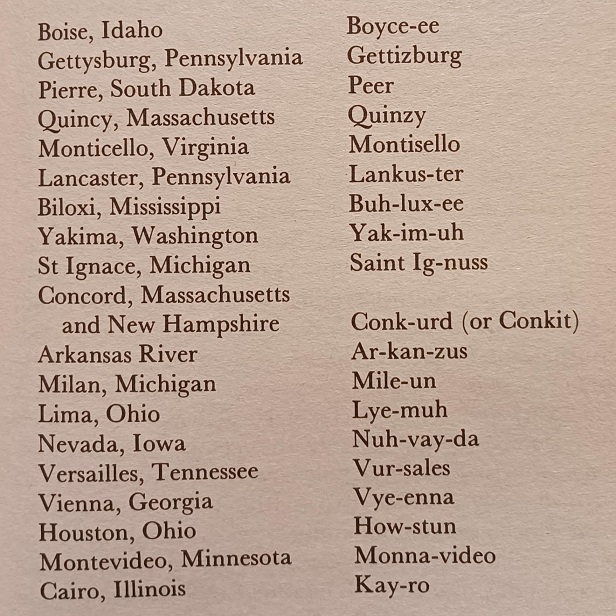
Anyway, a small selection of Rutland photos can be found here. It's not just British place-names - here's a list from Bill Bryson's excellent Mother Tongue featuring US place-names with counter-intuitive pronunciations:

I recall that during Butler's time in the Welsh team and particularly on his being named as captain in 1983 there was a bit of suspicion of him in some quarters owing to his public school and Cambridge University background (and not, presumably, something more appropriate like coal-mining). Similarly during his career as writer and broadcaster his penchant for slightly flowery poetic flights of fancy was a bit Marmite-y, and occasionally prompted the thought that he was enjoying the sound of his own voice more than the audience was. But his occasional commentary sparring with Brian Moore was always entertaining and clearly derived from mutual affection, like for instance this entertaining exchange about Gavin Henson's leg-shaving habits before he kicked the monster penalty that defeated England and started Wales' 2005 Grand Slam campaign.
He also did some interesting stuff outside of the narrow subject of rugby union, including this half-hour documentary about his birthplace and my place of residence, the city of Newport. Among the many interesting historical snippets included are a bit about the city's key role in the Chartist movement, the Newport Rising in particular, and the role of John Frost in all of it. Frost managed to avoid being massacred and lived to the ripe old age of 93, long enough to be pardoned for his role in the uprising, but not long enough to see various Newport landmarks being named in his honour including John Frost Square in the city centre and John Frost School.
We'll come back to the square in a minute, but the school illustrates the city's rather incoherent approach to commemorating its Chartist history: it was renamed (it was formerly plain old Duffryn High School) in 2015, but only two years earlier the city had approved the demolishing of the Chartist mosaic/mural in the city centre, albeit in a rather unprepossessing location on an underpass wall.
Anyway, back to John Frost Square, in a roundabout sort of way (that's a hilarious pun, for reasons that you'll see in a minute) - I was delivering Nia to her best friend's house at the weekend for a sleepover and pointed out the big clock sitting on top of a pair of steel columns that occupies the roundabout at the entrance to the new(ish) Glan Llyn estate, which in turn occupies part of the western end of the vast Llanwern steelworks site. Anyway, I told Nia that I was vaguely aware that the clock used to be in the city centre somewhere and moreover had some sort of mechanism that opened up the top and did something dramatic on the hour.

Just to clear up another couple of Newport claims-to-fame in the Butler documentary: it is certainly true that Joe Strummer lived in Newport in the 1970s (when he went by the name Woody Mellor), but it seems to have only been for about a year between 1973 and 1974, so any formative influence on his later work with the Clash seems a bit dubious. Even more dubious is the claim that Newport was the place where the mole grip was invented, as there seems to be a general consensus that it was invented (admittedly under a different name) in Nebraska in the 1920s. Newport was certainly the centre for UK manufacture from the 1950s onwards, but anyone claiming that means they were invented here needs to, so to speak, get a grip.

Meet the Northridges - they're a twentieth-century family. From the state of Nebraska, they are living through some history. It's a tough place, Nebraska - the endless grassy plains, the rivers, the occasional tornado ripping through and destroying everything you own - and breeds tough people. And sure enough the family patriarch who narrates the first section here, John Wesley Northridge II, is an uncompromising and irascible old character, of half-Lakota ancestry, made almost entirely out of knuckles and gristle. Already an old man when we first meet him in the mid-1950s, he lives a fairly solitary existence on his remote farm, something that suits him very well, thanks very much.
The only people he consents to spend time with regularly are his old friend and neighbour Lundquist, his daughter-in-law Naomi (wife of his late son, John Wesley Northridge III) and, favourite of all, his granddaughter Dalva, only in her early teens in this part of the novel but already a fierce and independent girl not prepared to take any shit from anybody, including her grandfather.
John Wesley has an odd encounter with a Native American, Smith, who he has not seen since childhood, and decides that his life is drawing to a close and that some mental stock-taking is probably in order. He reminisces at some length about his younger life, lovers, wives, children, adventures, and frets about what will become of his family, especially Dalva, who by this time has already got herself knocked up by an unsuitable young man and had to give up the baby for adoption.
We then shift narrators and jump forward nearly 30 years to the mid-1980s, and Nelse, who we soon learn is Dalva's son, is contending with some challenges of his own: his slightly ill-defined job as some sort of nature ranger, his clandestine relationship with his girlfriend J.M., inconveniently married to someone else right now, and the recently-acquired knowledge of his true parentage and the desire to know more, maybe by actually meeting in person. Eventually after much indecision he decides to seek out Naomi and Dalva, on the flimsy pretext of doing a bird survey on their land (a subterfuge that soon collapses once he meets them). After an initial period of wariness he is soon integrated into the family and decides to stick around for a while, a decision cemented by J.M.'s coming to join him, having ditched her no-good husband at the cost of a couple of black eyes.
So far so idyllic, but there is a cloud on the horizon: Dalva has been nursing some unspecified abdominal pains that she should really have been to the doctor about a while back, and when she does she finds that her worst fears are realised and she has a fairly advanced case of ovarian cancer. This prompts a bout of pre-death contemplation of her own (though somewhat more premature than her grandfather's as she is only in her mid-forties), and she enlists Nelse's help to set a few matters straight before she embarks on her final road trip to end things in a manner of her own choosing rather than in a hospital bed.
The narrative described, above, as engaging as it is, isn't really the point here - it's more about the background against which it all takes place, encompassing nearly a century of American history from Wounded Knee onwards. It's also about the individual characters, principally the assorted narrators: John Wesley and Nelse as already mentioned, but also Naomi, Paul (John Wesley's other son) and Dalva. It's also, more than most novels, about the physical landscape within which it's set and the living creatures (not just human) who inhabit that landscape, and also the characters' physical connection with the natural world, be it through work-related physical effort, recreation or carnality.
I discovered after having started The Road Home that it's actually the sequel to an earlier novel, called simply Dalva. I am here to tell you that I didn't feel like I was missing anything here by not having read that already, but that I do now intend to seek it out and read it, as I enjoyed this tremendously. Harrison is probably best-known for Legends Of The Fall, a short novel from 1979 made into a film in 1994 starring Brad Pitt and Anthony Hopkins among others. Another story from the same collection, Revenge, was also made into a film starring Kevin Costner in 1990.
I suppose if one were being hyper-critical one might say the first half of The Road Home is better than the second, John Wesley Northridge II's voice being the most compelling one telling the most compelling story, and once Nelse's section that follows it has finished all the major revelations have happened, apart from the news that Dalva is going to die. This is minor stuff, though, and I recommend it highly, although you should be aware that it's a big book in every sense - 446 pages in a too-big-for-the-bookshelves format the same size as House Of Leaves.

The Palmer family have just arrived in a small village in the vicinity of Glastonbury Tor. There's Jim, Margaret, and the kids, Billy and Sarah. Billy is slightly older and is probably about ten, maybe a little older, though the exact details are left fairly vague. The family previously lived in Bath and had a pretty nice comfortable middle-class life thanks to Jim's job as a car dealer, but following some unwise (and possibly slightly murky) business deals that went tits-up Jim has now been declared bankrupt and been forced to downsize. He's got a job in a gentleman's outfitters in the village run by a cousin of Margaret's.
Jim finds the new job stifling and unexciting and harbours a general resentment at his reduced circumstances, despite it being very clear that it was his greed and poor judgment that led to his bankruptcy. He's also a good-looking man in his mid-thirties with an eye for a pretty girl, and in his lunch-hour trips to the local pub catches the eye of Liz Burridge, a buxom young lass with ambitions to move on up and make something of herself beyond the stifling confines of the village, and possibly also No Better Than She Ought To Be.
Meanwhile Billy and Sarah have started at the village school, with all the usual challenges of strict new teachers, unfamiliar lunchtime procedures and brutish classmates who want to ensure no threat to their dominance of the playground by giving you a precautionary kicking. Billy in particular is a bright and inquisitive boy and is soon fascinated by the stories surrounding Glastonbury Tor - King Arthur, Joseph of Arimathea, Jesus, all utter hogwash of course but good fun nevertheless.
Margaret, meanwhile, has struck up a friendship with Leonora Vale, the slightly witchy and eccentric lady who lives nearby, and has also tentatively involved herself with the local amateur dramatic society, who are in the early stages of preparing a production of Noël Coward's Private Lives. Margaret takes the part of Amanda, with the younger Sibyl being played by none other than Liz Burridge.
So Liz has a part in Private Lives, but is also, if you will, putting some life in Jim's private parts, when opportunity presents itself. Speaking of opportunities, Jim has also accepted a lucrative side job delivering a package for shady local character Gordon Towker to an associate of his in London: no names, no pack drill, no questions asked, etc. This provides a nice little pay day but also some worry when Towker and a couple of his associates are arrested for handling stolen goods shortly afterwards.
Meanwhile Billy is doing well at school but is starting to have certain awkward yet fascinating feelings, you know, down there. He's also getting out and about around the village increasingly independently with his schoolfriends, and on a trip out to check out the Big School that he will soon be going to spots his father in a car with Liz Burridge. He hasn't got her ankles up on the dashboard, exactly, but Billy knows enough about the world to know that they're kissing, and that they shouldn't be.
The opening night of Private Lives rolls around, and Jim realises a few things: firstly that Margaret has interests and talents outside of making his tea and looking after his children, and secondly that she's pregnant and hasn't told him yet. In combination with his having recently assumed a greater level of responsibility at the shop (following Margaret's cousin being taken out by a stroke from which he is unlikely to fully recover) this prompts a bit of an epiphany: perhaps it's time to knuckle down, accept his culpability for the collapse of his former business and cut down on the skirt-chasing a bit.
No people turning into chimps, murders, Nazi espionage or homicidal poetry here: this is a quiet, low-key sort of story with not even a crashing spaceship to break the calm. Like many novels of this type, though, there's more to it than meets the eye and actually quite a bit going on: Jim's dalliance with Liz, brush with criminal activity, and confrontation with his past mistakes; Margaret's assertion of her independence, partly via the play, partly via her friendship with feisty old bird Leonora (and of course she knows about Jim's affair, just as she's known about most of the previous ones); Billy's sexual awakening. Sarah is the only one who doesn't have much to do beyond make up the numbers and be occasionally annoying to her brother, as younger sisters do. Will Jim's newfound maturity and devotion stick beyond the moment the next fabulous arse comes into view? Will Margaret stand for it this time if he does stray? Will Billy perfect his wanking technique in time for Big School? Who knows?
The exact date when all this is set is left slightly vague, but some references to Harold Macmillan suggest we're in the late 1950s or very early 1960s, probably slightly before (according to Philip Larkin anyway) sexual intercourse was invented and still within Britain's long post-Second World War hangover. Despite what you might call (rather unfairly I think) its relative lack of ambition I enjoyed it very much: the Somerset Levels location and some of the narrative being seen through the eyes of a young(ish) boy put me in mind of The Levels. I'd never heard of Derek Johns before picking this book up in a charity shop in Brecon last week, but supposedly this is the first book in a series of four featuring Billy at various stages of his life and collectively known as The Billy Palmer Chronicles.
We had a family holiday up near Brecon last week, in this spacious barn conversion that my parents managed to find. Aha, Brecon, you'll be thinking, well that's awfully handy for walks in the Beacons and the like, to which I would say: no shit, Sherlock. But how to get away from childcare responsibilities for the day?
As it happens there are a couple of solutions to that conundrum: one is that Nia is pretty keen to come on these walks after her triumphant debut up Pen y Fan back in November of last year. The other is the presence of grandparents who, while still pretty sprightly and up for walks, aren't necessarily going to be coming up mountains any more and who therefore might be up for hanging out with Nia's younger siblings. Alys is on the cusp of being up for this sort of stuff as well, actually, but was ruled out here after finding that she has become quite lidderally too big for her boots.
So, anyway, a mountain walk. Pen y Fan, as the highest peak in the area, exerts a strong pull, but how to get up it in a way that provides some fresh challenges? The answer lies in a combination of an idea first explored (unsuccessfully) here and one mentioned here - from the first link the idea of ascending via the Bryn Teg ridge and the steep northern side of Cribyn, and from the second the idea of taking two cars, dropping one off, and then doing a non-circular walk ending in the location where you'd left the first car. Nothing like as grand as the full east-west traverse I'd mooted there, but since we had two vehicles at our disposal we thought we'd give it a go, not least because it offered the prospect of ending the walk at a pub, rather than at a remote car park in the middle of nowhere.
Apart from a slightly vexing walk in along lanes and farm tracks to get to the start of the ridge (which is shorter than the ones either side of it coming down from Pen y Fan and Fan y Big) the approach to Cribyn is a delight, much more so this time than last time as we weren't being smashed into the turf by gale-force winds. The sight of Cribyn ahead offers the exciting prospect of some steepness and scrambling, and there is a bit, but as almost always happens once you're actually on the ridge it's far less daunting than it seems from below. Getting from Cribyn to Pen y Fan is always a bit of a ball-ache as it involves a substantial descent and re-ascent, and to break this up the saddle between the two usually offers a good spot for a pork pie and a breather. Pen y Fan to Corn Du, by contrast, involves no more than 30-40 metres of re-ascent and once that's out of the way it's downhill all the way into Libanus, the two main walking routes peeling off the ridge to left and right about half a mile beyond Corn Du and the track along the top of Pen Milan being grassy and relatively unfrequented. There's a bit more yomping along country lanes at the end than you'd really like, but, crucially, the two-car approach allows you to park car number one right next to the Tai'r Bull in Libanus village and then pop in for a pint of Butty Bach before driving back to the Cwmgwdi car park to collect car number two. Overall walk distance was about 9.1 miles, not much more than the 8.7 miles that Nia and I did from the south side in November but accompanied by slightly more complaining towards the end, mainly (I think) due to a bit more high-level descent and re-ascent and a longer relatively uninteresting tail. So it goes.
Connoisseurs of childishly sniggersome words will note that Libanus (home of the Brecon Beacons National Park Visitor Centre, and mentioned previously in this post, mainly concerned, as so many blog posts are, with Freemasonry, mayonnaise and arses) is generally pronounced like how polite sophisticated people say Uranus, i.e. with the accent on the first syllable rather than the second. With that in mind those people may also find it amusing that the route map forms the shape of a slightly saggy arse.


new addition to this thread! July 2022: me, Nia, Ray, Hazel. interesting new (to me) non-circular route straight up the back of Cribyn and down into Libanus. pint of Butty Bach in the Tai'r Bull afterwards pic.twitter.com/8xnhrWHSWb
— Dave Thomas (@electrichalibut) July 29, 2022

Carl Streator (not, it turns out, his real name) is a journalist; in common with most journalists he is occasionally assigned stories that require delicate handling, or, to put it another way, require him to be intrusive into the private grief of others. But, hey, it's a living.
Carl's current assignment is investigating sudden infant death syndrome, or, more colloquially, cot deaths, or, since we're in the USA, crib deaths. Carl has noticed that a lot of the deaths have a common factor: the presence at the death scenes of a particular book of bedtime songs and poems open to page 27, the location of a particular lullaby of African origin.
Carl is, it turns out, the ideal person for this particular gig, because he inadvertently killed his wife and young daughter twenty-odd years previously by reading them the same poem. And one of his early interviewees, Helen Hoover Boyle, who killed her young son with the poem in a very similar way, turns out to know a lot more about it than she's letting on, at least at first.
Once Carl gains Helen's confidence a bit more she reveals what she knows: the lullaby is an African "culling song", used to usher the old and sick peacefully into the netherworld, and somehow found its way from the private collection of a man called Basil Frankie into the publicly-available anthology that was found at the death scenes. Helen, it turns out, is in possession of a lot of Frankie's old curios and artefacts (and, we are invited to assume, may have offed him herself as revenge for allowing the song to become public) and believes the song came from a wider book of magical incantations called a grimoire which she would dearly love to get her hands on. Helen also earns a nice little living offing people to order by reading the poem to them, and Carl, whose profession has made him someone well-able to quickly memorise and regurgitate text, soon finds that he has a similar power, and carves a swathe through some unsuspecting passers-by before he can get his murderous impulses under control.
Having decided that deaths on an unprecedented scale could ensue if the poem's power ever became public knowledge, Carl and Helen (accompanied by Helen's assistant Mona and her boyfriend Oyster) set off on a cross-country road trip to find and destroy all remaining copies of the anthology in which it appears. But the prospect of the power of life and death is an intoxicating thing, and once it becomes apparent that the grimoire was in Helen's possession all along Mona and Oyster make a bid to grab its power for themselves, and Carl and Helen find themselves having to unite to thwart them.
The idea of words alone being able to kill is a fascinating one and by no means unique to Lullaby - give the delivery medium a twist to make it seeing something rather than hearing it and both the Ring film series and Infinite Jest used something very similar. Cell was closer to Lullaby's premise, though its protagonists didn't technically die (though as good as, you might argue). The closest thing I can think of, and something that fascinated me when I read a piece about it in some "real-life mysteries" book when I was a teenager, is the Hungarian song Gloomy Sunday, allegedly responsible for a swathe of suicides (mainly in Hungary - a place, it should be said, with a notoriously high suicide rate anyway) over several decades, eventually including its own composer, Rezső Seress.
So it's an interesting premise, but as enjoyable as Lullaby is I think I would tend to agree with the Guardian review here when it says that Palahniuk suggests several routes the story could take but then doesn't actually choose to explore any of them, focusing instead on a lengthy book-burning road trip. Obvious questions include: how did the poem get from Basil Frankie's private collection into the public domain? What would happen if someone with technical know-how got hold of it? Could you (and we're back in Cell territory here) broadcast it widely, maybe subliminally, hidden in another signal? Could you commit suicide by reading it to yourself, or recording it and then playing it back?
Very much like Choke, the only other Palahniuk I've read, this is very funny and full of sharp pop-culture references but oddly meandering and unfocused once the central premise has been established. One associated piece of trivia: Jack Palance's real name was Palahniuk (it's Ukrainian - I mean, his name wasn't "Jack" either, to be fair) and they were apparently distantly related.
Another post expanding on a bit of passing Twitter nonsense: the purpose of the original poster in tweeting the clip in the tweet below was to mock the seemingly uncaring attitude of the baseball batter to having just injured a menial member of the groundstaff. The thing that struck me, though, was (as my quote tweet says) the description the commentator gives of the job the guy was doing before he got pinged by the ball.
It's a staple of lazy British humour that Americans don't understand the British usage of the word "shag", i.e. as a common euphemism for sexual intercourse, basically a slightly milder version of "fuck". It's not quite as simple as that, though, firstly because I suspect the Austin Powers films have brought the UK usage into the US lexicon a bit more, but also because there are US usages that are equally foreign to UK ears.some amusing US/UK usage differences here, in particular at 0:02 "you see one of the folks out there who's SHAGGING BALLS being helped off the field" #fnarr https://t.co/5pfpbC7auh
— Dave Thomas (@electrichalibut) July 19, 2022

Nicky Marlow is having a day of mixed fortunes; tears and laughter, light and shade, sausage and mash, that sort of thing. No sooner has he persuaded his lady friend, Claire, to agree to marry him than he gets a summons from the boss of the engineering firm for which he works to tell him that they're letting him go. No reflection on his work and all that, old chap, but times are tough and the company needs to make some savings.
Getting married is great and all, but it's taking on an extra mouth to feed, this being the mid-1930s and there being no chance of Claire taking on the role of main breadwinner. Sure, there are upsides, like getting your shirts ironed and easy access to eye-watering acts of unspeakable sexual depravity, but a regular income is essential. So Marlow has to get out there and find a new job, and it's not easy. Having been rebuffed by various firms he's starting to despair when Claire, a level-headed and resourceful sort of girl, hands him a newspaper cutting advertising a job which, while it's for a British company, is based in Milan. Fortunately Marlow speaks near-fluent Italian, having (rather implausibly) learnt the language from an Italian bloke he once shared a flat with, and - slightly reluctantly - applies for and gets the job.
The firm in question - the Spartacus Machine Tool Company Limited, based in Wolverhampton - turns out to manufacture armaments, or more accurately the machines required to turn them out, and has a lucrative contract with the Italian government to supply them and ensure their upkeep and maintenance. This being the mid-1930s that government is the fascist regime of Benito Mussolini, a man who's becoming increasingly pally with that Hitler chap over in Germany. But I expect that won't cause any complications at all.
So Marlow heads off to Milan and almost immediately discovers that things aren't going to be quite as simple as just making sure the books are in order and solving any practical engineering problems that might arise. Firstly it turns out that there was only a vacancy because his predecessor, Ferning, died in mysterious circumstances. Furthermore when Marlow is offered Ferning's former lodgings these turn out to be absurdly luxurious and way beyond what Ferning's salary could plausibly have supported. And a few of the staff in the Spartacus office don't really seem to do anything much, but nonetheless the local foreman Bellinetti seems sensitive about any suggestion that they could be let go.
Things start to come into focus when Marlow is visited by a General Vagas, apparently a former contact of Ferning's. Marlow assumes that he must be a former business contact of Ferning's but after a couple of meetings Vagas makes a suggestion: for a discreet fee, payable directly to Marlow and outside of any business relationship with the company, he, Vagas, would be interested in details of orders for Spartacus' products: who, when, how much, etc. All information that the general could acquire by other menas without bothering Marlow, but who has the time? And how much more efficient to get it from the horse's mouth, and ensure adequate, nay generous, reward?
Marlow begins to see how Ferning was paying his hotel bills, but his pesky British sense of fair play makes him balk at accepting the offer. He has every intention of refusing Vagas' offer when he comes into contact with his new neighbour, Zaleshoff, an American also trying to run a business in Milan. Zaleshoff, it turns out, is already acquainted with Vagas and urges Marlow to cultivate a relationship, accept his offer and then feed Vagas bogus information that he and Marlow can cook up between them. Zaleshoff also lets slip that he believes Vagas to be an agent of Nazi Germany, and Vagas in turn (when he and Marlow next meet) accuses Zaleshoff of being an agent of Soviet Russia. So who should Marlow trust? And what happens if the Italian authorities find out?
Well, we get to find out the answer to that question fairly quickly, as Vagas' treacherous wife denounces everyone to the rozzers and a warrant is issued for Marlow's arrest. Fortunately his new best friend Zaleshoff (and his mysterious sister, Tamara) is on hand to help him escape in thrilling style by jumping from moving trains, walking miles across country in the dead of night and eventually trekking the last few miles to the Yugoslav border in the snow, with a bit of help from a batty old mathematician and his daughter who put them up for the night and guide them towards the border crossing and safety. It only then remains for Marlow to have a final confrontation with Vagas (who has also escaped from Italy) in Belgrade, and then make the journey back to England to Claire and a new and less dangerous job.
It's interesting to compare Cause For Alarm (published in 1938) with, say, The Thirty-Nine Steps (published in 1915): Richard Hannay is a slightly aristocratic rugged outdoorsman, endlessly resourceful, ruthless when the situation demands it and by handy coincidence an explosives expert, something that comes in handy at least once. Nicky Marlow, on the other hand, while certainly no fool, is just a regular middle-class guy, slightly naïve in imagining that business and politics can be kept separate, especially when the business in question is manufacturing weapons that will be used to kill people, perhaps even British people. The main difference, though, is the overall tone and general flavour of the authors' respective political sympathies, something neither John Buchan nor Ambler made much attempt to hide. Buchan's are generally right-wing and authoritarian, whereas Ambler is clearly coming from a perspective of being much more sympathetic to left-wing causes. It's notable how sympathetic the character of Zaleshoff is, despite it being transparently obvious to everyone, Marlow included, that he is not American at all but a Soviet agent. In that sense (i.e. left-wing leanings, spicy moral ambiguity) it's quite a modern novel for 1938, much more so than, say, its rough contemporary Rogue Male, which was closer to The Thirty-Nine Steps.
This is the first Eric Ambler novel I've read, but he was apparently very highly-regarded by people like Graham Greene and John le Carré and I found his economical and drily humorous prose style to be very readable. Only a couple of minor criticisms: the little interlude towards the end where Marlow and Zaleshoff hole up in what turns out to be the house of elderly and previously eminent mathematician Carlo Beronelli who (on discovering Marlow's familiarity with some of his earlier work) gives Marlow a sneak preview of his new work, some utterly barking ramblings on the subject of perpetual motion, is perhaps a little odd, and breaks up the momentum of the narrative a bit. And the final showdown with Vagas doesn't really resolve anything in an especially dramatic way, other than by confirming that he definitely is a Nazi spy. But it's very good, and my tidy 2009 Penguin Modern Classics reissue was less than a pound in the St. David's Hospice charity shop just round the corner from our new house, which was nice.

So there's this girl, Rachel. And she's on a train. I mean, not all the time, just twice a day as part of her commute. It's a suburban branch line connecting with one of the main London termini and the trains trundle along in a fairly leisurely way, calling at all the intermediate stations and occasionally stopping at signals. One of the regular stopping points happens to be round the back of a row of suburban houses whose back gardens slope gently towards the line so that passengers (Rachel included) can see in.
Rachel amuses herself by imagining some back-story for the couple who she occasionally sees sitting on their back terrace and who she calls Jason and Jess. So far so normal, just a bit of harmless fun, right? Well strap yourselves in as we throw the points lever, pass a signal at danger, kick over the drinks trolley and make a screeching diversion to Unreliable Narrator Central, with an intervening stop at Shady Ulterior Motive Parkway. It quickly becomes apparent that Rachel is something of a Hot Mess - not only is she an alcoholic given to necking a couple of bottles of warm Chenin Blanc for breakfast, but her inappropriate drunken antics have resulted in her losing her job and only keeping up the charade of commuting to London and back to conceal the fact of her sacking from her friend Cathy, from whom she is renting a room.
There's more, though: it further transpires that Rachel used to live in the house a couple of doors down from the one Jason and Jess live in, with her now-ex-husband Tom. Their marriage ended as a result of Rachel's escalating drinking, their failure to have children, and eventually Tom's infidelity with Anna, the woman who is now his wife and who lives with him and their baby Evie in the house. So Rachel's interest in Jason and Jess is not just innocent idle daydreaming, and only intensifies when she sees Jess in the garden kissing a man who is not Jason, and shortly afterwards reads of Jess's disappearance in a newspaper. Only it turns out she isn't called Jess, of course, she's called Megan, and her husband (and inevitable prime suspect in her disappearance) is called Scott.
Rachel is troubled by these developments. She's got a few troubles closer to home to worry about as well, though, like the night she went to Blenheim Road (where Megan, Scott, Tom and Anna live) and then woke up, bloodied and bruised, in her bed the following morning with almost no recollection of what had gone on in between except vaguely frightening memories of shouting and violence. Furthermore when Cathy returns to a flat liberally festooned with piss and sick she's not best pleased and threatens to throw Rachel out if she doesn't get a grip on her drinking.
Rachel decides that she needs to tell Scott about her sighting of Megan and the other man in the garden. But how to do it? Obviously going there in person is a Really Bad Idea, partly because Scott might actually be a murderer, but also because it would involve going past the front of Tom and Anna's house, and Rachel has a bit of previous for acts of drunken harassment and has been warned off going near them on pain of getting the police involved. But the magical effects of a couple of cans of ready-made gin and tonic make it seem like a really great idea, so off she goes.
The mystery man turns out to be Megan's therapist, Dr Kamal Abdic, who promptly gets hauled in by the police for questioning, but then released again for lack of evidence. It now transpires that Megan was pregnant at the time she died, but that neither Scott nor Kamal was the father. In order to solve the deepening mystery Rachel realises that in addition to sobering up occasionally she's going to have to remember what happened on her lost night, how she sustained her injuries, and what she saw. The gradual recovery of this information leads her to re-assess certain moments from her past life which she assumed she'd misremembered in a drunken haze, and realise she'd been gaslit by someone she'd previously trusted and who may be harbouring some secrets relevant to Megan's disappearance.
The narrative actually presented in the book isn't quite as linear as that, as it intersperses the main first-person viewpoint (Rachel's) with Megan's (mainly in flashback from a year or so before the main series of events) and Anna's. Megan in particular has some interesting back-story including the accidental death of her baby daughter some years earlier. Anna's sections provide a bit of context for some of Rachel's weird drunken stalky behaviour, but don't add a lot else until right at the end when they become highly relevant. I mean, I don't want to reveal all the details, and maybe I'm just an idiot, but I can tell you that I only had the big OOOOOHHH RIIIIGHT moment wherein I clocked what the answer was going to be on page 298 of a 409-page book, which is not bad going for a novel with a fairly limited number of major characters (and therefore suspects).
As always the key consideration with a novel of this type is: did it keep me wanting to know what happened next? And the answer is: yes, very much so, as can be gauged by my zipping though it in less than a week. Rachel is an alternately endearing and infuriating central character and the alcoholic's cycles of WAHEEEEYY I'M ON THE SAUCE EVERYTHING'S BRILLIANT followed by OHHHH FUCK WHAT HAVE I DONE are pretty well rendered. The mystery is resolved without Rachel having to turn into some booze-crazed Wallander/Rebus flawed detecting genius either.
Lots of points of similarity with other similar works in the same genre, as you can imagine, for instance the business with Megan's baby daughter has a touch of the Barbara Vine about it - long-buried past crime for which the only punishment the perpetrator received was years of internal guilt and torment. Seeing something fleetingly from a train and then having to piece together the fragments to reveal a crime is a trope that's been used quite a few times in the crime genre, notably in Agatha Christie's 4:50 From Paddington, a book I once started and then never finished, as described here. The crime-related thriller/female author/slightly unreliable female narrator/publishing mega-sales sensation thing is oddly reminiscent of Gillian Flynn's Gone Girl, published a year or two earlier, although its narrator (and I should add that I've never read it) seems to be a proper psychopath rather than a drunk. Like Gone Girl, The Girl On The Train was made into a major film which relocates the action from Oxfordshire to suburban New York, although the character of Rachel (played by Emily Blunt) remains English.

It struck me during a futile attempt to use it to inflate some tyres on my daughter's bicycle the other day...
Bikeability day at school tomorrow for Nia. great as she's just inherited a new bike from her cousin. better just pump up the tyres AAAAAARRGGH one Schrader and one Presta valve FUUUCCK how will my single pump cope with that #stress
— Dave Thomas (@electrichalibut) June 27, 2022
...that my electrical tyre-inflating device with its twin illumination beams on the front was a dead ringer for some sort of flying craft that I'd seen somewhere. A bit of further thought dredged up the right answer from the memory banks: the crime-fighting craft used by Nite Owl in Alan Moore's Watchmen. It's far from clear in the book what method of lift and propulsion the craft uses, as it's far from aerodynamic (a sort of stumpy ellipsoid) but we're presumably meant to infer some sort of non-magical propulsion system as it's only Dr. Manhattan who has any "real" superpowers.
Conversely it's very clear what powers the digital pump: a cable which allows it to be plugged into a car's lighter socket, which is great but does mean you need to be in the vicinity of a car to run it, which prompted a bit of a head-slapping moment when I brought it into the house to pump up the bike tyres with. I suppose I could have carted the bike out to the street and done it there, but it was dark and I couldn't be bothered, so I just used the manual pump in the end, which as it happens was necessary to accommodate the two different valve types anyway. I have subsequently bought one of these gizmos to facilitate in-house automated pumpage.
Anyway, see for yourself:

Edwards Schmedwards, this was seven-year-old me's absolute rugby hero https://t.co/0Dr2ghReLs
— Dave Thomas (@electrichalibut) June 12, 2022


