Tuesday, February 27, 2018

Tuesday, February 20, 2018
get in the bach of the fan
It was my birthday at the weekend. No need for congratulation or commiseration, particularly, although if you really want to make some sort of donation I'm sure we can come to some arrangement. No, I mention it because among the splendid array of presents I received was an item that cannot be grasped in the hand, still less worn or drunk or inserted into any bodily orifices, but is nonetheless of inestimable value to the busy father-of-three: a day with no obligations and positive encouragement to get myself out and get up some mountains.
But where to go? I decided I didn't want to go anywhere I'd been before, which actually didn't leave a large number of decent-sized peaks in the Brecon Beacons area, because I've been up most of them at one time or another, But I remembered looking over to the west while trudging up Fan Llia on this previous walk almost exactly two years ago and noticing an interesting bulky mountain just across the valley. This turned out to be Fan Nedd, so I devised the walk below to bag it.

A couple of points to note: Fan Nedd isn't actually the high point of the walk; that's Fan Gyhirych (725 metres, 2379 feet) a couple of miles to the west, which is a more stereotypical Beacons peak: relatively gentle slope on the south side (i.e. the side you walk up, unless you're a nutter) and a big steep gouged-out glacial cliff on the north side. The Pen y Fan range to the east and the Black Mountain to the west (of which the summit of Fan Gyhirych provides spectacular views on a good day) are the same.
This is probably a better walk than the Fan Fawr one, for reasons related to the ones explored here. The crucial factor is that you do it clockwise: this gives you a nice long 4-5 mile walk in along sections of the old Sarn Helen Roman road and the Beacons Way before you hop over a stone wall near the Ogof Ffynnon Ddu cave network (watch out for sinkholes) and join a vehicle track that takes you most of the way to the summit of Fan Gyhirych. From there you cross over a col to the north-west ridge of Fan Nedd and the steepest bit of ascent of the day before traversing the length of the summit ridge and dropping down steeply back to the Blaen Llia car park. My GPS track log says it was 11.8 miles in total. The altitude profile tells the story, although you need to ignore the height info as that seems to be on the fritz - the high point of the day is 725 metres, not 405 metres. Think of it as height relative to the start point, I suppose.

These are remote hills and nowhere near as frequented as, say, Pen y Fan - we saw, if my recollection is correct, seven other people all day, all near the summit of Fan Gyhirych, and passed near enough for a greeting to three of them. It'd be pretty bleak in bad weather, but as it happened barring a couple of brief flurries of light rain and snow we had dry conditions and good visibility all day. Cloud height is the single most important factor on these walks - it doesn't really matter if it's raining, as long as you've got appropriate clothing, but if you can't see where you're aiming for then you can easily get into trouble.
Going back to what I was saying above, the things that make this a good walk clockwise - a relatively gentle walk in, all the high-altitude excitement concentrated into the second half of the walk, a quick no-messing-about descent off the final summit back to the car park - would make it a bad one anti-clockwise. You'd have a brutal initial ascent straight up the south side of Fan Nedd, and then once you'd got off Fan Gyhirych a long and energy-sapping walk out without the prospect of further excitement to keep you going.
Trig point news: there's one on top of each of the main summits. The one on Fan Nedd has been given a lick of white paint and a dragon stencil, the same as Fan Fawr and Hay Bluff and a few others; the one on Fan Gyhirych hasn't, possibly because it was deemed to be outside of the painting crew's jurisdiction but maybe because it's got a chunk missing at one of the bottom corners and is sitting in a mini-lake and therefore may not have long left before it falls over and goes the way of the one on top of Waun Fach in the Black Mountains.
I took a few photos, which can be found here.
Tuesday, February 13, 2018
fancy a threesome?
Historic times here at the Electric Halibrary. Let me explain: you will of course recall that at the end of the review of Heather McGowan's Schooling in 2014 I observed that it was the 42nd book in the series with a one-word title. Well, that number has gone up to 54 in the intervening three years, and, fascinatingly, while the 42 comprised 21.65% of the total of 194 books up to that point, the subsequent 12 comprise 22.64% of the total of 54 books I've read since that one. So I'm keeping up a pretty consistent percentage, without putting any conscious thought into the book selection process, or at least not any conscious thought that takes the number of words in the book's title into account.
The real story here though is that since Exposure follows on the heels of Matter and Stick it's the first time in the entire history of this blog that I've read three monolexic titles consecutively. You can gasp in disbelief all you want, but it's true. Deal with it. There have been eight previous occasions where I've read two consecutively, as follows:
The real story here though is that since Exposure follows on the heels of Matter and Stick it's the first time in the entire history of this blog that I've read three monolexic titles consecutively. You can gasp in disbelief all you want, but it's true. Deal with it. There have been eight previous occasions where I've read two consecutively, as follows:
- Utz and Bluesman in Jan/Feb 2008
- Walter and Watchmen in Feb/Mar 2009
- Inversions and Unless in July 2009
- Kleinzeit and Weekend in Aug/Sep 2010
- Invisible and Choke in Apr/May 2012
- O-Zone and Stoner in April 2014
- Fremder and the aforementioned Schooling in Oct/Nov 2014
- Pilgermann and Surfacing in Dec 2016/Jan 2017
the last book I read

Simon and Lily Callington have a nice enough life - a house in Muswell Hill, three children aged between five and eleven, decent jobs; she works part-time as a teacher, he has a mid-ranking job at the Admiralty. They're not rich but they get by OK.
Simon is fairly unambitious and has no aspirations to ascend into the higher echelons of the organisation where the serious covert intelligence work (or, if you will, spying) takes place, but he does associate professionally with those who do, most notably Giles Holloway, the man who helped Simon get the job in the first place. No doubt Giles had been impressed at Simon's ability to keep a secret, since the two of them had previously been lovers, something even Lily doesn't know about. Since we're in 1960, this sort of thing becoming public knowledge would be a pretty big (and career-ending, and prosecution-inviting) deal.
Giles is a valuable asset, and speaks fluent Russian, which is handy, but he's also a little bit of a loose cannon and quite partial to The Drink. One night these things come together with unforeseen consequences: he's taken home some Tip Top Super Secret documents which absolutely shouldn't have left the office, and while perusing them with a few tumblers of whisky takes a tumble down the stairs from his study and shatters his lower leg. In desperation he phones up Simon from the hospital and persuades him to pop round and collect the incriminating briefcase and sneak it back onto his desk at the office somehow.
Simon manages to accomplish the collection bit, but quickly forms the opinion that getting the briefcase back into the office without being caught red-handed with a load of documents he has no business seeing will be almost impossible. So he dithers a bit and hides the case in the wardrobe. Fortunately Lily is made of more pragmatic and decisive stuff, partly as a result of having been born in Germany and escaping with her mother to England just prior to World War II. So she grabs a spade, pops out to the back garden under cover of darkness and buries the briefcase in a secluded thicket. And just in the nick of time, because some slightly sinister men from some shady government department have come to the front door and would like to have words. And in Simon's case those words are "you're fuckin' nicked, sunshine".
So Simon is in prison, and obviously not bringing in any income, so Lily has to rent out the house to an American family and rent a cottage in a little village on the end of a branch line on the Kent coast. The children start attending the local school and Lily does some housekeeping work for a rich local widower. Meanwhile things are at something of an impasse: the document can't be found, so Simon can't be linked to it directly, although someone has planted a camera in his desk at the office. It can't have been Giles, as Giles is still in hospital and, having survived a brush with gangrene, now discovers that he has galloping lung cancer and hasn't long to live.
It's all very untidy, and Giles' superior, the charming, silver-haired, urbane but slightly sinister Julian Clowde, is determined to tie it all up so that he, in particular, can't be incriminated. Having failed to "get at" Giles in hospital thanks to the intervention of a stereotypically formidable matron, he takes the train to Lily's village to see if he can, hem hem, "persuade" her to be a little more helpful. He has, however, made two crucial miscalculations: firstly, Lily's childhood experiences have left her with a steely determination, and secondly when you threaten a woman's children you enter a WORLD OF SHIT.
Like Restless and Sweet Tooth this comes with some of the trappings of a Cold War spy thriller without actually being one (of the three, Restless probably comes closest). It's very good on the details of post-war Britain: the stifling repressiveness of the class system, the bland farty cabbageyness of the food, the residual suspicion of foreigners, and very good on the details of what it's actually about, which is the fierce irrationality of love (especially for one's own children), the fragility of what seem like firm ideas like "home", the difficulty of really knowing other people, even those one lives with. The plot, such as it is, is all tied up rather neatly at the end, and the climactic episode with Julian Clowde menacing Lily on the beach is a bit of an incongruous swerve into action thriller territory given the fairly glacial pace of what's gone before. It's also worth observing, as this Guardian review does, that the book essentially re-enacts the plot of The Railway Children.
Lily, who's really the principal protagonist here, is a very engaging and intriguing central character, and you certainly want to keep reading to see what happens next, even if, when you get to the end, you find, on reflection, that not much really has. Exposure probably isn't quite as good as the other two Dunmore novels I've read, Your Blue-Eyed Boy and Talking To The Dead, but it's still pretty good. I should add that I acquired it before Dunmore's death in June 2017, and that wasn't a conscious factor in my decision to read it now, it was just the next cab off the rank.
Friday, February 09, 2018
take a hike, asshole
I saw the countdown of the last 20 or so walks in Britain's Favourite Walks a week or two ago, many of them very familiar to me. It was of special interest as we're off to the Lake District for a week in early April and I harbour ambitions to get out for a day in the mountains at least once during our time there, and, moreover, lots of the most popular walks in this list are in that area, not surprisingly.
Obviously a few quibbles about the selection criteria: I get that you've got to grab the interest of as wide a spectrum of people as possible, from your Nan who just wants a mile or two on unchallenging terrain with a nice view and a nice tea shop at the end, to the more hardcore scrambling enthusiast who'd prefer to shin up Buachaille Etive Mòr in a blizzard. That said it does seem a bit of a stretch to include things like the West Highland Way which at over 95 miles is clearly a multi-day proposition if you're going to do the whole thing and therefore more of a gruelling mini-holiday than what most people would consider "a walk".
Also, a lot of the items on the list are what you might consider destinations rather than walks. A piddling distinction, perhaps, but most people love, say, Rhossili beach (myself among them) without being especially attached to any particular single walk that has it as the main destination. So let's say two people nominated two completely different walks featuring Rhossili as a highlight: do they get considered as two separate items? Or bundled together under the same heading? That consideration is quite pertinent to the slightly surprising number one walk on the list, Helvellyn. The classic walkers' route up here is via Striding Edge, but that won't be for everyone, indeed Julia Bradbury chose to take a different and slightly less gnarly route up via Glenridding Common. So is the winning walk specifically "Helvellyn via Glenridding Common", or is it "any walk that happens to have Helvellyn as its primary objective"? It's slightly unsatisfactory.
Anyway, these are minor quibbles. The top ten featured five walks in Lakeland (only three-and-a-half of them involving serious mountains) and two in Snowdonia, with the remainder dotted elsewhere across northern England. There were only two (number 3, Malham in the Yorkshire Dales and number 10, Mam Tor in the Peak District) that I hadn't done. Here are the ones I had:
1. Helvellyn: I say "slightly surprising number one" just because I'd assumed it'd be one of the country high points like Snowdon or Scafell Pike, but it is obviously a fine and noble mountain, and with a special place in my memory as it's the first serious mountain I ever climbed, back in the late 1980s when I would guess I was about 15 or 16. We climbed it from the Thirlmere side (from the car park here, I think), which is a pretty direct route to the summit but not the most scenic angle of ascent. I've never been back since, which of course means that I've never been across Striding Edge, something I definitely want to rectify before I get too crumbly and decrepit to do it.
2. Snowdon: I can't actually remember how many times I've been up here, but it must be half a dozen or so, most recently in typically grim weather in 2009. Again, there are half a dozen or so "classic" routes up the mountain, and the programme didn't commit to any specific one. I rather like the circular route ascending via the Snowdon Ranger path and descending by the Rhyd Ddu path, not least because it ends at a pub. If you're in a hurry, like at the end of the Three Peaks Challenge, then up the Pyg and down the Miner's is the way to go.
 4. Cat Bells: This is the "half" in my three-and-a-half Lakeland mountains, because at 451 metres (1480 feet) it's really only a hill. The walk here has it as the focal point, but if you're serious then it's just the first stop-off on the classic Newlands horseshoe walk, the high point of which is Dale Head at the far end of the Newlands valley, which (as you can see) features a rather splendid summit cairn.
 5. Scafell Pike: I've been up here twice, most recently a furious yomp up from Wasdale at about 4am as the middle summit of the Three Peaks Challenge. This is the most challenging of the three walks for several reasons - you're starting in the dark at around 2am which is psychologically quite difficult, although it was a warm dry night when we did it in 2006, and it's the sharpest and steepest of the three ascents and the scramble up onto the summit dome is scree-y and challenging. But it's all worth it to see the sun rise over the trig point at 4:30am before scooting back down to the minibus for a bacon sandwich. The other time was in the late 1980s, probably the second major peak I did after Helvellyn, via the longer (but better) route from the farm at Seathwaite.
 6. Tryfan: this is a terrific mountain that I've only been to the top of once, in some fairly stinging wind and rain in the mid-1990s. The picture shows me trying to hold onto a loose-fitting woolly hat next to the Adam and Eve rocks which mark the summit. It was definitely not a day to attempt the leap between the two rocks, though.
7. Buttermere: this is the low-level walk around the lake which we did on a family trip to the Lakes in the late 1980s. I don't recall much about it except there being a rock tunnel at one point.
8. The Old Man Of Coniston: one of our earliest Lakeland peaks, back in the late 1980s/early 1990s.
9. Dunstanburgh, Northumberland: the castle is the point here and there's not too much fuss about how you get there, though a walk along the beach is nice. The equally impressive (and slightly less ruined) Bamburgh castle is a couple of miles further north, also right on the beach. We had a family holiday in the area in May 1981 - I can date it this specifically as I recall watching the England v Scotland football match on the TV in our holiday cottage, Scotland winning through a John Robertson second-half penalty.
Obviously a few quibbles about the selection criteria: I get that you've got to grab the interest of as wide a spectrum of people as possible, from your Nan who just wants a mile or two on unchallenging terrain with a nice view and a nice tea shop at the end, to the more hardcore scrambling enthusiast who'd prefer to shin up Buachaille Etive Mòr in a blizzard. That said it does seem a bit of a stretch to include things like the West Highland Way which at over 95 miles is clearly a multi-day proposition if you're going to do the whole thing and therefore more of a gruelling mini-holiday than what most people would consider "a walk".
Also, a lot of the items on the list are what you might consider destinations rather than walks. A piddling distinction, perhaps, but most people love, say, Rhossili beach (myself among them) without being especially attached to any particular single walk that has it as the main destination. So let's say two people nominated two completely different walks featuring Rhossili as a highlight: do they get considered as two separate items? Or bundled together under the same heading? That consideration is quite pertinent to the slightly surprising number one walk on the list, Helvellyn. The classic walkers' route up here is via Striding Edge, but that won't be for everyone, indeed Julia Bradbury chose to take a different and slightly less gnarly route up via Glenridding Common. So is the winning walk specifically "Helvellyn via Glenridding Common", or is it "any walk that happens to have Helvellyn as its primary objective"? It's slightly unsatisfactory.
Anyway, these are minor quibbles. The top ten featured five walks in Lakeland (only three-and-a-half of them involving serious mountains) and two in Snowdonia, with the remainder dotted elsewhere across northern England. There were only two (number 3, Malham in the Yorkshire Dales and number 10, Mam Tor in the Peak District) that I hadn't done. Here are the ones I had:
1. Helvellyn: I say "slightly surprising number one" just because I'd assumed it'd be one of the country high points like Snowdon or Scafell Pike, but it is obviously a fine and noble mountain, and with a special place in my memory as it's the first serious mountain I ever climbed, back in the late 1980s when I would guess I was about 15 or 16. We climbed it from the Thirlmere side (from the car park here, I think), which is a pretty direct route to the summit but not the most scenic angle of ascent. I've never been back since, which of course means that I've never been across Striding Edge, something I definitely want to rectify before I get too crumbly and decrepit to do it.
2. Snowdon: I can't actually remember how many times I've been up here, but it must be half a dozen or so, most recently in typically grim weather in 2009. Again, there are half a dozen or so "classic" routes up the mountain, and the programme didn't commit to any specific one. I rather like the circular route ascending via the Snowdon Ranger path and descending by the Rhyd Ddu path, not least because it ends at a pub. If you're in a hurry, like at the end of the Three Peaks Challenge, then up the Pyg and down the Miner's is the way to go.
 4. Cat Bells: This is the "half" in my three-and-a-half Lakeland mountains, because at 451 metres (1480 feet) it's really only a hill. The walk here has it as the focal point, but if you're serious then it's just the first stop-off on the classic Newlands horseshoe walk, the high point of which is Dale Head at the far end of the Newlands valley, which (as you can see) features a rather splendid summit cairn.
 5. Scafell Pike: I've been up here twice, most recently a furious yomp up from Wasdale at about 4am as the middle summit of the Three Peaks Challenge. This is the most challenging of the three walks for several reasons - you're starting in the dark at around 2am which is psychologically quite difficult, although it was a warm dry night when we did it in 2006, and it's the sharpest and steepest of the three ascents and the scramble up onto the summit dome is scree-y and challenging. But it's all worth it to see the sun rise over the trig point at 4:30am before scooting back down to the minibus for a bacon sandwich. The other time was in the late 1980s, probably the second major peak I did after Helvellyn, via the longer (but better) route from the farm at Seathwaite.
7. Buttermere: this is the low-level walk around the lake which we did on a family trip to the Lakes in the late 1980s. I don't recall much about it except there being a rock tunnel at one point.
8. The Old Man Of Coniston: one of our earliest Lakeland peaks, back in the late 1980s/early 1990s.
9. Dunstanburgh, Northumberland: the castle is the point here and there's not too much fuss about how you get there, though a walk along the beach is nice. The equally impressive (and slightly less ruined) Bamburgh castle is a couple of miles further north, also right on the beach. We had a family holiday in the area in May 1981 - I can date it this specifically as I recall watching the England v Scotland football match on the TV in our holiday cottage, Scotland winning through a John Robertson second-half penalty.
Monday, February 05, 2018
the federer bureau of investigation
A couple of thoughts after watching a bit of the men's Australian Open tennis final the other day. Firstly, I should lay my cards on the table and say that I'm delighted that Roger Federer won, as I'm a big fan and I'd like to see him stay ahead of Rafael Nadal at the head of the overall list of Grand Slam singles title winners. I have no beef with Nadal, I should add, as he is wholly admirable and gives every indication of being a lovely bloke, but it seems right to me that Federer, the best all-round tennis player I've ever seen (not that I am any kind of expert) stays at the top of the list. Even the most ardent admirer of Nadal, and there are many (including a substantial contingent of The Ladies, if you know what I mean, and doubtless a few of The Guys too), would have to admit his tennis is a bit more based on power, supreme fitness and bloody-minded persistence and perhaps doesn't have the aesthetic grace and finesse of Federer's. Plenty of overused clichés are available: the open-topped sportscar versus the Sherman tank, the rapier versus the broadsword, the sgian-dubh versus the shillelagh, if you want something a bit more Brit-centric.
Another reason is that despite both players having achieved the career Grand Slam, Nadal's Grand Slam singles record looks a bit more uneven than Federer's as it's more skewed towards the tournament he's won the most, the French Open. Ten out of his sixteen titles were won here, compared with eight out of Federer's twenty being at Wimbledon. So it occurred to me to wonder: what if we built a list of Grand Slam winners ordered by how many singles titles they'd won that were not at their favourite event? The idea is that this would be some crude measure of their versatility across different tournaments, different surfaces, different times of year, all that stuff. So here's the starting list (shamelessly stolen from Wikipedia): everyone who's won more than five Grand Slam men's singles titles.
And here's the re-ordered list if you exclude the one they won the most:
Obviously this is very satisfying to me as it places Federer head and shoulders above the others. It also shunts a lot of the oldsters down to the bottom of the list as back in the day travelling from your home country to other parts of the world was a ridiculously time-consuming undertaking and so a lot of people didn't bother. So Bill Tilden drops from 10 to 3 and the serious one-tournament wonders like Sears, Larned, and Renshaw drop to zero. It's harsh, but fair. Let's try another formula - multiply everything together! Hang on, though, anyone who hasn't done the career Grand Slam will get a product of zero; we'd better add one to everything first, just to be fair. So someone who's won all the Grand Slams once will get a Grand Slam Factor or GSF of 16, whereas someone who's won one of them four times will end up with a GSF of 5. That sounds about right; consistency and versatility is what we're trying to reward here.
The biggest casualties are the two-Slam wonders Borg and Tilden, while the consistent three-Slam guys like Rosewall and Lendl get a leg-up. Once again the oldsters get shunted to the bottom of the list, but, I mean, come on, guys, make an effort - if you can't be bothered to live in the right era of history with high-speed travel and communications, not to mention sports psychologists and Lucozade, then I've no sympathy for you.
That said, I expect if you come up with some suitably contorted formula you can probably work your guy to the top of the list. There's a challenge for all you Laurence Doherty fans out there.
Another reason is that despite both players having achieved the career Grand Slam, Nadal's Grand Slam singles record looks a bit more uneven than Federer's as it's more skewed towards the tournament he's won the most, the French Open. Ten out of his sixteen titles were won here, compared with eight out of Federer's twenty being at Wimbledon. So it occurred to me to wonder: what if we built a list of Grand Slam winners ordered by how many singles titles they'd won that were not at their favourite event? The idea is that this would be some crude measure of their versatility across different tournaments, different surfaces, different times of year, all that stuff. So here's the starting list (shamelessly stolen from Wikipedia): everyone who's won more than five Grand Slam men's singles titles.
| Player | Total | Australian Open | French Open | Wimbledon | US Open |
|---|---|---|---|---|---|
| Roger Federer | 20 | 6 | 1 | 8 | 5 |
| Rafael Nadal | 16 | 1 | 10 | 2 | 3 |
| Pete Sampras | 14 | 2 | 0 | 7 | 5 |
| Roy Emerson | 12 | 6 | 2 | 2 | 2 |
| Novak Djokovic | 12 | 6 | 1 | 3 | 2 |
| Rod Laver | 11 | 3 | 2 | 4 | 2 |
| Björn Borg | 11 | 0 | 6 | 5 | 0 |
| Bill Tilden | 10 | 0 | 0 | 3 | 7 |
| Fred Perry | 8 | 1 | 1 | 3 | 3 |
| Ken Rosewall | 8 | 4 | 2 | 0 | 2 |
| Jimmy Connors | 8 | 1 | 0 | 2 | 5 |
| Ivan Lendl | 8 | 2 | 3 | 0 | 3 |
| Andre Agassi | 8 | 4 | 1 | 1 | 2 |
| Richard Sears | 7 | 0 | 0 | 0 | 7 |
| William Renshaw | 7 | 0 | 0 | 7 | 0 |
| William Larned | 7 | 0 | 0 | 0 | 7 |
| René Lacoste | 7 | 0 | 3 | 2 | 2 |
| Henri Cochet | 7 | 0 | 4 | 2 | 1 |
| John Newcombe | 7 | 2 | 0 | 3 | 2 |
| John McEnroe | 7 | 0 | 0 | 3 | 4 |
| Mats Wilander | 7 | 3 | 3 | 0 | 1 |
| Laurence Doherty | 6 | 0 | 0 | 5 | 1 |
| Tony Wilding | 6 | 2 | 0 | 4 | 0 |
| Jack Crawford | 6 | 4 | 1 | 1 | 0 |
| Don Budge | 6 | 1 | 1 | 2 | 2 |
| Stefan Edberg | 6 | 2 | 0 | 2 | 2 |
| Boris Becker | 6 | 2 | 0 | 3 | 1 |
| Frank Sedgman | 5 | 2 | 0 | 1 | 2 |
| Tony Trabert | 5 | 0 | 2 | 1 | 2 |
And here's the re-ordered list if you exclude the one they won the most:
| Player | Favourite tournament | Number of titles | Corrected number |
|---|---|---|---|
| Roger Federer | Wimbledon | 8 | 12 |
| Pete Sampras | Wimbledon | 7 | 7 |
| Rod Laver | Wimbledon | 4 | 7 |
| Rafael Nadal | French Open | 10 | 6 |
| Novak Djokovic | Australian Open | 6 | 6 |
| Roy Emerson | Australian Open | 6 | 6 |
| Björn Borg | French Open | 6 | 5 |
| Fred Perry | Wim / US | 3 | 5 |
| Ivan Lendl | French / US | 3 | 5 |
| Andre Agassi | Australian Open | 4 | 4 |
| Ken Rosewall | Australian Open | 4 | 4 |
| John Newcombe | Wimbledon | 3 | 4 |
| Mats Wilander | Aus / French | 3 | 4 |
| René Lacoste | French Open | 3 | 4 |
| Don Budge | Wim / US | 2 | 4 |
| Stefan Edberg | Aus / Wim / US | 2 | 4 |
| Bill Tilden | US Open | 7 | 3 |
| Jimmy Connors | US Open | 5 | 3 |
| Henri Cochet | French Open | 4 | 3 |
| John McEnroe | US Open | 4 | 3 |
| Boris Becker | Wimbldeon | 3 | 3 |
| Frank Sedgman | Aus / US | 2 | 3 |
| Tony Trabert | French / US | 2 | 3 |
| Jack Crawford | Australian Open | 4 | 2 |
| Tony Wilding | Wimbledon | 4 | 2 |
| Laurence Doherty | Wimbledon | 5 | 1 |
| Richard Sears | US Open | 7 | 0 |
| William Larned | US Open | 7 | 0 |
| William Renshaw | Wimbledon | 7 | 0 |
Obviously this is very satisfying to me as it places Federer head and shoulders above the others. It also shunts a lot of the oldsters down to the bottom of the list as back in the day travelling from your home country to other parts of the world was a ridiculously time-consuming undertaking and so a lot of people didn't bother. So Bill Tilden drops from 10 to 3 and the serious one-tournament wonders like Sears, Larned, and Renshaw drop to zero. It's harsh, but fair. Let's try another formula - multiply everything together! Hang on, though, anyone who hasn't done the career Grand Slam will get a product of zero; we'd better add one to everything first, just to be fair. So someone who's won all the Grand Slams once will get a Grand Slam Factor or GSF of 16, whereas someone who's won one of them four times will end up with a GSF of 5. That sounds about right; consistency and versatility is what we're trying to reward here.
| Player | Total | Aus | French | Wim | US | GSF |
|---|---|---|---|---|---|---|
| Roger Federer | 20 | 6 | 1 | 8 | 5 | 756 |
| Rafael Nadal | 16 | 1 | 10 | 2 | 3 | 264 |
| Roy Emerson | 12 | 6 | 2 | 2 | 2 | 189 |
| Rod Laver | 11 | 3 | 2 | 4 | 2 | 180 |
| Novak Djokovic | 12 | 6 | 1 | 3 | 2 | 168 |
| Pete Sampras | 14 | 2 | 0 | 7 | 5 | 144 |
| Fred Perry | 8 | 1 | 1 | 3 | 3 | 64 |
| Andre Agassi | 8 | 4 | 1 | 1 | 2 | 60 |
| Ivan Lendl | 8 | 2 | 3 | 0 | 3 | 48 |
| Ken Rosewall | 8 | 4 | 2 | 0 | 2 | 45 |
| Björn Borg | 11 | 0 | 6 | 5 | 0 | 42 |
| Jimmy Connors | 8 | 1 | 0 | 2 | 5 | 36 |
| René Lacoste | 7 | 0 | 3 | 2 | 2 | 36 |
| John Newcombe | 7 | 2 | 0 | 3 | 2 | 36 |
| Don Budge | 6 | 1 | 1 | 2 | 2 | 36 |
| Bill Tilden | 10 | 0 | 0 | 3 | 7 | 32 |
| Mats Wilander | 7 | 3 | 3 | 0 | 1 | 32 |
| Henri Cochet | 7 | 0 | 4 | 2 | 1 | 30 |
| Stefan Edberg | 6 | 2 | 0 | 2 | 2 | 27 |
| Boris Becker | 6 | 2 | 0 | 3 | 1 | 24 |
| John McEnroe | 7 | 0 | 0 | 3 | 4 | 20 |
| Jack Crawford | 6 | 4 | 1 | 1 | 0 | 20 |
| Frank Sedgman | 5 | 2 | 0 | 1 | 2 | 18 |
| Tony Trabert | 5 | 0 | 2 | 1 | 2 | 18 |
| Tony Wilding | 6 | 2 | 0 | 4 | 0 | 15 |
| Laurence Doherty | 6 | 0 | 0 | 5 | 1 | 12 |
| Richard Sears | 7 | 0 | 0 | 0 | 7 | 8 |
| William Renshaw | 7 | 0 | 0 | 7 | 0 | 8 |
| William Larned | 7 | 0 | 0 | 0 | 7 | 8 |
The biggest casualties are the two-Slam wonders Borg and Tilden, while the consistent three-Slam guys like Rosewall and Lendl get a leg-up. Once again the oldsters get shunted to the bottom of the list, but, I mean, come on, guys, make an effort - if you can't be bothered to live in the right era of history with high-speed travel and communications, not to mention sports psychologists and Lucozade, then I've no sympathy for you.
That said, I expect if you come up with some suitably contorted formula you can probably work your guy to the top of the list. There's a challenge for all you Laurence Doherty fans out there.
Wednesday, January 31, 2018
why did the halibut cross the ocean? to see his flatmates
In a shocking and shameful dereliction of duty and a betrayal of everything that this blog stands for, I note that we have only done one halibut-related post in the last FIVE FREAKIN' YEARS, and that one was really just a passing mention before my attention wandered onto the subject of Katy Perry's tits. Oh sure, there's been Halibut Towers this and The Curse Of Electric Halibut that, but that butters no parsnips compared to raw unadorned data about large flatfish of the genus Hippoglossus.
The previous proper halibut post from October 2012 was mainly concerned with the catching of a whopping 186-kilogram specimen off the coast of Norway (as you'll see from the following stories, Norway is pretty much Halibutsville Central when it comes to big ones). In similar vein, today's Daily Mail carries a story about a British fisherman landing the "world's biggest ever halibut" while on a fishing trip to, you've guessed it, Norway. So what you'll be thinking is: wow, I wonder how big that was - the 2012 one made no claim to be a record-breaker but this one must be bigger than that, at the very least. So you'd perhaps be surprised to learn that this one weighed in at a mere 153 pounds, which is a fraction under 70 kilograms. It turns out that this is one of those records where you have to read the small print carefully - it's the biggest "shore-caught" halibut on record, the other monster ones being presumably landed onto boats.

Undeterred by this the fisherman carried out one of the primary obligations of the halibut-wrangler, which is to lie down next to the fish and pose for the photo. The canonical measure of halibut size (in contrast to giant squid size, where the standard London bus is used) from the selection of things deemed to be understandable by Joe Public, who has literally no idea how much a kilogram weighs, is some hand-wavey estimate of how many human-meal-sized portions it would yield. You'll recall my scepticism about the number quoted for the 186kg specimen - the claim made here is as follows:
Anyway, the proper world record for catching a halibut, no ifs, buts, maybes or nonsense about having to be standing on the shore, on a Tuesday, wearing a woolly hat and blue underpants, is a gargantuan 233kg specimen (although the Daily Mail, as is their wont, stick bloody-mindedly to various forms of imperial measurement throughout) caught by German fisherman Marco Liebenow back in 2013. "Heavier than a wild gorilla", apparently. A wild one, mind. Wild? I was absolutely livid, etc.
The previous proper halibut post from October 2012 was mainly concerned with the catching of a whopping 186-kilogram specimen off the coast of Norway (as you'll see from the following stories, Norway is pretty much Halibutsville Central when it comes to big ones). In similar vein, today's Daily Mail carries a story about a British fisherman landing the "world's biggest ever halibut" while on a fishing trip to, you've guessed it, Norway. So what you'll be thinking is: wow, I wonder how big that was - the 2012 one made no claim to be a record-breaker but this one must be bigger than that, at the very least. So you'd perhaps be surprised to learn that this one weighed in at a mere 153 pounds, which is a fraction under 70 kilograms. It turns out that this is one of those records where you have to read the small print carefully - it's the biggest "shore-caught" halibut on record, the other monster ones being presumably landed onto boats.

Undeterred by this the fisherman carried out one of the primary obligations of the halibut-wrangler, which is to lie down next to the fish and pose for the photo. The canonical measure of halibut size (in contrast to giant squid size, where the standard London bus is used) from the selection of things deemed to be understandable by Joe Public, who has literally no idea how much a kilogram weighs, is some hand-wavey estimate of how many human-meal-sized portions it would yield. You'll recall my scepticism about the number quoted for the 186kg specimen - the claim made here is as follows:
The fish made 160 fillets, which would be worth around £4,000 to a high end fish restaurantTwo obvious thoughts: firstly that is under a sixth of the number of portions claimed for the 186kg halibut, a fish a little over two-and-a-half times as large. Since I found the original estimate implausible, maybe that's OK, though. But, secondly, if you do the price calculation, 160 portions fetching £4000 works out at 25 quid a portion. Can that be right? Well, Waitrose charge £28.99 a kilo for halibut, which works out at between £5 and £7 for a fairly normal-sized portion. Maybe "high end" restaurants (whose suppliers won't be charging as much as Waitrose, don't forget) really do apply that much of a mark-up.
Anyway, the proper world record for catching a halibut, no ifs, buts, maybes or nonsense about having to be standing on the shore, on a Tuesday, wearing a woolly hat and blue underpants, is a gargantuan 233kg specimen (although the Daily Mail, as is their wont, stick bloody-mindedly to various forms of imperial measurement throughout) caught by German fisherman Marco Liebenow back in 2013. "Heavier than a wild gorilla", apparently. A wild one, mind. Wild? I was absolutely livid, etc.
Tuesday, January 30, 2018
the last book I read

Here on Earth we take the whole planet occupation thing for granted. Simply evolve over a series of aeons from single-celled amoebae floating around in the primordial soup and over time progress in a leisurely manner to the current pinnacle of development occupying a comfy wing-backed chair puffing ruminatively on a pipe-stem perusing the paperwork for some complex hire-purchase agreement, all without ever really considering whether we're entitled to be here or not.
On a Shellworld, however, things are a bit more complex: these are artificially constructed worlds (the exact construction methods and the identity of the architects being a bit of a mystery) with various species (depending which Shellworld you choose) acting as custodians and getting to pick and choose who occupies each of the many concentric levels. So you might have humanoids on one level, beating the shit out of each other as humanoids do, and then some giant whale-creatures on the water-filled next level, and some freaky-ass motherfuckers resembling sentient hot-air balloons floating about on the next level, with the whole thing overseen by some gigantic blue lobsters. A bit more like renting a room in a shared house than just casually inheriting an entire planet.
Anyway, this particular Shellworld, Sursamen, has the usual motley selection of occupants, but our main concern is with the Sarl, basically humanoid types who occupy one of the levels, and conform very precisely to humanoid cliché by being bloodthirsty slaughtering warlike types. As we join the action there's a battle going on, during the course of which the current king, Hausk, is mortally wounded and is unexpectedly ushered into the netherworld by his supposed right-hand man, tyl Loesp. Unknown to any of the regicidal mob, the king's son, and the rightful next king, Ferbin, witnesses the whole thing and flees for his life with his comedy manservant, Holse.
Ferbin was never especially keen to be king, although pretty keen on cashing in on the whole playboy prince thing with the drinking and the whoring and the like. But that doesn't mean he'll be happy to hand the throne over to the man who murdered his father. As it happens, though, Ferbin has some other family contacts: his sister, Djan Seriy Anaplian, left home many years previously to join a shadowy organisation called The Culture (ahaaaa, etc. etc.). So he and Holse set off to find her.
It turns out that not only is Djan Seriy Anaplian a citizen of The Culture (I can't improve on "AI-moderated anarcho-utopia" from here so I'm just going to re-use it), she is an operative with Special Circumstances, the super-exclusive ultra-badass black-ops division who can kill you just by looking at you. Furthermore, she was on her way to Sursamen anyway in an unofficial capacity to pay her respects to her dead father, and is happy to turn it into something a bit more official. The added complicating factor is that Djan and Ferbin's half-brother Oramen remains on Sursamen, theoretically as Prince Regent, awaiting the occasion of his eighteenth birthday whereupon he will inherit the throne from tyl Loesp, who's been appointed some sort of Lord Protector. The trouble is, as everyone but Oramen knows, tyl Loesp isn't going to let that happen and is going to ensure that Oramen meets with an "accident", probably of the furiously stabby variety, some time before his birthday.
In the meantime Oramen is being kept out of trouble by being sent to oversee the excavations of an ancient city gradually being exposed by the retreat of a gigantic waterfall. This process is exposing some seriously strange shit, and when winter arrives and the whole falls area freezes over this allows excavations to continue behind the falls, whereupon some seriously strange shit is revealed, of the planet-endangering variety. Luckily, Djan, Ferbin, Holse and a small army of Culture drones and sentient missiles arrive at this point and embark on a furious pursuit to the planet's core to try and avert disaster.
Seasoned Banks readers will detect more than a whiff of Inversions here - vaguely mediaeval civilisation, with access to some relatively advanced weaponry (e.g. basic firearms) thanks to some judicious (or foolhardy or meddling, depending on your point of view) nudging by previous Culture involvement, and a badass female Special Circumstances agent. Obviously there is a raft of hard sci-fi stuff that Inversions didn't have - the Shellworlds, all the various alien ships that Ferbin and Djan hitch lifts on, the apocalyptic battle at the end in which (SPOILER ALERT) pretty much everyone dies.
The usual points about the morality of super-advanced civilisations intervening in the development of less-advanced ones are chewed over here (just as they were in Inversions). There's an obvious parallel between the actual physical hierarchy of levels on Sursamen and the implicit multi-level hierarchy of civilisations that runs from the Sarl up through the Oct who administer the day-to-day running of the Shellworlds, the Nariscene who supervise them, the Morthanveld who oversee them and the Culture who in turn consider themselves above all of the others.
Like all Banks' books this is not without flaws: it drags a bit in the middle between Ferbin leaving Sursamen and returning in the company of Djan, in particular during the interlude where they encounter former Special Circumstances agent Xide Hyrlis, whose function seems mainly to be tedious about multiverse theory for a number of pages and then refuse to be of any help whatsoever. And as thrilling as the bit at the end where they blast around the giant turbines and gears at the planet's core is, it all seems a bit compressed (60-odd pages out of 600) and a jarring change of pace given the leisurely unfolding of what's gone before, and the flashing and banging distracts you from the fact that precious few of the Big Questions raised are actually answered. Like, for instance: why do the Iln have such an implacable thing for destroying Shellworlds? And why, if you have such an implacable thing on the go, choose to achieve it by getting yourself buried in silt for several millennia and revived by a suitably advanced civilisation, rather than just, you know, popping off and doing the job straight away?
In the implicit league table of Culture novels that everyone who's read more than one of them keeps in their heads I would say this is in the mid-range along with The Player Of Games and Use Of Weapons - better then Excession which I found a bit tedious, but not as good as Consider Phlebas, Look To Windward or Inversions. It's all good fun and never less than compulsively readable, though, so no complaints.
Wednesday, January 24, 2018
dry January? more like DIE January
Another day, another gratifyingly early fulfilment of a New Year's resolution, this one being to really step up the brutal and relentless culling of authors who have previously featured on this blog. It's still January and we've already clocked up one, that one being sci-fi/fantasy author Ursula Le Guin, whose book The Dispossessed featured here just over two years ago and who died yesterday aged 88. That's actually fairly quick work by the usual standards of the Curse of Electric Halibut - only Dibdin, Hoban, Matheson and Salter were knocked off more quickly.
I also need to fill in a missing entry from 2017, since JP Donleavy died on 11th September and I seem to have missed it. Unless I've missed anyone else (which is quite possible) that takes the current count to nineteen.
As it happens January 22nd isn't the earliest start to a year of authorial slaughter; 2017 started as early as January 2nd with the demise of John Berger. The belated inclusion of Donleavy means that 2017 is now the joint-deadliest year on record with four deaths, a record it shares with 2013.
I also need to fill in a missing entry from 2017, since JP Donleavy died on 11th September and I seem to have missed it. Unless I've missed anyone else (which is quite possible) that takes the current count to nineteen.
As it happens January 22nd isn't the earliest start to a year of authorial slaughter; 2017 started as early as January 2nd with the demise of John Berger. The belated inclusion of Donleavy means that 2017 is now the joint-deadliest year on record with four deaths, a record it shares with 2013.
| Author | Date of first book | Date of death | Age | Curse length |
|---|---|---|---|---|
| Michael Dibdin | 31st January 2007 | 30th March 2007 | 60 | 0y 59d |
| Beryl Bainbridge | 14th May 2008 | 2nd July 2010 | 77 | 2y 50d |
| Russell Hoban | 23rd August 2010 | 13th December 2011 | 86 | 1y 113d |
| Richard Matheson | 7th September 2011 | 23rd June 2013 | 87 | 1y 291d |
| Elmore Leonard | April 16th 2009 | 20th August 2013 | 87 | 4y 128d |
| Iain Banks | 6th November 2006 | 9th June 2013 | 59 | 6y 218d |
| Doris Lessing | 8th May 2007 | 17th November 2013 | 94 | 6y 196d |
| Gabriel García Márquez | 10th July 2007 | 17th April 2014 | 87 | 6y 284d |
| Ruth Rendell | 23rd December 2009 | 2nd May 2015 | 85 | 5y 132d |
| James Salter | 4th February 2014 | 19th June 2015 | 90 | 1y 136d |
| Henning Mankell | 6th May 2013 | 5th October 2015 | 67 | 2y 152d |
| Umberto Eco | 30th June 2012 | 19th February 2016 | 84 | 3y 234d |
| Anita Brookner | 15th July 2011 | 10th March 2016 | 87 | 4y 240d |
| William Trevor | 29th May 2010 | 20th November 2016 | 88 | 6y 177d |
| John Berger | 10th November 2009 | 2nd January 2017 | 90 | 7y 55d |
| Nicholas Mosley | 24th September 2011 | 28th February 2017 | 93 | 5y 159d |
| Helen Dunmore | 10th March 2008 | 5th June 2017 | 64 | 9y 89d |
| JP Donleavy | 21st May 2015 | 11th September 2017 | 91 | 2y 114d |
| Ursula Le Guin | 6th December 2015 | 22nd January 2018 | 88 | 2y 49d |
Monday, January 15, 2018
valley of the dulls

The convention seems to be to look at the 1:50000 Landranger series; even in Ousefleet if you zoom in to 1:25000 there's all sorts of fascinating drainage ditches and the like to be seen. As marvellous as this is from a nerdy academic perspective these places are all phenomenally dull by their very nature on the ground, and by virtue of their physical geography probably boggily nightmarish to traverse. Dull as ditchwater, in fact, quite literally.

Ousefleet is in the vicinity of Scunthorpe, which in addition to being a canonical example of the difficulty of writing sensible text-parsing profanity filters is a sort of marginal entry on the list of amusing UK place names, a subject I addressed at greater length (and with more sniggering) here. Note that photographer Dominic Greyer has made a career (and very nice too) out of spotting and documenting this sort of stuff, and in addition to books now offers all sorts of merchandise if you would like to buy your loved one a mug with, for instance, BELL END emblazoned on it.
Sunday, January 14, 2018
a low spurn count
Here's a bit of a round-up of some bits and bobs that probably don't merit a blog post of their own:


 You'll recall that the general (though not completely uncontroversial) consensus is that the spit has been destroyed and re-formed (slightly further west each time) many times in the past, typically every 250 years or so, and that it's overdue for such an occurrence to happen again but that it's been held at bay by a series of shoring-up measures dating back to the 1850s. Well, it sounds like nature has finally found a way through. You can see the damage pretty clearly on Google's latest satellite photo - pre-2013 (have a look here, for instance) there was a narrow green strip running all the way along. So it'll be interesting to see what happens now, given that the authorities seem to have plumped (probably rightly) for a policy of managed retreat, i.e. letting nature take its course. What you would expect to happen is for future storms to eventually carve a permanent channel through the breach and then gradually eat away the spit all the way down to the end, and then for the longshore drift and silt deposition process to start to build a new spit from the mainland end. Note that we're talking geological timescales here, though - none of us is going to see it.
I was going to make the point (but forgot) in the account of my Black Mountains walk that this is a particularly good time of year to be up on these hills - not just because a glorious crisp sunny winter's day is a good time to be up a hill pretty much anywhere, but specifically because these hills have a reputation (entirely deserved) for being boggy, even on top of the ridge. This is partly geography - they're big whale-backed ridges with flat tops, rather than the more exciting rocky arêtes that you get in, say, Snowdonia - but partly just a reflection of how relatively un-scary and easily accessible and therefore highly-populated they are, and therefore the amount of erosion that takes place. In some places they've laid some flat stones to form a path and prevent you disappearing up to the knees in peat.
Anyway, the point is that good times to be up there and avoid excessive boggy squelchiness are high summer, when there's been a chance to bake off some of the water (though it's never completely dry) or in sub-zero winter temperatures when everything's frozen solid. You do have to address a few different problems then, though, like not slipping over and shattering a hip, especially at my age.
Other walk-related news: I've uploaded some pictures to the photo gallery, something I mean to get round to doing more often. New Year's resolutions, again.
Speaking of New Year's resolutions, another was to get the old blogging frequency up a bit, as 2017 was the least bloggy year on record with a pitiful 44 posts. Now there are obviously some mitigating factors here, not least being preoccupied with The Boy, but since he's now trundling round the house in his walker shouting the odds and ripping telephone directories in half I'm very much hoping that I'll have a little more time to think about other things in 2018. There is also the Twitter factor, i.e. the increased likelihood that if I see some amusing link or have some throwaway comment to make on current affairs I'll do it on Twitter rather than here. I suspect I will never regain the dizzy heights of 2007 when I cranked out 282 posts, and I'm fine with that, but my limited aspiration is to arrest the decline whereby every year since 2010 has seen fewer posts than the year before. Given the paltry output I managed in 2017 that should be a lowish bar to clear.
Here's a couple of graphs:


Every cloud has a silver lining, and in the case of 2017 you can see that while my reading habits were affected a bit, the total number of books I read didn't see the same steep drop-off as the general blog posting did. As a consequence the "book posts as a percentage of overall posts" number is at an all-time high of 29.55%.
As it happens this seemingly small drop-off (13 books against 15 in 2016) masks the extent of the fall a bit, as it turns out that 2017 also holds the record for shortest average book length (253 pages) and therefore fewest overall pages read (3292 compared with 4404 in 2016). Here's some more graphs:


Lastly, and completely unconnected to blogging or statistical nerdery, I can't remember exactly what series of link-following led me to this article about the Spurn peninsula in East Yorkshire, but you'll (possibly) recall that Hazel and I visited it way back in August 2007 (so this is one of those 282 posts). We drove on the excitingly rough and evidently frequently repaired and re-routed track down to the car park by the old lighthouses and had a bit of a walk around (it is, as you can imagine, rather exposed and windy). Well, it turns out that back in December 2013 there was a particularly vicious storm which washed away a section of the road, as well as most of the vegetation and sand dunes which hold the peninsula together, and you haven't been able to drive down there since.
 You'll recall that the general (though not completely uncontroversial) consensus is that the spit has been destroyed and re-formed (slightly further west each time) many times in the past, typically every 250 years or so, and that it's overdue for such an occurrence to happen again but that it's been held at bay by a series of shoring-up measures dating back to the 1850s. Well, it sounds like nature has finally found a way through. You can see the damage pretty clearly on Google's latest satellite photo - pre-2013 (have a look here, for instance) there was a narrow green strip running all the way along. So it'll be interesting to see what happens now, given that the authorities seem to have plumped (probably rightly) for a policy of managed retreat, i.e. letting nature take its course. What you would expect to happen is for future storms to eventually carve a permanent channel through the breach and then gradually eat away the spit all the way down to the end, and then for the longshore drift and silt deposition process to start to build a new spit from the mainland end. Note that we're talking geological timescales here, though - none of us is going to see it.
Monday, January 08, 2018
a mountain sense of excitement
It's always nice to at least make a start on fulfilling a New Year's resolution early doors, less than a week after New Year's Day in this particular case. The resolution was the pretty bland one made by approximately a gazillion people across the country: get a bit more exercise. In my own case one of the ways I wanted to do this was by getting back into some regular mountain expeditions, and as it happened I had a free day yesterday (Hazel and her sister Paula having cooked up some childcare activities not specifically requiring my assistance) and, moreover, the weather forecast was for it to be cold, but clear and sunny.
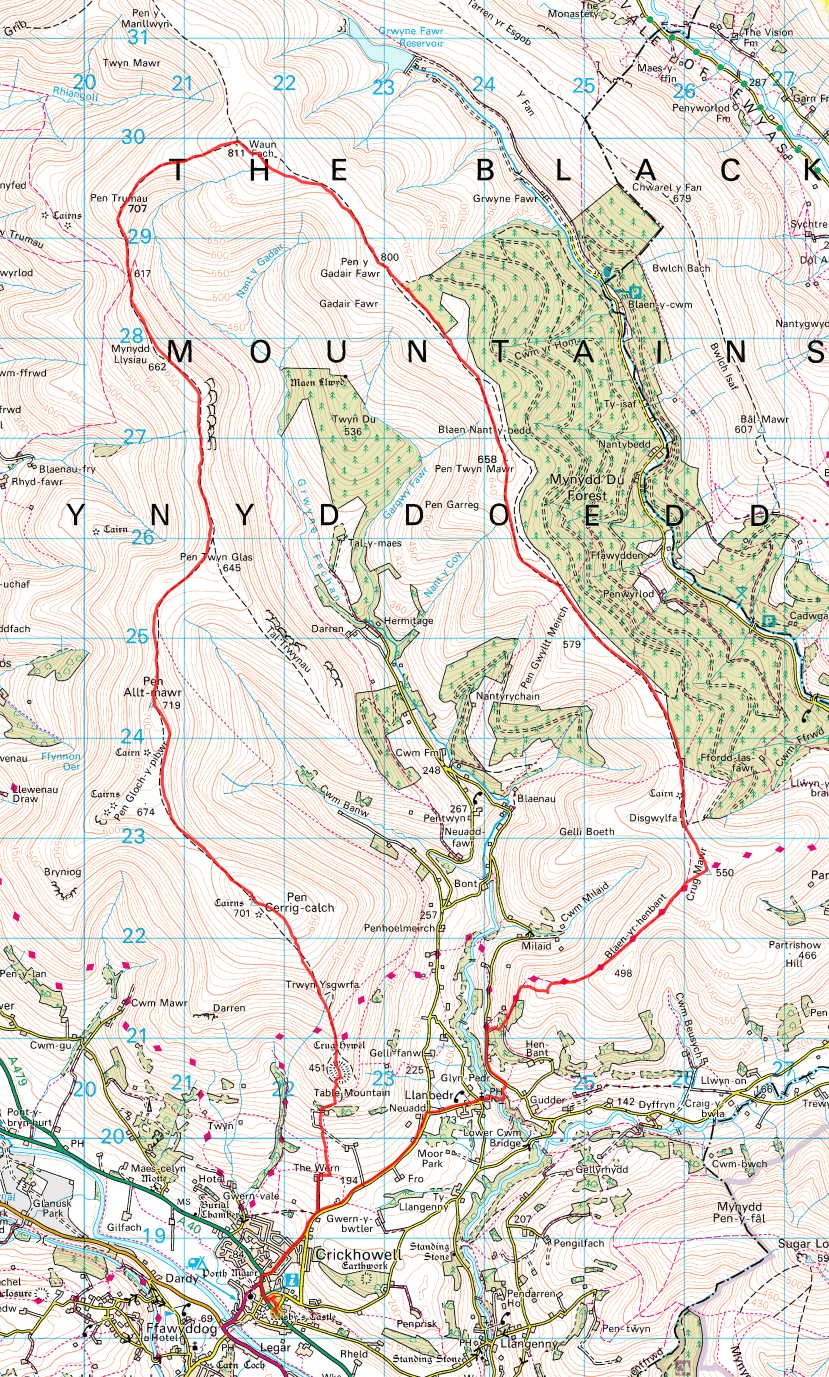
That sounded like perfect walking weather, so I quickly came up with a route incorporating some terrain I'd walked before (and some I hadn't) and which involved not too long a drive to get to the start point. What I ended up with was parking in the free car park at Llanthony Priory and setting off up the steep path up the side of Loxidge Tump that eventually brings you out on the top of the ridge which carries a section of the Offa's Dyke Path. Once I'd joined that it was a long and fairly flat ridge walk all the way to the trig point at the top of Hay Bluff. Then (replicating a section of this walk from March 2011 in slightly different weather conditions) I dropped down across the Gospel Pass road, up onto Lord Hereford's Knob (fnarr, etc) and then down the Daren Lwyd ridge back into the Vale of Ewyas and back along the road to the car park.


Route map (created here) and altitude profile (via GPS Visualizer) are below; as always do the right-click/open in new tab thing for a better view (same goes for the photos above).


Since physical geography doesn't arrange itself expressly for the convenience of the walker there are always ways in which a walk could be improved (see this one for instance). Here's a few thoughts on this one:
That sounded like perfect walking weather, so I quickly came up with a route incorporating some terrain I'd walked before (and some I hadn't) and which involved not too long a drive to get to the start point. What I ended up with was parking in the free car park at Llanthony Priory and setting off up the steep path up the side of Loxidge Tump that eventually brings you out on the top of the ridge which carries a section of the Offa's Dyke Path. Once I'd joined that it was a long and fairly flat ridge walk all the way to the trig point at the top of Hay Bluff. Then (replicating a section of this walk from March 2011 in slightly different weather conditions) I dropped down across the Gospel Pass road, up onto Lord Hereford's Knob (fnarr, etc) and then down the Daren Lwyd ridge back into the Vale of Ewyas and back along the road to the car park.


Route map (created here) and altitude profile (via GPS Visualizer) are below; as always do the right-click/open in new tab thing for a better view (same goes for the photos above).


Since physical geography doesn't arrange itself expressly for the convenience of the walker there are always ways in which a walk could be improved (see this one for instance). Here's a few thoughts on this one:
- as you can see from the altitude profile, the initial mile-and-a-half or so involves quite a steep ascent. It's nowhere near as steep as the graph makes it look, as the vertical scale is exaggerated somewhat, but it certainly gets the lungs going early doors. This is pretty much inevitable when you want to join a ridge halfway along; the only way to avoid this would be to do the whole ridge in a giant horseshoe walk (a bit like this one) starting somewhere near Pandy, but that would be a long walk and in January there probably wouldn't be enough daylight to do it;
- it would be nice if there were a definite summit to attain, ideally at the highest point of the day. The highest point of the day was actually the top of the Black Mountain at 703 metres, but this is almost impossible to pinpoint as it's only fractionally higher than the ridge on either side and isn't marked by anything useful like a trig point or even a cairn;
- once you come off the Daren Lwyd ridge at Capel-y-ffin the walk back along the road is longer than you'd ideally like - you don't mind a mile or so just to warm down and loosen up the legs, but this is around three miles, which gets to be a bit of a slog by the end;
- given the amount of exercise I've had in the past year or so (very little, mainly owing to being preoccupied with a baby boy with some medical and feeding challenges) I probably should have eased back into hill-walking with something about half the length (the track log says it was 15.3 miles) and not attacked it at quite the berserk speed that I'm inclined to adopt when I'm off the leash and out on my own. 24 hours later I'm in the early stages of what I expect to be a fairly crippling bout of DOMS; all my own fault of course.
Friday, January 05, 2018
mounds of love, by Kate's bush
Here's a couple of recent news (or, more accurately, "news") stories which revisit some stuff featured a few years back right here on this very blog.
Firstly, here's a disturbing tale of dismemberment featuring a faulty elevator which may have just been badly maintained or could have been, like, possessed by Satan in some way. I mean, it's possible, right? It's disturbing partly because of the basic detail of the story as related in the text, but also because of the graphic video of the incident embedded in the Daily Mail story which auto-plays as soon as you open the page. So, for that reason, please observe this prominent TRIGGER WARNING before you click through to the story.
You'll recall a couple of previous lift-related posts wherein I describe my wholly rational suspicion of them as a vertical transportation device, even though we're told they are Perfectly Safe and accidents Hardly Ever Happen, just like planes. That's all precious little comfort to the Chinese lady involved in the leg incident, assuming they managed to get her to hospital before she bled to death, and still less to the unfortunate Russian lady involved in this incident in 2014. No point rushing her to hospital, sadly. Oddly, that Daily Mail story is dated exactly one day after my more recent lift-related blog post (if you look at the comments you'll see I noted this at the time). Coincidence? OR IS IT?!!?!? Well, yes. And then there's this Spanish lady, messily dispatched by a lift (ironically, literally in a hospital this time) shortly after giving birth to a daughter. The angry and vengeful lift gods clearly have it in for the ladies at the moment.
Secondly, while I don't pay much attention to my blog stats any more - partly out of laziness, and partly because there are some suspicious patterns in the visit activity which I suspect are bot-related and render the stats a bit meaningless - I can tell you that my most-visited blog post of all time is still this one from 2010 about the lovely Alice Roberts and her televised skinny-dipping activities. Just to save you the trouble, I can reveal that it's not nearly as exciting as you (and everyone else visiting the page) were probably hoping. But seven years on in these days of Naked Attraction you've got to give the viewers at least a little bit of what they want, so when Kate Humble stripped off for similar reasons for her new series Kate Humble: Off The Beaten Track it was obviously felt obligatory to flash a bit of arse on camera. And while there's absolutely nothing wrong with that, and - just to be clear - I'm certainly not uninterested in Kate Humble's bottom, I was a bit vexed that the various furiously masturbating tabloid journalists embedding the video clip in their stories couldn't muster the one-handed keyboard skills to type the exact location of the lake Kate and her companion were frolicking in. Somewhere in Snowdonia was the best they could do, though I accept it's probably only me that cares. Anyone hoping for a furtive glimpse of, hem hem, "humble pie" will be disappointed, though.
Firstly, here's a disturbing tale of dismemberment featuring a faulty elevator which may have just been badly maintained or could have been, like, possessed by Satan in some way. I mean, it's possible, right? It's disturbing partly because of the basic detail of the story as related in the text, but also because of the graphic video of the incident embedded in the Daily Mail story which auto-plays as soon as you open the page. So, for that reason, please observe this prominent TRIGGER WARNING before you click through to the story.
You'll recall a couple of previous lift-related posts wherein I describe my wholly rational suspicion of them as a vertical transportation device, even though we're told they are Perfectly Safe and accidents Hardly Ever Happen, just like planes. That's all precious little comfort to the Chinese lady involved in the leg incident, assuming they managed to get her to hospital before she bled to death, and still less to the unfortunate Russian lady involved in this incident in 2014. No point rushing her to hospital, sadly. Oddly, that Daily Mail story is dated exactly one day after my more recent lift-related blog post (if you look at the comments you'll see I noted this at the time). Coincidence? OR IS IT?!!?!? Well, yes. And then there's this Spanish lady, messily dispatched by a lift (ironically, literally in a hospital this time) shortly after giving birth to a daughter. The angry and vengeful lift gods clearly have it in for the ladies at the moment.
Secondly, while I don't pay much attention to my blog stats any more - partly out of laziness, and partly because there are some suspicious patterns in the visit activity which I suspect are bot-related and render the stats a bit meaningless - I can tell you that my most-visited blog post of all time is still this one from 2010 about the lovely Alice Roberts and her televised skinny-dipping activities. Just to save you the trouble, I can reveal that it's not nearly as exciting as you (and everyone else visiting the page) were probably hoping. But seven years on in these days of Naked Attraction you've got to give the viewers at least a little bit of what they want, so when Kate Humble stripped off for similar reasons for her new series Kate Humble: Off The Beaten Track it was obviously felt obligatory to flash a bit of arse on camera. And while there's absolutely nothing wrong with that, and - just to be clear - I'm certainly not uninterested in Kate Humble's bottom, I was a bit vexed that the various furiously masturbating tabloid journalists embedding the video clip in their stories couldn't muster the one-handed keyboard skills to type the exact location of the lake Kate and her companion were frolicking in. Somewhere in Snowdonia was the best they could do, though I accept it's probably only me that cares. Anyone hoping for a furtive glimpse of, hem hem, "humble pie" will be disappointed, though.
Thursday, January 04, 2018
the last book I read

Ernest Stickley jr. is a little bit whooaaahh, a little bit wheeeyyy, a bit tasty, a bit dodgy. He's a geezer. Leave your car lying around, he will nick it. As a consequence, as we meet him he's just finished a seven-year stretch for armed robbery and is in the market for something to do.
Something to do, in the short term, turns out to be hanging out in Miami and tagging along as assistant bagman to his old friend Rainy while Rainy does a delivery for Chucky Buck, a local drug dealer. What Rainy and Stick don't realise is that this particular payment is to one of Chucky's key suppliers, Cuban gangster Nestor Soto, in compensation for Chucky accidentally involving some of Nestor's men with some undercover cops at the cost of some money, product and inconvenience to Nestor. Moreover, the compensation deal comes with a little extra spice: Chucky's agreed, as part of his penance, that Nestor's men get to kill the bagman.
As it turns out, it's Rainy who actually carries the bag, and promptly gets his ass ventilated for his trouble. But a second bagman wasn't part of the plan, and Nestor's boys see him as just an added bonus, so Stick has to make a sharp exit, pursued by a hail of bullets. So now Chucky's boys and Nestor's boys are looking for Stick. So he should probably leave town, right? Well, the thing is, Chucky had promised Rainy five grand for making the delivery, and, since the delivery was made, Stick reckons that money is now owed to him. Also, Stick's ex-wife lives nearby and Stick hasn't seen his now-fourteen-year-old daughter since she was seven and is keen to reconnect. And, in any case, he's not the sort to be scared off by some Cuban heavies with big guns.
So after a chance encounter with local wheeler-dealer Barry Stam in a car park - during the course of which Stick helps Barry out by breaking into his Rolls-Royce - Stick gets a job as Barry's chauffeur, a job which comes with free accommodation in the servants' quarters of Barry's massive mansion in Bal Harbour. Barry has many connections in the local area, including foxy investment advisor Kyle McLaren (who, it turns out, is a bit susceptible to the rakish charms of slightly shady types like Stick), but also to Chucky and Nestor, whom he occasionally has over to the house for business and social meetings, occasions at which Stick is expected to be in attendance as barman and general dogsbody. Awkward.
One of Barry's latest schemes is to try and get his local contacts (Chucky and Nestor included) to invest in a new film project that a producer friend is trying to get off the ground. The initial version of the project gets a pretty dim reception, mainly due to the concept being a bit shit and the financing arrangements technically illegal, but Stick starts to see a way whereby he might be able to cook up a scam to persuade Chucky to invest in a (completely fictitious) re-jigged version of the film project, thereby relieving him of the five grand he owes Stick plus a substantial extra wedge for good measure. The trouble is he needs to find a way to do this without either torpedoing his burgeoning relationship with Kyle (who, while susceptible to Stick's personal charms, is a bit dubious about being involved in actual lawbreaking) or getting himself killed by Chucky or Nestor's goons, who are already looking for an opportunity to discreetly waste him anyway.
As I said back at the time of reading Riding The Rap in 2009, you know what you're going to get with an Elmore Leonard book, and Stick ticks most of the boxes - sly characterisation, snappy dialogue, twisty plot, a bit of humour, a bit of sex and violence, 300 pages tops, bish bosh, sorted. This one (published in 1983) is a pretty good one. The main reason it's not as good as the really good ones (Killshot is probably my absolute favourite) is partly related to the thing I mentioned in the Riding The Rap review about re-use of old characters. This is an early example (possibly the first, I haven't checked) of this, Ernest Stickley having previously appeared in 1976's Swag. There's just a suspicion that Leonard likes the Stick character a bit too much - having him, for instance, bone Barry's bimbo girlfriend Aurora, Barry's 'luded-up wife Diane and Kyle (though the last encounter is a bit unsatisfactory, presumably because he's knackered and/or dehydrated by then) all in the same night is just a bit implausible and doesn't really serve to advance the plot very much. Stick is also generally just a little bit too cool and on top of every situation, though the same criticism could be levelled at Raylan Givens (from Riding The Rap) and probably a few other Leonard protagonists as well.
Stick was filmed in 1985, starring Burt Reynolds in the title role. Not a bad bit of casting, I'd say, though I already knew about the film before I'd read the book, so maybe it was inevitable that I pictured Stick as looking a bit like Burt Reynolds anyway. I've never seen it, but it seems to follow the disappointing pattern of a lot of Leonard adaptations by not being very good. This seems to have been caused by a bit of monkeying with the script including the tacking-on of a climactic bit involving Stick rescuing his daughter from some kidnappers (nothing of the sort happens in the book), but also by Reynolds having a director (one Burt Reynolds) unwilling to rein him in and get him to conform to the character in the book a bit more. As Siskel and Ebert say, the film (as it is with all Leonard's books) is right there on the page, you don't need to tart it up or change it.
Speaking of films, one thing that struck me here is that Stick is a bit of a prototype for the character of Chili Palmer from Get Shorty, one Leonard book which was filmed pretty successfully. Both have the same real first name (Ernest), both are shady types who drift into involvement with the movie business and bring their real-life experiences to bear on bringing some realism to movie scripts written by soft Hollywood fat-cat types with ponytails. The action in both books also starts off in Miami, though Get Shorty swiftly relocates to Los Angeles. There's even a bit where a principal villain gets pushed off a balcony.
As I've said before, if you read the late-1980s sequence that goes Glitz, Bandits, Freaky Deaky, Killshot, that could be all the Leonard you'll need. There really aren't any bad ones, though.
Subscribe to:
Posts (Atom)