Monday, March 26, 2012

the last book I read

Ordinary Thunderstorms by William Boyd.

Adam Kindred's been a bit of a silly boy - set up nicely over in the US with a lucrative and stimulating job as a climatologist and a happy marriage, he succumbs to the temptation of a furtive quickie with one of his students, who inconveniently turns out to be a bunny-boiler and bombards him and his wife with texts and phone calls, all of which end up costing Adam his job and his marriage. So he finds himself back in the UK setting up job interviews, one of which brings him to London.

He's sitting in a café mulling over the interview he's just had at Imperial College when he meets Philip Wang, who's sitting at the table next to him. They strike up a desultory conversation over a cup of coffee, Wang leaves, and Adam thinks no more of it, until he realises that Wang has dropped a folder on the floor as he left. He phones Wang and agrees to come and meet him at his flat (which happens to be just round the corner) to return it.

Adam gets buzzed up to Wang's flat and is slightly surprised to find Wang in the bedroom with a bread knife protruding from his torso and blood pissing out all over the floor. Having not helped the situation by yanking the knife out and getting his fingerprints all over it, he then realises the killer may still be in the flat and scarpers down the fire escape. Now at this point the obvious thing to do, and the thing anyone would do in real life, would be to go straight to the police and report the murder. But that would make for an unsatisfyingly short novel, so instead Adam pops into the pub round the corner for a pint to calm down a bit, and then decides to head back to his hotel to freshen up first. Back at the hotel he has two close encounters, firstly with the killer who has pursued him and whom he manages to deter with a bit of ninja-style combat with his briefcase, and secondly with the police who screech up just as he's making a sharp exit.

So you're a wanted man, on the run in central London. Clearly your best course of action here is to hide in a hedge for a bit and collect your thoughts. So Adam locates a convenient bit of ground by Chelsea Bridge (the little isosceles triangle between the road and the river here, in fact) and decides to lie low for a bit until he works out what to do next.

Now a man hiding in a hedge isn't really going to drive the narrative along, so we need more plot strands. Here's a couple, then - Wang's death has caused a bit of (understandable) consternation at the company he worked for, Calenture-Deutz, as they were in the throes of FDA approval for a new anti-asthma drug which could make them gazillions of pounds, and for which Wang was the head of the research team. Meanwhile Jonjo Case, former SAS paratrooper and current hush-hush no-questions-asked killer for hire, is looking to try and clear up the loose ends from his latest job, rubbing out this science guy who was getting too near some inconvenient truths. This Adam Kindred guy taking the rap for the murder is handy and all, but it'd be even better if he was to meet an unfortunate accident as well, just to rule out any nasty surprises later. Meanwhile foxy London copper Rita Nashe, freshly transferred to the river police unit, is investigating a report of some scruffy-looking guy dismembering a seagull on a patch of waste ground by Chelsea Bridge....

Adam decides that he can't spend the rest of his life living in a hedge, even though he's been able to keep himself fed by a bit of begging and bin-scavenging (and seagull-murdering). After meeting up with single mother and prostitute Mhouse and going along to her deranged revivalist church in Rotherhithe (mainly for the free grub) he enters into a financial arrangement with her whereby he rents her spare room. Well, it's better than a hedge. Inevitably he ends up "entering into" her in a more physical sense as well, once appropriate payment has changed hands. Meanwhile he's also doing a bit of amateur sleuthing on the side based on the contents of the dossier from Wang that he's still got. It's all a bit difficult when you don't officially exist, though.

Help is at hand, however - fellow churchgoer Vladimir has a source who can get hold of fake passports, and he's used one of them to get himself a bank account, a credit card and a job. Having suggested that Adam move in with him, he then ups and dies of a drug overdose. This is great in one sense, as Adam can (after a judicious haircut) pretend to be him and take over his job, which just happens to be as a porter in a hospital, but awkward in another sense as there's this bit fat Russian in the spare room who needs disposing of, and he's starting to smell a bit. But, you know, omelettes, eggs, and all that sort of thing.

Just to throw a spanner in the works, though, old Jonjo Case is still around, and he's gradually following the trail that leads to Adam. First port of call is to pay a visit to the Rotherhithe sink estate and see if Mhouse knows where Adam is, and then casually kill her after she's served her purpose. When Adam reads about her death in the paper he feels obliged to stick his head above the parapet (in his new hospital porter persona) and confirm her identity, and in so doing meets the officer in charge of the case, none other than foxy Rita Nashe, whereupon sparks fly and both of them come over all unnecessary in the trouser department.

Eventually Adam's amateur sleuthing reveals the dastardly plot around the asthma drug trials and the reason Wang had to be unceremoniously rubbed out (he Knew Too Much, basically), and with some help from Rita's dad engineers a bit of corporate espionage which ensures that bad old unscrupulous Big Pharma get what's coming to them, and the police are tipped off as to the identity of those really responsible for Wang's death. And so Adam (now thoroughly settled into his hospital porter identity) and Rita link arms and stroll off into the sunset together.

There are a few loose ends, though - while Jonjo Case is off Adam's back in the short term, having been obliged to flee across the Channel to the Netherlands after being revealed as Wang's murderer, he departs metaphorically shaking his fist back towards London and giving it all the I'll Get You, Penelope Pitstop, so will he return to wreak his revenge? Also, sweet though Rita and Adam's relationship is, she still knows him as Primo Belem the hospital porter (the name on Vladimir's black-market passport), a subterfuge which (as Adam himself concedes) can't possibly survive the two of them actually living together. And as unquestioning as she's been up to now about a lowly hospital porter conducting international espionage, you can't help thinking she'll be a little bit upset when he tells her the truth.

These are strands (there were a few in Restless as well) that would have been tied up more securely in a bog-standard thriller, so is Boyd - perhaps conscious that he's been slumming it a bit genre-wise - doing this on purpose to distinguish Ordinary Thunderstorms from a bog-standard thriller and pitch it more into the realm of literary fiction where loose ends are often left at the end? There is some slightly arch business going on with the name (Ingram Fryzer) of the drug company boss as well - as well as being the name of Christopher Marlowe's murderer it's presumably also a punning echo of another real-life drug company.

Criticising what is essentially a thriller for being a bit implausible is a bit churlish, but there are a few bits which strain the reader's disbelief-suspending powers - Adam's not going straight to the police on discovering Wang for one thing, not to mention his rashly yanking the knife out of Wang's side (surely everyone knows not to do this?), thereby both getting his fingerprints all over it and hastening Wang's demise. The convenient circumstances of Vladimir's death and Adam's inheriting of his new job - which just happens to be in the very hospital where some of the drug trials were carried out - are a bit, well, convenient as well, as are the points in the story (the initial encounter with Jonjo Case and the subsequent briefcase-fu, disposing of Vladimir's body) where Adam turns into a sort of proto-Jason Bourne at the drop of a hat. Most bizarre of all is the episode towards the end where Adam casually murders Vincent Turpin, a vagrant who was trying to blackmail him - a murder we're presumably meant to applaud since it's been revealed that Turpin is a bit of a paedo and therefore fair game. I suppose, to be fair, it would be hard to name a successful and satisfying thriller that was not hugely implausible when you sat back and thought about it afterwards, though.

It would be remiss of me not also to mention the other works whose plots Ordinary Thunderstorms echoes, most notably The Fugitive - man arrives at scene of murder just as actual murderer makes good his escape, is assumed to have committed the murder himself, escapes, reveals unsuspected resourcefulness, unearths dastardly medically-themed plot, infiltrates medical institutions to gather evidence, reveals evidence, brings down evildoers, the end. More than one of Robin Cook's medical thrillers (Fever is probably the best one) contain similar medical conspiracies that need to be exposed as well. The main character finding a body at the start of the novel and subsequently having his whole life turned upside-down also echoes the plot of Boyd's own earlier novel Armadillo (not one of his best), and I suppose as the canonical innocent-man-on-the-run-trying-to-clear-his-name story John Buchan's The 39 Steps should get a mention here as well.

Another odd coincidence is that the name of the hospital where Adam gets his portering job is St. Botolph's, the same name as the town in The Wapshot Chronicle. The real St. Botolph is the patron saint of travellers and farming, and also the man who gave his name to Boston, Lincolnshire - and therefore also to Boston, Massachusetts - "Boston" being a contraction of "Botolphston" or something similar.

I wouldn't want you to think the slightly nit-picky tone above means I didn't enjoy Ordinary Thunderstorms, because it's thoroughly readable and very exciting, with characters (unlike a lot of thrillers) you actually care about. It's just that after the excellence of things like Brazzaville Beach and The Blue Afternoon this seems a bit.....ooh, I dunno - unambitious? Start with those, anyway.

Friday, March 23, 2012

the last book I read

The Wapshot Chronicle by John Cheever.

So we're in New England, in the fictional Massachusetts town of St. Botolphs, and we're about to meet the Wapshots. There's Sarah, who we first meet being carried away on an Independence Day parade float by a runaway horse, her husband Leander, a retired sailor now running day trips for tourists on the SS Topaze, venerable and formidable cousin Honora, owner of the Topaze and of Sarah and Leander's house and not about to let them forget it, and finally Sarah and Leander's sons Moses and Coverly.

Much eccentricity follows, lovable and otherwise. When the Wapshots rescue Rosalie Young from the car crash in which her boyfriend has been killed and let her recuperate in their house, it's not long before her and Moses are getting up to a bit of sneaky doctors and nurses in the bedroom. Honora, who happens to have been hiding in the wardrobe at the time (it's a long story), decides that it's about time Moses (who, we gather, has been putting it about a bit among the local girls as well) went off and made his way in the world. So he heads off to Washington while Coverly runs away to head after him and ends up in New York, and subsequently ends up marrying nice-but-dim Betsey and joining the army.

Meanwhile, back in St. Botolphs, Leander contrives to sink the SS Topaze after a rudder failure in a storm and an argument with some submerged rocks. The salvaged boat is permamently moored near the house and Sarah opens it to the public as a floating trinket shop, with some success, much to Leander's chagrin.

And what of Moses? Well, he meets the enigmatic Melissa though her guardian, a distant cousin and another formidable matriarchal type, Justina. Melissa lives at Justina's family seat, Clear Haven, a rambling and semi-derelict old country mansion with various gnarled old retainers in attendance. After a brief courtship Moses and Melissa are married and take up residence at Clear Haven, where they are subjected to Justina's increasingly eccentric behaviour. Meanwhile Coverly and Betsey have had a falling-out and a brief separation during which Coverly embarks on a brief dalliance with homosexuality - a dalliance comprising fretting about it a bit and resisting the advances of a work colleague rather than any actual hot man-on-man action. Anyway, Betsey soon returns and the natural order of things is restored, some nice cathartic God-fearing heterosexual coupling banishing all that deviant stuff from Coverly's mind, exactly as happens in real life. Moses' problems are solved in a similarly convenient way by Clear Haven being burnt to the ground and its various occupants scattering to the four winds, Moses and Melissa included.

As is obligatory with any family saga of this kind (see here, here and here for examples) there's a big family gathering at the end, prompted in this case by Leander's funeral - his last excursion into the sea for a swim proving fatal. Melissa and Betsey have already produced sons, so the next generation of Wapshots is assured.

I think it's fair to say that this is an odd book in many ways. A good comparison might be to Old School - first novel by a guy previously well-known as a writer of short stories, and one which in many ways reads like a bunch of short stories glued together into novel form. Various elements - Rosalie's time at the Wapshot house, the business with Leander's first wife and her daughter, Moses' mission of mercy to the woman who's fallen off her horse - drift into the narrative and then vanish. The Wapshot Chronicle is weirder than Old School, though, and it's fascinating to see the stuff swimming around beneath the surface here - the women are eccentric and capricious, both the stereotypical matriarchs like Honora and Justina, but also Betsey and Melissa, and the men alternately mesmerised, bewildered and frustrated by them. And then there's the curious interlude featuring Coverly, after Betsey has temporarily abandoned him, and his dalliance with Pancras, his superior at work who tries to persuade Coverly to come on a "business trip" to England with him. Cheever precedes this short section of the novel thus:
And now we come to the unsavory or homosexual part of our tale and any disinterested reader is encouraged to skip.
This all makes mores sense once you know that Cheever himself struggled with his bisexuality for most of his adult life. Oddly, this subject came up on Start The Week on Radio 4 a couple of weeks ago as part of a general discussion about how many authors were not generally very nice people in real life. The only comment I have to add to the discussion is how phenomenally camp Colm Tóibín is, a fact which in combination with his Irish accent makes him sound not unlike Graham Norton. Cheever's sexuality issues will be no surprise to fans of Seinfeld, incidentally, as they formed the basis of a whole episode in season four in 1992.

Anyway, The Wapshot Chronicle won the National Book Award for fiction in 1958, as did The Corrections in 2001. My brief list here goes: 1958, 1965, 1988, 2001.

on the tee, Brian Wtf? and Bob Meh

Each year brings a new influx of fresh-faced young hopefuls onto the PGA tour, fresh from illustrious feats either in college golf or on the Nationwide Tour. And, who knows, maybe one of them will turn out to be the new Boo Weekley or Duffy Waldorf - not in terms of playing achievements so much as by having an amusing name. Here are my new favourites, both of whom are currently competing in the Arnold Palmer Invitational at Bay Hill:
  • Jason Kokrak - as the video in that link reveals, it seems to be pronounced "Coe-crack" rather than "Cock-rack"; still pretty funny though.
  • John Huh - a man whose name sounds as if whoever registered his birth got distracted by something halfway through. It turns out that he's of Korean ancestry, so my assumption was that it'd be pronounced "Hoo". And maybe it is, but (again, have a look at the video) the US commentators seem to have gone with the comedy pronunciation. It's a bit like Jonatton Yeah? from the excellent (and sadly under-appreciated) Charlie Brooker/Chris Morris comedy series Nathan Barley. And if you're thinking "that's the stupidest spelling of Jonathan I've ever seen", then I have further golf-related news for you.

Saturday, March 17, 2012

deploy the 10" shaming wand

I'm glad that the shocking business with abortion legislation in Texas has popped up on Ben Goldacre's radar, because his entirely proper outrage about it illustrates the ridiculousness of his statements in the belief survey I linked to a while back. You cannot rationally simultaneously hold to the positions that:
  • the Texas law is an abomination amounting to state-sponsored punishment of women by making them undergo pointless violation and extended anguish and trauma as revenge for wanting to exercise choice and autonomy over their own reproductive health, and moreover an abomination dreamt up principally by fundamentalist Christians
  • I'm not really bothered about the question of whether God exists, it's all a bit boring really
Well, if the fundamentalist Christians are right and you really are going to BURN IN HELL FOR ALL ETERNITY for choosing to have an abortion, then it's actually rational and compassionate for them to be enacting legislation that makes getting an abortion more difficult, isn't it? So the question is actually pretty important, isn't it?

I don't want this to be about Dr. Ben, though, as in general he is a source of good sense and rationality. That Texas sonogram bill is one of the most sulphurously evil things I've ever seen, though. And again, it's perhaps hard to understand just how evil while sitting here in the UK with our state-funded medical care and our multiple hospitals within easy reach of most people - if your only nearby hospital is a Catholic-run one that won't perform terminations at all, even to save the life of the mother (for fear of getting excommunicated), even if the fetus is already dead, and you then have to travel (assuming that you have the resources to do so, and can get time off work) potentially tens or hundreds of miles to a hospital that will perform the procedure, the last thing you need is to be told that some men somewhere have decided that you, as a weak and feeble-minded woman, clearly won't have realised how human reproduction works or the consequences of what you're about to do, and so you need to be painfully probed, then have an unwanted ultrasound scan shoved in your face and (just in case you close your eyes or something) described to you in detail, and then be forced to wait another 24 hours before having the procedure carried out.

Again, just to recalibrate our ethics-ometer here, the purpose of all this is to:
  • shame and humiliate women for exercising choice over their own sex lives, and not just being passive semen receptacles;
  • deter people who would otherwise seek abortions from doing so, with the consequence that they either have the child (which the enactors of the bill will instantly stop caring about as soon as it's outside the womb) as God intended or undergo some kind of botched amateur procedure which will take her pansy pinko pro-choice heathen ass out of the gene pool anyway. It's a win-win situation;
  • remind people that women may own the wombs, but they and those wombs are owned by men, and suggestions otherwise make baby Jesus cry;
  • throw a smokescreen over all this by claiming it's about "providing information" while simultaneously enacting further legislation that will indemnify doctors from getting sued should they withhold information from women that might otherwise have inclined them to get an abortion.
Here's a montage of a week's worth of Garry Trudeau's Doonesbury cartoon strips on exactly this subject. To see the one here in readable form (as Blogger only wants to display it really small for some reason) right-click and select "Open in New Tab". To see them in their original form on the website, start here.


To be honest I find Doonesbury a bit incomprehensible a lot of the time as you need to live with it for a while to get to know who the characters are, but this is exactly what political cartooning should be: courageous, savage and satirical. Predictably, despite Doonesbury's status as an American institution (and one whose liberal instincts are hardly a secret) a disappointingly large proportion of newspaper editors who would normally carry the strip failed to display a similar degree of courage (or indeed respect for their readers) and evidently felt it might be better to have a week off and just put up some old Garfield cartoons instead or something.

Friday, March 16, 2012

they mervynned me

Two further quickies: firstly let's give a posthumous Welshman of the Day award to Mervyn Davies, the former Wales and British Lions number 8 and Grand Slam-winning captain in 1976, who has died aged 65. I don't think I ever saw him play "live", as my earliest rugby-watching recollections that I can attach a specific date to are from Wales' next (and last until 2005) Grand Slam year, 1978, by which time Davies had been forced into early retirement by a brain haemorrhage.

Secondly, I caught most of Frost On Interviews on BBC4 the other day, and I was struck firstly by how interesting it all was, despite being at times a bit of a mutually congratulatory circle jerk between Frosty, Parky, the Melvster and others, but secondly by how odd it was to hear Sir David Frost refer to Anthony Eden by pronouncing the "th" in "Anthony" as a "th" and not as a "t", i.e. as in "anthology" rather than "antidote". This sounds odd when someone with a still nominally English accent (though Frost's tortured vowelisations are pretty uncategorisable these days) does it, as it's a specifically American thing. I have no idea why this pronunciation became the standard one in the US while the "t" one is the standard one in the UK. I suppose the many decades Frost has spent in the USA have had an influence (on him, that is, rather than pronunciation habits in general). The Americans still drop the "h" when abbreviating the name, though: the only person Wikipedia has a page for who goes by the first name "Thony" is this obscure French footballer.

they melvynned me

Here's something at once grindingly disappointing and compellingly bizarre: Melvyn Bragg having a pop at "militant atheism" (translation: atheists who talk about it anywhere other than really quietly, in the dark, in a cupboard) and, inevitably, Richard Dawkins in particular. It's very hard to pull out a point from his disjointed ramblings but it seems to be the usual one regarding "respect", i.e. that there are certain fact claims about the universe that are deemed arbitrarily to be off-limits to investigation or criticism or, heaven forbid, ridicule.

While it is fascinating to see the effects of the cultural brainwashing that makes people enthuse about old religious texts, traditions and beliefs without ever thinking to engage with the basic question "yes, but is any of it true?", one would have hoped that Melvyn might have been one of those who had shaken themselves free of it. I do have just a suspicion that, like AC Grayling, Melv is occasionally guilty of being distracted by the leonine magnificence of his own hair. Also: watch it, Melv, you're starting to sound a bit shrill and strident there.

This particular bout of bile was filmed as part of Sky TV's The Book Show, and Melv does bang on incomprehensibly about the King James Bible a couple of minutes in, so I wonder whether this was prompted by his having written a book about the cultural and literary influence of the KJV a few months back.

This is all a great pity, because I am a devoted fan of Bragg's Radio 4 show In Our Time which is a fascinating programme about proper heavyweight intellectual matters which I often hear the first 15 minutes or so of on a Thursday morning and then have to go and catch up with later on iPlayer.

Wednesday, March 14, 2012

we exist; fear us

A bit more on atheist shrillness, or at least accusations thereof, if you've got a couple of minutes. Someone had the bright idea, after all the shocked pearl-clutching and swooning over atheist billboards in the past, of speculating about what sort of wording would be anodyne enough not to cause conniptions among the devout. Well, inspired by this challenge, someone has undertaken a real-life test of it by attempting to get the banner below stuck on the side of a bus in Pennsylvania. Brace yourselves:


About as inoffensive as it's possible to get, I'm sure you'll agree, since all it's doing is announcing, as if it were some sort of revelation, that atheists exist, and can be found on that wretched hive of scum and villainy, the internet. Amusingly, though, or appallingly, depending on your mood, the transport authority rejected it on the grounds of its being "controversial".

So when the cretins at Spiked have another of their bizarre periodic eruptions of bile towards atheism and ask questions like this:

Are atheists really a beleaguered minority in the US? Is it really a great taboo today to profess that you do not believe in God?
- then the simple answers are respectively: yes they are, and yes, clearly it is. Not in the coffee shop in Hampstead that you filed your piece from, perhaps, but certainly in Pennsylvania.

Contrast that salutary demonstration of what gets classed as "shrillness" and "stridency" - i.e. anything that's not staying indoors and pretending they don't exist - when perpetrated by atheists with the sort of poisonous bigotry that gets a free pass when it's perpetrated by members of the major religions. Not just a free pass, moreover, but a forum in a supposedly respectable newspaper for you to trot out the view that same-sex marriage is as bad as slavery.

And it's no use Richard Coles getting all groovy vicar on us and saying hey, that's not the kind of religion I do, guys, and if Jesus were around today he would in a very real sense be hanging out with the gays and probably even going to their weddings - it is the wishy-washy "inclusive" C of E bullshit trotted out by the likes of Richard Coles that excuses and enables the vicious intolerance of people like Cardinal O'Brien who purport to believe in the same magic book and magic friend. And in any case, the Cardinal's right and Coles is wrong: the Bible does prohibit being gay. So if you are a gay Christian, then you have some thinking to do: essentially, one of them will have to go. You could live a life of miserable repression and conflict while still being able to hang out at the jam stall with the vicar at the church fête, but on balance I'd suggest ditching the belief in the exact factual accuracy of a book that starts with a story about an enchanted garden, an angry giant and a talking snake, for fuck's sake.

I must just link, as a parting shot, to this article in the New Statesman by Bryan Appleyard, as I think it must be the stupidest thing I've ever read on the subject of religion and atheism, and bear in mind at this point that I've read a few Spiked articles and some stuff over at the Guardian's Comment Is Free section. Almost every single paragraph contains either a reference to atheists being "militant", "fundamentalist" or a "cult", or some gratuitous Dawkins-bashing (by Alain de Botton, among others), or a massive flaming straw man completely misrepresenting what atheists believe - odd, really, seeing as how it's about as simple a philosophical position as it's possible to take. Here's a good bit:

The third leg of neo-atheism is Darwinism, the AK-47 of neo-atheist shock troops. Alone among scientists, and perhaps because of the enormous influence of Richard Dawkins, Darwin has been embraced as the final conclusive proof not only that God does not exist but also that religion as a whole is a uniquely dangerous threat to scientific rationality.
Whoa, hang on: "Darwinism", which I take to mean acceptance of the entirely uncontroversial Theory of Evolution, is in some way to do with God and religion, and not about finches and earthworms and the like at all. How does that work then?

Actually I must reproduce the de Botton bit about Dawkins, just because it's so priceless. Check this out:
He has taken a very strange position. He's unusual, in that he came from an elite British Anglican family with all its privileges and then he had this extraordinary career, and now he stands at the head of what can really be called a cult . . . I think what happened was that he has been frightened by the militancy of religious people he has met on his travels and it has driven him to the other side.

It smacks of a sort of psychological collapse in him, a collapse in those resources of maturity that would keep someone on an even keel. There is what psychoanalysts would call a deep rigidity in him.
Blimey. Well, at least no-one accused atheists of being Nazis. That sort of thing is best left to the Pope.

Saturday, March 10, 2012

celebrity lookeylikey of the day

As with the Michael Gove one I'll offer you two today and you can take your pick: who does gargantuan Welsh centre (and try-scorer against Italy today) Jamie Roberts most resemble?

Is it actor, ex-fiancé of Julia Roberts and schoolboy shower-based bumrape enthusiast Jason Patric?


Or is it venerable Dandy strongman and cow-pie enthusiast Desperate Dan?


You decide.

live and let Viv

There's been much fond reminiscence in the media this week on the occasion of the great Sir Vivian Richards' 60th birthday, so it seems only fair to throw my own misty-eyed nostalgic maunderings into the pot as well.

I'm slightly too young to remember the legendary West Indies' tour of England in 1976, as I was only six at the time and in any case we were living in South Korea where you could get things like Sesame Street via the American forces' network, but not the Test match coverage, sadly. Anyway, this was the series where Tony Greig made his spectacularly ill-judged remarks about making the West Indies "grovel" prior to the series and was rewarded by Richards carting England around mercilessly for 232 at Trent Bridge, 135 at Old Trafford and 291 at the Oval, and West Indies winning the series 3-0.

So my first memory of seeing Richards bat "live" was for Somerset in the 1981 Benson & Hedges Cup final, where he made an unbeaten 132, the last 50 or so in partnership with his old mate Ian Botham, as Somerset cantered to victory. This was the golden age of foreign imports playing in the English county game, with Richards and Joel Garner for Somerset, Gordon Greenidge and Malcolm Marshall for Hampshire, Alvin Kallicharran for Warwickshire, Glenn Turner and Imran Khan for Worcestershire, Zaheer Abbas and Mike Procter for Gloucestershire and Clive Rice and Richard Hadlee for Nottinghamshire, plus no doubt many more that I've forgotten about.

The first time I saw him bat in a Test match was in 1984 at Edgbaston, where he carried on from his record-breaking feats in the preceding one-day series by making 117, mostly in partnership with Larry Gomes. I had to resort to listening on the radio to his fastest-ever Test century (a record which still stands, despite Adam Gilchrist's best efforts), also against England at Antigua in 1986. His form declined a bit in the late 1980s, but it's typical of the man that when he had to make some runs, in his last ever Test series, also in England in 1991, he made 376 at an average of 53 (and 60 in his last-ever innings at the Oval) to keep his overall Test average above 50.

Statistics schmatistics, though, and you can keep your Pontings and Laras and Tendulkars, with their superior Test aggregates and averages - great though they all are, Viv is still the most exciting batsman I've ever seen play. There may have been lower-order sloggers who hit the ball harder and further (though not many), but none of them made Test double-centuries or averaged 50. And none of them were as ineffably and effortlessly cool, either.

Sunday, March 04, 2012

snap snap grin grin nudge nudge moist moist say no more

In these times of financial hardship and uncertainty, the ever-present threat of nuclear armageddon and the bizarre antics of our own increasingly unhinged government, it's important to retain both a sense of perspective and a sense of humour, however puerile. It's in that spirit of childlike hope and optimism and schoolboy sniggering that I offer you this heading to a sub-section of a chapter in an instructional manual I consulted for some advice earlier today. I wonder if you can guess what sort of book it was?


Well, obviously it was this coookery book in which I sought some advice regarding roasting times for chickens. Why, what did you think it was? Eh? Eh?

Tuesday, February 28, 2012

d) nun of the above

Good job I was only about 15 minutes late getting to work yesterday morning, as Start The Week with Andrew Marr on Radio 4 was shaping up to be possibly the most annoying programme ever broadcast. The title "Faith and Doubt" set the alarm bells ringing even before the guests were announced - "doubt" being a code-word usually used to make the religious sound reasonable and open to new evidence, prepared to adjust their belief system if required, that sort of thing, as well as maybe just a little bit tortured and interesting. It differs from "scepticism" in that it's clearly understood that the doubt will be resolved by a re-affirmation of faith, or at least an undertaking to try harder at it, rather than the abandonment of it.

If that hadn't been enough of a red flag, the name of the first guest, Karen Armstrong, would have given the game away. Armstrong is the former Roman Catholic nun who, after her decision to give up the nunning game (hardest game in the world, the old nunning game), has gone on to forge a lucrative career as a writer of articles and books on religion. These aren't especially in keeping with her Roman Catholic upbringing, though, being more in the wishy-washy hand-waving vein familiar to anyone who's ever stumbled across Terry Eagleton's writings.

Clearly they couldn't risk having an actual rationalist on the show being a spoilsport and not playing by the rules (though I was hoping to be proved wrong and find they'd saved the fourth chair for AC Grayling) - instead they wheeled out a couple of writers of broadly sympathetic views and Richard Holloway, a former bishop whose career seems to have followed a similar trajectory to Armstrong's, i.e. from orthodoxy to a sort of vague hand-waving hello clouds hello sky metaphorical mystical transcendence bullshit.

Just to sidetrack for a minute, I had the idea in my head that the early-90s Kristin Scott Thomas ITV series Body And Soul was a loose adaptation of Armstrong's book Through The Narrow Gate, dealing as it does with a young woman's transition from being a nun to, well, not being a nun any more, with just a little bit of low-key soft-core partial nudity (stockings and the like) to draw the punters in (this is presumably why it stuck in my mind). Anyhoo, it turns out that the two are completely unrelated apart from the coincidental plot similarities - the TV series being based on a novel by Marcelle Bernstein.

Back to the main topic: what you need to pull this sort of thing off successfully is a set of tactics very similar to the accommodationists - a lofty disdain for the "extremists" at both ends of the spectrum (flying commercial jetliners into buildings and writing harsh and sarcastic articles on the internet being broadly equivalent in terms of unacceptable rudeness, apparently), a steadfast refusal ever to define clearly what any of the terms you bandy around (like, for instance, "God") actually mean, and a sort of chuckly patronising dismissal of those who attempt to challenge or tie you down on what you mean and what you actually believe.

Again, this is religion as metaphor without the moral courage or clarity of thought to come out and say OK, but the supernatural water/wine loaves/fishes stuff is all bollocks, though. You have to master the Janus-like ability to say to the mass of 99% of religious people - who totally believe Jesus was a real live white guy with nice hair and lovely white teeth and a beard who just happened to live in the Middle East - yes, we're defending your core beliefs against those nasty shrill scientists who really just want to herd your grannies into the gas chambers, and simultaneously to engage in "respectable", "intellectual" debate on Radio 4 where you do a lot of "could it not be said" and "might we say" and "in a sense" without ever making any testable claim about any aspect of reality. Throw in a bit of conflation of religion (carefully left undefined) and morality and some guff about charity and the kiddies, plus the obligatory Dawkins-bashing, and you're done.

Dawkins-bashing is a pastime where interest never flags completely, but fluctuates in proportion to how much he's been in the news lately. Just at the moment he's been popping up in various places - I caught a bit of Nicky Campbell's The Big Questions (better title: Big Questions To Which The Answer Is No) the other day, but I expect there were others - to publicise the poll on religious belief that his foundation commissioned from Ipsos-MORI recently, and which has some interesting, though hardly very surprising, things to say about the reality of religious belief and observance in the UK, the gist of it being that most people are bovinely unreflective about the whole thing and just rock up to church every Sunday out of habit and social convention, or possibly for the cakes, rather than out of any sort of evangelical fervour, or because they're quite lidderally bonkers about Jesus or anything like that.

Anyway, this fairly uncontroversial stuff has provoked an astonishing upspewing of vitriol from the conservative press - most absurdly the episode a week or so ago where a journalist rang Dawkins up to have a pop at him for one of his ancestors having owned some slaves. To be fair even some of the commenters at the Daily Mail felt this was crossing the line into ridiculousness, which tells you something.

Possibly as part of the same publicity round Dawkins popped up in a debate with the cuddly old Archbishop of Canterbury this week about the whole God thing. I must confess I find Rowan Williams quite fascinating, and it's not just the mesmerising eyebrows, it's the fact that he's a clearly highly intelligent man who believes some patently ridiculous stuff. The interior of his brain must resemble some sort of partially-cleared minefield, with all sorts of barbed wire and giant red signs with skull & crossbones logos on them to mark places where trains of thought must not trespass, lest they unleash an explosion of cognitive dissonance.

As you might expect the debate was all quite donnish and mutually respectful, so in the absence of any "shrillness" to complain about the Mail were left with having to jump on Dawkins' referring to himself at one point as an "agnostic" and claim it as some big AHA! moment. As I said before I think "agnostic" is a term to be avoided, partly because it grants a sort of respect to these particular ridiculous claims that we don't grant to similar ones about Santa Claus and the Easter Bunny, and partly because it's meaningless, since we're technically agnostic about virtually everything that isn't just true by definition ("all bachelors are unmarried" and the like). Anyone who doesn't get this is respectfully requested to wash down their portion of Flying Spaghetti Monster with a nice cuppa from Russell's Teapot, or alternatively to consider whether the Archbish might admit to a 0.1% (or 0.01% or 0.00001%, whatever) smidgen of doubt about the whole God thing. I suspect he would, so you have to ask the question: does that make him an agnostic? Sauce for the goose, sauce for the gander, innit.

pob's your uncle

Here's a contribution to the ongoing debate over which 1980s celebrity the current Education Secretary Michael Gove most resembles: Pob or Rick Moranis. Rick Moranis got my vote, but it appears that the people at lovable scatological Geordie publication Viz have other ideas. Have a look:

Tuesday, February 21, 2012

golden showers with fanny intervals

Good to see the BBC keeping up their recently instigated tradition of dropping the c-bomb on live TV and radio at inopportune moments (not that there are many opportune ones). The latest one involves weather forecaster Alex Deakin dropping it into a weather forecast. He was trying to say "bucket-loads of sunshine", but - well, see for yourself.

the last book I read

Roadside Picnic by Arkady and Boris Strugatsky.

Redrick "Red" Schuhart is a stalker. What that means is that he makes a living scavenging various mysterious alien artefacts from The Zone, one of half-a-dozen sites on Earth where alien visitors arrived briefly some years before, before buggering off again as quickly as they came.

These Zones are cordoned off from public access, partly for the public's own safety, since there are physical objects there that can maim or kill, as well as more nebulous things like weird local concentrations of gravity that can crush vehicles (and, needless to say, people) like a grape. The exclusion of Joe Public is also partly prompted by less altruistic motives, inevitably, as some of the alien artefacts, while potentially dangerous if mishandled, have wide-ranging applications for energy, public health, and the like and The Man wants to ensure he gets his cut.

With anything like this there's going to be a thriving black market as well, of course, as long as people are prepared to pay enough to make it worthwhile for other people to risk their lives by breaking into the Zones. Which is where Red comes in. He's an old hand at navigating round the weird death-dealing phenomena to get to the good stuff, and being able to get it out of the Zone and move it on to the right people. Red takes the occasional occupational hazards in his stride - a two-year jail sentence, his old co-stalker and mentor Buzzard Burbridge falling into a pool of alien goop and having his legs dissolved below the knee, another co-stalker snagging some alien spider-web stuff and subsequently dying, that sort of thing.

One of the problems with being a stalker, apart from the constant danger of getting arrested or shot or stumbling into a gravitational anomaly and getting turned inside-out, is the long-term effects of spending a lot of time in the Zone - there's no measurable radiation being emitted, but something happens to stalkers, and those that don't find themselves rendered incapable of having children altogether produce offspring that are a bit, well, odd. Red's daughter Monkey is a case in point, being so named because, well, she looks a bit like a monkey.

It's in a desperate attempt to generate a lump sum to get some (almost certainly futile) treatment for Monkey that Red takes on One Last Job - finding the Holy Grail of stalkerdom, the Golden Ball, which supposedly has the power to grant wishes. Only old Buzzard has seen this before, and he's passed on two vital pieces of information to Red: not only where it is, but also the importance, on this trip more than ever before, of taking a co-stalker with you - you see, one of you will have to die before the other can get to the Ball.

Needless to say Red decides not to share this piece of information with his co-stalker - in a piece of cruel irony, Buzzard's son Arthur - and once the inevitable unpleasantness has been got out of the way, Red is free to approach the ball, by this stage in a state of almost religious ecstasy.

And then what? Well, we never find out, so you'll have to make up your own mind. Judging by what's gone before, a sudden burst of cleansing joy and happiness whereby everything is OK and no-one has to suffer ever again is probably unlikely, though. I think a useful comparison is to view this book as being a sort of polar opposite of the Iain M Banks books within the science fiction genre (with my usual caveats about whether that categorisation is even sensible or useful) - the Bankses are all about the glorious possibilities of technology to make worlds better places to live, laugh, hang-glide and have weird freaky sex, with the denizens of the Culture representing a sort of perfected version of humanity, while Roadside Picnic is about some unknown aliens dropping into Earth on their way somewhere else (possibly a hang-gliding and freaky sex party, who knows) and just randomly dumping a load of garbage with no particular purpose in mind, probably not noticing the human race even existing, and with no intention of ever coming back. It's very much like, as the book's title suggests, a bunch of people having an impromptu picnic by the side of the road and leaving behind a load of orange peel, biscuit wrappers and plastic forks without any thought to the effect on the local wildlife. A profoundly gloomy view, you might say, but that sort of grinding mundane reality whereby contact is fleeting, baffling and unaccompanied by any sort of context, let alone an instruction manual, seems a much more likely way for any First Contact scenario to play out.

The other way in which this differs from the Bankses is that they are in the main quite big chunky books, while this is a slim 145 pages. There's enough ideas here to fill a much bigger book, though, if you were less inclined to terseness and leaving the reader to work things out for himself. I thought it was excellent in a grimy and gloomy and weird and haunting (and typically Russian, one might argue) sort of way.

Roadside Picnic is most famous for being the source material on which Andrei Tarkovsky's celebrated 1979 film Stalker is based (here's a 5-minute version). Pretty loosely based, by the sound of it, even though the Strugatsky brothers wrote the screenplay. I therefore consider this further confirmation of my earlier theory about short novels being easy to adapt into films. Tarkovsky's most famous film Solaris was also an adaptation of a science fiction novel, this time by Polish author Stanisław Lem. I haven't seen either of the Tarkovsky films, though I have seen the 2002 Steven Soderbergh/George Clooney version of Solaris, which I thought was pretty good in a glum sort of way. I expect the Tarkovsky version is even glummer, though.

Monday, February 20, 2012

gower's about that then

As it was my birthday last weekend we decided to head off for an impromptu weekend away - fortunately we are within relatively easy reach of the UK's first Area Of Outstanding Natural Beauty, the Gower peninsula. We booked into the surprisingly extensive and luxurious accommodation at the King's Head in Llangennith - surprising because rather than being attached to the pub the accommodation is based in a couple of purpose-built blocks out the back which I had no idea were there. It's all very nice, anyway, and the pub is as great as when I first went there 20-odd years ago. Usually when we visited Gower back in the day we'd stay at the Hillend campsite over at the northern end of Rhossili beach, and it's very much still there should you fancy something more rustic (and only a mile and a bit from Llangennith village, so you can walk to the pub if you like).

Apart from my epic solo walk on the Friday (of which more in a minute) we had a relatively leisurely weekend, though we did slot in a quick look round the ruined delights of Weobley Castle and the obligatory trip to the Worm's Head Hotel for a pint and a bowl of soup while looking at one of the best views in Britain.

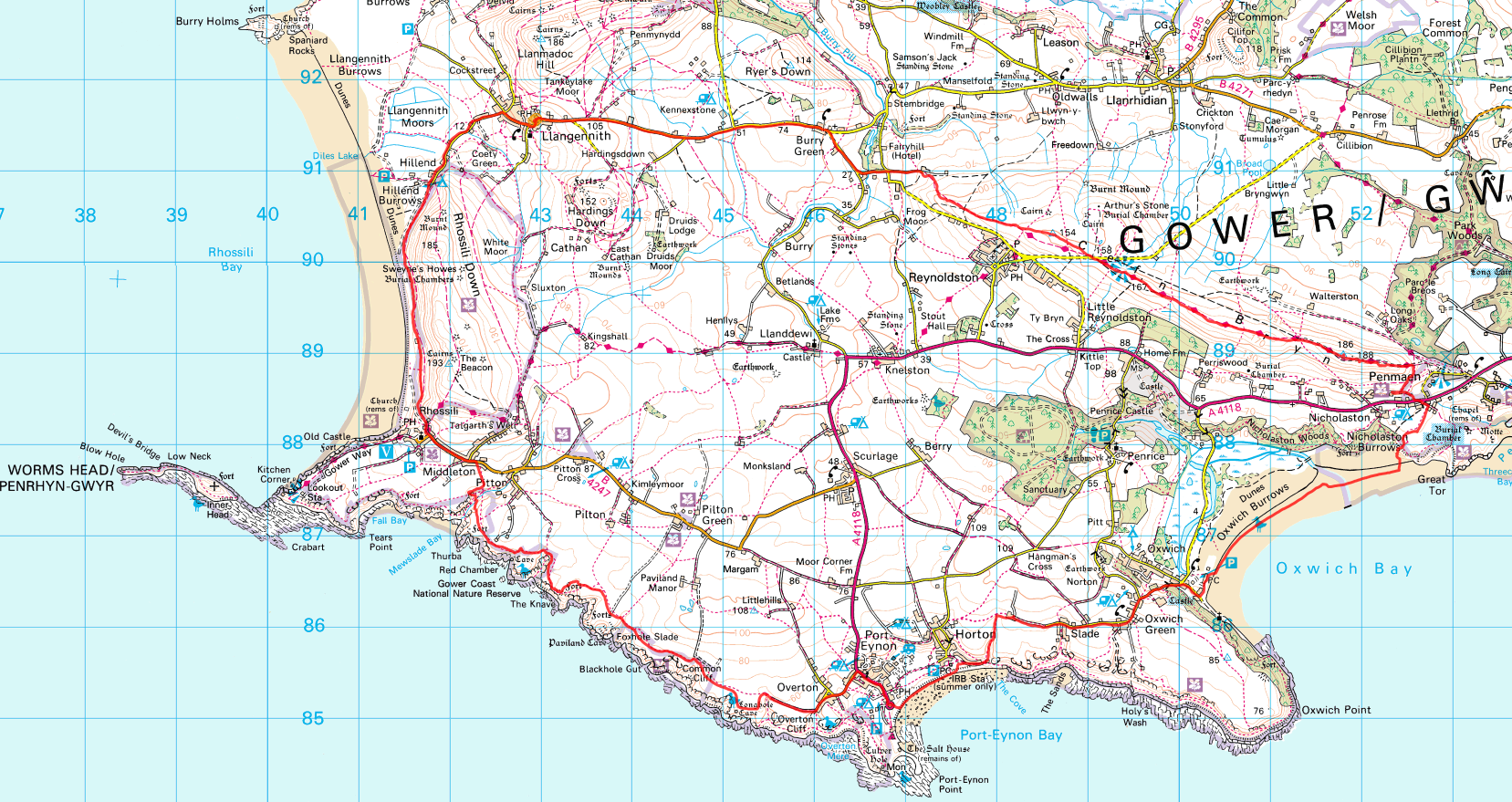
Anyway, while Hazel was off in Penarth on a photographic assignment on the Friday I took myself off for a walk. A couple of constraints: I didn't have the car with me, so I'd have to start from the pub, and one thing Gower doesn't really have is major heights - the highest point being the trig point on The Beacon on top of Rhossili Down at 193 metres (633 feet). So I cooked up a plan whereby I'd walk over to Burry Green, then up onto the Cefn Bryn ridge - the most extensive bit of high ground in the area, and only a smidgen lower than Rhossili Down at 186m (610ft), down into Oxwich, over to Port Eynon, and then along the clifftop path to Rhossili village and then back along the beach to Llangennith.

As I've said before, when I'm off the leash in terms of having to wait for people to catch up with me I tend to go a bit mental, and Friday was no exception - my GPS track log reckons that the whole circuit was 20.4 miles, which explains my fairly ravenous need for a pint by the end. Fortunately the King's Head had some excellent local ale brewed by the Gower Brewery, which turns out to be just down the road at the Greyhound Inn. Anyway, here's the route map - if clicking on it doesn't provide the detail you're after then try here instead.


I did take a few photos as well - link to follow. [STOP PRESS: here they are.]

Sunday, February 19, 2012

the last book I read

Frankie & Stankie by Barbara Trapido.

Dinah and Lisa de Bondt are two young sisters growing up in South Africa. Daughters of German parents, whose families fled Nazi-era Germany before the outbreak of the Second World War, they soon find that the family has exchanged one repressive regime for another, as their childhood sees the rise of apartheid.

As they move up through school the girls move through a series of best friends and favourite teachers, as girls do, which reflect their differing personalities - Lisa, despite having a gammy arm, is the outgoing robust type while skinny blond asthmatic Dinah is the delicate bookish one.

Eventually puberty and teenagerdom beckons, with all the messy business of menstruation and boys, but also a gradual realisation that they are in a little bubble of privilege which others, some of them people they see every day, are excluded from. Dinah's gradual political engagement is ramped up when she starts going out with Sam, who is a proper activist with links to all sorts of equal-rights campaigning groups and therefore a recipient of regular hassle from the police. Eventually Dinah and Sam decide that enough is enough and skip the country, emerging off the ship at Southampton in early 1964 optimistic of a new life.

Anyone who's read Trapido's earlier novels - my two are Brother Of The More Famous Jack and Juggling - will find this one a bit of a departure. The earlier two hads lots of stuff happening, but they were mostly about people, with all their fascinating frailties and foibles, and with most of the narrative drive being provided by their inter-relationships. Frankie & Stankie, on the other hand, is driven along by the history of South Africa in the second half of the twentieth century, and, although there are lots of people in it, they have to take a back seat to the grand sweep of events. Lots of people come and go without the narrative ever really settling on one of them for long enough to get us interested in them - we get some background about the girls' grandparents and parents and their arrival in South Africa, lots of comings and goings with teachers and schoolfriends, and then a brief sequence of Dinah's boyfriends at the end before she hooks up with Sam.

Even Dinah and Lisa aren't terribly compelling characters - after the girls hit ten or so Lisa barely features in the book at all, and Dinah takes over as the single main protagonist, but even then we don't really get much of an idea about what makes her tick. For instance, she seems to fall into her relationship with Sam almost by accident, and is swept along by the consequences of his political activism (including the relocation to the UK) without ever engaging with it much. And some of the exposition about South African history, fascinating though it is, reads like it's been shoehorned in just because the author had done the research and didn't want it to go to waste, a bit like Neal Stephenson's Sumerian stuff.

This turns out not to be true, as it happens, and the book as a whole makes a great deal more sense when you realise that it's a lightly fictionalised work of autobiography, Sam for instance being a fictional version of Trapido's late husband Stanley. For all that, though, I'm not sure it really works, Trapido's light-hearted style and all the exposition about apartheid being somewhat awkward bedfellows, for one thing. And those big chunks of history leave precious little space for all the usual stuff that makes Barbara Trapido novels so enjoyable, i.e. all the little quirky human bits. So, admirable intentions and all that, but really if you want novels about apartheid then you probably ought to be reading something grittier like the couple of recent entries in this list, or something by JM Coetzee, Nadine Gordimer or André Brink. Conversely if you want a Barbara Trapido novel then I'd urge you to read Brother Of The More Famous Jack.

Monday, February 13, 2012

hey, Sweden!

I'm sure many many others have blogged about the unique trials and frustrations of a trip to IKEA, so I won't add to the list - suffice it to say that I've always found the furniture to be robust, easy to assemble and reasonably priced, and overall generally worth the anguish involved in getting round the shop and finding what you want.

Obviously when you don't find what you want, as happened when we went to the IKEA over in Cardiff Bay the other day to look for some CD racks, the best course of action to take, if you can restrain yourself from going on some sort of mental Viking rampage, torching the place and dispatching everyone therein to Valhalla, is to pop into the Swedish food shop by the main checkouts and buy some weird stuff.

Now obviously you're going to buy some Swedish meatballs, and quite right too. You'll also be wanting a couple of packets of the creamy sauce mix.

I picked up a couple of more exotic things in there the other day as well - Scandinavian food shops are a good fit to my particular food enthusiasms because they are a rich source of bizarre fish products. So in addition to picking up a few jars of herrings in a variety of outlandish marinades (the mustardy ones look particularly good) I grabbed a jar of herring roe caviar-y stuff and a tube of spread made from similar ingredients.


I haven't tried the jar yet, but I did have some of the squeezy fish product on some toast at the weekend, and.....well, it's a bit odd. You'd be expecting something like taramasalata in a tube (and I bow to no man in my love for taramasalata), and it's a bit like that, but overwhelmingly sweet as well. If you've ever had an urge for a spreadable product that combines the fishy goodness of taramasalata and the sweet fruity deliciousness of jam, preferably by tasting like a mixture of taramasalata and jam, then look no further, as this is the product for you. But what to call it? Tarajamasalata? Taramasalarmalade? Answers on a postcard, etc.

Saturday, February 11, 2012

2012: a whisky odyssey

Right, more whisky. Don't mind if I do.

These are both bottles acquired in different circumstances over the Christmas period which I'm just catching up on. Firstly, Balvenie Doublewood. This is one of the readily available (this bottle was from Tesco, bought on the way over to spend New Year with fellow Munroists and whisky enthusiasts Jenny & Jim) entry-level malts from the Balvenie distillery, Signature being the other. The distillery is in Dufftown, the spiritual home of Speyside whisky, and is owned by Grants who also own Glenfiddich.

Doublewood is a bit like the Glenmorangie Lasanta featured here last time in that it gets a lengthy period of maturation in bourbon casks followed by a short blast in sherry casks at the end. They're a bit cagey about exactly how long it gets in the sherry casks (the label says "a few months"), but it looks like less than the two years the Lasanta gets.

Anyway, a nice big sniff reveals the usual toffee and fruit cake stuff you'd expect from a sherry-matured Speysider, plus something fruity and sweet over the top; strawberry Chewits maybe? This instructional video says they do apply a bit of light peating to their malt, but I don't think you can really tell. It's less sweet than that when you drink it, perhaps nearer the more polite Speysiders like the Cardhu and the Knockando than the really thick dark ones like the Lasanta or the Aberlour. It's very nice though.

Secondly, Highland Park. Now I know this one has technically featured here before, but I really only referred to it in passing a couple of times, and as I have consistently banged on about it being my favourite ever since I thought it would be worth expanding on that a bit (not to mention verifying that it was still the case). As luck would have it my lovely wife bought me a bottle for Christmas, so that all worked out quite nicely.

Highland Park distillery is in Orkney, and is the northernmost distillery in Scotland. This is the standard 12-year-old; as always many other expressions are available including the multi-award-winning 18-year-old and some ludicrously expensive limited editions. Now your man in the video there says that you have to seek out the peat smoke in the 12-year-old as it isn't obvious - I disagree as it seems completely obvious to me. It's not as much of a karate chop to the gizzard as you get with, say, the Caol Ila or the Laphroaig, but it's definitely there. You get other stuff as well, though, a bit of fudgy sweetness and a blast of the same sort of meaty seaweedy cabbageyness you get with the Tobermory and Ledaig and to a lesser extent with the Old Pulteney. Same sort of story when you drink it, except it's even zingier and peatier - still not as much as the Islays, but more than the coastal Highlanders like the Ben Nevis and the Clynelish.

The late great Michael Jackson - no, not him, the other one - once described Highland Park as "the greatest all-rounder in the world of malt whisky" and that sounds about right to me. Is it still my favourite? Yes, I think so.

Friday, February 10, 2012

in which I am filled with a mixture of excital and disappointal

Let's start with a headline of the day, before we move on to other more lofty matters. This is how the BBC introduced a story about the fall-out from Scottish outside-half Dan Parks' decision to hang up his international boots in the wake of Scotland's butchering of what should have been a winning position in a knuckle-chewingly awful game against England last weekend, and his own culpability in having his kick charged down by Charlie Hodgson early in the second half to gift England the only try of the game.

I'm actually inclined to agree with Jim Telfer that Parks was probably a bit hard done by, as he had been for much of his career. Yes, he was a pretty limited attacking outside-half, but so was Jonny Wilkinson and it never did him much harm. Robinson's positive eagerness to let him fall on his sword over last week's defeat (for which he was by no means solely to blame) seems a bit churlish.

Anyway, the headline reads a bit oddly, don't you think? Here's the sub-headline, which also reads a bit oddly, for the same reason.

"Retiral"? Is that a word? "Retrial", which uses the same letters, certainly is (same goes for "trailer", come to think of it), but surely the word the headline-writers were having a bit of a mental block over here was "retirement"? There's a single citation here (which, to be fair, has it as a Scottish usage), but it's hardly a ringing endorsement.

No matter. The other reason the Parks story stuck in my head was that Wales are playing Scotland in Cardiff this weekend, and the last time that happened not only was Dan Parks the Man of the Match, but the game ended with one of the most insanely exciting last five minutes of any game I've ever seen, Wales scoring 17 points without reply to win 31-24. My poor old nerves could do with a more sedate cruise to victory this time, though, particularly after the last-minute nature of our win over Ireland last Sunday.

Back to rugby-related words, and continuing the Dan Parks links: it is odd how the number 10 position in rugby union has such a wide variety of names, usage of which splits broadly across national boundaries (I'm thinking solely of English-speaking nations here: I mean, obviously the French have a different word for it). I think the usage breaks down like this:

England: fly-half
Wales: outside-half
Scotland: stand-off
New Zealand: first five-eighth

I can't think of another position that has so many alternative names - the New Zealanders call what everyone else calls an inside centre a second five-eighth, and people used to call flankers wing-forwards (though that usage is largely obsolete now), but that's about it. I suppose it just reflects the pivotal play-making nature of the number 10 position - a bit like the quarterback in American football, but without the helmet, body armour and terrifying religiosity.