Wednesday, May 31, 2023

maps and gaps

A couple of updates on topics of regular interest (yes, all right, of interest to me anyway): firstly, following the review of Killing Mister Watson, I should note that the book is another for the list of books with maps in, in this case a couple of maps of the south-western Florida area where the story takes place. It's just a general map of the area, no attempt made to highlight particular locations relevant to the story except The Watson Place, which as we saw is actually marked on general modern-day maps of the area anyway.


Secondly, a cricket-related update in recognition of the start of the home Test match season tomorrow: an update to a couple of occasional lists last visited here and here respectively. Firstly the list of batsmen with multiple innings scores of over 250 needs a couple of additions: David Warner of Australia and Tom Latham of New Zealand. The full current list with each joiner's date (i.e. the date on which they made their second and qualifying score) is below:
  • Don Bradman (1930)
  • Walter Hammond (1933)
  • Javed Miandad (1987)
  • Brian Lara (1994)
  • Graeme Smith (2003)
  • Sanath Jayasuriya (2004)
  • Virender Sehwag (2006)
  • Stephen Fleming (2006)
  • Kumar Sangakkara (2006)
  • Younis Khan (2009)
  • Ramnaresh Sarwan (2009)
  • Mahela Jayawardene (2009)
  • Chris Gayle (2010)
  • Hashim Amla (2012)
  • Michael Clarke (2012)
  • Alistair Cook (2015)
  • David Warner (2019)
  • Tom Latham (2022)
Both Warner and Latham are recent featurees on the other list, as well, which is the list of lowest never-made scores in men's Test matches. The lowest entry on that list, as it has been since Herschelle Gibbs made 228 in early 2003, is 229. Interestingly the next five gaps above it in the list as of 2015 (238, 245, 252, 263, 264) have now all been filled, and the next gap is now at 265. The most recent bit of gap-plugging was by Latham himself when he made 252 against Bangladesh in early 2022. 

the last book I read

Killing Mister Watson by Peter Matthiessen.

Welcome to the south-west Florida coast. A constantly-shifting landscape of sandbars, mangrove swamps, shallow rivers and islands. The sort of place that's hard to travel around without a suitable boat and extensive local knowledge, and even then one good cathartic hurricane can change everything. That river mouth you wanted to make use of to get to the sea? Yeah, that's way over yonder now. The island you wanted to visit? Gone. And the people on it? They're gone too.

So, as you might imagine, any ideas of property rights over any of the bits of low-lying land here are elastic at best, and even if they were agreed upon, who's going to enforce them? As a consequence, as you might also imagine, this is an ideal place for anyone who wants to discreetly lose themselves somewhere beyond the usual range of law enforcement. It's not a holiday camp, though: you've still got to be prepared to put the work in to build yourself a shelter and scratch some sort of a living out of the soil. But you may find that when it comes, as it inevitably will, to enforcing your own claim to the bit of land you lay claim to in the event of disputes, and maybe to extending your claims to other pieces of land already claimed by others, that a certain elasticity of morals is actually quite helpful, and that it may just come down to being prepared to do what the other guy wouldn't

Into this environment comes Edgar Watson, a man - in common with quite a few of his co-residents of the area - with a slightly murky past that he doesn't necessarily welcome close questioning about. He's acquired the claim on a decent-sized patch of land down at Chatham Bend and has some ambitious ideas about building a house, clearing the land, growing sugar cane and selling the syrup. All of which is just dandy with the neighbours, who don't object to one of their number showing a bit of zest for private enterprise; after all, a successful business brings job opportunities and the lure of making a bit of money off the back of others' initiative. I mean, some of the rumours about EJ Watson's previous life and exploits, some of which might have contributed to his decision to occupy this remote backwater, are a bit hair-raising, but who knows what the real story is. Watson himself sure isn't telling, and despite being a man of considerable personal charm has a quick way with a knife or a gun brandished in the direction of anyone asking questions which probe too deeply.

But Mr. Watson hasn't done anything untoward since he's been at Chatham Bend, pays his bills on time, and has even brought his wife and children down to join him. True, there have been certain rumours about some of the workers he's had on the island cutting down the sugar cane, including that rather than pay some of them for their labour Watson has arranged for them to meet with some sort of "accident". But the appetite to investigate the disappearance of a few itinerant (and mostly black) cane-cutters is pretty low. The brutal murder inflicted upon Wally and Bet Tucker in a claim dispute over a neighbouring island is less easy to shrug off, especially as Bet was pregnant at the time and some pretty reliable witnesses say Watson's boat was seen in the area, but there's just enough plausible deniability to dissuade the locals from pressing things. Part of the reluctance, of course, derives from the knowledge that any retribution would almost certainly have to be organised by the locals themselves, official law enforcement being located many miles away and almost certainly reluctant to get involved.

But what proof is enough proof? What level of violence against other claim-holders would convince people that they might be next and that some sort of collective action should be taken? Things come to a head when Leslie Cox, a figure from Watson's previous life who seems to exert some sort of hold over him, arrives in the area and is taken on by Watson as a sort of foreman. It's not long before the body count starts to ramp up dramatically, and in the wake of the Florida hurricane of 1910 the locals gather among the devastation only to hear the put-put-put of Mr. Watson's boat, and a terrible and irrevocable decision is arrived at.

In terms of the narrative structure of Killing Mister Watson, this is where we came in: the novel's prologue features the ritual execution of Watson by his former friends and neighbours and what follows is a lengthy flashback. So there's no doubt over what's going to happen at the end (as if the novel's title itself were not enough of a giveaway); what the rest of the novel explores is the gradual realisation by the locals that only their own actions are going to save them. It's also about the terrible glamour of the ruthless psychopath, and the furtive regard that law-abiding people who understand the social contract have for those who choose to ride roughshod over it. It is, it must be said, quite slow to build up to the point where the pivotal violence erupts, and features a varied cast of characters who it's sometimes hard to keep track of. But the evocation of the watery Florida landscape is excellent and Watson's deadly charm rendered in a way that makes it easy to understand how things happened they way they did. The intensely real evocation of a landscape and the characters that fit into it is somewhat reminiscent of The Road Home; as with Jim Harrison, Peter Matthiessen is best known for a film made from one of his earlier works, At Play In The Fields Of The Lord

The main point to make about the events portrayed here is that they did, in some form at least, actually happen, EJ Watson being a real person whose home was substantial enough (and its former owner notorious enough) to warrant inclusion on maps of the area even now. Many of the minor characters were also real people, including storekeeper Ted Smallwood whose premises still exist in Chokoloskee.


Killing Mister Watson is the first book in a trilogy, still available as three separate books but also as a condensed and re-worked single volume, Shadow Country, which won the National Book Award in 2008. As part of the promotional activity for that book here's an interview with Matthiessen from 2008 where he explores some of the book's themes.

Monday, May 22, 2023

amis is as good as amile

I'm a busy man, so it's rare for me to explicitly note authorial deaths here that aren't the direct result of my book-blogging activities. Lord knows the relentless (if irregular) schedule of slaughterings of published novelists keeps me busy enough without bothering to note the peaceful passing of those whose death I had no hand in. 

Nonetheless the death of Martin Amis at the age of 73 is a fairly big deal in literary circles, and I did read a few of his novels, so it probably warrants mention here. He has been mentioned here a few times before, as it happens, but mainly in connection either with his father, Kingsley Amis, or his great friend Christopher Hitchens. There is a sharply ironic twist to what I see I once referred to as Amis' "puppyish big-brother adoration" of Hitchens in the fact that he eventually fell victim to the same illness, oesophageal cancer.


The picture above shows the section of my bookshelves devoted to people called Amis, and as you can see alongside the eleven books I own by his father I have three by Martin: Dead Babies, Success and Money

Pretty much any list of Amis' best books will have Money as the top entry - I don't really have enough data to be able to offer an opinion, but it's very good, in a quintessentially 1980s sort of way: drink, drugs, general depravity, lots of authorial smart-arsery and showing-off including inserting himself into the narrative at one point, and indulgence of the author's penchant for jarringly fourth-wall-breaking character names (John Self here; later novels had characters called Keith Talent and Clint Smoker). I actually rather liked Success, partly because (rather like the later Julian Barnes novel Love, etc.) it featured a pair of principal male characters, one hugely flamboyant, one rather more introverted, and had the introverted one end the novel in rather better shape than the flamboyant one, something (no doubt reflecting my own personality type) that I found appealing. As for Dead Babies, his second novel, it's enjoyable enough in a scabrous sort of way, but pretty silly, and features a section which would have been a shoo-in for the literary Bad Sex Award had that existed in 1974. 


For completeness I should add that, while I never read the book, I have seen the 1989 film of Amis' 1973 debut novel The Rachel Papers, which I quite enjoyed, largely because it featured the lovely Ione Skye during the period of a couple of years where she was A Thing.

Wednesday, May 10, 2023

take it to the ridge

The last post was a bit of a downer, wasn't it? Failure, frustration, fuckery: the three Fs. Not what you want. So it's fortunate that I found a walk in the archives (from October 2022) which I hadn't shared here, this one proceeding largely according to plan, just to provide a bit of contrast. 

So you'll recall I mentioned here the idea of doing a long one-way traverse of the main Beacons ridge, probably from east to west, making use of two vehicles, and you'll also recall we did a sort of trial run of that approach here (though incorporating a slightly shorter walk).

We didn't actually do any of that stuff in the end, but I mention it because the walk which Alex found in a copy of Trail magazine (it's route 3 here) replicates much of the route of that long ridge walk, although it does it out-and-back stylee starting and finishing at the Storey Arms car park. I generally find out-and-back routes involving retracing significant amounts of ground a bit frustrating but this one looked like a good strenuous challenge and offered the prospect of ascending Pen y Fan twice in a single day, something I'd never done before.

So, anyway, we camped here the previous night so as to be able to get an early-ish start the following morning, and broadly replicated the walk from the magazine, though exercising the option of using the paths which bypass Fan y Big and Cribyn on the way back. Route map and altitude profile are below (open in a new tab for bigger versions). 


Our only other significant deviation from the magazine route - apart from a bit of faffing about towards the end of the outward leg to find the "proper" summit of Waun Rydd, which is a bit indistinct and not on the main path - was to loop back from Corn Du to the car park on a different path, one that turned out to involve a bit of annoying descent and re-ascent which isn't really what you want at the end of a strenuous 15-mile walk. It would in hindsight have been better to either go back the way we'd come up, or to loop around and take the path slightly further along which follows the contours round. But, overall, a good and challenging day out in great company and generally benign weather. The most challenging bit of the day, as you might imagine, is standing in the pronounced dip between Cribyn and Pen y Fan and girding yourself mentally and physically for the relentless ascent of 220 metres or so that needs to be done to get up and over Pen y Fan for the second time. 

A few photos can be found here. I've replicated the two summit shots from Pen y Fan below; note that I also tacked them onto the end of this Twitter thread

Tuesday, May 09, 2023

king marvellous

Remember the heady days of Wills-&-Kate-mania, back before his face started going all weird? Believe it or not that (i.e. their wedding) was as far back as April 2011, a date which I commemorated by fucking off up a mountain for the day (in, thankfully, splendid weather) and declining to engage with any of it on any level. Ah, memories. 

A lot has happened since then for all of us, William included, including some salacious, probably untrue, but nonetheless extremely entertaining rumours about his sexual preferences and most notably the recent demise of his elderly grandmother and the belated ascent of his father to actual King of the United Kingdom, remembering of course that we live in one of the more absurd of the gazillion possible parallel universes, one where concepts like Being A King exist as actual things. As part of the ceremonial transition from beloved public surrogate grandmother figure who was almost certainly an Actual Nazi in private to jug-eared halfwit and maker of overpriced oaty biscuits who inexplicably owns a significant chunk of Wales, there's a coronation ceremony to be held, where the great British public can enjoy many hours of wall-to-wall TV coverage of tens of millions of pounds being hosed up the wall so that an elderly man can be fitted with an absurdly impractical hat, which he will almost immediately take off and never wear again.

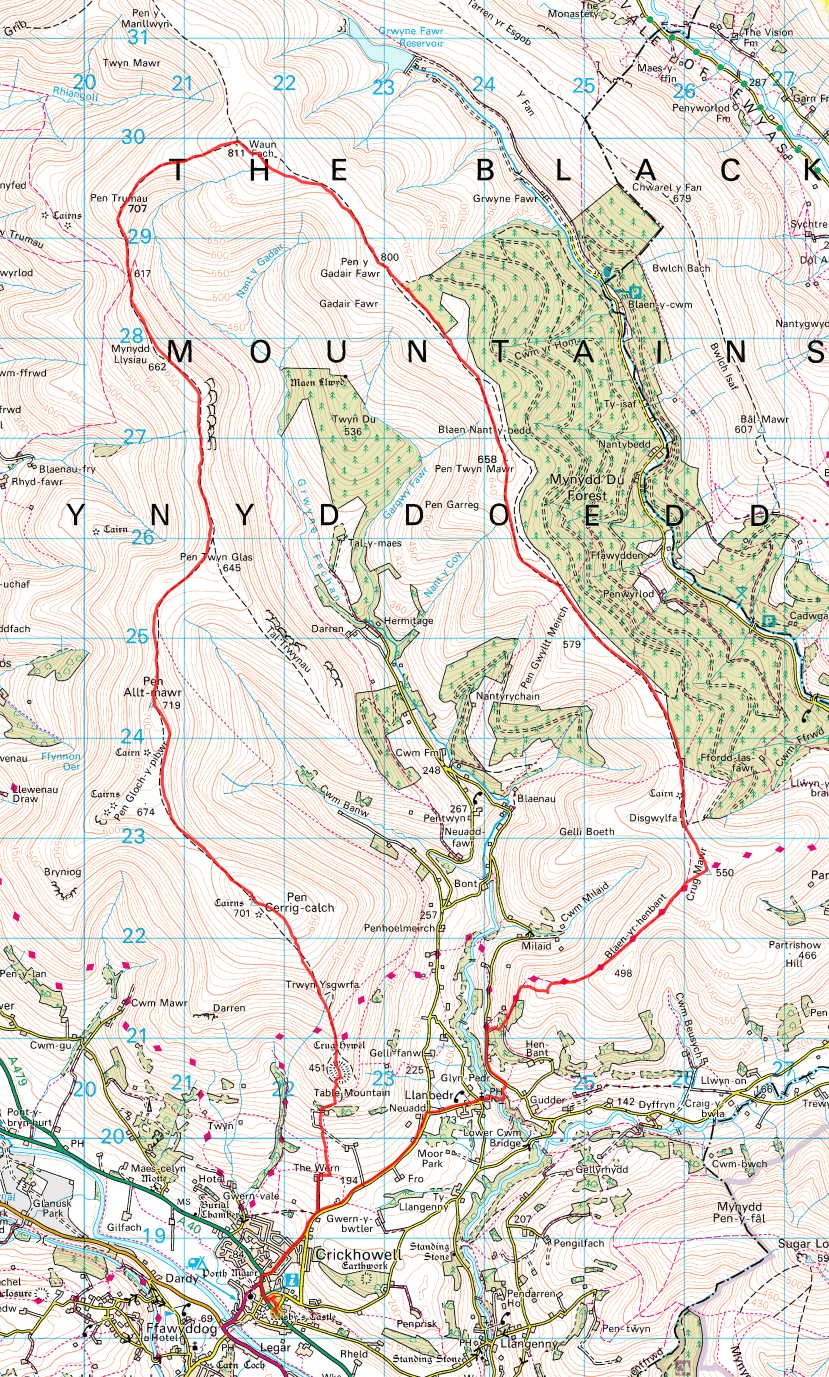
So, all in all, I concluded that it wasn't for me, and, since I was offered the opportunity by my patient and understanding wife to absent myself from proceedings for most of the day, I decided to go and walk up some hills. Adhering to the general (albeit loose) principle that I'd prefer to do a walk I haven't done before (even if some of the intermediate summits aren't new) I devised a walk of around 16 miles in the Black Mountains, on the grounds that that would provide a nice challenge that would occupy me for most of the day.

One obvious cloud on the horizon, no pun intended, was the absolutely atrocious weather forecast. But, if you've only got one day, you have to just do the thing you intend to do in the weather that presents itself, or stay home. So I packed up my waterproof gear and headed off, the plan being to park at the Pont Cadwgan car park, cross the road and head roughly westwards through the Mynydd Du forestry to the ridge which eventually leads north-west-ish to Waun Fach, the highest point of the Black Mountains (and which I visited once before as part of the epic 20-mile hike mentioned here), and then loop round the head of the Grwyne Fawr valley, bag the trig point on top of Rhos Dirion and then head back down the parallel ridge and eventually drop off the top of the ridge back down to the car park.

The tricky bit of most walks of this nature is getting started, in particular getting up above the fence-line marking the boundary between areas where you have to be careful about path-following to avoid straying into someone's property and open land where you can just wander where you like constrained only by the natural topography. This walk proved a rather extreme example of that for a couple of reasons: firstly that the weather forecast was unfortunately pretty accurate and the actual conditions provided weather that varied between annoying light drizzle and relentless heavy drizzle. This doesn't prohibit going out in it, but it does mean everything is several times more difficult and time-consuming, especially when you have a need to regularly consult phone and map for navigation purposes, and in this case it was both as the phone coverage was pretty much non-existent. The second reason was that it turned out that the people who manage the Mynydd Du forestry have been conducting a ruthless campaign of path closures recently, including pretty much all paths that lead up onto the ridge.

After an hour or so of fruitless trudging up and down forestry trails and occasional retracing of steps I decided to call it a day and head back to the car park to try a different route. Hilariously, it then took me another hour to find a route out of the forestry back to the road, and even more hilariously having regained the road and thought, well, at least it's just a regular trudge of a mile or so from here back to the car park, I then had to negotiate a flooded section of road by climbing a bank and scrambling into a hedge.


Scarcely believably, by the time I'd got back to the car and taken some of my frustration out on a pork pie and a couple of spicy Peperamis, I'd clocked up almost six miles of fruitless and increasingly enraged and waterlogged wanderings (roughly clockwise in the map below). I was reminded of our doomed attempts (in similar weather) to bag the couple of seemingly innocuous Munros behind our holiday cottage in Ballachulish in 2011.


I couldn't just give up and go home, though, partly because it was only lunchtime and there'd be a very real danger of still catching the tail-end of the coronation coverage, but also because I wanted to do a thing that actually achieved its original objective, however modest. As luck would have it my route back took me past the Fro car park, which is conveniently placed for a furious up-and-back assault on the Sugar Loaf from its north-eastern slopes, an angle from which, as it happened, I'd never been up it before (previous ascents were from south and, erm, also south).

The weather was still pretty shitty - not quite as rainy but very misty - but on a nicer day this would be a pretty good route up, nice steady ascent, probably some nice views. The only drawback is that there isn't an obvious way of making it a non-step-retracing circular walk without incurring a significant amount of low-level tedium at either start or end. I wasn't in the mood to worry about this and just smashed straight up, bagged the trig point and then came straight back down by the same route, four miles round trip, bish bosh, sorted. 

So, lessons: don't assume that getting to the start point will be straightforward, do as much research as you can but be prepared to be thwarted and have to replan either in a minor way or in a completely wholesale throw-plans-away-and-start-again way, do take an actual map in case of mobile signal blackspots, don't be put off by a bit of rain but do take some appropriate wet-weather gear and if you get completely fucked over doing your original thing, go and do another thing. As a life philosophy there's not quite as much there as there is in playing French cricket, but it's still good. 

Monday, April 24, 2023

the last book I read

Love Is Blind by William Boyd.

Meet Brodie Moncur. He's a tuner. What, a large pelagic fish of the mackerel family? Well, no. This guy tunes pianos for a living and is already building quite a reputation for himself in Edinburgh as the go-to guy in the piano-tuning game (hardest game in the world, the old piano-tuning game). Octaves all stretchy and flabby? E-flat a little too flat? Perfect fifths sound like diminished sixths? Brodie's your man.

Brodie works for the established Edinburgh piano-making firm of Channon's and has already proven himself a useful and resourceful employee, not just for his technical skill but also for some innovative and profitable business and sales ideas. So when the company decides to expand and start up a new showroom in Paris, Brodie is given the job of assistant manager, the top job obviously going to a member of the Channon family, regardless of their level of crookedness and incompetence.

Anyway, Brodie relocates to Paris and immediately comes up with a couple of profile-raising and money-making ruses for Channon's: firstly setting up a tuning and repair business in the local area, rather than having to ship something literally the size of a piano all the way to Edinburgh, and secondly acquiring the services of some high-profile pianists to play Channon pianos in some sort of prototypical product placement/sponsorship type of deal. Their main catch turns out to be John Kilbarron, a fiery Irish pianist, probably slightly past his sell-by date and these days a bit keen on the old sauce and occasionally unreliable, but still a big crowd-puller. Brodie is given personal responsibility for ensuring Kilbarron's pianos are tuned exactly to his specifications, including lightening the keys to accommodate some increasing weakness in Kilbarron's right hand (almost certainly connected to the epic booze consumption). 

During the course of his duties for Kilbarron (actually the Kilbarrons, plural, as John's brother Malachi acts as a manager for his brother) Brodie meets John Kilbarron's girlfriend and companion Lydia ("Lika") Bloom, an aspiring (but, we are invited to infer, slightly rubbish) opera singer. Brodie's interest immediately perks up: I wouldn't mind lifting her lid and adjusting her G-string, showing her my classical fingering technique, etc., and as it turns out the feeling seems to be mutual and they soon embark on a clandestine affair.

Several other things then happen at once: a dispute between the Kilbarrons and Channon's results in their contractual relationship being terminated, Brodie coughs up a gallon of blood, is diagnosed with tuberculosis and sent to the south of France to convalesce and on his return is sacked by Channon's after a series of financial irregularities is discovered. It is made clear to Brodie that non-one seriously suspects him, but the alternative (and, as it happens, correct) explanation is that the younger Channon is responsible, and blood is thicker than water, old chap, I'm sure you understand.

Brodie is therefore free to resume his employment with the Kilbarrons, directly this time, and accompany them to Russia for a lucrative concert tour. All the to-ing and fro-ing between St. Petersburg and the country dacha that their Russian benefactor has laid on provides some limited opportunities for Brodie and Lika to do some discreet boning, but evidently they're not discreet enough and they are discovered by Malachi. Malachi is shrewd enough to know that telling John would send him into an alcoholic spiral and endanger the concerts, but uses the knowledge as leverage to have Brodie and Lika do his bidding (item one: no more boning). Gradually the whole professional relationship deteriorates and eventually Brodie quits. This might not be so bad but he also takes the opportunity to subtly sabotage Kilbarron's piano so that that night's concert is a fiasco. The combined knowledge that Brodie has fucked his concert and his girlfriend is too much for John Kilbarron and he challenges Brodie to a duel. In turn-of-the-century St. Petersburg these are generally stylised affairs where both protagonists fire into the air, honour is seen to have been done (by virtue simply of turning up, presumably) and everyone goes home. Not so in this case as it soon becomes clear that John Kilbarron very much intends to kill Brodie in a very real and non-stylised sense, and Brodie only manages to escape his fate by wielding Lika's pistol that he has concealed about his person and shooting Kilbarron through the chest with it.

Apparently there are some legal consequences to shooting someone through the heart in a field, and bearing in mind these, as well as Malachi's likely lust for revenge, Brodie and Lika flee St. Petersburg and make a circuitous way through various European cities in an attempt to escape. But Malachi is relentlessly determined, and after their travels take them to southern France, then Edinburgh (incorporating a brief reunion with Brodie's family including dreadful old patriarch Malky Moncur) and then back to France again, they discover that Malachi is still on their trail. Eventually Brodie awakens in a hotel room in Nice to discover that Lika has left him and gone to present herself to Malachi, it being her he really wants. Brodie struggles to make sense of this and tracks her down to Paris where she reveals that she has been married to Malachi since she was eighteen and transferred her affections to John with his approval for the collective good of their business arrangements, but that a similar arrangement with Brodie was intolerable to him. 

Brodie mooches around Switzerland for a while making a living from piano-tuning but still has suspicions that Malachi has agents on his tail, and so decides in a more radical course of action: fuck right off round the world to the Andaman and Nicobar Islands, a destination he selects by literally sticking a pin in a map. Precious few pianos here but he finds work as an assistant to Page Arbogast, an anthropologist studying the local tribes. He is happy enough in his work but still experiences occasional paranoia about Malachi - will he pursue him even here? Will one of his tubercular attacks finish him off first? Will Lika free herself from Malachi and come to him?

Wikipedia tells me that this is Boyd's fifteenth novel; by my calculations I have read twelve of these fifteen, the only omissions being the early novel An Ice-Cream War, the faux-biography Nat Tate and the James Bond story Solo. By this stage you pretty much know what you're going to get and it's hard to avoid comparisons with other Boyd works - the obvious one is the broad similarities between the love story here and the one in The Blue Afternoon; lovers carrying on an affair despite the female protagonist being inextricably attached to someone else and planning to escape to grow old together but never quite managing to land the happy ending. Like Sweet Caress it's also something of a return to the biographical style of earlier novels like The New Confessions and Any Human Heart after a period of producing more plot-driven thrillers like Restless and Ordinary Thunderstorms. One thing that you know you're going to get with a Boyd is a Ruddy Good Story - I'm suspicious of any attempt to group writers into "novelists" and "storytellers", usually because the latter category is used as an excuse for, or a badge-of-honour inverted-snobbery revelling in, horrible clunky prose, not something you could ever accuse Boyd of. 

That said, there are a few quibbles: the nature of the hold that Malachi has over Lika is never very well explained, and nor is the relentlessness with which he pursues Brodie (though to be fair I suppose he did kill his brother), and some of the ventures into music theory to explain the emotional impact of a particular piece of music have a whiff of authorial insistence in displaying the depth of his research. Brodie also seems to be irresistibly attractive to women: in addition to Lika there's a whiff of something with Brodie's Russian doctor, the young daughter of the Kilbarrons' Russian benefactor throws herself at him and at the end of the novel Page Arbogast makes it fairly clear that she is Well Up For It as well. 

But it's very good and tremendously readable, as Boyd's novels always are (this is the sixth to appear on this blog, which brings Boyd level with Ian McEwan in joint second place behind Iain Banks). I would say it's definitely better than its immediate predecessor Sweet Caress, and you'd probably have to go all the way back to 2002's Any Human Heart to find one that's better. The early-1990s pair of Brazzaville Beach and The Blue Afternoon remain my favourites, though. 

Tuesday, April 18, 2023

loched and loaded

It's been something like eighteen months so here's another whisky post. The main items of interest among a very gratifying selection of whisky delights at Christmas and my birthday were a pair of bottlings from the Loch Lomond distillery, something I'd never tried before and something you never used to see in the major outlets like supermarkets or Amazon. But evidently they've had a bit of a rebrand and a sales push of late and well, here we are.

The two bottles I have are the standard no-age-statement entry-level single malt which they have decided to call Loch Lomond Classic, and the 10-year-old expression (which interestingly doesn't seem to be listed on their website). The distillery itself is right on the Lowland/Highland region boundary in the same way as Glengoyne is; in fact Loch Lomond is slightly further south (and a few miles further west) than Glengoyne. Nonetheless it's classed as a Highland whisky.

What you'd broadly expect here is that the older whisky would be slightly darker and deeper and richer than the younger one, and that's pretty much what you get, The younger one has the slight magic-marker smell that young whisky has, but also just a hint of something fruity, maybe apples or pears. The older one is slightly sweeter, and, as you can see from the photo - it's the one on the right - darker, and also has just a hint of that parsnip/Marmite/leather-topped writing desk savouriness that slightly older whisky sometimes has. It seems kind of obvious to say that the older one is better, but, well, it is. Both are pretty polite, smoke-free whiskies of the sort you would expect from the Highland/Speyside region; as I've said before my preference is for something a bit more rough and ready but there's absolutely nothing wrong with either of these.

As I've said elsewhere, most distilleries manage to concoct some claim of being the oldest, highest, biggest, based on some slightly weaselly definition of the word in question. Loch Lomond doesn't exactly do this, but its bottles do carry a legend that says "since 1814" (you can see it in the picture above), which even the most charitable observer would have to say is a big fat lie of the sort that you would surely think would be legally actionable. Presumably just enough smoke can be blown up the impartial observer's ass by the fact that there was a short-lived distillery on the banks of Loch Lomond from 1814, even though it only existed for a handful of years and the new distillery, which opened in 1965, has no connection to it and is in a completely different location.


The other thing people know, or rather think they know, about Loch Lomond is that it's the whisky that Tintin's adventuring buddy Captain Haddock used to drink. Well, what's the problem with that, you might say - it's right there in the books, see?


Well, the problem is related to both the date-related slipperiness above and the multiple re-workings of the Tintin books over the years, something I previously mentioned here. In fact the panel from The Black Island featuring the train was originally drawn as containing Johnnie Walker whisky and only re-drawn to say Loch Lomond in the early 1960s when the early books were re-issued in colour. The re-issue dates and the date of the re-opening of the distillery are pretty close together, but it seems highly likely that the re-drawing work commenced before the new Loch Lomond distillery was even open, and it seems unlikely that Hergé was following upcoming developments in Scotch whisky so avidly as to have been aware of it. The most likely explanation is that he just chose a nicely generic Scottish-sounding name (perhaps with some help from his English translators) without any particular intention that it mirror the name of a real-life entity and the fact that it subsequently did is just a coincidence. OR IS IT, etc. etc.

Monday, April 17, 2023

killebrity lookylikey of the day

My elder daughter, as befits a massive Harry Potter fan who has read the entire novel sequence about nine times and has many assorted items of Potterobilia in her possession, has a Harry Potter-themed duvet and pillow set, which features among other cartoonish renderings of the principal characters Harry's pet snowy owl, Hedwig (yeah, I know, owls again). This is all well and good but to me the owl as rendered has more than a touch of the Jason Voorhees about him, don't you think?


Wednesday, April 12, 2023

celebrity lookeylikey of the day

Let's do another one, this time involving actual people rather than delicious items of breakfast pastry and birds of prey. Here's Robert Z'Dar, your go-to man in the 1980s and 1990s for scary-faced psychotic villains in various movies of varying quality including Maniac Cop and (as pictured here) 1989's Tango & Cash, which I recall paying actual money to go and see in the cinema at the time of its release. Z'Dar's USP was, and there's no nice way of saying this, an absolutely freakin' massive lower jaw (due to a genetic condition called cherubism). Pictured alongside him is another man with a similar (though admittedly slightly less startling) chin: 2022 Masters champion Scottie Scheffler. 


As I said before this year's Masters tournament started, the 2023 version was the first one in eleven years to finish on Easter Sunday, usually a trigger for an outpouring of religious nonsense from the winner.  As it happens this year's winner, Jon Rahm, was a bit more understated about the whole thing (I mean, he could be a Satanist for all I know), but to counteract that here's Scheffler's own post-victory interview from last year, with much glorifying of God and similar horseshit.

owlebrity pastrylikey of the day

It was Alys's birthday a couple of weeks ago, and Alys is a big fan of cute wildlife of all kinds, and owls in particular, so one of the things we did to celebrate was take her to this owl sanctuary up at Festival Park in Ebbw Vale. It's a funny little place, to be honest, but to be fair it does what it says on the tin in that they have lots of owls, including a couple that they got out and allowed the kids to interact with. As an aside, you will recall that we visited another owl sanctuary (one with what I deduce to be a higher budget for general site maintenance and presentational stuff) in the vicinity of Kington in Herefordshire in 2015; Alys probably doesn't remember that one, though, as she was only about three months old at the time.

A week or so later as part of general birthday celebrations for both girls (Nia's birthday is a week after Alys's) we went to Center Parcs for the weekend, and had some treats for breakfast including some pains au chocolat as everyone loves them, including me. It was only when I chanced to look at one of them end-on that I was struck by its uncanny resemblance to the barn owl we'd interacted with a week or so earlier. See for yourself:

That picture is obviously cropped to just the relevant bit; the small item of prey that the owl's baleful gaze is fixed upon is in fact Huwie, as you can see here. I'm happy to be able to report that he was able to make good his escape without being torn apart by razor-sharp beak and talons, eaten and then burped up again as an owl pellet a short time later.


Saturday, April 08, 2023

the last book I read

Farewell, My Lovely by Raymond Chandler.

Meet Philip Marlowe: he's a maverick private investigator, who doesn't play by the book, but - dammit - he gets results. Actually, results - and the paychecks that come with them - have been a bit thin on the ground lately, so when he spots a suspicious-looking giant white guy entering a primarily black Los Angeles nightclub called Florian's, his finely-tuned detectival instincts tell him he should follow and take a look. 

Sure enough the guy, who turns out to be called Moose Malloy, also turns out to be fresh out of prison and looking for his pre-prison girlfriend, Velma (no, not that one). When the club's owner explains that the club has changed ownership since Velma's day and he can't help, Moose expresses his disappointment by snapping his neck like a stick of celery. After the police express minimal interest in the resulting case (the murder of a black man not really being the sort of thing to get them off their fat cop asses) Marlowe decides to investigate Moose's motive by seeing if he can locate Velma.

In quick succession Marlowe finds Jessie Florian, the ex-wife of the nightclub's former owner, who claims that Velma is dead, and gets a seemingly unrelated call from a man called Lindsay Marriott, who wants Marlowe to act as a sort of bodyguard for a trip to a nearby canyon for a rendezvous - something to do with delivering a ransom payment for a stolen jade necklace. And not without good reason, it tuns out, for no sooner have they turned up at the rendezvous point than Marlowe is coshed unconscious, and - the cosh-wielder having presumably got their eye in properly by this point - Marriott is coshed to death.

Some further lines of enquiry are opened up by Mrs. Grayle, the owner of the ransomed jade necklace, and by Jules Amthor, a supposed psychic whose name Marlowe finds secreted in the filters of some of Marriott's marijuana cigarettes. Mrs. Grayle is something of a minx - bored rich wife, older husband probably not cutting the mustard in the bedroom department - and makes it known to Marlowe that she is Well Up For It. Marlowe's encounter with Amthor is somewhat stranger - on being questioned by Marlowe about supplying the drugs to Marriott he has Marlowe escorted off the premises by some corrupt cops and entrusted to the care of a Dr. Sonderborg, who keeps him in a drugged stupor for a few days before Marlowe is able to escape. 

Using Mrs. Grayle's name as leverage, Marlowe manages to extract the information that Malloy may be hiding out in a boat moored just offshore outside of the city's jurisdiction and used for gambling activity. Malloy turns out not to be on board but Marlowe meets with the boat's owner, local bigwig Laird Brunette, who agree to make some enquiries within the LA underworld.

Marlowe arranges a date with Mrs. Grayle and when she turns up lands her with a surprise: he knows that she is Velma, and married her current elderly husband, the poor sap, under a false name. Moreover, he has her old boyfriend Moose, who she fingered to the cops for the crime that got him (falsely) put away, right here in the hotel bathroom and he'd really like a word. Mrs, Grayle is not having any of it, though, and shoots Malloy before making good her escape, only to be caught up with by the cops some time later and shooting herself rather than be taken in. 

The main things to say about Farewell, My Lovely are that a) it's very entertaining b) substantial parts of the plot don't really make any sense and c) that doesn't really matter. What I'm thinking of for b) are things like the bizarre interlude with Jules Amthor and Dr. Sonderborg, which read as if parachuted in from a completely separate novel. Oddly, this isn't far from the truth, as Farewell, My Lovely was a reworking of a few originally separate short stories. The point of it, though, isn't the seamless interlocking of all the plot elements but the overall style, some elements of which seem hackneyed now - rumpled cynical wisecracking private eye, chaotic domestic arrangements, complex and generally disastrous personal life, unconventional methods - but which Chandler and some of his contemporaries such as James M Cain and Dashiell Hammett were early exponents of.

Needless to say this stuff was and is tremendously popular material for films, and Farewell, My Lovely has been filmed a few times, though oddly only once under its original title. Most of the other Marlowe novels, including The Big Sleep and The Long Goodbye have been filmed (often multiple times) as well. 

Tuesday, March 28, 2023

you don't know dick

So you might have seen news of the death of Dick Fosbury a week or so ago, and you'll have been hanging out in the pub with your mates going oh, yeah, Dick Fosbury, the Fosbury flop, you know, revolutionised the high jump - *slurps pint* - revolutionised it. You know, before Fosbury - Mexico, 1968 it was - people could jump about, oh, I dunno, this high *gestures at about knee height*, and then along comes this lanky Fosbury bloke and only goes and leaps clean out of the stadium! Backwards! Revolutionary. Course *colossal belch*, everyone does it now, innit. 

Well, I'm here to be the annoying guy at the next table who acts as a sort of human QI klaxon and goes WELL ACTUALLY it's not quite as simple as that. Thinking about it, this is a bit like the post I did after the demise of Arnold Palmer, with a similar disclaimer that it's not in any way having a pop at Fosbury, just making a couple of observations about how actual events get massaged into a sort of glorious mythic version which irons out some of the inconvenient messy complexities of actual reality.

A brief tangent: it was actually this tweet which prompted me to actually do a bit of research here:

There are some interesting responses in the comments, including the only other example which occurred to me - the switch in ski-jumping from an in-flight posture with the skis extended in parallel to one where they're in a sort of V-shape, which turns out to be considerably more aerodynamic for reasons I can't begin to fathom. I recall seeing (probably on Ski Sunday) a Finnish jumper called Matti Nykänen doing it in the 1980s and it eventually became the standard, just as the Fosbury flop did (with some caveats, see below). 

Anyway, Ian Leslie's tweet was evidently a bit of research in advance of this interesting article about Fosbury. I mean there is a bit of life-coach bollocks in there as well - "seize the adjacent possible", if you please - but even in that exact section there is an interesting point: Fosbury's innovation was only feasible, or safely feasible anyway, because of advances in landing mat technology.

The physics of the Fosbury flop are fascinating and stem from a realisation (Fosbury had a background in engineering) that it wasn't necessary for the whole body to be above the level of the bar at the same time (as, broadly, it was for the variety of previous techniques); indeed in a perfectly executed flop the centre of mass of the athlete passes under the bar. Think of it as exchanging the energy required to lift an entire bucket of water over the bar for the much lower energy required to use a hose to siphon the water over bit by bit. This video shows the progression through the years from the basic scissors (essentially just hurdling the bar; I'm sure you can make up your own jokes about furious scissoring in the women's event) of the early years to some variation of the Western roll in the 1920s and a gradual transition to the full straddle by the 1950s, and then Fosbury and his successors. Note also the equivalent video showing the progression of the ski-jumping world record with the switch to the modest V-shape in the early 1990s and the gradual exaggeration of the posture to the full spatchcock of modern jumpers. 

Here's the mildly contrarian HOT TAKE bit: you would think, from watching that video, which shows only floppers post-1968, that Fosbury's innovation prompted an immediate switch, by everyone, to the new technique, with a bit of embarrassed coughing all round at not having thought of it themselves. Not so, actually, as there was quite a lengthy transitional period where straddlers persisted and in fact claimed the men's high jump gold at the very next Olympics, in Munich in 1972 (for which Fosbury failed to qualify) and the women's high jump gold at the one after that, in Montreal in 1976. The men's world record was only claimed by a flopper in 1973 - Fosbury's Olympic-winning (and, to be fair, Olympic record-setting) height of 2.24 metres in 1968 was four centimetres short of the world record at the time. Moreover, the world record was reclaimed by a straddler, Vladimir Yashchenko, in 1977 and only relinquished finally to a flopper in 1980. As I see I said here, the world records for the two styles are still only ten centimetres apart, despite no-one having seriously competed with the straddle since about 1980. It's interesting to speculate how things might have panned out if Yashchenko's career hadn't been ended by a knee injury when he was only 20, and if his illustrious predecessor Valeriy Brumel, who raised the world record six times in about two years in the early 1960s, and was still the world record holder at the time of Fosbury's Olympic triumph, hadn't had his career ended by a motorcycle accident when he was only 25.

Furthermore, it's interesting to note that Fosbury may well not even have been the pioneer of this style; Canadian jumper Debbie Brill was also doing it in the mid-1960s and it's not clear who thought of it first or to what extent the two pioneers knew about each other. This article is the only one I can find which quotes Fosbury referring to Brill, but it's a bit vague. 

Lastly, it's also interesting to note the progression of the world records for the main jumping events (high jump, long jump and triple jump) and theorise that human progress in this area has stagnated. These are some of the longest-standing records in athletics:

  • Men's high jump: Javier Sotomayor, 1993 (30 years)
  • Women's high jump: Stefka Kostadinova, 1987 (36 years)
  • Men's long jump: Mike Powell, 1991 (32 years)
  • Women's long jump: Galina Chistyakova, 1988 (35 years)
  • Men's triple jump: Jonathan Edwards, 1995 (28 years)
  • Women's triple jump: there was a 26-year gap between 1995 and 2021 but subsequently the record has been raised twice by Yulimar Rojas. Still, you know, exceptions, rules, etc.

Maybe another similar technical revolution is needed. Or maybe we've just cracked jumping, as a species, and that's it, barring evolving some extra limbs or something.

Thursday, March 23, 2023

four shalt thou not count, neither count thou two, excepting that thou then proceed to three

Inspired by this tweet a month or two back to give the subject a bit of thought, I present to you now my collected Books Of The Year list wherein I nominate three from each of the years of this blog's existence (well, I only did one from 2006 as there were only a handful). Three seemed the right number to make the decision-making tricky from an average yearly sample of twenty or so. No particular rules except I tried to avoid picking two by the same author (not generally a problem) and tried not to agonise about it too much or spend too much time on it. 

The table below presents the list; I've spiced it up a little by including a piece of text (strictly unedited) from the original review which will hopefully either give a flavour of the book, ruin a key aspect of the plot, or just amuse. I may make this A Thing in future as part of the annual book round-up I try to do in January.

Year Author Title Comment
2006 Anita Shreve The Weight Of Water two parallel intertwined stories kind of story
2007 William Boyd Restless inevitable betrayals and double-crossings
TC Boyle Riven Rock traumatic formative sexual experiences
Joyce Carol Oates The Falls small fly in the ointment of her marital bliss
2008 Robertson Davies The Cunning Man all manner of throwaway literary and cultural anecdotes
F Scott Fitzgerald The Great Gatsby driving off gaily in your Hispano-Suiza, getting your scarf caught in the wire wheels and strangling yourself
Anne Tyler A Patchwork Planet all you've got left to hold the reader's attention is your actual skill at writing believable characters
2009 Iain M Banks Inversions knife missile which she uses to escape, with impressively bloody results
Cormac McCarthy The Road what will you do when you meet people who will do those things, and more
Isabel Colegate The Shooting Party ruthlessly enforced social structures and strictures preventing you from ever saying what you really think
2010 Peter Ackroyd Chatterton only employed as a model because he was working up to running off with his wife
Joyce Carol Oates We Were The Mulvaneys periodically fleeing to the next one when anyone starts to rely on her too much or show her any personal affection
Stieg Larsson The Girl With The Dragon Tattoo the obligatory secret subterranean porn dungeon for the hero to be rescued from in the nick of time as he is about to be buggered to death
2011 Kazuo Ishiguro Never Let Me Go hopefully we might carry on a bit longer, and avoid the organ-harvesting death squads
Tim Winton Cloudstreet much roistering and raging and rollicking, not to mention rucking and rogering
Patricia Highsmith The Talented Mr Ripley various psychological issues, like, you know, murdering people
2012 Iain M Banks Look To Windward but in fact on a deadly mission so secret EVEN HE DOESN'T KNOW WHAT IT IS!!!
William Boyd Ordinary Thunderstorms a man hiding in a hedge isn't really going to drive the narrative along, so we need more plot
Arkady & Boris Strugatsky Roadside Picnic the constant danger of getting arrested or shot or stumbling into a gravitational anomaly and getting turned inside-out
2013 TC Boyle Drop City a guy who can render his own bear-fat, make moose sausages and knock together a dog-sled with just a few bits of discarded porcupine guts and some whittling
Alison Lurie Foreign Affairs what sympathetic people might call "flighty", "free-spirited", "eccentric", etc., but the rest of us would just call "mental"
Ian McEwan The Innocent Progress down the tunnel towards the Russian sector continues, as does Leonard's progress down Maria's "tunnel", hem hem
2014 GB Edwards The Book Of Ebenezer Le Page all of whom disappoint him in some way with their laziness, stupidity, and embrace of modern ideas like the motor car, feminism or the television set
Russell Hoban Riddley Walker any notion of standard rules for spelling and grammar have gone out of the window, not that anyone has windows any more
Walter Tevis The Queen's Gambit eating properly, heading down the gym and, most importantly, cutting out the pints of white wine for breakfast
2015 Sebastian Faulks Birdsong getting better acquainted with Mrs. Azaire by going down on her comme une tonne de briques while René is out of the house
Richard Yates Revolutionary Road otherwise intelligent young people waking up one morning in their sterile little suburban box and realising that they don't know each other at all
Christopher Priest Inverted World necessitate a rethink of the policy of keeping the plebs ignorant of the outside world
2016 Marilynne Robinson Home before either his father dies or Jack's desire to disappear and be away from responsibility and scrutiny gets the better of him
Daniel Woodrell Winter's Bone everyone has too many guns, drinks too much hooch and is cooking up crank
EL Doctorow Ragtime falls out of a wardrobe while having a furtive wank
2017 Robertson Davies The Rebel Angels the circumstances in which he subsequently murdered McVarish during the course of an elaborate sex game
Yann Queffelec The Savage Wedding the persuasive suggestion that with Ludo gone things might get a bit spicier in the boudoir department
Kurt Vonnegut Cat's Cradle causes the sea, as well as all rivers, streams and groundwater on the planet, to solidify into ice-nine, instantly ending almost all life
2018 Russell Banks The Sweet Hereafter attach an actual face to the child in the back of the bus disappearing off a ravine into the cold murky water
LP Hartley The Go-Between they interrupt Ted giving Marian a practical farming tutorial, in particular a demonstration of some vigorous ploughing
Tom Wolfe A Man In Full a bit of a problematic Mary Sue in an otherwise unmitigated sea of arseholes
2019 Kazuo Ishiguro The Remains Of The Day Miss Kenton is wearing a sign that says AVAILABLE, or possibly RIDE ME LIKE ONE OF LORD DARLINGTON'S PRIZE MARES
Marilynne Robinson Gilead what's a respectable Reverend doing having a son in his late sixties, the randy old goat?
Iain Banks Transition one person's disastrous turn of events about which Something Must Be Done is someone else's wholly necessary and exciting developments
2020 Jim Crace Harvest ill-equipped to adapt to quickly-changing circumstances, and WAIT A MINUTE here are some circumstances quickly changing
Mark Z Danielewski House Of Leaves the fact that a corridor has just poofed into appearance out of freakin' nowhere
Alasdair Gray Lanark only if you're some sort of hopelessly gauche naïve ingénue who expects fictional narratives to follow a linear pattern, hahahaha
2021 John Christopher The Death Of Grass so a few people's lawns die, you might say, no biggie
Hilary Mantel Bring Up The Bodies actual public bloody dismemberment rather than discreet shuffling off to a nunnery
Arturo Perez-Reverte The Flanders Panel the pristine "original" work? What does that even mean? What do words, in general, even mean?
2022 China Miéville The City & The City a city (takes drag on cigarette) .... OF THE MIND. Though, erm, also totally real (coughs)
Jim Harrison The Road Home a fierce and independent girl not prepared to take any shit from anybody, including her grandfather
Tim Winton Breath all good things must come to an end, even bracingly transgressive and dangerous under-age sex

Monday, March 20, 2023

the last book I read

The Underground Railroad by Colson Whitehead.

Cora's life seems pretty sweet, on the face of it*, if by sweet you mean relentlessly shitty and brutal. Born into slavery on the Randall plantation in Georgia, as was her mother Mabel before her, after her grandmother Ajarry was kidnapped and transported from Africa to America, Cora lives with a group of other slaves and works in the cotton fields. The slaves are kept fed and sheltered, after a fashion, but woe betide you if you fail to harvest your allotted amount of cotton, talk back to the white masters or try to escape.

Escape certainly seems like a pretty appealing option given the unrelenting hardship of day-to-day life, but the risks are appalling - a crack team of slave-catchers is just waiting to be unleashed and if you are caught you will be brought back to the plantation and executed in an appallingly protracted and public fashion pour encourager les autres

As it happens Cora's mother, Mabel, escaped from the plantation ten years or so previously and, despite the best efforts of elite slave-catcher Ridgeway and his men, was never caught. When her fellow slave Caesar comes to her and suggests an escape bid she is initially resistant but eventually agrees, and they set out across the swamps in the dead of night.

Caesar has been in touch with agents of the Underground Railroad, in real 19th-century America a network of safe routes for escaping slaves, but as depicted here an actual physical railroad with trains and tunnels and people maintaining secret stations in slave states. Cora and Caesar hook up with a sympathetic farmer who has access to an underground station and ride the rails up to South Carolina. 

Meanwhile, back at the plantation, Cora and Caesar's absence is swiftly noted and the slave-catchers sent after them, a team led by Ridgeway who is taking a personal interest in retrieving Cora after a rare failure in the pursuit of her mother. Cora and Caesar have found refuge in South Carolina, though, which operates a much more liberal regime, former slaves being provided with housing and gainful employment while, yes, technically still being owned by the state, but, hey, who's counting? And it's better than being back in Georgia swinging from a rope, right? Pay no attention to the medical staff taking blood samples for no apparent reason and the strong encouragement for black women to consent to being sterilised. I mean, it's for your own convenience - the state doing you a favour, when you think about it. 

Cora is starting to smell a rat when the decision to move on is taken for her - she gets wind of slave-catchers making enquiries and flees to the house of the local station agent for the Underground Railroad. And not before time as they are hot on her tail and burn the house down, leaving her to board the next available train and get off at the next available stop, which happens to be a partly-abandoned station in North Carolina. Well, North Carolina will be pretty much like South Carolina, right? Only, you know, further north and all. Well, not a bit of it as they have decided the whole slavery thing is just too much trouble and decided on a policy of just exterminating black people wholesale and instead shipping in Irish and Italians to do the menial jobs the slaves formerly did. Having been rescued by the station agent, Martin, a rather unlikely and reluctant hero, having inherited the job from his father, Cora is obliged to endure a miserable few months hiding in the attic of his house while awaiting an opportunity to escape. Eventually the inevitable happens and one of the neighbours denounces Martin and his wife Ethel to the authorities, Ridgeway and his henchmen turn up at the house, throw Cora in the back of the cart to be returned to Georgia and cart Martin and Ethel off to be summarily hanged. 

In some ways the fact that it was Ridgeway who was on hand to make the arrest is a good thing for Cora, as if it had been one of the local goons she would probably have been strung up and set on fire there and then. On the other hand now she has to endure a long and uncomfortable cross-country slog back to her old plantation with the likelihood of a more protracted and public death at the end of it. Fate intervenes, though, when, after they have crossed into Tennessee, the cart is held up by a group of black men who rescue Cora and leave Ridgeway and his men tethered with their own chains.

Cora, the group leader, Royal, and the others make their way (via the Underground Railroad) to Indiana, another (ostensibly at least) more liberal state, and take refuge at the farm of John Valentine, along with a host of other waifs and strays and runaways. Useful work is provided, there is an extensive library, Cora and Royal begin a tentative romance, all seems calm. But even here there is discontent, not so much internally to the farm but among their predominantly white neighbours. This big black community is all very well, you know, but all that fancy book-learnin' might give them ideas. And the next thing you know they'll be round here cutting our throats and defiling our daughters. Maybe it'd be better on the whole to have a bit of regrettable but necessary unpleasantness and rid ourselves of them. 

And so a mob descends on the Valentine farm, bent on general mayhem and destruction, except for the persistent Mr. Ridgeway who only has eyes for Cora, and, once he has captured her, the location of the Underground Railroad. Cora takes him to the nearest station she knows, under a remote barn rumoured to be the terminus of a long-abandoned branch line to who knows where. With the last of her strength she grapples Ridgeway off the rickety stairway down to the platform and, as he lies wounded on the ground, limps off down the tunnel. After an unknowable amount of time in the darkness she emerges near a road and hitches a ride on a wagon headed for Missouri and then west to California.

The history of slavery in the United States has, unsurprisingly, been a rich subject for various forms of art. Notable similarities with The Underground Railroad can be found in parts of Beloved, for instance, and some of it will seem familiar to anyone who's seen 12 Years A Slave. The principal difference is the conceit of having the railroad be an actual physical thing, rather than a metaphor. This provides an odd juxtaposition with the gritty realism of what's going on generally, since a) it's not an actual thing that ever existed and b) a moment's thought will make the whole thing fall apart. Leave aside that it's inconceivable that the stations would not have been found and the rails made impassable, where did all the metal come from? Didn't someone notice entire locomotives going missing? How did they stop the tunnels from falling in? What about ventilation? Wouldn't it be literally impossible to cope with the changes in elevation for an underground railway on a bigger scale than, say, a single city? Clearly all of these things are trivially true, but the idea presumably is that you hold one part of the book (the gritty realist bits) in one part of your mind and the other (the bits featuring the railroad) in another, and apply slightly different rules to each. Whether you can do that or find that the two parts rub together in an uncomfortable way is probably just a matter of taste, and of how much of a tedious literalist you are. It should be noted that quite a few of Colson Whitehead's earlier works have a fantastical and/or speculative element to them as well. My personal feeling is that while I did find the friction between the two elements occasionally troublesome, it didn't detract from the overall effect, which, I should make clear, was tremendously impressive. 

Other people who were tremendously impressed included the Pulitzer Prize committee for 2017, which makes The Underground Railroad the second novel I've read in 2023 to have received it, the other being The Overstory. Perhaps it's time for a recap of my Pulitzer list, which goes as follows: 1928, 1940, 1953, 1961, 1981, 1985, 1988, 1989, 1992, 1994, 1996, 2003, 2005, 2007, 2017, 2019. It also won the National Book Award the previous year; my updated list here goes: 1958, 1962, 1965, 1980 (paperback), 1988, 1993, 2001, 2016.

* I promise this is the last time I will do this