| Player | Tournament | Year | Round | Result | Winner |
|---|---|---|---|---|---|
| Branden Grace | Open | 2017 | third | tied 6th | Jordan Spieth |
| Rickie Fowler | US Open | 2023 | first | tied 5th | Wyndham Clark |
| Xander Schauffele | US Open | 2023 | first | tied 10th | Wyndham Clark |
Thursday, June 22, 2023
what the hell am I doing golfing in LA
Tuesday, June 20, 2023
the last book I read
Temples Of Delight by Barbara Trapido.
Alice Pilling's life is pretty good by most people's standards - comfortably-off parents, albeit a bit on the slightly vulgar nouveau riche side prone to occasionally pronouncing French words incorrectly, a nice place at a nice private school for nice girls - but she craves a bit of, I dunno, excitement, even danger. This promptly arrives in the person of Veronica McCrail, known to all her friends as Jem, a tall and confident girl much given to snarky back-sassery to teachers, enthusiasm for works of subversive art and literature and hilarious stories of her hilarious family and their adventures - all pretty transparently bogus, but Alice is a sweet and trusting and gullible type, so it's all good. The two strike up a close, if somewhat mismatched, friendship, which is abruptly terminated when Jem fails to secure a scholarship to continue her studies in the Upper School (the sixth form, basically, or, erm, year thirteen or so in the crazy modern system).
Alice's continuing academic excellence has her lined up for a place at Oxford, and it's there that she meets with Roland Dent, a local schoolteacher, and they strike up a relationship. While Alice seems quite content to drift along having nice day trips and occasionally hanging out with Roland's schoolboys who are slightly breathlessly intimidated by an Actual Woman, Roland already has some major plans for Alice which culminate in his making her Mrs. Dent. On a trip to the north of England with some of the boys Alice and Roland take some time out for a drive in the countryside, whereupon he makes it clear that they will shortly be parking in a secluded woodland spot so that he can deflower her, whereupon she makes it clear that this will be happening over her dead body and as if to prove the point drives the car off a bridge and into a river.
In the wake of this unsuccessful relationship, and while recuperating from the crash, Alice then enters, perhaps rather rashly, into another relationship with Matthew Riley, the young man who helped to rescue her and Roland from their drowned car. Then, after five years of silence, a letter arrives from Jem with some news: firstly she is in a Catholic hospital in Hampshire dying from cancer, secondly that she is pregnant and due to give birth imminently, and thirdly that she has come into possession of some information about a novel shortly to be published by an American publisher which she believes plagiarises some of her own teenage writings, and wants Alice to deal with it after she's gone.
Dealing with the novel situation involves engaging with Giovanni Angeletti, the American publisher in question, who happens to be in the country and accompanies Alice on a lengthy search for Jem's original manuscript. Once this is found Giovanni takes it upon himself to track down Jem and, having done so just too late to allow Alice to see her again before she dies, drops the bombshell that Jem's dying wish was that Alice be the legal guardian of her (safely delivered) child.
So Giovanni will now jet off back to America and out of Alice's life, right? Well, no, actually, as in addition to there being a few novel-related (not to mention baby-related) loose ends to tie up, it turns out Giovanni has a non-academic interest in Alice, even after she reveals that she herself is pregnant, presumably as a result of her brief (and now ended) relationship with Matthew. Will Jem's writings ever see the light of day (now under her own name rather than that of the plagiarist)? Will Giovanni still want to make Alice the third Mrs. Angeletti? Will Alice want to become the third Mrs. Angeletti, especially after discovering that both the previous holders of that title died in slightly mysterious circumstances?
Those of you with absurdly long memories will recall that I read Juggling, which is a loose sequel to Temples Of Delight, back in early 2007 (it was the 12th book review on this list, this one being the 370th). Back in those days the reviews were a bit less verbose so I see that I didn't include much in the way of plot detail, but basically it involves Alice's two daughters and their adventures. I don't remember much about it (I mean, it was 16 years ago) but I remember enjoying it greatly, as I have every Barbara Trapido book that I've read (with the possible exception of Frankie & Stankie which I did have some reservations about). Temples Of Delight is no exception, despite the implausibilities of plot - partly this is because some parts of it, and some of the characters, are supposed to mirror the plot and characters of Mozart's opera The Magic Flute. You've got to be a bit careful with this to avoid your readers concluding that you're just manoeuvring your characters into situations according to some pre-conceived formula, rather than just letting things happen, but of course if your readers are smart enough to worry about this stuff they'll presumably be smart enough to realise that this is actually how most novels get written anyway, just less transparently. Another similar example on this list is A Thousand Acres which mirrors the structure of Shakespeare's King Lear, and just as there I was not troubled by any particular familiarity with the source material here, which in many ways is probably a good thing.
Anyway, Temples Of Delight is itself a delight to read; I suppose what I would say is if you have the choice it would probably be better to read it and Juggling in the "right" order in order to have the shared narrative flow a bit better. Doesn't really matter, though.
Tuesday, June 13, 2023
all the pretty hearses
You'll recall how I, even now only dimly aware of the awesome and terrible power I wield via this blog, joked about how the recent death of Martin Amis wasn't my fault, since I'd never posted a review of any of his books here. Well, just to redress the balance, here's one that definitely is my fault: Cormac McCarthy, who died today aged 89. I did speculate here back in 2013 that given his relatively un-prolific rate of output it was unclear whether we'd get any more novels before the inevitable happened - well, evidently mindful of this, and perhaps conscious that he was pushing his luck time-wise since my review of Blood Meridian appeared here all the way back in July 2009, he had a clearing of the decks in 2022 and knocked out two novels, The Passenger and Stella Maris.
But the Curse Of Electric Halibut will not be denied, and when it finally took effect McCarthy had clocked up a survival span of just under fourteen years, wresting the previous record from the cold dead hands of Alison Lurie. McCarthy's demise adjusts the average age and curse length values to just over 82 and just under six years respectively.
The Road and No Country For Old Men are the other two novels that appear here, and all three are excellent in their own way. The Road would be The One, though.
Friday, June 09, 2023
the last book I read
Dept. Of Speculation by Jenny Offill.
There is a woman. A woman with no name. Well, presumably she has a name in her actual life (yes, yes, all right, fictional life) but we're never told what it is. She meets a man, also nameless, and they start up a relationship which eventually leads to marriage and the arrival of a daughter.
Having children changes the dynamic of the relationship, as it always does, and both parents' concerns shift towards keeping a small person alive and entertained rather than indulging themselves and each other. Moreover, while both have jobs it's the wife ("the wife" is how she's referred to pretty much exclusively for most of the book) who has to make most of the sacrifices to accommodate childcare needs - hey, because patriarchy, amirite, ladies?
So the husband (again, this is how he is referred to, although the story is told exclusively from the wife's point of view) is off at work while the wife is at home watching CBeebies in her slippers. She is a writer and teacher of writing so there is at least the possibility of doing some work during this time, and she does a couple of writing projects, notably a sort of general history of space exploration in collaboration with an ex-astronaut, though she struggles to find a fresh angle on the well-known material.
Meanwhile hubby is out and about in the office, just hanging out, having lunch with colleagues without a care in the world, and, eventually, having an affair with an attractive young redheaded colleague. I mean I don't want to imply that this is inevitable behaviour; many men (including, just to be clear, me) manage to return to work while their wives are still on maternity leave without feeling the need to put it about relentlessly. The part that probably is inevitable is the part where the wife finds out and is, understandably, not pleased. After an awkward confrontation and a bit of A Scene between the three points of the love triangle outside the husband's office, it is agreed that wife, husband and daughter will uproot from urban New York and try to patch things up in a more rural environment with trees and grass and squirrels and shit.
So far, so meh, you might say: why, this is a perfectly commonplace tale told a thousand times before. There's a couple of answers to that: firstly every tale of conflict and woe has some properties that are uniquely its own, and secondly if you're not going to write a plot-driven heart-pounding arse-quaking thrillathon about sending an army of zombie Hitler clones to reboot the Sun then you might consider doing something interesting and unusual with novel style and structure instead. In this particular case that means the whole novel is written as a series of short paragraphs, many conveying something mostly tangential to the plot but hopefully coalescing into some deeper meaning.
Ironically this works best in the first half of the book where the tone is much more meandering and discursive; about halfway through the viewpoint shifts from first- to third-person (though still with the wife as the focus) and adopts much more of a linear narrative to describe the marital breakdown. I think this second part is less effective, partly from just being a more orthodox narrative cut up and mucked around with a bit.
This New York Times review asks the following question about the wife's unwritten second novel, referred to a couple of times in the book:
What is this novel? Why hasn’t it been written?
There is a sense in which one might ask the same question of Dept. Of Speculation itself. It's a very delicate balancing act writing a novel as trimmed of extraneous fat as this: you have to be careful not to trim away so much that you lose a sense of what's actually going on. I should add that this doesn't mean I didn't enjoy it; the structure works pretty well and some of the stuff about childbirth and early-years parenthood is very insightful, and, heck, it's 177 pages of widely-spaced narrow paragraphs so it's very quick to read.
Thursday, June 01, 2023
the best (and worst) of blondie
Literature and sport are all very well, you'll be saying, but what I really want is to stuff my big fat stupid face with some delicious cakey goodness until I fart. Well, Electric Halibut is here for you. It was my wife's birthday last week and, as is (intermittently) traditional, I concocted some goodies to celebrate. A few highlights from previous years include 2020's chocolate brownie cake, a triumph taste-wise but on an unfeasibly massive scale given that we were occupying at that time a moment in human history where it was uniquely difficult to share any of it with anyone outside the house. We did eventually work our way through all of it but it was quite an epic struggle.
H's birthday today so bought this interesting cake. Huwie came with me and was very intent on reading the label. Served it up and he leaned over to H and whispered "Mum, it's a SUSPICIOUS CAKE". Actually very nice and not at all suspicious pic.twitter.com/EgSyJEPmuq
— Dave Thomas (@electrichalibut) May 26, 2022
- 250 g unsalted butter
- 250 g white chocolate
- 125 g white granulated sugar
- 125 g light brown soft sugar
- 4 medium eggs
- 250 g plain flour
- 200 g white chocolate chips
- 50g fresh raspberries, chopped
Melt the butter and chocolate together (I used the microwave; a bowl over a pan of water would work just as well) mix it all up, add the sugar and eggs, mix some more, stir in the flour (if you're using an electric mixer, do this bit with a spoon first to avoid being engulfed in a mushroom cloud) and then the raspberries and chocolate chips (don't use the electric mixer at all here or you will end up with a uniformly pink cake with no raspberry bits in it).
That should give you a thick but still pourable batter which you can pour into a paper-lined brownie/traybake tin and put in an oven at around 180C/gas mark 4 for about 20-25 minutes. As with the brownies you want a slight wobble in the middle when you take them out. Let them cool and then put them in the fridge (overnight is good), then cut into smallish squares (they're pretty rich). You'll find the edge squares are a bit more cakey while the ones from the middle have a denser, rawer texture.
Anyway, they were exceptionally well-received and disappeared pretty quickly, helped by us being away for the weekend with another family of five. Where were those guys back in 2020 to help with the monster brownie cake? Well, locked in their house, obviously, but you take my point.
Wednesday, May 31, 2023
maps and gaps
- Don Bradman (1930)
- Walter Hammond (1933)
- Javed Miandad (1987)
- Brian Lara (1994)
- Graeme Smith (2003)
- Sanath Jayasuriya (2004)
- Virender Sehwag (2006)
- Stephen Fleming (2006)
- Kumar Sangakkara (2006)
- Younis Khan (2009)
- Ramnaresh Sarwan (2009)
- Mahela Jayawardene (2009)
- Chris Gayle (2010)
- Hashim Amla (2012)
- Michael Clarke (2012)
- Alistair Cook (2015)
- David Warner (2019)
- Tom Latham (2022)
the last book I read
Killing Mister Watson by Peter Matthiessen.
Welcome to the south-west Florida coast. A constantly-shifting landscape of sandbars, mangrove swamps, shallow rivers and islands. The sort of place that's hard to travel around without a suitable boat and extensive local knowledge, and even then one good cathartic hurricane can change everything. That river mouth you wanted to make use of to get to the sea? Yeah, that's way over yonder now. The island you wanted to visit? Gone. And the people on it? They're gone too.
So, as you might imagine, any ideas of property rights over any of the bits of low-lying land here are elastic at best, and even if they were agreed upon, who's going to enforce them? As a consequence, as you might also imagine, this is an ideal place for anyone who wants to discreetly lose themselves somewhere beyond the usual range of law enforcement. It's not a holiday camp, though: you've still got to be prepared to put the work in to build yourself a shelter and scratch some sort of a living out of the soil. But you may find that when it comes, as it inevitably will, to enforcing your own claim to the bit of land you lay claim to in the event of disputes, and maybe to extending your claims to other pieces of land already claimed by others, that a certain elasticity of morals is actually quite helpful, and that it may just come down to being prepared to do what the other guy wouldn't.
Into this environment comes Edgar Watson, a man - in common with quite a few of his co-residents of the area - with a slightly murky past that he doesn't necessarily welcome close questioning about. He's acquired the claim on a decent-sized patch of land down at Chatham Bend and has some ambitious ideas about building a house, clearing the land, growing sugar cane and selling the syrup. All of which is just dandy with the neighbours, who don't object to one of their number showing a bit of zest for private enterprise; after all, a successful business brings job opportunities and the lure of making a bit of money off the back of others' initiative. I mean, some of the rumours about EJ Watson's previous life and exploits, some of which might have contributed to his decision to occupy this remote backwater, are a bit hair-raising, but who knows what the real story is. Watson himself sure isn't telling, and despite being a man of considerable personal charm has a quick way with a knife or a gun brandished in the direction of anyone asking questions which probe too deeply.
But Mr. Watson hasn't done anything untoward since he's been at Chatham Bend, pays his bills on time, and has even brought his wife and children down to join him. True, there have been certain rumours about some of the workers he's had on the island cutting down the sugar cane, including that rather than pay some of them for their labour Watson has arranged for them to meet with some sort of "accident". But the appetite to investigate the disappearance of a few itinerant (and mostly black) cane-cutters is pretty low. The brutal murder inflicted upon Wally and Bet Tucker in a claim dispute over a neighbouring island is less easy to shrug off, especially as Bet was pregnant at the time and some pretty reliable witnesses say Watson's boat was seen in the area, but there's just enough plausible deniability to dissuade the locals from pressing things. Part of the reluctance, of course, derives from the knowledge that any retribution would almost certainly have to be organised by the locals themselves, official law enforcement being located many miles away and almost certainly reluctant to get involved.
But what proof is enough proof? What level of violence against other claim-holders would convince people that they might be next and that some sort of collective action should be taken? Things come to a head when Leslie Cox, a figure from Watson's previous life who seems to exert some sort of hold over him, arrives in the area and is taken on by Watson as a sort of foreman. It's not long before the body count starts to ramp up dramatically, and in the wake of the Florida hurricane of 1910 the locals gather among the devastation only to hear the put-put-put of Mr. Watson's boat, and a terrible and irrevocable decision is arrived at.
In terms of the narrative structure of Killing Mister Watson, this is where we came in: the novel's prologue features the ritual execution of Watson by his former friends and neighbours and what follows is a lengthy flashback. So there's no doubt over what's going to happen at the end (as if the novel's title itself were not enough of a giveaway); what the rest of the novel explores is the gradual realisation by the locals that only their own actions are going to save them. It's also about the terrible glamour of the ruthless psychopath, and the furtive regard that law-abiding people who understand the social contract have for those who choose to ride roughshod over it. It is, it must be said, quite slow to build up to the point where the pivotal violence erupts, and features a varied cast of characters who it's sometimes hard to keep track of. But the evocation of the watery Florida landscape is excellent and Watson's deadly charm rendered in a way that makes it easy to understand how things happened they way they did. The intensely real evocation of a landscape and the characters that fit into it is somewhat reminiscent of The Road Home; as with Jim Harrison, Peter Matthiessen is best known for a film made from one of his earlier works, At Play In The Fields Of The Lord.
The main point to make about the events portrayed here is that they did, in some form at least, actually happen, EJ Watson being a real person whose home was substantial enough (and its former owner notorious enough) to warrant inclusion on maps of the area even now. Many of the minor characters were also real people, including storekeeper Ted Smallwood whose premises still exist in Chokoloskee.
Killing Mister Watson is the first book in a trilogy, still available as three separate books but also as a condensed and re-worked single volume, Shadow Country, which won the National Book Award in 2008. As part of the promotional activity for that book here's an interview with Matthiessen from 2008 where he explores some of the book's themes.
Monday, May 22, 2023
amis is as good as amile
Wednesday, May 10, 2023
take it to the ridge
The last post was a bit of a downer, wasn't it? Failure, frustration, fuckery: the three Fs. Not what you want. So it's fortunate that I found a walk in the archives (from October 2022) which I hadn't shared here, this one proceeding largely according to plan, just to provide a bit of contrast.
So you'll recall I mentioned here the idea of doing a long one-way traverse of the main Beacons ridge, probably from east to west, making use of two vehicles, and you'll also recall we did a sort of trial run of that approach here (though incorporating a slightly shorter walk).
We didn't actually do any of that stuff in the end, but I mention it because the walk which Alex found in a copy of Trail magazine (it's route 3 here) replicates much of the route of that long ridge walk, although it does it out-and-back stylee starting and finishing at the Storey Arms car park. I generally find out-and-back routes involving retracing significant amounts of ground a bit frustrating but this one looked like a good strenuous challenge and offered the prospect of ascending Pen y Fan twice in a single day, something I'd never done before.
So, anyway, we camped here the previous night so as to be able to get an early-ish start the following morning, and broadly replicated the walk from the magazine, though exercising the option of using the paths which bypass Fan y Big and Cribyn on the way back. Route map and altitude profile are below (open in a new tab for bigger versions).
Our only other significant deviation from the magazine route - apart from a bit of faffing about towards the end of the outward leg to find the "proper" summit of Waun Rydd, which is a bit indistinct and not on the main path - was to loop back from Corn Du to the car park on a different path, one that turned out to involve a bit of annoying descent and re-ascent which isn't really what you want at the end of a strenuous 15-mile walk. It would in hindsight have been better to either go back the way we'd come up, or to loop around and take the path slightly further along which follows the contours round. But, overall, a good and challenging day out in great company and generally benign weather. The most challenging bit of the day, as you might imagine, is standing in the pronounced dip between Cribyn and Pen y Fan and girding yourself mentally and physically for the relentless ascent of 220 metres or so that needs to be done to get up and over Pen y Fan for the second time.
Tuesday, May 09, 2023
king marvellous
Remember the heady days of Wills-&-Kate-mania, back before his face started going all weird? Believe it or not that (i.e. their wedding) was as far back as April 2011, a date which I commemorated by fucking off up a mountain for the day (in, thankfully, splendid weather) and declining to engage with any of it on any level. Ah, memories.
A lot has happened since then for all of us, William included, including some salacious, probably untrue, but nonetheless extremely entertaining rumours about his sexual preferences and most notably the recent demise of his elderly grandmother and the belated ascent of his father to actual King of the United Kingdom, remembering of course that we live in one of the more absurd of the gazillion possible parallel universes, one where concepts like Being A King exist as actual things. As part of the ceremonial transition from beloved public surrogate grandmother figure who was almost certainly an Actual Nazi in private to jug-eared halfwit and maker of overpriced oaty biscuits who inexplicably owns a significant chunk of Wales, there's a coronation ceremony to be held, where the great British public can enjoy many hours of wall-to-wall TV coverage of tens of millions of pounds being hosed up the wall so that an elderly man can be fitted with an absurdly impractical hat, which he will almost immediately take off and never wear again.
So, all in all, I concluded that it wasn't for me, and, since I was offered the opportunity by my patient and understanding wife to absent myself from proceedings for most of the day, I decided to go and walk up some hills. Adhering to the general (albeit loose) principle that I'd prefer to do a walk I haven't done before (even if some of the intermediate summits aren't new) I devised a walk of around 16 miles in the Black Mountains, on the grounds that that would provide a nice challenge that would occupy me for most of the day.
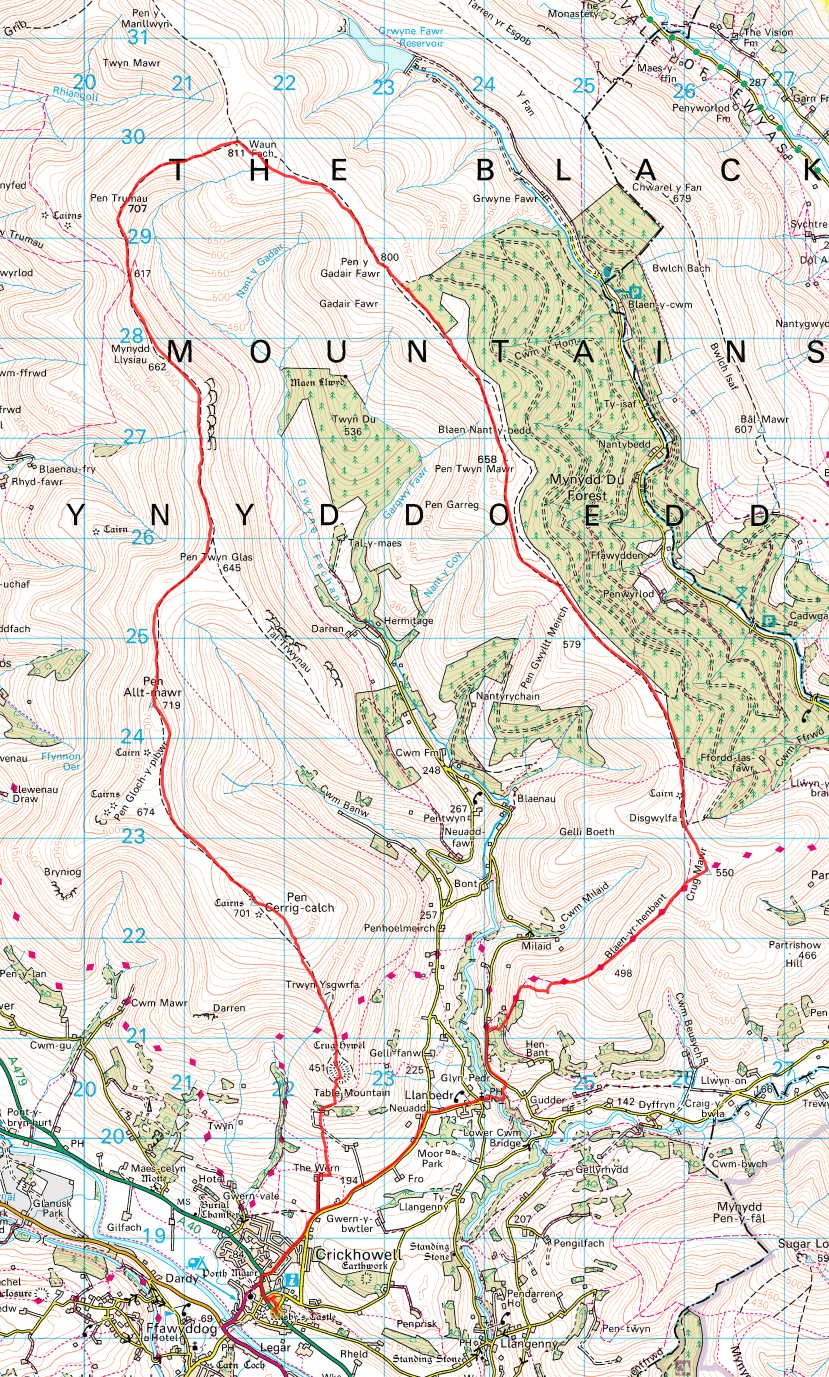
One obvious cloud on the horizon, no pun intended, was the absolutely atrocious weather forecast. But, if you've only got one day, you have to just do the thing you intend to do in the weather that presents itself, or stay home. So I packed up my waterproof gear and headed off, the plan being to park at the Pont Cadwgan car park, cross the road and head roughly westwards through the Mynydd Du forestry to the ridge which eventually leads north-west-ish to Waun Fach, the highest point of the Black Mountains (and which I visited once before as part of the epic 20-mile hike mentioned here), and then loop round the head of the Grwyne Fawr valley, bag the trig point on top of Rhos Dirion and then head back down the parallel ridge and eventually drop off the top of the ridge back down to the car park.
The tricky bit of most walks of this nature is getting started, in particular getting up above the fence-line marking the boundary between areas where you have to be careful about path-following to avoid straying into someone's property and open land where you can just wander where you like constrained only by the natural topography. This walk proved a rather extreme example of that for a couple of reasons: firstly that the weather forecast was unfortunately pretty accurate and the actual conditions provided weather that varied between annoying light drizzle and relentless heavy drizzle. This doesn't prohibit going out in it, but it does mean everything is several times more difficult and time-consuming, especially when you have a need to regularly consult phone and map for navigation purposes, and in this case it was both as the phone coverage was pretty much non-existent. The second reason was that it turned out that the people who manage the Mynydd Du forestry have been conducting a ruthless campaign of path closures recently, including pretty much all paths that lead up onto the ridge.
After an hour or so of fruitless trudging up and down forestry trails and occasional retracing of steps I decided to call it a day and head back to the car park to try a different route. Hilariously, it then took me another hour to find a route out of the forestry back to the road, and even more hilariously having regained the road and thought, well, at least it's just a regular trudge of a mile or so from here back to the car park, I then had to negotiate a flooded section of road by climbing a bank and scrambling into a hedge.
Scarcely believably, by the time I'd got back to the car and taken some of my frustration out on a pork pie and a couple of spicy Peperamis, I'd clocked up almost six miles of fruitless and increasingly enraged and waterlogged wanderings (roughly clockwise in the map below). I was reminded of our doomed attempts (in similar weather) to bag the couple of seemingly innocuous Munros behind our holiday cottage in Ballachulish in 2011.
I couldn't just give up and go home, though, partly because it was only lunchtime and there'd be a very real danger of still catching the tail-end of the coronation coverage, but also because I wanted to do a thing that actually achieved its original objective, however modest. As luck would have it my route back took me past the Fro car park, which is conveniently placed for a furious up-and-back assault on the Sugar Loaf from its north-eastern slopes, an angle from which, as it happened, I'd never been up it before (previous ascents were from south and, erm, also south).
The weather was still pretty shitty - not quite as rainy but very misty - but on a nicer day this would be a pretty good route up, nice steady ascent, probably some nice views. The only drawback is that there isn't an obvious way of making it a non-step-retracing circular walk without incurring a significant amount of low-level tedium at either start or end. I wasn't in the mood to worry about this and just smashed straight up, bagged the trig point and then came straight back down by the same route, four miles round trip, bish bosh, sorted.
So, lessons: don't assume that getting to the start point will be straightforward, do as much research as you can but be prepared to be thwarted and have to replan either in a minor way or in a completely wholesale throw-plans-away-and-start-again way, do take an actual map in case of mobile signal blackspots, don't be put off by a bit of rain but do take some appropriate wet-weather gear and if you get completely fucked over doing your original thing, go and do another thing. As a life philosophy there's not quite as much there as there is in playing French cricket, but it's still good.
Monday, April 24, 2023
the last book I read
Love Is Blind by William Boyd.
Meet Brodie Moncur. He's a tuner. What, a large pelagic fish of the mackerel family? Well, no. This guy tunes pianos for a living and is already building quite a reputation for himself in Edinburgh as the go-to guy in the piano-tuning game (hardest game in the world, the old piano-tuning game). Octaves all stretchy and flabby? E-flat a little too flat? Perfect fifths sound like diminished sixths? Brodie's your man.
Brodie works for the established Edinburgh piano-making firm of Channon's and has already proven himself a useful and resourceful employee, not just for his technical skill but also for some innovative and profitable business and sales ideas. So when the company decides to expand and start up a new showroom in Paris, Brodie is given the job of assistant manager, the top job obviously going to a member of the Channon family, regardless of their level of crookedness and incompetence.
Anyway, Brodie relocates to Paris and immediately comes up with a couple of profile-raising and money-making ruses for Channon's: firstly setting up a tuning and repair business in the local area, rather than having to ship something literally the size of a piano all the way to Edinburgh, and secondly acquiring the services of some high-profile pianists to play Channon pianos in some sort of prototypical product placement/sponsorship type of deal. Their main catch turns out to be John Kilbarron, a fiery Irish pianist, probably slightly past his sell-by date and these days a bit keen on the old sauce and occasionally unreliable, but still a big crowd-puller. Brodie is given personal responsibility for ensuring Kilbarron's pianos are tuned exactly to his specifications, including lightening the keys to accommodate some increasing weakness in Kilbarron's right hand (almost certainly connected to the epic booze consumption).
During the course of his duties for Kilbarron (actually the Kilbarrons, plural, as John's brother Malachi acts as a manager for his brother) Brodie meets John Kilbarron's girlfriend and companion Lydia ("Lika") Bloom, an aspiring (but, we are invited to infer, slightly rubbish) opera singer. Brodie's interest immediately perks up: I wouldn't mind lifting her lid and adjusting her G-string, showing her my classical fingering technique, etc., and as it turns out the feeling seems to be mutual and they soon embark on a clandestine affair.
Several other things then happen at once: a dispute between the Kilbarrons and Channon's results in their contractual relationship being terminated, Brodie coughs up a gallon of blood, is diagnosed with tuberculosis and sent to the south of France to convalesce and on his return is sacked by Channon's after a series of financial irregularities is discovered. It is made clear to Brodie that non-one seriously suspects him, but the alternative (and, as it happens, correct) explanation is that the younger Channon is responsible, and blood is thicker than water, old chap, I'm sure you understand.
Brodie is therefore free to resume his employment with the Kilbarrons, directly this time, and accompany them to Russia for a lucrative concert tour. All the to-ing and fro-ing between St. Petersburg and the country dacha that their Russian benefactor has laid on provides some limited opportunities for Brodie and Lika to do some discreet boning, but evidently they're not discreet enough and they are discovered by Malachi. Malachi is shrewd enough to know that telling John would send him into an alcoholic spiral and endanger the concerts, but uses the knowledge as leverage to have Brodie and Lika do his bidding (item one: no more boning). Gradually the whole professional relationship deteriorates and eventually Brodie quits. This might not be so bad but he also takes the opportunity to subtly sabotage Kilbarron's piano so that that night's concert is a fiasco. The combined knowledge that Brodie has fucked his concert and his girlfriend is too much for John Kilbarron and he challenges Brodie to a duel. In turn-of-the-century St. Petersburg these are generally stylised affairs where both protagonists fire into the air, honour is seen to have been done (by virtue simply of turning up, presumably) and everyone goes home. Not so in this case as it soon becomes clear that John Kilbarron very much intends to kill Brodie in a very real and non-stylised sense, and Brodie only manages to escape his fate by wielding Lika's pistol that he has concealed about his person and shooting Kilbarron through the chest with it.
Apparently there are some legal consequences to shooting someone through the heart in a field, and bearing in mind these, as well as Malachi's likely lust for revenge, Brodie and Lika flee St. Petersburg and make a circuitous way through various European cities in an attempt to escape. But Malachi is relentlessly determined, and after their travels take them to southern France, then Edinburgh (incorporating a brief reunion with Brodie's family including dreadful old patriarch Malky Moncur) and then back to France again, they discover that Malachi is still on their trail. Eventually Brodie awakens in a hotel room in Nice to discover that Lika has left him and gone to present herself to Malachi, it being her he really wants. Brodie struggles to make sense of this and tracks her down to Paris where she reveals that she has been married to Malachi since she was eighteen and transferred her affections to John with his approval for the collective good of their business arrangements, but that a similar arrangement with Brodie was intolerable to him.
Brodie mooches around Switzerland for a while making a living from piano-tuning but still has suspicions that Malachi has agents on his tail, and so decides in a more radical course of action: fuck right off round the world to the Andaman and Nicobar Islands, a destination he selects by literally sticking a pin in a map. Precious few pianos here but he finds work as an assistant to Page Arbogast, an anthropologist studying the local tribes. He is happy enough in his work but still experiences occasional paranoia about Malachi - will he pursue him even here? Will one of his tubercular attacks finish him off first? Will Lika free herself from Malachi and come to him?
Wikipedia tells me that this is Boyd's fifteenth novel; by my calculations I have read twelve of these fifteen, the only omissions being the early novel An Ice-Cream War, the faux-biography Nat Tate and the James Bond story Solo. By this stage you pretty much know what you're going to get and it's hard to avoid comparisons with other Boyd works - the obvious one is the broad similarities between the love story here and the one in The Blue Afternoon; lovers carrying on an affair despite the female protagonist being inextricably attached to someone else and planning to escape to grow old together but never quite managing to land the happy ending. Like Sweet Caress it's also something of a return to the biographical style of earlier novels like The New Confessions and Any Human Heart after a period of producing more plot-driven thrillers like Restless and Ordinary Thunderstorms. One thing that you know you're going to get with a Boyd is a Ruddy Good Story - I'm suspicious of any attempt to group writers into "novelists" and "storytellers", usually because the latter category is used as an excuse for, or a badge-of-honour inverted-snobbery revelling in, horrible clunky prose, not something you could ever accuse Boyd of.
That said, there are a few quibbles: the nature of the hold that Malachi has over Lika is never very well explained, and nor is the relentlessness with which he pursues Brodie (though to be fair I suppose he did kill his brother), and some of the ventures into music theory to explain the emotional impact of a particular piece of music have a whiff of authorial insistence in displaying the depth of his research. Brodie also seems to be irresistibly attractive to women: in addition to Lika there's a whiff of something with Brodie's Russian doctor, the young daughter of the Kilbarrons' Russian benefactor throws herself at him and at the end of the novel Page Arbogast makes it fairly clear that she is Well Up For It as well.
But it's very good and tremendously readable, as Boyd's novels always are (this is the sixth to appear on this blog, which brings Boyd level with Ian McEwan in joint second place behind Iain Banks). I would say it's definitely better than its immediate predecessor Sweet Caress, and you'd probably have to go all the way back to 2002's Any Human Heart to find one that's better. The early-1990s pair of Brazzaville Beach and The Blue Afternoon remain my favourites, though.
Tuesday, April 18, 2023
loched and loaded
It's been something like eighteen months so here's another whisky post. The main items of interest among a very gratifying selection of whisky delights at Christmas and my birthday were a pair of bottlings from the Loch Lomond distillery, something I'd never tried before and something you never used to see in the major outlets like supermarkets or Amazon. But evidently they've had a bit of a rebrand and a sales push of late and well, here we are.
The two bottles I have are the standard no-age-statement entry-level single malt which they have decided to call Loch Lomond Classic, and the 10-year-old expression (which interestingly doesn't seem to be listed on their website). The distillery itself is right on the Lowland/Highland region boundary in the same way as Glengoyne is; in fact Loch Lomond is slightly further south (and a few miles further west) than Glengoyne. Nonetheless it's classed as a Highland whisky.
What you'd broadly expect here is that the older whisky would be slightly darker and deeper and richer than the younger one, and that's pretty much what you get, The younger one has the slight magic-marker smell that young whisky has, but also just a hint of something fruity, maybe apples or pears. The older one is slightly sweeter, and, as you can see from the photo - it's the one on the right - darker, and also has just a hint of that parsnip/Marmite/leather-topped writing desk savouriness that slightly older whisky sometimes has. It seems kind of obvious to say that the older one is better, but, well, it is. Both are pretty polite, smoke-free whiskies of the sort you would expect from the Highland/Speyside region; as I've said before my preference is for something a bit more rough and ready but there's absolutely nothing wrong with either of these.
As I've said elsewhere, most distilleries manage to concoct some claim of being the oldest, highest, biggest, based on some slightly weaselly definition of the word in question. Loch Lomond doesn't exactly do this, but its bottles do carry a legend that says "since 1814" (you can see it in the picture above), which even the most charitable observer would have to say is a big fat lie of the sort that you would surely think would be legally actionable. Presumably just enough smoke can be blown up the impartial observer's ass by the fact that there was a short-lived distillery on the banks of Loch Lomond from 1814, even though it only existed for a handful of years and the new distillery, which opened in 1965, has no connection to it and is in a completely different location.
Monday, April 17, 2023
killebrity lookylikey of the day
My elder daughter, as befits a massive Harry Potter fan who has read the entire novel sequence about nine times and has many assorted items of Potterobilia in her possession, has a Harry Potter-themed duvet and pillow set, which features among other cartoonish renderings of the principal characters Harry's pet snowy owl, Hedwig (yeah, I know, owls again). This is all well and good but to me the owl as rendered has more than a touch of the Jason Voorhees about him, don't you think?
Wednesday, April 12, 2023
celebrity lookeylikey of the day
Let's do another one, this time involving actual people rather than delicious items of breakfast pastry and birds of prey. Here's Robert Z'Dar, your go-to man in the 1980s and 1990s for scary-faced psychotic villains in various movies of varying quality including Maniac Cop and (as pictured here) 1989's Tango & Cash, which I recall paying actual money to go and see in the cinema at the time of its release. Z'Dar's USP was, and there's no nice way of saying this, an absolutely freakin' massive lower jaw (due to a genetic condition called cherubism). Pictured alongside him is another man with a similar (though admittedly slightly less startling) chin: 2022 Masters champion Scottie Scheffler.
As it happens this year's winner, Jon Rahm, was a bit more understated about the whole thing (I mean, he could be a Satanist for all I know), but to counteract that here's Scheffler's own post-victory interview from last year, with much glorifying of God and similar horseshit.#themasters Sunday is Easter Sunday for the first time since 2012. looking forward to some tedious God-bothering from the winner. Bernhard Langer, Zach Johnson and Bubba Watson memorable recent-ish culprits
— Dave Thomas (@electrichalibut) April 6, 2023
owlebrity pastrylikey of the day
That picture is obviously cropped to just the relevant bit; the small item of prey that the owl's baleful gaze is fixed upon is in fact Huwie, as you can see here. I'm happy to be able to report that he was able to make good his escape without being torn apart by razor-sharp beak and talons, eaten and then burped up again as an owl pellet a short time later.