Showing posts with label up the revolution. Show all posts

Thursday, January 02, 2025

the last book I read

The Leopard
by Giuseppe Tomasi di Lampedusa. 

Yes, it's a man's life in 1860s Sicily. Well, if you happen to be a Prince commanding a substantial kingdom. all the quails you can eat, etc., anyway. The man in this happy position is Fabrizio, patriarch of the aristocratic Salina family, and a generally impressive and physically imposing individual (as befits the leopard which is the family crest), knocking on towards middle age but still capable of taking a carriage down to the local village for a bit of recreational whoring, coming back to the family castle and after nothing more than a quick reviving limoncello administering a teeth-rattling seeing-to to the wife as well before a hearty breakfast.

Italy at this stage in its history doesn't really exist as a nation-state in the modern sense, being instead a series of contiguous kingdoms controlled by various aristocratic families. But changes are afoot - various coarse and malodorous proletarian types are agitating for the formation of a united Italy, including a group under the leadership of Giuseppe Garibaldi, taking some time off from inventing biscuits to do a bit of the old revolution. 

The Prince is an intelligent and thoughtful man, and realises that the changes that are probably inevitable will have a major impact on him and his family, but also recognises that there is little he can directly do to influence the tide of history. In any case, there are local and family matters to attend to, including the betrothal of his nephew Tancredi to Angelica, the daughter of the local mayor. Tancredi is marrying a bit below himself socially here, but the complex calculations involved in making a good and mutually beneficial marriage have to take into account the fact that Angelica's father is absurdly rich, while the Salinas, despite possessing aristocratic pedigree up the wazoo, are a bit strapped for cash.

With the possible end to his family's rule over their portion of Sicily in sight, Fabrizio has cause to reflect on questions like: what is the point of any of it, really? The strategic marriages, the endless social whirl, the dinner parties that no-one particularly enjoys and which serve merely as an opportunity for the hosts to show off their wealth and their cooks to show off their abilities to slaughter various items of local wildlife and stuff them inside each other. 

Fast-forward 25 years or so to 1883 and we find Fabrizio contemplating the end of his life as he sits in a bath-chair on a hotel balcony. Suffering what we are probably meant to infer is a series of strokes, he drifts further into his own internal thoughts as people rush around him moving him onto the bed and administering the last rites. Has Tancredi's marriage to Angelica been of any benefit politically, since it seems not to have been as happy as they'd hoped personally? Will he, Fabrizio, be the last of his line as Prince? What will become of Sicily and the new Italy? 

Finally we jump another quarter of a century to 1910 and see what is left of the Salinas dynasty: basically not much except Fabrizio's elderly daughters overseeing what remains of their property. The ruthless utilitarian march of progress is represented here by the state overseer of religious relics who visits and conducts an audit of the family chapel, declares most of the supposed relics housed there to be worthless (and in some cases blasphemous) and orders their removal. 

As always, write about what you know is a good maxim for a first novel; in this case an only novel as The Leopard was published a year or so after Giuseppe Tomasi di Lampedusa's death in 1957. He was himself the last of a line of Sicilian princes, a line which ended in 1946 when Italy abolished its monarchy and became a republic. Its posthumous publication adds it to a short and ill-defined (and quite possibly incomplete) list on this blog which certainly includes Notice, The Book Of Ebenezer Le Page and all three of the Stieg Larssons. Previous books on this list which were originally published in Italian include Invisible Cities, The Name Of The Rose and Foucault's Pendulum. A not-particularly-up-to-date list including other languages can be found here. Lastly, the themes being explored here of privileged types contemplating the end of an era about to be swept away by momentous events are a bit reminiscent of The Shooting Party

Anyway, it's very good, wryly and slyly humorous and doesn't wed itself to any particularly firm position on the regime that Fabrizio represents or the one which is about to replace it: sure, the whole idea of inherited ruling privilege is a bit absurd, and while Fabrizio himself is a benign and (relatively) progressive figure the system has nothing in place to prevent the odd insane tyrant popping up in the line of succession. But is the alternative better? And even if it is, does it justify the inevitable upheaval and bloodshed in bringing it about? The fact that it's taken me over a month to read a relatively short book (just over 200 pages) shouldn't be taken to mean that it's indigestible or forbidding, more that it's been Christmas and solitude (and therefore reading opportunities) has been hard to come by. 

The Leopard was famously made into a film in 1963 starring Burt Lancaster, something which might make you think: wow, I didn't know Burt Lancaster spoke Italian. Well, he may or may not have done, but his lines were delivered in English (and dubbed into Italian for the Italian version) while most of the cast delivered their lines in Italian (which was dubbed into English for the English version), something I would imagine might have made the filming a bit confusing. Like many people I became aware of Luchino Visconti's oeuvre through the potted summary delivered by Inspector Leopard here

Tuesday, May 09, 2023

king marvellous

Remember the heady days of Wills-&-Kate-mania, back before his face started going all weird? Believe it or not that (i.e. their wedding) was as far back as April 2011, a date which I commemorated by fucking off up a mountain for the day (in, thankfully, splendid weather) and declining to engage with any of it on any level. Ah, memories. 

A lot has happened since then for all of us, William included, including some salacious, probably untrue, but nonetheless extremely entertaining rumours about his sexual preferences and most notably the recent demise of his elderly grandmother and the belated ascent of his father to actual King of the United Kingdom, remembering of course that we live in one of the more absurd of the gazillion possible parallel universes, one where concepts like Being A King exist as actual things. As part of the ceremonial transition from beloved public surrogate grandmother figure who was almost certainly an Actual Nazi in private to jug-eared halfwit and maker of overpriced oaty biscuits who inexplicably owns a significant chunk of Wales, there's a coronation ceremony to be held, where the great British public can enjoy many hours of wall-to-wall TV coverage of tens of millions of pounds being hosed up the wall so that an elderly man can be fitted with an absurdly impractical hat, which he will almost immediately take off and never wear again.

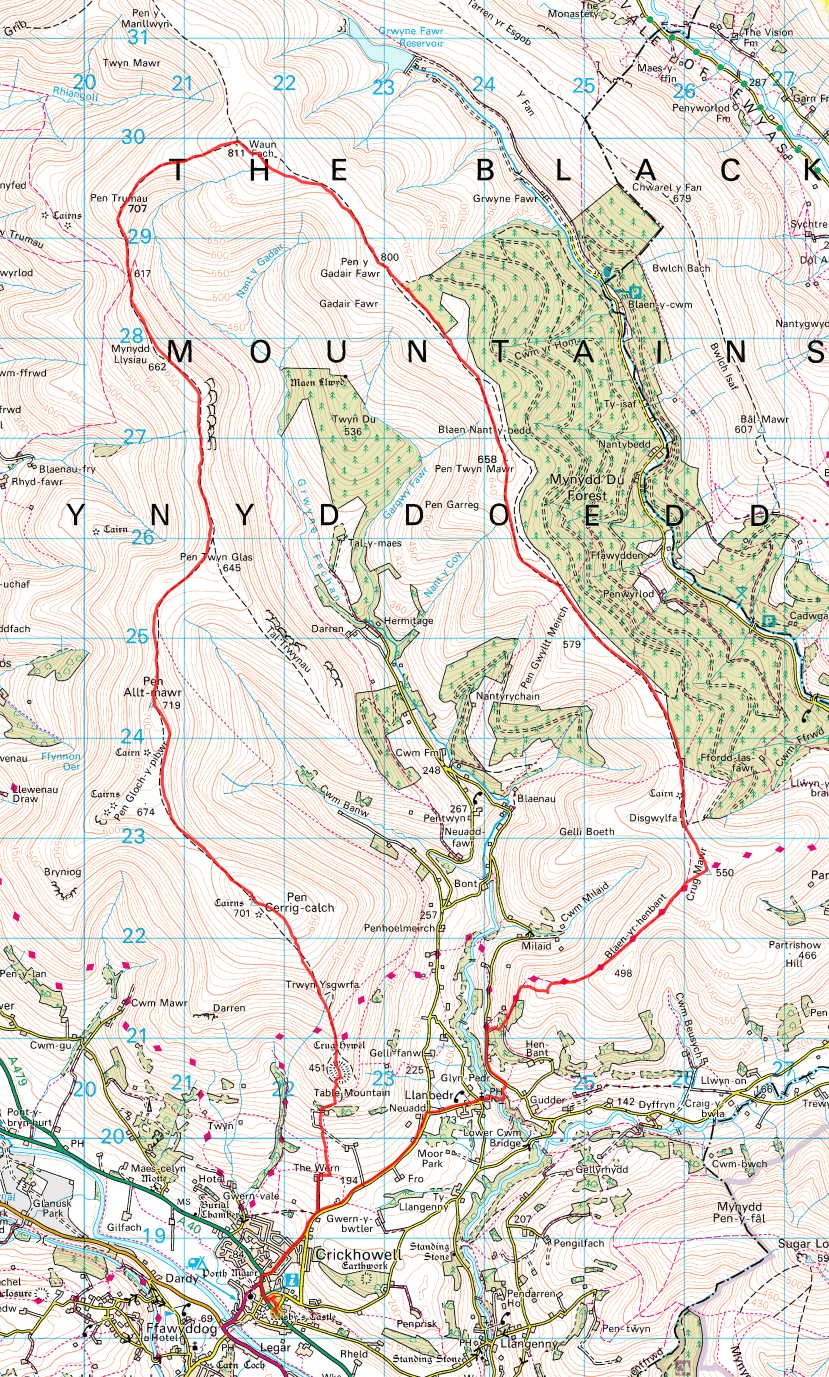
So, all in all, I concluded that it wasn't for me, and, since I was offered the opportunity by my patient and understanding wife to absent myself from proceedings for most of the day, I decided to go and walk up some hills. Adhering to the general (albeit loose) principle that I'd prefer to do a walk I haven't done before (even if some of the intermediate summits aren't new) I devised a walk of around 16 miles in the Black Mountains, on the grounds that that would provide a nice challenge that would occupy me for most of the day.

One obvious cloud on the horizon, no pun intended, was the absolutely atrocious weather forecast. But, if you've only got one day, you have to just do the thing you intend to do in the weather that presents itself, or stay home. So I packed up my waterproof gear and headed off, the plan being to park at the Pont Cadwgan car park, cross the road and head roughly westwards through the Mynydd Du forestry to the ridge which eventually leads north-west-ish to Waun Fach, the highest point of the Black Mountains (and which I visited once before as part of the epic 20-mile hike mentioned here), and then loop round the head of the Grwyne Fawr valley, bag the trig point on top of Rhos Dirion and then head back down the parallel ridge and eventually drop off the top of the ridge back down to the car park.

The tricky bit of most walks of this nature is getting started, in particular getting up above the fence-line marking the boundary between areas where you have to be careful about path-following to avoid straying into someone's property and open land where you can just wander where you like constrained only by the natural topography. This walk proved a rather extreme example of that for a couple of reasons: firstly that the weather forecast was unfortunately pretty accurate and the actual conditions provided weather that varied between annoying light drizzle and relentless heavy drizzle. This doesn't prohibit going out in it, but it does mean everything is several times more difficult and time-consuming, especially when you have a need to regularly consult phone and map for navigation purposes, and in this case it was both as the phone coverage was pretty much non-existent. The second reason was that it turned out that the people who manage the Mynydd Du forestry have been conducting a ruthless campaign of path closures recently, including pretty much all paths that lead up onto the ridge.

After an hour or so of fruitless trudging up and down forestry trails and occasional retracing of steps I decided to call it a day and head back to the car park to try a different route. Hilariously, it then took me another hour to find a route out of the forestry back to the road, and even more hilariously having regained the road and thought, well, at least it's just a regular trudge of a mile or so from here back to the car park, I then had to negotiate a flooded section of road by climbing a bank and scrambling into a hedge.


Scarcely believably, by the time I'd got back to the car and taken some of my frustration out on a pork pie and a couple of spicy Peperamis, I'd clocked up almost six miles of fruitless and increasingly enraged and waterlogged wanderings (roughly clockwise in the map below). I was reminded of our doomed attempts (in similar weather) to bag the couple of seemingly innocuous Munros behind our holiday cottage in Ballachulish in 2011.


I couldn't just give up and go home, though, partly because it was only lunchtime and there'd be a very real danger of still catching the tail-end of the coronation coverage, but also because I wanted to do a thing that actually achieved its original objective, however modest. As luck would have it my route back took me past the Fro car park, which is conveniently placed for a furious up-and-back assault on the Sugar Loaf from its north-eastern slopes, an angle from which, as it happened, I'd never been up it before (previous ascents were from south and, erm, also south).

The weather was still pretty shitty - not quite as rainy but very misty - but on a nicer day this would be a pretty good route up, nice steady ascent, probably some nice views. The only drawback is that there isn't an obvious way of making it a non-step-retracing circular walk without incurring a significant amount of low-level tedium at either start or end. I wasn't in the mood to worry about this and just smashed straight up, bagged the trig point and then came straight back down by the same route, four miles round trip, bish bosh, sorted. 

So, lessons: don't assume that getting to the start point will be straightforward, do as much research as you can but be prepared to be thwarted and have to replan either in a minor way or in a completely wholesale throw-plans-away-and-start-again way, do take an actual map in case of mobile signal blackspots, don't be put off by a bit of rain but do take some appropriate wet-weather gear and if you get completely fucked over doing your original thing, go and do another thing. As a life philosophy there's not quite as much there as there is in playing French cricket, but it's still good. 

Tuesday, March 16, 2021

the last book I read

The Lacuna by Barbara Kingsolver.

Oh, Mexico; it sounds so sweet with the sun sinking low. Well, Harrison Shepherd isn't here on holiday, it's just the latest in a series of short-term homes he's shared with his mother, Mexican by birth and currently shacked up with some slightly shady Mexican businessman in the coastal location of Isla Pixol.

Subsequently, as Mother's relationships come and go, Harrison moves around, spending time in both Mexico and the United States, and occasionally spending some time with his father, who lives in Washington DC. It's while attending a DC boarding school that Harrison starts to suspect that he may not be as other boys, in that he doesn't share their interest in other girls.

All the while Harrison has been obsessively keeping diaries, something he continues to do after he returns to Mexico, following a hasty and early exit from school. The diary covering this period has been conveniently destroyed, but we are invited to infer that there was some sort of homosexual scandal necessitating a swift departure. While looking for work in Mexico City Harrison is employed as a plaster-maker by celebrated muralist Diego Rivera and eventually becomes a permanent live-in member of his household staff, which also means falling into the orbit of Rivera's charismatic wife, Frida Kahlo

Harrison graduates from plaster-maker to cook, which means providing for the wide selection of guests the Riveras play host to, mainly people who share their radical socialist politics. The ante is upped considerably in 1937 when none other than Leon Trotsky and his entourage come to stay, and Harrison, in addition to his cooking duties, is put to work as Trotsky's secretary. Trotsky keeps up a furious schedule of work in exile, as well as finding the time to have an affair with Frida, the randy old goat. Harrison comes to think of him as a friend, which makes it all the more painful when Trotsky is assassinated in August 1940. All of the members of the household come under suspicion, and, fearing that the contents of his diaries may be of interest to the police, Frida arranges for Harrison to flee to the United States on the pretext of delivering a batch of her artworks to a museum.

Once back in the USA, Harrison has to find a new career, and after his war work is completed and his father dies he moves out of the city to Asheville, a small town in North Carolina, where he busies himself writing a historical novel, set in Mexico. Slightly unexpectedly this is a huge hit, as is its sequel, and Harrison unexpectedly becomes a celebrity. So far so terrific, but now we're into the late 1940s and full-blown COMMIE PANIC. No-one is safe from being interrogated about their past, nor from being obliged to sign forms proclaiming their ideological purity and their dedication to America, Mom, apple pie etc. So when the FBI come sniffing around Harrison, as a high-profile author and semi-celebrity, and start asking: so, is there anything in your past life that might be of interest, honesty obliges him to say: well, not really, unless you count that time I LITERALLY LIVED WITH TROTSKY.

The FBI's interest in Harrison does not go unnoticed in Asheville, and rumours soon start to circulate about the exact nature of Harrison's military discharge and the propriety (or otherwise) of his relationship with his faithful stenographer and assistant Violet Brown. When Harrison is summoned to give an account of himself in front of the House Un-American Activities Committee, he decides that this might be a good time to leave Asheville and return to Mexico, not that this is likely to put him beyond the FBI's reach if they did decide to pursue charges. Harrison has other ideas in mind, though, and after he and Mrs. Brown return to Isla Pixol Harrison disappears after going for a swim in the sea. He is presumed dead, and his will is discharged which leaves pretty much everything to Violet. It is only on the death of Frida Kahlo three years later that Violet receives a trunk of items, including many of Harrison's clothes and possessions from his 1930s residency in Mexico, but also a note from Frida which suggests that all may not be as it seems.

This is the third Barbara Kingsolver book I've read, and the second to appear on this list after The Poisonwood Bible nine years ago (Prodigal Summer is the other one). It's a book of two halves, really, the first mainly concerned with Harrison's time associating with the real-life characters who populate the Rivera residence(s). Frida Kahlo is the focus here, an extraordinarily magnetic character and seemingly irresistibly attractive to men despite being partially crippled and suffering from all manner of other health problems, many of them the legacy of a horrific bus accident when she was eighteen when she was impaled by a piece of wreckage. The second half of the book is mainly concerned with the absurdity and injustice of the anti-communist paranoia of the 1940s and 1950s, and the terrible and bitter irony of a country attempting to combat infiltration by a supposedly sinister and totalitarian regime by proscribing and criminalising the inner thoughts of its citizens. There is an odd parallel here with the previous book on this list, Johnny Got His Gun, in that its author Dalton Trumbo (who is briefly mentioned in this book) was blacklisted by the same committee. 

While this is generally very enjoyable, and by no means a slog despite its considerable length (670 pages), a couple of criticisms nonetheless: firstly it is a bit slow in places, and secondly Harrison Shepherd is a rather bloodless and passive character, content to be swept along by the stronger will of others (his mother, Frida, Trotsky, even Violet Brown) rather than initiating anything major himself. Partly this is a limitation of the novel's chosen structure: if you write a novel featuring real-life characters interwoven with your fictional ones, there is a limit to the extent to which the fictional characters can interact with and materially affect the lives of the real ones. If you were to have, say, Harrison Shepherd assassinating Trotsky, or intervening heroically to prevent his actual assassin Ramón Mercader from doing the deed, you're into the Inglourious Basterds realm of alternative history. I was put in mind of this passage (referring to principal protagonist Arthur Dent) from Douglas Adams' So Long And Thanks For All The Fish, not otherwise a book with many points of similarity to this one:


To be fair to Harrison, overt and publicly-apparent fucking of the sort that he would be interested in (i.e. with other men) would be as certain a route to public ostracism and possible legal proceedings in the 1940s as having suspected Communist tendencies.

There is an odd parallel with current events as well, in that some of the later section takes place during the US polio epidemic of 1948, and so there is a widespread quarantine in place which prevents people meeting face-to-face, especially in Asheville which is portrayed as a polio hotspot

The Lacuna won the Women's Prize for Fiction (formerly various other things including the Orange Prize) in 2010; previous winners on this list are Bel Canto, We Need To Talk About Kevin and Home. Nonetheless if you were to ask me for a single Kingsolver recommendation I would still point you towards Prodigal Summer

Friday, May 08, 2015

conservapocalypse now

After the crushing disappointment of last night (to all right-thinking people who are not smirking old Etonian Nazi space lizards, anyway), there's been much talk of the 2015 general election following the pattern of the 1992 general election, and rightly so, as there certainly are some interesting parallels, mainly in the way the opinion polls had the two major parties running neck and neck in the run-up to polling day, only for it to be apparent from the early exit polls that the Conservatives were getting a much higher percentage of the votes than had been forecast, and then for the number of seats won by the Conservatives to exceed even the number forecast by the exit polls. That pattern was repeated almost step-for-step here, much to many people's chagrin, including my own.

Many theories were put forward to account for this, notably Shy Tory Factor, the theory being that people who intend to vote for right-wing parties tend to selectively lie about their intentions to pollsters. There's a similar thing in the USA called the Bradley effect, but for all that these things have been given names I'm not convinced they exist. It's an awfully persuasive narrative for progressive liberal types, since it implies that conservatives are slightly ashamed of their voting intentions, and SO THEY BLOODY WELL SHOULD BE, right?

Another theory about 1992 is that when voters got in the polling booth and looked the ballot paper in the face they had a last-minute spasm about possibly returning Neil Kinnock as Prime Minister and decided to vote differently. I'm not sure I really buy that either, but since Ed Miliband's own personal approval ratings lagged behind his party's opinion poll ratings throughout the campaign, maybe something similar happened here. Who knows?

Anyway, Ed is no more, and neither is Nick Clegg, while slippery old Nigel Farage managed to fulfil the letter of his promise to resign if he didn't get elected in Thanet South, while making it mean pretty much nothing other than that he's off on his hols and might pick up the job again on his return.

I must confess to feeling a bit sorry for Clegg and the Liberal Democrats - I can't see how they could have done anything other than agree to the Conservative coalition after the 2010 election, given that the slump in Labour's vote meant that Labour plus Liberal Democrats (a more obvious match, on the face of it) wouldn't have had enough seats for a majority. Once that coalition arrangement had been put in place it was always likely to be a bit of a poisoned chalice, though, and when the inevitable happened and Clegg had to back off a key, high-profile manifesto pledge (in this case over tuition fees), they'd probably torpedoed their chances at the next election. Of course the irony is that the voters who turned away from the Liberal Democrats in droves as a punishment for not being able to curb the excesses of a Conservative government now find themselves having helped to install a majority Conservative government unfettered by any need to pay even lip service to keeping more liberal types onside. As if to prove the point, and as a sort of symbolic FUCK YOU to their erstwhile coalition partners, I see the Conservatives have immediately stated an intention to revive their horrifyingly illiberal snoopers' charter. Nice.

I must confess to feeling a bit sorry for Ed Balls as well: a lumbering and charmless politician no doubt but one who (since Gordon Brown and Alistair Darling aren't around to be blamed any more) became the focus of all the wholly bogus Conservative rhetoric about government borrowing under the last Labour administration, and wasn't either self-confident enough to refute it or nimble enough to dodge it. But, we'll always have Ed Balls Day.

Obviously there were a few high points, notably the deposing of George Galloway in Bradford (and his possibly getting prosecuted into the bargain, though sadly I imagine that almost certainly won't happen), Caroline Lucas keeping her seat for the Greens in Brighton, and my vote actually counting for something in returning Jessica Morden with a slightly increased Labour majority in my constituency of Newport East (helped, it must be said, by a collapse in the Liberal Democrat vote).

So, doom and gloom, then? Well, frankly, yes. But I have answers! Watch this space....

Monday, September 30, 2013

a hilariously ironic blog post title

I was picked up and taken to task, and quite rightly, by my good friend Doug a short while back for using the phrase "achingly dull" twice in separate blog posts in relatively quick succession (actually on closer examination they were a little over two years apart, but I think Doug's point stands) to describe the Duke and Duchess of Cambridge, gawd bless 'em. Not that I think it's an inaccurate description, as I'm sure that they are fantastically vacuous in person, despite the healthy glow of unearned privilege and the expensive orthodontics, but it behooves one to try not to repeat oneself, even when one's self-editing faculties are dulled by a raging throatful of republican bile.

Anyway, I was inspired to wonder what other blogversational tics I overuse, perhaps without realising it. A futile exercise pretty much by definition, you might say, since if you don't realise it, well, you won't realise it. And you may be right, but I think a capacity for sober, objective and unforgiving self-analysis is a quality to be admired and striven for. So in that vein I offer you the following: a catalogue of my overuse of the word "hilariously" during the lifetime of this blog. I find myself drawn to this word as it conveys a sort of sense of the jaw-dropping ridiculousness of much of the world and the people who inhabit it. But anyway, I probably overdo it, as is evidenced by the list that follows. Note that I've restricted myself to instances where the word "hilariously" qualifies an adjective in the classic adverb/adjective kind of way.

So:
Of course, now I've done that, I will be unable to use the word ever again, except perhaps in an ironically self-referential kind of way. Conversely you might argue that once you start doing blog posts about word usage and frequency in your own blog posts you've already disappeared most of the way up your own arsehole anyway. I'm reminded of the novelist in David Lodge's Small World who was provided with a computer analysis of his own writing style and word usage and found himself unable to write ever again. We shall see.

Another way to monitor word usage is to use the excellent Wordle, which provides a graphical view of word frequency. Here's the word cloud for the current front page of this blog:


You can just paste a load of text in as well. No prizes for guessing which song lyric this cloud was derived from, but you can see how you could generate an interesting quiz out of it; just present the cloud and get people to name the song.


Thursday, July 25, 2013

royal spoil

Last one for the moment, I promise: one of the other things I've experienced in the course of general Facebook discourse illustrates quite neatly the way in which reflexive reverence for the royal family is very like reflexive adherence to religion. You can imagine, based on the blanket coverage even in the usually more sensible corners of the UK media (and top marks to the Guardian for offering a "Republican" button to switch it all off), how much inane royal baby chatter there's been on Facebook lately.

That's mildly irritating to me, but understandable and fine and I don't get all aerated about it - people can post what they like, and I'm not the Facebook police, after all. But I do demand that the same courtesy be extended to me if I wish to post an update or a comment mildly dissenting from the mass fawning and forelock-tugging. However, the usual reaction is a sort of tutting "why are you spoiling it for everyone?".

The religious parallel, which I hope is clear, is with things like the atheist bus adverts, where a general background noise of public goddism is deemed to be the default, but any overt reference to atheism, however mild, prompts a spate of mass swooning and pearl-clutching. It's the sort of (possibly willed, possibly unconscious, I don't know) blindness to what's around you every hour of every day that's the target of this hoary old parable:
There are these two young fish swimming along and they happen to meet an older fish swimming the other way, who nods at them and says "Morning, boys. How's the water?" And the two young fish swim on for a bit, and then eventually one of them looks over at the other and goes "What the hell is water?"
That specific wording is from this series of quotes from David Foster Wallace's This Is Water, which is a transcript of his commencement address to students at Kenyon College in Ohio in 2005. As usual with DFW it's a bit verbose and convoluted but has some good stuff. It's available in book form, but best to watch and hear it as originally delivered, I think.

last refuge of the scoundrel

I should point out that while the conversation referenced in that last post was a pretty good stab at filling out the Unthinking Deference To Unearned Privilege Bingo card, other royalist tropes are available. Off the top of my head a couple we didn't cover are:
  • they do a lot for tourism! Look at all the Americans visiting Buckingham Palace. Because of course a) literally everyone who visits Buck House gets a personal audience with the Queen and b) literally no-one visits the palaces at Versailles or Schönbrunn any more now they aren't inhabited by your actual living breathing royalty.
  • they seem like nice people! and they've just had a baby! WHY DO YOU HATE NICE PEOPLE!? AND BABIES!! I'm sure they're lovely. And I'm delighted that all is well with the baby, just as I'm generally disposed not to wish ill upon any other pair of randomly-selected prospective parents that I don't know from Adam. Actually, I say I'm sure they're lovely; what I actually think is that I'm sure they're achingly dull in person to the extent that you'd have to chew your own lower limbs off if you ever got stuck in a room with them, but on the other hand they're both blandly attractive with nice teeth, which is the main thing. I think we can all agree that Prince Charles is an idiot, though. So much so that when Liz finally pops her clogs I think we should take the homeopathic approach to the succession; maximum royal power will be achieved by successively diluting the number of monarchs until it is at an infinitesimal and indeed undetectable level. 
To be fair, I find the fact that Charles (a known crank about a wide variety of topics) is a big supporter of homeopathy to be less worrying than that Jeremy Hunt, someone who is specifically paid to know better, is as well. A homeopathic concentration of Conservative politicians in positions of power would be highly desirable as well.

william, it was really nothing

I had an educational exchange of views on Facebook last night which helped to crystallise some of my annoyance about the acres of uncritical blanket coverage devoted to the arrival of the royal baby. In fairness to the media, it is the silly season and there is literally fuck all else to report, except David Cameron's laughably ill-thought-out and undemocratic attempts to police the rude bits of the internet. More on that later, perhaps.

I take the view that if you put your ill-considered views on the internet you are personally responsible for any public ridicule you receive, and furthermore if that ridicule causes you personal offence or discomfort then you should consider re-evaluating those views. I certainly willingly submit my own ramblings on this blog, on any topic, to those rules. That plus having redacted the names of the protagonists (except my own) clears my conscience regarding reproducing the Facebook exchange here. I do so not to poke fun (well, maybe a bit) but to illustrate the ticking-off of various Royalist Bingo boxes.


I hope it's legible; Blogger's image reproduction options remain a bit shit, unfortunately. I've labelled a few points that I think are of interest.
  1. first appearance of the "if you don't have the monarchy, you'll have President Blair; IS THAT WHAT YOU WANT" trope;
  2. not really sure what this is about; yes, there are other rich people in the world, and some of them may well have come by their riches by dubious means, but not many of them are heads of state. In any case this is a blatant "look over there" argument;
  3. a variant on number 1; get rid of the royal family and the only choices are a US-style presidency or Zimbabwe-style anarchy. Personally my preference is for something like the Irish system whereby the President is pretty much a ceremonial role, with the ribbon-cutting and the state openings of parliament and the like, but can express opinions freely. My affection for this system is no doubt tied to my affection for the current Irish president Michael D Higgins, who I think is a pretty splendid bloke. Here he is just shooting the shit on a talk show in a casual way, a way you couldn't really imagine Lizzie Windsor doing, and here he is in slightly more combative mode (to be fair, a year or so before he became president) ripping some Tea Party guy a new one. 
  4. argumentum ad populum. If 51% of the population don't agree with an opinion you hold, you are apparently not allowed to express it.
  5. I presume that this is a reference to the Crown Estates; obvious points in relation to this are that firstly the monarch's claim to these inheres in their office as monarch, and not in their person, so it's a moot point what the position would be if the office got abolished, and secondly it's another "look over there" dodge. To put it another way, I'm allowed to say "cancer is bad" without having found a cure, and in a similar way I should be allowed to say "hereditary monarchy is bad" without having a specific roadmap for its abolition. 
  6. argumentum ad populum again
  7. this is a whiplash-inducing oscillation between two positions, firstly the PRESIDENT BLAIR position from #1, but also the entirely contradictory position that the monarch wields no political power anyway. Well, if that's the case it doesn't really matter who does the job, does it? or even if the job exists at all?
  8. I couldn't resist throwing the God thing in as a bit of chum in the water. I have literally no idea where this came from though, or what it's meant to mean;
  9. Well, that was asking for both barrels;
  10. And a bit of passive-aggressive bullshit to finish. 
I should say, in the interests of full disclosure, that there were a handful more comments after the point where I've cut the thread off, but none of them particularly relevant to the topic. As I've said before, the subject of the monarchy is quite a good litmus test for people you thought were just regular people; express the mildest dissent from the default position and some of them will lose the plot in a pretty spectacular way.

Sunday, April 01, 2012

in which kate middleton's crack is irreparably widened

I humbly submit here for your critical appraisal my latest work of challenging and confrontational performance art - a searing and unforgiving indictment of the inequalities inherent in the concept of a hereditary monarchy, and a thoughtful reflection on the atrocities carried out in its name.


My earlier, less successful attempt at the same thing is recorded for posterity here.

This sort of visceral, zeitgeist-y art terrorism doesn't just make itself, you know. I had to consider the choice of tools carefully - I pondered for a while the symbolism of taking an axe to William's shapely neck, but decided that might be a bit dangerous and would probably just propel the mug across the room to smash against a distant wall somewhere, out of camera shot.


So I went for the great big lump hammer in the end; a wise choice I think.


In the interests of full disclosure and candour I should point out that this is not just wanton destruction - the mug in question had sustained a crack in an accidental dishwasher-related incident the previous week and would have had to be thrown away anyway. In any case, while I am no friend of the monarchy, the mug was given to us as a wedding present (a slightly ironic one, admittedly) and was a perfectly good mug, at least until it got cracked. I realise this takes the edge off the performance art piece slightly, but hopefully you'll have proceeded through this blog post in a linear fashion and watched the video before reading this bit.

The mug was one of a set of two, as it happens, and while the other remains un-cracked and therefore currently in use for hot beverage storage and transportation, it's not impossible that it too could sustain irreparable damage at some point, at which time I may unleash another video upon an unsuspecting world. Maybe I'll have a shit in it or something.

Wednesday, January 11, 2012

would jubileeve it

It's Wednesday so it must be time for Pointless Pedantry Hour. Strap yourselves in.

There was a bit on the Today programme earlier in the week (or it might have been on Start The Week, I can't remember) about the dear old Queen's Diamond Jubilee this year. The presenter went on to say that this was only the second Diamond Jubilee year in British history, the other being wacky old Queen Victoria's in 1897.

Now I am not a constitutional monarchy expert, as you know, in fact I'm more of a "first up against the wall come the revolution" kind of guy, but this struck me as surely incorrect. Stay with me and I'll explain.

Here's the thing: either 2012 is a Diamond Jubilee year by virtue of being a year that, when it started, was scheduled to contain the date of the 60th anniversary of the current monarch's accession to the throne, in which case it will remain a Diamond Jubilee year even if the Queen dies before February 6th, or it isn't a Diamond Jubilee year at all yet, but it will be once we've got to February 6th without the Queen buying the farm (and I reluctantly concede that I know of no reason to think she is in any immediate danger of checking out). Or, I suppose, we could say, as a third option: it is a Diamond Jubilee year, but it could retrospectively be declared not one if the Queen should be shot by Prince Philip in a hunting accident or randomly murdered and concealed in a shallow grave on the Sandringham estate (not necessarily by Prince Philip, but who knows) in the next month or so.

Anyway, either way, by most of those definitions 1820 was a Diamond Jubilee year as well, being the year that, when it started, was scheduled to contain (on October 25th) the 60th anniversary of the accession of George III. This never actually happened, as George (who was thoroughly deaf, blind and mad by this time) died on January 29th, but the exact same radio bit could have been done on January 10th 1820, if things like radio had been invented then.

Sunday, May 01, 2011

guillotine some sense into 'em, is what I say

Yeah, all right, last word on this for the moment - here's the Independent's Johann Hari with a cogent summary of the viewpoint of those of us subject to a hot flush of cringing embarrassment every time the royal wedding gets a mention. If you prefer a spoken-word version of the same article, try this.

Just to nip another inane response in the bud, and to re-use a phrase from the last (unrelated) post, I have, in general, no personal animosity towards the individuals who collectively comprise the British royal family, with a couple of exceptions which I'll come to in a minute. In particular, while I suspect that on a personal level they are achingly dull people you wouldn't want to be trapped in a room with, William and Kate seem like a personable enough couple, and from William's past pronouncements it's very possible that they would have preferred a low-key ceremony of their own devising like everyone else gets, rather than the ludicrous Disneyland spectacle they were required to participate in. The point is that they got no choice - heaven forbid they should have decided they didn't want a church wedding at all, or to marry but not have any kids, or not marry but have kids anyway, or rope Kate's sister Pippa into a ménage à trois (come on, you would, wouldn't you?), or any of the other choices they'll never get to even consider. This sort of talk is usually the lead-in to the next monarchist canard, which goes something like: see, they do a difficult and demanding job; you wouldn't want to do it, would you? To which the answer is no, I most certainly would not, so let's abolish the job altogether; that way no-one has to do it. Problem solved.

Some useful resources for those confronted with the usual pro-monarchy nonsense can be found here.

Scrolling back through some of Johann Hari's old Independent articles provides this useful hook from which to hang a paragraph or so about the less benign side of the royals. Even if we leave aside the flirtation with Nazism (whitewashed nicely in The King's Speech) there's still Charles' hare-brained obsession with quackery, religion and some other bullshit too vague to be worthy of a name. Since we're unlikely to see any change to the current system under the current monarch, I think perhaps the best-case scenario is for Charles to succeed to the throne and be unable to resist the temptation to hold forth on various topics in stereotypically blithering and ill-informed fashion and to interfere with government policy-making in exactly the way the current Queen has been scrupulously careful not to do. I think if we suddenly acquire a politically-engaged King, and a massive idiot to boot, public patience could wear thin quite quickly.

More importantly, what the heck was Princess Beatrice wearing on her head (see picture above) for the wedding? Theories I've seen so far include:
  • antlers
  • an octopus
  • a stylised representation of the female reproductive system
I would love it if it were the last one, but it seems unlikely. A strong contender for Scariest Eye Make-Up of the day, as well.

Saturday, April 30, 2011

panem et circenses

I'm not going to tackle the subject of the Royal Wedding face-on as it would be a) the longest blog post ever and b) a torrential outpouring of bile punctuated by occasional incoherent guttural barking and salivating, and, well, really, no-one wants that.

So I'll sneak up on the subject tangentially by observing the close parallels between uncritical royalism and adherence to religion. One of the most obvious parallels is the co-opting of an unrelated concept (patriotism and morality, respectively) and dishonestly shackling it to your chosen brand of voodoo nonsense, and then suggesting that if you want to throw away the voodoo nonsense then the other thing has to go too.

Here's how it goes for religion: "You're an atheist? Well then you have no moral code you AMORAL HEARTLESS SOULLESS DEAD-EYED BABY-EATING KILLING MACHINE!!!"

The equivalent for royalism is: "You want to get rid of the Royal family? WHY DO YOU HATE BRITAIN???"

Express the mildest reservations about God or the Queen and you tend to find yourself shackled to a giant straw man, making further rational discussion difficult.

Of course the two things come together anyway on the occasion of a royal wedding, because there's the lengthy voodoo ritual itself, involving the cuddly beardy old Archbishop of Canterbury, head of the Church of England, who embodies his church's tweedy woolly vacuous vagueness perfectly in this video, where he drops the word "God" in a couple of times, but, really, you come away not really knowing what he really believes about anything. As I've said before, the cowardly refusal to set out what you really believe (so that it can get a deserved kicking) disguised as "thoughtfulness" and "inclusiveness" or some such bullshit is probably more annoying than the table-thumping biblical fundamentalism of the more out-there American preachers. At least you know what they think.

Still, it kept the proles happy, and that's the main thing. You know where else they had uncritical flag-waving crowds all vying to outdo each other in the patriotic chanting stakes? That's right, Nuremberg.

Oops.

Friday, April 29, 2011

the revolution will not be televised

Not being subject to the mass outbreak of flag-waving Stockholm Syndrome that seems to have gripped the rest of the nation in the run-up to the Royal Wedding, I decided the day would be better spent burning off some calories (not to mention a bit of republican frustration and revolutionary rage) up a hill somewhere.

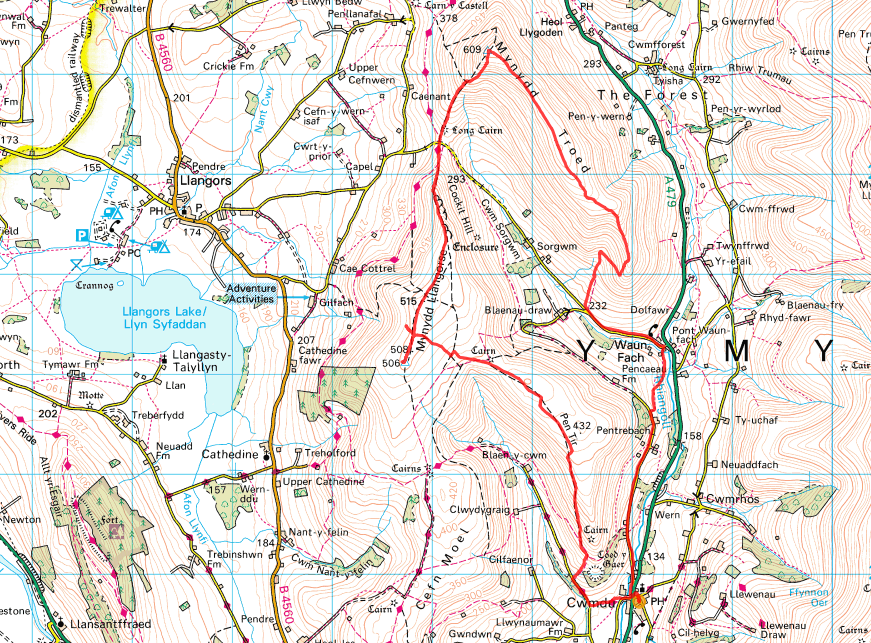
The "somewhere" in question turned out to be some hills over between Crickhowell and Llangorse Lake. These are overlooked by the higher hills that I went up on my epic Black Mountains horseshoe walk a year or so ago, but they were new to me, so I thought I'd check them out. I parked up in Cwmdu and headed up Mynydd Llangorse, and then across to Mynydd Troed and back into Cwmdu. A round trip of, according to my GPS data, exactly ten miles (and around four hours) - route map is here, altitude profile is below (just to be clear, measurements are in metres, so the high point is a whisker under 2000 feet).


Llangorse Lake supposedly has an afanc or lake monster known locally as "Gorsey". No sign of it today, though. Indoors watching the wedding, I expect. Apparently William kissed Kate "on the upper balcony"; if I'd known that was going to happen I might have watched. Oh and apparently her ring was very tight. Now then, stop it.

As always I took some photographs (of the walk, not of Kate's ring), including the ritual OCD-esque bagging of the two available trig points; photos can be found here.

Tuesday, November 09, 2010

warseholes!

It's November, and so we need something to offset the general gloom and depression caused by the clocks going back, hoodie-clad feral ne'er-do-wells sticking fireworks up cats' arses and the impending cavalcade of fake jollity and saturated fat that is Christmas. So here's your opportunity to vote in the annual poll run by New Humanist magazine to determine the biggest contributor to irrational boneheaded fuckwittery in 2010.

I have to start by saying that the 2010 shortlist isn't quite as strong as last year's - this is partly because previous winners can't be re-nominated, so that removes the Pope from the running straight away.

The current front runners are Sheikh Maulana Abu Sayeed and Hojatoleslam Kazem Sedighi; I'm slightly surprised to see them neck and neck, though, since I can't really see "tits cause earthquakes" being as poisonous as "rape is A-OK with me, hell yes". As for the others I've remained resolutely uncharmed by the revelation that Ann Widdecombe dances like Humpty Dumpty, preferring to focus on her being a dreadful reactionary God-bothering old harridan. On the other hand, now she's no longer an MP she's less influential than she used to be (though she does write a tremendously loopy column for the Daily Express). Baroness Warsi is annoying as while I'm entirely down with the idea of more Asian women in positions of power within government, it's mildly discouraging that the most high-profile one is such a fucking idiot. Lauren Booth and Terry Jones are just loons without any real platform to cause genuine harm.

At the end of the day it's got to be Prince Charles, though, hasn't it? The jug-eared inbred cretin. And his shortbread is overpriced as well.

Friday, September 25, 2009

gawd bless yer, ma'am

Couple of interesting things about the review of William Shawcross's biography of the Queen Mother in the Independent today:
  • Firstly, the reviewer makes the common error of writing the phrase "soft-pedal" as "soft-peddle". Unlike "get shut of" this one is in the Eggcorns database, and the comments make the astute point that this sounds plausible because "peddle" means "sell", and "soft sell" is a phrase in reasonably common use. Whereas the musical derivation of "soft-pedal" is a bit less obvious. But it's right and "soft-peddle" is wrong, so deal with it.
  • Secondly, and more entertainingly, the book provokes Johann Hari into this tremendously vitriolic hatchet job on the Queen Mum, everyone's favourite lovable fishbone-inhaling Nazi grandmother. Then again if the very fact of us having a ROYAL FAMILY, for fuck's sake, in the 21st century doesn't provoke you to pull your own face off in rage and frustration then there may be something wrong with you.