Thursday, November 30, 2006

such a fine sight to see

Couple of interesting articles in the Independent this week:

  • Joe Queenan's trans-America road trip. Personal highlight: discovering that there's a monument to the Eagles (and "Take It Easy" in particular) in Winslow, Arizona comprising, among other things, a girl (my lord) in a flatbed Ford. Only in America, etc., etc....T-shirts are available, needless to say.


  • One about Sufjan Stevens in today's Independent Music supplement. Some interesting biographical stuff, as well as a plug for his new album, a collection of Christmas-related tunes, both traditional and newly composed. A lot of his stuff straddles the line between over-orchestrated kitsch tweeness and bonkers genius; this one sounds as if it might be a bit fey even for me, though. Any of Illinois (reviewed in a post near here not so long ago), Michigan or The Avalanche would be a better starting point. There doesn't seem to be an online version of this, or I couldn't find it anyway. Pop round and I'll lend you the paper.

let's rock! and take photographs!

Just a quick one to plug my sister Hannah's latest posting on rockfeedback.com - this one is a review of the My Chemical Romance gig at the Brixton Academy on November 12th. She just wrote the words for this one, but further examples of her work can be found at the following gig reviews: Kasabian (photos only) and The Raconteurs (words and photos). If anyone wants to offer her a highly-paid photojournalism job, I'll be happy to pass the offer on for only a small cut of the profits.

Not that my endorsement of Hannah's latest work, which is, of course, excellent, constitutes an endorsement of MCR's work in any way. Hannah says: great. I say: ludicrously overblown Kevin The Teenager-style goth nonsense. One-word summaries of the other two bands if you want them - Kasabian: nondescript, The Raconteurs: terrific. But - hey! - make your own mind up.

Wednesday, November 29, 2006

the last book I read

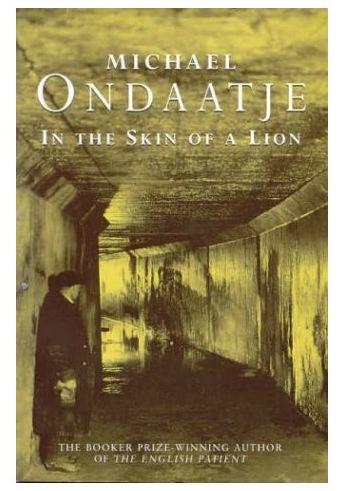
In The Skin Of A Lion by Michael Ondaatje.

It seems to be a while since I did one of these - not sure why; it's not as if I've been consciously not reading, or reading excessively slowly. Having said that, this isn't a book you could race through in high speed in a single sitting. Michael Ondaatje (most famous for The English Patient and its subsequent film adaptation) is a poet as well as a novelist, and the his prose has a powerfully poetic quality to it; it's complex, allusive, evocative, thick, rich, chewy, all those things (sorry, I'm watching James May and Oz Clarke talking about wine on the television and I think my language may have been influenced by it).

Actually it reminds me of Strandloper in some ways, in that it weaves together actual historical events (in this case the building of the modern city of Toronto) with imagined ones; a sort of collection of factual rocks with fictional mortar occupying the gaps and holding it all together. It's also not in the business of making life easy for the reader; you have to concentrate and read between the lines to work out what's going on. Unlike Strandloper, however, which for all its refusal to pander to the reader in other ways is at least linear chronologically, this leaps about all over the place, just to confuse you further. Keep your wits about you and it's very enjoyable, though.

Or, alternatively, it's a cubist novel. Make your own mind up.

Tuesday, November 28, 2006

what in Swansea am going on here?

Anyone who's of roughly similar age to me (say 4 or 5 years either way) will surely remember Absolutely. Sketch show, primarily Scottish cast, went out on Channel 4 at about 10pm at various points between 1989 and 1993. And it was very very good - the "Stoneybridge" sketch is the one everyone remembers, judging by how often it features in those "100 Greatest Comedy Sketches" shows, but there was lots of other great stuff as well, the best of which usually featured John Sparkes, one of the great unsung comedy geniuses of the 20th century. And, interestingly, or perhaps not, one of only two regular cast members who weren't Scottish (he's Welsh. Another candidate for Welshman of the Day, perhaps. The other non-Scot, Morwenna Banks, is, as far as I know, English).

So why am I telling you this, assuming you don't know it all already? Well....I decided, several months ago now, that I'd quite like to own the whole thing on DVD. And since every half-baked unfunny sitcom you can think of is out on DVD these days, I fully expected just to log on to Amazon, click the "Buy Now" button and that would be it. But....no. It turns out that Absolutely has never been released on DVD, much to the chagrin of the large fan community. So much so, in fact, that one particularly rabid fan has set up a website specifically dedicated to getting it released. There is an online petition which can be found here: I strongly urge you to leave a comment (this counts as signing it, I guess). Then once it's been released you can buy it for me for Christmas! Perfect.

Welshman of the day

Actually this is more a couple of of everyday objects that you might have lying around the house, not knowing that they are named after Welshmen.

Captain Morgan rum

Named after Sir Henry Morgan, notorious 17th-century pirate and later, slightly more respectably, Lieutenant Governor of Jamaica. Born in Llanrhymny, Glamorgan in 1635(ish), did lots of looting and pillaging in South and Central America, hot-footed it back to England and got knighted by Charles II and sent off to the Caribbean. Nice work if you can get it!


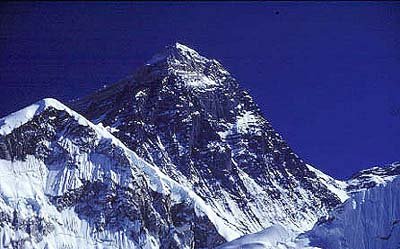
Mount Everest

Named after Colonel Sir George Everest, born near Crickhowell in 1790, geographer and Surveyor-General of India. The mountain itself was surveyed by Everest's successor, Andrew Waugh, who named it after his predecessor, presumably because he didn't know what the native name was, or he couldn't pronounce it. Speaking of pronunciation, an interesting footnote is that Sir George pronounced his surname "Eve-rest" and not "Ever-est". So we've all been saying it wrong all these years.

Monday, November 27, 2006

sport thoughts

Rugby

I didn't see much of the rugby at the weekend, as I was out getting muddy in The Cotswolds (see previous post). Couple of brief observations though:

  • Look out for England in the Six Nations. They will almost certainly be better than they've been in the autumn internationals, partly because it's hard to see how they could be any worse, and partly because they'll almost certainly have a new coach by then. Who that'll be is an interesting question. A couple of the West Country boys could be in the frame, I reckon: Richard Hill of Bristol and Dean Ryan of Gloucester. Hill has just signed a new contract with Bristol until (I think) 2010, though, so the RFU would have to shell out to poach him. From a selfish point of view I hope he stays around at Bristol for a while....

  • Look out for Australia in the World Cup. I think the Aussie coaching staff are being a bit cute with all the switching round of positions they've been doing during the autumn series - Giteau at scrum-half, Rogers at outside-half, etc., etc. You can bet your house that, come the World Cup, Stephen Larkham will be back at outside-half, assuming he's fit. He was there for the Scotland game and they instantly looked like a different team. I would play Giteau at inside centre as well (not sure who that leaves to play scrum-half, though). Here's a heretical notion: if Larkham had been fit for the whole 100+ minutes of the 2003 World Cup final, instead of being constantly on and off (and eventually just off) with a facial injury, Australia would have won, for all the heroics Elton Flatley performed with the boot while he was on in Larkham's place.

Cricket

Two questions to be answered here:

1) Why didn't Australia enforce the follow-on after England's first innings in Brisbane?

Let's start with a bit of scene-setting background. In order to have the option of enforcing the follow-on, a captain has to have done two things:

  • Batted first (either by winning the toss and batting, or by losing the toss and being asked to bat)

  • Bowled the opposing team out for a first innings lead of 200 runs or more

One of the reasons you might choose to bat first is this: cricket pitches are prepared to be in tip-top shape at the start of the match, and tend to deteriorate thereafter. So typically the later in the match it is, the more difficult batting becomes as the wicket dries out, cracks start to appear, it gets scuffed up by batsmen & bowlers running up and down on it, the bounce of the ball becomes more variable, etc., etc. So if you bat first, not only do you get first use of the pitch, you condemn your opponents to having to bat last, when the pitch is at its most worn.
Bearing that in mind, a couple of reasons you might decide not to enforce the follow-on are:

  • Enforcing the follow-on effectively means swapping innings 3 and innings 4, i.e. you elect to bat last, having not planned to at the start. You might decide you don't really want to do that, as you don't know how much the pitch will have broken up during the opposition's second innings.
  • You want to give your bowlers a rest. Usually more of an issue when you've bowled out the opposition for, say, 400 instead of 157, unless McGrath's sore heel was really bothering him. But if you have spent a day and a half in the field and achieved your 200-run lead by the skin of your teeth, you might decide that your bowlers are too knackered to trot back out and do it all again.

I suspect Ponting's reason wasn't either of these; more likely he just wanted to grind England's nose in the dirt psychologically by removing even the slightest possibility of an England win. Following on 445 behind you could still harbour thoughts of bowling out the opposition cheaply second time round for a miraculous win; being asked to make the best part of 700 to win removes any thoughts of winning - quite apart from the unlikeliness of scoring that many on a 4th/5th day pitch, there wouldn't be enough time left in the match to do it anyway.

The other reason may be: if Australia have had a weakness over the last 10-15 years it's been occasionally tripping up in pursuit of small-ish 4th innings totals. Also, they were famously on the wrong end of a defeat by India after making them follow on in Calcutta about 6 years ago, a match in which most of the senior Aussies playing here (Ponting, Gilchrist, Hayden, Langer, Warne, McGrath) were involved. A team winning after following on is incredibly rare, in fact it's happened three times in the history of test cricket (1894 and 1981 being the other two - strangely Australia were the losing side on both those occasions as well), but there might be some demons still knocking around in Ponting's head.

2) Why can't people bat to save Test matches any more?

England's second innings performance at Brisbane was better than their first innings, good enough to take the match into the relative respectability of a fifth day anyway. But they still scored at 3.7 runs an over, a rate that would have been unthinkable a few years ago for a team trying to bat out time for a draw. In these circumstances there's nothing to be gained by attacking - if you're chasing 650 to win then finishing on 28 for 8 gets you a draw, while 400 all out means you lose. Three key England batsmen, Strauss, Collingwood and Flintoff, got out to shots they shouldn't have been considering playing (in Strauss's case for the second time in the match). Has the art of batting for a draw been lost? I can think of a handful of great draw-earning innings I've seen in recent years:

  • Mike Atherton's 185 not out for England against South Africa at Johannesburg in 1995

  • Alec Stewart's 164 for England against South Africa at Manchester in 1998

  • Gary Kirsten's 275 for South Africa against England at Durban in 1999. Kirsten batted for 14 and a half hours, the second longest innings in Test history.

  • Michael Vaughan's 105 for England against Sri Lanka at Kandy in 2003

  • Ricky Ponting's 156 for Australia against England at Manchester in 2005

These are the exception rather than the rule, though. Too often teams whose sole purpose should be blocking the ball back to the bowler for 8 hours perish in a flurry of shots. Why? Too much one-day cricket? The hectic pace of modern life? Search me.

weekend photos

We went for a 15-mile walk around the edge of the Cotswolds at the weekend as a training exercise for the Dartmoor trip in January. Photos can be found here.

Very pleasant walk, nice scenery, some interesting historical sights to see - a word of warning though: if you're thinking of emulating our exact route, watch out while walking through Lye Farm near Bencombe (about half a mile due south of Uley), as there is an unmarked electric fence strung next to a gate on the footpath. Just at the right height to brush your arse against as you step back to get out of the way of the gate while opening it, as I did. Amusingly, despite witnessing my arse-electrocuting antics, Andy slipped on some mud and grabbed the fence with his hand a couple of minutes later; cue more zapping and swearing. Lye Farm, consider yourself named and shamed. Like you care.

Sunday, November 26, 2006

album of the day

Gold by Ryan Adams.

There's a sort of perverse rock snob temptation with any given artist to latch on to one of their more obscure albums as being the "definitive" one. Just to separate oneself from the common herd who, God forbid, just heard a couple of tunes on the radio and decided they quite liked them, without hearing the full back catalogue or absorbing the artists's full tortured history.

The point I'm fumbling my way towards making is this: Ryan Adams is a phenomenally prolific recording artists who's released something like 7 albums in the last 5 or 6 years. Some of these are a bit on the non-commercial, or just lumpy and inconsistent side, but they have their devotees nonetheless (Heartbreaker and Love Is Hell in particular), but one stands out as being a focused and considered bid for world domination, and it's this one. Possibly for that reason, this is the best thing he's done. It's got the trademark early-70's Stonesy acoustic/electric guitar & Hammond organ combo allied to some terrific songs and Adams' plaintive country-blues yelp.

Some of his other stuff (Heartbreaker and Cold Roses, for instance) is good too. Just don't let anyone try and tell you it's as good as this, cos it isn't.

Interesting Ryan Adams fact: anyone who hasn't heard of him assumes you mean his near-namesake Bryan Adams when you mention him, and, curiously, they share a birthday, November 5th (1974 and 1959, respectively).

Friday, November 24, 2006

never mind the science, look at the running about and shouting

"Dumbing down" is an over-used expression, but I feel compelled to use it here to describe the current state of BBC science programming, or what passes for it these days.

I was reminded of this while half-heartedly watching Journeys From The Centre Of The Earth on BBC2 last night (while eating a prawn curry - see previous post); the presenter Iain Stewart (Dr. Iain Stewart, apparently) did a lot of running about and pointing at things (and shouting), and there were a couple of wacky animated sections, for no apparent reason, but very little in the way of solid science.
Ironically, the one time he did take some time to explain something in a fair amount of detail it was the theory about there having been a catastrophic flood about 8,000 years ago where the rising waters of the Mediterranean inundated the Black Sea area and raised the water levels to what they are today. It's one of those theories that sounds like it really ought to be true (not least because it provides an explanation for the Biblical flood story; you know, Noah, two by two, all that stuff) but it's by no means widely accepted as such in the scientific community. I don't want to get into the evolution argument again, but this is a useful contrast: here is something that really is a "theory" in the sense that the layman would understand it, in that there is active dispute about it between scientists and other scientists (as opposed to between scientists and nutters).

The programmes that originally got my goat, though, were in the BBC's flagship science programme Horizon. There was a time this was a really good proper science programme - not any more it would seem. Just to give you a couple of examples:

October 10th 2006: Chimps Are People Too. Flagship fact: chimps share 99.4% of their DNA with humans. Well, that's very interesting. And? Some detailed analysis of why the remaining 0.6% makes all the difference? An overview of our common ancestry and parallel development? Nope - Danny Wallace arsing around with some chimps. Brilliant. Amusing footnote - it appears the 99.4% figure may be an overestimate anyway, and the true figure may be more like 96% - see Doug's post on the subject the other day. Which might have invalidated some of what the programme was saying, had it actually been saying anything at all.

November 7th 2006: Pandemic. This one looked more promising on the surface in that it was actually about something proper - the H5N1 avian flu virus, and what might happen if there was a full-scale outbreak among humans. However.....it fudged making clear the central key fact, i.e. that the tipping point comes when the disease mutates to a form whereby it can be passed from human to human without any avian involvement. Until this happens you can lick as many infected chickens as you like and there'll never be an outbreak. The serious science that would have underpinned all this had evidently been ditched for a lengthy dramatisation of the imagined early stages of an outbreak, presumably because, as the review in The Independent said the next day (I paraphrase somewhat), the intended audience knew everything there was to know about viral DNA mutation, but would be surprised to hear that some imaginary American would be a bit upset if his son died of bird flu.

apparently Thursday is the new Friday

Well, I didn't get to sample the apple & mint jelly - I'd forgotten it was Thursday night, and Thursday night is (occasionally) pub quiz night. So I had to knock up something quick for dinner, and I came up with this:

Dave's Prawn Laksa

You will need (these quantities are for 1 person, i.e. me. Multiply them up as required. I haven't put quantities for some of them as I assume it's obvious, i.e. as much or as little as you want, within reason. Don't come complaining to me if you put a pint of lime juice in and it ends up tasting horrible.):
  • Prawns (I had a 220g packet of jumbo king prawns, which was more than enough for me)
  • Coconut milk - about half a tin. Shake up up before opening it, otherwise you get half a tin of really thick coconut goo and half a tin of water.
  • Garlic
  • Red Chillies
  • Ginger
  • Lemon grass (mine comes out of a jar)
  • Fresh coriander (ideally. Mine came out of a jar last night, though)
  • Laksa paste. Reuben Solomon's Singapore Laksa paste is the one I use, and it's great. Sainsbury's sell it, or at least the one in Bristol does.
  • Lime juice
  • Fish sauce
  • Noodles (I used the big fat wormy udon ones last night, but any old noodles will do. Amoy ones are good.)

Fry up the garlic, chillies, ginger and lemon grass a bit. Bung a couple of big spoonfuls of the paste in and stir it around a bit. Add the coconut milk, lime juice & fish sauce and stir it all around so it's mixed together. Chuck the prawns in, cook for 5 minutes or so, add the noodles, another 2-3 minutes, add the coriander, stir it in. Serve. Eat. Bish, and, indeed, bosh. Total preparation and cooking time: about 15 minutes. And it's delicious. Well, I think so anyway.

Then we went to the pub, specifically the Hop House in Clifton village, which has a music quiz on Thursday nights. Nice pub, one major complaint: they don't have enough beer! They do a very delicious pint of Wadworth's 6X, but I don't think I've ever been there when they haven't run out of it at some point during the evening. Last night I managed to get in two pints before it ran out and I had to switch to something else. It can't be that difficult, surely? Other pubs seem to manage it OK.

Speaking of drinking something else, we came second in the quiz, and this week all the prizes were drink-based, specifically varying numbers of bottles of Quinn's, a sort of fruity alcopop that Diageo are marketing as "Fruit Made Alcohol", i.e. the alcohol comes from fermenting fruit, and is therefore presumably more "natural" in some way, as if this makes a blind bit of difference. Anyway, second prize was ten bottles of the stuff, and we didn't want to carry it home, or argue about dividing it up, so we drank the lot there and then. My head hurts a bit this morning! Though on the upside I am in no immediate danger of catching scurvy, which is nice.

Thursday, November 23, 2006

welcome to the Gabbatoir

Thanks to Doug for the title of this posting (I've corrected your spelling, though).

Well, day 1 of the Ashes in Australia 2006-2007 (Australia 346-3) looks very much like day 1 of the Ashes 2002-2003 in Australia (Australia 364-2). I think this one is less bad for a number of reasons, mainly because they chose to bat this time, as I hope we would have done had we won the toss. Nasser Hussain's decision to put the Aussies in last time was interpreted by most, rightly or wrongly, as an act of instant psychological surrender before the series was even underway, and the writing was on the wall from then on.

It's not great, though. On the upside, Flintoff was the best of the bowlers, and looks to have made a full recovery. But we have to get Harmison bowling properly again - he bowled like a drain today, which was why Flintoff only gave him 12 overs all day - or we're undoubtedly down the dunny without a paddle. If I was in charge I would do two things:
  • Get a bowling analyst in to tell Harmison what he's doing wrong. Simon Hughes seemed to have nailed it (left arm not coming down straight, falling away to the off side, no control as a result) on Channel 5's excellent TV coverage in the summer, so let's wheel him in to give the big fella a few pointers. Geoff Boycott (as usual) has some trenchant opinions too....
  • Get a sports psychologist or a hypnotist in to pep Harmison up mentally. He's got all the physical attributes you could want but he does seem a strangely diffident sort for a fast bowler. People like Dennis Lillee and Andy Roberts never had any trouble getting geed up to attack the batsman, literally in Lillee's case on one or two occasions. What's Jos Vantisphout up to these days? Or does he only do golfers?

On a brighter note, the apple and mint jelly does seem to be setting quite nicely. I might even sample a bit tonight. Just need to roast up a 6-pound haunch of venison to have it with.

Wednesday, November 22, 2006

apples part 2


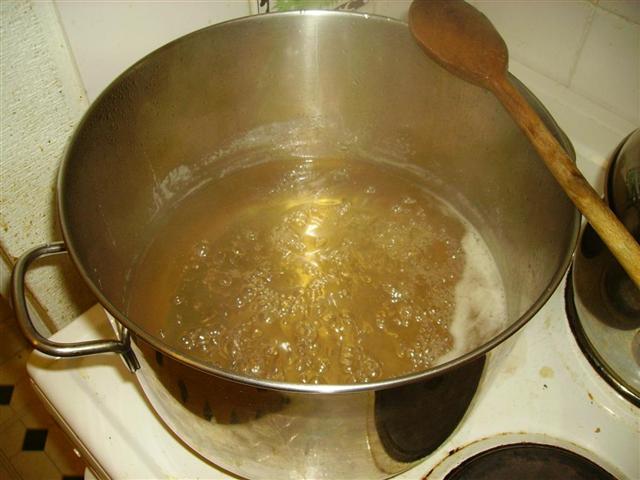
Well, the apples released all of their precious fluid overnight, so it was time to complete the jelly-making process. First a carefully calibrated amount of sugar was added to the apple juice. The juice had gone a bit cloudy, which concerned me slightly, but things were to miraculously sort themselves out later, as you'll see.


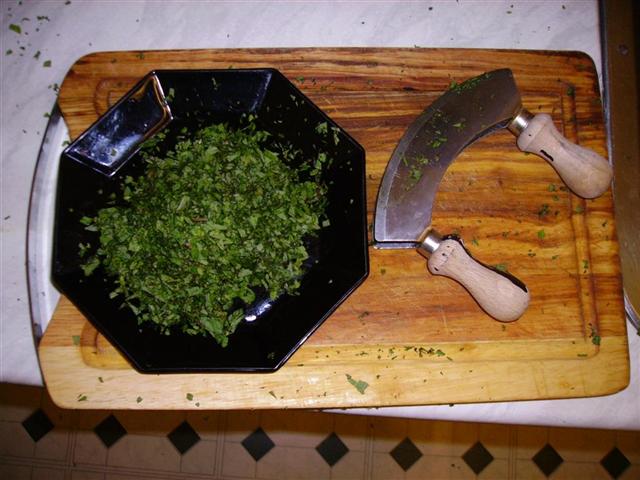
While the sugar was dissolving and the liquid coming to the boil, I chopped up some fresh mint.


By the time the liquid was boiling away enough to set, it had miraculously cleared. All that was needed was to skim off the scum that had risen to the top, and bung in the mint.


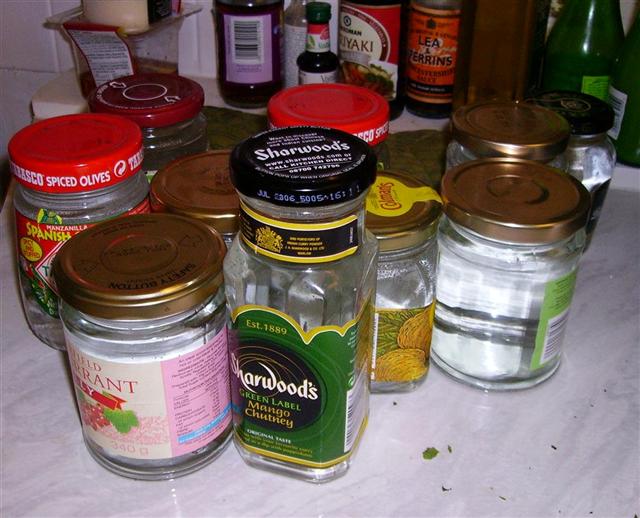
Then...clean up some spare jars, pour it all in, and stick it in the fridge. And wait for it to set. This is the key to the whole thing, of course; if it doesn't set then I've got a lot of sweet runny apple and mint sauce,
which isn't really what I want.


ooblextraordinary


This one is, if anything, even weirder. Remember, this is just cornflour and water mixed together, and then stuck on a vibrating plate. Isn't physics great?

oobleck and glurch

I came across this completely (well, to me anyway) fascinating clip on YouTube today: inauspicious beginnings with some bloke stirring a petri dish of cornstarch with a pencil, but it gets seriously weird towards the end. The crazy phenomenon in the last phase of the experiment is called the "Lovecraftian tentacle effect", apparently, a perfectly apt description (assuming you've read some Lovecraft).

It's all to do with non-Newtonian fluids, which display counter-intuitive effects like getting thicker when you stir them (and then thinner again when you stop). The cornstarch one (try mixing a load of cornflour with some water) is used in school science lessons to illustrate non-standard liquid behaviour. It's colloquially called oobleck, apparently, and is often used for teaching purposes in conjunction with another non-standard liquid called glurch. Great names! A note of caution though: section II of the article perpetuates the myth about glass windows thickening at the bottom over time because of the glass flowing like a (highly viscous) liquid. This is generally accepted not to be true - if you want an interesting example of a true super-viscous liquid try this.

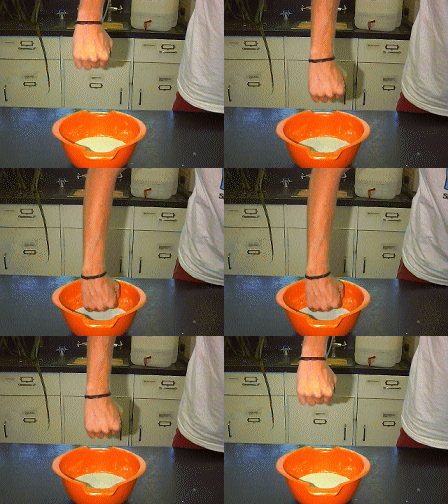
If you make custard with cornflour, you can walk on it, as this clip proves. Just don't stop or you'll sink.

Tuesday, November 21, 2006

pre-Gabba cricket thoughts

The 2006-2007 Ashes series kicks off in Brisbane tomorrow. I'm very excited and nervous about the whole thing. I think the Australians are justifiably heavy favourites, but I'm quite sure England can win. In the absence of some key players from the successful 2005 Ashes campaign, however, it's absolutely crucial that the following players have a huge series:
  • Andrew Strauss: Strauss scored two vital hundreds in the 2005 series, one brisk one to set up a declaration in the second innings at Old Trafford, and one painstaking one to keep England in the hunt on the first day at The Oval. I reckon at least a couple more will be required here. He has looked in good form in the build-up games, though.
  • Kevin Pietersen: the Aussies seem to have decided he's vulnerable to the short ball, so expect him to be targeted by the quick boys, Lee, Tait, etc. Then again Lee tried that on the last day at The Oval and disappeared for seven sixes. His contest with his mate Shane Warne will be pivotal, again.
  • Andrew Flintoff: if he gets injured and can't bowl, England are history. He's looked good since making his comeback during the Champions Trophy, but he'll have to bowl a lot of overs, especially if Harmison continues to have problems.
  • Steve Harmison: for me, the key to the whole series. His bowling on day one at Lord's in 2005 set the tone for the whole series (even though it was a game England eventually lost). Within a short space of time he'd cracked one into Justin Langer's elbow, pinged one off Matthew Hayden's helmet (ouch) and bent Ricky Ponting's helmet grille into his face. That was his best spell of the series, but he was involved at vital moments thereafter: the legside snorter to have Michael Kasprowicz caught behind at the death at Edgbaston, and the slower ball to castle Michael Clarke the night before. Don't underestimate his lower-order hitting power, either. His problems seem to me to be more mental than anything else; maybe England need to wheel in a sports psychologist. But if he's up for it and gets the ball in the right spot, particularly in the traditionally helpful conditions at Brisbane and Perth, then it could be carnage.
Additionally, the less experienced batsmen - Bell, Cook and Collingwood - will probably need to produce at least one significant innings each, Hoggard will need to take more wickets than he did in 2002-2003, and Duncan Fletcher will need the courage to give Monty Panesar a chance to attack the Australian batsmen.

Non-Ashes cricket talk: there's a rich and rewarding conversation to be had about who the world's best batsman is: Brian Lara, Sachin Tendulkar, Rahul Dravid, Ricky Ponting and Jacques Kallis are the names usually tossed into the hat on these occasions. For my money Ricky Ponting is the world's number 1 batsman, and the stats, world rankings, etc., bear this out; no-one can touch him for consistency of performance over the last 4 or 5 years.

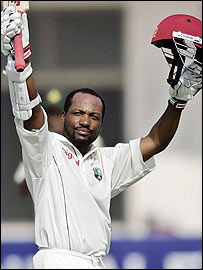
If it's the capacity for displays of complete genius you're after, though, then displays like Brian Lara's today for West Indies against Pakistan at Multan render all discussions pointless. There isn't another batsman in the world who could stroll to the wicket with his team 1-0 down in the series, flay a century before lunch off 77 balls, slow down to a canter in the afternoon and still finish the day on 196 not out off 230 balls. It would not surprise me at all to see Lara become the first man in history to pass 300 in a test innings on three separate occasions some time tomorrow. We should cherish Lara while he's around, as it won't be for much longer, and it'll be a long time before we see his like again.

Welshman of the day


Robert Recorde, 1510-1558, physician and mathematician.

Born in Tenby, attended the universities of both Oxford and Cambridge, acted as physician to the royal family, and died in a debtors' prison in Southwark.

Inventor of the equals sign (that's this for you non-mathematicians: "="). Also the inventor of the word zenzizenzizenzic meaning "raised to the eighth power", e.g. the zenzizenzizenzic of 2 is 256. This word has the most z's of any word in the English language, but it is a bit difficult to slip into conversation. Give it a go, though.

how do you like THEM apples

Hazel's parents have an apple tree in their back garden. And a highly productive one it is too, by the look of it, as she brought me a big bulging carrier bag of apples at the weekend. We cooked some with some pork chops on Sunday evening, I made some into an apple crumble on Monday, and I gave some away to my friend Robin who had some apple crumble ambitions of his own.

That still left, however, somewhere between 3 and 4 pounds of apples to be used. I was a little at a loss, frankly, until I leafed through a cookery book to discover a recipe for apple and mint jelly. For which the ingredients are: apples, sugar and mint. Well, surely nothing can go wrong with a recipe as simple as that.

So....


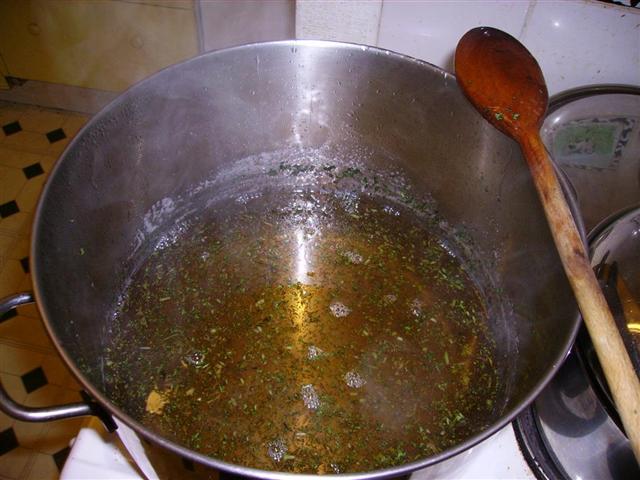
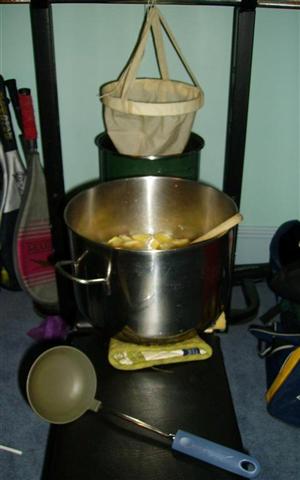
You start by coarsely chopping up the apples, bunging them in a big pan, adding enough water to cover them, and bringing them up to a simmer until the fruit softens (or in my case, as I left them to go and do something else, disintegrates).


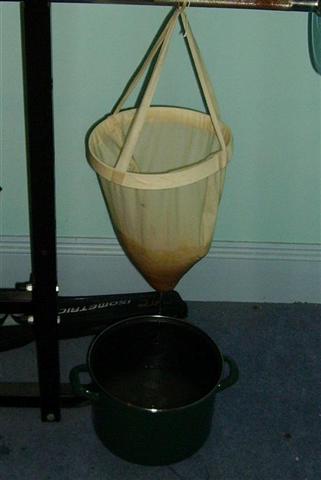
Then you drain the whole mushy juicy lot through a muslin bag into a convenient receptacle.

Luckily I already have a muslin fruit-straining bag from my sloe gin-making activities (you'll see it again on a blog post near here in January or February when I decant the sloe gin).

The idea is you leave this overnight until all the last juicy goodness has drained out of the apple goo, then boil it up again with some sugar, chop up and bung in some fresh mint and pour it into jars and leave it to set.


In theory it should end up looking like this. We'll see....

If anyone's expecting Christmas presents from me this year, by the way, I may have 20 or so jars of apple and mint jelly to get rid of around mid-December....

inadvertent lycopersicoid ambiguity

Just to clarify the whole cheese and tomato issue - my previous post (particularly the cheese section) might have given the impression that cooked tomatoes are a bad thing. So just to clarify: cooked tomatoes are fine. In fact if you're giving them a good solid cooking you can even leave the innards in, seeds and all. It all ends up as a sort of amorphous red mush, anyway.

Monday, November 20, 2006

feed me!! feed me NOW....


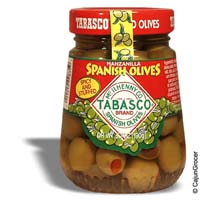
Not sure why I started thinking about food all of a sudden, but it probably dates back to a conversation I had with Hazel a while ago: Hazel doesn't like olives. Whereas I love olives - especially jars of Tabasco brand pimento-stuffed green manzanilla olives, but pretty much any olives will do. It struck me, however, that I've only really eaten them in bulk (and I do eat them a lot) since relatively recently. So....

Things I really like, but only started liking relatively recently, say within the last 5 or 6 years:
  • Olives
  • Avocados
  • Raw tomatoes (but see the caveat below)
  • Aubergines
Things I like, but only under strictly controlled conditions:
  • Tomatoes: raw is fine, but flesh only, i.e. no seeds. Raw tomato seed material is thoroughly nasty slimy material and should not be considered for consumption by right-thinking human beings. To coin a phrase I used earlier today: that's not food.
  • Cheese: opposite to the tomato rule, i.e. cooked is fine, raw not so good. Mozzarella on pizzas, mascarpone in pasta sauce, gruyere in gratin dauphinoise, parmesan stirred into pasta, all fine. Raw cheese, particularly the thumping great doorstops of luminous yellow rubbery stuff that seem to be Britain's contribution to the world of cheese, not good. Mozzarella I can just about stomach raw, but only because it doesn't really taste of anything. Goat's cheese is OK raw too, as it's just pleasantly salty rather than rankly cheesy.
  • Pizza: leaving the cheese issue aside as we've already covered it - I have some firm views on what should be allowed in pizzas, not necessarily conforming to any notion of Americo-Italian "authenticity", just personal whim and prejudice. Specifically: ham, pepperoni, onions, peppers, mushrooms, olives, all OK. Fish in any form, much as I like it in general, never on a pizza. And as for comedy toppings like spicy chicken, chilli con carne, etc., well, the least said the better. The only slightly wacky one I like is pineapple: I have an occasional weakness for Pizza Hut Hawaiian pizzas.
Things which are and always have been the devil's work:
  • Celery
  • Cauliflower
  • Capers. That's not food.
All beginning with "c". Interesting....

you can never have too many hats


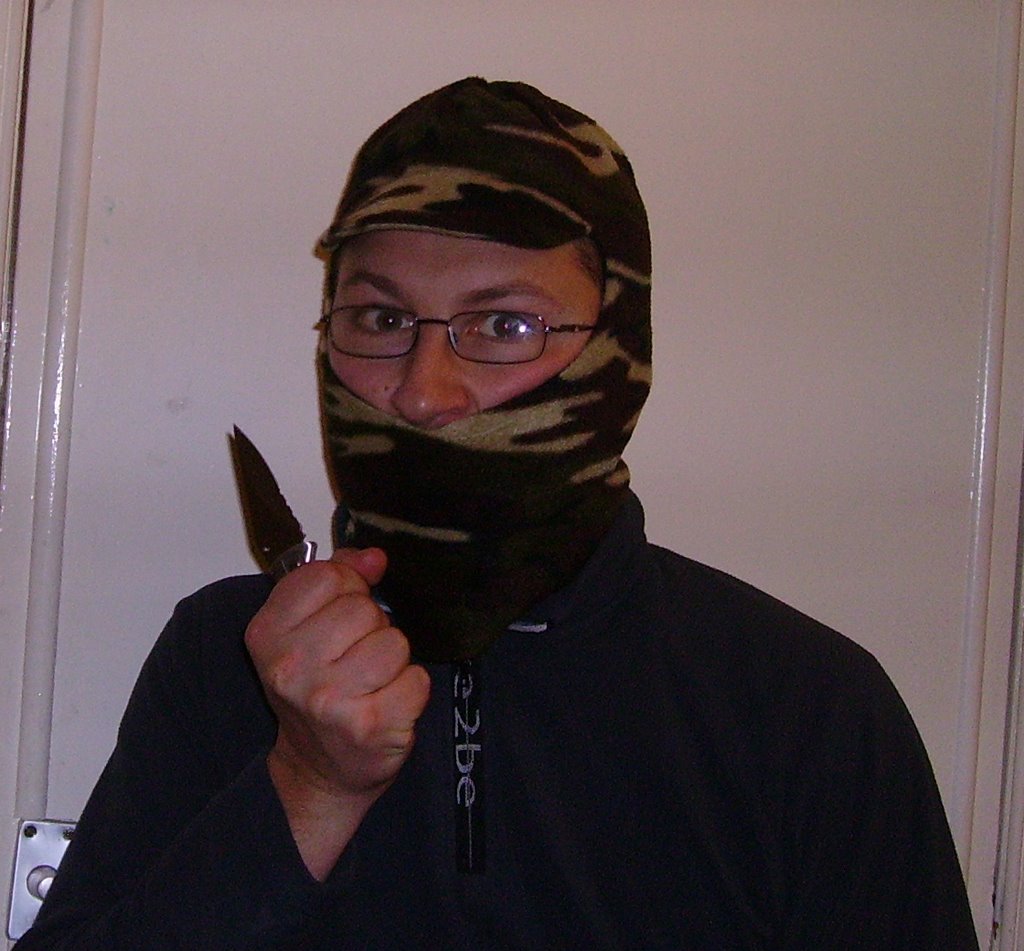
....especially when one of them is an army surplus camouflage-coloured peaked fleecy balaclava. This is the essential piece of kit in my Dartmoor kit collection. Only trouble is I've got such an enormous head that it doesn't fit quite as well as it should, but as long as I don't want to talk too much, or be able to hear anyone else talking, it should be OK. Works particularly well when combined with the locking sheep-gutting knife I bought a week or so ago, as you can see.