Friday, January 27, 2023
the path of righteousness
Thursday, January 26, 2023
dum dum de dum dum de dum dum de PARK STRIFE
More non-book-related posts, for the love of God, you say? Electric Halibut hears your anguished cries and rides to the rescue on his wingèd steed, entirely naked except for a pair of rather splendid patent-leather riding boots and a dab of Blue Stratos behind the ears.
So, as I mentioned a while back, we moved house during 2022, and of course one of the things that does (unless you've literally moved to the house next door, anyway, which sounds literally insane but which some of our friends literally did a few years back) is put you in the vicinity of some different parts of the city, in particular interesting green areas which might be worthy of exploration.
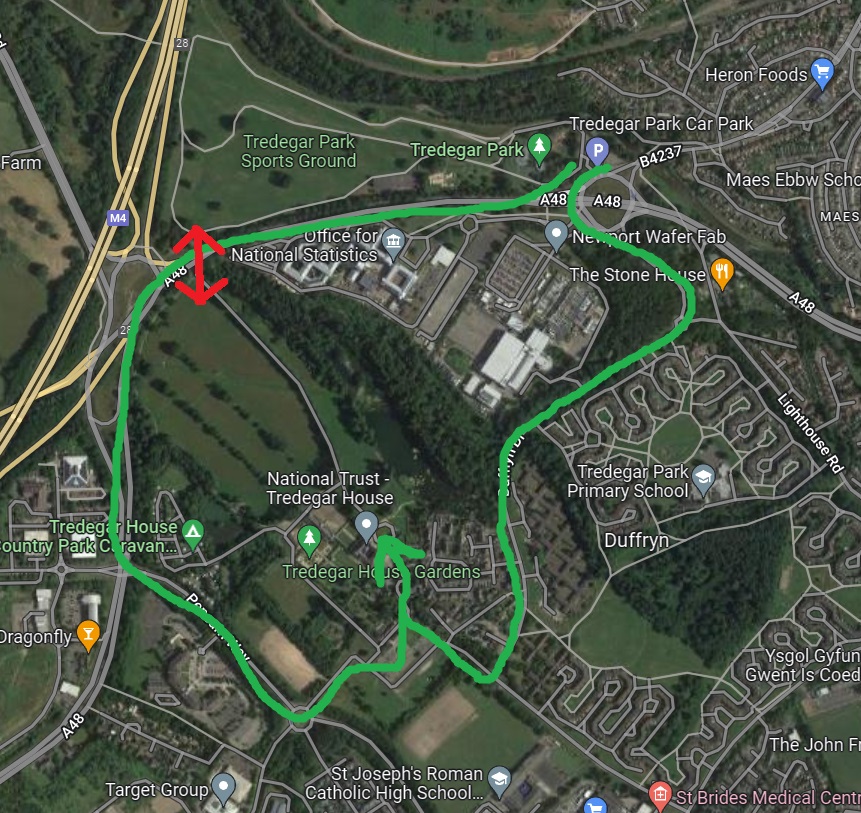
So what the aerial photograph and map above show is some near-contiguous areas of green parkland in the general west Newport area, Newport being essentially divided into western and eastern halves by the River Usk as it makes its meandery way north-south through it. Those areas are, broadly speaking:
- The little wooded area and park adjoining the northern edge of the mahoosive St Woolos Cemetery and accessible at its northern end from the roundabout on Risca Road; it is allegedly called Coed Melyn Park, which my rudimentary Welsh skills tell me just means "Yellow Tree Park". I can confirm that outside of certain times in autumn the trees are, in fact, predominantly green;
- the parkland area containing the Gaer hillfort;
- Tredegar Park (not to be confused with Tredegar House, below);
- Tredegar House and its surrounding park (not to be confused with Tredegar Park, above).
I have marked those four areas on both images above as yellow, red, blue and a sort of pale mauve, respectively (going from north to south). As you can see they are all very much adjacent to each other, but the connections between them aren't as simple as you might expect. This, in a nutshell, is the point of this post. Let's have a look at them in turn, starting from the top.
The first one is the connection between the bottom of Coed Melyn Park and the top of the Gaer hillfort; nothing fancy here but you can take a short walk from where the footpath emerges onto Western Avenue, cross Bassaleg Road via the traffic island and enter the park via its main entrance (there are several others along the park's eastern edge). So far, so good.
Take a walk in a broadly southerly direction through the park, maybe via a detour to the top of the hillfort (lots of trees so the location of the actual top is not particularly clear) along the recently-upgraded path and you will find yourself quite near, as the crow flies anyway, to Tredegar Park. So you'll be wanting, I would imagine, to continue your pleasant walk in that direction. Well, I've got some bad news for you, bucko, because there are some insurmountable obstacles in your way, specifically the River Ebbw and a railway line. If you want to continue to Tredegar Park then you'll have to follow the path round to where it ends at the gate at the end of Wells Close, find your way to the footbridge over the railway and then follow the roads round through the main car park and into the park. That's the green line on the map; the two red lines show imaginary crossings which would obviously be much better but would require some quite substantial engineering to bridge both railway and river. The only saving grace with the railway is that it isn't the South Wales main line (that takes a more southerly route to get to Cardiff and points west) but the more minor branch line to Ebbw Vale, calling at (among other places) Pye Corner as mentioned here.
Let's assume you've now made the long trek round and have enjoyed all the various delights Tredegar Park has to offer - some outdoor gym equipment, football pitches, a playground, some pleasant riverbank areas - and fancy completing your journey by visiting Tredegar House and its pleasant grounds. Well, strap yourself in for a connecting journey of even more unimaginable complexity and inconvenience, as you'll need to exit via the car park and take one of two possible on-road routes to get round to the only available access points on the south side of the house. How much more convenient it would be, you might think, if one could simply traverse the busy lower reaches of the A48 as it approaches junction 28, where the two parks are probably a hundred yards apart, at most. I mean, you would need a footbridge to avoid being messily dispatched by an HGV, or possibly an underpass to avoid having to thread a footbridge around the ornate (and now unused) pair of gates that face the road at this point.
How utterly marvellous to be able to get on your bike up around Risca Road (in the vicinity of our new house, for instance) and cycle in traffic-free bliss all the way down to Tredegar House; yes, maybe a couple of points where you might have to dismount to traverse a bridge but, really, tish and pshaw to that, certainly in comparison with the current situation. So come on, Newport City Council, how about a bit of joined-up thinking?
Wednesday, January 25, 2023
if there's a russell in your hedgerow, don't be alarmed now
After a period of relative inactivity comprising only one authorial death in a little over eighteen months, the Curse of Electric Halibut is back in business properly now, the latest victim being the third in a little over three months. This time it's American author Russell Banks, the title of whose 1991 novel The Sweet Hereafter eventually became too much of a temptation, the curse evidently having a keen sense of irony.
That book, the only one of his I've read, featured here in December 2018, which gives a curse length of just over four years. Banks was 82 which I suspect (and I should point out I haven't done the detailed calculations) shifts the average age hardly at all.
Banks is the second Russell to feature on the list, after Russell Hoban. That's not unique, as there are a couple of Williams and a couple of Johns on the list (and two people called James if you unpack JP Donleavy's initials), but his sharing a surname with another featuree (Iain Banks) is.
Monday, January 09, 2023
the last book I read
Count Zero by William Gibson.
Turner is a man who Gets Shit Done. Usually the messy kind of shit the big corporate overlords don't want to get their hands messy with as it involves activity on the borderline of legality, or well on the other side of it, like stealing stuff, shooting people in the face, that sort of thing. Only one thing hampering Turner's acceptance of further work in that line at the moment: he hasn't got a body! Well, he has, or most of one, but it's in a a preservation vat in more separate pieces than he would ideally like at the moment.
The benefit of being extremely useful to lots of rich and powerful organisations, though, is that they have an interest in seeing you get grafted back together after being messily exploded, and Turner's body (or all the bits of it that could be scraped off the street in New Delhi where he was dispatched, anyway) is soon rebuilt, his memories gradually re-enabled, and soon he finds himself recuperating in Mexico with a lady sharing his bed. You can't trust anyone, though, and it turns out she's just been testing him out to ensure he's fully recovered in every department, if you know what I mean, and I think you do. Having reported back to her superiors that Turner seems fine, he is quickly picked up for a new assignment: arrange the pick-up and recovery of a guy called Mitchell who wants to defect from one slightly shady bio-software mega-corporation to another. This involves Turner and his team hiding out in the Arizona desert with a team of medics who will scan Mitchell for any bio-booby traps (his brain is wired to explode, his hair has the plague, his entire leg is a missile, etc. etc.) before he is jetted off to his new employers to do all the new joiner stuff like being shown where the coffee machine and toilets are.
Needless to say, things don't go entirely according to plan and the person that arrives at the desert location in a rickety ultralight is Angie, Mitchell's daughter. Realising something dodgy is afoot Turner grabs Angie and scarpers in a high-powered jet, just in the nick of time as the hideout and everyone and everything in it is vaporised in an explosion.
Let's park what we might call Plot Strand #1 for a moment and pick up the next: Bobby Newmark is a fledgling hacker and cyber-jockey, surfing the collective virtual reality of the matrix under the moniker Count Zero, which would be a lot cooler if it were not self-applied. Pretty much the first actual cyber-job he takes on, testing out some security-penetrating software for a contact, nearly ends in his death as he encounters some black ICE which attempts to liquidise his frontal cortex, and he is only saved by the intervention of a mysterious entity with a female voice. After this close encounter Bobby has become known to certain powerful entities and has to make use of some of his (not entirely trustworthy) contacts to facilitate escaping and staying hidden.
Meanwhile, Marly Krushkova, former art gallery owner currently in disgrace in the art world for inadvertently passing off a forgery as real (thanks to the shady activities of her no-good ex-boyfriend) is contacted by the agents of a mega-rich art enthusiast called Josef Virek with an assignment: find the artist responsible for the real artworks that her fake was modelled on. Budget effectively limitless, no particular set method, just follow your instincts.
Bobby's attempts to find out where his dodgy software came from take him to the Sprawl, the partly-derelict, mostly-lawless mega-conurbation that occupies most of the east coast of North America from Boston to Atlanta. Turner and Angie eventually make their way there, too, via a brief stop-off to hole up with Rudy's brother, a brilliant engineer and chronic alcoholic, and "borrow" his armoured hovercraft for the trip, something that immediately comes in handy as they are attacked by a couple of guys in a helicopter and Turner is able to use the hovercraft (and a great big gun) to shoot the 'copter down and ram it, killing the occupants, who turn out to have been sent by the people who hired Turner in the first place to tidy up some loose ends.
Turner and Angie end up holed up in the same apartment as Bobby and his friends, whereupon it turns out that Angie is the female voice who saved Bobby earlier, and that moreover she has some bio-implants that enable her to jack into the matrix without having to engage with any computer hardware. Furthermore both she and Bobby have had cyber-encounters with mysterious beings of seemingly limitless power who seem to adopt the personas of voodoo gods when interacting with humans.
Marly, meanwhile, has travelled all the way into low-earth orbit to discover the creator of the artworks, which turns out to be an AI entity inhabiting an old mainframe satellite. It further transpires that Virek doesn't have much interest in art for art's sake but instead has detected some AI/bio-software elements in the artworks and wants to make use of that stuff to get him out of his vat and give him effective immortality. The various protagonists of the various strands of the story have to come together to stop him.
Count Zero is a sort of loose sequel to Neuromancer, one of the seminal works of 20th-century speculative fiction (as I have banged on about tediously here before). It doesn't share any major characters with the earlier book but is clearly set in the same fictional universe, a small number of years later (its relationship with Neuromancer is similar to Idoru's with Virtual Light, if you like). There is just a tangential mention, easy to miss in passing, of a couple of people who are clearly meant to be Molly and Case, Neuromancer's principal protagonists, and Turner's physical disintegration and rebuilding here is very similar to Case's neurological destruction and rebuilding at the start of Neuromancer. The mysterious AI entities who control much of the plot (the squishy puny humans merely scuttling round enacting their plans in the physical world) are presumably meant to be fragmented versions of Wintermute and Neuromancer, the earlier book's twin AIs.
Purely as a rollicking adventure story Count Zero probably works better than Neuromancer; just as with Bring Up The Bodies and Eternity part of this is down to being a sequel and therefore being able to skip a lot of world-building exposition and just crack straight on with the plot. If you're only going to read one it should probably still be Neuromancer, though, just for its genre-redefining cultural significance. There is a third book, Mona Lisa Overdrive, in what's generally called the "Sprawl trilogy", although if you can read the green text at the top of the accompanying image here you'll see my edition renders it as the "Neuromancer trilogy". Anyway, Count Zero is tremendously good fun and still startlingly prescient about the internet, rampant commercialism, societal decay and the dangers of AI given that it'll be 37 years old this year.
A couple of cultural echoes of other stuff: firstly the "slamhound" that catches up with Turner in the novel's first paragraph is very reminiscent of the Mechanical Hound from Fahrenheit 451 which was used for a pretty similar purpose, although it was all about the stealthy lethal injections rather than the more messy exploding. Finally the voodoo entities crop up elsewhere as well, Baron Samedi featuring heavily in Live and Let Die, and Papa Legba in the late-period Talking Heads song of the same name.
Tuesday, January 03, 2023
the year of blogging dangerously infrequently
Here's the annual blog stats roundup, including graphs, if you like that sort of thing. The main headline news here is that this year (well, last year now) squeaked past 2017 by a single post to avoid being the joint-least-blog-post-y year on record at a paltry 45 posts. However, since 2017 included an all-time-low of 13 book reviews, while 2022 included a pretty healthy 23, that means that 2022 featured a measly 22 non-book-review posts while 2017 featured 31. There being more book posts than non-book posts is also a first for a calendar year. I can't really put my finger on a specific reason apart from the one I've already mentioned a few times which is that a lot of things that might have once ended up being blog posts end up on Twitter instead; to put it another way now that I have three kids I no longer have the free time or energy for extended blog ranting about a topic that piques my interest and might just do a short but sweary quote tweet or something instead.
Anyway, graphs follow. Note that following my realisation that I'd done the sex balance graph in a really stupid way last year I've recalibrated the scale to just show the percentage of books that were by female authors.
Thursday, December 29, 2022
the last book I read
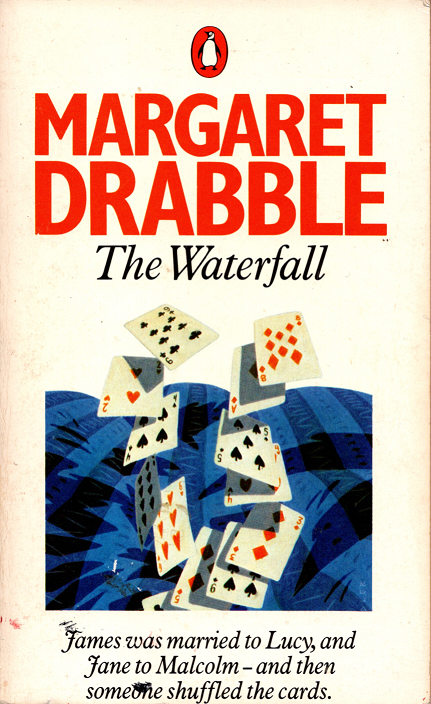
The Waterfall by Margaret Drabble.
Jane Gray - no, not that one - is having a mixed time of it. A published poet - hooray! - but not writing much these days - boo! - and about to give birth to her second child with husband Malcolm - hooray! - who has just moved out of the family home after an irretrievable breakdown of their marriage - boo!
Luckily she has a bit of help managing this emotional rollercoaster from her cousin Lucy and her husband James, not to mention some more practical assistance with giving birth at home (to a daughter, Bianca, to go with son Laurie who is about three) and subsequent basics like getting to the toilet and acquiring shopping.
We get a bit of back-story now: Malcolm is a guitarist and singer, quite highly-regarded in the particular musical circles he moves in (vaguely folky, maybe even a bit classical, as far as we can gather). The exact circumstances of his and Jane's split aren't made completely clear, but there seems to be an implication that Jane suspects he might secretly be gay - nonetheless it seems that post-split he has managed to shack up with another woman, so who knows. James, on the other hand, is a slightly shady car-dealer and occasional amateur racing driver.
Anyway, any doubts about the irrevocability of the split are soon, as it were, put to bed, as James' extreme attentiveness to Jane's welfare extends to his volunteering for helping-out duties without Lucy in tow and, during one of these, ending up in Jane's bed for a bit of light and cautious post-partum firkytoodling. The relationship continues as James' "business commitments" allow him a plausible smokescreen to be away from Lucy for days at a time, time he spends popping over and being jovial Uncle James for the kids for a while before taking Jane upstairs for a good seeing-to.
Eventually a "business trip" presents itself that offers an opportunity for James and Jane to get properly away, in this case to Norway where he is personally delivering an Aston Martin to a customer - inevitably in some shady way involving dodging tax, duty and/or insurance. The trip involves catching a ferry from Newcastle and so James and Jane and the kids head off there in the Aston Martin. All goes well until the car hits a brick dropped from a lorry ahead, flips over the central reservation, gets hit by an oncoming car and ends up ploughing into a tree on the opposite verge. By some miracle Jane and the kids are unhurt, but the driver of the oncoming car is dead and James is severely injured. All a bit awkward for Jane - James was scheduled to be away for two weeks, so as long as he recovers within that time they can get away without being rumbled. But James' injuries are more serious than that, and, in any case, what if he dies? Don't Lucy and his parents have a right to know? Jane bimbles around uselessly for several days until the decision is taken out of her hands by Lucy phoning her at her hotel - Malcolm has rumbled them and told her and she has made the necessary enquiries and found out what's happened.
Thankfully it turns out that James will make pretty much a full recovery - after Lucy arrives and takes charge of his convalescence it becomes clear to Jane that their affair will be over, though once he's recovered they do manage to meet up for a bit of valedictory fucking. Jane finds herself OK with this and moreover finds that the experience has rekindled some of her poetic inspiration.
So what to make of this? I recall in my short but rambling review of Drabble's A Natural Curiosity back in the very very early late-2006 days of this blog I bemoaned not quite grasping what the book was meant to be about or what its purpose was. I think I have similar feelings here, although I guess I do see some of the purpose: The Waterfall was written much earlier in Drabble's career (1969) and embodies some proto-feminist themes like female independence, female control over sexuality and fertility, not having to settle for a man just because he is the major breadwinner and father of your children, getting sexually involved with men just because you want to rather than for any ulterior motive involving marriage or support. That said, and despite the back cover blurb describing the novel as "a bitter-sweet song of sexual love", there's never much insight into what attracted Jane to James in the first place. We don't get any clear sense of unstoppable lust from either participant, especially not Jane who is a strangely inert and passive central character. James' motivations are similarly opaque, and even allowing for his business trips it's unclear how he's able to conceal the affair from Lucy.
Those considerations aside this is perceptive in its observations about 1960s sexual politics and the messiness of love and childbirth, without any of the central characters being engaging enough to really make you care very much about what happens to them. I'm not sure I really buy its being described here as "experimental", unless that refers to the occasional shifts between first-person and third-person narrative voices; this seems like a very low bar to clear for "experimental" status, though. I think Margaret Drabble probably suffers a bit from her surname being ripe for cheap puns on the word "drab" as well as other related puns. Of the three novels I've read from her lengthy career The Radiant Way is probably the best.
Friday, December 16, 2022
here's summit I prepared earlier
Monday, December 05, 2022
the last book I read
Rebecca by Daphne du Maurier.
Our unnamed narrator is a woman in her early twenties, carrying out a menial and pretty unrewarding job as personal assistant, companion and general dogsbody to the dreadful Mrs Van Hopper, who is rich, brash, American and generally frightful. Into their orbit in the Monte Carlo hotel where they are currently staying comes Maxim de Winter, fortysomething, slim, handsome, but troubled in a moody and - hey - slightly sexy way. Once Mrs Van Hopper has been conveniently removed from the field of play for a couple of weeks by a well-timed bout of illness our narrator and Mr de Winter find themselves mutually at a loose end and end up spending some time together. He is twenty years older than her and a bit prone to mysterious periods of enigmatic silence, but he evidently finds her company refreshing and ends up asking her to marry him (and ditch Mrs Van Hopper into the bargain).
After a low-key wedding the new couple return to England. But where will they live? Well, it just happens that Maxim has a mahoosive country house called Manderley in south-west England (probably Cornwall but never explicitly identified as such). So the new Mr and Mrs de Winter rock up there in their fancy motor car and move in. Gargantuan house, hot and cold running servants, all the pâté you can eat, plus extensive grounds and access to a private cove and harbour - what's not to like? Well, a few things, actually: most significantly the lingering influence of Maxim's first wife, Rebecca, who drowned off the coast nearby a year or so earlier and the remnants of whose presence can still be felt around the house, in things like the decor and menu choices but more directly in the form of Mrs Danvers, Manderley's housekeeper and dominating presence among the staff, and who (it soon becomes clear) had a very close relationship with Rebecca and was utterly devoted to her.
A more assertive character might take a new broom to all this stuff and put their own stamp on the place, but the new Mrs de Winter is a slightly shy young woman and is a bit intimidated by the whole affair, and by Mrs Danvers in particular. Indeed it soon becomes apparent that Mrs Danvers' devotion to her former mistress may have made the short but significant journey from devotion to obsession - having set up home in Manderley's east wing, Mrs de Winter discovers that Maxim and Rebecca's former rooms in the west wing have been kept by Mrs Danvers in pristine condition exactly as Rebecca left them on the day she died: dust-free, clothes in the wardrobe, fresh flowers, nightdress laid out on the bed.
Rebecca's continuing influence seems to extend to Maxim as well, though, who is occasionally remote and uncommunicative. As a consequence the subject of Rebecca is never raised around the house, and tension and mutual misunderstanding continue. Is Maxim still in love with Rebecca? Does he regret his hasty second marriage? Will anyone actually talk to each other and find out? Things come to a head when the de Winters agree to host a fancy-dress ball at Manderley and Mrs de Winter is manipulated by Mrs Danvers into commissioning a costume resembling one of the de Winter ancestors, only to find that it is an exact replica of something Rebecca wore shortly before she died and that her husband now refuses to speak to her for the remainder of the evening.
More important real-world considerations intervene the following day when a large ship runs aground on the rocks near Manderley. That of itself doesn't directly affect the inhabitants of the house, but when a diver goes down to assess the damage to the ship's hull he discovers Rebecca's boat, the one she went out in on the night she drowned, on the sea-bed nearby; not only that but the remains of a body are in the cabin.
The de Winters (their disagreement of the previous night seemingly forgotten) discuss this new development: who could the body be? Rebecca was supposedly alone on the night she died and her body was washed up, battered by the sea and rocks, months previously, identified by Maxim and interred in the family crypt. Yeah, well, about that, says Maxim: actually [MULTIPLE PLOT SPOILERS AHEAD] I lied - the body in the boat will be found to be Rebecca's. But how do you know, dear? Well, because I shot and killed her and then put it there.
The full story of Maxim and Rebecca's marriage then emerges: enraptured by her beauty and charisma and (I like to imagine) eye-watering sexual proclivities Maxim married her without getting to know her very well, just as he had with the second Mrs de Winter, but unlike the second Mrs de Winter Rebecca turned out to be a borderline psychopath: controlling, violent and pathologically unfaithful to Maxim including having a long-running affair with her own first cousin, Jack Favell.
While Mrs de Winter is still giddy from the revelation that Rebecca is not, in death, a rival for her husband's affections, and that in fact he detested her, it soon becomes clear that there will be an inquest into her death and that Maxim will be required to testify and answer some awkward questions. These don't include having to explain why she was shot, as luckily his bullet passed straight through her without smashing into any bones, but do include having to account for the fact that the boat appeared to have been deliberately scuttled. The inquest eventually reaches a verdict of suicide, but back at Manderley Jack Favell turns up wanting some answers about a note she sent him on the day of her death and a mysterious visit to a London doctor a few days earlier. The de Winters, Favell and one of the officials from the inquest hotfoot it to London (no mean feat in the days before the M5 and M4) to track down the doctor and determine the purpose of her visit. Was she pregnant? If so, who by? And does that make it more or less likely that she subsequently killed herself?
The doctor retrieves his notes and reveals that no, she wasn't pregnant, but instead had some sort of inoperable tumour that probably would have killed her within a year. We are invited to conclude that she then goaded Maxim into killing her by claiming to be pregnant with someone else's child, thus avoiding a lingering and painful demise. Released from the prospect of Maxim getting put away for murder they speed back towards Manderley, learning on the way that Mrs Danvers has done a flit, presumably tipped off by Favell. Maxim has a Bad Feeling and wants to get back to Manderley as soon as possible, driving right through the night to do it, only to arrive back to a dark and moonless night but with an odd crimson glow on the horizon. Yes, you know what they say: red sky at night, Manderley's alight.
Just as with Pride And Prejudice and probably a few other titles on this list, my expressing an opinion is unlikely to change the accumulated weight of critical opinion about Rebecca, so embedded is it in literary culture from its famous first line onwards. As it happens, I enjoyed it greatly, building from its mundane opening May-to-December romance via the various plot revelations to increasing levels of weirdness and borderline hysteria, with the accompanying (but skilfully avoided) risk of ridiculousness. It seems to me as much a novel about the ridiculousness of arbitrary social structures based around class and sex as it is one about manipulation, betrayal and murder, but there is of course no problem with it being both things. Both of the principal protagonists have traits that will irritate modern readers: Maxim is remote, emotionally distant and generally a bit of a pompous and insensitive arse, and the second Mrs de Winter is frustratingly pliant and unassertive, although she does grow a pair somewhat in the second half of the book. Mrs Danvers' motivations remain slightly opaque: while it was evidently narratively OK to strongly imply that Rebecca was a cock-hungry man-eater and that the little seaside cabin she used to use for assignations was regularly liberally festooned with jism, giving anything more than the faintest nod towards the notion that Mrs Danvers loved Rebecca in that way would probably have been unacceptable in the 1930s.
On a similar subject, when the famous Hitchcock adaptation was made in 1940 they were obliged to alter the circumstances of Rebecca's death so that it was accidental (slipping on the wet quay and hitting her head), as the accepted moral code in force at the time for films would not allow a spouse to get away with murder. I have never seen that film, nor, perhaps surprisingly, have I acquired any knowledge of the plot of the second half of the book over the last several decades, so all the various twistiness was pleasingly fresh and surprising to me. Daphne du Maurier's books were a rich source of material for films, notable examples being The Birds and Don't Look Now (both based on short stories).
Lastly, our protagonist is never named during the book (apart from being the second Mrs de Winter, of course) but does let slip on one occasion that people regularly mis-spell her name, so I like to imagine it being Paraphernalia or Emphysema or Chlamydia or something. Other books featured on this blog whose principal protagonists are never given a name include Rogue Male, The Road, Blood Meridian, Surfacing and The Memoirs Of A Survivor.
Tuesday, November 22, 2022
let's polish up this list, me old dutch
Obviously I can't leave that link at the bottom of the last book post hanging, so here's an updated version of the list in that 2015 post about novels originally written in other languages, and read, by me, just to be absolutely clear, in English translations. I think the only novel I've read any substantial amount of in another language was Le Grand Meaulnes which I was required to have a crack at in about 1986 as part of the AO Level French syllabus (and as you can see below I cheated a bit by having an English copy to hand as well). As an aside, even if your spoken/written French is reasonably good, as mine was, the bar to reading novels in French is fairly high owing to the sudden lobbing-in of a whole new tense (almost never used in colloquial French) and associated verb forms that you have to get to grips with.
Anyway, the main thing to note here is that the two most prominent European languages that were missing (and which I specifically mentioned in the previous post) are now ticked off: Polish by Solaris and Dutch by The Dinner. There are still a few more obscure European languages omitted, most notably Finnish, Romanian and Bulgarian, but there is a lower probability of coming across one of those on a random browse through a second-hand bookshop. I'm taking the view here that my reading of some of the Moomin books with Alys doesn't count, especially since the bare minimum of research after writing the first half of this sentence reveals that while Tove Jansson was Finnish the Moomin books were actually written in Swedish.
- Italian: Alessandro Baricco, Italo Calvino, Umberto Eco, Primo Levi, Italo Svevo
- French: Alain-Fournier, Michel Houellebecq, Françoise Sagan, Jean-Paul Sartre, Yann Queffelec
- Norwegian: Knut Hamsun, Jostein Gaarder, Jo Nesbø
- Russian: Fyodor Dostoyevsky, Leo Tolstoy, Arkady and Boris Strugatsky, Aleksandr Solzhenitsyn
- Danish: Peter Høeg
- German: Franz Kafka, Heinrich Böll, Patrick Süskind, Elfriede Jelinek, Elias Canetti
- Czech: Milan Kundera
- Swedish: Stieg Larsson, Henning Mankell
- Hungarian: Sándor Márai
- Spanish: Gabriel García Márquez, Mario Vargas Llosa, Arturo Pérez-Reverte, Isabel Allende
- Japanese: Haruki Murakami, Banana Yoshimoto, Kenzaburō Ōe, Yukio Mishima
- Hebrew: Amos Oz
- Portuguese: José Saramago
- Dutch: Herman Koch
- Polish: Stanisław Lem
the last book I read
Monday, November 21, 2022
grim (reaper) and bear it
Monday, November 07, 2022
the last book I read
Days Without End by Sebastian Barry.
Tom McNulty is just a simple Irish country boy in the mid-19th century American west. And what is there for a simple Irish country boy to do in the mid-19th century American west? Well, there's always showbiz. Tom and his friend John Cole, wandering teenage wastrels both, happen into a saloon in rural Missouri where the landlord is on the lookout for an act. I mean, ideally some girls to entertain the punters, but girls being in short supply he has the idea of putting these two pretty young teenage boys into some flouncy dresses and having them cavort around the stage.
And a very fine job the boys make of it as well, and they're quite the sensation in the local area. But eventually the bloom of youth wears off them and they're a bit too burly and stubbly to convince any more, not to mention having trouble fitting into the frocks. so it's a regretful farewell to the stage and off to enlist in the army, this being the obvious other thing for young men without much of that fancy book-learnin' to do.
Plenty for army boys to do in these exciting times, not least persuading those pesky native tribes to vacate the land so that the American Dream can be enacted upon it. During the course of a particularly brutal purge of some Sioux, Tom and John find themselves entrusted with the care of Winona, a young Sioux girl whose family have been massacred. During a break from fighting they set up home together as a little family group.
It should probably be made clear at this point that Tom and John Cole are more than just good pals, topping chums, brothers in arms, etc. This is hinted slightly coyly in the early part of the book and then driven home, as it were, with this short paragraph:
Righto, then. During this period of tranquility Tom resumes his habit of wearing women's clothing, sometimes for showbiz purposes, sometimes just casually round the house.
All good things must some to an end, though, and this time it's not the natives that need quelling (though there's always a bit of that going on in the background); no, this time it's white man against white man in the American Civil War. If anything this requires wading through even more brutal slaughter than before, not to mention a period of being captured by Confederate troops, imprisoned, and barely avoiding starving to death. After finally being released they collect Winona and make their way down to Tennessee where an old army friend is running a tobacco farm and needs help.
Once again there is a brief period of tranquility and domestic bliss, and once again it's short-lived - first some dubious characters that they met on the road on the way to Tennessee and exchanged gunfire with track them down and require further gunfire and close-range slaughtering to get rid of, and secondly word comes from Tom and John's old commanders in their Sioux-quelling days that a bargain has been struck for the return of some white hostages, but that it involves giving Winona back to what remains of her family.
Tom re-enlists in the army and delivers Winona back to reluctantly oversee her handover. As it happens after someone looks at someone in a funny way or coughs at the wrong moment the handover descends into a hail of hot lead and arrows in both directions and Tom and Winona are just about able to escape and make their way back to Tennessee, though not without Tom having to dispatch an old colleague of his who is intent on killing Winona.
And so domestic bliss descends again. There is, however, the small matter of Tom's desertion from the army and that small and isolated incident of murder, and sure enough eventually the authorities come for him. Rather than have everyone on the farm dispatched in a climactic gun battle Tom consents to be taken away to trial. Is this finally it, or will there be a last-minute reprieve?
Well, more in that in a minute. This is variously a story of war and conflict, a love story and an empowering LGBTQ+ story - in that while obviously the central couple of Tom and John are gay there's also the element of what you might call, if you were so inclined, Tom's genderfluidity, or, if you preferred, Tom's penchant for wearing dresses. There's an oddly dreamlike quality to the whole thing that means that while some of the descriptions of people being decapitated by cannonballs are quite graphic, there's never much of a sense of immediate peril to the main protagonists (contrast, for instance, with something like Blood Meridian which is set at a similar time). The first-person viewpoint contributes, of course: unless you're doing something slightly experimental or you're going to switch viewpoints dramatically your I-guy isn't going to die halfway through the book. The whole business with Winona is slightly odd, too: she pretty much instantly switches to regarding Tom and John as surrogate parents, despite them being implicated in the wholesale slaughter of her actual family before (to their credit, obviously) saving her. And finally (PLOT SPOILER ALERT) while the temptation to give Tom a last-minute reprieve and a happy ending was evidently overwhelming, I couldn't honestly say the resulting plot swerve was very plausible.
So it was fine, but I can't say I was knocked sideways by it in quite the same way as the judges for the 2016 Costa Book Award evidently were. My list (i.e. ones I've read) for the novel award here goes: 1976, 1977, 1978, 1980, 1987, 1994, 1996, 1997, 1998, 2000, 2002, 2005, 2006, 2009, 2012, 2016, 2019. Days Without End also won the 2017 Walter Scott Prize, a relatively new award specifically dedicated to historical fiction; Wolf Hall is the only other winner I've read.