Friday, July 22, 2022

fancy a cormorant? well how about a shag then

Another post expanding on a bit of passing Twitter nonsense: the purpose of the original poster in tweeting the clip in the tweet below was to mock the seemingly uncaring attitude of the baseball batter to having just injured a menial member of the groundstaff. The thing that struck me, though, was (as my quote tweet says) the description the commentator gives of the job the guy was doing before he got pinged by the ball.

It's a staple of lazy British humour that Americans don't understand the British usage of the word "shag", i.e. as a common euphemism for sexual intercourse, basically a slightly milder version of "fuck". It's not quite as simple as that, though, firstly because I suspect the Austin Powers films have brought the UK usage into the US lexicon a bit more, but also because there are US usages that are equally foreign to UK ears. 

There are actually a surprisingly large number of meanings for the word "shag", many of them common to both US and UK English: from shag pile carpets and shag tobacco (collectively, I suppose, nouns that could be back-formed from the related adjective "shaggy") to various large seabirds of the family Phalacrocoracidae. The US-specific ones include the dance craze that gave this 1989 film its title, and more specifically a meaning that we don't have at all in the UK as far as I know: to chase after something at speed. Highly amusingly to UK audiences it's usually combined with either "ass" or "balls" in standard US usage, "shag ass" having a general sense of hurrying or getting moving, broadly similar to "haul ass", and "shagging balls" having the specific meaning of collecting up all the balls whacked to various corners of the practice ground during baseball practice and returning them for re-use.

So I think the conclusion here is that if someone asks you for a shag in the UK it's pretty obvious what they're talking about; in the US you could and probably should respond to their question with one of your own, specifically: ass or balls?

Friday, July 15, 2022

the last book I read

Cause For Alarm by Eric Ambler.

Nicky Marlow is having a day of mixed fortunes; tears and laughter, light and shade, sausage and mash, that sort of thing. No sooner has he persuaded his lady friend, Claire, to agree to marry him than he gets a summons from the boss of the engineering firm for which he works to tell him that they're letting him go. No reflection on his work and all that, old chap, but times are tough and the company needs to make some savings.

Getting married is great and all, but it's taking on an extra mouth to feed, this being the mid-1930s and there being no chance of Claire taking on the role of main breadwinner. Sure, there are upsides, like getting your shirts ironed and easy access to eye-watering acts of unspeakable sexual depravity, but a regular income is essential. So Marlow has to get out there and find a new job, and it's not easy. Having been rebuffed by various firms he's starting to despair when Claire, a level-headed and resourceful sort of girl, hands him a newspaper cutting advertising a job which, while it's for a British company, is based in Milan. Fortunately Marlow speaks near-fluent Italian, having (rather implausibly) learnt the language from an Italian bloke he once shared a flat with, and - slightly reluctantly - applies for and gets the job.

The firm in question - the Spartacus Machine Tool Company Limited, based in Wolverhampton - turns out to manufacture armaments, or more accurately the machines required to turn them out, and has a lucrative contract with the Italian government to supply them and ensure their upkeep and maintenance. This being the mid-1930s that government is the fascist regime of Benito Mussolini, a man who's becoming increasingly pally with that Hitler chap over in Germany. But I expect that won't cause any complications at all.

So Marlow heads off to Milan and almost immediately discovers that things aren't going to be quite as simple as just making sure the books are in order and solving any practical engineering problems that might arise. Firstly it turns out that there was only a vacancy because his predecessor, Ferning, died in mysterious circumstances. Furthermore when Marlow is offered Ferning's former lodgings these turn out to be absurdly luxurious and way beyond what Ferning's salary could plausibly have supported. And a few of the staff in the Spartacus office don't really seem to do anything much, but nonetheless the local foreman Bellinetti seems sensitive about any suggestion that they could be let go. 

Things start to come into focus when Marlow is visited by a General Vagas, apparently a former contact of Ferning's. Marlow assumes that he must be a former business contact of Ferning's but after a couple of meetings Vagas makes a suggestion: for a discreet fee, payable directly to Marlow and outside of any business relationship with the company, he, Vagas, would be interested in details of orders for Spartacus' products: who, when, how much, etc. All information that the general could acquire by other menas without bothering Marlow, but who has the time? And how much more efficient to get it from the horse's mouth, and ensure adequate, nay generous, reward?

Marlow begins to see how Ferning was paying his hotel bills, but his pesky British sense of fair play makes him balk at accepting the offer. He has every intention of refusing Vagas' offer when he comes into contact with his new neighbour, Zaleshoff, an American also trying to run a business in Milan. Zaleshoff, it turns out, is already acquainted with Vagas and urges Marlow to cultivate a relationship, accept his offer and then feed Vagas bogus information that he and Marlow can cook up between them. Zaleshoff also lets slip that he believes Vagas to be an agent of Nazi Germany, and Vagas in turn (when he and Marlow next meet) accuses Zaleshoff of being an agent of Soviet Russia. So who should Marlow trust? And what happens if the Italian authorities find out?

Well, we get to find out the answer to that question fairly quickly, as Vagas' treacherous wife denounces everyone to the rozzers and a warrant is issued for Marlow's arrest. Fortunately his new best friend Zaleshoff (and his mysterious sister, Tamara) is on hand to help him escape in thrilling style by jumping from moving trains, walking miles across country in the dead of night and eventually trekking the last few miles to the Yugoslav border in the snow, with a bit of help from a batty old mathematician and his daughter who put them up for the night and guide them towards the border crossing and safety. It only then remains for Marlow to have a final confrontation with Vagas (who has also escaped from Italy) in Belgrade, and then make the journey back to England to Claire and a new and less dangerous job.

It's interesting to compare Cause For Alarm (published in 1938) with, say, The Thirty-Nine Steps (published in 1915): Richard Hannay is a slightly aristocratic rugged outdoorsman, endlessly resourceful, ruthless when the situation demands it and by handy coincidence an explosives expert, something that comes in handy at least once. Nicky Marlow, on the other hand, while certainly no fool, is just a regular middle-class guy, slightly naïve in imagining that business and politics can be kept separate, especially when the business in question is manufacturing weapons that will be used to kill people, perhaps even British people. The main difference, though, is the overall tone and general flavour of the authors' respective political sympathies, something neither John Buchan nor Ambler made much attempt to hide. Buchan's are generally right-wing and authoritarian, whereas Ambler is clearly coming from a perspective of being much more sympathetic to left-wing causes. It's notable how sympathetic the character of Zaleshoff is, despite it being transparently obvious to everyone, Marlow included, that he is not American at all but a Soviet agent. In that sense (i.e. left-wing leanings, spicy moral ambiguity) it's quite a modern novel for 1938, much more so than, say, its rough contemporary Rogue Male, which was closer to The Thirty-Nine Steps.

This is the first Eric Ambler novel I've read, but he was apparently very highly-regarded by people like Graham Greene and John le Carré and I found his economical and drily humorous prose style to be very readable. Only a couple of minor criticisms: the little interlude towards the end where Marlow and Zaleshoff hole up in what turns out to be the house of elderly and previously eminent mathematician Carlo Beronelli who (on discovering Marlow's familiarity with some of his earlier work) gives Marlow a sneak preview of his new work, some utterly barking ramblings on the subject of perpetual motion, is perhaps a little odd, and breaks up the momentum of the narrative a bit. And the final showdown with Vagas doesn't really resolve anything in an especially dramatic way, other than by confirming that he definitely is a Nazi spy. But it's very good, and my tidy 2009 Penguin Modern Classics reissue was less than a pound in the St. David's Hospice charity shop just round the corner from our new house, which was nice. 

Thursday, July 07, 2022

the last book I read

The Girl On The Train by Paula Hawkins.

So there's this girl, Rachel. And she's on a train. I mean, not all the time, just twice a day as part of her commute. It's a suburban branch line connecting with one of the main London termini and the trains trundle along in a fairly leisurely way, calling at all the intermediate stations and occasionally stopping at signals. One of the regular stopping points happens to be round the back of a row of suburban houses whose back gardens slope gently towards the line so that passengers (Rachel included) can see in. 

Rachel amuses herself by imagining some back-story for the couple who she occasionally sees sitting on their back terrace and who she calls Jason and Jess. So far so normal, just a bit of harmless fun, right? Well strap yourselves in as we throw the points lever, pass a signal at danger, kick over the drinks trolley and make a screeching diversion to Unreliable Narrator Central, with an intervening stop at Shady Ulterior Motive Parkway. It quickly becomes apparent that Rachel is something of a Hot Mess - not only is she an alcoholic given to necking a couple of bottles of warm Chenin Blanc for breakfast, but her inappropriate drunken antics have resulted in her losing her job and only keeping up the charade of commuting to London and back to conceal the fact of her sacking from her friend Cathy, from whom she is renting a room. 

There's more, though: it further transpires that Rachel used to live in the house a couple of doors down from the one Jason and Jess live in, with her now-ex-husband Tom. Their marriage ended as a result of Rachel's escalating drinking, their failure to have children, and eventually Tom's infidelity with Anna, the woman who is now his wife and who lives with him and their baby Evie in the house. So Rachel's interest in Jason and Jess is not just innocent idle daydreaming, and only intensifies when she sees Jess in the garden kissing a man who is not Jason, and shortly afterwards reads of Jess's disappearance in a newspaper. Only it turns out she isn't called Jess, of course, she's called Megan, and her husband (and inevitable prime suspect in her disappearance) is called Scott.

Rachel is troubled by these developments. She's got a few troubles closer to home to worry about as well, though, like the night she went to Blenheim Road (where Megan, Scott, Tom and Anna live) and then woke up, bloodied and bruised, in her bed the following morning with almost no recollection of what had gone on in between except vaguely frightening memories of shouting and violence. Furthermore when Cathy returns to a flat liberally festooned with piss and sick she's not best pleased and threatens to throw Rachel out if she doesn't get a grip on her drinking. 

Rachel decides that she needs to tell Scott about her sighting of Megan and the other man in the garden. But how to do it? Obviously going there in person is a Really Bad Idea, partly because Scott might actually be a murderer, but also because it would involve going past the front of Tom and Anna's house, and Rachel has a bit of previous for acts of drunken harassment and has been warned off going near them on pain of getting the police involved. But the magical effects of a couple of cans of ready-made gin and tonic make it seem like a really great idea, so off she goes. 

The mystery man turns out to be Megan's therapist, Dr Kamal Abdic, who promptly gets hauled in by the police for questioning, but then released again for lack of evidence. It now transpires that Megan was pregnant at the time she died, but that neither Scott nor Kamal was the father. In order to solve the deepening mystery Rachel realises that in addition to sobering up occasionally she's going to have to remember what happened on her lost night, how she sustained her injuries, and what she saw. The gradual recovery of this information leads her to re-assess certain moments from her past life which she assumed she'd misremembered in a drunken haze, and realise she'd been gaslit by someone she'd previously trusted and who may be harbouring some secrets relevant to Megan's disappearance.

The narrative actually presented in the book isn't quite as linear as that, as it intersperses the main first-person viewpoint (Rachel's) with Megan's (mainly in flashback from a year or so before the main series of events) and Anna's. Megan in particular has some interesting back-story including the accidental death of her baby daughter some years earlier. Anna's sections provide a bit of context for some of Rachel's weird drunken stalky behaviour, but don't add a lot else until right at the end when they become highly relevant. I mean, I don't want to reveal all the details, and maybe I'm just an idiot, but I can tell you that I only had the big OOOOOHHH RIIIIGHT moment wherein I clocked what the answer was going to be on page 298 of a 409-page book, which is not bad going for a novel with a fairly limited number of major characters (and therefore suspects).

As always the key consideration with a novel of this type is: did it keep me wanting to know what happened next? And the answer is: yes, very much so, as can be gauged by my zipping though it in less than a week. Rachel is an alternately endearing and infuriating central character and the alcoholic's cycles of WAHEEEEYY I'M ON THE SAUCE EVERYTHING'S BRILLIANT followed by OHHHH FUCK WHAT HAVE I DONE are pretty well rendered. The mystery is resolved without Rachel having to turn into some booze-crazed Wallander/Rebus flawed detecting genius either.

Lots of points of similarity with other similar works in the same genre, as you can imagine, for instance the business with Megan's baby daughter has a touch of the Barbara Vine about it - long-buried past crime for which the only punishment the perpetrator received was years of internal guilt and torment. Seeing something fleetingly from a train and then having to piece together the fragments to reveal a crime is a trope that's been used quite a few times in the crime genre, notably in Agatha Christie's 4:50 From Paddington, a book I once started and then never finished, as described here. The crime-related thriller/female author/slightly unreliable female narrator/publishing mega-sales sensation thing is oddly reminiscent of Gillian Flynn's Gone Girl, published a year or two earlier, although its narrator (and I should add that I've never read it) seems to be a proper psychopath rather than a drunk. Like Gone Girl, The Girl On The Train was made into a major film which relocates the action from Oxfordshire to suburban New York, although the character of Rachel (played by Emily Blunt) remains English.

Monday, July 04, 2022

the last book I read

Great Apes by Will Self.

The artist Simon Dykes is living the basic London minor media celebrity lifestyle to the full: we meet him at the opening of an exhibition at a gallery, sipping some wine, and then moving on to a club to meet his girlfriend Sarah, whereupon they hoof a heroic amount of dodgy cocaine, go home and rut like crazed weasels for the remainder of the night.

Pretty much standard showbiz debauchery so far, then, but when he wakes up the following morning he finds that his girlfriend has literally GONE APE. Literally as in LITERALLY turned into a big hairy gibbering chimpanzee, along with, it turns out, the rest of the world, and indeed Simon himself. This is, needless to say, a surprising and disturbing development.

Simon finds coping with this radical change in circumstances tricky, since his attempts to communicate with his simian companions result in much furious shrieking and hooting and gesticulating but not much meaningful communication. Simon is carted off to a secure facility for his own protection and there comes under the wing of Zack Busner, a maverick psychologist with some unconventional ideas about treatment.

Once some of the basic communication issues have been ironed out - chimps communicate mainly through sign language with vocalisations just added here and there for emphasis - Simon comes to realise that the chimps inhabit a world very like our own, with planes and cars and art galleries and the like. There are differences, reflecting some specifically chimply modes of behaviour, such as an obsession with inspecting each other's arseholes, and a robustly uninhibited attitude to public sex, including with one's own children. Humans, meanwhile, occupy in this world the status of affectionately-regarded primate cousin, and are paraded in zoos for public entertainment and occasionally repatriated to their natural habitat in the African jungle.

Simon assumes that whatever is terribly wrong with the world will at some point just snap back into human form and everything will be all right again, but in the meantime he and Busner try to reintegrate him into polite(ish) chimp society and try to examine some of the underpinnings of his delusion. Is he a chimp imagining he is human? Or a human imagining he is a chimp? Working on a theory that reconnecting with some of his estranged family members may help spark some sort of mental recalibration, Busner arranges a meeting with Simon's ex-wife and children, which in turn prompts an expedition to see humans in the wild in Africa. Will reconnecting with other humans help Simon rediscover his humanity?

This is the first Will Self novel I've read, though of course I am pretty familiar with him as a general public intellectual and occasional figure of fun on TV comedy shows. Despite Shooting Stars being, in general, a hoot, Self has always come over as a rather humourless character (some of this is him playing a role, of course, but still) just a little bit too impressed with his own fearsome intellect and vocabulary. His public image has also suffered a bit in the aftermath of an extremely messy public divorce from his wife, the late journalist Deborah Orr.

So I was pleasantly surprised to enjoy Great Apes quite a bit, while absolutely agreeing with the assessment in this Guardian review that it "doesn't seem to go anywhere much". It's fairly obvious early on that that's what's going to happen (i.e. no particularly satisfying resolution) and that the best thing to do is just strap in and be borne along by the scatological glee of the whole enterprise - every second sentence has the chimps inspecting their own arseholes, complimenting the shiny magnificence of each other's arseholes, or - when a female in oestrus approaches within grabbing range - jumping on and humping away furiously for a few seconds before calmly resuming the conversation.

The Point, inasmuch as there is one beyond the scatological glee, is to hold up a mirror to our own uncontrollable urges and conventions regarding things like social interaction, communication and sex, as well as make some slightly clunky points about racism by having the chimps treat their close relatives, the bonobos, as some sort of underclass only fit for menial jobs. I'm not sure any of that works especially well, and it's probably better just to enjoy it like a chimp rampaging round a china shop throwing its own shit about - nothing especially constructive happens, but my goodness the chimp has a lot of fun doing it.

It's hard to avoid some obvious cultural references, most obviously Planet Of The Apes (the urge to have Simon's girlfriend be called Janet rather than Sarah for punny potential must have been almost irresistible) and the odd business with horse-sized dogs and dog-sized horses (kept as house-pets by the chimps) is oddly reminiscent of Gulliver's Travels. Neither of those comparisons really stands up to very close scrutiny, but they occurred to me while I was reading it, so I offer them to you anyway.

Friday, July 01, 2022

comiclebrity pumpylikey of the day

It struck me during a futile attempt to use it to inflate some tyres on my daughter's bicycle the other day...

...that my electrical tyre-inflating device with its twin illumination beams on the front was a dead ringer for some sort of flying craft that I'd seen somewhere. A bit of further thought dredged up the right answer from the memory banks: the crime-fighting craft used by Nite Owl in Alan Moore's Watchmen. It's far from clear in the book what method of lift and propulsion the craft uses, as it's far from aerodynamic (a sort of stumpy ellipsoid) but we're presumably meant to infer some sort of non-magical propulsion system as it's only Dr. Manhattan who has any "real" superpowers. 

Conversely it's very clear what powers the digital pump: a cable which allows it to be plugged into a car's lighter socket, which is great but does mean you need to be in the vicinity of a car to run it, which prompted a bit of a head-slapping moment when I brought it into the house to pump up the bike tyres with. I suppose I could have carted the bike out to the street and done it there, but it was dark and I couldn't be bothered, so I just used the manual pump in the end, which as it happens was necessary to accommodate the two different valve types anyway. I have subsequently bought one of these gizmos to facilitate in-house automated pumpage.

Anyway, see for yourself:

Sunday, June 19, 2022

phil yer boots

I note that after the sad death of Welsh rugby legend Phil Bennett last week his legendary try against Scotland at Murrayfield in the last game of the 1977 Five Nations Championship has, as the kids say, "gone viral". So I thought a bit of wholly unnecessary micro-analysis might be in order.
Firstly, yes, yes, all right, the pass from Bennett to Burcher about halfway through the move was probably forward, albeit marginally (and Bill McLaren does say as much during the replay on the BBC coverage).


Secondly, for all the excitement of the build-up - Fenwick's starting the move off after getting the ball from JPR Williams, Gerald Davies' side-steps and hand-off, Bennett's intervention, Burcher's improvised quarterback-style overhead pass - the real magic happens within the space of about a second just after all this. Firstly Steve Fenwick has to wait for Burcher's floaty pass to arrive and then ship it straight on pronto before being ploughed into the turf by a Scotsman:


And then, just after this, it's easy to miss just how much work Bennett still has to do to get past the last two Scottish defenders:


Lastly, even as Bennett touches down and the crowd, and Bill McLaren, go wild, note how David Burcher keeps it real by deeming the try worthy of a prolonged celebration amounting to a single clap before pulling himself together after such an unseemly emotional outburst and trotting back to the halfway line for the conversion. Different times.


Wales won the game 18-9, by the way, giving them the second of four consecutive Triple Crowns, two of which were upgraded to Grand Slams, including Bennett's last Wales game against France the following year in which he scored two tries. 

Wednesday, June 15, 2022

the last book I read

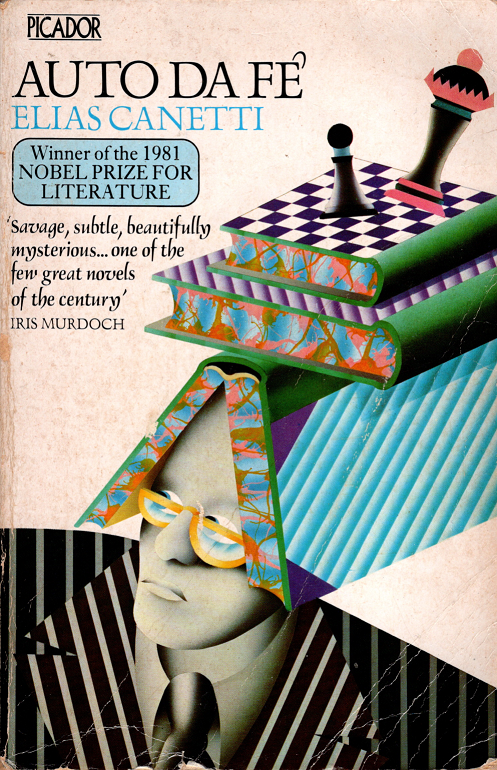
Auto-da-Fé
by Elias Canetti.

A rum cove, this Peter Kien. An eminent sinologist living in a mid-European city (never named but most likely a thinly-fictionalised Vienna), he generally eschews the many professorships and guest lecturing gigs he is offered (thanks to an inheritance he can live off without having to work much, which is nice) in favour of hanging out in his apartment with his gargantuan book collection. I mean, who in their right mind would choose books as more palatable companions than people, right? Oh all right then. 

But there are tedious administrative chores to be attended to - cooking, dusting, unblocking the toilet, that sort of thing - and eminent sinologists have too much of the old eminent sinology (hardest game in the world, the old eminent sinology game) to do to be bothered with such trivial matters. So Kien hires a housekeeper, Therese, a robust woman of middle-aged years, and after she shows an unexpected interest in his books Kien rashly proposes marriage, despite having very little idea of what the, erm, practical details involve.

Things start to unravel pretty quickly after that. After a botched attempt at conjugal beastliness Kien and Therese retreat to separate areas of the apartment, and after things escalate further Kien finds himself cast out of his own apartment and onto the street. This causes a couple of obvious problems: firstly he is separated from his beloved books and secondly he has to interact with other members of the human race, something he is ill-equipped to do. He ends up in a dingy club and meeting with a chess-playing dwarf, Fischerle, who saves him from being beaten up and having his money stolen, but then befriends him with the intention of swindling him out of his money. Kien's mental state is starting to fray round the edges somewhat by this stage and he spends a considerable amount of time every night arranging his wholly imaginary library in his hotel room.

Therese, meanwhile, back in the apartment, has struck up a relationship with the apartment block's concierge, Benedikt Pfaff, a man considerably less prissy than Kien about asserting his conjugal rights for services rendered. Somehow Therese, Pfaff and Fischerle cook up a scheme to relieve Kien of a substantial sum of money by pawning all of his books and when Kien discovers the plot and a scuffle ensues everyone ends up down at the police station. 

In a moment of clarity Kien manages to get a telegram off to his brother George, an eminent psychiatrist, who makes his way across Europe to help. George, in contrast to his brother, is a pragmatic and can-do sort of bloke and he quickly sorts out the Therese and Pfaff situation, retrieves all the pawned books and reinstates Peter in his apartment. So, everything's peachy again, right? Well, in a tragic failure of literally his core area of expertise, George has failed to spot that Peter has undergone some sort of catastrophic mental collapse as part of his ordeal, pushing him from A Bit Odd to Properly Deranged and precipitating the climactic act of self-destruction that ends the story.

So, what do we make of this? The short answer is: fucked if I know. A slightly longer answer might involve a list of books on this list to which this has some similarities: I'd say those would include Demian, Nausea, Hunger and probably a few others: one obvious theme here is young (or youngish - Peter Kien is supposed to be about forty) men with no pressing need to work for a living swanning around having rich internal monologues with little direct relationship to reality. It's unclear, for instance, what's going on with the section where both Peter and Therese seem to believe that each has murdered the other, or in the section where Fischerle gears up to head off to foreign parts to make his fortune as a chess grandmaster only to be messily murdered instead. 

What it's supposed to be All About is highly debatable, though it is certainly the case that a generally low opinion of women is a theme throughout. The general critical opinion seems to be that the character of Benedikt Pfaff, who is certainly portrayed as a violent and brutish type who may or may not have sexually abused his own daughter, is some sort of criticism of totalitarianism in general and the fledgling Nazi regime in particular. People in general struggle to communicate with and understand each other? Well, sure. People who love books are dreadful and deserve to die in a fire? Hmmm, not so sure about that.

This was Canetti's only novel, published in 1935 (but not published in English until the late 1940s). The bulk of his literary output seems to have been collections of essays on various topics, but the other thing for which he is most famous is the non-fiction work Crowds And Power, published in 1960. Overall his literary output seems thin for a Nobel laureate, but nonetheless the committee (who are undoubtedly more knowledgeable than me) awarded Canetti the literature prize in 1981. 

It's not an easy or comfortable read, but I quite enjoyed it in a perverse sort of way. It has a violent energy that's quite bracing, although there are peaks and troughs - I found the middle section involving Fischerle and Kien's extended travels round the city tougher going than the other sections involving Kien and Therese and the apartment. The fact that it took me over two months to get through it is partly a reflection of the density of the prose and partly of the fact the we moved house halfway through and opportunities for reading diminished somewhat among the ensuing chaos. Whatever the reason the only books on this list I read at a slower pages-per-day rate were Sunset Song, The Infernal Desire Machines Of Doctor Hoffman, Paddy Clarke Ha Ha Ha, Midnight's Children, Zeno's Conscience, The Bridge Of San Luis Rey, The Conservationist, The Human Stain and Tropic Of Cancer. I certainly wouldn't describe all of those as gnarly and impenetrable, so clearly there are other factors at play here, like for instance the intervention of non-book-related life events, a balance Peter Kien would have done well to learn to observe. 

Wednesday, May 25, 2022

goodbye, cubey tuesday

Halibut Towers has always been a location of the mind, not tied to anything as mundane as actual physical bricks and mortar, concrete and steel, wattle and daub, cowshit and bits of twig and what have you. And just as well, as our recent house move means that I'm currently sitting in the fourth physical manifestation of Halibut Towers since the birth of this blog back in late 2006 (one in Bristol, three in Newport). More on the move and the new house later (well, maybe) but here's a specific thing that caught my eye when we moved in.

Our predecessor left quite a considerable quantity of what you might call "bonus house contents" - or less charitably "random stuff", or less charitably still "shit" - in the house when he vacated it. Overall that's been a pain in the arse, though there have been a few things that we decided we might keep. Anyway, this item is really neither of these things but as it's just sitting quietly on a mantelpiece minding its own business and staying out of the way I'm fairly neutral about it.

So, it's a calendar. Big fucking deal, you might say, and you'd be mostly right, but the detail of its construction caught my eye. As you can see it's basically two cubes which you have to juggle around to make the correct number for the day of the month. Again, big fat hairy deal, you might say, but I was prompted to wonder about the distribution of the numbers across the two cubes, as you can't just randomly distribute the digits across the twelve available spaces and assume it'll work, as there may be numbers you need that you won't be able to make. Before we get into any theorising, here are the numbers on the first cube (0, 1, 2, 6, 7, 8):

And here are the numbers on the second (0, 1, 2, 3, 4, 5):

The secret with these things is not to try and bite off more than you can chew and come up with some all-encompassing Theory of Everything right off the bat, but instead make some obvious statements and see where they lead you. Here's a couple:

  • You need a 1 and a 2 on both cubes, for two reasons: firstly that they need to pair with every other number to make 10-19 and 20-29 and there isn't enough space to store all the second digits on a single cube, and more obviously that you'll need to be able to make 11 and 22.
  • You need a 0 on both cubes, for the first reason above (but not the second, as the zeroth of May is not a thing).

So each cube has three faces already spoken for by the digits 0, 1, 2. That leaves us with six faces as yet unoccupied, and the digits 3-9 to accommodate. Well, that's us fucked, then, you may be saying, because that's seven digits to fit in six spaces. And indeed we would be EXCEPT for the saving grace that you don't need two separate digits for 6 and 9 because you can just turn one upside-down to get the other (and the additional saving grace that you don't need a 69th of May, still less a 96th of May).

It is my assertion that it doesn't particularly matter how you distribute the remaining digits and the arrangement we have here of 3, 4, 5 on one cube and 6, 7, 8 (and by rotation 9) on the other is purely arbitrary. I guess the way to convince yourself of this is that none of the digits 3-9 ever have to be paired with another from the same range and there'll always be a 0, 1 or 2 on the "other" cube to pair with regardless of where they end up.

As always, needless to say I'm not the first person to ponder this problem: others including the great Martin Gardner have kicked it around as well.

Friday, April 29, 2022

sounds like a cue for a song

The World Snooker Championship is on again, which means it's time for some pointless bitching about how the scoring system is all wrong, or something like that. Well actually I'm totally over all that now and have moved on with my life, and so should you. No, today's snooker-related post (also a music-related post, as you'll see) was inspired by this tweet:

What this tweet is alluding to, of course, is the 1986 hit single Snooker Loopy by The Matchroom Mob featuring Chas & Dave. You'll note if you watch the linked clip that Chas & Dave solve the problem by emphasising Meo's Italian ancestry rather than his relatively modest snooker career achievements. You'll recall with a cringe as well the bits at the end of each verse where the player featured in that verse sings the last line himself, with results that might be described as charmingly amateurish, if you were literally insane and/or deaf. 

Snooker Loopy is enough of a cultural trope that you'll notice I used snippets of its lyrics as the titles of at least two snooker-related blog posts, the one I linked to above and this one from a year or so earlier. 

Anyway, back to the song, and the Tony Meo verse in particular - one thing I remember being baffled by at the time and which has become no clearer in the intervening 36 years is: what the heck is Meo actually saying in his one line of what you might loosely call "singing", if you were literally insane etc. etc.? Well, you might say, here's where your multifarious lyric websites come in handy. This one for example offers up the entire verse as follows: 

Now ol' Meo as we all know's
Got loadsa dappa suits
London bred and he keeps his head
'Though he's got Italian roots
Emotional but he keeps his cool
'Til he reaches the finals
And whether he wins or whether he don't
"I always bite me eyeballs"

I mean, what? Leave aside the physical impossibility of biting your own eyeball, at least without removing it from its socket first, still less the impossibility of playing professional-level snooker afterwards, why would you be doing that? Most of the other lyric websites say the same thing, though of course there may be a certain amount of websites just copying each other's content going on here. This site chooses to take a rather prissy approach to potentially offensive content and not only asterisk out the word "balls" which features several times but also render Willie Thorne's name as "W***** Thorne". More confusingly they render Meo's line as "I always b*** me eyeballs" which is a bit mystifying and should surely be "I always b*** me eyeb****" for consistency anyway.

Other variations are available including here, here and here. A quick recap of the main contenders:

I always bite me eyeballs
I always b*** me eyeballs
I always wipe me eyeballs
I always pipes his eyeballs
I always pipe me eyeballs

Strangely, while you might be raising an eyebrow (or an eyeball) at the last two, it's these, or more specifically the last one, which turn out to be correct, as confirmed by the late Chas Hodges himself, or possibly whichever prankster ran his Twitter account in 2012. See for yourself:

I expect you'll be experiencing the same mild disappointment as when we finally discovered, together, what the B-52s were saying in Love Shack. But there you are, no use piping your eye over spilled satin and silk, as Chas would have said. 

Sunday, April 10, 2022

the last book I read

Station Eleven by Emily St. John Mandel.

So there's been a global pandemic of an airborne flu-like viral disease. I mean, stop me if you've heard this one before. This one is a bit more deadly than COVID-19, though, and has taken out around 99% of the global population.

We're going to tell this story via jumping between various timelines, though, so come with me now to fair Toronto where we lay our scene, and verily and forsooth and hey nonny nonny and all that stuff we're in a theatre, and we're Doing A Shakespeare, King Lear in fact. Playing the king is none other than celebrated film actor Arthur Leander, a bit balding and past his prime and in the throes of divorcing his third wife but making a return to the theatre, his first love, the roar of the greasepaint, the smell of the crowd, all that stuff. 

Actually, Arthur is feeling a bit peaky tonight as he has some sort of flu-y bug that he picked up somewhere (it's never very clear where). He is unable to keep this a secret for long as halfway through the play he has a massive heart attack, scrapes agonisingly down the scenery and expires on the floor. It's never completely clear whether we are to assume that he died of the flu virus which has already made landing in North America, or just carked it in an unrelated incident. Either way, his death soon pales into insignificance as the virus rips through all major cities, giving those trapped in them a terrible dilemma - try to get out? but how? in a car? all the roads are gridlocked - stick around? but where is safe? and how do you get food? and what happens when the water and electricity go off?

We now zoom forward twenty-odd years to a post-pandemic world. One obvious difference: not nearly as many people. Most of those who have survived do so outside of the cities, which are vaguely alluded to as chaotic mass graveyards. But there's no TV or internet, so what do you do in the small gaps of leisure time that remain in between the life-and-death struggles for survival? Well, what the Travelling Symphony do (as the name suggests) is rove around and play music to the people who remain in the various scattered settlements, as well as enacting some Shakespeare plays. The cast of actors and musicians has changed over time as people have come and gone, but one of the principals as we meet them is Kirsten, who just happens to have been a child actor in Arthur Leander's fateful production of King Lear back in the before times.

The Travelling Symphony pass through many towns on their roving travels, generally around the southern end of Lake Michigan, to mixed receptions and crowds. I mean, that's showbiz, right? But things change when they pass through the small settlement of St. Deborah by the Water - they've visited before, but since then the town seems to have been taken over by some slightly odd culty religious types, led by a smiling young man just referred to as The Prophet. The Travelling Symphony do a performance and are then invited to stay, or, if they don't fancy that, to leave one of their young women as a bride for the prophet, whereupon the more savvy members of the troupe smell what's in the air and organise a very swift packing up and moving on, heading for the airport terminals at Severn City where it is rumoured that there is a Museum of Civilisation - a repository of old artefacts: mobile phones, credit cards, passports and the like.

Turns out that's not the end of it, though, as hot on the heels of the discovery that a child from St. Deborah by the Water has stowed away with the company, two of the sentries sent out from the place where they've stopped to camp fail to return from their patrol. What's going on?

Probably about time for another excursion into the past - we get some insight into Arthur Leander's early life and in particular his relationship with his first wife Miranda. Miranda spends much of her time working on her comic-book opus Station Eleven, a sort of science fiction graphic novel thing. It further transpires that by a sequence of coincidences one of the few printed copies of Station Eleven has ended up in the hands of Kirsten, who reveres it as some sort of holy relic. 

Kirsten and her friend August go off on a foraging expedition in the morning following the sentries' disappearance, ahead of the main group, who they expect to catch them up. But when they get back onto the road, the caravan is nowhere to be seen. What's going on? 

All becomes clear as Kirsten and August meet an advance patrol from the prophet's group on the road, and see that they have a hostage with them: Sayid, one of the sentries who disappeared from the camp. One thing that surviving in a post-apocalyptic wasteland teaches you is some serious survival skills, though, and Kirsten (who is some sort of knife-throwing ninja) and August (who carries a bow and arrow) dispatch the patrol with brutal efficiency and rescue Sayid, who tells them that the Symphony got wind of the prophet's group and changed course to avoid them, and moreover that the prophet's group are just behind them and they should probably get moving. Too late, though, as they are discovered, and brought out from their hiding place at gunpoint. 

Redemption arrives in the nick of time from an unexpected source, though, and the group reunite with the main body of the Travelling Symphony, whereupon they complete the journey to Severn City Airport and meet the much larger group who have lived there ever since the airport was used as a venue for diverting flights away from major cities in the early days of the pandemic. But do they stick around in relative safety, or continue their travels, maybe to the south where there are rumours of settlements where people have managed to get the power back on?

Any novel depicting the onset of a viral pandemic and the aftermath of the societal breakdown that follows in its wake will have to bear comparison with many other novels in a similar genre, most obviously Stephen King's epic The Stand. If you remove the requirement for the apocalypse to be specifically human-viral in nature then you can add The Road, O-Zone, Riddley Walker, Dr. Bloodmoney, Cat's Cradle, When She Woke, The Pesthouse and The Death Of Grass just from the list of previous featurees on this blog. 

The Stand is the obvious point of comparison, though, and the contrasts are interesting. Both focus on the early days of the outbreak (though Station Eleven's timeline jumps around a lot more), but Station Eleven explicitly avoids getting into the detail of the collapse of society and the associated murder and cannibalism and instead jumps forward twenty years to the relative tranquility of the post-pandemic routine, though of course you can still be randomly raped and murdered at any time. This is obviously a carefully-considered authorial decision, the idea presumably being to focus on the uncrushable nature of the human spirit and the humanising influence of Art, but it makes the post-pandemic sections oddly light on peril. Obviously there are some other differences as well, most notably The Stand's explicitly supernatural elements. 

The sections featuring Arthur Leander, his first wife Miranda, and her graphic novel which finds its way into Kirsten's hands and functions as some sort of metaphor for the post-pandemic world are interesting in their own way but to my mind occupy too high a percentage of the book, and the whole graphic novel sub-plot seemed to be striving for some significance that I couldn't quite grasp. While perfectly adequately entertained I found myself keen to get back to what Kirsten was doing and see where that strand of the story was going. 

So, anyway, is Station Eleven as good as The Stand? No, but they are different books and that's a high bar to clear anyway. Is it nonetheless excellent? Yes it is. It was made into a TV series in 2020 (with seemingly some significant changes to plot and characters), filming ironically being disrupted by the onset of a global viral pandemic, though thankfully a slightly less deadly one. The rapid onset of societal panic here is very reminiscent of the turmoil of the early days of COVID-19 (again, differences of scale and severity notwithstanding) and the general feeling that as great as they are in normal times a big city with a gazillion other people is just the worst place to be when things all Kick Off in a big way.

Station Eleven also won the Arthur C Clarke Award in 2015, an award which (as its name suggests) is for novels classified as science fiction, something which seems a bit of a stretch here. The same could be said of the 2010 winner, which just happens to have been the previous book on this list, The City & The City. Those are the only two winners to feature on this blog, but authors who have featured here who won the award for different books include Margaret Atwood, Christopher Priest, Neal Stephenson and M John Harrison

Tuesday, March 29, 2022

a short interval where I interpret the internet

Same as last time, just a few follow-up thoughts after the last book review

Firstly, I follow Flags Mashup Bot on Twitter because I have a nerdy fascination with flags (I follow a few map-related accounts for a similar reason). Basically that account produces flags of imaginary countries by combining the colours and names of two existing countries and their flags. Here's a thing they came up with a couple of days ago:

One for the coincidence OR IS IT files (the answer as always being: yes; yes it is). It turns out the Ul Qoma flag is a fairly regular featuree as an ingredient; presumably there's just a database of flags that the bot randomly chooses from. But (and I'm sure you're ahead of me here) in what sense is there actually a flag of Ul Qoma? 

Fortunately for the purposes of this post, and also for the theory that 90% of Twitter interaction is just bots interacting with and retweeting each other, there is a counterpart bot called Original Flags Bot which replies to each of the mashup tweets with images of the original flags. The Ul Qoma one is the one on the left. 
A bit of Google image searching turns up this page which seems to suggest that the flags (there is a Besźel one as well, though it doesn't seem to be in the mashup database) were cooked up for the 2018 TV adaptation, which is the explanation that makes the most sense, on reflection.

Another thing I noticed from reading The City & The City was the regular use of the word "interstices"; it's a good word and describes the notion of unseen things lurking in unsuspected spaces pretty well, this being one of the novel's major themes. I think most people know how to pronounce "interstices"; emphasis on the second syllable, in-TERSE-tiss-eeze. What was less familiar to me was the use of the singular form of the noun. Challenge number one here is: what even is the singular form of "interstices"? I think if you'd asked me a couple of weeks ago I would have said: actually I dunno, is it one of those words ending in "x" that gets an "ices" in the plural form? Like, say, "matrix", or "index"? So maybe the singular form is "interstix" or "interstex" or something like that? Not a completely ridiculous thing to imagine, but, as it happens, wrong: the singular form is "interstice". But how are we saying that? Surely not in-TERSE-tiss-ee? But, equally, surely not IN-terst-ICE either?

Well, it turns out it's in-TERSE-tiss. I think this is counter-intuitive for a couple of reasons; firstly that I still have the residual sense of saying something like "matrice" or "indice" which would be obviously wrong, and secondly that most three-syllable words that start "inter-" have the emphasis on the first syllable rather than the second, like "interview", "internet", "interval", "intercom", and so on. "Interpret" is the only other obvious example I can think of of such a word where the emphasis falls on the second syllable.

Monday, March 28, 2022

the last book I read

The City & The City by China Miéville.

Evenin' all. The name's Borlú: Inspector Tyador Borlú of the Extreme Crime Squad. Yeah, I guess I'd call myself a maverick cop: don't always play by the book, but - dammit - I get results. Where? Well, I'm in Besźel, but there's another city as well - a city (takes drag on cigarette) .... OF THE MIND. Though, erm, also totally real (coughs). Anyway, I'm going to hand you back to your blogger now. No further questions; mind how you go.

Um, thanks. So we're in Besźel, a rather run-down city-state on the far Eastern edges of Europe, probably somewhere in the area occupied by Romania and Bulgaria, and Inspector Tyador Borlú of the Extreme Crime Squad has been called out because, well, there's been an extreme crime. Murder, in fact: a young woman found dumped naked under an old mattress on a piece of waste ground next to a newish housing development. But who is she? And why was she killed? 

Borlú finds it frustratingly difficult getting his investigation off the ground, even the basic stuff like finding out the young woman's name. He soon realises that this is because he's starting his investigation in the wrong place. We need to do a wibbly-wobbly dissolve here for a bit of exposition. The city-state of Besźel, it turns out, occupies only a portion of the larger physical city where it is located. The other half(ish) of the physical city is occupied by the neighbouring (and rather more affluent) city-state of Ul Qoma, with a complex and circuitous border dividing the two, including areas of "cross-hatch" which are in both cities at once. But you can't just walk from one to the other, my goodness no; well, in fact you can in that it is physically possible, but it is forbidden in the strictest terms and if you do you will attract the attention of the shadowy organisation called Breach who police these things in a very robust way. 

For that reason Besźel and Ul Qoma natives are conditioned from birth not only to avoid the possibility of physical breach but even to "unsee" things right in front of them which are in the "other" city. Even waving at someone across the city boundary, or reading a street-sign, admiring a building - these are all acts of mental breaching which run the terrible risk of bringing Breach down upon you, something you emphatically do not want.

Anyway, it turns out that the murdered woman is Mahalia Geary, an American student based in Ul Qoma and heavily involved in various archaeological digs there. But why would someone kill her? Well, it turns out that she was involved with various shady unificationist groups in both cities - people who, as the name suggests, want an end to the segregation of the city. In order to continue his investigation Borlú finds himself having to cross into Ul Qoma by the only legally permitted method, crossing at the single border point under Copula Hall, a building existing simultaneously in both cities. It's not quite as simple as that, though, as after a lifetime of studiously unseeing everything in Ul Qoma he now has to undergo a rigorous and intensive acclimatisation programme to teach him to flip all that on its head and instead unsee everything in Besźel. 

On hooking up with some of Mahalia's associates - both the respectable kind at her place of study and the sketchier kind who shared her subversive views - Borlú becomes convinced that she was murdered because she knew something, something about the city, something that she was not meant to have known. But what? Could it be connected to her work on the fringe theory that there is actually a third city, Orciny, invisible to both Besźel and Ul Qoma and secretly controlling both? 

Eventually things kick off when Borlú tries to smuggle Mahalia's friend Yolanda over the border back into Besźel and a sniper picks her off with a head-shot at the checkpoint. But she was in Ul Qoma and the shooter was in Besźel, so whose jurisdiction does it fall under? And since the murder occurred across the legal border boundary, no breach has technically occurred, so there's nothing for Breach to be interested in. Borlú soon solves that problem by chasing the sniper and shooting him. Trouble is the shooter is in Besźel and Borlú is in Ul Qoma, so this is an act of breach, and sure enough almost immediately various shadowy figures appear as if from thin air, seize Borlú, tranquilise his ass and spirit him off to a mysterious location for interrogation. 

Once in the clutches of Breach Borlú soon realises that they are just a bunch of guys, albeit deadly combat ninja stylee ones, and moreover guys who are quite interested in what Mahalia knew, and Borlú now knows, which is why he hasn't just been summarily rubbed out and dumped in a canal like some of the more commonplace breachers. Some further detective work (facilitated by Breach's near-limitless powers within the city boundaries) reveals that the whole Orciny thing is a fairy-tale (if there is a shadowy third city it is Breach itself) designed to cover up a much more mundane scheme of corrupt selling-off of archaeological artefacts to large corporations, a scheme involving various high-ranking Besźel government officials who will stop at nothing to avoid capture, even arranging large-scale breachings and plunging the whole city/cities into anarchy. 

As with many mystery thrillers the pay-off here (i.e. wherein the solution to the mystery is revealed) doesn't really match up to the build-up (it's some fairly vanilla cheesy corporate evil), but by the time we get to it (and all the various climactic explosions and shootings) that doesn't really matter as that's not what the book is about. What it is about is the perfection of the central conceit of the two cities, their geographical intertwining and the conditioned behaviour of their respective inhabitants. This is the sort of idea that constantly teeters on the edge of absurdity - the reader, in a way, is having to do their own "unseeing" to avoid the whole fragile construction shattering under the strain of its own implausibility. There are a few jarring moments when foreigners visit the cities and start galumphing about breaching left right and centre like a herd of bleedin' elephants where there is a danger of the reader taking a step back and saying: yes, actually this is a bit silly, but generally the reader is kept securely tethered to the central premise, something that takes considerable authorial skill and discipline.

No doubt there are a few metaphors being played out here: the fundamental absurdity of arbitrary lines on a map as dividing lines between groups of closely-related people on the ground, totalitarianism and the desire to control even the near-unconscious thought processes of your citizens (so echoes of Nineteen Eighty-Four, of course), but also the "unseeing" that most of us do every day (or at least every day during non-pandemic conditions when we're free to roam the streets) of litter, dogshit, homeless people, conflict, harassment, etc. 

The most important thing to take away here, though, is that this is an absolutely terrific read for anyone even slightly interested in boundary-pushing fiction, mystery thrillers, or really just fiction in general, and I recommend it highly. Here's a brief interview with the author wherein he gives a potted summary of the plot.

The City & The City was adapted into a four-part TV series in 2018 starring David Morrissey (a former featuree here) as Borlú; obviously the key question you'll be asking is: how do they render the "unseeing"? And the answer is: with some blurring, like this. That works OK as far as I can see, though as it happens the mental picture I had was of the "other" city sort of receding to a lower-contrast, lower-brightness washed-out near-monochrome. Potayto potahto though, innit.

The City & The City also won a host of science fiction and fantasy awards - even though, unlike Miéville's earlier work, it arguably contains almost no elements of either genre - including the venerable Hugo Award, the other recipient of which to feature on this blog was The Dispossessed

Tuesday, March 22, 2022

shocking news

A couple of quick follow-ups (follows-up?) to the My Abandonment post:

You'll recall my slight bafflement at the odd but pivotal episode in the book where Caroline and her Dad stumble upon an odd little makeshift building where they meet another odd couple (a woman and a boy), get agreement that they can stay the night, and then find the following day that the woman has killed Dad while Caroline and the boy were out sledging (no, not like that). Well, it turns out that Peter Rock's earlier novel The Bewildered featured a group of people who steal copper wire from power lines and have some sort of odd addiction to being in close proximity to high-voltage lines and even getting electric shocks. So I think those in the know (i.e. who've read the earlier book) are meant to draw the inference that the couple here (and their odd dwelling place - the Shock Shack, the Yurt of Hurt, the Shed of Dead, if you will) are perhaps characters from the earlier book and that their odd behaviour and baldness is a side-effect of extended proximity and occasional zappings. This newspaper article reproduced on Rock's website alludes to links between the two novels as well. 

I should add that while I try not to be a language prescriptivist the repeated use of the word "electrocution" to describe the receipt of non-fatal electric shocks made my teeth itch a bit, as the word as originally coined in the late 19th century was a portmanteau of "electricity" and "execution" and specifically referred to an electric shock resulting in death. Buuuuut language evolves and all that stuff and I note through gritted teeth that some (though not all) dictionaries now allow "death or severe injury" as a possible outcome. 

Lastly, I note from the Kirkus review I've already linked to that one of the main protagonists of The Bewildered uses Yukio Mishima's The Sailor Who Fell From Grace With The Sea as a sort of life guide, which seems like a generally bad idea.

Monday, March 21, 2022

the last book I read

My Abandonment by Peter Rock.

Caroline's Mum has died, so now she lives with her father. Not that unusual, of course. And where do they live? Weeeeell slightly unusually they live in a series of makeshift shacks built from tarpaulins, branches and bits of moss in the vast area of Forest Park on the edge of Portland, Oregon. A thrilling environment for a thirteen-year-old, though, right? Well, yes, in some ways, although there are the mundane day-to-day concerns of keeping dry and warm, not getting assaulted and/or murdered, finding somewhere dry and secure to keep your stuff (or enduring having to carry it around with you) and not being discovered by the authorities, who take a dim view of this sort of thing.

Discovery is also a risk when Caroline and her father have to make their regular trips into the city (which is fortunately only a short walk away over the St. Johns Bridge) to buy food and supplies and also to collect and deposit Dad's monthly veteran's pension cheques, their only regular source of income. But you've got to eat, and while Caroline maintains a little vegetable patch in the forest that doesn't feed them both, and similarly while she and Dad are pretty crafty with the old Swiss army knife it's pretty difficult to whittle yourself a new pair of shoes out of tree bark when the old ones wear out. 

Nonetheless Caroline and Dad have managed to exist like this for about four years, since they were reunited in initially rather vague circumstances following Caroline's stint with some foster parents. But all good things come to an end, and, following a chance encounter where Caroline is spotted in the vicinity of their current lodgings by a jogger, The Man turns up, tooled up and in intimidating numbers and Caroline and Dad find themselves carted off to a place of confinement and questioning where they are kept separated from each other.

Caroline is placed in the care of some people who seem nice but are very curious about the exact details of her life in the forest with Dad and keen to determine how she's managed without formal education (answer: pretty well, as she's acquired a set of encyclopedias, so she's pretty much on top of any subject starting A to L). As apparently sympathetic as they are to their situation they aren't about to allow them to continue living in the forest; instead they arrange for Dad's practical outdoor skills to be put to use by finding him a job on a horse ranch, a job that comes with living quarters provided and the prospect of Caroline attending school like "normal" people. 

It is here that some cracks start to appear, in particular in Dad's psychological state - we already know he is a veteran and seems to be suffering from some form of PTSD, and he has constant dreams about helicopters from which he awakens in an agitated state. Nonetheless he is diligent about his work and Caroline is happy exploring the ranch and making plans for going to school. Then one night Dad decides that it's time for them to pack their bags, slip away and jump on a bus to who knows where. An escape from the gilded cage and the prying eye of The Man? Or a spectacular pissing on one's newly-acquired chips? You decide.

Things get more chaotic from here on - Dad and Caroline spend a period squatting in a condemned hotel block for a while and Dad accepts some shady and mysterious work from some shady characters to beef up their savings. Eventually it is decided that it's time to get out of the city and forage for nuts and berries in the countryside. It turns out that it may not have been the best time of year to make this decision, though, as once they've taken a bus journey into central Oregon Caroline and Dad soon find themselves trudging through snow and having to spend a series of fairly miserable nights either in the open or breaking into uninhabited buildings for shelter. This culminates in the bizarre episode where Caroline and Dad break into some sort of remote hut, powered by some sort of Heath Robinson series of wires spliced off a nearby power-line, only to find it already occupied by a woman and a boy, both A Bit Strange in some indefinable way - after it is agreed that they can stay the night Dad suggests that Caroline take the boy out to play in the snow in the morning so he and the woman can have "a chat". It's unclear whether Dad was expecting any jiggy-jiggy but that's not what ensues, or maybe it is and then an argument breaks out - either way when Caroline returns to the hut (meeting a hastily-departing woman on the way) she finds Dad entangled in the wires and clearly dead from a massive electric shock. 

After dragging his body to a more appropriate final resting place (a nearby cave), Caroline sets off on her own. She still has some of Dad's money (and access to future cheques until such time as the authorities learn of his death), but will she be able to manage without him? Or will she be better off without his increasingly erratic guidance?

I mean, PLOT SPOILERS and all, but the ending is more upbeat than you might expect from what's gone before: Caroline treks all the way to Boise, Idaho to revisit her childhood foster home and ponder on some of the questions raised (or, rather, implicitly invite the reader to ponder on them), like: why was Caroline put into foster care in the first place? Is the sister she grew up with, who she knew as Della, actually her real-life sister, as Dad had suggested? And given that he'd basically just turned up out of the blue one night and spirited her off, can we be sure he was actually her father after all? And what of her mother? None of these questions is answered in any definitive way but Caroline departs satisfied, returns to rural Oregon and finds herself an outdoorsy job that enables her to live as she wants.

My Abandonment is based on a curious real-life case from 2004 where a fiftysomething man and his daughter were discovered living in Forest Park in circumstances very similar to those described in the book. According to the news articles collected on the author's own website, the real-life story ends at the point the pair did a runner from their post-forest accommodation. Who knows what happened to the real-life pair after that, but this is the point in the fictional version where things really start to unravel, mainly through Dad's increasingly suspect decision-making and Caroline's growing awareness that he is not the rock-solid infallible life guide she'd always thought he was when she was younger. What was wrong, she thinks, with the nice little life we were starting to settle into at the ranch? I could have made some friends at the school. Would that really have been worse than dodging drug dealers in a derelict hotel, or shivering in a snowy field? Is this "freedom"? Is being warm and comfortable really so bad?

The circumstances of Dad's eventual demise are a bit odd, to say the least. I'm not sure what we are to make of the pair they meet in the little yurt with the power hook-up, who they assume are mother and son but turn out not to be. Why do they talk so strangely? Why are they both bald? What happened inside the yurt while Caroline was outside in the snow? How come the woman is so casual about having just committed a murder? The whole episode just seemed to have a slightly incongruous tone in comparison to the rest of the book. I suppose I should add that the ending seems slightly implausible as well, Caroline managing to re-integrate herself into society somewhat is a nice satisfying conclusion to her character arc but you can't help feeling there'd have been more difficulty involved in doing something as basic as applying for a library card if you'd basically disappeared from society for several years, and if you provided your real name or some real documents that would surely invite the possibility of setting some alarms off at whatever government agency prised her and Dad out of the forest camp in the first place.

You're inclined to let Caroline off, though, because she is a very appealing central character and you are rooting for things to work out for her. She's somewhat reminiscent of Ree in Winter's Bone: undemonstrative and a bit quiet to start with but developing a steely self-reliance as she gets older. The father/child relationship with the father's death at the end is also reminiscent of The Road, although the father here is a much more ambiguous character. The doomed desperation to stay away from any reliance on "society" with its money and television and cheeseburgers and squalid moral compromises is also slightly reminiscent of The Mosquito Coast (whose father figure also dies at the end).

The key with a novel written from the viewpoint of a thirteen-year-old girl (she's about seventeen by the epilogue at the end) who's obviously very bright but has had a rather unconventional upbringing is to make her voice convincing, something that will go unnoticed if you do it right, but will be jarring if you get it wrong. I think it's pretty well done here, Caroline being fairly naïve about many things and (at least at first) unquestioning about some of the odder aspects of her situation, and occasionally reeling off factoids and definitions that she's obviously memorised out of one of her encyclopedias. 

Some reservations about unanswered questions aside (mainly relating to Caroline's earlier childhood and the fatal interlude at the House Of Electric Death) this is powerful and engaging stuff, grappling with tricky questions about parenthood, trust, freedom and acceptable levels of state intrusion into people's lives, or, to look at it the other way round, the state's duty of care to prevent people fucking up their lives and the lives of their children. 

My Abandonment was adapted into a film called Leave No Trace in 2018, which appears to take some considerable liberties with the later stages of the plot, including leaving out the father's death.