Bear with me once again as I indulge my fondness for map-related trivia. Here's an interesting little website that uses data from the UK electoral roll to pick out hotspots for particular surnames, i.e. regions of the country where that name is statistically over-represented. As the explanatory blog post explains, it's far from infallible, but it's quite interesting nonetheless.
Also interesting is the feature whereby you can put in your name and your spouse's name and see if it can work out where you might have met. As it happens there's absolutely no chance of it identifying where I met my wife, for a couple of reasons - firstly because we met (10 years ago this last New Year's Eve!) in Thornton Heath in south London, somewhere neither of us has ever lived, but secondly, and more interestingly, because the hotspots for our respective pre-marital names, Thomas and Hannant, are about as far apart as it's possible to get in mainland Britain, in terms of east-west separation anyway.
The hotspot on the left, somewhere just a few miles north-east up the River Towy from Carmarthen in west Wales, is the one for Thomas. It's obviously pretty unsurprising that this should be in Wales, although as I understand it most of my forebears lived a bit further east, nearer Cardiff. The Hannant hotspot is a few miles north of Norwich, about a third of the way between Norwich and Cromer. I seem to recall my father-in-law telling me he thought the name was of French origin, although other theories are available, including a possible Scottish origin.
Anyway, thank goodness for increased social mobility, as it would take quite a bit of dedication to sustain a relationship over that distance - even if you're ignoring the exact centres of the hotspots and just going from Carmarthen to Norwich Google Maps reckons it'll take somewhere in the region of five-and-a-half hours to drive, or seven-and-a-half if you're on the train.
Sunday, February 28, 2016
Friday, February 26, 2016
it's a steady job, but he wants to be a paperback reader
I got the train and bus into work this morning, something I used to do every day but now only do when there's a specific reason to. That reason is usually (and tonight is no exception) that I'm planning to go straight to some sort of social event afterwards involving alcohol consumption and don't want to be sipping orange juice and lemonade all night.
One of the most important things to remember when taking public transport, for the serious bookworm at least, is to take a book with you. I always have my current book in my laptop bag anyway, which is fine for going to work, but I'm planning to leave the bag in the office later so I need to remember to transfer the book to being on my person in some way. This prompted a couple of thoughts about problems which solely afflict dedicated Book People like me:
if you're not intending to carry a bag, you need a pocket big enough to slip a paperback into. You can generally just about fit a standard A-format paperpack (a standard Penguin, say) into the back pocket of a pair of jeans, but only if it's not too thick (and, I suppose, if you haven't got such a massive arse that the back pocket has no "give" in it at all). This is a bit unsatisfactory, as you'll discover as soon as you try to sit down. What you really need is a jacket with some of those big internal pockets that I like to call "poacher's pockets" although they're actually something slightly different. My battered old Nike fleecy zip-up jacket illustrates what I mean perfectly, as well as giving a tantalising glimpse of my current reading material. No clues!- even if you have the right sort of jacket, you can still have a problem. Most obviously, it might be glorious summer weather and you don't really want to be wearing a jacket at all. One alternative that I have occasionally resorted to in the past is slipping the book into the external side pocket of a pair of cargo shorts. You need to be careful that it doesn't fall out when you sit down, though, although if you're sitting down for any length of time you'll presumably have the book in your hand anyway, as you'll be reading it.
- freakishly outsize books can cause a problem - these problems range from very thick standard-size paperbacks (Infinite Jest, say) which cause an unsightly bulge in your coat and weigh one side of it down, to paperbacks only available in the giant C-format (aka "trade paperbacks") which probably won't fit in a pocket at all. One example on my bookshelves (which I have yet to read) is Mark Z Danielewski's House Of Leaves, which seems not to be available in any smaller format, presumably because all the crazy typesetting trickery in the original makes it un-reformattable. Probably best to save these for holiday reading when you only have to lug them as far as a sun lounger.
- another nightmare scenario is: you need to take a trip such as the one I'm taking today, but you've nearly finished your current book, and aren't confident that you'll have enough reading matter left to see out the trip. So what do you do? Take a different book? That's unsatisfactory as it means starting one book before finishing another, which not only contravenes some unwritten rules but also muddies the narrative flow. It's like having a glass of beer followed by a glass of wine - lovely, but if the last sip of beer and the first sip of wine have to be mixed together that'd probably be a bit grim. The alternative is to take two books, which is probably better, but the combined bulk may start to cause what I like to call Infinite Jest Syndrome, as above. You could always carry one in each pocket, I suppose, just to even out the weight distribution, although it might then start to look to your fellow travellers as if you were wearing some sort of suicide belt.
- lastly, you'll know you're a proper bookworm when you can't take a trip to the toilet for a sit-down visit without taking your current book with you, and moreover get all twitchy and nervous if you need a poo but can't find your book.
- a corollary to the last one is: I've often wondered about the acceptability of getting my book out of my laptop bag at work and taking it to the office toilet with me. My gut feeling is that it's probably not an acceptable thing to do, but of course all I'm going to do instead is surf Twitter on my phone, so it's not as if there's any productivity cost associated with it.
Labels:
books,
crackpot theories,
pointless ridiculosity,
travel
Sunday, February 21, 2016
is there an eco in here? not any more
Recoil in horror, readers, as the Electric Halibut LIIIIIIBRARY OF DEEEEEEAAAAATH claims another victim. This time it's Italian polymath Umberto Eco: novelist, philosopher, semiotician, literary critic, leg spin bowler, masseur, plasterer, surgeon, groovy cat, gentleman, scholar and acrobat. A formidable CV indeed, but one that did him no good: once I'd read The Name Of The Rose and posted a review to this blog, it was literally guaranteed that he was going to die at some unspecified point in the near, medium or distant future. And so it proved.
The roll call of those directly and specifically slaughtered by this blog, therefore, now reads as follows:
Eco's death doesn't affect the stats much, as it happens, since the average age for authors to be offed by my book reviews is around 80, and the average time for the curse to take effect is around four years. My nominees from June 2015 (on the occasion of James Salter's death) were Joyce Carol Oates, David Lodge and Milan Kundera. Since I failed to spot Eco then those may as well stand for next time.
Here's an interesting long and wide-ranging interview Eco gave to the Paris Review in 2008, during the course of which he inexplicably failed to predict my hand in his eventual demise.
The roll call of those directly and specifically slaughtered by this blog, therefore, now reads as follows:
| Author | Date of first book | Date of death | Age | Curse length |
|---|---|---|---|---|
| Michael Dibdin | 31st January 2007 | 30th March 2007 | 60 | 0y 59d |
| Beryl Bainbridge | 14th May 2008 | 2nd July 2010 | 77 | 2y 50d |
| Russell Hoban | 23rd August 2010 | 13th December 2011 | 86 | 1y 113d |
| Richard Matheson | 7th September 2011 | 23rd June 2013 | 87 | 2y 291d |
| Elmore Leonard | April 16th 2009 | 20th August 2013 | 87 | 4y 128d |
| Iain Banks | 6th November 2006 | 9th June 2013 | 59 | 7y 218d |
| Doris Lessing | 8th May 2007 | 17th November 2013 | 94 | 7y 196d |
| Gabriel García Márquez | 10th July 2007 | 17th April 2014 | 87 | 7y 284d |
| Ruth Rendell | 23rd December 2009 | 2nd May 2015 | 85 | 5y 132d |
| James Salter | 4th February 2014 | 19th June 2015 | 90 | 1y 136d |
| Henning Mankell | 6th May 2013 | 5th October 2015 | 67 | 2y 152d |
| Umberto Eco | 30th June 2012 | 19th February 2016 | 84 | 3y 234d |
Eco's death doesn't affect the stats much, as it happens, since the average age for authors to be offed by my book reviews is around 80, and the average time for the curse to take effect is around four years. My nominees from June 2015 (on the occasion of James Salter's death) were Joyce Carol Oates, David Lodge and Milan Kundera. Since I failed to spot Eco then those may as well stand for next time.
Here's an interesting long and wide-ranging interview Eco gave to the Paris Review in 2008, during the course of which he inexplicably failed to predict my hand in his eventual demise.
Labels:
books,
crackpot theories,
death
Monday, February 15, 2016
looks like I've peaked too early again
A couple of brief additions to the previous post: firstly you'll notice that there appear to be two summit shots in the photo gallery, one at a low cairn and one at a trig point. This is because Fan Fawr is relatively unusual in having a trig point on its summit ridge, but not at the highest point - the trig point is located half a kilometre or so south-west of the summit and about 20 metres lower.
It's easy to get into the mindset of thinking that trig points are there solely for the walker's navigational and photo-compositional convenience, and simply denote the highest point of a mountain, but of course their original purpose was nothing of the sort. The vast majority of the time if there'a a trig point on top of a mountain it'll be at the summit, but there's no guarantee. In this case the idea presumably was to allow a line of sight off the south-western end of the ridge. The nearest obvious trig points that you might want to be able to see are on the nearby tops of Fan Frynych and Fan Nedd; all three of these seem to have been subjected to a fairly recent smartening-up regime comprising a nice coat of white paint and a stencilled-on red dragon.
While fretting over the slightly unsatisfactory end to the walk route, it occurred to me that you could of course do the walk the other way round, unless you had some quasi-mystical fear of travelling widdershins. At least that way you'd get the scrambling around to get across the ridge, down the steep slope to the Dringarth and down to the footbridge (unless it was high summer and you could just stepping-stone across the river) out of the way while you were still fresh.
The only trouble with that is that it would put the high point of the day (Fan Fawr) no more than a third of the way round the walk, which seems unsatisfactory to me. This is one of those things that you don't realise you have an opinion about until you stop and think about it, but I reckon the ideal arrangement is to have the day's main summit about two-thirds of the way round your route. You don't want it so late in the day that you're too knackered to get up it, but equally you don't want to knock it off too early and have the rest of the day be an anti-climax. Something like four distinct peaks of which the third is the big one would be about perfect, I reckon. Obviously the first rule of having a rule is that you get to break it all the time, as a look back at the high points of some previous walks reveals:
It's easy to get into the mindset of thinking that trig points are there solely for the walker's navigational and photo-compositional convenience, and simply denote the highest point of a mountain, but of course their original purpose was nothing of the sort. The vast majority of the time if there'a a trig point on top of a mountain it'll be at the summit, but there's no guarantee. In this case the idea presumably was to allow a line of sight off the south-western end of the ridge. The nearest obvious trig points that you might want to be able to see are on the nearby tops of Fan Frynych and Fan Nedd; all three of these seem to have been subjected to a fairly recent smartening-up regime comprising a nice coat of white paint and a stencilled-on red dragon.
While fretting over the slightly unsatisfactory end to the walk route, it occurred to me that you could of course do the walk the other way round, unless you had some quasi-mystical fear of travelling widdershins. At least that way you'd get the scrambling around to get across the ridge, down the steep slope to the Dringarth and down to the footbridge (unless it was high summer and you could just stepping-stone across the river) out of the way while you were still fresh.
The only trouble with that is that it would put the high point of the day (Fan Fawr) no more than a third of the way round the walk, which seems unsatisfactory to me. This is one of those things that you don't realise you have an opinion about until you stop and think about it, but I reckon the ideal arrangement is to have the day's main summit about two-thirds of the way round your route. You don't want it so late in the day that you're too knackered to get up it, but equally you don't want to knock it off too early and have the rest of the day be an anti-climax. Something like four distinct peaks of which the third is the big one would be about perfect, I reckon. Obviously the first rule of having a rule is that you get to break it all the time, as a look back at the high points of some previous walks reveals:
- a smidgen over half-way into the Sugar Loaf walk;
- just over a third of the way round the Table Mountain walk;
- almost exactly halfway round the Pen Y Fan trip (but something like 75% of the way in terms of effort, given the severity of the conditions);
- a textbook two-thirds of the way round the Radnor walk;
- halfway round my epic Black Mountains round-trip (but that walk has a longish low-altitude tail on it);
- about 60% of the way round the stag-weekend Black Mountain walk;
- just over halfway round my Llangorse royal-wedding-avoidance trip;
- two-thirds of the way round our Exmoor walk.
Labels:
crackpot theories,
the great outdoors
what becomes of the brecon hearted
As I've said before, when you're a parent of two, and (in my case) married to someone whose work commitments often extend into weekends, you don't get many opportunities for a free weekend day, without childcare commitments, to just go and do what you like, so it's important to capitalise on those opportunities when they arise.
So when it became apparent that this Saturday was just such an opportunity, I decided to get out and walk up some hills, and to hell with the weather forecast. Fortunately my fellow NCT alumnus Alex was available as well, so we drove over into the Brecon Beacons to walk a route of my own devising.
My principal objective here was to do something I hadn't done before, so instead of finding a new way up Pen Y Fan I decided to try a circular walk starting at the Blaen Llia car park just north of Ystradfellte and taking in Fan Fawr, the highest point in what you might call the "central Beacons", that is to say the area west of the Pen Y Fan range and east of the Black Mountain, both bits incorporating higher peaks but also higher numbers of people.
The route basically described a sort of teardrop/horseshoe shape around the ridges surrounding the Dringarth valley, which for the last 100 or so years has incorporated the Ystradfellte reservoir. The weather forecast wasn't great but actually we got through the entire day without being unduly troubled by either extreme cold, high winds or stuff falling out of the sky (a bit of wispy snow excepted). The major weather phenomenon we were hampered by somewhat was low cloud. which became a major problem as we started to head round the head of the valley and towards Fan Fawr. As reasonably confident as I am with a map and compass it's reassuring to have some GPS backup at this point, and in particular it was invaluable to have the BackCountry Navigator app on my phone, which gives you an instant graphical view of where you currently are on an OS map. If we hadn't had this available to us we'd probably have had to bail out of attempting the ascent of Fan Fawr, as it was only intermittently visible even when we were standing right in front of it.
Of course this sort of techno-wizardry is a double-edged sword in many ways, not least in that it tempts you into attempting stuff that you might otherwise think better of (if you were only armed with a paper OS map and a compass, say), and also that it does tend to drain your phone battery, which is problematic if you suddenly have a need to phone, say, mountain rescue.
There was a light dusting of snow on the ridges on the way round, and quite a bit of snow on top of Fan Fawr, although it looked fairly recent as it was still quite powdery and hadn't acquired the treacherous icy crust which made our previous jaunt up the main Beacons peaks a bit dicey. Overall I'd say this is about 80% of a really great walk, the only drawback being the unsatisfactory end, whereby instead of being able to just cut back across country to the car park when you cross the Afon Dringarth via the footbridge below the reservoir dam, you have to do a detour south to get back onto the road and loop back north to the car park. It may well be possible to find a route, but we couldn't see one, so we decided that rather than scramble about fruitlessly we'd accept a couple of miles of extra slog along well-marked paths and road. In hindsight (assuming there isn't an obvious route back that we just missed) it would have been better to leave the car in Ystradfellte village and have that as the start/finish point, at the cost of maybe a mile's extra overall distance.
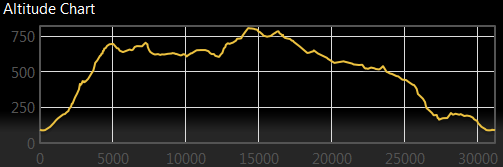
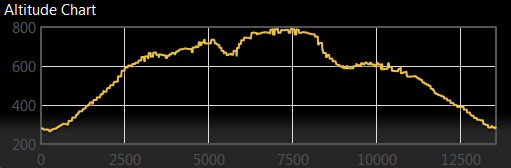
Anyway, here's the route map (via Map To GPS) and altitude profile (via GPS Visualiser) - total distance according to the GPS track log (which I have no reason to doubt) was 13.2 miles. As always, click to provide embiggenment. A small selection of photos can be found here.
So when it became apparent that this Saturday was just such an opportunity, I decided to get out and walk up some hills, and to hell with the weather forecast. Fortunately my fellow NCT alumnus Alex was available as well, so we drove over into the Brecon Beacons to walk a route of my own devising.
My principal objective here was to do something I hadn't done before, so instead of finding a new way up Pen Y Fan I decided to try a circular walk starting at the Blaen Llia car park just north of Ystradfellte and taking in Fan Fawr, the highest point in what you might call the "central Beacons", that is to say the area west of the Pen Y Fan range and east of the Black Mountain, both bits incorporating higher peaks but also higher numbers of people.
The route basically described a sort of teardrop/horseshoe shape around the ridges surrounding the Dringarth valley, which for the last 100 or so years has incorporated the Ystradfellte reservoir. The weather forecast wasn't great but actually we got through the entire day without being unduly troubled by either extreme cold, high winds or stuff falling out of the sky (a bit of wispy snow excepted). The major weather phenomenon we were hampered by somewhat was low cloud. which became a major problem as we started to head round the head of the valley and towards Fan Fawr. As reasonably confident as I am with a map and compass it's reassuring to have some GPS backup at this point, and in particular it was invaluable to have the BackCountry Navigator app on my phone, which gives you an instant graphical view of where you currently are on an OS map. If we hadn't had this available to us we'd probably have had to bail out of attempting the ascent of Fan Fawr, as it was only intermittently visible even when we were standing right in front of it.
Of course this sort of techno-wizardry is a double-edged sword in many ways, not least in that it tempts you into attempting stuff that you might otherwise think better of (if you were only armed with a paper OS map and a compass, say), and also that it does tend to drain your phone battery, which is problematic if you suddenly have a need to phone, say, mountain rescue.
There was a light dusting of snow on the ridges on the way round, and quite a bit of snow on top of Fan Fawr, although it looked fairly recent as it was still quite powdery and hadn't acquired the treacherous icy crust which made our previous jaunt up the main Beacons peaks a bit dicey. Overall I'd say this is about 80% of a really great walk, the only drawback being the unsatisfactory end, whereby instead of being able to just cut back across country to the car park when you cross the Afon Dringarth via the footbridge below the reservoir dam, you have to do a detour south to get back onto the road and loop back north to the car park. It may well be possible to find a route, but we couldn't see one, so we decided that rather than scramble about fruitlessly we'd accept a couple of miles of extra slog along well-marked paths and road. In hindsight (assuming there isn't an obvious route back that we just missed) it would have been better to leave the car in Ystradfellte village and have that as the start/finish point, at the cost of maybe a mile's extra overall distance.
Anyway, here's the route map (via Map To GPS) and altitude profile (via GPS Visualiser) - total distance according to the GPS track log (which I have no reason to doubt) was 13.2 miles. As always, click to provide embiggenment. A small selection of photos can be found here.
Labels:
photolinks,
the great outdoors
Sunday, February 14, 2016
pulled off at half-time
A bit of unfortunate slapdash photo-captioning in this match summary of France's slightly unexpected 10-9 win over Ireland in the first Six Nations match on Saturday. I didn't see any of it as I was slogging up a mountain in the snow at the time (more on this later) but it sounds like it was a pretty desperate and attritional affair, only livened up - or so I gather from the photo caption below, anyway - by the spectacle of Irish outside-half Jonathan Sexton being furiously "milked" by a bald-headed member of the backroom staff. It's all part of the coaching and motivational routine, and presumably serves to settle the nerves before key place kicks.
Just in case you can't read the caption there, it reads as follows:
Johnny Sexton was frustrated to have to come just before France's match-winning tryIn reality I assume there's a missing "off" before the word "just" there, but like I say I didn't see the game so I couldn't say for sure.
Labels:
hotd,
pointless ridiculosity,
rugby,
sport
Friday, February 05, 2016
voodoo chilli (slight reburn)
I have a bit of a thing for spicy food, as anyone who's kept up with my periodic documentation of my Korean noodle fetish will know. That love for chilli-based stuff extends to having a few bottles of chilli sauce in the fridge, just in case anything needs spicing up at short notice. My collection doesn't begin to compare with that of my friend Jim, who has a whole kitchen cupboard full of various chilli-based weaponry, most of it probably technically illegal under some UN chemical weapons treaty. Here's my current hall of fame:
From left to right:
These are all within what I deem to be the acceptable boundaries of good sense when it comes to chilli sauce - my rule of thumb being that if licking a few drops off your finger causes either a heart attack or severe finger and tongue blistering and the need to quaff three pints of full-fat milk afterwards, then you've strayed into the realms of comedy sauce products which are no use to anyone for any actual culinary purpose. Despite that there is a bit of an arms race going on to create things that rate highest on the Scoville scale of chilli intensity. Consider that both the sriracha and Tabasco (and probably the Encona as well) rate at about 2000-2500 Scoville units - the Mama Sita's might be a bit hotter; then consider that Dave's Insanity Sauce, one of the trailblazers for pointlessly hot and inedible sauce products, weighs in at about 180,000 units. Then consider that some of the products made by Blair's rate at over 10 million Scoville units. Then ask: why?
From left to right:
- a somewhat elderly (best before some time in 2012, but I'm pretty sure no germs can survive in there) bottle of Encona West Indian chilli sauce. This is nice, quite sharp and vinegary, but still good as a plate-side dipping sauce;
- a bottle of Flying Goose brand sriracha sauce - purchased in Tesco a couple of days ago. More on this in a minute;
- some bog-standard Thai-style sweet chilli dipping sauce from Asda, pretty mild;
- a bottle of Heinz-brand green sauce supposedly made from jalapeno peppers, not as fiery as you might think, and also probably a number of years past its best before date;
- a bottle of Mama Sita's Hot Pepper Sauce - this is supposedly made from a chilli called Labuyo that is cultivated in the Philippines, very similar to Tabasco but a bit hotter;
- your basic bog-standard Tabasco - no self-respecting bacon sandwich or Bloody Mary should be without it;
- a bottle of Fiesta peri-peri sauce from (I think) Aldi.
These are all within what I deem to be the acceptable boundaries of good sense when it comes to chilli sauce - my rule of thumb being that if licking a few drops off your finger causes either a heart attack or severe finger and tongue blistering and the need to quaff three pints of full-fat milk afterwards, then you've strayed into the realms of comedy sauce products which are no use to anyone for any actual culinary purpose. Despite that there is a bit of an arms race going on to create things that rate highest on the Scoville scale of chilli intensity. Consider that both the sriracha and Tabasco (and probably the Encona as well) rate at about 2000-2500 Scoville units - the Mama Sita's might be a bit hotter; then consider that Dave's Insanity Sauce, one of the trailblazers for pointlessly hot and inedible sauce products, weighs in at about 180,000 units. Then consider that some of the products made by Blair's rate at over 10 million Scoville units. Then ask: why?
Thursday, February 04, 2016
the last book I read
The Man Who Fell To Earth by Walter Tevis.
A man walks into a remote Kentucky town. Not your typical Kentucky town-dweller: tall, pale, skinny. His name is Thomas Jerome Newton, and he's from another planet.
Having made a few exploratory trips into town from the site where his spaceship crash-landed to sell various items of precious metal jewellery, partly to raise some initial cash and partly to verify that he can interact with humans without being detected, Newton moves on to more ambitious pursuits, like building up a multi-million-dollar business empire off the back of various patents for technological wonders, knowledge of which he has brought with him from his home planet.
It's difficult to start and maintain such a business without becoming publicly-known, though, still less without having to trust other people to do some of the work for you. Among the people Newton chooses to trust are borderline-alcoholic housekeeper Betty-Jo and physicist Nathan Bryce. He needs Bryce's help for his Big Secret Project, which turns out to be building a spaceship - this spaceship will return to Newton's home planet Anthea (supposedly in our own solar system, though Newton is cagey about exactly where; it pretty much has to be Mars, though) which has been ravaged by war and drought, and bring back a small number of surviving Antheans to live on Earth, co-exist with humans and, through their prior experience and superior technology, save the human race from annihilating itself and rendering its planet a wasteland.
Obviously it would be unwise just to blurt all this out and expect people to go: yup, OK then, here, let me help you with that Illudium Pu-36 Explosive Space Modulator. So Newton maintains the pretence of being an eccentric, though human, businessman by continuing to wear the fake nipples and contact lenses that disguise his true form. Eventually Bryce starts to smell a rat and rigs up an X-ray machine to capture an image of Newton, weird alien internal structure and all, without his knowledge; eventually Newton is forced to confide in Bryce that yes, he's from another planet, but we come in peace and just want to help you avoid blowing yourselves up. None of that nice planet, we'll take it stuff, good lord no.
Inevitably, though, the authorities get wind of what's going on and take a more paranoid view of the whole situation. So they spirit Newton away to an undisclosed location and get down to some serious probing. Having failed either to conclusively establish that he's from another planet, or get him to confess his plans for world domination, they're obliged to let him go, but not until they've done a couple of last-minute tests on him. Unfortunately one of these tests involves shining high-power X-rays into his eyes, blinding him.
So Newton's plans for sending a ship to Anthea are thwarted. When Bryce finds him again, supping gin in a bar in New York, some sort of political crisis is happening which makes Newton's help more vital than ever. But why would Newton - blind, alcoholic, and with no hope of ever seeing anyone from his home planet again, now that the planetary alignment has shifted - want to bother helping?
The Man Who Fell To Earth (first published in 1963) is most famous for the 1976 film based on it starring David Bowie as Thomas Jerome Newton - Bowie's first major film role and probably still his most successful one, playing some drug-addled emaciated weirdo not being that much of a stretch for mid-70s Bowie. I must confess I haven't actually seen the film, but the book is a tight, fairly short and highly entertaining and provoking read. As always it's about things other than nipple-less aliens building space rockets: more general alienation, loneliness, alcoholism, the impossibility of ever really knowing anyone else, that sort of thing. It's suggested that it may be at least partly autobiographical, and the struggles with alcoholism certainly echo Tevis's own.
There are echoes of other science fiction here: the thing of a representative of a tired, weakened, enervated civilisation on its last legs but still technologically in advance of our own looking for a new start on our green and fertile planet has been done a few times elsewhere. There are also a few echoes of Algis Budrys' Who?, not least in the general Cold War paranoia, but also in the central character's being a figure of suspicion to the authorities, not conclusively enough that they can pin anything on him, but just enough for them to never be able to leave him alone.
The other Tevis in this list, The Queen's Gambit, is probably better, but this is also very good, in its understated way. My edition (featuring a picture of David Bowie from the film) is a Sight & Sound special edition that I assume was originally given away with a copy of the magazine.
A man walks into a remote Kentucky town. Not your typical Kentucky town-dweller: tall, pale, skinny. His name is Thomas Jerome Newton, and he's from another planet.
Having made a few exploratory trips into town from the site where his spaceship crash-landed to sell various items of precious metal jewellery, partly to raise some initial cash and partly to verify that he can interact with humans without being detected, Newton moves on to more ambitious pursuits, like building up a multi-million-dollar business empire off the back of various patents for technological wonders, knowledge of which he has brought with him from his home planet.
It's difficult to start and maintain such a business without becoming publicly-known, though, still less without having to trust other people to do some of the work for you. Among the people Newton chooses to trust are borderline-alcoholic housekeeper Betty-Jo and physicist Nathan Bryce. He needs Bryce's help for his Big Secret Project, which turns out to be building a spaceship - this spaceship will return to Newton's home planet Anthea (supposedly in our own solar system, though Newton is cagey about exactly where; it pretty much has to be Mars, though) which has been ravaged by war and drought, and bring back a small number of surviving Antheans to live on Earth, co-exist with humans and, through their prior experience and superior technology, save the human race from annihilating itself and rendering its planet a wasteland.
Obviously it would be unwise just to blurt all this out and expect people to go: yup, OK then, here, let me help you with that Illudium Pu-36 Explosive Space Modulator. So Newton maintains the pretence of being an eccentric, though human, businessman by continuing to wear the fake nipples and contact lenses that disguise his true form. Eventually Bryce starts to smell a rat and rigs up an X-ray machine to capture an image of Newton, weird alien internal structure and all, without his knowledge; eventually Newton is forced to confide in Bryce that yes, he's from another planet, but we come in peace and just want to help you avoid blowing yourselves up. None of that nice planet, we'll take it stuff, good lord no.
Inevitably, though, the authorities get wind of what's going on and take a more paranoid view of the whole situation. So they spirit Newton away to an undisclosed location and get down to some serious probing. Having failed either to conclusively establish that he's from another planet, or get him to confess his plans for world domination, they're obliged to let him go, but not until they've done a couple of last-minute tests on him. Unfortunately one of these tests involves shining high-power X-rays into his eyes, blinding him.
So Newton's plans for sending a ship to Anthea are thwarted. When Bryce finds him again, supping gin in a bar in New York, some sort of political crisis is happening which makes Newton's help more vital than ever. But why would Newton - blind, alcoholic, and with no hope of ever seeing anyone from his home planet again, now that the planetary alignment has shifted - want to bother helping?
The Man Who Fell To Earth (first published in 1963) is most famous for the 1976 film based on it starring David Bowie as Thomas Jerome Newton - Bowie's first major film role and probably still his most successful one, playing some drug-addled emaciated weirdo not being that much of a stretch for mid-70s Bowie. I must confess I haven't actually seen the film, but the book is a tight, fairly short and highly entertaining and provoking read. As always it's about things other than nipple-less aliens building space rockets: more general alienation, loneliness, alcoholism, the impossibility of ever really knowing anyone else, that sort of thing. It's suggested that it may be at least partly autobiographical, and the struggles with alcoholism certainly echo Tevis's own.
There are echoes of other science fiction here: the thing of a representative of a tired, weakened, enervated civilisation on its last legs but still technologically in advance of our own looking for a new start on our green and fertile planet has been done a few times elsewhere. There are also a few echoes of Algis Budrys' Who?, not least in the general Cold War paranoia, but also in the central character's being a figure of suspicion to the authorities, not conclusively enough that they can pin anything on him, but just enough for them to never be able to leave him alone.
The other Tevis in this list, The Queen's Gambit, is probably better, but this is also very good, in its understated way. My edition (featuring a picture of David Bowie from the film) is a Sight & Sound special edition that I assume was originally given away with a copy of the magazine.
Labels:
books,
films,
music,
the last book I read
Sunday, January 31, 2016
don't you need some doggy to love
Couple of further follow-up observations on old blog posts - firstly, continuing the 2016 theme of celebrity deaths I note the demise of Paul Kantner, songwriter, singer and guitarist with Jefferson Airplane, and, subsequently, Jefferson Starship. It should be noted that he'd quit the band before they mutated, unforgivably, into Starship. Kantner seems, endearingly, to have remained committed to his early counter-culture ideals and sticking it to The Man in general into his 70s. Here's the Airplane rattling through Volunteers at Woodstock in 1969.
Secondly, what is it with Australian rugby league stars and inappropriate sex acts with dogs? You'll recall the strange case of Joel Monaghan and his ill-advised dalliance with a golden labrador in 2010 - well the latest drink-fuelled atrocity is Mitchell Pearce's equally ill-advised drunken dry-humping of a small poodle-like creature at an Australia Day party, captured by an unnamed third party on video and now, inevitably, all over the internet. As boneheaded as this is I'm not sure it compares with Monaghan's exploits, since as far as I can see at no point does Pearce's penis directly contact, still less enter, any part of the dog. If I were him I'd be more embarrassed, in hindsight, at my blatant lack of shame or concern about what appears to be a large piss-stain on the front of my shorts. It is alleged he'd pissed on the sofa as well.
Interestingly, Mitchell Pearce was also involved in one of the most legendary of all pissed-up Aussie rugby league rampages, Craig Gower's terrorising of a golf resort in 2005 - it was he, aged about 16, who was chased "in a threatening manner" by Gower and subsequently vomited on. Maybe that incident made more of an impression than he realised at the time.
Secondly, what is it with Australian rugby league stars and inappropriate sex acts with dogs? You'll recall the strange case of Joel Monaghan and his ill-advised dalliance with a golden labrador in 2010 - well the latest drink-fuelled atrocity is Mitchell Pearce's equally ill-advised drunken dry-humping of a small poodle-like creature at an Australia Day party, captured by an unnamed third party on video and now, inevitably, all over the internet. As boneheaded as this is I'm not sure it compares with Monaghan's exploits, since as far as I can see at no point does Pearce's penis directly contact, still less enter, any part of the dog. If I were him I'd be more embarrassed, in hindsight, at my blatant lack of shame or concern about what appears to be a large piss-stain on the front of my shorts. It is alleged he'd pissed on the sofa as well.
Interestingly, Mitchell Pearce was also involved in one of the most legendary of all pissed-up Aussie rugby league rampages, Craig Gower's terrorising of a golf resort in 2005 - it was he, aged about 16, who was chased "in a threatening manner" by Gower and subsequently vomited on. Maybe that incident made more of an impression than he realised at the time.
Thursday, January 28, 2016
look, it's moby's dick
Couple of further cetacean observations: firstly that there was a bit about the whale strandings on the Today programme this morning which included the claim that the sperm whale's brain is the largest of any animal that has ever lived. I'm not disputing the claim, since it's true, but it does seem to be begging a flippant response along the lines of: well, that's as may be, but they're not very fucking bright, are they? The big blubbery cretins. Harsh? Perhaps.
Secondly, there seems to be a bit of a journalistic thing of calling sperm whales "gentle giants". I'm not sure where this comes from, but while you could argue for the description being appropriate for the big filter-feeding rorquals like the blue whale, sperm whales are actually some bad-ass motherfuckers. For one thing, they eat squid, including the big ones, and they have been rumoured to attack and sink ships, though there's some doubt as to how likely that is. It hasn't stopped Hollywood basing the plot of the new movie In The Heart Of The Sea around it, though. The film is a fictionalised version of the story of the ill-fated whaling ship Essex as previously mentioned here - I couldn't speak for the whole film but the trailers are heavy on the whale-wrangling and boat-smashing and light on the murder and cannibalism.
Lastly, most of the news stories about the recent strandings mention that the whales were all male - as it happens you ought to be able to work this out just by looking at the pictures of the corpses. Honestly, you don't know where to look. Gentle giants? More like genital giants, amirite?
"Sperm whales have the largest brain of any animal that has ever lived"
Podcast: https://t.co/xVQwC4c6z2 pic.twitter.com/2hhAjFbUfA
— BBC Radio 4 Today (@BBCr4today) January 27, 2016
Secondly, there seems to be a bit of a journalistic thing of calling sperm whales "gentle giants". I'm not sure where this comes from, but while you could argue for the description being appropriate for the big filter-feeding rorquals like the blue whale, sperm whales are actually some bad-ass motherfuckers. For one thing, they eat squid, including the big ones, and they have been rumoured to attack and sink ships, though there's some doubt as to how likely that is. It hasn't stopped Hollywood basing the plot of the new movie In The Heart Of The Sea around it, though. The film is a fictionalised version of the story of the ill-fated whaling ship Essex as previously mentioned here - I couldn't speak for the whole film but the trailers are heavy on the whale-wrangling and boat-smashing and light on the murder and cannibalism.
Lastly, most of the news stories about the recent strandings mention that the whales were all male - as it happens you ought to be able to work this out just by looking at the pictures of the corpses. Honestly, you don't know where to look. Gentle giants? More like genital giants, amirite?
Labels:
big rubbery squids,
death,
films,
science bits
Tuesday, January 26, 2016
whale whale whale whale whale how very nice
As well as keeping you up to date with the latest developments in cock graffiti the world over, here at Electric Halibut we also ensure that you've got your finger on the pulse when it comes to exploding whales, not that any of these big blubbery oafs have a pulse any more, apart from a small seismic blip when they explode.
As it happens there's been some big exploding whale news this week as part of the more general whale-related goings-on on the Norfolk and Lincolnshire coasts, where a group of sperm whales have got themselves stranded, and subsequently died, in the biggest sperm whale beaching ever recorded in Britain. It seems to be part of a larger pattern of beachings as there have been a dozen more on the northern coasts of the Netherlands and Germany in the last couple of weeks. As always, the reasons why these mass beachings occur are opaque and subject to much wild speculation: sonar? sea pollution? climate change? dwindling food supply? blind chance?
It's been reported that one of the whales washed up in Skegness has "exploded" - don't be expecting anything as spectacular as some of the whale detonations of the past, though (though to be fair at least one of those was artificially enhanced) - what seems to have happened here was a bit of a venting of foul-smelling air once one of the biologists cut into the whale, a pretty common occurrence by all accounts. There may yet be some scope for a whale explosion of a different kind, though, as the fifth whale to be found appears to have come to rest on a former weapons range on the Lincolnshire coast, a site rumoured to contain much unexploded ordnance. So it could just take a bit of shifting of sand or internal organs, the whale rolling into a slightly different position, and kablooie, hallelujah, it's raining whale. Watch this space.
As it happens there's been some big exploding whale news this week as part of the more general whale-related goings-on on the Norfolk and Lincolnshire coasts, where a group of sperm whales have got themselves stranded, and subsequently died, in the biggest sperm whale beaching ever recorded in Britain. It seems to be part of a larger pattern of beachings as there have been a dozen more on the northern coasts of the Netherlands and Germany in the last couple of weeks. As always, the reasons why these mass beachings occur are opaque and subject to much wild speculation: sonar? sea pollution? climate change? dwindling food supply? blind chance?
It's been reported that one of the whales washed up in Skegness has "exploded" - don't be expecting anything as spectacular as some of the whale detonations of the past, though (though to be fair at least one of those was artificially enhanced) - what seems to have happened here was a bit of a venting of foul-smelling air once one of the biologists cut into the whale, a pretty common occurrence by all accounts. There may yet be some scope for a whale explosion of a different kind, though, as the fifth whale to be found appears to have come to rest on a former weapons range on the Lincolnshire coast, a site rumoured to contain much unexploded ordnance. So it could just take a bit of shifting of sand or internal organs, the whale rolling into a slightly different position, and kablooie, hallelujah, it's raining whale. Watch this space.
Labels:
death,
science bits
the last book I read
The Sea by John Banville.
Max Morden, art critic and historian, has come to a nice quiet guest house in a quiet Irish seaside town in the aftermath of the death of his wife, Anna, from cancer. Not just any old guest house, though, but the former residence of the Grace family who he knew as a child, mainly through their twin children Chloe and Myles.
So we're in That Last Golden Summer territory here, or more specifically that sub-category That Last Golden Summer At The End Of Which That Thing Happened Where My Whole Life Went To Shit. So while he's ostensibly retreating to the coast to regroup after his wife's death and concentrate on making some progress on his latest book, on French artist Pierre Bonnard, Max is actually mooning around drinking too much and reflecting on his childhood visits and his friendship with Chloe and Myles.
Chloe was your standard spiky slightly feisty tomboyish type, while Myles was altogether stranger, web-toed and practically mute, although that didn't stop him and Chloe having that near-telepathic thing that twins have (at least in fiction). Their parents, Mr & Mrs Grace, also employed a governess, Rose, whose life Chloe in particular enjoyed making a misery. Max tagged along for trips to the seaside and other adventures, although seemingly more through proximity and convenience than through any great mutual liking.
So Max continues (in the book's nominal present) to fester at the guest house while his recollections flit between Chloe and Myles and more recent memories of his wife Anna's final days in hospital. Eventually he gets around to describing The Thing that happened to tear the Graces' lives (and to a lesser degree his own) apart - one of those sticky pre-adolescent sexual awakening things followed by a shocking and self-desctructive act of twinly solidarity by Chloe and Myles.
The whole "elderly person retreats to remote location to reflect on their life and That Golden Summer while the past threatens to catch up with them in unexpected ways" thing is a trope well-used in modern fiction, indeed the only other Banville on this list, Eclipse, is structured in a very similar way, as is The Heather Blazing and no doubt one or two others. The Sea is probably better than either of those, just because the queasy, claustrophobic cusp-of-puberty thing is always fascinating, and the contrast with Max's recollections of Anna's death is stark. That said, the pivotal event raises more questions than it answers and doesn't really fit with what we've been told about the twins up to that point.
But of course this is partly the point, since one of the things the book is about is the unreliableness of memory, even of fairly recent events like Anna's death, let alone childhood stuff from 50-odd years ago. The point is also that things like the plausibility of some of the key moments isn't really the point, the point being to revel in the richness of Banville's prose even as you think: well, that business with Chloe and Myles was a bit thinly-explained and unsatisfactory, wasn't it? And how much of this is meant to be taken as reliable recollection, since Max's arbitrary naming of the two nearby villages as Ballymore and Ballyless is pretty clearly not meant to be taken to resemble their real names?
The Sea won the Man Booker Prize in 2005 (not without some controversy), beating, among other shortlisted novels, Never Let Me Go. This makes it - I think - the sixth Booker winner on this list, after G., The Gathering, Hotel Du Lac, Paddy Clarke Ha Ha Ha and Midnight's Children. If pressed I'd have to say I think that Never Let Me Go is a better book, but I did enjoy The Sea, probably more than either of the other two Banvilles (Eclipse and The Book Of Evidence) I've read - Banville's gift for a beautifully-crafted sentence make you inclined to forgive him for some meanderingness and implausibility of plot.
The Sea was made into a film in 2013, presumably with some smoothing out of the timeline. Plenty of heavy types in the cast list, though.
Max Morden, art critic and historian, has come to a nice quiet guest house in a quiet Irish seaside town in the aftermath of the death of his wife, Anna, from cancer. Not just any old guest house, though, but the former residence of the Grace family who he knew as a child, mainly through their twin children Chloe and Myles.
So we're in That Last Golden Summer territory here, or more specifically that sub-category That Last Golden Summer At The End Of Which That Thing Happened Where My Whole Life Went To Shit. So while he's ostensibly retreating to the coast to regroup after his wife's death and concentrate on making some progress on his latest book, on French artist Pierre Bonnard, Max is actually mooning around drinking too much and reflecting on his childhood visits and his friendship with Chloe and Myles.
Chloe was your standard spiky slightly feisty tomboyish type, while Myles was altogether stranger, web-toed and practically mute, although that didn't stop him and Chloe having that near-telepathic thing that twins have (at least in fiction). Their parents, Mr & Mrs Grace, also employed a governess, Rose, whose life Chloe in particular enjoyed making a misery. Max tagged along for trips to the seaside and other adventures, although seemingly more through proximity and convenience than through any great mutual liking.
So Max continues (in the book's nominal present) to fester at the guest house while his recollections flit between Chloe and Myles and more recent memories of his wife Anna's final days in hospital. Eventually he gets around to describing The Thing that happened to tear the Graces' lives (and to a lesser degree his own) apart - one of those sticky pre-adolescent sexual awakening things followed by a shocking and self-desctructive act of twinly solidarity by Chloe and Myles.
The whole "elderly person retreats to remote location to reflect on their life and That Golden Summer while the past threatens to catch up with them in unexpected ways" thing is a trope well-used in modern fiction, indeed the only other Banville on this list, Eclipse, is structured in a very similar way, as is The Heather Blazing and no doubt one or two others. The Sea is probably better than either of those, just because the queasy, claustrophobic cusp-of-puberty thing is always fascinating, and the contrast with Max's recollections of Anna's death is stark. That said, the pivotal event raises more questions than it answers and doesn't really fit with what we've been told about the twins up to that point.
But of course this is partly the point, since one of the things the book is about is the unreliableness of memory, even of fairly recent events like Anna's death, let alone childhood stuff from 50-odd years ago. The point is also that things like the plausibility of some of the key moments isn't really the point, the point being to revel in the richness of Banville's prose even as you think: well, that business with Chloe and Myles was a bit thinly-explained and unsatisfactory, wasn't it? And how much of this is meant to be taken as reliable recollection, since Max's arbitrary naming of the two nearby villages as Ballymore and Ballyless is pretty clearly not meant to be taken to resemble their real names?
The Sea won the Man Booker Prize in 2005 (not without some controversy), beating, among other shortlisted novels, Never Let Me Go. This makes it - I think - the sixth Booker winner on this list, after G., The Gathering, Hotel Du Lac, Paddy Clarke Ha Ha Ha and Midnight's Children. If pressed I'd have to say I think that Never Let Me Go is a better book, but I did enjoy The Sea, probably more than either of the other two Banvilles (Eclipse and The Book Of Evidence) I've read - Banville's gift for a beautifully-crafted sentence make you inclined to forgive him for some meanderingness and implausibility of plot.
The Sea was made into a film in 2013, presumably with some smoothing out of the timeline. Plenty of heavy types in the cast list, though.
Labels:
books,
films,
the last book I read
Saturday, January 23, 2016
celebrity lookeylikey of the day
Recently-deceased Eagles mainman Glenn Frey, circa the turn of the 1980s (i.e. around the time of The Long Run, after he'd dispensed with the 1970s bandit moustache and cut the flowing locks back to a quintessential 1980s mullet), and David Naughton, star of the classic comedy/horror film An American Werewolf In London and of pretty much nothing else since as far as I know.
As well as his very brief movie career, David Naughton apparently had a singing career of similarly brief duration, comprising the phenomenally cheesy slice of disco nonsense Makin' It, which was a US top ten hit in 1979.
Labels:
death,
films,
lookeylikeytude,
music
Friday, January 22, 2016
the phallus of righteous justice
It seems so obvious in hindsight, but if you're thinking of defacing large areas of land with crude portrayals of giant spurting cocks - and who hasn't at least considered that at one time or another? - then actually snow is pretty much the perfect medium. Yes, you can go around with a can of weedkiller, possibly concealed up a trouser leg Great Escape stylee, and kill some grass, or hang precariously off a roof while daubing it with paint, but it's a lot of effort, and there'll probably be some sort of community service court order served on you whereby you have to go and clear it up afterwards, unless you can persuade your local council to do it for you.
Snow, on the other hand, is easy to manipulate, and - unless you live in Antarctica - there's a transient, ephemeral nature to it so that it'll eventually fade away without any intervention being required. The extra element of cleverness with this one in Gothenburg, Sweden is that it was drawn (at some degree of personal risk to the perpetrator, one assumes) on a frozen lake in a park, so that it was a while before the dead corporate hand of The Man was able to come up with a Health & Safety-compliant way of removing it.
The rather glorious footnote is that one of the officials tasked with removing the original, relatively small snow cock was so racked with guilt at what he had done that he organised the construction of a much larger, many times more magnificent cock in a nearby park.
As stupendous as this is, the guy who constructed it has made a bit of a schoolboy error: a crudely-daubed cock is not complete unless it has all spunk coming out of the end. Honestly, it's like these people know nothing.
If even snow-based cock-daubing seems a bit high-risk for you, then how about this: going out for a walk or a jog or a run with your GPS device and trying to make your route conform as closely as possible to the shape of a cock. It almost goes without saying that there is a whole website devoted to people drawing GPS cocks. If you have access to an aeroplane you can do much the same thing on a somewhat larger scale.
Labels:
maps,
pointless ridiculosity
Wednesday, January 20, 2016
headline of the day
Just as with my unseemly (for a fortysomething father-of-two, anyway) chortling over the contents of children's books here, the amusement factor here is mainly around the inherent sniggery amusingness of the word "flaps".
It's actually the headline for this fairly grim story about the current Tongan obesity crisis, and the problem of richer countries unloading their cheap unwanted cuts of meat on poorer countries. Nonetheless you'd think they could have rustled up a female New Zealand lamb exporter to enthuse about how the Tongans love the taste of her flaps, can't get enough of her flaps, despite the unusual smell, etc. etc.
Just in case we need a bit of orientation, the BBC article includes this helpful diagram.
It's actually the headline for this fairly grim story about the current Tongan obesity crisis, and the problem of richer countries unloading their cheap unwanted cuts of meat on poorer countries. Nonetheless you'd think they could have rustled up a female New Zealand lamb exporter to enthuse about how the Tongans love the taste of her flaps, can't get enough of her flaps, despite the unusual smell, etc. etc.
Just in case we need a bit of orientation, the BBC article includes this helpful diagram.
Labels:
food,
hotd,
pointless ridiculosity
already gone
Just to illustrate my point about my relationship with David Bowie's work being one of interest and respect rather than the intense love that some people had, the death of Glenn Frey yesterday resonates much more closely with my listening habits over the last 30 years or so. Despite my Dad's record collection having some solid American rock stuff like the Steve Miller Band and Santana I don't recall him ever having any Eagles, so I couldn't say exactly where I was first exposed to them, although of course growing up in the 1970s I'd have been bound to have heard some of their stuff just through a sort of cultural osmosis. It's actually quite possible that I was aware of Frey through hearing The Heat Is On on Top Of The Pops before I'd even heard of the Eagles.
What I can say is that I owned this compilation album during my student years and played it to death, usually in Doug's company. Particular highlights that I can recall are the "hilarious" post-drink-consumption call-and-response routine we used to do to Lyin' Eyes, and a visit to our student flat on Redland Road by the local constabulary after we'd been playing Hotel California at high volume out of an open window at about 3am. Great days.
That compilation CD, and the copy of One Of These Nights (aka the one with the Hitch-Hiker's Guide To The Galaxy theme tune on it) that I used to own both disappeared in the Great Bristol CD Disappearance of 1995, when a whole box of CDs went missing during the course of a move between flats (on the upside that did include my copy of Bridge Of Spies by T'Pau, which I can now plausibly deny ever having owned). I replaced the compilation with this (very) slightly more comprehensive one.
Frey did most of the lead vocal duties on their more orthodox country-rock tunes, which means that he sang most of the early stuff (Take It Easy, Peaceful, Easy Feeling, Tequila Sunrise, Lyin' Eyes) and was gradually replaced by Don Henley for the more straight-ahead rock stuff they got into later in their career after Bernie Leadon left and Don Felder and Joe Walsh joined (One Of These Nights, Hotel California, Life In The Fast Lane, The Long Run). There were various things I did a lot of at university that became so over-familiar that I don't do them all that much any more, including eating substantial quantities of mince and tinned tuna (though not at the same time), and listening to the Eagles falls into the same category. So I can't say I listen to a lot of Eagles stuff these days (though as with Bowie I daresay there's a couple on the in-car iPod selection*), but one of the side-effects of that is that it's nice to rediscover how great most of it is when I do listen to it, although Best Of My Love and New Kid In Town are still pretty dreary.
I saw the Eagles in concert on one of their many lucrative nostalgia tours on 17th June 2006. I can date it this precisely because having travelled down from Bristol with my friend Alex I then wandered off into the night after the gig to meet up with some friends in Fulham in order to go and see the tennis final at Queen's Club the next day. The Eagles line-up featured Henley, Frey and Walsh from the "classic" era - no Don Felder, who'd had an unrecoverable falling-out with Henley and Frey a few years earlier, and no Randy Meisner, who'd been replaced by Timothy B Schmit before the recording of The Long Run in 1979. They did actually have a new album to plug at the time, but mercifully kept that material to a minimum and focused on just doing a greatest hits package.
What I can say is that I owned this compilation album during my student years and played it to death, usually in Doug's company. Particular highlights that I can recall are the "hilarious" post-drink-consumption call-and-response routine we used to do to Lyin' Eyes, and a visit to our student flat on Redland Road by the local constabulary after we'd been playing Hotel California at high volume out of an open window at about 3am. Great days.
That compilation CD, and the copy of One Of These Nights (aka the one with the Hitch-Hiker's Guide To The Galaxy theme tune on it) that I used to own both disappeared in the Great Bristol CD Disappearance of 1995, when a whole box of CDs went missing during the course of a move between flats (on the upside that did include my copy of Bridge Of Spies by T'Pau, which I can now plausibly deny ever having owned). I replaced the compilation with this (very) slightly more comprehensive one.
Frey did most of the lead vocal duties on their more orthodox country-rock tunes, which means that he sang most of the early stuff (Take It Easy, Peaceful, Easy Feeling, Tequila Sunrise, Lyin' Eyes) and was gradually replaced by Don Henley for the more straight-ahead rock stuff they got into later in their career after Bernie Leadon left and Don Felder and Joe Walsh joined (One Of These Nights, Hotel California, Life In The Fast Lane, The Long Run). There were various things I did a lot of at university that became so over-familiar that I don't do them all that much any more, including eating substantial quantities of mince and tinned tuna (though not at the same time), and listening to the Eagles falls into the same category. So I can't say I listen to a lot of Eagles stuff these days (though as with Bowie I daresay there's a couple on the in-car iPod selection*), but one of the side-effects of that is that it's nice to rediscover how great most of it is when I do listen to it, although Best Of My Love and New Kid In Town are still pretty dreary.
I saw the Eagles in concert on one of their many lucrative nostalgia tours on 17th June 2006. I can date it this precisely because having travelled down from Bristol with my friend Alex I then wandered off into the night after the gig to meet up with some friends in Fulham in order to go and see the tennis final at Queen's Club the next day. The Eagles line-up featured Henley, Frey and Walsh from the "classic" era - no Don Felder, who'd had an unrecoverable falling-out with Henley and Frey a few years earlier, and no Randy Meisner, who'd been replaced by Timothy B Schmit before the recording of The Long Run in 1979. They did actually have a new album to plug at the time, but mercifully kept that material to a minimum and focused on just doing a greatest hits package.
There's been a bit of a historical critical backlash against the Eagles, just because they were so unbelievably successful, and there are those who resented their gradual transition from country-rock band to orthodox rock band, and would have you listen exclusively to the Flying Burrito Brothers instead. As it happens I do very much like a bit of Flying Burrito Brothers, but you shouldn't be ashamed of listening to the Eagles too, no matter what the Dude says. Part of the criticism seems to be that the Eagles (and Frey in particular) were just a bit too interested in hits and money and success to be "proper" credible musicians. I don't know about that, but this lengthy and interesting Rolling Stone piece from 1975 reveals Frey to be a very shrewd and ambitious character, and one not afraid to steamroller others in pursuit of perfection. But, as he himself said, bands are not democracies.
[* actually, no - the current 172-song selection contains NO Eagles material whatsoever.]
[* actually, no - the current 172-song selection contains NO Eagles material whatsoever.]
Sunday, January 17, 2016
hello and welcome to snatch of the day
The junior doctors' strike has put Jeremy Hunt's name back on the front pages of late, so it was pretty much inevitable, especially given the BBC's considerable previous in this area, that someone was going to call him a cunt live on air at some point. Bravely throwing herself on the grenade this time was BBC 6 Music's Niki Cardwell, who dropped the c-bomb during a news bulletin. Despite the sub-headline and the embedded media clip this Mirror article doesn't actually allow you to "Listen to BBC newsreader's unfortunate slip-up", since the relevant moment is obscured by an unnecessarily deafening bleep. However some excellent person has put together a YouTube collection of some of the best inadvertent (or was it?) Jeremy Cuntery, including the classic Jim Naughtie and Andrew Marr moments; Niki Cardwell's slip-up is at about 0:52.
A break from all the relentless cuntery was provided last Saturday by Match Of The Day rentapundit Mark Lawrenson, who during a seemingly innocuous piece of analysis about Everton managed inexplicably to mispronounce Steven Pienaar's name (it's at about 0:22 into this clip). Gabby Logan coped about as well as could be expected, under the circumstances.
Labels:
pointless ridiculosity,
sport,
wordy fun
Friday, January 15, 2016
john, I'm only carking
Yeah, so this is my Bowie post. Deal with it.
Shock revelation: I was never an enormous Bowie fan. I have some of his music, sure, but it's never been one of the central planks of my regular music listening, stuff I keep returning to. I would guess that whenever I refresh the 200-odd tunes on my 1GB iPod Shuffle (which I primarily use for in-car entertainment) there's more often than not a Bowie song on there somewhere, but not lots, and not always any at all. [Actually, hang on, hang on, let me have a look - my current 172-song selection includes three: Ziggy Stardust, Suffragette City and TVC15] You can get some idea about how serious a fan I was by looking at the Bowie albums I actually own: one reasonably definitive (at the time of its release in 1993) singles collection and the first Tin Machine album. In my defence I should say that while Tin Machine are now generally reviled, the album was widely regarded as a bracing back-to-basics return to form for Bowie at the time, and that some of it still sounds pretty good, opening track Heaven's In Here in particular.
I think there are a few reasons, as excellent as much of the music is, that I wasn't ever a proper Bowie fan. One is that I'm slightly too young - the archetypal super-dedicated Bowie fan would be about ten years older than me, so that they would have been in their early teens at around the time that Ziggy Stardust propelled Bowie to freaky global superstardom in 1972. Another reason is that the constant assuming of different characters for the songs makes the whole thing a little arch and calculated for my taste. I suppose the way I would put it is: my preference is for people to totally be "in" their music, rather than standing an ironic distance away from it and pointing at it.
All that said, I don't think you could name another rock artist who had a greater cultural influence, and he seems (drug-crazed incidents aside) to have been a good bloke who also (despite spending decades in the United States) seems never to have lost his bone-dry British sense of humour. It's slightly surprising, given his facility for slipping between on-stage personas, that he was a fairly ropey actor - my last sighting of him was as a deeply unconvincing Nikola Tesla in the otherwise excellent The Prestige in 2006.
Here's an interview plus a few songs from his appearance on the Dick Cavett show in late 1974, notable for raucous performances of Young Americans and Footstompin' (originally by the Flairs and whose riff provided the basis for Fame, one of my favourite Bowie songs) and also, in the early stages of the interview in particular, a vivid demonstration of how a raging cocaine addiction turns you into an emaciated sniffy twitchy paranoid nutter.
Shock revelation: I was never an enormous Bowie fan. I have some of his music, sure, but it's never been one of the central planks of my regular music listening, stuff I keep returning to. I would guess that whenever I refresh the 200-odd tunes on my 1GB iPod Shuffle (which I primarily use for in-car entertainment) there's more often than not a Bowie song on there somewhere, but not lots, and not always any at all. [Actually, hang on, hang on, let me have a look - my current 172-song selection includes three: Ziggy Stardust, Suffragette City and TVC15] You can get some idea about how serious a fan I was by looking at the Bowie albums I actually own: one reasonably definitive (at the time of its release in 1993) singles collection and the first Tin Machine album. In my defence I should say that while Tin Machine are now generally reviled, the album was widely regarded as a bracing back-to-basics return to form for Bowie at the time, and that some of it still sounds pretty good, opening track Heaven's In Here in particular.
I think there are a few reasons, as excellent as much of the music is, that I wasn't ever a proper Bowie fan. One is that I'm slightly too young - the archetypal super-dedicated Bowie fan would be about ten years older than me, so that they would have been in their early teens at around the time that Ziggy Stardust propelled Bowie to freaky global superstardom in 1972. Another reason is that the constant assuming of different characters for the songs makes the whole thing a little arch and calculated for my taste. I suppose the way I would put it is: my preference is for people to totally be "in" their music, rather than standing an ironic distance away from it and pointing at it.
All that said, I don't think you could name another rock artist who had a greater cultural influence, and he seems (drug-crazed incidents aside) to have been a good bloke who also (despite spending decades in the United States) seems never to have lost his bone-dry British sense of humour. It's slightly surprising, given his facility for slipping between on-stage personas, that he was a fairly ropey actor - my last sighting of him was as a deeply unconvincing Nikola Tesla in the otherwise excellent The Prestige in 2006.
Here's an interview plus a few songs from his appearance on the Dick Cavett show in late 1974, notable for raucous performances of Young Americans and Footstompin' (originally by the Flairs and whose riff provided the basis for Fame, one of my favourite Bowie songs) and also, in the early stages of the interview in particular, a vivid demonstration of how a raging cocaine addiction turns you into an emaciated sniffy twitchy paranoid nutter.
Wednesday, January 13, 2016
a tome with the halibuts
Couple of footnotes to yesterday's yearly blogging round-up: despite the book count being the equal-second-lowest on record at 19, closer analysis reveals that the total page count was quite high, higher in fact than any year since the annus mirabilis of 2011 when I managed to get through 33 books, helped by, among other things, a lengthy honeymoon and no kids. 2015's page count totalled 6330 pages, a considerable improvement over last year's 4988.
You'll be ahead of me here and already observing that a high page count combined with a lowish book count must mean the average book length was quite high, and sure enough 2015's average book length of 333.16 is the highest on record, comfortably exceeding 2011's 321.12. While 2011's selections included a 924-page book (Until I Find You) and a 746-page book (The Girl Who Kicked The Hornet's Nest), 2015's selections included nothing longer than The Redeemer at 562 pages. On the other hand 2015 included only two books of under 200 pages, whereas 2011 included eight, and even 2014's paltry 16 books included five. So it's all about the consistency.
happy blogmanay
Time for the New Year roundup of last year's blog stats and some points of interest, mainly (or more likely only) to me. The numbers down and to the right a bit don't lie, and last year was, by a small margin, my least bloggy year yet, only a late splurge of three posts on December 29th getting me up into three figures.
2015's total of 101 posts is the lowest ever for a completed year, just below the previous year's 104. Things were looking promising when I'd clocked up 59 posts in the first half of the year, compared with 45 in 2014, but then things went into a steep decline with only 42 posts in the second half of the year, compared with 59 in 2014. Game of two halves, innit.
On the other hand, I logged 19 book reviews in 2015, which exceeds the previous year both in absolute and percentage terms (i.e. the percentage of total posts that were book reviews).
Speaking of books, I note that in my ongoing attempt to smash the patriarchy my reading of A New Dominion straight after The Dispossessed represents just the tenth occasion during the lifetime of this blog where I've read two female-authored books in succession. On three of those occasions I've gone on to scale the dizzy heights of a third one as well, as follows:
2015's total of 101 posts is the lowest ever for a completed year, just below the previous year's 104. Things were looking promising when I'd clocked up 59 posts in the first half of the year, compared with 45 in 2014, but then things went into a steep decline with only 42 posts in the second half of the year, compared with 59 in 2014. Game of two halves, innit.
On the other hand, I logged 19 book reviews in 2015, which exceeds the previous year both in absolute and percentage terms (i.e. the percentage of total posts that were book reviews).
Speaking of books, I note that in my ongoing attempt to smash the patriarchy my reading of A New Dominion straight after The Dispossessed represents just the tenth occasion during the lifetime of this blog where I've read two female-authored books in succession. On three of those occasions I've gone on to scale the dizzy heights of a third one as well, as follows:
- Laura Blundy, Notice and The Talented Mr. Ripley in August/September 2011;
- The Poisonwood Bible, The Gathering and The Fifth Child in November/December 2011;
- Ripley Under Ground, My Summer Of Love and The History Of Love in June/July 2013.
Subscribe to:
Posts (Atom)