Saturday, August 31, 2024

the last book I read

In Country by Bobbie Ann Mason.

Saigon ... shit. Western Kentucky ... also a bit shit, as it happens, though in different ways. Having been in Saigon, or Vietnam in general, during the war and then ending up in Western Kentucky is probably doubly shit - Sam Hughes hasn't done that as she was born during the war but her uncle Emmett and some of his buddies have. Her father Dwayne did the Vietnam bit but sadly not the coming home bit as he was killed out there at the age of twenty-one. 

There's not a great deal to do in the small town where Emmett and Sam live - Sam does a bit of work at the local burger bar and a bit of desultory casual boning with her boyfriend Lonnie. Sam's mother, Irene, has long since headed off elsewhere in Kentucky with her new boyfriend and has recently provided Sam with a half-sister. Emmett, meanwhile, shows no particular inclination to get a job, living off what remains of his military pension and some handouts from the local veterans' association and seemingly suffering from some physical symptoms which might or might not be after-effects of exposure to Agent Orange and similar noxious stuff (or might just be acne and wind) and some non-physical symptoms which are almost certainly some form of post-traumatic stress disorder.

Sam is in her late teens now and is getting a bit more interested in what happened in Vietnam, both to Emmett and his buddies (who are a bit tight-lipped on the subject) and to Dwayne. Obviously Dwayne isn't around to tell her anything, but Irene has a small stock of letters from Dwayne, sent from Vietnam, and Dwayne's mother has an old diary, delivered back in his personal effects after his death, which she doesn't think contains anything interesting but which she admits she hasn't really read. Sam, however, devours it and finds a harrowing story of young American men dropped into the jungle, crippled by the constant raging shits, terrified at the prospect of being confronted by a mysterious enemy emerging from the jungle at any moment, long periods of boredom interspersed with occasional furious panicked activity, occasionally coming across a decomposed corpse, either friend or foe, and the gradual deadening of affect at witnessing and occasionally perpetrating all the killing.

Sam now has access to a car, albeit a fairly knackered Volkswagen Beetle, purchased from one of Emmett's old war buddies, and decides that she wants to go to the Vietnam Veterans' Memorial in Washington DC and find her Dad's name among the tens of thousands. Emmett and Dwayne's mother agree to tag along on the road trip (no small commitment as it's about 800 miles) - maybe performing this little ritual can bring Sam and maybe even Emmett some closure? Well, maybe.

I recall seeing the film of In Country as part of a late-night drunken movie marathon in what would probably have been the early- to mid-1990s; it was made in 1989 (the novel was published in 1985) during the brief period when Emily Lloyd (who plays Sam, with a pretty convincing accent, not that I could tell a Kentucky accent from a Texas one) was the next big thing acting-wise. It also stars Bruce Willis as Emmett, trying to break out from the early comedy roles and John McClane into something a bit more serious. I mean, it's OK, but I couldn't absolutely swear I stayed awake for the whole thing, and the book is much better. The film is, to be fair, better than the only other film I remember watching on the same night, which was Sleepwalkers, a film (written by Stephen King) about a small town infiltrated by a family of bizarre incestuous werecats. Not a high bar to clear, to be fair.

Anyway, it's an engaging read without doing anything very startling. The Vietnam war is of course a rich source of inspiration for artistic works (films probably more than books); books on this list that feature it (generally a bit more tangentially than In Country does) include The Human Stain, The Overstory, Fiskadoro, Bluesman, Sweet Caress and Watchmen. There's also The Quiet American, although while it's set in Vietnam strictly speaking the action there happens before the American involvement in the war kicks off. 

Wednesday, August 28, 2024

talking at cross purposes

A few things of note from our camping trip to Buckinghamshire last week. Firstly, yes, all right, I am forced to concede that Buckinghamshire clearly does actually exist, despite my suggestions here that it doesn't. Secondly, we stayed at Home Farm, near Radnage, about five miles north-west of High Wycombe. 

You might ask at this point: of all the marvellous places to go in this glorious country, why would you go camping in the vicinity of High Wycombe, with all due respect to the fine people who live there? Well, mainly because it is roughly equidistant between where we live and where our friends live up near Melton Mowbray in Leicestershire. Wait a minute there, you'll be saying, a straight line between South Wales and Leicestershire doesn't go through the Chilterns, you crazy mofo. Well, yes, you're right, halfway on a direct line would put us somewhere in the vicinity of Bromsgrove. But - and no disrespect intended to Bromsgrove - who wants to go on holiday in Bromsgrove? I mean, apart from those with an overriding historical interest in the nail-making industry, of course. So we pulled the line south-east a bit and ended up in the Chilterns, a place I know very slightly, mainly because I know a few people who grew up there, rather than because I've been there many times.

One of the things I do know about the Chilterns, and was reminded of on looking at some maps of the area surrounding Radnage, is that there are a few chalk hill figures in the vicinity, most notably the Whiteleaf Cross in the vicinity of Princes Risborough and the Watlington White Mark near, erm, Watlington. I know these things because I grew up in (among many other places) Newbury and went a few times to see the White Horse of Uffington, about 20 miles away to the north-west, often combined with a look at the nearby Uffington Castle hillfort and maybe even a stroll of a mile or so along the Ridgeway to Wayland's Smithy. Hang on, you'll be saying, that's away from the Chilterns, and moreover, away from, I'd venture to suggest, the point. Well, the point, if you'll allow me, is that my parents had a book called White Horses And Other Hill Figures by a chap called Morris Marples which had a very interesting chapter in it about the Uffington horse, but also many other chapters describing other horses, the vast majority of them concentrated into a fairly small area in Wiltshire. It's not just horses, either - there are a couple of giant human figures at Wilmington and Cerne Abbas, and various other things of different shapes and sizes including the figures at Whiteleaf and Watlington as mentioned above, and another which we'll come to in a minute.

Anyway, my parents seem to have lost or got rid of their copy of the Marples book - which was first published in 1949 but was still in print into the 1980s - but fortunately the internet exists and I was able to get hold of quite a handy second-hand copy from the excellent people at World of Books for a very reasonable six quid. The reason I did this, just to finally get to the point after several paragraphs of discursive waffle, is that I'd spotted the village of Bledlow very close to Radnage and had remembered that there was another cross listed in the Marples book on a nearby hill, generally known as the Bledlow Cross.

If you look at a present-day OS map of the area you'll see that the Bledlow Cross is still marked. The map on the right here is the current one; the one on the left is earlier (1960s at the latest) and has an actual cross marked in roughly the right orientation. 

I was going to go on to say: good luck finding it via Google Maps' aerial photography, though, because there's absolutely fuck all evidence of it and it's all just trees. I would have said this despite my knowledge of some clearing work having been done in the last couple of years (more on this later), having examined the aerial views before we went on holiday (I mean, I am not an idiot). Having just this minute looked again, though, I can see a clearing and a faint cross. It's not exactly clear (the green-on-green colour scheme doesn't help) but it's definitely there. I can only assume the satellite imagery has been updated at some point in the last few weeks. 

Anyway, intrigued by its apparent disappearance I put "Bledlow Cross" into YouTube to see if I could find anything and came across this rather splendid video of these two tweedy chaps going on a quest to find it. They do mention that some clearance work (presumably including felling some trees) was done as recently as February 2024 and when they eventually find the cross it is reasonably free of vegetation, though not particularly white. 

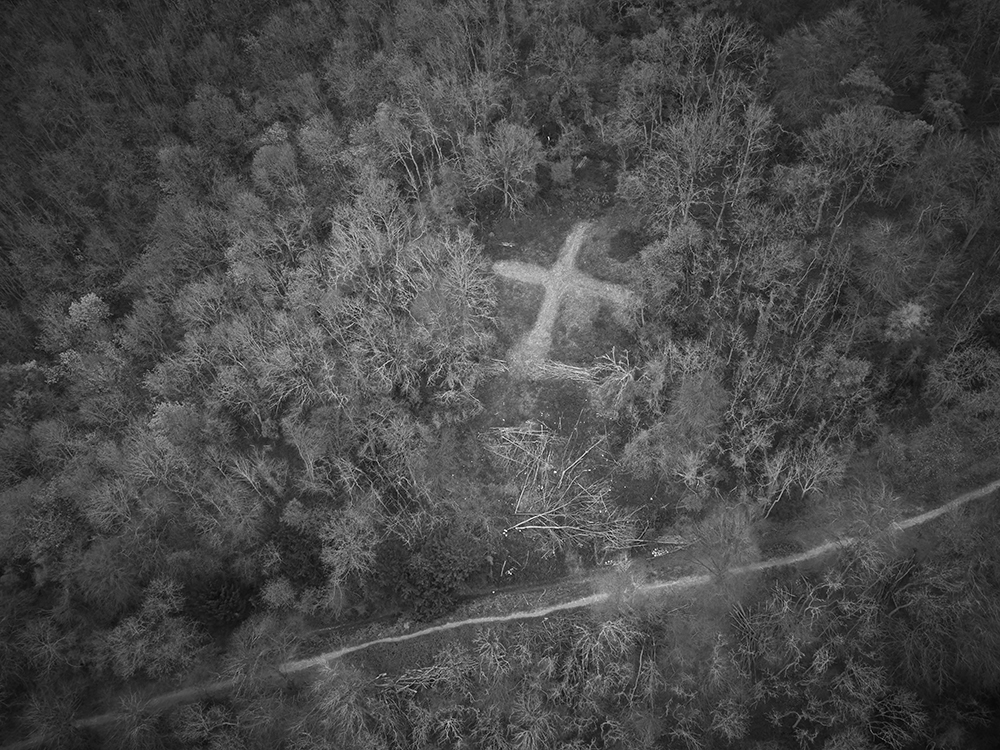
Time for a photo gallery before we get to the bit where we go on an actual quest to find it ourselves. Here's a picture from probably the first couple of decades of the 20th century showing the cross on a tree-free hillside, a photo from the Marples book which is probably from the 1940s, a photo from Mark Hows' splendid website which I would guess is maybe 1980s, a still from the video mentioned above and a drone shot resulting from the scouting expedition described here


So, anyway, the upshot of all this is that I persuaded all nine people in our party that we should go for a walk in the general area, including a couple of sections of the Ridgeway and the Icknield Way and a bit of geocaching, but also incorporating a quick bit of off-path scrambling about to see if we could find the cross. The couple of rope swings (one of which features in the video) were very handy here both as a navigational aid and also a distraction for those less inclined than the hardcore adventurers (me, Jim and Nia) to plough through brambles and nettles to get to what's basically a couple of medium-sized ditches. 

Anyway, the update I can give you from August 9th 2024, which is the date we visited, is that a substantial amount of regrowth has happened since the clearance work and the initial rush of YouTubers visiting to make videos. It's only grass and general weeds but it does substantially obscure the cross, and if the people involved don't want their excellent work to be in vain then a more regular programme of clearance looks like it'll be essential. Here's a few photos - Jim at the cross's lower extremity, a view looking up to the top of the cross and Nia at the cross's rough midpoint with its eastern side-arm behind her.


The map below shows the (anticlockwise) route of the walk; almost exactly six kilometres in total, although that includes some aimless thrashing about trying to find the cross and later a couple of seemingly non-existent geocaches. If you just did the walk like a sensible human being it's probably not much more than five. 


A quick footnote: the other major site of interest we visited was the Hellfire Caves in West Wycombe, which are well worth a look, and whose creator (he didn't do the actual digging, he got some plebs in to do that) Sir Francis Dashwood seems to have been a hell of a guy. We also did the walk up the hill to see his mausoleum and the church which he had a giant golden ball built on top of just so he and his mates could sit in it drinking port and chewing the fat.

We also did a bit of parkrun tourism at Wycombe Rye on Saturday and had an unexpected celebrity encounter with Vernon Kay, though we disappointingly didn't manage to sneak into any of the photographs (I think we're somewhere behind his head in the first one). We then went to the lido at the start/finish line afterwards for a dip. Swimming pools in general aren't really my thing, let alone outdoor ones on a slightly overcast day, and I haven't been in an outdoor pool in Britain since occasional visits to the one at the Northcroft Centre in Newbury as a child. That one seems to have had a substantial spruce-up and refurbishment lately; it's safe to say the Wycombe Rye one has not and could perhaps do with one. 

So, did we have a nice week? Yes we did. Am I going to prioritise a return trip for another holiday? Eh, probably not, although I am going to keep an eye on further developments with the Bledlow Cross to see if anything exciting happens. If it disappears beneath a sea of grass and bracken again then I'm going to be a bit - no, wait for it - cross. 

Wednesday, August 14, 2024

the last book I read

American Psycho by Bret Easton Ellis.

Patrick Bateman has it pretty good, all things considered - lucrative job doing something mysterious in finance in New York, spiffy business cards, a nice apartment, a whole wardrobe full of designer suits and ties, a highly eligible girlfriend, at least one other woman on the side, regular dinner reservations at exclusive eateries with his group of acquaintances, all of whom do pretty much the same job as him. So he's pretty happening. He's also - and it's hard to characterise this in an acceptable way in these days of acceptance and understanding of mental health issues - properly and utterly bananas.

Let's join Patrick for a typical day, shall we? Up at dawn for a visit to the gym, then home to apply an extensive range of moisturising products and primp his fabulous hairdo, pick out one of his expensive Valentino suits, then off to the office for a day of seemingly not doing very much while getting his secretary Jean to screen his calls and cancel all his appointments. Maybe there'll be time to fit in a game of squash with a colleague, and then after work a few drinks with other colleagues, all identically clad in sharp suits, braces and glasses, then on to the latest achingly hip restaurant (via a bit of competition to see who can do the impossible job of getting a reservation) for some of the latest creations in Burmese-Ecuadorian fusion or something, and so to bed, probably with some tight little thing from the gym or a nightclub, or the waitress from the restaurant. And then, refreshed, exactly the same thing, perhaps with minor variations in restaurant choice, the following day.

There are a few clouds on the horizon of this otherwise sunny existence: everyone, including Patrick, is constantly being mistaken for someone else; in Patrick's case this is usually Marcus Halberstam, who he perceives to be beneath him by virtue of having a slightly inferior hairstyle. Conversely Patrick perceives Paul Owen to be slightly above him in the hierarchy for similar reasons (slightly better haircut, a slightly more fashionable shade of off-white on his business cards, the ability to get restaurant reservations at prohibitively trendy Dorsia) and hatches a bold and unusual plan to get back at him for this perceived slight: murder him frenziedly with an axe and then dispose of the corpse. I mean, sometimes the simplest solutions are the best.

Having done this, and emboldened by no-one seemingly giving the most tepid of fucks as to Owen's whereabouts, Patrick embarks on a spree of further murders (mostly using Owen's apartment as a venue), pretty much all of these involving women and increasingly brutal and sexual in nature. Those are the ones Patrick really takes some trouble over; others are quicker and more impulsive: stabbing a child at the zoo, shooting a homeless guy in the street, that sort of thing. That last murder attracts the attention of the police and is the catalyst for a pursuit across Manhattan (and a few more killings) which ends with Patrick taking refuge in his office building and leaving a breathless confession on his lawyer's answering machine.

The plot thickens at this point, though: not only does the lawyer not take Patrick's confession seriously (indeed he has trouble recognising who Patrick is), he says that Owen can't be dead because he had dinner with him only a few nights ago. Moreover, when Patrick re-visits Owen's apartment, expecting to find it festooned with entrails and with severed heads in the fridge, he instead finds it clean and with a real estate agent showing prospective tenants around.

So what's going on? Clearly Patrick is a massively unreliable narrator, but are we to assume that the murders never happened? Has the whole thing been a fantasy? Well, those reading the book will have to make up their own minds as it's left slightly ambiguous, but you do have to wonder about the noise and the smell, not to mention the logistics of disposing of several corpses without being rumbled. Then again it wouldn't be the first time this sort of thing had gone apparently unnoticed by the neighbours.

Whatever the reader might conclude about the likelihood of the murders described having actually happened, they will almost certainly have some idea of what point the book is trying to make. Clearly there's some black satire on consumerism, 1980s greed, the emptiness of Patrick and his cronies' day-to-day activities, the implicit sexism and racism involved in it. There are lots of very funny sections - the early chapters where Patrick describes in excruciating detail the designer clothes he and his dinner companions are wearing, the braying banality of Harvard and Yale types hailing each other by their surnames across a crowded restaurant, Patrick's gradual mental disintegration throughout the course of the book - but there's no getting away from the brutality and graphicness of the descriptions of the murders of the several women that Patrick dispatches. It was this stuff that got the book into trouble when it was originally published in 1991 and it remains (slightly bizarrely) banned in the Australian state of Queensland. 

To be honest, as open as I am to experimental and transgressive fiction, I did find the extensive descriptions of torture and murder of women a bit hard to stomach. I suppose this is part of the point of the book, though: some of whose themes are (or seem to me to be) to do with what JG Ballard called "the death of affect", i.e. the flattening out of emotion in response to an increasingly overwhelming rush of stimuli, and a corresponding need for more and more extreme input in order to provoke feeling.

I can't say I absolutely loved American Psycho, but it works pretty effectively as an extreme blackly comic satire of its targets. I was already familiar with its 2000 movie adaptation (though I don't think I've ever seen the whole thing), which is mainly notable for a remarkable and career-reviving central performance from Christian Bale as Patrick Bateman. Obviously the film does tone down some of the old ultraviolence a bit, though it's still pretty graphic, and is more explicitly comic than the book. It also features Jared Leto playing much the same part as he does in Fight Club, i.e. a pretty rival and target of resentment whose main plot role is to be ritually brutalised (to death, in this case) by the protagonist. American Psycho is the third novel on this list to be adapted into a film starring Christian Bale, the other two being Empire Of The Sun and Metroland

Wednesday, July 24, 2024

sorry, I'm feeling a little horse

I was entertained for a couple of hours on Twitter (on X, if you musk, I mean must) yesterday by some increasingly lurid speculation about what a woman named Charlotte Dujardin had done to a horse in a video that had been submitted to, and was under investigation by, some central authority governing equestrian sport and moreover was of a serious enough nature for her to immediately withdraw from the upcoming Paris Olympics.

A bit of background for the non-horse-adjacent such as myself: Charlotte Dujardin is a prominent equestrian sportswoman in the somewhat esoteric field of dressage who also happens to be the joint-most-bemedalled British female Olympian of all time. You might, as I very definitely already have done, make a relative value judgment about the lung-busting athletic prowess of cyclist Laura Kenny (the other joint record-holder) and someone making a horse walk sideways and do a bit of skipping, but that's what the record books show.

Anyway, the incriminating video, despite what internet speculation might have had you believe (i.e. some sort of Catherine the Great thing), contains some footage of Dujardin getting a bit enthusiastic with a whip while training a horse in an indoor training ring. No doubt there are acceptable guidelines for how hard and often you're allowed to hit a horse with a whip, both in official competition and elsewhere, and I have no reason not to believe those who say Dujardin is exceeding them here, but I do also wonder how people think horses get trained to do the weird stylised movements that dressage requires. I mean, it'd be lovely if you could get them into a meeting room and go through all this stuff on a whiteboard as if you were discussing football tactics, but horses are - and I'm aware there might be people outraged at this statement - EXTREMELY DIM and you've got to do things in a more basic way.

I was reminded here of the furore in 2021 around the widely-circulated photograph of Irish racehorse trainer Gordon Elliott sitting on a dead horse while making a phone call. I could have understood a degree of outrage if he had subsequently been revealed to have strangled the horse to death with his bare hands, but no, it had just (as far as I can gather) dropped dead while out on a training gallop. Again, those seemingly outraged that the death of horses might be seen as a relatively normal day-to-day thing in the multi-million-pound horse-racing industry seemed to be ignoring some fairly obvious realities which I had a go at articulating at the time.


Back to the current controversy - you will be unsurprised to learn that someone has already been and made sure that Dujardin's Wikipedia page has been updated with a sober and objective summary of the current situation.


Some of the material that made its way onto the internet during the initial excitement contained some links to Horse & Hound, the publication of choice for the Barbour-jacket and shooting-stick set. While I was there I was offered a couple of other links, one of which was to this story:

Just to be clear, in the equestrian community "sheath" is the euphemism of choice for "cock", so this, just to be even clearer, is an interview with a woman whose job it is to prise lumps of hardened knobcheese out of the ends of horses' cocks. I mean, someone's got to do it, I suppose. Nothing I could say here will be better than just letting the article speak for itself, so here you go:


This is just about perfect; my only complaint is that Horse & Hound weren't tempted to borrow the Daily Mail's usage habits and make occasional references to HIS ENORMOUS HORSEHOOD or something similar.

Note also that specialist horse knob cleaning products are available, including this one which tries (unsuccessfully) to put a slightly cutesy spin on the whole business. 

Tuesday, July 23, 2024

schauffele schauffele catchy python

You'll recall I made some scornful references to my general disinclination towards "checking exhaustively" and the like in my post about the Scheffler/Schauffele distribution of the first two majors of the golfing year. Well, my interest was further piqued by Bryson DeChambeau winning the US Open in June, and then further piqued by Xander Schauffele winning the Open at Troon just the other day. More specifically, what I mean by that is: it's not difficult to notice that the name DeChambeau shares quite a few letters with Schauffele, and then to pose the more general question: what's the maximum number of letters that the four major winners in a particular year have shared? 

This is one that is going to require checking exhaustively, and manually doing the legwork would be extremely tedious even for an enthusiast of data-related nerdery like myself. So I plunged off down a different alley, still squarely located within the general Nerd Central district, extracted the relevant data from Wikipedia, massaged it into shape a bit, and then wrote a Python program to do the relevant comparisons for me. 

The results are in the table below. These are the years when there was at least one letter common to all four major winners; implicitly it only includes years when all four majors were held, so nothing pre-1934 (when the first Masters tournament was held), a few missing years during World War II, and no 2020 (when the Open was cancelled). Also, we're only considering surnames here, and I've trimmed the occasional "jr." and "III" off the end of surnames where that made the comparison problematic or challenged my rudimentary Python skills.

Of the 84 "full" years, 29 appear in the list below, and only ten have more than one letter in the matching list. Perhaps slightly surprisingly, the two years (1953 and 2000) where a single player won three out of the four majors only have a single match each, Walter Burkemo and Vijay Singh spoiling the party for Ben Hogan and Tiger Woods respectively. Anyway, the main headline here is that of those ten, nine have two letters in the matching list and only one, this very year of Our Lord 2024, has a whopping four to put it well out in front. Obviously a whole year of people with absurdly long and letter-rich surnames helps. 

Year Matches Who
1935 r Perry, Parks, Revolta, Sarazen
1948 on Cotton, Hogan, Hogan, Harmon
1949 e Locke, Middlecoff, Snead, Snead
1951 an Faulkner, Hogan, Snead, Hogan
1953 o Hogan, Hogan, Burkemo, Hogan
1960 e Nagle, Palmer, Hebert, Palmer
1961 er Palmer, Littler, Barber, Player
1962 al Palmer, Nicklaus, Player, Palmer
1963 s Charles, Boros, Nicklaus, Nicklaus
1970 c Nicklaus, Jacklin, Stockton, Casper
1974 r Player, Irwin, Trevino, Player
1975 a Watson, Graham, Nicklaus, Nicklaus
1977 n Watson, Green, Wadkins, Watson
1979 r Ballesteros, Irwin, Graham, Zoeller
1980 as Watson, Nicklaus, Nicklaus, Ballesteros
1983 so Watson, Nelson, Sutton, Ballesteros
1984 er Ballesteros, Zoeller, Trevino, Crenshaw
1989 a Calcavecchia, Strange, Stewart, Faldo
1991 a Baker-Finch, Stewart, Daly, Woosnam
1993 na Norman, Janzen, Azinger, Langer
2000 s Woods, Woods, Woods, Singh
2004 n Hamilton, Goosen, Singh, Mickelson
2006 o Woods, Ogilvy, Woods, Mickelson
2010 e Oosthuizen, McDowell, Kaymer, Mickelson
2011 lr Clarke, McIlroy, Bradley, Schwartzel
2019 o Lowry, Woodland, Koepka, Woods
2021 m Morikawa, Rahm, Mickelson, Matsuyama
2023 a Harman, Clark, Koepka, Rahm
2024 chee Schauffele, DeChambeau, Schauffele, Scheffler

Friday, July 19, 2024

the last book I read

The Tiger In The Smoke by Margery Allingham.

Meg Elginbrodde has just received a couple of photographs of her husband, supposedly taken quite recently, in London. Nothing so very unusual about that, you might say, but it's a bit unexpected in this particular case as Martin Elginbrodde's last known location was understood to have been scattered over a wide area somewhere in France during World War II. 

So what's happened? Have his discorporated remains been re-assembled in a vat somewhere? Well, it's not really that sort of novel, so no. Have rumours of his death been exaggerated? Well, maybe, but if so there are some pressing questions, most notably: where's he been for the past several years? And where does this leave Meg's current fiancé, Geoffrey Levett?

Meg is a sensible girl, so she realises this is probably someone faking seeing, or even being, Martin for some reason; but why? Fortunately she just happens to be the cousin of the famous amateur sleuth Albert Campion, who in turn has lots of contacts in the police, so she is easily able to gather a posse of people to help her out when the time comes to meet the mysterious photo-sender to find out what he wants. 

The whole rendezvous doesn't really go as planned; while Campion and his Met sidekick Chief Inspector Luke want her to engage discreetly with her contact and allow them to get a good look at him, she instead spots him (still looking like her husband) from across a railway station concourse, shouts at him and causes him to scarper. An odd thing for him to do if he was actually Martin Elginbrodde, you might say, and you'd be right, as once he's been collared it turns out he's a known wrong 'un called Duds Morrison wearing a false moustache, and, more bizarrely, a distinctive old jacket that really did used to belong to Martin.

So how did Duds get hold of the jacket? And what did he hope to gain by impersonating Martin? Well, he isn't telling during the brief period the police can hold him before having to release him (wearing a false 'tache not technically being a crime), and he isn't telling in a more permanent way shortly afterwards as he turns up bludgeoned to death in an alleyway. 

So what's going on? Who offed Duds? How did he come by the jacket? What's Geoffrey - who seems to have disappeared - up to? How is old Mrs. Cash, who has connections to Meg's family but also seems to be a bit of a shady character on the quiet, involved in all this? And what's going on with the motley band of musicians who parade around the town in military uniforms and seem to have been in suspicious proximity to the scene of Duds' murder?

Well, the answer to the Geoffrey question is that he was with Duds when he died, having chased him down the alley in a bid to get some information out of him about the whole Martin Elginbrodde thing. That meant that he got in the way of Duds' assailants - the Army band - and therefore had to be kidnapped to ensure he couldn't identify any of them, so he's been trussed up like a turkey in their basement hideout while they try and work out what to do next. 

The point of all this, it turns out, is that the band all served together in the army, along with Martin Elginbrodde, and took part in a shady black-ops mission somewhere in France to rub out a couple of key enemy agents. The actual rubbing out was done by Jack Havoc, another ex-army colleague and a bit of a dab hand with the old killing. Moreover, Havoc has just escaped from prison after they foolishly entrusted him to a psychiatrist for an evaluation, whereupon he killed him and exited via the window (probably a bit like this). The band are aware that there is some treasure to be retrieved from the house in France where the mission took place, but only Havoc knows the details, and even he doesn't know some key facts.

Sure enough Jack Havoc arrives in the hideout, takes charge of the group and reveals some more details - the nature and location of the treasure were known to Martin Elginbrodde, and he made arrangements to have the information passed to Meg in the event of his death and her getting married again. The actual information resides in some documents which Martin wrote and which Jack means to get his hands on before Meg does the deed. Needless to say Geoffrey, at this point, realises he's in a lot of trouble.

Meanwhile Albert Campion's finely-tuned detectival instincts have led him to smell a rat regarding the Army band and to arrange to pay a call (with the police in tow) to their lodgings, a basement under a shop. They don't have any sort of warrant or any reason to detain the band, who soon make themselves scarce, but a snoop around soon reveals Geoffrey Levett, bound and gagged in a corner.

Good news for Geoffrey, but Jack Havoc remains at large, and fiercely focused on getting to the treasure. Meanwhile Martin's document comes to light - guarded by an old friend of the family until what he deemed to be the right moment to hand it over - and Geoffrey, Campion, Campion's wife Amanda, and Meg, now in possession of the treasure's location, head off to France to find it. 

So, all's well that ends well, then? Well, not quite, as Jack Havoc is still at large, and as well as being a bit stabby is also a shrewd and resourceful guy. Meg's father, Canon Avril, has his number, though, and has twigged that he is in fact old Mrs. Cash's no-good son and a childhood acquaintance of Meg's. Fat lot of good that does him, though, as Jack administers a (for once, non-fatal) stabbing, extracts the location of the treasure and heads off to rustle up a boat to take him across the Channel, with Chief Inspector Luke in hot pursuit. And so the scene is set for all parties to converge on the abandoned clifftop house where the treasure is secreted, and to discover what it is, who's going to get to go home with it, and who isn't going to get to go home at all.

The Tiger In The Smoke is actually the first of the "couple of slim paperbacks" I coyly alluded to here after I picked them up from the shelves in the Acton Trussell village hall. I'd vaguely heard of Margery Allingham before, and I was vaguely aware that there'd been a TV series based on the Campion series, starring ex-Dr Who Peter Davison as Campion. That series adapted eight of the eighteen books in the series that were published during Allingham's lifetime, but didn't include The Tiger In The Smoke (the fourteenth in the series, published in 1952). In many ways, despite it being highly-regarded by many, this isn't that surprising, as a) it's not really an orthodox whodunit and b) Campion himself is a very peripheral character in it. That said, he does provide the single most significant moment of deduction in the whole book, i.e. the realisation that the Army band are the people responsible for Duds' death, a realisation that almost certainly saves Geoffrey Levett's life.

The chapters set in the underground lair while the gang try to work out what to do next and await Jack Havoc's arrival are genuinely thrilling, and there is a significant dissipation of tension when the police come calling and Geoffrey is rescued. This is a good 60-plus pages from the end of the book, though, and at this point the story changes into a somewhat different kind of story as the main characters zoom off to France for a treasure hunt. This is all fine, but structurally it's a bit odd, and Jack Havoc's eventual (apparent) demise is a bit unsatisfactory - basically he's very tired after all his nefarious activities and rather disappointed at the nature of the treasure (i.e. nothing he can nick and sell on for a fortune) and so he slinks off down a drainage ditch to avoid the police and eventually jumps off a cliff. Um, what?

Anyway, it's all good fun and has some sly humour and some atmospheric descriptions of post-war, pre-Clean Air Act London interwoven with all the robbing and murdering. Jack Havoc is an intriguing villain, and Allingham is a much better writer of prose than some of her crime-writing contemporaries (Agatha Christie, for instance). As an aside it's interesting to note that the country legend of the same name didn't release his first records until 1955, and so this short paragraph wouldn't have seemed as oddly jarring then as it does now.

The Tiger In The Smoke was made into a film, Tiger In The Smoke, in 1956. The Wikipedia page says that the film omits the "principal character" of Albert Campion, but actually, as I said above, he's not really that crucial to the plot at all. It is also the second book in this series to have a title of the form The X In The Y, the other being The Catcher In The Rye.

Monday, July 08, 2024

lookeylikey slash headline of the day

Is it just me who has trouble parsing this headline I saw the other day?

OK, so let's start at the beginning: "I'm a Wimbledon champion marrying fan" - well, OK so you're a fan; I might have hyphenated "Wimbledon champion-marrying" or even "Wimbledon-champion-marrying" just to make it clearer, but let's carry on ... wait, now the rest of the sentence doesn't make sense.

Back up all the way to the beginning and it becomes clear that the starting "I'm" relates to "champion" rather than "fan", and that it was the fan who stopped the champion for a selfie. It didn't help that I initially read "help run tennis" as "help ruin tennis", but that's the fault of my appalling age-related vision deterioration, not the headline writers. 

It seems to me, and I could be wrong, that assuming "fan" to be the subject of the first line is the more natural reading. It would really only have taken the addition of an "a" before "fan" to flip the default reading around, though. I'm not sure whether this is more properly classified as a garden-path sentence or a noun pile-up, or maybe even a crash blossom.

Anyway, the actual story relates to 2017 Wimbledon champion Garbiñe Muguruza, the only player to defeat each of the Williams sisters in Grand Slam finals, and, and I hesitate to say this these days for fear of being LITERALLY CANCELLED, possessor of a very lovely pair of legs. The guy she was accosted by for a selfie in New York just happens to be a top model who was working for Tom Ford at the time, just in case you want to calculate your chances of being able to successfully pull off a similar manoeuvre on the top tennis star of your choice without getting your ass tased and ending up with an ASBO.

Anyway. it also struck me while looking through some photos of Muguruza for, hem hem, "research purposes" that she looks a bit like Imogen Heap, who I see I used the phrase "strange equine beauty" in connection with here, and also compared with Ronni Ancona. I actually think the Muguruza-Heap resemblance is closer, but I include all three anyway; make up your own mind.


Monday, July 01, 2024

the last book I read

Mona Lisa Overdrive by William Gibson.

Kumiko Yanaka is just like any normal teenager, really: Snapchatting, squeezing spots, being hastily packed off to London by her father, a high-ranking yakuza boss, lest she become a kidnapping (or worse) target in the gang war that's about to break out in Japan. 

Kumiko ends up in the house of, and under the protection of, one Roger Swain, apparently indebted to her father and therefore motivated to keep her safe, but to an external observer a bit of a dodgy-seeming character himself, and with a few other suspicious characters on his payroll, notably Sally Shears, who gets assigned the job of keeping an eye on Kumiko. Sally has mirrored lens implants instead of eyes and a general air of simmering dangerousness, and of being a bit of a loose cannon not necessarily inclined to do Swain's exact bidding.

Meanwhile, in a warehouse in a former landfill site in New Jersey, Slick Henry and his mates are taking a delivery - not your usual couple of Amazon parcels, this one is a comatose man shackled to, and wired into, a giant block of computer hardware.

Meanwhile, in a beach house in Malibu, Angie Mitchell, the world's foremost simstim star (basically immersive virtual reality films), is having some time to herself after getting off a pretty brutal drug habit, and contemplating a return to film-making.

Meanwhile, Mona lies in bed in her slum bedroom in Florida after another hard day getting pimped out to various punters by her boyfriend, Eddy. It's grim and dangerous work, but it pays the rent, and her recounting the tales of what the punters make her get up to is the only way old Eddy can get it up these days.

So if you've been paying attention, and have ever read a book before, you'll expect that these threads will start to come together and interweave as the story progresses. Now read on, etc.

So firstly Eddy returns very excited from a meeting with a prospective business associate: he's made a deal for a substantial amount of money and all Mona has to do is travel to this private clinic and submit to a full medical examination, all strictly above board and definitely not suspicious at all. 

Readers who are doing things in the prescribed order and have read Neuromancer and Count Zero will already know Angie Mitchell from Count Zero - daughter of a prominent bioscientist who fitted her with some state-of-the-art cranial bio-implants (which enable her to access cyberspace without having to plug any wires into anything) before arranging her escape from the clutches of the mega-corporation he was employed by. Unfettered access to cyberspace turns out to be a two-way street, though, and Angie is plagued by visitations from various self-aware AI entities which appear to take the form of Haitian voodoo gods.

In a further echo of Count Zero, the comatose guy entrusted to Slick's care turns out to be Bobby Newmark, Count Zero himself and Angie's former boyfriend. And in a callback to Neuromancer, Sally Shears turns out to be that book's principal female protagonist Molly Millions. The fate of her ex-partner Case, expert cyber-jockey and Neuromancer's other main protagonist, is unclear.

That's all very cute, but what's actually going on? Well, Mona's visit to the mysterious clinic provides a clue - she wakes up after surgery to find that she's been surgically altered - some face work, new teeth, new tits - to resemble Angie Mitchell. But why? Barely any time to contemplate this as Sally Shears arrives, beats the shit out of various medical people and the goons minding Mona, and bundles her into a car. Not long after this, following some more ass-kicking courtesy of Sally, Mona is joined by the actual Angie Mitchell and they speed off to a rendezvous in New Jersey, guided by Angie's voodoo gods. They arrive shortly after some other interested parties - interested specifically in Bobby Newmark and the entity he's wired into - arrive and start killing people. Fortunately Angie has special connections both to the voodoo entities and to Bobby, and equally fortunately Sally/Molly is a one-woman ass-kicking machine, and the other parties are swiftly rubbed out, in time for some stuff to play out which might give a small amount of insight into What The Hell Is Going On.

So: Bobby has been using his bespoke cyberspace rig to investigate the appearance of a new and mysterious entity in cyberspace - the rig having been acquired, not entirely legitimately, from the legendary and insane Tessier-Ashpool family, whose sole survivor, 3Jane, a wholly cyberspace entity these days following the demise of her physical self, has taken the whole thing quite badly and hatched plans for various acts of revenge, including the kidnap of Angie Mitchell and the planting of Mona's body (augmented to look like Angie) to make it look as if she'd died. At the same time the voodoo entities (you'll remember I'm sure that these are the avatars of the various fragmentary remains of the merged single AI that was created at the end of Neuromancer) have become aware of the new artifact and have concluded that it is the handiwork of yet another AI, this one a representative of a wholly alien civilisation. Bobby and Angie, now freed from their physical bodies, head off within cyberspace to seek out the new arrivals.

This is the third book in the Sprawl trilogy (or the Neuromancer trilogy, take your pick). Standard sequelitis means it isn't as good as either of its predecessors, largely because the plot doesn't really make sense. In particular, while the alien incursion into cyberspace is easy enough to grasp (it's a theme used, with a twist, in a few other works including Excession), the whole thing about the plot to kidnap Angie Mitchell and the nature of the Tessier-Ashpool family's involvement is just baffling (especially since, as this lengthy analysis points out, the whole bit involving planting Mona's body assumes a future world where DNA analysis doesn't exist). Sure, it gives Sally/Molly an excuse to kick some ass, and maybe that's good enough. Kumiko's role is all a bit confusing as well, being seemingly just required to facilitate the stitching together of some otherwise unrelated plot strands but not otherwise actually, you know, do anything.

The beauty of Gibson's writing, though, is that this doesn't particularly matter. Again, like Count Zero, this is more of a wham-bam futuristic thriller than Neuromancer, with much less focus on the inner-space world of the cyber-jockeys, but that's fine. As always, if you start with Neuromancer and then just read as many of the sequels as you feel inclined to, that'd be fine. 

Tuesday, June 18, 2024

the last book I read

Charlotte Gray by Sebastian Faulks.

So there's this woman, erm ... *checks notes* ... Charlotte Gray. Daughter of a First World War veteran, with whom she has a slightly prickly relationship, keen to help out with the Allied war effort now that it's 1942 and the Second World War is in full swing but a bit removed from the action in her native Scotland. 

So she relocates to London, that being the centre of the war effort, and takes a job at a doctor's surgery. It's not long before opportunities of various kinds come her way, though, largely through the time-honoured route of meeting people at parties: firstly a man called Cannerley who has some connections with the shady G Section who seem to organise clandestine activities in France, and secondly Peter Gregory, an RAF pilot, haunted by the loss of most of his friends over the past few years but still seemingly keen to conduct a daring sortie, all guns blazing, into Charlotte's knickers. 

Charlotte happens to be fluent in French after spending a lot of time there during her childhood, a thing that for obvious reasons is of intense interest to Cannerley and his organisation. After a few discreet meetings Charlotte is inducted into the organisation and given an initial mission: parachute into the occupied part of France, make contact with some local representatives of the Resistance and distribute some vital radio components. At the same time Peter Gregory is being given some orders of his own for an airborne mission into France.

Peter's mission starts first and Charlotte soon gets some bad news: he's gone missing. She decides that the best thing to do is get on with her own mission and see if she can locate him while she's over there. So after some rudimentary spy training (basically: don't do this) and some equally rudimentary parachute training (open door, jump out, try not to die) Charlotte finds herself jumping out of a plane and making contact with some people in the village of Lavaurette, including Julien Levade (codename Octave) who leads the Resistance operation. His father, a semi-retired painter, provides some cover for Charlotte (now going by the name Dominique) by employing her as a housekeeper in his rambling old mansion on the outskirts of the village.

Charlotte conducts various side quests while she's staying in Lavaurette, including travelling as far as Limoges to deliver some vital radio parts, all the while keeping an ear out for news of the fate of Peter Gregory. Charlotte's calmness and efficiency gain the respect of her Resistance colleagues and her superiors in London, but then Shit Gets Real as the flimsy pretence of the independence of the Vichy regime is crushed and the Nazis roll into town, bringing with them a ramping up of the existing regime of rounding up Jews and deporting them. This includes the parents of local boys André and Jacob, the boys subsequently being hidden by the Resistance in various locations around the village, but also old man Levade, betrayed by some weaselly local collaborators. After an I ASK ZE KVESTIONS show-trial at the Levade house the old man is carted off and loaded onto a train, while the local police are charged with guarding Julien and Charlotte. Julien facilitates Charlotte's escape, kills the collaborator and then flees into hiding. Charlotte, meanwhile, heads for Paris, partly with the intention of making contact with someone who can facilitate her return to England, but also partly to attempt to intercept André and Jacob, who were inevitably discovered by the Gestapo and taken away.

Peter Gregory, meanwhile, is alive and mostly well, though limping a bit after breaking his leg parachuting into a tree. By extraordinary good luck he was rescued by some people sympathetic to the Allied cause, and by further extraordinary good luck (his French being rudimentary at best) they manage to arrange his transit to Marseille where he meets up with some English-speaking contacts and is spirited back to England by a circuitous route traversing North Africa.

Charlotte makes contact with her man in Paris and arranges her transport back to England; she also visits the internment camp at Drancy where most of the deportees from the village are held, but the massive industrial scale of the operation prevents her from seeing any of the individuals she's looking out for, still less effecting some sort of daring rescue. With ruthless inevitability the process grinds on to its conclusion, with the internees either dying en route to the death camps (as old man Levade does) or surviving the trip only to then be exterminated in the gas chambers (as André and Jacob are).

Charlotte returns to London to be debriefed by G Section and mildly scolded for exceeding the terms of her original mission, and to be tearfully reunited with (and subsequently de-briefed by, oy oy) Peter Gregory. 

This is the third novel in Sebastian Faulks' loose trilogy of books about France - the other two are The Girl At The Lion d'Or, which I haven't read (although I was present at a book-signing for it with Faulks himself about 35 years ago), and Birdsong, which featured here in February 2015. All three feature the First World War as a major theme - Birdsong is mostly set during it and includes many scenes set in the trenches, and while Charlotte Gray is set during the Second World War it carries heavy echoes of the earlier conflict. Both the older Levade and Charlotte's own father are haunted by their memories of what took place, and Lavaurette is oddly demographically skewed by having a large proportion of a whole generation of men wiped out. 

I think on the whole Birdsong is a better book, as enjoyable as Charlotte Gray is - I think most of this is related to pacing; the Nazis only turn up and things Kick Off in a big way fully two-thirds of the way through the book. Before that we get a fair bit of scene-setting in England, including a brief sex scene which won Faulks the Bad Sex Award in 1998 (which he slightly humourlessly did not turn up to collect), and quite a lot of Charlotte hanging out with Julien and his father and blissfully bicycling from village to village in the sunshine delivering radio crystals and the like, which is lovely but oddly peril-free. The flipside of this is that when Charlotte encounters the full industrial efficiency of the Nazi killing machine she is, as resourceful as she is, utterly powerless to do anything about it, and André and Jacob's harrowing journey to their inevitable end is genuinely quite difficult to read.

Narratively that's obviously the right thing to do, a daring James Bond-style rescue mission being completely implausible, but it's a bit of a downer, and it makes the subsequent tearful reunions in England a bit hollow. This is no doubt intentional - my only quibble would be that the neatness of Charlotte's resolution of her mysterious childhood trauma involving her father is a bit nice and convenient, and the implication that, hey, the boys' deaths in the gas chamber weren't completely in vain because it in some way enabled Charlotte to get over being a bit upset about some childhood shit from twenty years earlier is a bit hard to swallow. Indeed you might reasonably ask: what was the sum total of Charlotte's achievements in France? Some minor courier work and encouragement to the Resistance, sure, but aside from making some cursory enquiries with his contacts she discovered next to nothing about Gregory's whereabouts while she was there and contributed precisely nothing to his safe return home, and, as mentioned previously, didn't manage to save any of the Lavaurette villagers from the gas chambers.

The World War II theme puts Charlotte Gray in the company of quite a long list of earlier books featured here - the review of The Reader has a list. Its having a person's full name as a title puts it on a slightly shorter list which also includes Laura Blundy, Riddley Walker and Fanny Hill. It was also filmed (starring Cate Blanchett as Charlotte) in 2001.

Monday, June 17, 2024

snorklebrity lookeyspikey of the day

Today's pairing features my son Huw, in the pool at our holiday house in Brittany a couple of weeks ago and borrowing some of his big sister's swimming accessories, in particular her face-mounted snorkel, and also the strange underwater artificial dinosaur hybrid submarine that I drew for my school yearbook at Bandung International School in Java in about 1979 (when I would have been about nine). Obviously the shape and positioning of the snorkel is the thing that brought the two together in my mind.


The drawing was accompanied by the following explanatory (well, sort of) text:


It's interesting to unpick all the things that (consciously or unconsciously) influenced both the drawing and the text in my nine-year-old mind:
  • The BBRFC on the creature's sleeve, and indeed the rest of the design of the T-shirt the creature is wearing, is a reference to Bandung Barbarians Rugby Football Club, a loosely-organised group of expatriates from various countries (mainly the UK, Australia and New Zealand) for which my father used to turn out. My recollection of the various rugby days out we went to during our time in Java was that they were mainly a pretext for epic beer consumption, probably mainly the product of the Anker brewery with whom the club seemed to have cooked up some sort of endorsement/sponsorship deal, judging by the club T-shirt I am wearing in the images below (probably taken at Pangandaran). The beardy guy piloting the craft is also probably modelled on my Dad, though I should point out he has never smoked a pipe as far as I know.

  • The general concept for the creature is clearly adapted/stolen from the Tintin book Red Rackham's Treasure which I read approximately a gazillion times. The smaller shark-based craft there was the brainchild of eccentric genius Professor Calculus. That's his English name, anyway, he was called Tournesol in the original French books. Translations into other languages are available, including, rather marvellously, Welsh; who knows what his name is there. 
  • Obviously kids love dinosaurs, and you can see bits from at least three separate dinosaurs in the design of the creature: the head with its distinctive crest is clearly a parasaurolophus, the big fin thing on its back looks as if it's from a dimetrodon, and the spiked tail is a bit like that of a stegosaurus, informally known in slightly tedious paleontological nerd humour circles as a thagomizer. The fins at the rear are presumably a hangover from the fish design I stole the idea from, and I have no idea why the front limbs seem to have their elbows on backwards.

Wednesday, June 12, 2024

our father who art in heaven, I lost my mess in pew eleven

One other thing, also tangentially book-related: we went to a family gathering last week and it was held in the Community Centre in the village of Acton Trussell, which we've been to before as it's conveniently located near to several of Hazel's extended family. I see that I mentioned it briefly once before, as the book I was reviewing (William Maxwell's They Came Like Swallows) was one that I'd acquired from their quite extensive shelves on a previous visit. I see that at the time there was an honesty box in place; this seems to have gone now, probably as a result of no-one carrying small-denomination coins around any more post-COVID. Instead there seems to be some sort of loose book-swap scheme in place where you're encouraged to swap in a book when you take one out. Sadly I didn't come armed with any spare books, so I am now in credit to the tune of a couple of slim paperbacks and need to redress the balance on my next visit. 

I was also musing over the name of the village in my head on the drive up as it seemed faintly reminiscent of something I remembered from somewhere else, and it finally came to me in the latter stages of the journey (somewhere on the M6 I'd guess) - the name of the fictitious village of Stackton Tressell inhabited by cross-dressing comedy duo Hinge & Bracket in their various radio and TV programmes (and the occasional sherry advert) in the 1970s and 1980s was (a bit of Googling revealed) based on the real-life village of Acton Trussell, which just happens to have been where Patrick Fyffe, who played Dame Hilda Bracket, was born. George Logan, who played Dr. Evadne Hinge, was born near Glasgow, since you ask. Dear Ladies, which ran on BBC2 from 1983 to 1985, is the particular Hinge & Bracket vehicle that I remember - I would describe it as gentle comedy evoking the occasional wry chuckle rather than any pant-wetting hilarity.

Also spotted on one of the notice boards in the main hall while I was there was this frankly mind-boggling bit of groovy-vicar desperate grasping at young-person relevance and engagement. I mean I genuinely think that if Jesus were with us today - and, in a very real sense, he is, of course - he'd be rolling about in a paddling pool full of custard, or whatever it is that Messy Church implies.

I mean, even if you can get past the Charlotte Church jokes, there's still a faintly sniggery element here, and it would be highly advisable for their promotional video segments to be a bit more careful about phrasing than they seem to have been about ten seconds in here; the phrase "people just coming in all their mess" would probably have best been avoided.